
You call a crowd a society and the sentence sounds fine. You call a neighborhood, a nation and a dinner club all by the same word and it starts to say almost nothing. The trouble is not the word itself: society stretches from the people on your street to a whole civilization and from a friendly club to polite society.
This guide sorts 15 society synonyms by meaning so you can name the exact group you mean. If the point is people who live and share life together, say community. If the point is everyone in a country, say population. And if the point is shared ways of life, say culture.
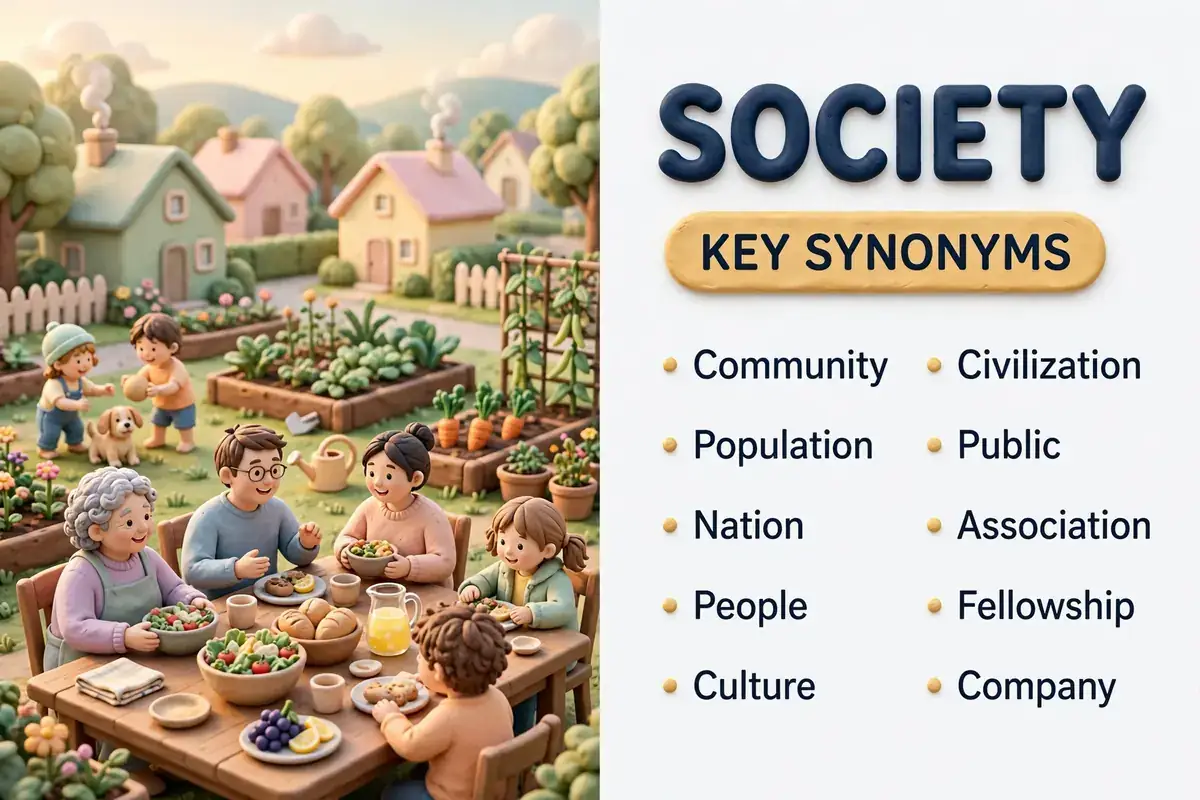
Top 10 Society Synonyms at a Glance
| # | Synonym | Meaning Difference |
|---|---|---|
| 1 | Community | People sharing a place and daily life |
| 2 | Population | People counted as a number |
| 3 | Nation | People sharing a country and identity |
| 4 | People | People in general, plainest word |
| 5 | Culture | Shared customs and ways of life |
| 6 | Civilization | Advanced, large-scale ordered life |
| 7 | Public | People as citizens or an audience |
| 8 | Association | People joined for a shared purpose |
| 9 | Fellowship | A warm bond of shared interest |
| 10 | Company | People together as companions |
Quick Facts About “Society”
- Part of speech: a noun. You live in a society, join a society, or study a society.
- Three core meanings: (1) people living together in an ordered community, as in modern society, (2) an organized group with a shared purpose, as in a historical society, (3) fashionable people, as in high society.
- Count and noncount use: “a society” can mean one group, as in “a local history society.” “Society” alone often means people in general.
- Register: neutral. Society suits everyday speech, school writing, news, and formal essays. Merriam-Webster lists companionship and community among its senses.
The Closest Synonym: Community
Community is the closest synonym for society, because it covers the word’s most basic job: people living together and sharing daily life. When a group of people shares a place, a school, a street, or a set of interests, community names that shared life directly.
Still, community is not identical to society. It stresses a smaller, closer group with real ties. Society is broader: it can mean a whole nation, a civilization, a formal association, or fashionable people.
Choice test: for neighbors and shared local life, community works. For a whole country counted as a number, use population. For shared customs and ways of life, use culture.
Where “Society” Comes From (Etymology)
According to Etymonline, the word is recorded in the 1530s with the sense of companionship and friendly association with others. It came through Old French societe, from Latin societas, meaning fellowship, association, alliance, union, or community.
That Latin word came from socius, meaning companion or ally, from a root meaning to follow. The sense of a group or club formed for a set purpose is recorded from the 1540s, and the sense of people bound by neighborhood and living together in an ordered community from the 1630s.
The sense of the more cultivated part of a community, the fashionable world, is recorded by 1823.
Can You Swap Them Freely?
In short: only inside the same meaning group, and only when the sense matches. A counting word collapses in a sentence about neighbors helping each other, and a warm-bond word in a census sentence:
- ✅ “The community raised money to repair the playground.” (neighbors acting together ✔)
- ❌ “The population raised money to repair the playground.” (population counts people, it does not act as neighbors ✘, say community)
- ✅ “The population of the town grew last year.” (a count ✔, say population)
- ❌ “The fellowship of the town grew last year.” (fellowship is a warm bond, not a count ✘, say population)
Before you substitute, ask which sense you mean: neighbors, a counted number, a nation, shared customs, or a formal group.
Society Synonyms in Detail
Group 1: People Who Live Together
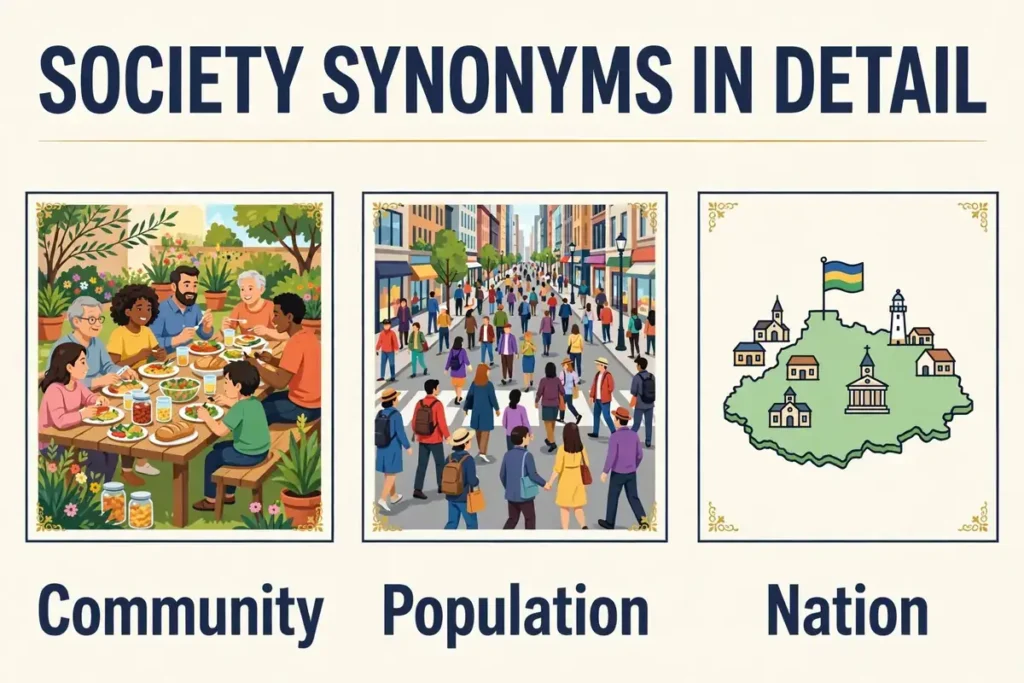
1. Community
- Meaning: People who live in the same place or share interests, values, or daily life.
- Difference: The closest match for society in its everyday sense. It stresses shared place and shared life.
- Best used for: Neighborhoods, schools, local news, everyday speech.
- Formality: Neutral · CEFR: B1 · Frequency: Very common
- Example (Neighborhood): “The community raised money to repair the playground.”
- Example (School): “Our school community includes students, parents, and teachers.”
- When NOT to use it: For a whole country counted as a number, use population.
2. Population
- Meaning: All the people who live in a place, counted as a group.
- Difference: Population stresses number and counting. It says how many, not how people live.
- Best used for: Reports, news, census writing, school writing.
- Formality: Neutral · CEFR: B1 · Frequency: Very common
- Example (News): “The population of the town grew last year.”
- Example (School): “What is the population of your state?”
- When NOT to use it: For a small friendly neighborhood group, use community.
3. Nation
- Meaning: A large group of people sharing a country, history, language, or government.
- Difference: Nation stresses country and shared identity. It is bigger and more political than community.
- Best used for: History, news, politics, essays.
- Formality: Neutral to formal · CEFR: B2 · Frequency: Very common
- Example (History): “The nation celebrated 100 years of independence with parades.”
- Example (News): “The nation watched the election results late into the night.”
- When NOT to use it: For a street, school, or club, use community or association.
4. People
- Meaning: Men, women, and children in general, or the members of a group.
- Difference: People is the plainest and most general word. It claims nothing about organization or shared culture.
- Best used for: Everyday speech, news, plain writing.
- Formality: Neutral · CEFR: A2 · Frequency: Very common
- Example (Neighborhood): “The people in our building share a garden.”
- Example (News): “People across the city joined the street cleanup.”
- When NOT to use it: When the organized or cultured sense matters, use society.
Group 2: Shared Life, the Public, and Organized Groups
5. Culture
- Meaning: The shared ideas, customs, arts, and ways of life of a group.
- Difference: Culture names shared life, not the people themselves. A society has a culture; the two are not the same.
- Best used for: Essays, school writing, travel, arts.
- Formality: Neutral · CEFR: B2 · Frequency: Very common
- Example (Travel): “The culture of the island shows in its music and food.”
- Example (School): “Students studied the culture of ancient Rome.”
- When NOT to use it: For people counted in a place, use population.
6. Civilization
- Meaning: An advanced stage of human social life, with cities, laws, and writing.
- Difference: Civilization stresses progress and large-scale order over a long time. It is the biggest word here.
- Best used for: History, essays, formal writing.
- Formality: Formal · CEFR: C1 · Frequency: Common
- Example (History): “Trade helped the civilization grow along the river.”
- Example (Essay): “Roads, laws, and schools are marks of a civilization.”
- When NOT to use it: For a small local group, use community.
7. Public
- Meaning: The people of a place as a whole, especially as citizens or an audience.
- Difference: Public stresses people in their public role, as voters or an audience.
- Best used for: News, politics, media writing.
- Formality: Neutral · CEFR: B2 · Frequency: Very common
- Example (Media): “The public asked for clearer news about bus routes.”
- Example (Politics): “The mayor promised to listen to the public before the vote.”
- When NOT to use it: For a private club or small circle, use association.
8. Association
- Meaning: People joined for a shared purpose, often with rules and members.
- Difference: Association stresses formal joining and purpose. People choose to join it.
- Best used for: Clubs, charities, business, formal writing.
- Formality: Neutral to formal · CEFR: B2 · Frequency: Common
- Example (Club): “The residents association meets on the first Tuesday of each month.”
- Example (Charity): “The association runs a food bank for families.”
- When NOT to use it: For people who simply live near each other, use community.
9. Fellowship
- Meaning: A friendly group bound by shared interest, belief, or work, with a warm tone.
- Difference: Fellowship stresses warmth and shared feeling, not rules. It suits churches and clubs.
- Best used for: Churches, clubs, writing, formal occasions.
- Formality: Neutral to formal · CEFR: C1 · Frequency: Common
- Example (Church): “The fellowship meets for tea after the Sunday service.”
- Example (Writing): “She found fellowship among the poets at the summer school.”
- When NOT to use it: In dry legal writing, use association.
10. Company
- Meaning: People together as companions or guests, at one time and in one place.
- Difference: Company stresses being together right now, as guests or friends.
- Best used for: Everyday speech, stories, invitations.
- Formality: Neutral · CEFR: A2 · Frequency: Very common
- Example (Home): “We had company for dinner, so we set an extra place at the table.”
- Example (Story): “He enjoyed the company of old friends on the long walk home.”
- When NOT to use it: For a whole nation or shared culture, use nation.
Group 3: More Specific Kinds of Society
11. Collective
- Meaning: People who act or work together as one body, sharing decisions and rewards.
- Difference: Collective stresses joint action and shared control. It suits workers and artists.
- Best used for: Arts, work, politics, essays.
- Formality: Neutral to formal · CEFR: C1 · Frequency: Less common
- Example (Arts): “The artists collective opened a shared studio.”
- Example (Work): “The collective voted to share the profits equally.”
- When NOT to use it: For people who only live near each other, use community.
12. Citizenry
- Meaning: All the citizens of a place, taken as a body.
- Difference: Citizenry stresses citizenship and civic duty. It suits voting and public life.
- Best used for: News, politics, formal writing.
- Formality: Formal · CEFR: C1 · Frequency: Less common
- Example (News): “The citizenry turned out in large numbers to vote.”
- Example (Politics): “An informed citizenry keeps public debate honest and open.”
- When NOT to use it: In casual talk about neighbors, use people.
13. Brotherhood
- Meaning: A close bond among group members, or a group joined by shared belief or work.
- Difference: Brotherhood stresses loyalty and kin-like ties. It can sound old-fashioned and male.
- Best used for: History, unions, formal writing.
- Formality: Neutral to formal · CEFR: C1 · Frequency: Less common
- Example (Union): “The brotherhood of railway workers backed the strike fund.”
- Example (History): “The brotherhood kept its records in the town hall.”
- When NOT to use it: For a mixed or casual group, use association.
14. Social order
- Meaning: How a society is arranged, with its ranks, rules, and customs.
- Difference: Social order names the arrangement, not the people. It suits essays, not everyday talk.
- Best used for: Sociology, essays, formal writing.
- Formality: Formal · CEFR: C1 · Frequency: Less common
- Example (Essay): “Schools, courts, and families hold the social order together.”
- Example (History): “War shook the social order of the whole region.”
- When NOT to use it: For a friendly local group, use community.
15. The masses
- Meaning: Ordinary people as a large group, opposed to a small powerful group.
- Difference: The masses stresses size and ordinariness, often with a political tone.
- Best used for: News, politics, history.
- Formality: Neutral to formal · CEFR: C1 · Frequency: Common
- Example (News): “The new bus fares hit the masses hardest.”
- Example (History): “Radio brought news to the masses for the first time.”
- When NOT to use it: In warm writing about neighbors, use community.
Best Alternatives by Context
Pick by the situation.
- Neighborhood newsletter case: The newsletter thanks the people on Maple Street for the park cleanup. Community wins, because the readers share a street and a task. For the headcount, population wins. For the club that runs it, association wins.
- School essay case: An essay about city life needs society for the general idea and community for the street level. For shared food, music, and festivals, culture wins. For a census table, population wins.
- News report case: A report on voting needs public for voters as an audience and citizenry for the formal civic sense. For the country as a whole, nation wins. For ordinary people hit by a fare rise, the masses wins.
- Club notice case: A notice for a history club needs association for the formal group with members and dues. For the warm feeling among members, fellowship wins. For a group sharing a studio and decisions, collective wins.
For nearby families, see group synonyms for a small set of people, values synonyms for shared beliefs, and collaborate synonyms for people working together.
Which Society Synonym Should I Choose?
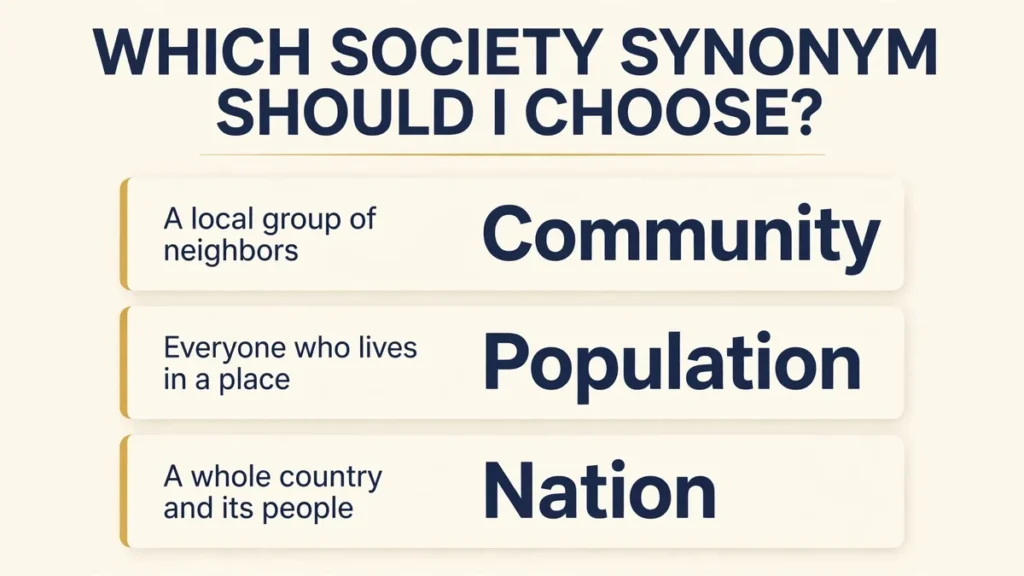
| Situation | Best pick | Why it wins |
|---|---|---|
| Neighbors sharing daily life | Community | Shared place and life |
| People counted as a number | Population | Counting is the point |
| People sharing a country | Nation | Country and identity |
| People in general, plainest word | People | General and plain |
| Shared customs and ways of life | Culture | Shared life, not people |
| Advanced, large-scale ordered life | Civilization | Progress and order |
| People as citizens or audience | Public | Public role is the point |
| People joined for a purpose | Association | Formal joining and purpose |
| A warm bond of shared interest | Fellowship | Warmth and feeling |
| People together as companions | Company | Being together right now |
| A group acting as one | Collective | Joint action and control |
| All citizens as a body | Citizenry | Citizenship is the point |
| A close loyal bond or order | Brotherhood | Loyalty and kin-like ties |
| How a society is arranged | Social order | The arrangement |
| Ordinary people as a large group | The masses | Size and ordinariness |
Antonyms of Society
1. Antonyms for society as people living together
| Antonym | Meaning Difference |
|---|---|
| Isolation | Living apart from other people |
| Solitude | Being alone, often by choice |
| Seclusion | Kept apart from other people |
| Loneliness | Sadness from lack of company |
| Exile | Forced to live away from home |
2. Antonyms for society as organized and cultured life
| Antonym | Meaning Difference |
|---|---|
| Anarchy | No order or government at all |
| Disorder | No working order or control |
| Chaos | Wild confusion, no arrangement |
| Lawlessness | No respect for law or rules |
| Barbarism | Rough life without well-mannered order |
Words Commonly Confused With Society
Community versus population is the closest pair to watch. Community names people who share a place and daily life, and it can act: a community raises money and meets. Population names people as a number, and it cannot act. You praise a street’s community, but you count a town’s population.
Culture versus civilization matters for essays. Culture names shared customs and ways of life. Civilization names an advanced stage of ordered life, with cities, laws, and writing. A small island can have a rich culture without being a civilization, and one civilization holds many cultures.
Association versus fellowship matters for clubs. Association names a formal group with rules, officers, and members. Fellowship names the warm bond among members. A club is an association; the friendly feeling at its meetings is fellowship.
Company versus association matters too. Company means people together right now, as guests or companions. Association means a formal group with a purpose and a name. You enjoy the company of friends at dinner, but you join an association to support a cause.
Substitution test failures: “The population raised money to repair the playground” fails, because a population is a count, not neighbors who act, so say “the community raised money.” “She moved in high community” fails, because high society is a fixed phrase, so keep “high society.” “The fellowship of the town grew last year” fails for a census count, so say “the population grew.”
American vs British English
Society is spelled the same in American and British English, and so are all 15 synonyms here, except one pair: Americans write civilization and organized, the British write civilisation and organised.
One meaning trap matters: in American English a public school is a state school, free and open to all, while in British English it is a private fee-paying school. This article uses American spelling throughout.
Collocations and Idioms With Society
Only use combinations native speakers actually use:
- modern society: the way people live now.
- civil society: groups outside government, such as charities.
- high society: fashionable rich people and their social life.
- polite society: people who follow good manners in formal life.
- secret society: a private group with hidden membership.
- consumer society: a society where buying shapes daily life.
- society pages: newspaper pages about famous people’s social life.
- a danger to society: a person judged harmful to others.
- the good of society: what helps people in general.
Use high society only for fashionable people, civil society only for groups outside government, and a danger to society only in legal or news writing.
Practice Exercises
Exercise 1: Neighborhood scenario set. You edit the Maple Street newsletter. Pick the best word from the brackets.
- The people on Maple Street raised money for the park. (community, population, fellowship)
- The town report counts every person who lives here. (nation, population, company)
- The street festival shows the shared food, music, and customs of the area. (culture, citizenry, company)
- The history club has officers, dues, and a name. (association, the masses, people)
- The notice thanks the warm bond among the club members. (association, fellowship, civilization)
Exercise 2: Spot the wrong word. Each sentence has one word that does not fit; name it and fix it.
- “The population raised money to repair the playground.”
- “She moved in high community after her marriage.”
- “The fellowship of the town grew last year, the census said.”
- “The company of the town voted on the new school plan.”
Answer key
- Exercise 1: (1) community; (2) population; (3) culture; (4) association; (5) fellowship.
- Exercise 2: (1) population, use community; (2) community, use society in the fixed phrase “high society”; (3) fellowship, use population; (4) company, use citizenry.
Frequently Asked Questions
What is the best synonym for society?
Community is the closest synonym when society means people who live and share daily life together. For a whole country counted as a number, population is better. For shared customs and ways of life, culture is better. The best pick depends on which sense you mean.
What is the difference between society and community?
Society is the broader word: it can mean a nation, a civilization, a formal association, or fashionable people. Community is narrower and means a smaller group with real ties, such as neighbors or a school. Use community for local life and society for the larger idea.
Can population replace society?
No, not in most sentences. Population means people counted as a number, so it fits census tables and news reports about size. It cannot act, meet, or help, so it fails for neighbors raising money or joining a club. For acting groups, use community or association instead.
What is the difference between culture and civilization?
Culture names the shared customs, arts, and ways of life of a group. Civilization names an advanced stage of ordered life, with cities, laws, and writing. A small island can have a rich culture without being a civilization, while one civilization can hold many cultures.
What does high society mean?
High society means fashionable rich people and their social life, such as balls, clubs, and charity galas. It comes from the sense of society recorded by 1823 for the more cultivated part of a community. Keep the fixed phrase as it is, and do not swap in community or population.
Which synonym should students use in essays?
In essays, prefer community for local shared life, nation for a country and its identity, and culture for shared customs. Reserve civilization for large-scale history, citizenry for civic writing, and the masses for political writing. Avoid fellowship and brotherhood in formal essays unless the bond is the point.
Conclusion
The right replacement for society depends on which group you mean. Neighbors call for community, a counted number calls for population, a country calls for nation, shared customs call for culture, and a formal group calls for association.
One last check: read the sentence aloud with the replacement in place. If it names the exact group you meant, keep it. If it counts people when you meant neighbors, or names a bond when you meant a census, swap again.

About Sajjad Ahmed
Sajjad Ahmed is the author behind Guest Paster, where he writes about English vocabulary, synonyms, word meanings, and practical word usage.
His content is designed to help readers understand the differences between similar words, discover suitable alternatives, and use English vocabulary more effectively in everyday writing and communication.
Before publishing, Sajjad focuses on presenting word choices in a clear and easy-to-understand format, with relevant meanings, context, and examples where helpful.
Through Guest Paster, his goal is to make vocabulary learning simpler and provide useful language resources for students, writers, English learners, and anyone looking to expand their vocabulary.
Areas of Focus: English Vocabulary • Synonyms • Word Meanings • Word Usage • Language Learning
Author: Sajjad Ahmed
Website: Guest Paster