
You has very few true synonyms. It is a pronoun that refers to the person or people being referred to in conversation. What people generally need is not a synonym, but an alternative that provides additional information.
For a number of listeners, use you all, y’all, you guys or you lot. To one listener in historical or poetry writing, use Thou (subject) or thee (object). In a formal essay, the most common solution would be to rephrase the sentence around certain nouns like readers, researchers or applicants.
Alternatives at a Glance
| Alternative | Meaning / Use | Best Used For |
| Thou | Old singular subject form | Historical or poetic writing |
| Thee | Old singular object form | Historical or poetic writing |
| Ye | Older/dialectal form | Historical or dialectal contexts |
| You all | Explicit plural you | Clear group address |
| Y’all | Informal plural you | Casual group address |
| You guys | Informal group address | Casual conversation |
| You lot | Informal plural address | Casual British English |
| Youse / Yous | Dialectal plural you | Regional informal speech |
| Yinz | Regional plural you | Western Pennsylvania speech |
| Unu / Allyuh | Caribbean plural forms | Regional/Creole contexts |
Quick Facts About “You”
| Fact | Answer |
| Part of speech | Personal pronoun |
| Grammatical person | Second person |
| Number | Singular or plural (the form does not change) |
| Subject and object form | you |
| Possessive forms | your (before a noun), yours (standing alone) |
| Reflexive forms | yourself (singular), yourselves (plural) |
| Register | Neutral |
| Closest historical synonym | thou (singular), ye (plural) |
| Best use | Speaking or writing directly to someone |
Why English Has Almost No Synonyms for You
Most words have synonyms because they describe something: happy can become glad or pleased with only a small change in shade. A pronoun does not describe anything. It encodes a relationship between the speaker and the listener, and it carries grammatical information about number and role in the sentence. Swapping it for another word changes who is being addressed or how the speaker sounds.
That is why every item in the table above does something extra. It adds plurality, region, age, or attitude. The sentence Are y’all coming? tells you more than Are you coming? does, because it signals that several people are being asked.
A useful rule for everyday writing: keep you unless you have a reason to specify number, adopt a regional or historical voice, or avoid direct address entirely.
How “You” Replaced “Thou”: A Short History
Understanding the history makes every alternative on this page easier to place.
Old English had three numbers:
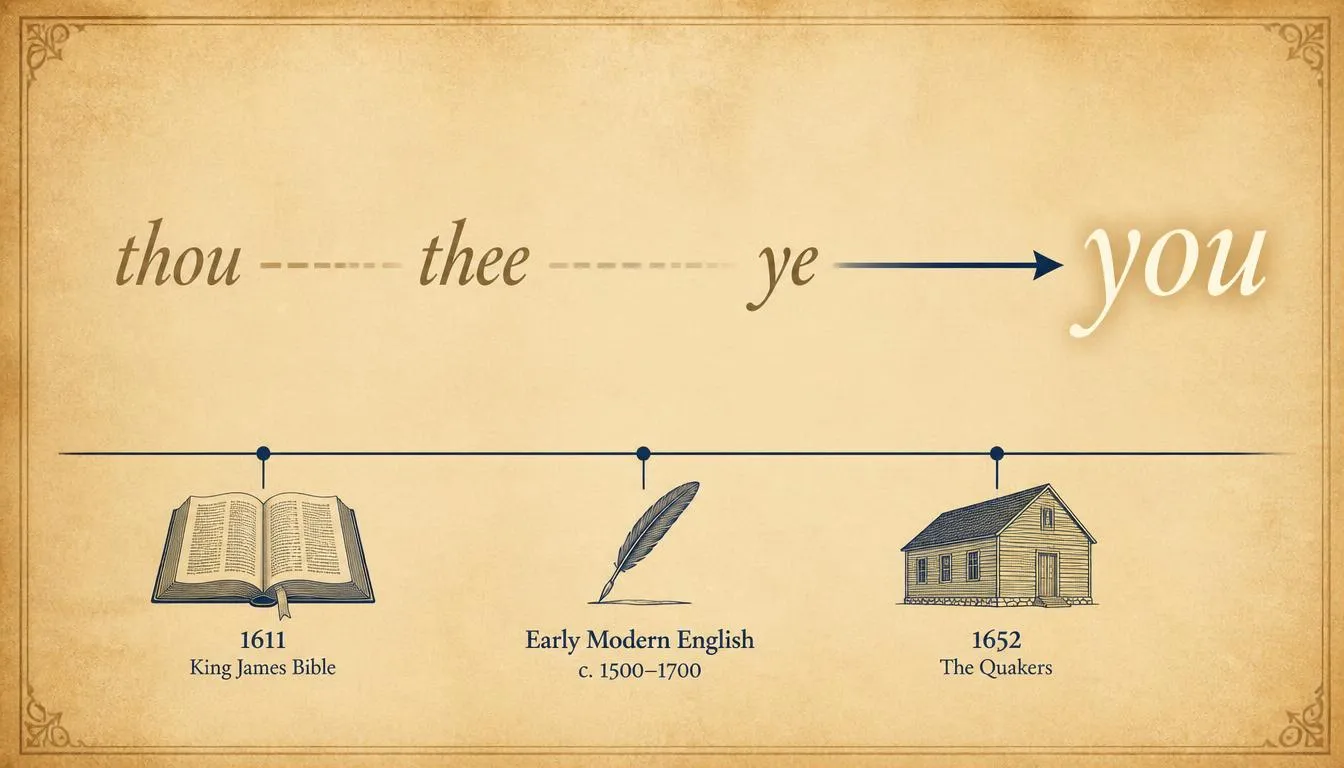
The language once had separate second-person pronouns for one person, two people, and many people. Reference works on the history of you report that the dual form disappeared by the twelfth century and that the singular form was gone from standard use by the early 1600s. Singular thou and plural ge (pronounced roughly like ye) were the core pair.
Middle English borrowed a politeness system:
English adopted a pattern familiar from French and Latin, in which one pronoun is familiar and another is respectful. Thou and thee became the familiar singular. Ye and you became the plural, and they were also used to address a single superior or a stranger. Linguists call this the T–V distinction, after Latin tu and vos.
Early Modern English blurred it:
In the 1500s and 1600s, speakers moved between the forms depending on mood and relationship. By the 1600s, using thou toward a social equal could sound deliberately insulting. A famous example is the prosecutor at Sir Walter Raleigh’s 1603 trial, who used thou to a defendant as an act of contempt.
You won:
Subject and object forms of ye and you merged, and you became the single general form. Research on the period dates the generalization of you to roughly 1300–1600, with the abandonment of the thou system concentrated between about 1500 and 1650. By the eighteenth century, thou was effectively gone from most spoken English.
Religion preserved thou:
The King James Bible, completed in 1611, kept thou, thee, thy, and thine for singular address and ye, you, your, and yours for plural, copying the singular–plural distinction of the original Hebrew, Aramaic, and Greek. The Religious Society of Friends (Quakers), founded in England in 1652, also kept thee and thou as a statement of equality, at a time when the general public still used the distinction. Because of this religious use, thou today often sounds more formal and reverent than everyday you, which is the opposite of its original role as the casual form.
New plurals filled the gap:
Once you had to serve both one person and many, speakers invented new plural markers. Some varieties kept ye. Others created y’all, you guys, you lot, youse, and yinz. These are not slang accidents. They fill a real grammatical hole that standard English has not closed.
Historical and Poetic Alternatives
Thou
What it is: the old singular subject pronoun, used where modern English would say you as the subject of a verb.
How it works: Thou takes its own verb endings. Thou art corresponds to you are, and thou knowest to you know.
Examples:
- Thou art welcome in this house.
- Where goest thou at this hour?
Best for: historical fiction, poetry, quoting older religious texts, or deliberately archaic style.
Avoid when: you are writing anything modern and practical. In a work email, thou reads as a joke or a mistake. It also remains in use in some traditional dialects of northern England and Scotland, where it is a living form and not an affectation.
Thee, Thy, and Thine
Thee is the object form: I give thee my word. Thy and thine are the possessives, matching your and yours. A common error is using thee as a subject, as in Thee art kind. The Quaker tradition actually did this in speech, which is a historical quirk, but in literary writing the subject form is thou.
Ye
Historical role: originally the plural subject form, and in Middle and Early Modern English also a respectful way to address one superior.
A common misconception: the ye in the faux-antique spelling Ye Olde Shoppe is not the pronoun at all. It is the word the. Early printing presses imported from the Continent lacked the letter thorn, so printers substituted the letter y.
Still alive: unlike thou, ye never fully died. It is used as an everyday plural you in many parts of Ireland, and in Newfoundland and Labrador. Irish English even builds a small family of forms around it, including yeer (your), yeers (yours), and yeerselves (yourselves). A corpus study of Irish English reported by linguist Stan Carey in 2016 found ye used in the Republic of Ireland but not at all in the Northern Ireland sample, where youse appeared instead.
Examples:
- Are ye coming to the match? (Irish English)
- Ye have been warned. (archaic or literary)
Plural Alternatives: The Real Competition
When people search for another word for you, plural address is usually what they need. Here is how the main options differ.
You All and Y’all
You all is the full form and y’all is its contraction. The phrase you all is recorded in print by 1824 in a book of letters about the American South, and y’all as a spelling appears in the 1850s in American sources, according to the Oxford English Dictionary, which dates its earliest citations to 1856 and 1858.
Dictionary entries and linguistic surveys agree on the broad picture: the term grew up in the American South, spread widely during the twentieth century, and is now common well beyond that region.
The origin is debated. Some linguists point to the Scots-Irish phrase ye aw. Others have proposed links to African American English or Caribbean creoles. An amateur-historian opinion piece in 2022 reported even earlier London examples from the 1600s, including one from 1631, but also noted a gap of nearly a century before American use and suggested the earlier and later forms might be separate words.
Most linguists treat y’all as an American development that arose through ordinary grammatical change. It also appears in other places, including South African Indian English and some Atlantic island dialects, which suggests parallel, independent development.
Grammar notes:
- The all in y’all works as a plural marker and does not strictly mean “everyone.” People can say some of y’all, just as they can say some of us.
- Y’all has a possessive, written y’all’s, which is evidence that it functions as a true pronoun. Spellings vary, but y’all is far more common in print than ya’ll, which is a frequent error.
- Larger groups can be signaled with all y’all or all of y’all.
- Some speakers, especially outside the South, use y’all for a single person, usually meaning that person plus their group. Many Southerners reject this.
Culture and popularity:
In 2025, NPR reported on the term’s rise, tying it to country music, hip-hop, and a growing preference for warm, inclusive-sounding group address. The slogan y’all means all has also been used as a message of welcome toward immigrants and marginalized communities.
Examples:
- Are y’all ready to order?
- Could you all please sign in at the front desk?
Best for: friendly, informal group address. Avoid when: you are writing formal reports, legal text, or academic work.
You Guys
Where used: the most common informal plural in much of the United States, especially the Midwest, Northeast, South Florida, and West Coast, and also common in Canada and Australia. Reference sources note that it has displaced youse in many places.
The inclusivity debate: guys was originally a masculine term, and some speakers now avoid you guys for mixed groups. Linguists quoted in popular coverage say this concern is part of why y’all has gained ground. Plenty of speakers use guys in a fully gender-neutral way and feel no tension, so context and audience matter.
Examples:
- Do you guys want to grab lunch?
- I’ll meet you guys outside.
You Lot
Where used: British English, and also Australia and Palmerston Island. It can be affectionate (Thanks, you lot) or exasperated (What have you lot been doing?). Australian English also has you mob.
Example: Are you lot coming to the pub, or what?
Youse and Yous
Where used: widely in Ireland, in Scotland (especially the Central Belt), Australia, and New Zealand, and in some US urban dialects including New York City and Chicago, as well as the Ottawa Valley in Canada. Spellings vary, and yiz and yez are also used in Irish English.
Example: Did youse see that?
Caution: many readers will perceive it as non-standard. Use it in dialogue and quotation, not in neutral prose.
Yinz
Where used: primarily in Western Pennsylvania, with a strong association with Pittsburgh. Its ancestors are Scots-Irish forms such as you ones and you’uns. Etymonline notes you-uns in Ohio by 1810. Because speakers use several competing forms in this area, spelling varies: yinz, yunz, you’uns, y’ins, and others.
Example: Yinz coming to the game Sunday?
Unu and Allyuh
These plural forms belong to Caribbean English and English-based creole languages. They are sometimes missing from English-only lists, but they are the everyday plural you for many speakers. Use them only when writing authentically in that voice.
Number-Specific Phrases
When the exact count matters, add a number word.
- You two addresses exactly two people: Can you two move the table upstairs?
- You both also addresses two people and stresses that the statement applies to each: Thank you both for staying late.
- You three, you four, you all continue the pattern. These are not synonyms for you, but they solve the same practical problem, which is that bare you does not say how many people are meant.
When “You” Means “People in General”
Sometimes you does not address a real listener. It stands for anyone: You never know what you’ll find at a flea market. This generic you is perfectly natural in speech and informal writing. In formal writing it can feel vague, and the best replacements are not synonyms but restructurings.
| Generic you | Better in formal writing |
| You never know what will happen. | One never knows what will happen. |
| You can see the trend in the data. | The data show a clear trend. |
| When you overcrowd classrooms, learning suffers. | When schools overcrowd classrooms, learning suffers. |
| You need a license to drive. | Drivers need a license. |
A note on one: it works, but it can sound stiff, and overusing it makes prose feel old-fashioned. A specific noun is usually clearer.
Another Word for “You” in an Essay
This is one of the most searched versions of the question, and the answer is different from the plural question. University writing centers, including Purdue’s, give consistent guidance: in academic writing, avoid you and your. The reasons they give are that second person sounds informal, it can be ambiguous about whether the writer means the reader or people in general, and it can make readers feel singled out or excluded if the claim does not apply to them.
The same sources note exceptions. Second person is acceptable, and often expected, in instructions, recipes, how-to guides, and some informal or creative writing.
A practical method for revising an essay sentence:
- Ask who “you” really means. Is it researchers, voters, patients, students, or readers?
- Name that group. Replace you with the specific noun.
- Check the verb. Make sure the subject and verb still agree.
- If no group fits, restructure. Move the idea into the passive voice or make the evidence the subject of the sentence.
Before and after:
- You can see that temperature affects the reaction. → The results show that temperature affects the reaction.
- If you ignore safety rules, you risk injury. → Workers who ignore safety rules risk injury.
- You should consider both sides. → Readers should consider both sides.
Choosing by Context
Everyday conversation. Keep you. Add you all, y’all, or you guys when you need to clarify that several people are meant.
Business email. You is clear and professional. For groups, a precise noun such as team, colleagues, attendees, or customers often reads better than a casual pronoun. Avoid you guys with senior or international audiences you do not know well.
Customer-facing writing. Direct address often works well here, because it makes the text feel personal. You will receive a confirmation within two business days is clearer than Customers will receive.
Creative writing. Match the voice to the character. Thou, thee, and ye build historical atmosphere. Regional plurals such as youse, yinz, you lot, or y’all signal where a speaker comes from. Use them consistently and only where you know the dialect, because a mismatched dialect form reads as parody.
Social media. You, y’all, you guys, and everyone are all common. Words like folks, friends, and everyone are terms of address and not grammatical synonyms, but they often do the same job.
Translation and language learning. Many languages have separate formal and informal you (French tu and vous, Spanish tú and usted, German du and Sie, and Urdu tum, tu, and aap). English historically had this too, with thou and you, and lost it. When translating into English, the formality usually has to be carried by tone and word choice instead of the pronoun.
A Regional Guide to Second-Person Plurals
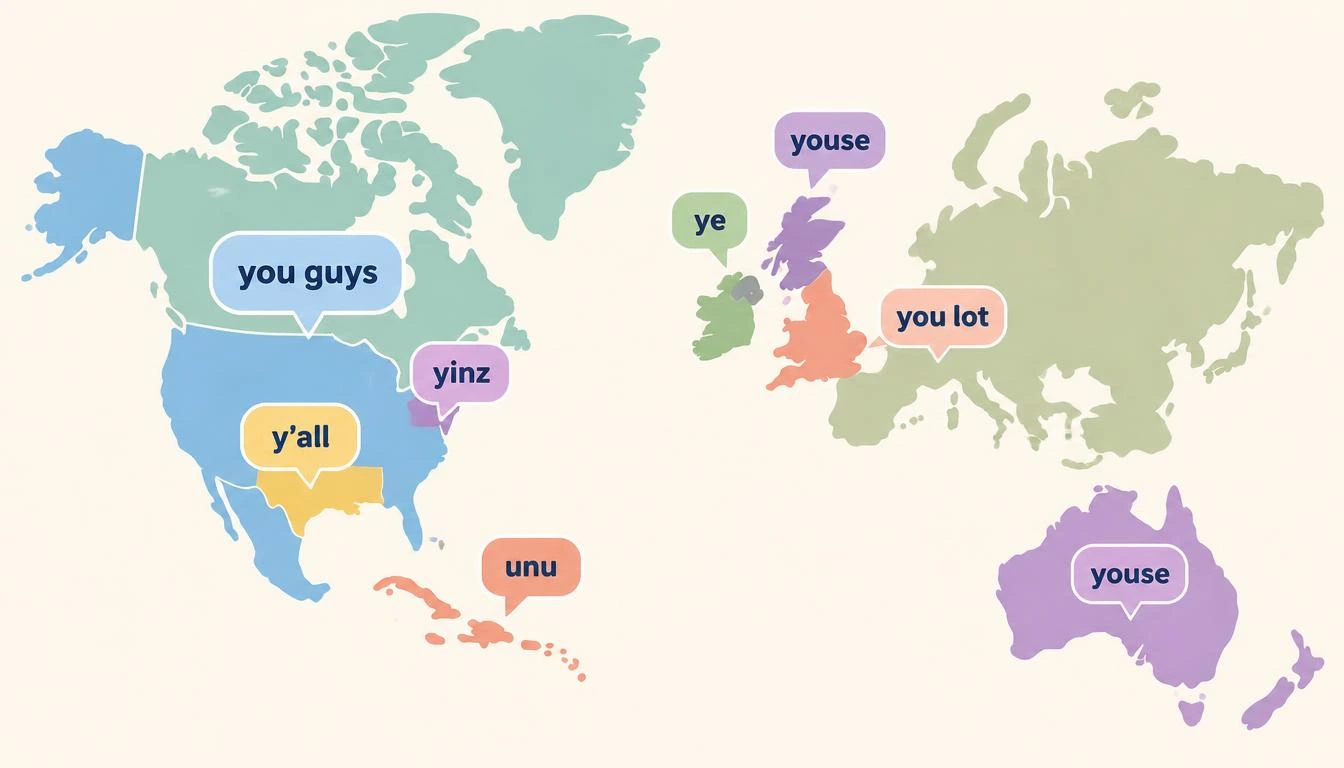
| Region | Common plural forms |
| Southern United States | y’all, you all |
| Most of the US | you guys |
| Western Pennsylvania | yinz, you’uns |
| New York City, Chicago and other urban US areas | youse, yous |
| Canada | you guys; ye in Newfoundland and Labrador |
| England | you lot |
| Scotland | yous, youse, yous’uns, ye in some areas |
| Ireland | ye, youse, yiz |
| Australia | you guys, you lot, youse, you mob |
| New Zealand | you guys, yous |
| Caribbean | unu, allyuh |
These are tendencies and not rules. Speakers move between forms, and many forms overlap across regions. Treat the table as a guide to what sounds natural, not as a list of what is correct.
Words Often Confused With “You”
Several words appear in searches near you but are different things.
- Your and yours are possessive forms of you, not substitutes for it.
- Yourself and yourselves are reflexive forms and cannot replace you in an ordinary sentence.
- One, people, anyone, readers can replace you only after a sentence is rewritten, and they do not mean the same thing. One refers to a person in general. You can point at a specific listener.
- You’ll and you’ve are contractions of you will and you have. Expanding them is a grammatical operation, not a synonym swap.
- Everyone and folks address or describe a group but do not grammatically mean you.
Why You Has No Real Antonym
Antonyms are meaning opposites, such as hot and cold. Pronouns do not have those. I, we, he, she, and they are different grammatical persons, not opposites of you. They contrast with you by pointing to a different participant in the conversation. Anyone offering a list of “antonyms of you” is stretching the term.
Common Mistakes
| Mistake | Better approach | Why |
| Using thou in a modern email | Use you | Thou sounds archaic or like a joke |
| Writing Thee art in a literary poem | Use Thou art | Thee is the object form |
| Spelling it ya’ll | Write y’all | The apostrophe replaces the letters ou from you |
| Replacing every you in an essay with one | Name the group, or restructure | One repeated sounds stiff |
| Using y’all in a formal report | Use a specific noun | The register is too informal |
| Treating your as a synonym | Use it only as a possessive | It is a different part of speech |
| Using youse or yinz in neutral prose | Reserve for dialogue | They read as strongly regional |
How This Guide Was Researched
This guide was prepared by comparing dictionary and etymology references, linguistic overviews, academic papers on the history of English pronouns, university writing-center guidance, and recent reporting on current usage.
Where a claim is disputed, such as the origin of y’all, the guide says so and does not choose a side. Regional descriptions come from reference works and are tendencies, not universal rules. Language changes quickly, and informal forms in particular shift in popularity, so check a current dictionary for the latest labels before using any form in formal work.
Practice Exercises
Fill in the Blanks
Choose from: thou, thee, y’all, two. Each word is used once.
- A knight addresses a lady: “I give ___ my solemn word.”
- A character in a Shakespeare-style play says: “___ art mistaken, good sir.”
- A Texan writes in a group chat: “Are ___ still coming tonight?”
- A teacher speaks to exactly two students: “Could you ___ please stay behind?”
Rewrite the Sentences
Rewrite each sentence for the context in brackets.
- You can see from the data that sales increased. [academic report]
- Are you coming to the meeting? [asking five colleagues]
- You must show identification at reception. [visitor policy, third person]
Match the Words
Match each term with its best description.
A. Thou B. Yinz C. You lot D. Ye E. Thee
- Plural form associated with Western Pennsylvania
- Archaic singular subject
- Plural form used in Ireland and Newfoundland and Labrador
- Archaic singular object
- British informal plural
Quick Quiz
1. Which statement about modern standard English is true? A. It has separate singular and plural forms of you B. It uses the same form of you for one and many C. Still uses thou for formal address D. It uses ye as its plural
2. Which form is the archaic singular object pronoun? A. Thou B. Ye C. Thee D. Yinz
3. What is usually the best way to avoid “you” in an academic essay? A. Replace it with thou B. Replace it with y’all C. Name the specific group or rewrite the sentence D. Repeat one in every sentence
4. In “Ye Olde Shoppe,” the word “ye” means: A. You (plural) B. The C. Your D. Yes
5. Which plural is most associated with British English? A. Yinz B. Y’all C. You lot D. Allyuh
Answer Key
Fill in the blanks: 1. thee 2. Thou 3. y’all 4. two
Rewrite examples (sample answers):
- The data show that sales increased.
- Are you all coming to the meeting? (or: Are you guys coming? / Are y’all coming?)
- Visitors must show identification at reception.
Matching: A–2, B–1, C–5, D–3, E–4
Quiz: 1–B, 2–C, 3–C, 4–B, 5–C
Frequently Asked Questions
What is the closest synonym for “you”?
For one person in historical or poetic style, thou (subject) and thee (object). For several people, you all, y’all, you guys, or you lot, depending on region. No single word replaces you in every context.
What can I say instead of “you” in an essay?
Usually a specific noun, such as readers, researchers, students, or citizens, or a restructured sentence that avoids addressing the reader directly. Purdue-affiliated and other university writing centers advise avoiding you in academic writing.
What is a poetic word for “you”?
Thou for a singular subject and thee for a singular object. They produce an old-fashioned tone and are best used deliberately.
Is “y’all” singular or plural?
Mainly plural. Some speakers, especially outside the American South, also use it for one person who stands for a group. Many Southern speakers consider that incorrect. Context makes it clear.
Where did “y’all” come from?
It is a contraction of you all. The phrase appears in print in 1824, and the contracted spelling appears in the 1850s. Its origins are debated, with Scots-Irish influence and African American English both proposed, and earlier English examples complicating the picture. Most linguists see it as an American development.
What is the plural of “you”?
Standard English uses you for both. Many dialects add a marker, such as you all, y’all, you guys, you lot, youse, yinz, or ye.
Why did English drop “thou”?
The plural you became a polite way to address individuals, and over time speakers used it for everyone to avoid accidentally insulting someone. By the eighteenth century, thou had largely disappeared from everyday speech, though religious use and some dialects preserved it.
Is “you guys” gender neutral?
Many speakers use it that way, but its masculine origin leads some people to avoid it for mixed or inclusive audiences. You all, y’all, everyone, or folks are alternatives.
Is “you” a word that can be a noun?
Yes, in rare cases. Phrases like a true you or the real you use it as a noun. That is a separate use from the pronoun.
What does “ye” mean in “Ye Olde Shoppe”?
It means the. It is not the pronoun. The y stands in for the old letter thorn.
Conclusion
An alternative to you is a matter of precision, not language. Modern you, however, does a rather large amount of work: it can address one listener or an entire audience, a friend or a stranger, a casual conversation or a formal correspondence. The use of alternatives becomes worthwhile only when they provide something you do not.
For groups you all, y’all, you guys and your lot mark pluralities in different regional voices. Thou, thee and ye convey an antiquated tone in terms of historical or poetic effect. For essays and official documents, the most powerful option is normally to rephrase the sentence to talk about the people that it’s actually about. When you want to match the person, number, tone and place you are thinking of using, it is generally easy to know what word to use.

About Sajjad Ahmed
Sajjad Ahmed is the author behind Guest Paster, where he writes about English vocabulary, synonyms, word meanings, and practical word usage.
His content is designed to help readers understand the differences between similar words, discover suitable alternatives, and use English vocabulary more effectively in everyday writing and communication.
Before publishing, Sajjad focuses on presenting word choices in a clear and easy-to-understand format, with relevant meanings, context, and examples where helpful.
Through Guest Paster, his goal is to make vocabulary learning simpler and provide useful language resources for students, writers, English learners, and anyone looking to expand their vocabulary.
Areas of Focus: English Vocabulary • Synonyms • Word Meanings • Word Usage • Language Learning
Author: Sajjad Ahmed
Website: Guest Paster