Many writers call any famous person noted but that habit causes trouble. A pop star with a hit song is famous but few people call her noted. A scholar with one great book earns the word noted because it points at a quality people observed. Renowned, however is the closest synonym for noted and it fits best when the fame rests on real work.
This guide compares 15 noted synonyms from renowned to famed, with plain meanings, real examples and honest limits so you can pick the word that fits your sentence and your reader.
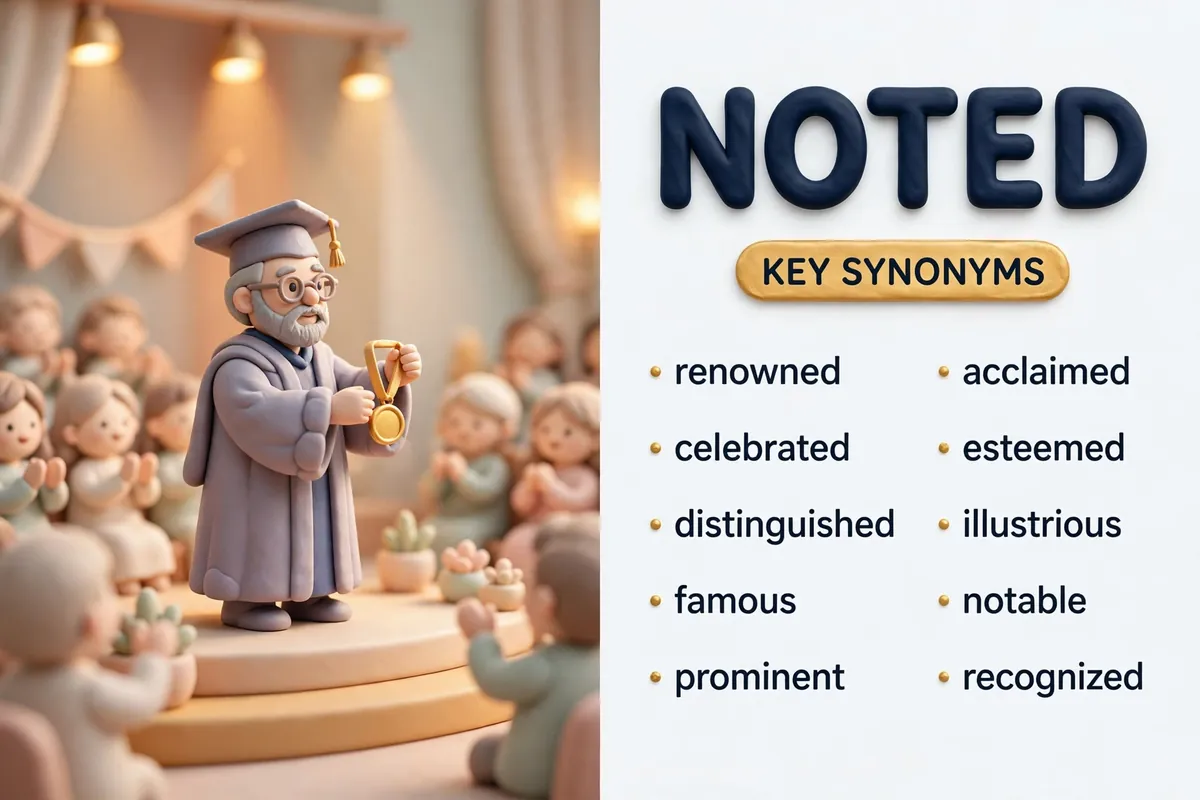
Noted Synonyms at a Glance: Top 10
| # | Synonym | Meaning Difference |
|---|---|---|
| 1 | Renowned | Known and admired for a special quality |
| 2 | Celebrated | Praised in public for great work |
| 3 | Distinguished | Marked by excellence and high standing |
| 4 | Famous | Known by very many people |
| 5 | Prominent | Easy to see, important in a field |
| 6 | Acclaimed | Praised loudly by critics or the public |
| 7 | Esteemed | Held in high respect by others |
| 8 | Illustrious | Famous for great deeds over time |
| 9 | Notable | Worth noticing, stands out |
| 10 | Recognized | Known and accepted for a skill |
Quick Facts About “Noted”
- Part of speech: adjective. The verb is note, and the noun is note.
- Core meaning: widely known, especially for a special quality or skill.
- Two main senses: (1) famous for something, as in a noted author; (2) observed for a special quality.
- Register: neutral to formal. Noted also fits news, essays, and formal speech.
- Common mistake: using noted for anyone famous. So noted needs a reason, like a book or a career.
The Closest of the Noted Synonyms: Renowned

Renowned is the closest of these noted synonyms, because it covers the same ground in the fullest form: a name many people know, tied to real work and real praise. First, test the swap and it holds. “She is a noted historian” becomes “She is a renowned historian.” “His noted study of birds changed the field” becomes “His renowned study of birds changed the field.”
Renowned also wins on warmth. It adds admiration to fame, so it fits artists, scientists, and writers whose work earned public praise. But noted stays cooler and plainer. Our guide to power synonyms also covers the words for that strength behind a public name. One limit matters: renowned needs a wide audience, so use noted when the circle is small and the quality is real.
Where Noted Synonyms Come From
According to Etymonline, however, noted comes from the verb note. Note, however, dates to around 1200 as noten, “observe, take mental note of, mark carefully,” from Old French noter, “indicate, designate, take note of, write down,” from Latin notare, “to mark, note, make a note,” from nota, “mark, sign, note, character, letter.”
Noted as an adjective dates to around 1300 as a past participle of note, and it first meant “observed.” The sense “observed for some special quality, conspicuous, distinguished” also dates to the mid-15th century. The noun note also carries the same root, and its sense “reputation, fame” dates to the late 14th century. Etymonline notes that Latin nota links in older tradition to notus, from noscere, “to come to know,” yet the scholar de Vaan calls that link impossible, so the root stays unknown.
The history explains the word behind these noted synonyms. It began with a mark. A mark singles a thing out, so notice over time turns into fame. Read the full entry at Etymonline.
Can You Swap Noted With Any of These Words?
In short: only inside the same meaning group.
- ✅ “She is a noted historian of Rome.” (famous for real work ✔)
- ✅ “She is a renowned historian of Rome.” (famous and admired ✔)
- ❌ “They call her a notorious historian of Rome.” (notorious means famous for something bad ✘, say noted or renowned)
- ✅ “The noted bakery draws a line every morning.” (known for its bread ✔)
- ✅ “He gave a distinguished lecture on the stars.” (excellent and respected ✔)
Before you substitute one of these noted synonyms, first ask what the fame rests on: a skill, a work, or a long life.
Noted Synonyms in Detail
Group 1: Famous for Great Work
1. Renowned
- Meaning: Known and admired by many for a special quality or deed.
- Difference: Renowned, however, adds admiration to fame. Noted means known, but among these noted synonyms, renowned means known and praised.
- Best Used For: Artists, scientists, and writers with a strong public name.
- Formality: Neutral to formal · CEFR: C1 · Frequency: Common
- Example (Work): “The renowned chef, however, opened a small restaurant in her hometown.”
- Example (News): “The renowned surgeon also spoke about the new heart treatment.”
- When NOT to Use It: For a person known only in a small circle, use noted instead.
2. Celebrated
- Meaning: Praised in public for great work or talent.
- Difference: Celebrated, however, adds public praise. A noted writer earns respect, but among these noted synonyms, a celebrated writer earns applause.
- Best Used For: Authors, actors, and winners of big prizes.
- Formality: Neutral to formal · CEFR: B2 · Frequency: Common
- Example (Arts): “The celebrated pianist, however, played to a full hall in Vienna.”
- Example (School): “Our celebrated teacher also won the national award for science.”
- When NOT to Use It: For quiet respect without public praise, use esteemed instead.
3. Famous
- Meaning: Known by very many people, in many places.
- Difference: Famous, however, is the widest word here, and it needs no reason. A noted scientist earns fame through work, but among these noted synonyms, a famous person may earn it through luck.
- Best Used For: Everyday talk, news, and well-known names.
- Formality: Neutral · CEFR: A2 · Frequency: Very common
- Example (Daily): “The famous singer, however, filled the stadium in one night.”
- Example (News): “A famous actor also bought the old cinema in town.”
- When NOT to Use It: For fame tied to real achievement, use noted or renowned instead.
4. Illustrious
- Meaning: Famous for great deeds over a long time.
- Difference: Illustrious, however, adds history and honor. A noted scholar shines now, but an illustrious scholar shines across a lifetime.
- Best Used For: Leaders, scholars, and heroes of the past.
- Formality: Formal, literary · CEFR: C1 · Frequency: Less common
- Example (History): “The illustrious general, however, wrote his memoirs.”
- Example (School): “She also studied the illustrious poets of old.”
- When NOT to Use It: For a young person with one success, use noted instead.
5. Acclaimed
- Meaning: Praised loudly by critics or the public.
- Difference: Acclaimed, however, points at the praise itself. A noted author has a strong name. An acclaimed author has reviews to prove it.
- Best Used For: Books, films, and plays that critics love.
- Formality: Neutral to formal · CEFR: C1 · Frequency: Common
- Example (Books): “Her acclaimed novel won three major prizes.”
- Example (Film): “The acclaimed director also opened the festival.”
- When NOT to Use It: For fame without critics involved, use famous instead.
6. Famed
- Meaning: Known far and wide for a special quality.
- Difference: Famed, in fact, sounds old-fashioned and grand, and it fits legends and tales. Noted sounds plain and modern.
- Best Used For: Stories, legends, and heroes of the past.
- Formality: Formal, literary · CEFR: C1 · Frequency: Less common
- Example (Travel): “The famed gardens draw visitors from every country.”
- Example (Story): “A famed knight rode out at dawn.”
- When NOT to Use It: In plain everyday speech, use famous instead.
Group 2: Respected for Standing and Character
7. Distinguished
- Meaning: Marked by excellence and high standing.
- Difference: Distinguished, however, stresses quality and rank. A noted professor has a known name, but among these noted synonyms, a distinguished professor holds a chair and wins honors.
- Best Used For: Professors, judges, and senior officials.
- Formality: Formal · CEFR: C1 · Frequency: Common
- Example (Work): “The distinguished judge opened the new law school.”
- Example (School): “A distinguished scientist also visited our class last week.”
- When NOT to Use It: For a pop star or a viral name, use famous instead.
8. Esteemed
- Meaning: Held in high respect by others.
- Difference: Esteemed, in fact, stresses respect more than fame. A noted writer has readers, but of these noted synonyms, an esteemed writer has the trust of other writers.
- Best Used For: Colleagues, mentors, and trusted experts.
- Formality: Formal · CEFR: C1 · Frequency: Common
- Example (Work): “Our esteemed colleague retires after forty years.”
- Example (Daily): “The esteemed doctor also answered every question with patience.”
- When NOT to Use It: For a person known for one hit song, use famous instead.
9. Eminent
- Meaning: Standing high above others in a field.
- Difference: Eminent, however, adds height. A noted lawyer wins cases, but an eminent lawyer shapes the law itself.
- Best Used For: Scholars, scientists, and senior thinkers.
- Formality: Formal · CEFR: C1 · Frequency: Less common
- Example (Work): “An eminent historian spoke at the university.”
- Example (News): “The eminent physicist received the highest national honor.”
- When NOT to Use It: In casual talk, use well-known instead.
10. Revered
- Meaning: Deeply respected for character or work.
- Difference: Revered, in fact, adds feeling close to love. A noted teacher earns praise. A revered teacher earns devotion from students.
- Best Used For: Teachers, spiritual leaders, and heroes.
- Formality: Formal · CEFR: C1 · Frequency: Common
- Example (School): “The revered teacher taught three generations of children.”
- Example (Faith): “Pilgrims visit the revered saint’s shrine each year.”
- When NOT to Use It: For a person known only for skill, use acclaimed instead.
Group 3: Standing Out From the Crowd
11. Notable
- Meaning: Worth noticing, standing out.
- Difference: Notable, however, is the closest cousin of noted. A noted person has a known name, but within these noted synonyms, a notable person has a trait that catches the eye.
- Best Used For: Events, traits, and works that deserve attention.
- Formality: Neutral to formal · CEFR: B2 · Frequency: Very common
- Example (News): “The report lists three notable changes in the law.”
- Example (Daily): “Her most notable skill is her calm under pressure.”
- When NOT to Use It: For a person famous across the world, use renowned instead.
12. Prominent
- Meaning: Easy to see and important in a field.
- Difference: Prominent, in fact, stresses position and visibility. A noted doctor has a good name, but a prominent doctor leads the hospital.
- Best Used For: Leaders, buildings, and public roles.
- Formality: Neutral to formal · CEFR: B2 · Frequency: Common
- Example (Work): “A prominent lawyer took the case for free.”
- Example (News): “The prominent tower shapes the skyline.”
- When NOT to Use It: For a quiet expert with no public role, use noted instead.
13. Recognized
- Meaning: Known and accepted for a skill or role.
- Difference: Recognized, however, stresses acceptance by others. A noted artist has fans. A recognized artist has awards and museum shows.
- Best Used For: Experts, professionals, and award winners.
- Formality: Neutral · CEFR: B2 · Frequency: Very common
- Example (Work): “She is a recognized expert on birds of the north.”
- Example (School): “The recognized author visited our library.”
- When NOT to Use It: For a person known only by rumor, use famous instead.
14. Well-Known
- Meaning: Known by many people in a place or a field.
- Difference: Well-known, in fact, is the plainest swap. It drops the formal tone. A noted scholar sounds grand. A well-known scholar sounds friendly.
- Best Used For: Everyday speech and local names.
- Formality: Neutral · CEFR: B1 · Frequency: Very common
- Example (Daily): “The well-known baker sells out before noon.”
- Example (Travel): “We stayed at a well-known hotel.”
- When NOT to Use It: In a formal essay, use noted or renowned instead.
15. Legendary
- Meaning: Famous through stories told over many years.
- Difference: Legendary, however, adds story and time. A noted athlete wins medals now. A legendary athlete lives on in tales after retirement.
- Best Used For: Sports heroes, old tales, and epic deeds.
- Formality: Neutral to formal · CEFR: B2 · Frequency: Common
- Example (Sport): “The legendary runner still holds the old record.”
- Example (Story): “Children love the legendary tale of the city.”
- When NOT to Use It: For a person famous only this year, use noted instead.
Best Noted Synonyms by Context
These noted synonyms, however, fit real scenes.
At work. A manager, however, writes a letter of praise for a senior engineer. Distinguished also fits best, because it names excellence and rank. Esteemed also works when the letter stresses respect.
In a biography. A writer, however, tells the life of a great painter. Renowned also leads, because the painter earned fame through work. Famed follows for the old tales, but acclaimed fits the reviews of each show.
In a travel guide. A writer lists places worth a visit. Famed also fits the old gardens, because stories made them known. Notable fits a small site with one strange trait, but prominent fits the tower that shapes the skyline. A noted captain lifts a whole team on a voyage, and our guide to teamwork synonyms covers the words for shared effort.
Which Noted Synonym Should I Choose?
Each of these noted synonyms, however, fits one sense.
| Situation | Best pick | Why it wins |
|---|---|---|
| Fame from real work | Renowned | The closest word |
| Public praise and applause | Celebrated | The ceremony |
| A name known everywhere | Famous | The widest word |
| Great deeds over a lifetime | Illustrious | The honor |
| Praise from critics | Acclaimed | The reviews |
| An old tale or legend | Famed | The story |
| Excellence and high rank | Distinguished | The standing |
| Deep respect from others | Esteemed | The trust |
| The top mind in a field | Eminent | The height |
| Warm respect, close to love | Revered | The feeling |
| Worth a second look | Notable | The trait |
| A visible leader in a field | Prominent | The position |
| Accepted skill with proof | Recognized | The acceptance |
| A plain local name | Well-Known | The simple tone |
| A hero of old stories | Legendary | The myth |
Collocations and Idioms With Noted
Only combinations fluent speakers actually use:
- noted for: as in “She is noted for her work on bees.”
- a noted scholar: as in “A noted scholar spoke at the college last night.”
- a noted author: as in “The noted author signed books after the talk.”
- noted authority: as in “He is a noted authority on old maps.”
- a person of note: as in “A person of note attended the opening.”
- take note of: as in “Take note of the change in her voice.”
- worthy of note: as in “His early poems are worthy of note.”
Words Commonly Confused With Noted
Noted versus famous. Famous, however, means known by many, for any reason at all. But noted means known for a real quality or deed. A singer with one viral video is famous, but a scholar with forty years of research is noted. Fame can arrive in a day, but noted takes time and work.
Noted versus notable. Notable means worth noticing, but noted means already noticed by many. A notable detail catches your eye once, but a noted person holds the eyes of a whole field. Use notable for a trait, and pick from these noted synonyms for a name.
Noted versus notorious. Notorious means famous for something bad. A noted judge earns praise, but a notorious judge earns headlines for scandal. Never swap the two, but remember the feeling flips from respect to shame. When writers praise noted work, they often mean work of high worth, and our guide to quality synonyms covers the words for that worth.
Noted versus popular. Popular, however, means liked by many. Noted, however, means known for achievement. A popular teacher makes class fun, but a noted teacher writes books other teachers read. One person, however, can hold one word without the other.
Opposites of Noted Synonyms: Words That Mean the Reverse

| Noted word | Opposite | What changes |
|---|---|---|
| Renowned | Unknown | A known name fades to no name |
| Celebrated | Ignored | Public praise turns to silence |
| Distinguished | Ordinary | High standing drops to common |
| Famous | Obscure | A wide name shrinks to hidden |
| Prominent | Unnoticed | A visible figure passes unseen |
| Acclaimed | Unrecognized | Loud praise gives way to none |
| Esteemed | Disrespected | Deep respect turns to contempt |
| Notable | Unremarkable | A trait worth notice blends in |
Unknown, however, is the plain opposite for everyday writing, outside these noted synonyms. Obscure suits a hidden name, but unremarkable suits work that blends in.
Noted Synonyms: American vs British English
Noted, however, is spelled and used the same in American and British English, and so are most of these noted synonyms. Renowned, celebrated, and famous also never change across the Atlantic. But one small difference sits nearby: Americans write “recognized” where Britons write “recognised,” with an s in place of the z. This article also uses American spelling throughout.
Practice Exercises: Noted Synonyms in Use
First, test these noted synonyms in the exercises below.
Exercise 1: Fill in the blank. Choose the best word from the list: renowned, celebrated, notable, obscure, distinguished, famed.
- “Fill the gap: the _____ chef opened a small restaurant in her hometown.”
- “Her most _____ skill is her calm under pressure.”
- “In Vienna, the _____ pianist played to a full hall.”
- “The _____ judge opened the new law school.”
- “Visitors come from every country to see the _____ gardens.”
- “His work stayed _____ for years before critics found it.”
Exercise 2: Rewrite each sentence with a better synonym from this article.
- “A famous teacher taught three generations of children.”
- “One popular lawyer took the case for free.”
- “Visitors from every country come to see the famous gardens.”
- “He is a famous expert on birds of the north.”
Answer key
- Exercise 1: (1) renowned: a strong public name; (2) notable: a trait worth noticing; (3) celebrated: praise for a performer; (4) distinguished: excellence and rank; (5) famed: old gardens in stories; (6) obscure: hidden for years.
- Exercise 2: (1) “The revered teacher taught three generations of children”: revered fits warmth and service; (2) “The prominent lawyer took the case for free”: prominent fits a visible leader; (3) “The famed gardens draw visitors from every country”: famed fits old places in stories; (4) “He is a recognized expert on birds of the north”: recognized fits accepted skill with proof.
Frequently Asked Questions About Noted Synonyms
What is the best of the noted synonyms?
Renowned is the best of these noted synonyms, because it covers the same ground: a name many people know, tied to real work and real praise. Celebrated also fits public applause, distinguished fits high rank, and well-known fits plain talk, so the best word follows the scene.
What is the difference between noted synonyms and famous?
Noted, however, needs a reason behind the fame, like a book or a discovery. Famous needs no reason at all, so a viral video or a scandal can make a name known overnight. A noted scholar earns the word through work, but a famous singer may earn it through luck.
Can noted describe a place or a thing?
Yes, and writers also use it that way often. A noted restaurant earns praise for its food, a noted garden also draws visitors for its beauty, and a noted exception breaks a rule worth a mention. The sense stays the same: the place or thing stands out because people observed real quality.
What are the opposites of noted synonyms?
It, however, depends on the sense. For a famous name, however, the opposite is unknown, as in a writer nobody has heard of yet. For a visible figure, also use unnoticed, and for work that blends in, use unremarkable. Unknown is also the safe opposite when no sense stands out.
Is noted formal or informal?
Noted, however, is neutral to formal. It, however, fits news, essays, biographies, and formal speeches with ease. In plain everyday talk, well-known also often sounds more natural, while famous fits a casual chat. So use noted when the setting asks for a calm and serious tone.
Can I use noted in everyday speech?
Yes, but use it with care. Noted also sounds best when you name a real quality, like a noted teacher or a noted bakery. For a pop star or a viral video, famous fits better, since noted asks for work behind the name. So save noted for names that earned it.
Conclusion: Picking the Right Noted Synonyms
A name, however, earns its place among the noted synonyms when people observe real quality behind it. Renowned adds praise, celebrated adds applause, and distinguished adds rank, but each one starts from the same root: a mark that singles a person out.
However, pick one of these noted synonyms that matches the scene. Finally, use noted for quiet achievement, renowned for wide praise, and well-known for plain talk. The right word tells your reader not just that a name is known, but why it deserves the name.

About Sajjad Ahmed
Sajjad Ahmed is the author behind Guest Paster, where he writes about English vocabulary, synonyms, word meanings, and practical word usage.
His content is designed to help readers understand the differences between similar words, discover suitable alternatives, and use English vocabulary more effectively in everyday writing and communication.
Before publishing, Sajjad focuses on presenting word choices in a clear and easy-to-understand format, with relevant meanings, context, and examples where helpful.
Through Guest Paster, his goal is to make vocabulary learning simpler and provide useful language resources for students, writers, English learners, and anyone looking to expand their vocabulary.
Areas of Focus: English Vocabulary • Synonyms • Word Meanings • Word Usage • Language Learning
Author: Sajjad Ahmed
Website: Guest Paster