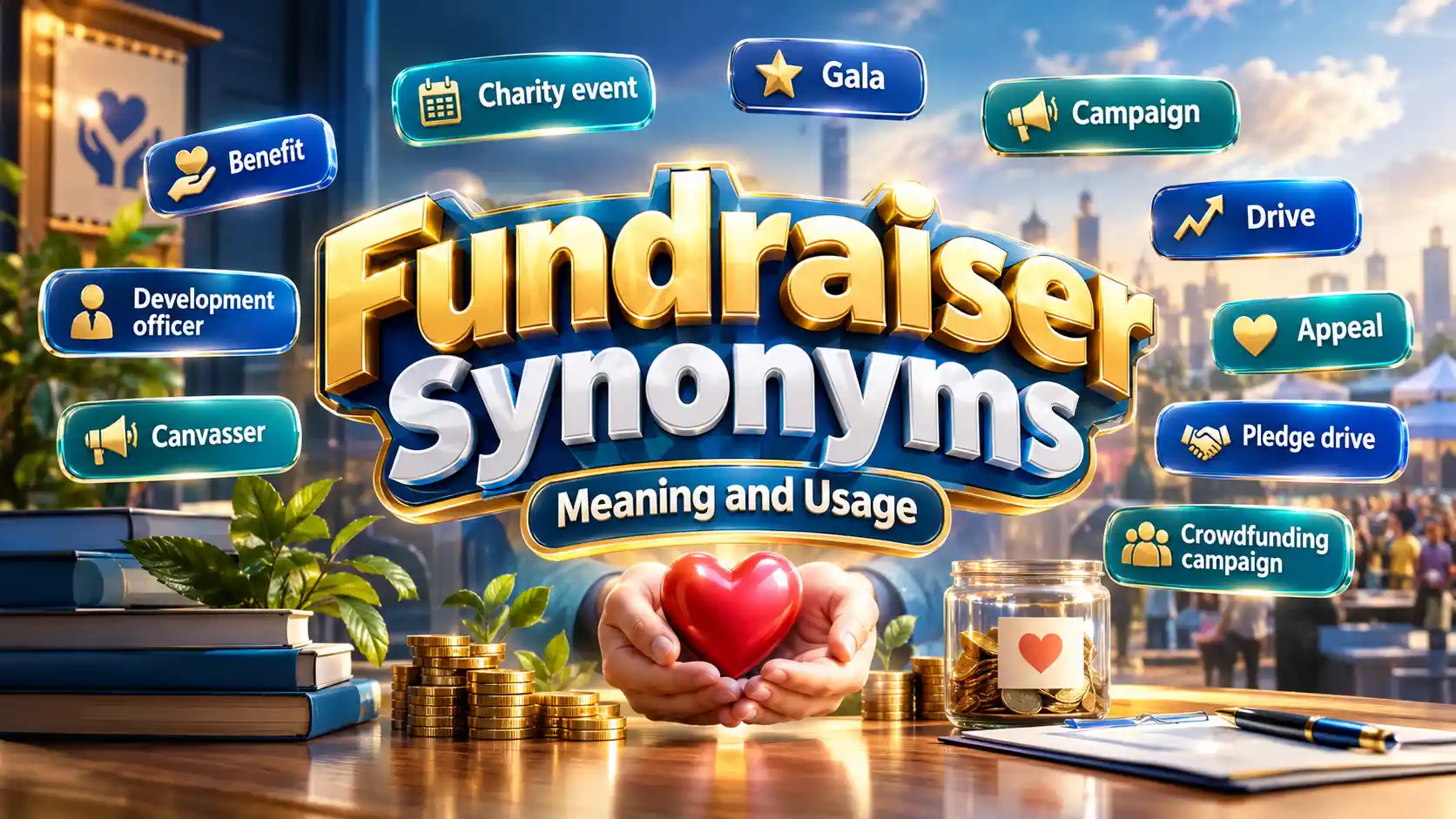
Fundraiser has two everyday meanings: a person who raises money for an organization or cause, and an event held to raise that money. That double meaning is why one synonym rarely fits every sentence.
Quick answer:
- For the event: use benefit (warm, charity-focused), gala (formal), or charity event (neutral).
- For the activity: use campaign, drive or appeal.
- For the person: use development officer (professional), canvasser (door-to-door) or fundraising professional (neutral).
Pick the word by asking one question first: am I naming a person, a party, or an effort?
Another Word For Fundraiser
| # | Synonym | What it means | Names a… |
| 1 | Benefit | Event or performance whose proceeds go to a cause | Event |
| 2 | Charity event | Neutral term for any money-raising occasion | Event |
| 3 | Gala | Formal, upscale fundraising evening | Event |
| 4 | Campaign | Sustained, organized effort toward a money goal | Effort |
| 5 | Drive | Time-limited push to collect money or goods | Effort |
| 6 | Appeal | Direct public request for donations | Effort |
| 7 | Pledge drive | Campaign built on promised gifts (public media style) | Effort |
| 8 | Crowdfunding campaign | Online collection of many small gifts | Effort |
| 9 | Development officer | Professional who manages donors and giving strategy | Person |
| 10 | Canvasser | Person who asks for donations door-to-door or in public | Person |
Quick Facts About “Fundraiser”
| Attribute | Detail |
| Part of speech | Noun (countable) |
| Meanings | 1) a person who raises funds; 2) a social event held to raise funds |
| Pronunciation | US /ˈfʌndreɪzər/, UK /ˈfʌndreɪzə/ |
| Syllables | 3 (fund-rais-er) |
| Related forms | fundraise (verb), fundraising (noun/adjective) |
| Spelling | “Fundraiser” is standard; “fund-raiser” is the less common variant |
| Register | Neutral |
What Is the Closest Synonym for Fundraiser?
For the event sense, benefit is the closest single word. Both mean an occasion organized to raise money for a person or cause, but benefit leans toward charity and entertainment (a concert, dinner or comedy night), while fundraiser can also cover a political dinner, a school bake sale or an online page.
If you want a word with exactly the same scope, fundraising event is the safest, though less elegant.
Word Origin and Etymology
Fundraiser is a simple English compound of fund and raiser. Fund comes from French fond (“bottom, stock, capital”), which goes back to Latin fundus (“bottom, foundation”). Raise comes from Old Norse reisa (“to lift up”).
Dating is where sources disagree, which makes a useful lesson in itself. Merriam-Webster gives 1881 as the first known use of fundraiser and 1869 for fundraising. Etymonline, by contrast, dates the spelling “fund-raiser” to 1957. If you cite a date in your own writing, name the dictionary, and avoid presenting one date as settled fact.
Can These Synonyms Be Used Interchangeably?
- Usually: fundraiser, benefit, charity event and fundraising event, when you mean a single occasion.
- Sometimes: drive, campaign and appeal, when the effort matters more than one evening.
- Rarely: pledge drive, solicitation and whip-round. Each carries a specific mechanism or register.
- Never: donation, grant, endowment or philanthropist. These sit on the giving side of the transaction, not the raising side.
The Two (Actually Three) Meanings
Most guides split “fundraiser” into person vs. event. In real writing, a third bucket matters: the activity (the ongoing asking). Keep the sets separate.
| Meaning | Good synonyms | Do not use |
| Event | benefit, gala, charity event, fundraising event, fete, bazaar, telethon, charity auction | development officer, canvasser |
| Activity / effort | campaign, drive, appeal, pledge drive, crowdfunding campaign, annual fund, capital campaign, collection, whip-round | gala, benefit |
| Person | development officer, fundraising professional, canvasser, solicitor, grant writer, campaigner | benefit, drive |
Detailed Synonym Meanings and Examples

Event Synonyms
1. Benefit
- Meaning: An event or performance held to raise money for a cause or a person.
- Difference from fundraiser: More specific to entertainment-based events with a charitable purpose; it also sounds warmer and more inviting.
- Best Used For: Concerts, theater nights, charity dinners.
- Formality: Neutral
- CEFR Level: B2
- Frequency: Common
- Examples:
- Community context: “The local theater hosted a benefit for the family who lost their home.”
- Arts context: “Tickets to the benefit included a silent auction.”
- When NOT to Use It: When you mean a person who raises money, or a very small event such as a bake sale, where it sounds inflated.
2. Charity Event
- Meaning: A broad term for any occasion organized to raise money for a cause.
- Difference from fundraiser: More descriptive and neutral; it stresses the charitable purpose rather than the money mechanism.
- Best Used For: News reports, calendar listings, invitations, marketing copy.
- Formality: Neutral
- CEFR Level: A2
- Frequency: Very Common
- Examples:
- News context: “The charity event drew hundreds of supporters despite the rain.”
- Workplace context: “Our team is volunteering at a charity event this weekend.”
- When NOT to Use It: When there is no gathering (for example, an online-only appeal) or when you need a memorable name for the event itself.
3. Fundraising Event
- Meaning: A gathering or activity whose purpose is to collect money for a cause.
- Difference from fundraiser: Nearly identical; it simply spells out the word “event,” which helps readers who are learning English.
- Best Used For: Flyers, school communications, formal descriptions.
- Formality: Neutral
- CEFR Level: B1
- Frequency: Very Common
- Examples:
- School context: “She volunteered to coordinate the fundraising event for the robotics team.”
- Nonprofit context: “Our annual fundraising event sells out every October.”
- When NOT to Use It: When the fundraiser is a person rather than an occasion.
4. Gala
- Meaning: A formal, celebratory fundraising event, usually with dinner and entertainment.
- Difference from fundraiser: Implies higher formality, glamour and higher ticket prices.
- Best Used For: Hospital galas, museum fundraisers, political dinners.
- Formality: Formal
- CEFR Level: B2
- Frequency: Common
- Examples:
- Nonprofit context: “The annual gala raised over half a million for cancer research.”
- Social context: “She bought a new gown for the charity gala.”
- When NOT to Use It: For casual, low-key events such as bake sales or fun runs.
5. Charity Auction
- Meaning: An event where donated items or experiences are sold to the highest bidder, with the proceeds going to a cause.
- Difference from fundraiser: Names the exact mechanism (bidding), while “fundraiser” can mean any format.
- Best Used For: Galas, school fairs, online auctions, sports memorabilia sales.
- Formality: Neutral
- CEFR Level: B2
- Frequency: Common
- Examples:
- Sports context: “A signed jersey topped the charity auction at $4,000.”
- School context: “Parents donated baskets for the school’s charity auction.”
- When NOT to Use It: For events that rely on ticket sales or open donations instead of bidding.
6. Telethon
- Meaning: A long television or online broadcast that mixes entertainment with requests for phoned-in or online pledges.
- Difference from fundraiser: Specific to the broadcast format and to donations pledged during the show.
- Best Used For: Disaster relief, large charity broadcasts.
- Formality: Neutral
- CEFR Level: B2
- Frequency: Uncommon
- Examples:
- Broadcast context: “The annual telethon featured celebrities answering phones.”
- Relief context: “The flood-relief telethon ran for twelve hours.”
- When NOT to Use It: For in-person events or fundraising that is not broadcast.
7. Fete
- Meaning: An outdoor festival or fair, often held to raise money for a school, church or charity.
- Difference from fundraiser: More casual and community-focused, with stalls, games and cake.
- Best Used For: School fairs, church events, village festivals (mainly British English).
- Formality: Informal to Neutral
- CEFR Level: B1
- Frequency: Uncommon
- Examples:
- British context: “The village fete raised money for the new playground.”
- School context: “The summer fete featured games, cakes and a raffle.”
- When NOT to Use It: For formal galas or professional fundraising campaigns; Americans usually say “fair” or “festival.”
8. Bazaar
- Meaning: A market-style event where goods are sold to raise money.
- Difference from fundraiser: Specific to a sale-of-goods format, often with craft or cultural elements.
- Best Used For: Church bazaars, holiday markets, charity craft sales.
- Formality: Neutral
- CEFR Level: B1
- Frequency: Uncommon
- Examples:
- Cultural context: “The annual bazaar featured handmade crafts from local artisans.”
- Charity context: “The charity bazaar raised funds for refugee families.”
- When NOT to Use It: For donation-only events where nothing is sold.
9. Sponsored Event (Walk, Run, Ride)
- Meaning: An event where participants collect pledges from supporters for completing a physical challenge.
- Difference from fundraiser: The money comes from pledges tied to an activity, not from ticket sales.
- Best Used For: Charity walks, fun runs, cycling challenges, marathons.
- Formality: Neutral
- CEFR Level: B1
- Frequency: Common
- Examples:
- Community context: “She joined the sponsored walk for the hospice.”
- Sports context: “Over 300 runners signed up for the sponsored 10K.”
- When NOT to Use It: For dinners, auctions or any event without a challenge element.
10. Charity Stream
- Meaning: A livestream in which viewers donate while a creator plays, performs or talks.
- Difference from fundraiser: Purely online and creator-led, with donations arriving in real time.
- Best Used For: Gaming communities, social media, online creators.
- Formality: Informal
- CEFR Level: B2
- Frequency: Growing
- Examples:
- Gaming context: “The 24-hour charity stream raised money for flood relief.”
- Social media context: “She hosted a charity stream for the local animal shelter.”
- When NOT to Use It: In formal reports or for offline events.
Effort and Activity Synonyms
11. Campaign
- Meaning: A sustained, organized effort to raise money toward a goal.
- Difference from fundraiser: Broader and longer-term; it is not tied to a single event.
- Best Used For: Nonprofit strategy, capital projects, political fundraising.
- Formality: Neutral to Formal
- CEFR Level: B1
- Frequency: Very Common
- Examples:
- Nonprofit context: “The campaign reached its goal three weeks early.”
- Political context: “The campaign has raised $2 million in small donations.”
- When NOT to Use It: For a single evening event.
12. Drive
- Meaning: A concentrated, time-limited push to collect money or goods.
- Difference from fundraiser: Stresses the effort and its deadline; it often includes goods as well as money.
- Best Used For: Food drives, coat drives, workplace collections.
- Formality: Neutral
- CEFR Level: B1
- Frequency: Very Common
- Examples:
- Community context: “The school’s canned food drive filled three trucks.”
- Workplace context: “Our department is running a book drive for the children’s hospital.”
- When NOT to Use It: For elegant, ticketed events; “drive” sounds practical, not glamorous.
13. Appeal
- Meaning: A public, often urgent or emotional request for donations.
- Difference from fundraiser: Focuses on the ask itself, which can run for weeks across mail, email and media.
- Best Used For: Disaster relief, year-end giving, direct mail, British English.
- Formality: Neutral to Formal
- CEFR Level: B2
- Frequency: Very Common
- Examples:
- Disaster context: “The charity launched an urgent appeal after the earthquake.”
- Seasonal context: “Our year-end appeal exceeded its target by 30%.”
- When NOT to Use It: When you are inviting people to attend something in person.
14. Pledge Drive
- Meaning: A campaign in which donors promise specific gifts, often on air or by phone.
- Difference from fundraiser: Built on promised contributions over a short, intense period.
- Best Used For: Public radio and TV, membership organizations.
- Formality: Neutral
- CEFR Level: B2
- Frequency: Uncommon
- Examples:
- Media context: “The station’s pledge drive raised $400,000 in one week.”
- Volunteer context: “Volunteers staffed the phones during the pledge drive.”
- When NOT to Use It: For one-off events with ticket sales.
15. Crowdfunding Campaign
- Meaning: An online effort that collects many small contributions from a large audience.
- Difference from fundraiser: Names the platform and the many-small-donors mechanism.
- Best Used For: Medical bills, creative projects, community rescues, GoFundMe-style pages.
- Formality: Neutral
- CEFR Level: B2
- Frequency: Very Common
- Examples:
- Personal context: “The family started a crowdfunding campaign for the surgery.”
- Local news context: “A crowdfunding campaign saved the independent bookshop.”
- When NOT to Use It: For offline events such as dinners or auctions.
16. Peer-to-Peer Fundraising
- Meaning: A method where supporters raise money from their own friends and networks on behalf of a charity.
- Difference from fundraiser: The charity provides the platform, but individual supporters do the asking.
- Best Used For: Charity marathons, birthday fundraisers, ambassador programs.
- Formality: Neutral to Formal
- CEFR Level: C1
- Frequency: Uncommon
- Examples:
- Nonprofit context: “Peer-to-peer fundraising powers most charity marathons.”
- Marketing context: “We gave each runner a personal donation page for peer-to-peer fundraising.”
- When NOT to Use It: For gala dinners or major-donor solicitation.
17. Giving Day
- Meaning: A single 24-hour online push for donations, usually run by a school or nonprofit.
- Difference from fundraiser: A fixed date with a countdown, social sharing and often matching gifts.
- Best Used For: Universities, schools, community foundations.
- Formality: Neutral
- CEFR Level: B2
- Frequency: Uncommon
- Examples:
- University context: “The university’s giving day brought in gifts from 40 countries.”
- School context: “Our giving day funds the new science lab.”
- When NOT to Use It: For year-round campaigns or in-person events.
18. Matching-Gift Campaign
- Meaning: A campaign where a sponsor or donor promises to match contributions up to a set limit.
- Difference from fundraiser: Describes the incentive that doubles every gift.
- Best Used For: Year-end appeals, giving days, emergency campaigns.
- Formality: Neutral
- CEFR Level: C1
- Frequency: Uncommon
- Examples:
- Nonprofit context: “Every gift is doubled during the matching-gift campaign.”
- Corporate context: “The company launched a matching-gift campaign for employees.”
- When NOT to Use It: When no matching pledge exists, since it would mislead donors.
19. Capital Campaign
- Meaning: A major, multi-year effort to fund a large project such as a building or endowment.
- Difference from fundraiser: Much larger and more strategic; it implies a big financial goal and a long timeline.
- Best Used For: Hospitals, universities, museums, large nonprofits.
- Formality: Formal
- CEFR Level: C1
- Frequency: Uncommon
- Examples:
- Healthcare context: “The hospital’s capital campaign will fund a new cancer wing.”
- Higher education context: “The university launched a capital campaign to build the new library.”
- When NOT to Use It: For small, short-term events.
20. Annual Fund
- Meaning: A recurring yearly fundraising effort that pays for ongoing operations.
- Difference from fundraiser: Operational and repeating, not event-based or project-specific.
- Best Used For: Schools, universities, nonprofits with regular budgets.
- Formality: Formal
- CEFR Level: C1
- Frequency: Uncommon
- Examples:
- School context: “The annual fund covers everything from library books to teacher training.”
- Nonprofit context: “Gifts to the annual fund are unrestricted and support daily operations.”
- When NOT to Use It: For capital projects or one-time emergency appeals.
21. Collection
- Meaning: The act of gathering voluntary contributions from a group, often by passing something around.
- Difference from fundraiser: Small-scale and immediate, more like passing a hat than running an event.
- Best Used For: Offices, churches, informal groups.
- Formality: Neutral
- CEFR Level: A2
- Frequency: Very Common
- Examples:
- Workplace context: “We took a collection for a colleague who has been ill.”
- Religious context: “The Sunday collection supports the food pantry.”
- When NOT to Use It: For large, organized events with a budget and entertainment.
22. Whip-Round
- Meaning: A quick, informal collection of money among friends or coworkers.
- Difference from fundraiser: British, casual and spontaneous, with small amounts for a personal cause.
- Best Used For: Leaving gifts, spontaneous goodwill gestures, UK conversation.
- Formality: Informal
- CEFR Level: C1
- Frequency: Common in the UK, rare in the US
- Examples:
- Office context: “We had a whip-round to buy him a proper send-off.”
- Band context: “A quick whip-round covered the taxi fare for the stranded drummer.”
- When NOT to Use It: In American writing or any formal document.
23. Solicitation
- Meaning: The formal act of requesting money, gifts or business.
- Difference from fundraiser: Legal and professional in tone; it describes the asking, not any event.
- Best Used For: Compliance documents, nonprofit regulation, legal writing.
- Formality: Formal
- CEFR Level: C1
- Frequency: Uncommon in general use, common in legal and nonprofit writing
- Examples:
- Legal context: “State law regulates charitable solicitation by phone.”
- Board context: “The board approved a solicitation plan for major donors.”
- When NOT to Use It: In everyday speech or invitations; it sounds cold and can imply pestering.
Person Synonyms
24. Development Officer
- Meaning: A professional who manages donor relationships and fundraising strategy for an institution.
- Difference from fundraiser: A formal job title that implies ongoing relationship-building rather than one-off asking.
- Best Used For: Universities, hospitals, large nonprofits, museums.
- Formality: Formal
- CEFR Level: C1
- Frequency: Uncommon
- Examples:
- Higher education context: “The development officer met alumni to discuss planned giving.”
- Healthcare context: “She moved from marketing to a development officer role at the hospital foundation.”
- When NOT to Use It: For volunteers or casual community fundraisers.
25. Fundraising Professional
- Meaning: A neutral umbrella term for anyone employed to raise funds.
- Difference from fundraiser: Makes clear that the person is a paid professional, not a volunteer or an event.
- Best Used For: Job descriptions, career articles, professional associations.
- Formality: Neutral
- CEFR Level: B2
- Frequency: Common
- Examples:
- Career context: “He worked as a fundraising professional for ten years before joining the foundation.”
- Job ad context: “We are hiring an experienced fundraising professional.”
- When NOT to Use It: For events or volunteers.
26. Canvasser
- Meaning: A person who asks for donations (or votes) door-to-door or in public spaces.
- Difference from fundraiser: Focuses on direct, face-to-face asking.
- Best Used For: Neighborhood campaigns, street charity collections.
- Formality: Neutral
- CEFR Level: B2
- Frequency: Uncommon
- Examples:
- Charity context: “The canvasser outside the station was collecting for the homeless shelter.”
- Political context: “Canvassers knocked on every door in the district.”
- When NOT to Use It: For major-donor relations or event planning.
27. Solicitor
- Meaning: A person who formally requests contributions or donations.
- Difference from fundraiser: More transactional and legalistic, and less about relationships.
- Best Used For: Formal fundraising operations, US legal and compliance contexts.
- Formality: Formal
- CEFR Level: C1
- Frequency: Uncommon
- Examples:
- Formal context: “The charity employed solicitors to approach major donors.”
- Legal context: “The solicitor registered with the state before canvassing.”
- When NOT to Use It: In British English, where “solicitor” mainly means a lawyer.
28. Grant Writer
- Meaning: A specialist who writes applications to win funding from foundations, companies and governments.
- Difference from fundraiser: Works through written proposals rather than events or personal asks.
- Best Used For: Nonprofits, research institutions, community projects.
- Formality: Neutral
- CEFR Level: B2
- Frequency: Common
- Examples:
- Nonprofit context: “Our grant writer secured funding for the after-school program.”
- Research context: “The lab hired a grant writer to prepare its applications.”
- When NOT to Use It: For someone who runs events or asks individuals for gifts.
29. Campaigner
- Meaning: A person who leads or works on a fundraising or awareness campaign.
- Difference from fundraiser: Broader; a campaigner may raise awareness or support without collecting money.
- Best Used For: Charities, causes, community movements.
- Formality: Neutral
- CEFR Level: B2
- Frequency: Common
- Examples:
- Health context: “The campaigner led a national appeal for cancer research.”
- Community context: “Local campaigners raised money to save the library.”
- When NOT to Use It: When the role is strictly professional donor management.
30. Chugger
- Meaning: British slang for a street fundraiser who approaches passers-by, from “charity mugger.”
- Difference from fundraiser: Carries a negative, mocking tone that “fundraiser” does not.
- Best Used For: Informal British speech and opinion writing, where that tone is intended.
- Formality: Informal (derogatory)
- CEFR Level: C1
- Frequency: Uncommon
- Examples:
- Conversation context: “I crossed the street to avoid the chuggers.”
- Opinion context: “Many people find chuggers intrusive.”
- When NOT to Use It: In professional or neutral writing, or when you want to respect the person’s work.
Commonly Confused Words (Not True Synonyms)
These words are often listed as synonyms, but they describe the giving side or the result of fundraising.
31. Donation
- Meaning: Money or goods given to a charity or cause.
- Difference from fundraiser: The result of fundraising; the thing that is given.
- Best Used For: Everyday references, donation requests, receipts.
- Formality: Neutral
- CEFR Level: A2
- Frequency: Very Common
- Examples:
- Casual context: “Your donation helps us feed families in need.”
- Retail context: “Would you like to add a donation to your purchase?”
- When NOT to Use It: For the organizer or the event itself.
32. Grant
- Meaning: A sum of money awarded by an organization, often a government or foundation, for a specific purpose.
- Difference from fundraiser: Awarded through an application process, not collected from the public.
- Best Used For: Nonprofits, research institutions, community projects.
- Formality: Formal
- CEFR Level: B2
- Frequency: Common
- Examples:
- Research context: “The lab received a grant from the National Science Foundation.”
- Nonprofit context: “We are applying for a grant to expand our after-school program.”
- When NOT to Use It: For individual donations or events.
33. Philanthropist
- Meaning: A person, usually wealthy, who donates money to good causes.
- Difference from fundraiser: A philanthropist gives money; a fundraiser asks for it.
- Best Used For: Describing major donors, benefactors and board members.
- Formality: Formal
- CEFR Level: C1
- Frequency: Common
- Examples:
- Society context: “The philanthropist donated $10 million to the university.”
- Foundation context: “She is a philanthropist who focuses on early childhood education.”
- When NOT to Use It: For someone who solicits funds from others.
34. Sponsor
- Meaning: A person or company that provides money for an event or cause, often in exchange for recognition.
- Difference from fundraiser: A sponsor gives funding; a fundraiser generates it.
- Best Used For: Corporate partnerships, event underwriting, sports teams.
- Formality: Neutral
- CEFR Level: B1
- Frequency: Very Common
- Examples:
- Corporate context: “The bank is the title sponsor for this year’s marathon.”
- Event context: “We need a sponsor to cover the venue costs.”
- When NOT to Use It: For individuals or teams who ask others for donations.
35. Endowment
- Meaning: A permanent fund whose investment income supports an organization.
- Difference from fundraiser: A long-term financial structure, not an event, effort or person.
- Best Used For: Universities, hospitals, cultural institutions.
- Formality: Formal
- CEFR Level: C1
- Frequency: Uncommon
- Examples:
- University context: “The endowment supports faculty research and student scholarships.”
- Arts context: “The museum’s endowment covers part of its annual operating costs.”
- When NOT to Use It: For short-term fundraising efforts or events.
36. Bequest
- Meaning: A gift of money or property left to an organization in someone’s will.
- Difference from fundraiser: A planned legacy gift, not raised through events or appeals.
- Best Used For: Planned giving programs, legacy societies, estate planning.
- Formality: Formal
- CEFR Level: C1
- Frequency: Rare
- Examples:
- Planned giving context: “She left a bequest to the animal shelter in her will.”
- Scholarship context: “The bequest funded a new scholarship in her husband’s name.”
- When NOT to Use It: For immediate fundraising activities.
Words Often Mistaken for Synonyms (They Are Not)
These appear in many synonym lists but describe the other side of fundraising:
- Philanthropist, patron, donor, benefactor: people who give, not people who raise.
- Sponsor: a business or person who funds an event, often for recognition.
- Donation, contribution, gift: the money itself, not the event or effort.
- Grant: money awarded after an application, not collected from the public.
- Endowment: a permanent invested fund, not an activity.
- Bequest: a gift left in a will.
Best Alternatives by Context
| Context | Best choices |
| Everyday conversation | fundraiser, benefit, drive |
| Formal writing | fundraising event, campaign, appeal |
| Nonprofit job posts | development officer, fundraising professional |
| Legal or compliance | solicitation |
| Social media | charity stream, crowdfunding campaign, giving day |
| Creative writing | gala, fete, bazaar, whip-round |
| School or community | bake sale, fun run, coin drive, book drive |
Which Synonym Should You Choose?
| Situation | Best choice | Why |
| Inviting friends to a concert for a cause | Benefit | Sounds warm and purposeful |
| Black-tie dinner | Gala | Signals formality |
| Office farewell gift | Whip-round or collection | Matches scale and tone |
| Online page for medical bills | Crowdfunding campaign | Names the mechanism |
| Public radio membership push | Pledge drive | Built on pledges |
| Disaster response | Appeal | Urgent and direct |
| Multi-year building project | Capital campaign | Signals scale |
| A person’s job title | Development officer | Accurate and professional |
The Formality Ladder (Original Framework)
Instead of memorizing lists, place your word on a scale from casual to formal:
- Whip-round / pass the hat: friends and coworkers, tiny sums
- Drive / bake sale / fun run: schools and communities
- Fundraiser / benefit / charity event: the neutral middle
- Campaign / appeal: organized nonprofit communication
- Gala / capital campaign / solicitation: formal, institutional, legal
Move one step up or down the ladder to match your audience. A whip-round in a grant proposal sounds careless; “solicitation” in a party invite sounds cold.
Exact vs. Near Synonyms
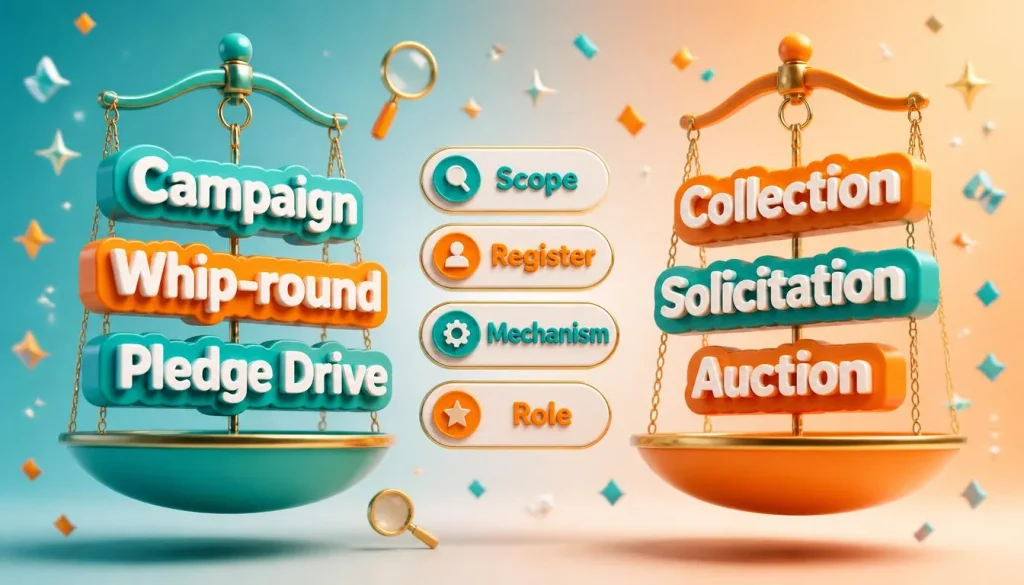
Nothing replaces fundraiser in every sentence, so choose which meaning shift you want:
- Scope shift: campaign (months) vs. collection (minutes).
- Register shift: whip-round (casual) vs. solicitation (legal).
- Mechanism shift: pledge drive (promises) vs. auction (bids) vs. crowdfunding (many small online gifts).
- Role shift: development officer (professional) vs. volunteer organizer.
Common Mistakes
| Mistake | Better | Why |
| “We attended a donation” | “We attended a fundraiser” | A donation is the gift, not the event |
| Calling a person a “gala” | Fundraiser or development officer | A gala is an event |
| Using “philanthropist” for someone who asks for money | Fundraiser | Philanthropists give |
| “Solicitor” for a UK fundraiser | Fundraiser or canvasser | Solicitor means lawyer in the UK |
| “Whip-round” in a US business email | Collection | Whip-round is mainly British |
| Calling every event a “gala” | Benefit or charity event | Gala implies formality and high prices |
Antonyms of Fundraiser
Fundraiser has no true antonym, so these show the opposite money direction.
| Sense | Opposite words | Why |
| Person | donor, benefactor, philanthropist, grant-maker | They give money rather than raise it |
| Person | beneficiary, recipient | They receive what is raised |
| Event/effort | disbursement, distribution, giveaway | Money goes out instead of coming in |
American vs. British English
- Both use fundraiser; “fund-raiser” is the less common spelling.
- Whip-round, fete, jumble sale, flag day, chugger are British.
- Pledge drive, telethon, bake sale, rummage sale, food drive feel American (Oxford also notes that telethons work in both countries).
- Solicitor is a false friend: a lawyer in the UK, a person or activity of soliciting in the US.
Fundraiser Words in South Asian English
English in South Asia mixes British, American and local usage. Common patterns include charity dinner, donation drive, relief appeal, telethon for disaster relief, and iftar-style charity events during Ramadan. If you write for this audience, use drive or appeal for collection efforts, and avoid words like “whip-round” that readers may not recognize. Always name the cause plainly.
Real-World Collocations and Phrases
Common combinations
- Verb + fundraiser: organize, host, hold, attend, launch a fundraiser
- Adjective + fundraiser: annual, online, virtual, school, political, charity
- Fundraiser + preposition: fundraiser for a cause, at a venue, on behalf of a family
Idioms and set phrases
- Pass the hat: collect money informally
- Rattle the tin: collect coins in public (British)
- Dig deep: give generously
- Chip in: each give a small amount
- In lieu of gifts: donations requested instead of presents
- Proceeds go to: standard phrase on fundraising materials
Modern Fundraising Vocabulary (Bonus)
Newer formats need newer words: peer-to-peer fundraising, giving day, matching gift, recurring donation, donor-advised fund, charity stream, virtual fundraiser, donation link. Use them when writing for today’s audience, because older synonym lists rarely include them.
Which Word to Use: 5-Second Test
- Person? → development officer or fundraising professional.
- One dated occasion? → fundraiser, benefit or gala.
- An ongoing effort? → campaign, drive or appeal.
- Online? → crowdfunding campaign, giving day or charity stream.
- Legal or compliance text? → solicitation.
Practice Exercises
Fill in the blanks
(benefit, gala, appeal, pledge drive, development officer, whip-round)
- The museum’s annual ______ included a five-course dinner and an auction.
- She works as a ______ at the university, meeting alumni about planned gifts.
- The station’s ______ kept public broadcasting on the air.
- The charity launched an urgent ______ after the flood.
- We did a quick ______ at work for Maya’s farewell gift.
- The theater staged a ______ concert for the children’s hospital.
Match the words
- Canvasser: A. Formal fundraising evening
- Gala: B. Person who asks door-to-door
- Drive: C. Direct request for donations
- Appeal: D. Time-limited collection effort
Quick quiz
- Which word means someone who gives money? (a) fundraiser (b) philanthropist (c) canvasser
- Which word is most formal? (a) whip-round (b) benefit (c) gala
- Which is a false friend in British English? (a) solicitor (b) patron (c) sponsor
- Which is best for an online page collecting small gifts? (a) capital campaign (b) crowdfunding campaign (c) gala
Answer key
Fill in: 1. gala, 2. development officer, 3. pledge drive, 4. appeal, 5. whip-round, 6. benefit Match: 1-B, 2-A, 3-D, 4-C Quiz: 1-b, 2-c, 3-a, 4-b
FAQ
What do you call an event to raise money?
A fundraiser, benefit, charity event or gala, depending on formality.
What is another word for a person who raises money?
Development officer, fundraising professional, canvasser or campaigner.
What is another word for raise money?
Fundraise, solicit, collect, canvass, appeal for funds, or run a drive.
What is the difference between a fundraiser and a benefit?
A benefit is usually a charity event with an entertainment feel. A fundraiser is broader and can also mean the person or an online page.
Is “fundraiser” one word or two?
One word is standard. “Fund-raiser” appears less often.
What is a fancy word for fundraiser?
“Gala” for a formal event, “development officer” for a professional.
What is a catchy name for a fundraiser?
Combine the cause with a vivid hook: “Paws for a Cause,” “Every Mile for Mia,” “Raise the Roof for Riverdale.”
Conclusion
The right synonym for fundraiser depends on what you are naming. A gala signals elegance, a benefit signals community, a drive signals urgency, a campaign signals long-term strategy, and a development officer signals professionalism.
Decide whether you mean a person, an event or an effort, then match the formality to your audience, and your wording will land the way you intend.

About Sajjad Ahmed
Sajjad Ahmed is the author behind Guest Paster, where he writes about English vocabulary, synonyms, word meanings, and practical word usage.
His content is designed to help readers understand the differences between similar words, discover suitable alternatives, and use English vocabulary more effectively in everyday writing and communication.
Before publishing, Sajjad focuses on presenting word choices in a clear and easy-to-understand format, with relevant meanings, context, and examples where helpful.
Through Guest Paster, his goal is to make vocabulary learning simpler and provide useful language resources for students, writers, English learners, and anyone looking to expand their vocabulary.
Areas of Focus: English Vocabulary • Synonyms • Word Meanings • Word Usage • Language Learning
Author: Sajjad Ahmed
Website: Guest Paster