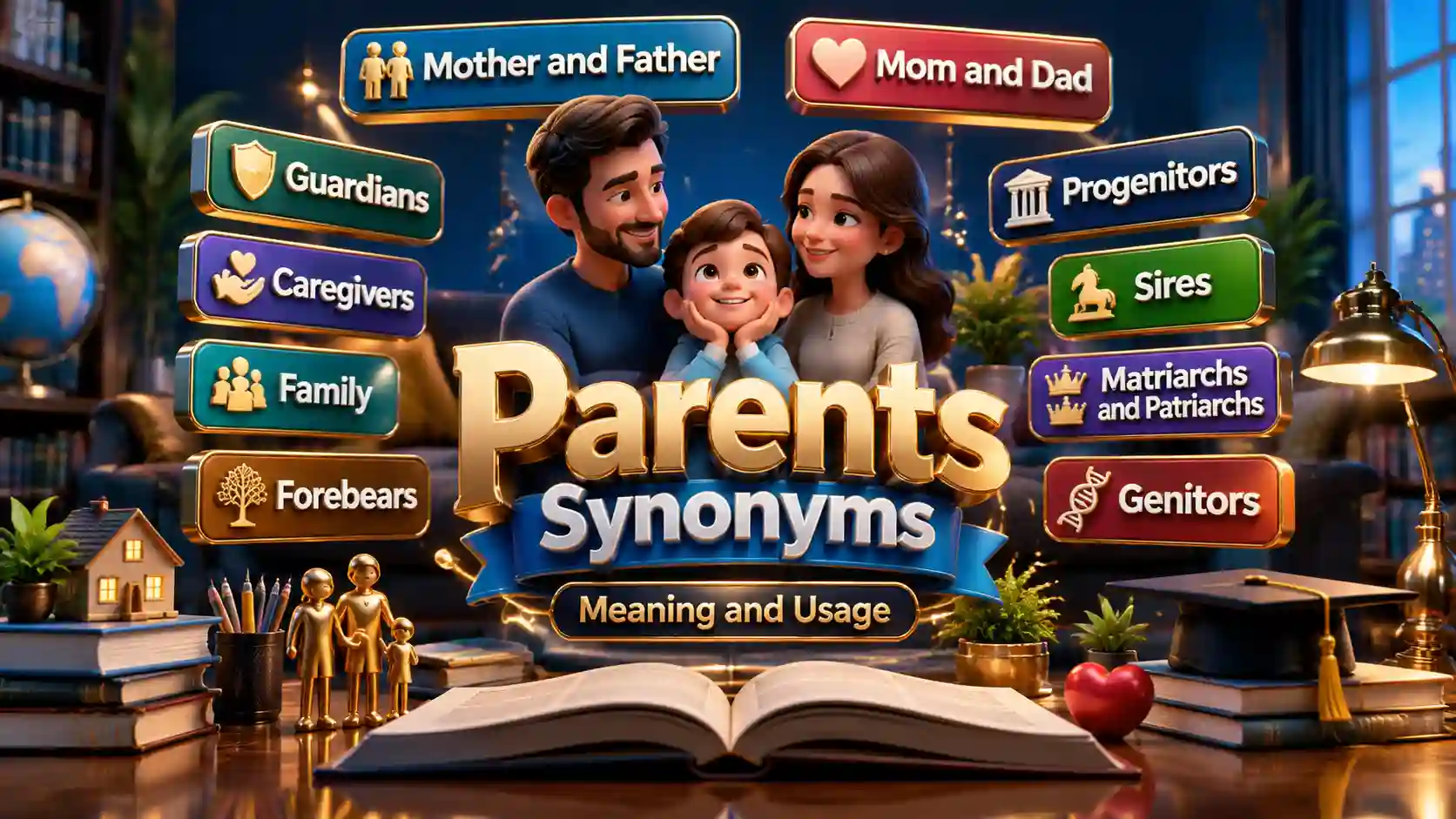
What Are Synonyms for Parents?
Parents are the people who have a child and are responsible for their care, support, guidance and upbringing. The word parents is a plural noun commonly used in everyday conversations, education, family discussions and formal writing.
While parents is the most common and neutral term, different alternatives may highlight specific meanings such as biological connection, emotional support, family roles or caregiving responsibilities. Choosing the right synonym depends on the situation, tone and purpose.
For example, guardians may be more suitable in legal contexts, while mom and dad expresses affection and familiarity. Understanding these alternatives helps writers and speakers communicate family relationships more accurately.
Best Synonyms for Parents
| # | Synonym | Meaning Difference | Best Used For | Formality |
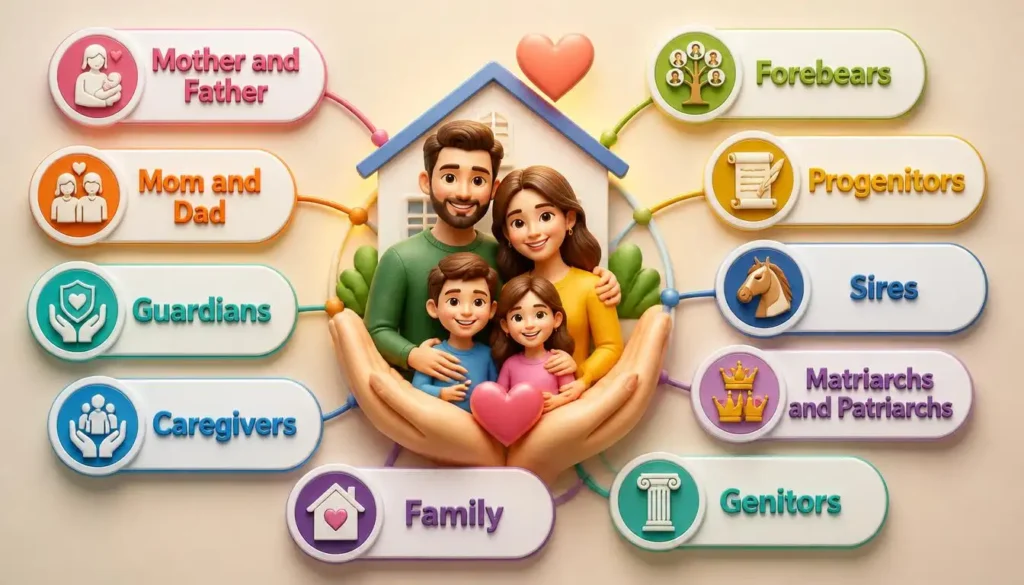
| 1 | Mother and Father | Specifically refers to female and male parents | Biological family discussions | Neutral |
| 2 | Mom and Dad | Affectionate and personal names for parents | Everyday conversation | Informal |
| 3 | Guardians | People legally responsible for a child’s care | Legal and official contexts | Formal |
| 4 | Caregivers | People who provide care and support | General caregiving situations | Neutral |
| 5 | Family | Broader term including parents and relatives | Emotional or social contexts | Neutral |
| 6 | Forebears | Refers to ancestors or earlier generations | Historical writing | Formal |
| 7 | Progenitors | People from whom someone descends | Academic or biological contexts | Formal |
| 8 | Sires | Biological fathers, especially in breeding or historical contexts | Specific biological contexts | Formal/Literary |
| 9 | Matriarchs and Patriarchs | Female and male heads of families | Family leadership discussions | Formal |
| 10 | Genitors | Biological parents who produce offspring | Scientific or technical writing | Formal |
Quick Facts About Parents
| Detail | Information |
| Part of Speech | Noun (plural) |
| Simple Meaning | People who have a child and provide care, support, and guidance |
| Singular Form | Parent |
| Word Forms | Parent, parental, parenthood, parenting |
| Formality | Neutral |
| Closest Synonym | Mother and father |
| Best Used For | General references to a child’s caregivers or biological family |
| Common Usage | Family conversations, schools, medical forms, social discussions |
What Is the Closest Synonym for Parents?

The closest synonym for parents is mother and father because it directly describes the two people who usually create and raise a child. However, there is an important difference.
Parents is a broader term because it can include biological parents, adoptive parents, step-parents, or anyone recognized as a child’s parent.
Mother and father specifically identifies gender roles and may not apply to every family structure.
Examples:
- My parents supported me throughout my education.
(General term covering all types of parents) - My mother and father encouraged me to study hard.
(Specifically identifies two parental roles)
In most situations, parents remains the safest and most inclusive choice. Use mother and father when you want to describe specific family roles.
Can These Synonyms Be Used Interchangeably?
The synonyms for parents cannot always be used interchangeably because each word carries a slightly different meaning. The correct choice depends on whether you are talking about biology, legal responsibility, emotional connection, or family relationships.
Usually Interchangeable
Some alternatives work well in general situations:
- Parents → Mother and father
Both describe people who raise or have a child, but mother and father is more specific. - Parents → Caregivers
This works when focusing on the act of providing care rather than biological connection.
Sometimes Interchangeable
Some words overlap only in certain contexts:
- Parents → Guardians
A guardian may act like a parent but does not necessarily have a biological relationship. - Parents → Family
Family may include parents, siblings, grandparents, and other relatives, so it is broader.
Rarely Interchangeable
Some terms describe a specific relationship:
- Parents → Progenitors
Progenitors focus on biological origin rather than emotional parenting. - Parents → Forebears
Forebears usually means ancestors, not current parents.
Not Interchangeable
Some words should not replace parents in normal conversation:
- Sires only refers to fathers or male biological creators.
- Matriarchs and patriarchs describe family leaders, not simply parents.
- Genitors is a technical biological term and may sound unnatural in everyday writing.
The best synonym depends on the message you want to express. For emotional writing use terms like mom and dad or family. And For legal documents, guardians may be more accurate. For scientific discussions, genitors or progenitors may be appropriate.
Detailed Synonym Meanings and Examples
1. Mother and Father
Meaning:
Mother and father are the two traditional parental roles responsible for bringing up a child.
Difference from parents:
This phrase is more specific because it identifies the individual roles instead of using the general term.
Best used for:
Family descriptions, personal stories, and discussions about biological relationships.
Formality: Neutral
Examples:
- My mother and father taught me the importance of honesty.
- The child was raised by a loving mother and father.
2. Mom and Dad
Meaning:
Mom and dad are affectionate, informal names for parents.
Difference from parents:
These words show emotional closeness and personal connection rather than simply describing a family role.
Best used for:
Casual conversations, childhood memories, and emotional writing.
Formality: Informal
Examples:
- I called my mom and dad after receiving my first job offer.
- Every child needs love and support from their mom and dad.
3. Guardians
Meaning:
Guardians are people legally or officially responsible for caring for a child.
Difference from parents:
A guardian may not be the child’s biological parent but has responsibility for their welfare.
Best used for:
Legal documents, adoption, custody cases, and official communication.
Formality: Formal
Examples:
- The school requires permission from a parent or guardian.
- Her grandparents became her legal guardians.
4. Caregivers
Meaning:
Caregivers are people who provide physical, emotional, or practical support.
Difference from parents:
The word focuses on caregiving duties rather than family connection.
Best used for:
Healthcare, social services, and general discussions about child support.
Formality: Neutral
Examples:
- Children need caring caregivers during their early years.
- Parents are often a child’s first and most important caregivers.
5. Family
Meaning:
Family refers to people connected through blood, marriage, adoption, or strong emotional bonds.
Difference from parents:
Family is broader and may include grandparents, siblings, cousins, and other relatives.
Best used for:
Emotional writing and social discussions.
Formality: Neutral
Examples:
- My family always supports my dreams.
- A strong family creates a positive environment for children.
6. Progenitors
Meaning:
Progenitors are ancestors or biological sources from whom someone originates.
Difference from parents:
The term emphasizes biological origin rather than raising or caring for children.
Best used for:
Academic, historical, and scientific writing.
Formality: Formal
Examples:
- Scientists studied the genetic history of human progenitors.
- The species developed from ancient progenitors.
7. Genitors
Meaning:
Genitors are biological parents who produce offspring.
Difference from parents:
This word focuses only on biological creation and does not include emotional parenting.
Best used for:
Scientific or technical contexts.
Formality: Formal
Examples:
- Researchers identified the genetic contribution of the organism’s genitors.
- Biological genitors may not always raise their children.
8. Forebears
Meaning:
Forebears are ancestors from previous generations.
Difference from parents:
Forebears usually refer to earlier family generations, not current parents.
Best used for:
History, genealogy, and heritage writing.
Formality: Formal/Literary
Examples:
- She researched the traditions of her forebears.
- His forebears came from a small European village.
9. Sires
Meaning:
Sires are male parents, especially fathers in biological or animal breeding contexts.
Difference from parents:
A sire refers only to the father or male biological contributor.
Best used for:
Animal breeding, historical texts, and biological discussions.
Formality: Formal
Examples:
- The horse’s sire was a championship winner.
- The study examined the role of male sires in reproduction.
10. Matriarchs
Meaning:
Matriarchs are women who lead or strongly influence a family.
Difference from parents:
A matriarch may be a mother but the word emphasizes leadership and authority.
Best used for:
Family history and cultural discussions.
Formality: Neutral/Formal
Examples:
- The family’s matriarch preserved important traditions.
- Her grandmother became the respected matriarch of the family.
11. Patriarchs
Meaning:
Patriarchs are men who lead or represent a family.
Difference from parents:
The word highlights family authority rather than the parenting role.
Best used for:
Historical, cultural, and family leadership contexts.
Formality: Neutral/Formal
Examples:
- The family patriarch guided younger generations.
- The village respected its older people patriarchs.
12. Parent Figures
Meaning:
Parent figures are people who provide guidance, care, and emotional support similar to parents.
Difference from parents:
A parent figure may not be a biological or legal parent but plays an important supportive role.
Best used for:
Personal stories, psychology, and discussions about emotional support.
Formality: Neutral
Examples:
- Her teacher became a strong parent figure during difficult years.
- Many children find support from positive parent figures.
13. Foster Parents
Meaning:
Foster parents are people who temporarily care for children who cannot live with their biological families.
Difference from parents:
They provide parental care but usually do not have a permanent biological relationship.
Best used for:
Adoption, child welfare, and social services.
Formality: Neutral/Formal
Examples:
- The child was welcomed by loving foster parents.
- Many foster parents provide safe homes for children.
14. Adoptive Parents
Meaning:
Adoptive parents are people who legally become parents through adoption.
Difference from parents:
The term specifically explains that the relationship was created through adoption rather than birth.
Best used for:
Family discussions, adoption records, and personal writing.
Formality: Neutral
Examples:
- Her adoptive parents supported all her goals.
- Adoptive parents often create strong emotional bonds with children.
15. Step-Parents
Meaning:
Step-parents are the spouses of a child’s biological parent who help raise the child.
Difference from parents:
They are connected through marriage or partnership rather than biological relation.
Best used for:
Blended family discussions.
Formality: Neutral
Examples:
- His step-parent helped him adjust to a new family.
- Many children develop close relationships with their step-parents.
16. Ancestors
Meaning:
Ancestors are people from whom a person is descended through previous generations.
Difference from parents:
Ancestors include parents, grandparents, and earlier generations, making the term much broader.
Best used for:
History, genealogy, and heritage discussions.
Formality: Neutral/Formal
Examples:
- She learned about her ancestors through family records.
- Their traditions came from their ancestors.
17. Progenitors
Meaning:
Progenitors are original creators, founders, or biological sources of a person or group.
Difference from parents:
The word emphasizes origin rather than the relationship between adults and children.
Best used for:
Science, history, and academic writing.
Formality: Formal
Examples:
- The researchers identified the species’ early progenitors.
- Ancient progenitors influenced later generations.
18. Lineage Bearers
Meaning:
Lineage bearers are people who continue or pass on a family line.
Difference from parents:
This term focuses on ancestry and continuation of family heritage.
Best used for:
Historical or cultural writing.
Formality: Formal
Examples:
- The royal family honored its lineage bearers.
- Each generation becomes a lineage bearer of cultural traditions.
19. Nurturers
Meaning:
Nurturers are people who provide care, encouragement, and emotional growth.
Difference from parents:
The focus is on emotional development rather than biological connection.
Best used for:
Educational, psychological, and inspirational writing.
Formality: Neutral
Examples:
- Great teachers can become powerful nurturers.
- Parents are often children’s first nurturers.
20. Providers
Meaning:
Providers are people who supply necessities such as food, shelter, education, or financial support.
Difference from parents:
The word focuses on responsibility and support rather than family identity.
Best used for:
Discussions about family responsibilities.
Formality: Neutral
Examples:
- Many parents act as primary providers for their children.
- The family’s main provider worked hard to support everyone.
21. Family Heads
Meaning:
Family heads are people who manage or represent a household.
Difference from parents:
A family head may not necessarily be a parent.
Best used for:
Social studies, cultural discussions, and official contexts.
Formality: Formal
Examples:
- The family head made important decisions.
- Community leaders met with each household’s family heads.
22. Household Leaders
Meaning:
Household leaders are people responsible for managing a family home.
Difference from parents:
This term highlights authority and responsibility, not necessarily parenting.
Best used for:
Reports, surveys, and social research.
Formality: Formal
Examples:
- The survey collected information from household leaders.
- Household leaders often manage family finances.
23. Caretakers
Meaning:
Caretakers are people who look after someone’s needs.
Difference from parents:
Caretakers may provide practical care without having a parental relationship.
Best used for:
General caregiving situations.
Formality: Neutral
Examples:
- Good caretakers provide safety and attention.
24. Support System
Meaning:
A support system is a group of people who provide emotional or practical help.
Difference from parents:
It includes friends, relatives, and communities, not only parents.
Best used for:
Personal development and social discussions.
Formality: Neutral
Examples:
- Her family became her strongest support system.
- Children need a reliable support system while growing up.
25. Family Unit
Meaning:
A family unit is a group of people living together or connected as a family.
Difference from parents:
It describes the entire family structure rather than only parents.
Best used for:
Social science, government, and formal writing.
Formality: Formal
Examples:
- The study examined changes in the modern family unit.
- A healthy family unit supports children’s development.
Best Alternatives for Parents by Context
Everyday Conversation
Best choices:
- Mom and dad
- Mother and father
- Family
- Caregivers
Examples:
- “I am visiting my parents this weekend.”
- “I am visiting my mom and dad this weekend.”
Mom and dad sounds warmer and more personal in casual speech.
Formal Writing
Best choices:
- Guardians
- Caregivers
- Family unit
- Household leaders
Example:
- “The child’s legal guardians completed the required documents.”
Academic Writing
Best choices:
- Progenitors
- Genitors
- Caregivers
- Family unit
Example:
- “Researchers examined the influence of parental caregivers on childhood development.”
Business Communication
Best choices:
- Parents
- Guardians
- Family members
Avoid overly emotional terms like mom and dad.
Example:
- “The program provides resources for parents and guardians.”
Creative Writing
Best choices:
- Mom and dad
- Parent figures
- Nurturers
- Family
Example:
- “Her grandmother became the parent figure she needed.”
Social Media
Best choices:
- Mom and dad
- Family
- Loved ones
- My people
Example:
- “Forever grateful for my family and the love they give me.”
Which Synonym Should I Choose?
Choosing the right alternative for parents depends on the exact meaning you want to communicate.
Use parents when:
You need a general and inclusive word.
Example:
- “Parents play an important role in childhood development.”
Use mom and dad when:
You want warmth, affection, or personal emotion.
Example:
- “My mom and dad always believed in me.”
Use guardians when:
You are discussing legal responsibility.
Example:
- “A guardian must sign the school form.”
Use caregivers when:
You want to focus on providing care.
Example:
- “Children need supportive caregivers.”
Use genitors or progenitors when:
You are writing scientifically about biological origins.
Example:
- “The study analyzed genetic information from biological progenitors.”
The best synonym is not always the closest in meaning. It is the word that matches your purpose, audience, and tone.
Exact and Near Synonyms: Difference
Synonyms are often similar, but they are rarely identical. Two words may share the same basic meaning while carrying different emotional, formal, or contextual meanings.
For parents, some words are exact in limited situations, while others are only related.
| Type | Examples | Difference |
| Exact Synonyms (Limited) | Mother and father | Directly refers to parental roles |
| Near Synonyms | Guardians, caregivers | Focus on responsibility rather than biological connection |
| Related Terms | Family, ancestors | Describe a wider relationship group |
For example:
- Parents and guardians may overlap when a guardian raises a child, but not every guardian is a biological parent.
- Parents and family are related, but family can include many other relatives.
- Parents and ancestors are connected, but ancestors usually refer to previous generations.
The best word depends on whether you want to emphasize biology, care, legal responsibility, emotional connection, or family identity.
Words Commonly Confused with Parents
Some words are related to parents but are not true synonyms.
Family
Why it is confused:
Parents are part of a family.
Why it is different:
Family includes siblings, grandparents, cousins, and other relatives.
Example:
- Correct: “My family visited me.”
- More specific: “My parents visited me.”
Ancestors
Why it is confused:
Parents are part of a person’s ancestry.
Why it is different:
Ancestors usually refer to earlier generations.
Example:
- “My ancestors came from another country.”
- “My parents live nearby.”
Guardians
Why it is confused:
Guardians may raise children.
Why it is different:
A guardian is defined by responsibility, often legally, not necessarily by birth.
Example:
- “Her aunt became her legal guardian.”
Relatives
Why it is confused:
Parents are relatives.
Why it is different:
Relatives include many family members beyond parents.
Example:
- “My relatives attended the wedding.”
- “My parents attended the wedding.”
Caretakers
Why it is confused:
Parents often take care of children.
Why it is different:
A caretaker provides care but may not have a family relationship.
Antonyms of Parents
There is no perfect opposite of parents, but some words represent the absence of parental care or relationships.
| Antonym / Opposite Idea | Meaning |
| Orphans | Children without living parents or without parental care |
| Dependents | People who rely on others rather than providing care |
| Children | The younger generation opposite to the parental role |
| Offspring | The children produced by parents |
| Abandoned children | Children left without parental support |
The closest relational opposite is usually children or offspring, because parents and children represent opposite roles within a family relationship.
Common Phrases with Parents
Parents and Children
Used when discussing the relationship between generations.
Example:
- “Strong communication between parents and children builds trust.”
First-Time Parents
Refers to people who have recently had their first child.
Example:
- “First-time parents often seek advice about childcare.”
Working Parents
Refers to parents who balance employment and raising children.
Example:
- “Working parents need flexible schedules.”
Single Parents
Refers to parents raising children without a partner.
Example:
- “Single parents often manage many responsibilities.”
Expecting Parents
Refers to people preparing for the birth of a child.
Example:
- “The course helps expecting parents prepare for childcare.”
Proud Parents
Used when parents feel happiness about their child’s achievements.
Example:
- “The proud parents celebrated their daughter’s graduation.”
New Parents
Refers to people who recently became parents.
Example:
- “New parents often experience many changes in daily life.”
Frequently Asked Questions
1. What is the closest synonym for parents?
The closest synonym for parents is mother and father because it directly identifies the people who have and raise a child. However, parents is broader because it can include adoptive parents, step-parents, and other recognized parental roles.
2. Can parents and guardians be used interchangeably?
Sometimes. A guardian may perform the same responsibilities as a parent, but the words are not identical. Guardian focuses on legal responsibility, while parent focuses on family relationship.
3. What is the definition of parents?
Parents are people who have a child and provide care, protection, guidance, and support. The term may refer to biological, adoptive, or recognized parental figures.
4. What is a more formal word for parents?
Formal alternatives include guardians, caregivers, progenitors, and genitors. The best choice depends on the context. For legal writing, guardians is usually more appropriate.
5. What can I use instead of parents in a sentence?
You can use alternatives such as mother and father, mom and dad, guardians, caregivers, or family, depending on the meaning.
Example:
- “My parents supported me.”
- “My guardians supported me.”
(The second sentence changes the meaning slightly by focusing on responsibility.)
6. What is the opposite of parents?
The opposite role of parents is usually children or offspring because parents provide care while children receive care. Words like orphans describe the absence of parental care rather than a direct opposite.
Conclusion
Choosing the right synonym for parents improves clarity and helps communicate the exact relationship you mean. While parents remains the most natural and widely accepted term, alternatives like mother and father, mom and dad, guardians, and caregivers highlight different aspects of family relationships.
Use emotional terms when writing personal messages, formal terms in legal or academic contexts, and technical terms only when discussing biology or research. Understanding these differences allows you to select words that match your audience, purpose, and tone.

About Sajjad Ahmed
Sajjad Ahmed is the author behind Guest Paster, where he writes about English vocabulary, synonyms, word meanings, and practical word usage.
His content is designed to help readers understand the differences between similar words, discover suitable alternatives, and use English vocabulary more effectively in everyday writing and communication.
Before publishing, Sajjad focuses on presenting word choices in a clear and easy-to-understand format, with relevant meanings, context, and examples where helpful.
Through Guest Paster, his goal is to make vocabulary learning simpler and provide useful language resources for students, writers, English learners, and anyone looking to expand their vocabulary.
Areas of Focus: English Vocabulary • Synonyms • Word Meanings • Word Usage • Language Learning
Author: Sajjad Ahmed
Website: Guest Paster