
Harsh is an adjective for something unpleasantly severe, rough, or unkind. People use it for weather, criticism, punishment, sound, and light. The best all-purpose synonym is severe, especially for rules, penalties, and conditions.
For criticism choose scathing or stern, for weather inclement, for a voice or noise grating or strident, and for fabric coarse. No single word covers every sense. Decide first what is harsh, then pick the synonym that fits: severity, cruelty, roughness, or sensory irritation.
Another Word For Harsh
| # | Synonym | Meaning Difference |
| 1 | Severe | Serious and intense, less emotional |
| 2 | Stern | Strict and unsmiling in manner |
| 3 | Cruel | Harsh with intent to cause pain |
| 4 | Brutal | Extremely harsh, almost violent |
| 5 | Bitter | Painfully sharp, often resentful |
| 6 | Scathing | Sharp, scornful criticism |
| 7 | Unforgiving | Allows no room for error |
| 8 | Inclement | Formal; weather only |
| 9 | Grating | Irritating to hear |
| 10 | Coarse | Rough in texture |
Quick Facts About Harsh
| Fact | Detail |
| Part of speech | Adjective |
| Simple meaning | Unpleasantly rough, severe, or strong |
| Pronunciation | Pronunciation | /hɑːrʃ/ (US), /hɑːʃ/ (UK) ([Merriam-Webster] |
| Syllables | 1 |
| Word forms | harsher, harshest, harshly, harshness |
| Formality | Neutral |
| Closest synonym | Severe |
| Best used for | Treatment, words, conditions, senses |
What Is the Closest Synonym for Harsh?
Severe is the closest general synonym. It means very serious or intense, and it describes things that are hard to endure or strictly judged. Dictionary.com lists severe, stern, and cruel among the senses of harsh. You can say harsh punishment or severe punishment, and harsh conditions or severe conditions, with almost no change in meaning.
Severe reads as factual, while harsh often carries a judgment that something was worse than necessary. “Severe weather” sounds like a forecast. “Harsh weather” sounds like something people had to live through.
Word Origin and Etymology
Etymonline traces harsh to Middle English harske (“rough, coarse, sour”), recorded around 1300. It is probably a northern word of Scandinavian origin, like Danish and Norwegian harsk (“rancid”), and is related to Middle Low German harsch (“rough”) and German harst (“rake”). It may go back to a root meaning “to scrape or comb.” The texture sense, originally “hairy,” is dated to the 1530s. The sense “offensive to the feelings” appears in the 1570s, and “disagreeable, rude” in the 1610s.
This history explains why one word can describe both a scratchy fabric and a cruel remark. Physical roughness came first, and the figurative meanings followed.
Can These Synonyms Be Used Interchangeably?
- Usually: severe, brutal, and unforgiving replace harsh easily when it describes conditions, penalties, or difficulty.
- Sometimes: stern, cruel, ruthless, and bitter work only when their extra shade of meaning (authority, intent, mercilessness, resentment) fits the situation.
- Rarely: draconian, inclement, and punishing fit a narrow range of nouns (laws, weather, schedules).
- No: grating, strident, shrill, rasping, glaring, and coarse describe the senses. They cannot describe a judge, a rule, or a winter.
Harsh Has Several Meanings: Separate Synonym Sets
A: severity, strictness, or cruelty (treatment, rules, criticism)
severe, stern, cruel, brutal, ruthless, merciless, caustic, scathing, draconian, abrasive
B: difficult conditions, climate, and weather
severe, brutal, unforgiving, punishing, bitter, inclement, rough
C: harsh reality or facts
bitter, brutal, grim, unforgiving
D: unpleasant to the senses (sound, light, texture)
grating, strident, shrill, rasping, glaring, coarse, rough
Adverb: harshly
severely, sternly, cruelly, brutally, bitterly, strictly, roughly
Detailed Synonym Meanings and Examples
CEFR levels and frequency ratings are editorial estimates for learners, not corpus measurements.
1. Severe
Meaning: Defined in full in the closest-synonym section above.
Difference from Harsh: More objective and less emotionally loaded.
Best Used For: Penalties, criticism, weather, shortages, consequences.
Formality: Neutral
CEFR Level: B2
Frequency: Common
Examples:
- The regulator imposed severe penalties for repeated violations. — business
- Forecasters expect severe storms overnight. — weather
When NOT to Use It: Skip it for textures and sounds, where it sounds odd.
2. Stern
Meaning: Serious and strict in manner, with no sign of softness.
Difference from Harsh: Suggests authority, not necessarily unfairness or cruelty.
Best Used For: Warnings, looks, teachers, managers.
Formality: Neutral
CEFR Level: C1
Frequency: Uncommon
Examples:
- The coach gave the team a stern warning after the missed practice. — sports
- Her supervisor took a stern line on safety violations. — workplace
When NOT to Use It: Don’t use it for weather, light, or sound.
3. Cruel
Meaning: Deliberately causing pain or showing no pity.
Difference from Harsh: Adds intent to hurt, which harsh does not require.
Best Used For: Treatment, jokes, punishments.
Formality: Neutral
CEFR Level: B2
Frequency: Common
Examples:
- The inspector reported cruel treatment of the animals. — legal
- Mocking his mistake in front of the class felt cruel. — school
When NOT to Use It: Don’t use it when nobody meant any harm, as with weather.
4. Brutal
Meaning: Savagely or shockingly severe.
Difference from Harsh: Stronger and more dramatic.
Best Used For: Winters, schedules, honesty, competition.
Formality: Neutral
CEFR Level: C1
Frequency: Common
Examples:
- The rescue team worked through brutal conditions on the mountain. — emergency response
- The review gave a brutal verdict on the failed launch. — business
When NOT to Use It: It overstates mild unpleasantness.
5. Ruthless
Meaning: Pursuing a goal with no pity for anyone affected.
Difference from Harsh: Points to a deliberate lack of compassion in a person or system.
Best Used For: Leaders, competitors, cost-cutting, decisions.
Formality: Neutral
CEFR Level: C1
Frequency: Common
Examples:
- Staff criticized the ruthless cost-cutting plan. — business
- The novel’s ruler silences every rival. He is ruthless. — literature
When NOT to Use It: It cannot describe weather, texture, or sound.
6. Merciless
Meaning: Giving no relief or forgiveness.
Difference from Harsh: Stresses that mercy was possible but withheld.
Best Used For: Critics, attacks, pressure, treatment.
Formality: Neutral
CEFR Level: C2
Frequency: Uncommon
Examples:
- Reviewers were merciless about the show’s technical problems. — arts
- Prisoners endured merciless treatment from their captors. — history
When NOT to Use It: Avoid it for neutral descriptions of difficulty.
7. Bitter
Meaning: Sharply painful, whether in cold or in feeling.
Difference from Harsh: Often adds resentment or lasting disappointment.
Best Used For: Wind, cold, disputes, disappointments.
Formality: Neutral
CEFR Level: B2
Frequency: Common
Examples:
- A bitter wind cut across the platform at 6 a.m. — commuting
- The two firms have a bitter history in court. — business
When NOT to Use It: Don’t use it for rules, light, or sound.
8. Grim
Meaning: Gloomy and unpleasant to face.
Difference from Harsh: Carries a mood of dread more than severity.
Best Used For: Facts, news, outlooks, determination.
Formality: Neutral
CEFR Level: C1
Frequency: Common
Examples:
- The report painted a grim reality for small farms. — news
- Doctors gave grim news to the family. — everyday
When NOT to Use It: Don’t use it for fabric, sound, or light.
9. Caustic
Meaning: Cutting in a way that burns or wounds.
Difference from Harsh: Specific to bitter, biting remarks (or corrosive chemicals).
Best Used For: Wit, comments, columns.
Formality: Formal
CEFR Level: C2
Frequency: Uncommon
Examples:
- The columnist wrote a caustic critique of the proposal. — journalism
- His caustic remark ended the friendly discussion. — conversation
When NOT to Use It: Don’t use it for weather or texture.
10. Scathing
Meaning: Fiercely critical and scornful.
Difference from Harsh: Limited to criticism, with an edge of contempt.
Best Used For: Reviews, audits, verdicts.
Formality: Neutral
CEFR Level: C2
Frequency: Uncommon
Examples:
- The critic’s scathing review closed the play within a week. — arts
- The audit delivered a scathing verdict on the agency’s spending. — government
When NOT to Use It: Don’t use it for conditions or senses.
11. Draconian
Meaning: Excessively severe, usually about laws.
Difference from Harsh: Implies the punishment is out of proportion.
Best Used For: Laws, policies, restrictions.
Formality: Formal
CEFR Level: C2
Frequency: Uncommon
Examples:
- Staff called the new attendance policy draconian. — workplace
- Critics said the draconian penalties were unfair to first-time offenders. — law
When NOT to Use It: Don’t use it for people or weather.
12. Unforgiving
Meaning: Leaving no room for mistakes.
Difference from Harsh: Focuses on the cost of error.
Best Used For: Terrain, deserts, industries, deadlines.
Formality: Neutral
CEFR Level: C2
Frequency: Uncommon
Examples:
- The unforgiving desert has no water for forty miles. — travel
- Trading is an unforgiving business for beginners. — finance
When NOT to Use It: Avoid it for a single remark or a noise.
13. Punishing
Meaning: Exhausting to endure over time.
Difference from Harsh: Stresses wear and fatigue.
Best Used For: Schedules, climbs, training, heat.
Formality: Neutral
CEFR Level: C2
Frequency: Uncommon
Examples:
- Nurses worked a punishing schedule of six night shifts. — healthcare
- The marathon includes a punishing climb at mile twenty. — sports
When NOT to Use It: Avoid it for words or tone.
14. Inclement
Meaning: Describes stormy, cold, or otherwise unpleasant weather.
Difference from Harsh: Narrower and more formal; weather only.
Best Used For: Notices, forecasts, event announcements.
Formality: Formal
CEFR Level: C2
Frequency: Rare
Examples:
- In case of inclement weather, the ceremony moves indoors. — event notice
- Flights may be delayed during inclement conditions. — travel
When NOT to Use It: Don’t use it for criticism, rules, or people.
15. Rough
Meaning: Not smooth, calm, or gentle.
Difference from Harsh: Casual and flexible, usually weaker in tone.
Best Used For: Handling, seas, bad days, surfaces.
Formality: Informal
CEFR Level: B1
Frequency: Very Common
Examples:
- The movers were rough with the piano. — everyday
- Fishing boats stayed ashore because of rough seas. — weather
When NOT to Use It: Skip it in formal reports, where severe is clearer.
16. Coarse
Meaning: Rough in texture or crude in manner.
Difference from Harsh: Mostly describes material quality.
Best Used For: Fabric, sand, hair, skin.
Formality: Neutral
CEFR Level: C1
Frequency: Uncommon
Examples:
- The coarse wool blanket scratched her arms. — home
- Workers spread coarse sand over the icy path. — maintenance
When NOT to Use It: Don’t use it for weather or criticism.
17. Abrasive
Meaning: Wearing others down through a blunt, irritating manner.
Difference from Harsh: Describes friction in personality or style.
Best Used For: Managers, communication styles, cleaners.
Formality: Neutral
CEFR Level: C2
Frequency: Uncommon
Examples:
- His abrasive style made colleagues avoid his meetings. — workplace
- She softened her abrasive tone after the feedback session. — workplace
When NOT to Use It: Don’t use it for punishments or weather.
18. Grating
Meaning: Irritating to hear.
Difference from Harsh: Focuses on annoyance, not severity.
Best Used For: Voices, noises, laughs.
Formality: Neutral
CEFR Level: C2
Frequency: Uncommon
Examples:
- The grating buzz of the alarm woke the whole floor. — home
- His grating laugh carried across the café. — everyday
When NOT to Use It: Don’t use it for conditions or rules.
19. Strident
Meaning: Loud, forceful, and unpleasantly sharp.
Difference from Harsh: Adds insistence and volume.
Best Used For: Voices, debates, demands.
Formality: Formal
CEFR Level: C2
Frequency: Rare
Examples:
- Her strident voice carried across the packed hall. — public speaking
- The op-ed took a strident tone against the plan. — media
When NOT to Use It: Avoid it for quiet harshness or physical conditions.
20. Shrill
Meaning: Piercingly high in pitch.
Difference from Harsh: Names pitch as the source of discomfort.
Best Used For: Whistles, alarms, cries.
Formality: Neutral
CEFR Level: C1
Frequency: Uncommon
Examples:
- A shrill whistle ended the match. — sports
- The smoke detector gave a shrill alarm at midnight. — home
When NOT to Use It: It cannot replace harsh when you mean severity.
21. Rasping
Meaning: Rough and scratchy to hear.
Difference from Harsh: Describes a dry, scraping sound quality.
Best Used For: Voices, breathing, old machinery.
Formality: Neutral
CEFR Level: C2
Frequency: Rare
Examples:
- A rasping noise came from the old fan. — home
- The actor used a low, rasping voice for the villain. — performance
When NOT to Use It: It never means strict or cruel.
22. Glaring
Meaning: Unpleasantly bright and dazzling.
Difference from Harsh: Describes light only.
Best Used For: Sunlight, headlights, overhead lamps.
Formality: Neutral
CEFR Level: C1
Frequency: Uncommon
Examples:
- The glaring noon sun made the screen impossible to read. — outdoors
- Glaring fluorescent lights flattened the whole store. — retail
When NOT to Use It: Don’t use it for sound, taste, or behavior.
Best Alternatives by Context
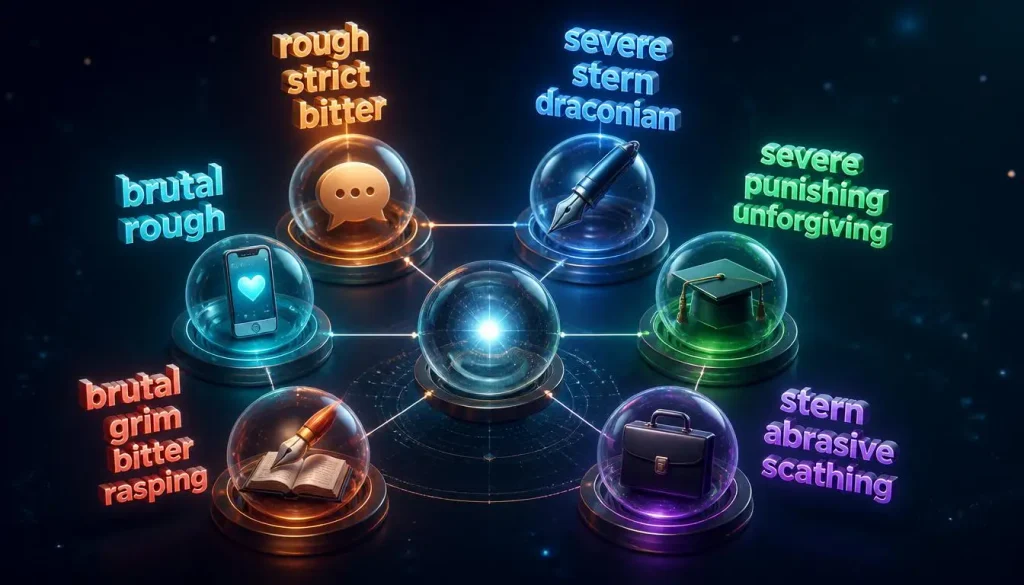
- Everyday conversation: rough (“a rough winter”), bitter (cold).
- Formal writing: severe, stern, draconian (for laws).
- Academic writing: severe, punishing, and unforgiving for conditions. Name the measurable idea rather than reaching for a fancier word.
- Business communication: severe (consequences), stern (warnings), abrasive (style), scathing (reviews).
- Creative writing: brutal, bitter, grim, rasping, unforgiving.
- Social media: brutal (“a brutal take”), rough.
Which Synonym Should I Choose?
| Situation | Best Choice | Why |
| Harsh punishment | Severe | Clear and neutral |
| Harsh teacher | Stern | Strict manner |
| Harsh treatment | Cruel | Implies suffering |
| Harsh review | Scathing | Sharp, scornful |
| Harsh remark | Caustic | Biting and hurtful |
| Harsh weather | Severe | Safe general choice |
| Harsh notice wording | Inclement | Formal, weather only |
| Harsh terrain | Unforgiving | No room for error |
| Harsh reality | Bitter | Painful truth |
| Harsh law | Draconian | Excessively severe |
| Harsh personality | Abrasive | Irritating manner |
| Harsh voice | Grating | Annoying sound |
| Harsh alarm | Shrill | High, piercing |
| Harsh sunlight | Glaring | Dazzling brightness |
| Harsh fabric | Coarse | Rough texture |
Exact and Near Synonyms: The Difference
True synonyms are rare because words that share a core meaning still differ in intent, intensity, scope, and register. Look at how each swap shifts the sentence:
- harsh punishment → severe punishment: nearly identical.
- harsh teacher → stern teacher: close, but stern does not imply unfairness.
- harsh treatment → cruel treatment: cruel adds a moral charge and intent.
- harsh weather → inclement weather: same idea, but narrower and more formal.
- harsh voice → grating voice: the focus moves to how it sounds.
Treat a thesaurus list as a shortlist, not a set of drop-in replacements.
Words Commonly Confused with Harsh
| Word | Why It Isn’t a True Synonym |
| Blunt | Direct, but not always unkind |
| Sharp | Many unrelated meanings |
| Stark | Bare or plain, not necessarily unpleasant |
| Stringent Strict | Demanding standards, no unkindness impliedFirm about rules, but not necessarily unkind or severe |
| Extreme | Very high degree, no unpleasant tone |
| Punitive | Describes purpose (punishment), not quality |
| Austere | Plain and simple, not hurtful |
Common Mistakes
| Mistake | Better | Why |
| Inclement criticism | Scathing criticism | Inclement is for weather |
| A glaring voice | A strident voice | Glaring describes light |
| A draconian winter | A brutal winter | Draconian describes laws |
| Cruel fabric | Coarse fabric | Texture needs a physical word |
| “Cruel” for a firm manager | Strict or stern | Cruel implies intent to hurt |
Antonyms of Harsh
Severity, treatment, and criticism
| # | Antonym | Why It’s the Opposite |
| 1 | Gentle | Soft in manner |
| 2 | Mild | Low in severity |
| 3 | Lenient | Allows leeway |
| 4 | Kind | Shows care |
| 5 | Merciful | Shows compassion |
| 6 | Humane | Avoids suffering |
Conditions and weather
| # | Antonym | Why It’s the Opposite |
| 1 | Mild | Easy to endure |
| 2 | Clement | Pleasant weather |
| 3 | Temperate | Moderate climate |
| 4 | Benign | Harmless, favorable |
| 5 | Moderate | Not extreme |
Sound, light, and texture
| # | Antonym | Why It’s the Opposite |
| 1 | Soft | Gentle to ear or touch |
| 2 | Smooth | No rough edges |
| 3 | Soothing | Calms the senses |
| 4 | Mellow | Warm and rounded |
| 5 | Harmonious | Pleasantly blended |
| 6 | Melodious | Pleasant and musical |
American vs British English
The spelling is identical in both varieties. The main difference is pronunciation: American speakers pronounce the r (/hɑːrʃ/), while standard British speakers usually do not (/hɑːʃ/).
Real-World Collocations and Phrases
Part A
- Harsh + noun: harsh winter, harsh climate, harsh conditions, harsh environment, harsh criticism, harsh words, harsh punishment, harsh treatment, harsh light, harsh chemicals, harsh voice
- Verb + harshly: criticize harshly, judge harshly, punish harshly, treat someone harshly, speak harshly
- Verb + harsh: sound harsh, seem harsh, prove harsh
- Harsh + preposition: harsh on, harsh to, harsh with
Part B
- Harsh reality and the harsh realities of life: set phrases for unpleasant facts people would rather avoid.
- Harsh but fair: a common way to describe criticism that is severe yet justified.
Practice Exercises
Fill in the blanks
(choose from: severe, stern, coarse, grating, inclement)
- The ceremony moves indoors in case of ______ weather.
- The headteacher gave the pupils a ______ warning about cheating.
- The regulator warned of ______ fines for repeat offenders.
- His ______ voice made the long call hard to endure.
- The cheap towel felt ______ against her skin.
Rewrite the sentences
(replace harsh with a more precise word)
- The harsh winter cut the village off for weeks.
- The editor’s harsh review ended the novelist’s hopes.
- The harsh buzzer startled everyone in the hall.
Match the words
| Word | Meaning |
| 1. Caustic | A. Excessively severe (laws) |
| 2. Draconian | B. Cutting and biting (remarks) |
| 3. Glaring | C. Showing no pity |
| 4. Rasping | D. Unpleasantly bright |
| 5. Merciless | E. Rough and scratchy (sound) |
Vocabulary quiz
- Which word is used mainly for weather? (a) strict (b) inclement (c) abrasive (d) cruel
- Which describes a law that is too severe? (a) draconian (b) mellow (c) glaring (d) bitter
- Which means irritating to hear? (a) rugged (b) grim (c) grating (d) stern
- Which suggests deliberate pain? (a) severe (b) cruel (c) rough (d) coarse
- Which describes sharp, scornful criticism? (a) scathing (b) benign (c) clement (d) velvety
Answer key
- Fill in the blanks: 1. inclement, 2. stern, 3. severe, 4. grating, 5. coarse
- Rewrite (sample answers): 1. The brutal (or bitter) winter cut the village off for weeks. 2. The editor’s scathing review ended the novelist’s hopes. 3. The shrill (or grating) buzzer startled everyone in the hall.
- Match: 1-B, 2-A, 3-D, 4-E, 5-C
- Quiz: 1-b, 2-a, 3-c, 4-b, 5-a
Frequently Asked Questions
What is the closest synonym for harsh?
The closest synonym for harsh is severe. It fits punishment, criticism, rules, and difficult conditions, and it sounds more factual and less emotional than harsh. It does not work for every sense, though. For rough fabric use coarse, and for an unpleasant noise use grating or strident.
Can synonyms for harsh be used interchangeably?
No, not fully. Harsh covers several senses, and each synonym matches only some of them. Severe fits penalties and conditions, stern fits a strict manner, inclement fits weather, and grating fits sound. Swapping words without checking the sense can change the meaning, so match the synonym to what is actually harsh.
What does harsh mean?
Harsh means unpleasantly severe, rough, or strong. It can describe treatment and criticism, conditions such as winter, and sensations such as sound, light, taste, or texture. Dictionaries generally treat it as a negative word, implying something is more unpleasant than it needs to be. The noun it modifies decides the exact meaning.
Is harsh a formal or informal word?
Harsh is a neutral word. It suits everyday conversation and professional writing equally well. When you need a more formal tone, use severe, stern, or inclement for weather. For casual speech, rough or brutal usually sounds more natural. Pick the register after you decide which sense of harsh you mean.
What is another word for harsh in tone?
Use stern for strict seriousness, caustic for cutting, hurtful remarks, strident for a loud, forceful voice, and abrasive for an irritating manner. Choose the word that matches what the listener felt: authority, hurt, volume, or friction. These words are not identical, so a stern manager and an abrasive manager are very different colleagues.
What is the opposite of harsh?
The opposite depends on the sense. For treatment and criticism, use gentle, kind, lenient, or merciful. For weather, use mild or clement. And for sounds, light, and textures, use soft, smooth, or soothing. A list of harsh synonyms and antonyms should always separate these senses rather than mix them.
Conclusion
A precise word does more work than a vague one. “A bitter wind” or “a scathing review” tells the reader something that “harsh” cannot. Before you reach for the default, ask what is actually harsh, and let that answer choose your word.

About Sajjad Ahmed
Sajjad Ahmed is the author behind Guest Paster, where he writes about English vocabulary, synonyms, word meanings, and practical word usage.
His content is designed to help readers understand the differences between similar words, discover suitable alternatives, and use English vocabulary more effectively in everyday writing and communication.
Before publishing, Sajjad focuses on presenting word choices in a clear and easy-to-understand format, with relevant meanings, context, and examples where helpful.
Through Guest Paster, his goal is to make vocabulary learning simpler and provide useful language resources for students, writers, English learners, and anyone looking to expand their vocabulary.
Areas of Focus: English Vocabulary • Synonyms • Word Meanings • Word Usage • Language Learning
Author: Sajjad Ahmed
Website: Guest Paster