A model is a noun and an adjective and a verb for something that acts as an example or representation of something else. Additionally, the term model can also refer to clothing models who display clothes for purposes of demonstrating their features or qualities. It’s the word alternatives that matters because it does five or six different jobs, and if you pick the wrong one, your meaning has already changed.
The most suitable alternative to writing everyday is example, if you want something similar that can be followed and version, if you want a type of product. Use framework for research and business. Use replica to make a physical copy.
When choosing between senses, first decide what sense you are referring to then match the word’s level of formality.
Another Word For Model
| # | Synonym | Meaning Difference |
| 1 | example | Points to conduct or a case |
| 2 | pattern | A design copied to make things |
| 3 | template | Reusable layout with blanks |
| 4 | prototype | Early working version for testing |
| 5 | replica | Accurate physical copy |
| 6 | version | One form of a product |
| 7 | framework | Structure for organizing ideas |
| 8 | paradigm | Field-wide way of thinking |
| 9 | exemplar | Formal word for a perfect case |
| 10 | sitter | Person posing for an artist |
Quick Facts About “Model”
| Feature | Detail |
| Part of speech | Noun, adjective, verb |
| Simple meaning | A guide, copy, or system to learn from |
| Pronunciation | US /ˈmɑːdl/; UK /ˈmɒdl/ |
| Syllables | 2 (mod-el) |
| Word forms | models, modeling/modelling, modeled/modelled, modeler |
| Formality | Neutral |
| Closest synonym | example |
| Best used for | Ideals, designs, copies, people, products, systems |
What Is the Closest Synonym for “Model”?
The closest single synonym is example. In dictionaries it is usually listed first because it covers the oldest and most common job of model: something held up to be followed or learned from. Formally, an example is a particular person, thing, or case that illustrates a general idea or is offered as worth imitating.
It swaps in cleanly in phrases like “a model for others” and “a model of patience,” giving “an example for others” and “an example of patience.”
It is plainer and less formal, and it carries no suggestion of perfection. Cannot replace model when you mean a physical copy, a product version, or a working system — so no single word is the best answer for every sense.
Word Origin and Etymology
According to Etymonline, English model entered the language in the late 16th century, borrowed through French modèle from Italian modello. The Italian word goes back to Latin modulus, a small measure or standard. The earliest English use was close to “a scaled design of a building,” which explains why architects’ models and “scale models” still feel central today.
From that starting point the meaning widened: first to anything worth copying, then to the person who poses for an artist, and later to the fashion and product senses. Role model is a 20th-century compound. For exact first-recorded dates, check the OED or Etymonline directly.
Can These Synonyms Be Used Interchangeably?
Usually: pattern and template for design; replica and miniature for physical copies. Tone shifts slightly but meaning holds.
Sometimes: example, ideal, and standard for conduct. Each stresses something different: a case, a perfect image, or a yardstick.
Rarely: framework, paradigm, and simulation for abstract models. A field’s habits, or what the audience expects, decide which fits.
No: Words from different senses never swap. A sitter cannot be a business framework, and a replica cannot be a role model.
Multiple Meanings: Separate Synonym Sets
This article covers the noun and adjective. Each set below belongs to one sense only; the numbers match the detailed list.
- Set A, example or ideal to follow: example (1), ideal (2), exemplar (3), paragon (4), standard (5)
- Set B, design or pattern to copy: pattern (6), template (7), blueprint (8), prototype (9), mockup (10)
- Set C, copy or representation: replica (11), miniature (12), maquette (13), representation (14)
- Set D, person who poses: sitter (15), subject (16), mannequin (17)
- Set E, product form: version (18), variant (19), type (20), design (21)
- Set F, abstract or working system: framework (22), paradigm (23), simulation (24)
Detailed Synonym of Model: Meanings and Examples
1. Example
Meaning: Defined in full in the closest-synonym section above.
Difference from model: Gentler and more everyday; it points to a person or case rather than a design.
Best Used For: Advice, teaching, and workplace conduct (Set A).
Formality: Neutral
CEFR Level: A2
Frequency: Very Common
Examples:
- Her patience with difficult customers set an example for the whole team. (workplace)
- Teachers often hold up one well-built essay as an example for the class. (classroom)
When NOT to Use It: Don’t use it for a physical copy or a person who poses.
2. Ideal
Meaning: The most perfect version of a quality, often imagined rather than seen.
Difference from model: More abstract; nobody has to have actually achieved it.
Best Used For: Values, speeches, and standards people aspire to (Set A).
Formality: Neutral
CEFR Level: B2
Frequency: Common
Examples:
- In her toast, Maya called her grandmother the ideal of quiet generosity. (family event)
- He measured every new coach against an ideal he had built from memory. (sports)
When NOT to Use It: Avoid it when you mean something real and tangible that people can actually copy.
3. Exemplar
Meaning: A person or thing that shows what a type or quality looks like at its best.
Difference from model: More formal and used mostly in writing; it praises the whole case rather than inviting copying.
Best Used For: Obituaries, policy papers, reviews (Set A).
Formality: Formal
CEFR Level: C2
Frequency: Uncommon
Examples:
- The obituary called him an exemplar of rural doctors who never turned a patient away. (newspaper)
- The policy paper treats the city’s bike network as an exemplar for other councils. (government report)
When NOT to Use It: Skip it in casual speech, where it sounds stiff.
4. Paragon
Meaning: Someone or something seen as flawless in one quality.
Difference from model: Stronger than model, and often used ironically.
Best Used For: Literary praise, humor, characters in fiction (Set A).
Formality: Formal
CEFR Level: C2
Frequency: Rare
Examples:
- Tomas is a paragon of punctuality; the train leaves and he’s already in his seat. (office humor)
- The novel’s heroine is a paragon of virtue, which makes her slightly hard to believe. (book review)
When NOT to Use It: Avoid it when you aren’t ready to claim something is perfect.
5. Standard
Meaning: A level of quality or behavior used as the yardstick for judging others.
Difference from model: Emphasizes measuring against it, not imitating it.
Best Used For: Quality, industry, and professional benchmarks (Set A).
Formality: Neutral
CEFR Level: B1
Frequency: Very Common
Examples:
- Her code review set the standard for the whole engineering department. (software team)
- Other bakeries in the district are judged against his sourdough, the local standard. (food)
When NOT to Use It: It feels impersonal when you want to praise a particular person to emulate.
6. Pattern
Meaning: A design, plan, or sample used as a guide when making something.
Difference from model: Stresses an outline that gets repeated, so it fits crafts and behavior more than people.
Best Used For: Sewing, crafts, and set routines (Set B).
Formality: Neutral
CEFR Level: B1
Frequency: Common
Examples:
- She cut the jacket from a paper pattern traced from her mother’s. (sewing)
- The new school used the district’s reading plan as a pattern for its own. (education)
When NOT to Use It: Don’t use it for a person someone admires.
7. Template
Meaning: A ready-made layout with blanks that you fill in for each new use.
Difference from model: Built for repeated reuse; a model may be one-off.
Best Used For: Documents, emails, slides, and web pages (Set B).
Formality: Neutral
CEFR Level: B2
Frequency: Very Common
Examples:
- Our HR team keeps a template for offer letters so nothing gets missed. (HR)
- I started with a free resume template and only changed the fonts. (job search)
When NOT to Use It: Don’t use it for an admired person or a physical copy.
8. Blueprint
Meaning: A detailed plan showing how something will be built or achieved.
Difference from model: It is the plan itself, not the finished thing or an example of it.
Best Used For: Construction, strategy, and policy (Set B).
Formality: Neutral
CEFR Level: C1
Frequency: Common
Examples:
- The pilot program became a blueprint for the rest of the county’s libraries. (public sector)
- The architect handed the family the blueprint for the extension. (construction)
When NOT to Use It: Skip it for a finished product; a blueprint is a plan, not the result.
9. Prototype
Meaning: An early working version built to test an idea before final production.
Difference from model: Always preliminary and meant to be tested or improved.
Best Used For: Engineering, product design, and startups (Set B).
Formality: Neutral
CEFR Level: C1
Frequency: Common
Examples:
- The engineers tested the prototype for six weeks before approving a run of 500 units. (manufacturing)
- Our startup showed investors a clickable prototype of the app. (startup pitch)
When NOT to Use It: Don’t use it for a finished product that is already on sale.
10. Mockup
Meaning: A non-working preview that shows how something will look.
Difference from model: It imitates appearance only; nothing needs to function.
Best Used For: Web design, packaging, and stage sets (Set B).
Formality: Neutral
CEFR Level: C1
Frequency: Common
Examples:
- The designer emailed a mockup of the new homepage on Monday. (web design)
- The set builders made a cardboard mock-up of the staircase. (theatre)
When NOT to Use It: Don’t use it for something that actually works.
11. Replica
Meaning: A close, accurate copy of an existing object, made to look the same.
Difference from model: Copies a specific original; a model can be an invented design.
Best Used For: Museums, collectibles, and displays (Set C).
Formality: Neutral
CEFR Level: C1
Frequency: Common
Examples:
- The museum displays a replica of the ship because the original is too fragile. (museum)
- He spent the winter gluing together a replica of a 1960s race car. (hobby)
When NOT to Use It: Don’t use it for an abstract idea or a person.
12. Miniature
Meaning: A much smaller version of something, made to scale.
Difference from model: Always implies small size; model does not.
Best Used For: Hobbies, souvenirs, and décor (Set C).
Formality: Neutral
CEFR Level: C1
Frequency: Uncommon
Examples:
- A miniature of the old railway station sits on the hotel lobby table. (hospitality)
- She collects miniatures of famous landmarks from her trips. (hobby)
When NOT to Use It: Avoid it when the copy is full-size.
13. Maquette
Meaning: A small preliminary model made by a sculptor or architect before full-scale work begins.
Difference from model: Narrower and tied to artistic planning.
Best Used For: Sculpture, architecture, and set design (Set C).
Formality: Formal
CEFR Level: C2
Frequency: Rare
Examples:
- The sculptor showed the council a clay maquette of the fountain. (public art)
- Students submitted maquettes of their stage designs for review. (design school)
When NOT to Use It: Avoid it outside art, architecture, and set design.
14. Representation
Meaning: Something that stands in for or depicts a real thing or system.
Difference from model: Broader and more abstract; it covers maps, diagrams, and images.
Best Used For: Science, geography, and technical writing (Set C).
Formality: Formal
CEFR Level: C1
Frequency: Common
Examples:
- The diagram is a simplified representation of how blood moves through the heart. (biology)
- Flat maps are representations of a curved surface. (geography)
When NOT to Use It: It sounds too abstract for a toy copy or a product type.
15. Sitter
Meaning: A person who poses for a portrait painter or photographer.
Difference from model: Limited to portraits, not runway or catalog work.
Best Used For: Art history and portrait studios (Set D).
Formality: Neutral
CEFR Level: C1
Frequency: Uncommon
Examples:
- The portraitist asked her sitter to hold still for another ten minutes. (art studio)
- Early photography required sitters to stay motionless during long exposures. (photo history)
When NOT to Use It: Don’t use it for fashion work, and note it also means “babysitter” in casual British speech.
16. Subject
Meaning: The person or thing an artist chooses to depict.
Difference from model: Doesn’t suggest the person was paid or formally posed.
Best Used For: Painting and photography (Set D).
Formality: Neutral
CEFR Level: B2
Frequency: Very Common
Examples:
- The photographer’s subject, an older fisherman, ignored the camera completely. (photography)
- Her favorite subject to paint is her neighbor’s garden. (amateur art)
When NOT to Use It: Avoid it in agency or runway contexts, where it sounds oddly clinical.
17. Mannequin
Meaning: In older fashion usage, a person employed to show clothes to buyers.
Difference from model: Dated in this sense; today it mostly means a shop dummy.
Best Used For: Historical or period writing about couture (Set D).
Formality: Neutral
CEFR Level: B2
Frequency: Rare
Examples:
- In the 1950s the couture house hired six mannequins for each seasonal show. (fashion history)
- The memoir recalls her years as a house mannequin in a Paris atelier. (memoir)
When NOT to Use It: Most readers picture a store dummy today, so choose “model” for current writing.
18. Version
Meaning: One particular form of something that exists in several forms.
Difference from model: Neutral and unbranded; it also fits software and text.
Best Used For: Products, apps, and documents (Set E).
Formality: Neutral
CEFR Level: A2
Frequency: Very Common
Examples:
- The 2024 version of the vacuum has a quieter motor. (retail)
- Which version of the app are you running? (tech support)
When NOT to Use It: Don’t use it for a person or a physical copy.
19. Variant
Meaning: A form that differs slightly from others of the same product or kind.
Difference from model: Implies a modification of a base design.
Best Used For: Vehicles, devices, and trim levels (Set E).
Formality: Neutral
CEFR Level: C1
Frequency: Common
Examples:
- The hatchback comes in a hybrid variant and a diesel one. (car review)
- The cheaper variant of the tablet has half the storage. (consumer tech)
When NOT to Use It: Reserve it for a modified form, not a plain standard product.
20. Type
Meaning: A category within a range of products that share key features.
Difference from model: Broader and less specific than a named model.
Best Used For: Casual or general questions about equipment (Set E).
Formality: Neutral
CEFR Level: A2
Frequency: Very Common
Examples:
- What type of boiler do you have? The installer will ask for the exact model number later. (home repair)
- Please state the type of printer you are using. (IT help desk)
When NOT to Use It: It’s too general when someone needs the exact product name.
21. Design
Meaning: A specific styled form in which something is produced.
Difference from model: Focuses on appearance and engineering, not on the product line.
Best Used For: Product reviews and industry news (Set E).
Formality: Neutral
CEFR Level: B1
Frequency: Very Common
Examples:
- The 2019 design of the kettle had a wider handle than today’s. (product review)
- Both phones share one design but use different chips. (tech review)
When NOT to Use It: Don’t use it for people or abstract frameworks.
22. Framework
Meaning: A structured set of ideas or rules for organizing thinking or work.
Difference from model: Offers structure to fill in rather than a simplified picture of reality.
Best Used For: Business, research, and psychology (Set F).
Formality: Neutral
CEFR Level: C1
Frequency: Common
Examples:
- The consultants proposed a framework for comparing subscription pricing options. (business)
- The study used a framework from cognitive psychology to code the interviews. (research)
When NOT to Use It: Don’t use it for a physical or scaled copy.
23. Paradigm
Meaning: A widely accepted set of assumptions that defines how a field thinks and works.
Difference from model: Larger in scale; it covers a whole discipline, not one system.
Best Used For: Academic and scientific writing (Set F).
Formality: Formal
CEFR Level: C2
Frequency: Uncommon
Examples:
- Germ theory replaced the earlier paradigm that blamed disease on bad air. (history of medicine)
- Remote-first hiring challenged the office-centered paradigm of recruiting. (HR)
When NOT to Use It: It’s overkill for a small example, and it needs an idea shared across a whole field.
24. Simulation
Meaning: A computer-based or staged imitation of how a system behaves.
Difference from model: A model is the description; a simulation is the model running.
Best Used For: Mathematical, scientific, and planning work (Set F).
Formality: Neutral
CEFR Level: C1
Frequency: Common
Examples:
- The city ran a traffic simulation before closing the bridge for repairs. (urban planning)
- Epidemiologists ran a simulation of three vaccination schedules. (public health)
When NOT to Use It: Don’t use it for an idea that isn’t actually run or tested.
Best Alternatives by Context
Everyday Conversation
Use example for something to follow, version or type for a product, and replica for a copy.
Formal Writing
Choose exemplar, paragon, or representation.
Academic Writing
In a research paper or for a psychology reader, framework and paradigm are the standard alternatives. For a mathematical model, simulation fits when the model is being run, and representation when it is being described.
Business Communication
For a business model, framework works best; blueprint suits a plan others will copy, and template suits reusable documents. Prototype fits products still being tested.
Creative Writing
Paragon gives characters a theatrical, slightly ironic edge. Sitter and mannequin add period flavor to artist and couture scenes.
Informal and Slang Use
There is no widely established slang synonym for model in any of its senses. Trade terms such as supermodel and cover girl are narrower and are covered under confusable words below. In casual speech people simply say version, copy, or example.
Which Synonym Should I Choose?
| Situation | Best Choice | Why |
| Praising someone to imitate | example | Natural and plain |
| Formal praise in writing | exemplar | Elevated but precise |
| Sewing or craft guide | pattern | Standard craft term |
| Reusable document layout | template | Implies fill-in reuse |
| Early test product | prototype | Signals it’s unfinished |
| Museum copy of an object | replica | Means accurate copy |
| Product release type | version | Works for goods and software |
| Business model | framework | Structured thinking tool |
| Research model of a field | paradigm | Whole-field way of thinking |
| Running mathematical model | simulation | Model in action |
| Portrait painter’s model | sitter | Art-studio standard |
Exact and Near Synonyms of Model: Difference
True synonyms are rare in English because two words almost never match in meaning, formality, and typical partners at the same time. Replica and miniature both describe copies, yet only one has to be small. Example and paragon both praise someone, but paragon claims perfection while example does not.
Register and scope do the rest. A framework is wider than a model of a single process, and a paradigm is wider still. A maquette belongs in an artist’s studio, while a mockup belongs on a designer’s screen. Always check who the word is usually used by and for what job before replacing model.
Words Commonly Confused with “Model”
These words are related to model but failed the substitution test, so they are not true synonyms.
| Word | Why It Isn’t a Synonym |
| mentor | Describes a guiding relationship, not an example |
| hero | Admired for deeds; not necessarily imitated |
| supermodel | Narrower; only top fashion models |
| influencer | Promotes products online; not a pose-for-art role |
| muse | Inspires artists; doesn’t pose or exemplify |
| theory | Explains why; a model shows how |
| hypothesis | A testable guess, not a representation |
| formula | A fixed expression, narrower than a model |
| equation | One mathematical statement within a model |
| schema | A mental or data structure, narrower in scope |
| sample | A small part of something, not a copy of it |
| make | The brand; the model is the specific product |
| mold | Shapes material; doesn’t represent anything |
Common Mistakes
| Mistake | Better | Why |
| The paradigm of phone I own | model / version | Paradigm is conceptual, not a product |
| She worked as a sitter on the runway | model | Sitter means a portrait subject |
| A replica of the budget | template / framework | Replicas copy objects, not ideas |
| My mentor is my role model, so they’re synonyms | keep separate | Mentor needs a relationship |
| Supermodel as a general synonym | fashion model | Supermodel is only top-tier |
Antonyms of “Model”
Model as an ideal or example (noun and adjective)
| # | Antonym | Why It’s the Opposite |
| 1 | bad example | Shows what not to do |
| 2 | cautionary tale | A case others should avoid |
| 3 | antithesis | Direct opposite of the ideal |
| 4 | flawed | Opposite of “model” as perfect |
| 5 | imperfect | Falls short of the standard |
| 6 | substandard | Below the expected quality |
Model as a copy or representation
| # | Antonym | Why It’s the Opposite |
| 1 | original | The thing the model copies |
| 2 | real thing | Not a stand-in or imitation |
| 3 | reality | What a model only approximates |
| 4 | actual | Existing, not represented |
| 5 | authentic | Genuine, not copied |
| 6 | genuine | The true article |
The “person who poses” and “product version” senses have no genuine antonyms, so none are listed here.
American vs British English
| Feature | American | British |
| Verb spelling | modeling, modeled | modelling, modelled |
| Agent noun | modeler | modeller |
| Pronunciation | /ˈmɑːdl/ | /ˈmɒdl/ |
| Preposition | modeled after | modelled on |
| Mockup spelling | mockup | mock-up |
The noun itself is spelled the same on both sides of the Atlantic; the differences are in the verb forms and a few phrases.
Real-World Collocations and Phrases
Part A: Common collocations
- Verb + model: build a model, adopt a model, run a model, train a model (machine learning), follow a model
- Model + noun: model citizen, model student, model answer, model home, model year, model number, model railway
- Adjective + model: role model, fashion model, business model, mathematical model, scale model, working model, statistical model
- Model + preposition: a model of (something), a model for (someone), modeled on or after (something)
Part B: Established phrases
- role model: a person whose behavior others copy
- model citizen: someone who behaves exemplarily in a community
- make and model: the brand and specific product of a vehicle or device
- the very model of: a classic frame used in the Gilbert and Sullivan song “the very model of a modern major-general” and borrowed for similar phrases
Practice Exercises
Fill in the blanks
Word bank: framework, replica, exemplar, template, version
- The museum sold a ______ of the ship in its gift shop.
- Please use the company ______ so every report looks consistent.
- The newest ______ of the app fixes the login bug.
- Her calm leadership made her an ______ for new managers.
- The team built a pricing ______ to test three revenue ideas.
Rewrite the sentences
Replace “model” with a better synonym.
- Our grandfather is a model of honesty.
- She built a model of the bridge from balsa wood.
- This year’s model has a bigger battery.
Match the words
| Word | Match |
| 1. paradigm | a. person posing for a portrait |
| 2. maquette | b. level used to judge quality |
| 3. sitter | c. shared way of thinking in a field |
| 4. prototype | d. sculptor’s small preliminary piece |
| 5. standard | e. first version for testing |
Vocabulary quiz
- Which word best fits a painter’s portrait model? (a) sitter (b) variant (c) template (d) framework
- Which is NOT a synonym of model? (a) replica (b) template (c) mentor (d) version
- Which word names a field’s shared way of thinking? (a) miniature (b) paradigm (c) mockup (d) type
- Which word names a sculptor’s small preliminary model? (a) maquette (b) sample (c) standard (d) design
- Which is the more formal word for a perfect case? (a) example (b) version (c) paragon (d) type
Answer key
Fill in the blanks: 1 replica, 2 template, 3 version, 4 exemplar, 5 framework.
Rewrite: 1 exemplar or paragon; 2 replica or miniature; 3 version (or design).
Match: 1-c, 2-d, 3-a, 4-e, 5-b.
Quiz: 1 a, 2 c, 3 b, 4 a, 5 c.
FAQ
What is a synonym for role model?
Good fits are exemplar and paragon. Mentor and hero are close in feeling but describe relationships or deeds rather than conduct to imitate.
What is a model in simple words?
A model is something used as a guide, a copy, or a simplified picture of something real. It can also mean a person who poses or shows clothes.
What is another word for “fashion model”?
There are few true synonyms. Runway model and catwalk model are narrower types, and mannequin is an older term for the same work. For an art studio, use sitter.
What is a synonym for “original model”?
Prototype if it was the first working version, original design if it came before later changes, or first version in plain language.
What is the best synonym for model?
Example is the closest all-round choice; the best word still depends on whether you mean an ideal, a design, a copy, a person, a product, or a system.
What are 10 good synonyms?
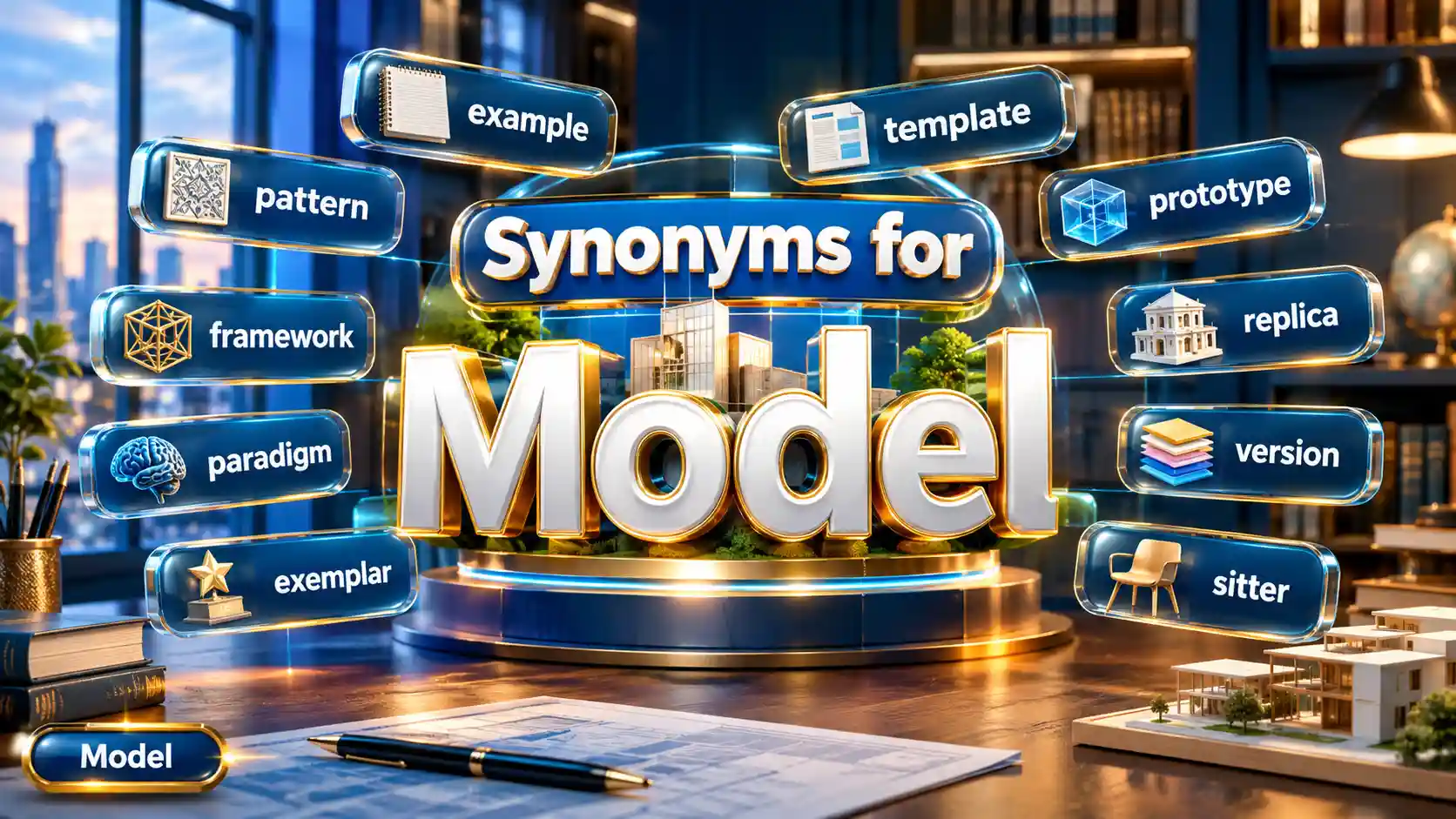
Example, pattern, template, prototype, replica, version, framework, paradigm, exemplar, and sitter. Use the context guide above to match each to the right sense.
Conclusion
Picking the right synonym for model keeps your reader from guessing which of its many jobs you mean.
A precise word such as replica, template, or framework makes the sentence clearer and more credible than a repeated model ever could. When in doubt, name the sense first, then pick the word whose tone and scope match your audience.

About Sajjad Ahmed
Sajjad Ahmed is the author behind Guest Paster, where he writes about English vocabulary, synonyms, word meanings, and practical word usage.
His content is designed to help readers understand the differences between similar words, discover suitable alternatives, and use English vocabulary more effectively in everyday writing and communication.
Before publishing, Sajjad focuses on presenting word choices in a clear and easy-to-understand format, with relevant meanings, context, and examples where helpful.
Through Guest Paster, his goal is to make vocabulary learning simpler and provide useful language resources for students, writers, English learners, and anyone looking to expand their vocabulary.
Areas of Focus: English Vocabulary • Synonyms • Word Meanings • Word Usage • Language Learning
Author: Sajjad Ahmed
Website: Guest Paster