“Funny” is one of the most overused words in English — and one of the most imprecise. It describes a hilarious joke, a witty person, a slapstick movie, or even a strange smell and a suspicious situation. That’s the problem: “funny” is a catch-all word, and catch-all words weaken your writing by forcing readers to guess your exact meaning.
Choosing the right synonym fixes this. It tells readers precisely what kind of humor (or oddness) you mean, how strong it is, and what tone you’re going for.
This guide covers the two core meanings of “funny,” synonyms by strength, clever/dry/silly/physical/sarcastic humor words, formal vs. casual options, an A–Z list, common mistakes, and a simple framework for picking the right word every time.
Quick Reference: The Most Useful Funny Synonyms
| Synonym | Best Meaning | Strength |
| Amusing | Mildly entertaining and pleasant | Mild |
| Humorous | Formal, general-purpose word for funny | Moderate |
| Comical | Funny because something looks or acts silly | Moderate |
| Witty | Clever, intelligent humor | Moderate |
| Hilarious | Extremely funny, big laughter | Strong |
| Droll | Quiet, dry, unusual humor | Mild–Moderate |
| Slapstick | Physical, exaggerated comedy | Moderate |
| Ridiculous | Funny because something is absurd | Moderate (often negative) |
| Quirky | Charming and unusual | Mild–Moderate |
| Sarcastic | Humor through irony or mockery | Moderate |
| Strange / Odd | “Funny” meaning unusual, not humorous | N/A |
The Two Meanings of “Funny” — Why This Matters Most
Before you reach for a synonym, you need to identify which “funny” you actually mean. This is the single most important distinction in this entire guide, and most synonym lists skip it entirely.
1. Funny Meaning Humorous
This is the meaning most people think of first. It applies when something makes you laugh, smile, or feel entertained.
Examples:
- A funny joke
- A funny movie
- A funny story
- A funny comedian
Appropriate synonyms: hilarious, humorous, amusing, witty, comical, entertaining
Example sentence upgrade:
- Basic: “The comedian was funny.”
- Better: “The comedian was hilarious.” (strong laughter)
- Or: “The comedian was witty.” (clever material)
- Or: “The comedian was amusing.” (pleasant, lighter humor)
2. Funny Meaning Strange or Unusual
This meaning has nothing to do with humor. It describes something that feels off, unexpected, or hard to explain.
Examples:
- There is a funny smell.
- Something funny is happening.
- That sounds funny to me.
Appropriate synonyms: strange, odd, peculiar, suspicious, weird, fishy
Why this distinction matters:
“A funny joke” and “a funny smell” are grammatically identical but semantically opposite. If you accidentally swap in a humor-based synonym for a strangeness-based sentence, the result is nonsensical:
- ❌ “There was a hilarious smell in the kitchen.”
- ✅ “There was a strange smell in the kitchen.”
Always ask yourself: am I describing laughter, or am I describing confusion/unease? That answer determines your entire word bank.
Funny Synonyms by Strength of Humor
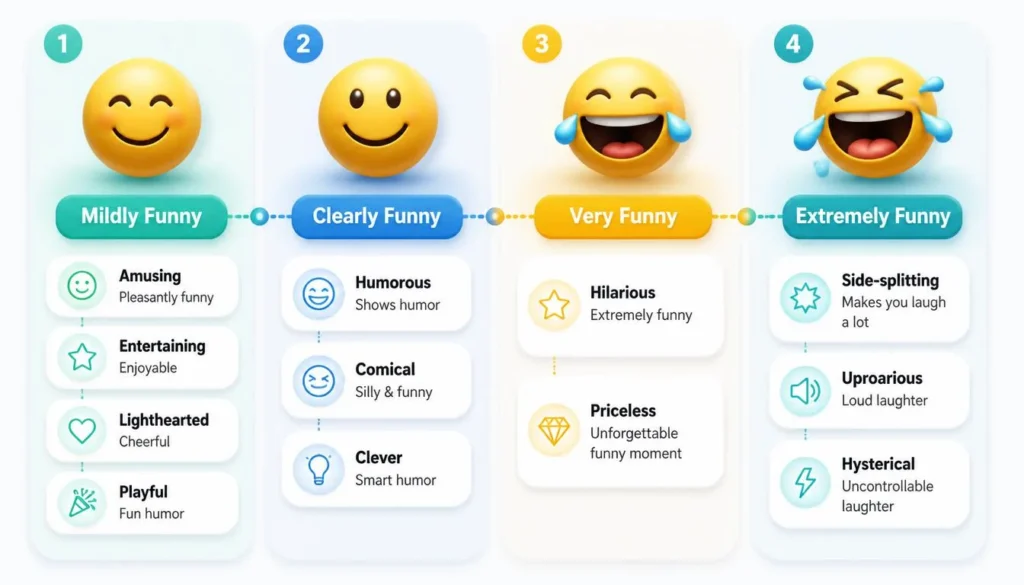
Humor isn’t binary — something can be mildly amusing or side-splittingly hilarious. Matching the intensity of your synonym to the intensity of the humor makes your writing far more accurate.
Mildly Funny Words (a smile, not a laugh)
Amusing
Meaning: Pleasantly funny or entertaining, without provoking strong laughter.
Example: “She shared an amusing story about her childhood.”
Best for: light conversation, anecdotes, casual writing.
Entertaining
Meaning: Enjoyable and engaging — doesn’t have to involve humor at all.
Example: “The speaker gave an entertaining presentation.”
Note: Entertaining is broader than funny; something can be entertaining through suspense or energy, not just jokes.
Lighthearted
Meaning: Cheerful, relaxed, not serious in tone.
Example: “It’s a lighthearted comedy perfect for a rainy afternoon.”
Playful
Meaning: Fun, cheerful, gently humorous.
Example: “His playful teasing made the interview feel relaxed.”
Moderately Funny Words (everyday humor)
Humorous
Meaning: Having or showing a sense of humor. The most “neutral” and professional-sounding synonym for funny.
Example: “The article includes several humorous examples.”
Best for: formal writing, reviews, professional descriptions.
Comical
Meaning: Funny because something looks, acts, or appears silly or exaggerated.
Example: “The actor’s comical expression had the whole audience laughing.”
Best for: physical actions, appearances, exaggerated situations.
Clever
Meaning: Funny through intelligence or creativity rather than silliness.
Example: “The advertisement uses clever humor to grab attention.”
Strongly Funny Words (big laughter)
Hilarious
Meaning: Extremely funny; causes loud, genuine laughter.
Example: “The movie was hilarious from beginning to end.”
Side-splitting
Meaning: Extremely funny (informal).
Example: “The comedian delivered a side-splitting set.”
Best for: entertainment writing, casual reviews.
Uproarious
Meaning: Producing loud, enthusiastic laughter.
Example: “The crowd gave an uproarious response to the punchline.”
Best for: reviews and more formal entertainment writing.
Clever and Intelligent Humor
Not all humor comes from jokes or silliness — some comes from sharp thinking, timing, and wordplay. These synonyms are especially useful for describing writers, speakers, and comedians.
Witty
Meaning: Funny because it’s clever, sharp, or intelligent — often through wordplay or quick observation.
Example: “Her witty response left the whole room laughing.”
A witty person doesn’t necessarily tell jokes; their humor comes from smart comments, quick replies, and clever phrasing.
Funny vs. Witty — the key difference:
- A person slipping on a banana peel is funny.
- A clever line about why people always slip on banana peels is witty.
Funny creates laughter. Witty creates laughter through intelligence.
Quick-witted
Meaning: Able to produce clever responses instantly.
Example: “The host is known for his quick-witted interviews.”
Best for: comedians, hosts, public speakers.
Tongue-in-cheek
Meaning: Humor that is deliberately exaggerated or not meant to be taken seriously.
Example: “The piece takes a tongue-in-cheek approach to modern etiquette.”
Common in: blogs, opinion writing, social media captions.
Dry and Subtle Humor
Some of the best comedy isn’t loud at all — it’s quiet, understated, and delivered with a straight face.
Droll
Meaning: Funny in a dry, unusual, or understated way.
Example: “He has a droll sense of humor that catches people off guard.”
Deadpan
Meaning: Funny because something humorous is said with a completely serious expression or tone.
Example: “Her deadpan delivery made the joke land even harder.”
Illustration: Someone saying “I love exercise — especially when it’s over” with a totally straight face is deadpan humor.
Wry
Meaning: Slightly ironic or sarcastic humor.
Example: “He gave a wry smile after hearing the news.”
Common in: criticism, observational writing, mature or literary tone.
Understated
Meaning: Subtle humor that avoids exaggeration.
Example: “The film has an understated comedic style that rewards close attention.”
Silly, Absurd, and Unusual Humor
Some things are funny simply because they’re strange, exaggerated, or completely unexpected.
Goofy — Silly and lovable. “His goofy dance moves always get a laugh.”
Zany — Wildly unusual and energetic. “The show is packed with zany characters and chaotic plots.”
Quirky — Unusual in a charming or interesting way (usually positive). “She has a quirky, offbeat sense of humor.”
Whimsical — Playfully imaginative. “The book has a whimsical tone full of odd little details.”
Absurd — Funny because it’s completely unreasonable or impossible. “The film builds its comedy on absurd, over-the-top scenarios.”
Ridiculous — So unreasonable it becomes funny — though this word can also carry a negative or dismissive tone. “The excuse was so ridiculous that everyone burst out laughing.”
Physical Comedy
Some humor comes purely from movement, action, or visual chaos rather than words.
Slapstick
Meaning: Physical comedy involving exaggerated actions, falls, chases, or accidents.
Example: “The movie is famous for its over-the-top slapstick scenes.”
Clownish
Meaning: Silly or exaggerated behavior, like a clown.
Example: “His clownish antics kept the kids entertained for hours.”
Sarcastic and Teasing Humor
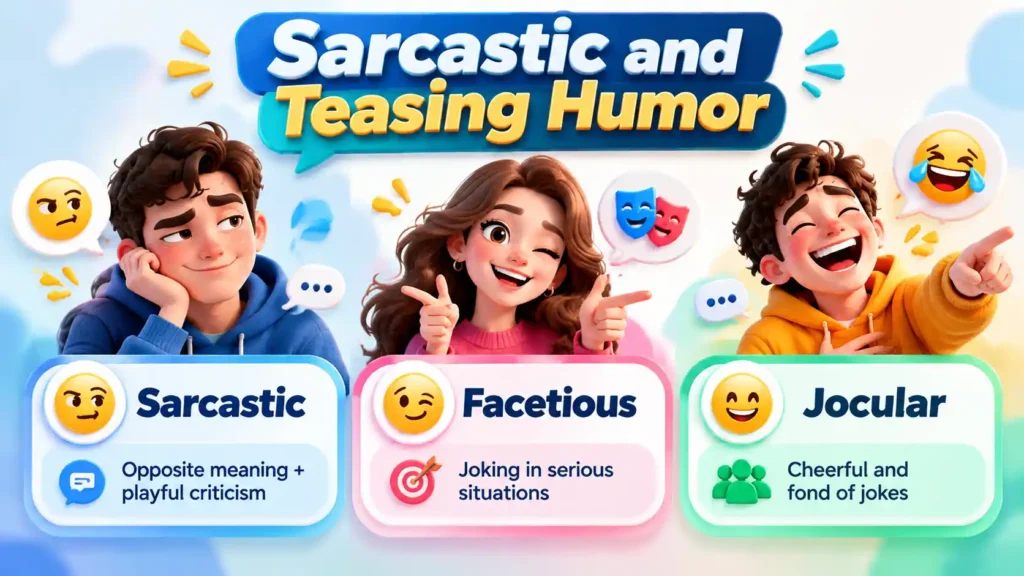
Humor built around irony, mockery, or playful criticism needs its own vocabulary — and its own caution.
Sarcastic
Meaning: Saying the opposite of what’s meant, often to mock or criticize.
Example: “His sarcastic remark got a laugh, but it clearly stung.”
Caution: Sarcasm can easily read as rude in writing, since tone of voice is missing — use it deliberately.
Facetious
Meaning: Joking about something that’s meant to be taken seriously.
Example: “He made a facetious comment right in the middle of the meeting.”
Important: Facetious does not simply mean “funny” — it often implies the joke was inappropriate or dismissive of a serious topic.
Jocular
Meaning: Cheerful and fond of joking; describes a personality or mood.
Example: “The manager was in a jocular mood all morning.”
Best for: formal writing, personality descriptions.
Casual and Slang Alternatives
In conversation, texting, or social media, people rarely reach for “hilarious” — they use informal shorthand instead.
| Expression | Meaning | Example |
| A riot | Extremely funny person or event | “The party was an absolute riot.” |
| A hoot | Very amusing | “That video was a hoot.” |
| A scream | A very funny person | “Your uncle is a total scream.” |
| Cracks me up | Makes me laugh | “That meme cracks me up every time.” |
| Priceless | Funny because of a reaction | “His face was priceless.” |
| Too much | Excessively funny | “Her stories are too much.” |
| I’m dead | Internet slang for very funny | “This comment section is killing me.” |
| LOL-worthy | Worth laughing at | “That caption is definitely LOL-worthy.” |
Funny Synonyms for Specific Situations
Describing a Funny Person
Use: witty, entertaining, humorous, hilarious, playful, quick-witted, a riot
Example: “He’s a witty storyteller who always keeps the room entertained.”
Describing a Funny Joke
Use: hilarious, clever, amusing, witty, comical, side-splitting
Example: “She told a hilarious joke that had everyone in tears.”
Describing a Funny Story
Use: amusing, entertaining, humorous, hilarious, delightful
Example: “He shared an amusing story from his college years.”
Describing a Funny Movie
Use: hilarious, comedic, slapstick, entertaining, farcical
Example: “The film blends slapstick comedy with genuinely clever writing.”
Describing Funny Writing
Use: humorous, witty, playful, lighthearted, entertaining
Example: “The author’s witty, playful tone makes even dry topics enjoyable.”
When “Funny” Means Strange or Unusual
This meaning is often overlooked in synonym guides, but it’s just as common in everyday English.
Strange
Meaning: Not normal or expected.
Example: “There was a strange noise coming from the attic.”
Odd
Meaning: Different from what’s usual — generally softer than “strange.”
Example: “That’s an odd way to approach the problem.”
Peculiar
Meaning: Unusual or distinctive, sometimes hard to explain.
Example: “The old house had a peculiar smell.”
Weird
Meaning: Very unusual or unexpected, common in casual speech.
Example: “That was a genuinely weird conversation.”
Suspicious
Meaning: Something feels wrong, dishonest, or questionable.
Example: “There’s something suspicious about this offer.”
Fishy
Meaning: Informal word for suspicious.
Example: “The whole deal sounds fishy to me.”
Curious
Meaning: Strange enough to draw attention or interest.
Example: “It was curious that nobody mentioned the missing report.”
A–Z Quick Reference List
A — Amusing, Absurd
C — Clever, Comical, Comedic, Curious
D — Droll, Deadpan, Delightful
E — Entertaining
F — Farcical, Facetious
G — Goofy
H — Hilarious, Humorous
J — Jocular
L — Laughable, Ludicrous, Lighthearted
O — Odd
P — Playful, Priceless, Peculiar
Q — Quirky
R — Ridiculous, Riotous
S — Slapstick, Side-splitting, Sarcastic, Strange, Suspicious
U — Uproarious, Understated
W — Witty, Wry, Weird, Whimsical
Z — Zany
Common Mistakes When Choosing Funny Synonyms
1. Using “hilarious” when you mean “strange”
❌ “There was a hilarious smell in the room.”
✅ “There was a strange smell in the room.”
Hilarious describes laughter — never oddness.
2. Treating “facetious” as a compliment
Facetious usually implies inappropriate or dismissive joking, not genuine humor. Calling someone’s comment “facetious” is rarely flattering.
3. Confusing “witty” with “funny”
A witty comment specifically involves intelligence or cleverness — not all funny things are witty.
- Funny: “The dog wore sunglasses.”
- Witty: “The dog looked more prepared for Monday than I am.”
4. Using “ridiculous” as pure praise
Ridiculous often carries a negative undertone (unreasonable, absurd) rather than simple amusement.
Example: “That excuse is ridiculous” implies disbelief, not admiration.
5. Repeating “funny” too often
Overusing the same word weakens writing.
- Weak: “The funny movie had funny characters and funny jokes.”
- Strong: “The hilarious movie had witty characters and clever jokes.”
How to Choose the Right Funny Synonym: A 3-Question Framework
Question 1: What kind of humor is it?
- Clever → witty
- Physical → slapstick
- Quiet and dry → droll
- Big, loud laughter → hilarious
Question 2: How strong is the humor?
- Small smile → amusing, pleasant, lighthearted
- Regular laugh → funny, humorous, comical
- Big laugh → hilarious, uproarious
Q 3: What’s the setting?
- Formal writing → humorous, amusing, comedic, entertaining
- Casual conversation → hilarious, a riot, cracks me up
- Creative writing → witty, whimsical, droll, playful
Sentence Improvement Examples
Basic: “The comedian was funny.”
Improved: “The comedian was hilarious and kept the audience laughing throughout the show.”
Basic: “She made a funny comment.”
Improved: “She made a witty comment that showed off her quick thinking.”
Basic: “The situation was funny.”
Improved: “The situation was comical because everything went wrong at once.”
Basic: “There was a funny noise outside.”
Improved: “There was a strange noise outside that nobody could explain.”
Frequently Asked Questions
What is another word for funny?
It depends on the meaning. For humor: humorous, amusing, hilarious, witty, comical. For strangeness: odd, unusual, peculiar, suspicious.
What is a stronger word than funny?
Hilarious, uproarious, side-splitting, and riotous all describe more intense humor than a plain “funny.”
What is a formal synonym for funny?
Humorous, amusing, comedic, entertaining, and mirthful all work well in professional or formal writing.
Is humorous the same as funny?
They’re closely related, but humorous sounds more formal and deliberate, while funny is more casual and general-purpose.
What is the difference between funny and hilarious?
Funny is a general term for anything amusing. Hilarious specifically means extremely funny — a stronger, more intense version.
What is the difference between witty and funny?
Funny describes anything that causes laughter. Witty specifically describes humor created through intelligence, cleverness, or wordplay — not all funny things are witty, and not all witty things are laugh-out-loud funny.
Can “funny” mean strange?
Yes. “That’s a funny joke” means humorous, while “that’s a funny smell” means strange or unusual. Context always decides which meaning applies.
Final Thoughts
“Funny” is a useful word, but it’s often too vague to carry real meaning on its own. The right synonym tells your reader exactly what kind of humor you mean, how strong it is, and in what tone.
Quick cheat sheet:
- Amusing — gentle, pleasant entertainment
- Humorous — the formal, all-purpose choice
- Hilarious — powerful, loud laughter
- Witty — clever, intelligence-driven humor
- Droll — dry, quiet, unusual comedy
- Comical — silly situations or appearances
- Slapstick — physical, exaggerated comedy
- Odd / Peculiar — when “funny” actually means strange
The best synonym isn’t the fanciest or most impressive one — it’s the one that precisely matches the type, strength, and setting of the humor (or strangeness) you’re trying to describe. Once you start choosing deliberately instead of defaulting to “funny,” your writing immediately feels sharper, clearer, and more engaging.

About Sajjad Ahmed
Sajjad Ahmed is the author behind Guest Paster, where he writes about English vocabulary, synonyms, word meanings, and practical word usage.
His content is designed to help readers understand the differences between similar words, discover suitable alternatives, and use English vocabulary more effectively in everyday writing and communication.
Before publishing, Sajjad focuses on presenting word choices in a clear and easy-to-understand format, with relevant meanings, context, and examples where helpful.
Through Guest Paster, his goal is to make vocabulary learning simpler and provide useful language resources for students, writers, English learners, and anyone looking to expand their vocabulary.
Areas of Focus: English Vocabulary • Synonyms • Word Meanings • Word Usage • Language Learning
Author: Sajjad Ahmed
Website: Guest Paster