
What Is Youth?
Youth is a noun referring to the period between childhood and adulthood, including adolescence and young adulthood. It also means young people as a group like “the youth of today” or the characteristics of being young, such as having lots of energy and feeling fresh.
As a result of multiple interpretations of youth, the best possible synonyms dependon whether referring to specific stage in life-long term relationship between people who share generational experience or quality inherent within certain demographic characteristics.
Different alternatives apply to different situations, for instance adolescence and young people for group development.
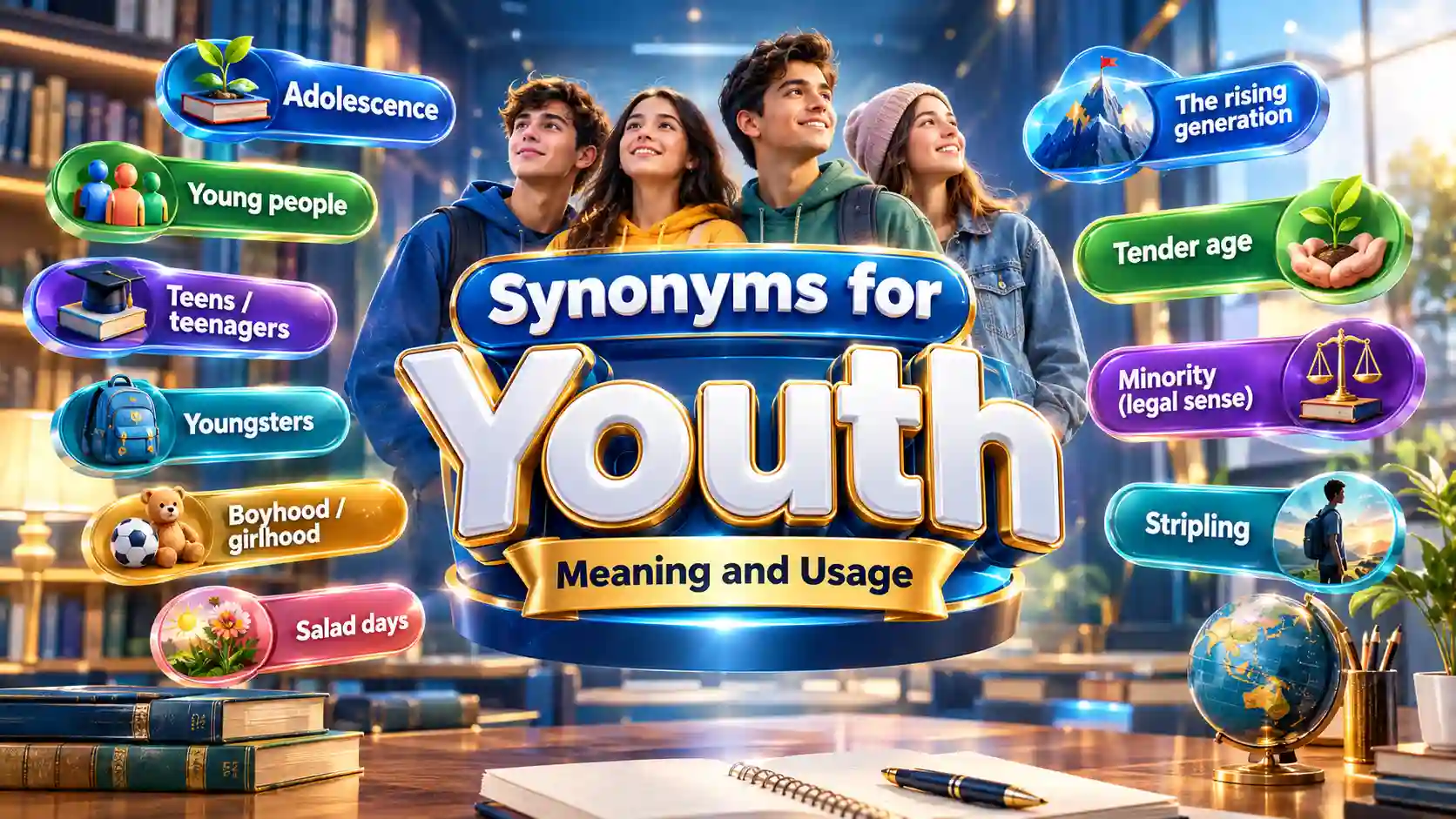
10 Best Synonyms for Youth
| # | Synonym | Meaning Difference | Best Used For | Formality |
|---|---|---|---|---|
| 1 | Adolescence | The developmental stage from puberty to adulthood — more clinical | Medicine, psychology, academic writing | Formal |
| 2 | Young people | The group, not the time period | News, reports, general writing | Neutral |
| 3 | Teens / teenagers | Specifically ages 13–19 | Everyday conversation, parenting content | Neutral |
| 4 | Youngsters | Warmer, more casual collective term | Conversation, storytelling | Informal |
| 5 | Boyhood / girlhood | Gender-specific version of youth | Memoir, biography, personal essays | Neutral–Formal |
| 6 | Salad days | Youthful idealism and inexperience, idiomatic | Reflective or nostalgic writing | Literary |
| 7 | The rising generation | Youth as future leaders or influence | Speeches, social commentary | Formal |
| 8 | Tender age | Young age, gentle/protective connotation | Legal, sentimental, or descriptive writing | Neutral–Formal |
| 9 | Minority (legal sense) | The legal state of being under age | Law, contracts, official documents | Formal |
| 10 | Stripling | A young, often inexperienced person (usually male) | Historical fiction, literary or humorous writing | Archaic/Literary |
Quick Facts About Youth
- Part of speech: Noun (also used attributively, as in “youth group”)
- Simple meaning: The time of being young; young people as a group; the quality of being young
- Pronunciation: /juːθ/ (rhymes with “tooth”)
- Syllables: 1
- Word forms: youth / youths (plural), youthful (adjective), youthfully (adverb), youthfulness (noun)
- Formality: Neutral — usable in casual and formal writing alike
- Closest synonym: Adolescence (for the life stage) or young people (for the group)
- Best used for: General reference to the life stage between childhood and adulthood, or to young people collectively
What Is the Closest Synonym for Youth?
It depends on the sense you mean. For the life stage, adolescence is closest — it’s the standard clinical and developmental term, though narrower: adolescence generally covers the teen years, while youth can stretch a bit further into the twenties depending on context. For people, young people is the closest and most neutral substitute — safer in formal writing than “kids” or “youngsters,” which carry more casual tone. There’s no one word that captures both senses as efficiently as “youth” does, which is why the word survives so much specific competition.
Can These Synonyms Be Used Interchangeably?
Usually:Young people, the young, and youngsters swap in cleanly for the collective sense — “today’s youth” and “today’s young people” mean the same thing.
Sometimes:Adolescence replaces youth when you’re describing the life stage (“Adolescence is a time of change”), but not the people themselves — you can’t say “the adolescence gathered,” only “the adolescents.”
Rarely:Juvenile and minor carry legal or clinical weight that plain “youth” doesn’t; swapping them in casual writing changes the tone noticeably.
No:Salad days and stripling are idiomatic or archaic — they work in reflective or literary writing but would sound out of place in a report or a business email.
Detailed Synonym Meanings and Examples

1. Adolescence
Meaning: The developmental period between puberty and adulthood.
Difference: More clinical and age-specific than “youth.”
Best used for: Academic, medical, psychological writing.
Formality: Formal.
Examples: “Adolescence brings rapid physical and emotional change.” / In a research paper: “Risk-taking behavior peaks during adolescence.”
2. Young People
Meaning: People who are young, generally under 25–30.
Difference: Refers to the people, not the time period.
Best used for: Journalism, reports, general commentary.
Formality: Neutral.
Examples: “Young people are driving the shift toward remote work.” / In a memo: “Our campaign targets young people aged 18–24.”
3. Teenagers / Teens
Meaning: People aged 13–19.
Difference: A narrower age band than youth.
Best used for: Everyday conversation, parenting content, marketing to that age group.
Formality: Neutral.
Examples: “Many teenagers manage their own social media accounts now.” / In a survey summary: “We polled 500 teens about career goals.”
4. Youngsters
Meaning: Young people, used affectionately or casually.
Difference: Warmer and more informal than “youth.”
Best used for: Casual conversation, storytelling.
Formality: Informal.
Examples: “The youngsters raced each other down the street.” / In dialogue: “These youngsters don’t know how good they have it.”
5. Boyhood
Meaning: The period of being a boy.
Difference: Gender-specific, often nostalgic.
Best used for: Memoir, biography.
Formality: Neutral to formal.
Examples: “He wrote a memoir about his boyhood in rural Ohio.” / “Boyhood friendships often shape adult character.”
6. Girlhood
Meaning: The period of being a girl.
Difference: Gender-specific, parallel to boyhood.
Best used for: Memoir, feminist writing, creative nonfiction.
Formality: Neutral to formal.
Examples: “She recalled her girlhood with a mix of fondness and pain.” / “Girlhood in the 1950s came with rigid expectations.”
7. Salad Days
Meaning: An idiom for one’s youthful, idealistic, inexperienced years.
Difference: Literary and specifically evokes naivety, not just age.
Best used for: Reflective essays, memoir, creative writing.
Formality: Literary/informal.
Examples: “In my salad days, I thought I could change the world overnight.” / “The band’s salad days produced their most experimental work.”
8. The Rising Generation
Meaning: The generation of young people coming into influence.
Difference: Emphasizes future potential and societal role, not just age.
Best used for: Speeches, social commentary.
Formality: Formal.
Examples: “The rising generation is more environmentally conscious.” / In a keynote: “We owe the rising generation better opportunities.”
9. Tender Age
Meaning: A young age, often used with a protective or sympathetic tone.
Difference: Carries emotional or legal weight “youth” doesn’t.
Best used for: Legal writing, sentimental or descriptive prose.
Formality: Formal.
Examples: “She began performing at the tender age of six.” / In a court filing: “The witness was of tender age at the time of the incident.”
10. Minor
Meaning: A person under the legal age of adulthood.
Difference: Strictly legal/administrative, not a general synonym.
Best used for: Legal, medical, institutional writing.
Formality: Formal.
Examples: “Minors require parental consent for the procedure.” / “This offer is void if signed by a minor.”
11. Juvenile
Meaning: A young person, especially in legal or clinical contexts; can imply immaturity.
Difference: Often carries a judgmental or institutional tone “youth” lacks.
Best used for: Legal writing, criminal justice, formal reports.
Formality: Formal.
Examples: “The juvenile justice system focuses on rehabilitation.” / “Juvenile behavior like that won’t be tolerated at work.”
12. Stripling
Meaning: A young, often slender or inexperienced person, usually male.
Difference: Archaic and literary.
Best used for: Historical fiction, poetry.
Formality: Archaic/literary.
Examples: “The striplings marched off to war, barely old enough to shave.” / “He was a mere stripling when he inherited the estate.”
13. Lad
Meaning: A boy or young man.
Difference: Informal, regionally flavored (especially British/Irish usage).
Best used for: Casual speech, dialogue, informal writing.
Formality: Informal.
Examples: “The lad helped his grandfather in the shop every weekend.” / In dialogue: “That lad’s got more sense than half the adults in this town.”
14. Adolescent
Meaning: A person going through adolescence.
Difference: Refers to the individual, where “youth” can mean the group or the era.
Best used for: Academic and medical writing.
Formality: Formal.
Examples: “Adolescents often experience major emotional shifts.” / “Schools should support adolescents through key transitions.”
15. Childhood
Meaning: The stage before adolescence.
Difference: Younger and more specific than youth; not a true synonym but frequently confused with it.
Best used for: General writing, education, psychology.
Formality: Neutral.
Examples: “Childhood memories often shape adult behavior.” / “Access to books in childhood correlates with literacy outcomes.”
16. Juvenescence
Meaning: The state or process of growing young; renewal.
Difference: Emphasizes vitality and rejuvenation rather than actual age.
Best used for: Literary and scholarly writing.
Formality: Formal.
Examples: “The garden’s juvenescence each spring delighted visitors.” / “His juvenescence of spirit defied his years.”
17. Bloom (of Youth)
Meaning: The state of being in one’s prime or freshest years.
Difference: Metaphorical — describes peak vitality, not a fixed age range.
Best used for: Poetic, romantic, reflective writing.
Formality: Literary.
Examples: “In the bloom of youth, she felt invincible.” / “The bloom hadn’t yet faded from his enthusiasm.”
18. Spring / Springtime (of Life)
Meaning: A metaphor for youth, drawing on the season of renewal.
Difference: Poetic, not literal.
Best used for: Literary, reflective, romantic writing.
Formality: Literary.
Examples: “In the springtime of their lives, they traveled the world.” / “Springtime gave way to the summer of maturity.”
19. Prime (of Life)
Meaning: The period of peak vitality and strength.
Difference: Emphasizes vigor rather than youth specifically — someone’s “prime” can happen at 40.
Best used for: Literary, sports, motivational writing.
Formality: Neutral to formal.
Examples: “He was in the prime of his youth when he took over the company.” / “Don’t waste your prime waiting for permission.”
20. Formative Years
Meaning: The years in which character and identity develop.
Difference: Focuses on development, not age itself.
Best used for: Academic writing, self-help, essays.
Formality: Formal.
Examples: “Her formative years were spent in a small coastal town.” / “Mentorship during the formative years improves long-term outcomes.”
21. Next Generation
Meaning: The generation that follows the current one.
Difference: Forward-looking, common in business and policy language.
Best used for: Business, education, technology writing.
Formality: Neutral to formal.
Examples: “We’re building tools for the next generation of engineers.” / “Investing in the next generation is our top priority.”
22. Young Blood
Meaning: New, energetic people entering a field or group.
Difference: Metaphorical and workplace-oriented, not a literal age term.
Best used for: Business, sports, organizational writing.
Formality: Neutral to informal.
Examples: “The team brought in some young blood this season.” / “We need young blood to modernize our processes.”
23. Greenhorn
Meaning: An inexperienced person, often but not always young.
Difference: Focuses on lack of experience, not age.
Best used for: Informal or historical writing.
Formality: Informal.
Examples: “The greenhorn reporter asked all the obvious questions.” / “Every expert was once a greenhorn.”
24. Whippersnapper
Meaning: A young, often overconfident person, usually used humorously.
Difference: Playful, slightly mocking tone.
Best used for: Humor, casual storytelling.
Formality: Very informal.
Examples: “These whippersnappers think they invented hard work.” / “Listen here, whippersnapper — I’ve been doing this since before you were born.”
Best Alternatives by Context
Everyday Conversation: teens, youngsters, kids, young people
Formal Writing: adolescence, young people, minor, tender age
Academic Writing: adolescence, adolescent, juvenile
Business Communication: young professionals, next generation, young blood
Creative Writing: salad days, stripling, boyhood/girlhood, bloom, springtime
Social Media: teens, young people, Gen Z-adjacent phrasing
Which Synonym Should I Choose?
Start by asking what you’re actually describing: a time period, a group, or a quality. Then check formality — a legal document needs “minor,” a memoir wants “boyhood.” Finally, consider connotation: “youngsters” reads warm, “juvenile” can read clinical or judgmental, “the rising generation” reads aspirational. Matching connotation to intent usually matters more than matching the dictionary definition exactly.
Exact and Near Synonyms: The Difference
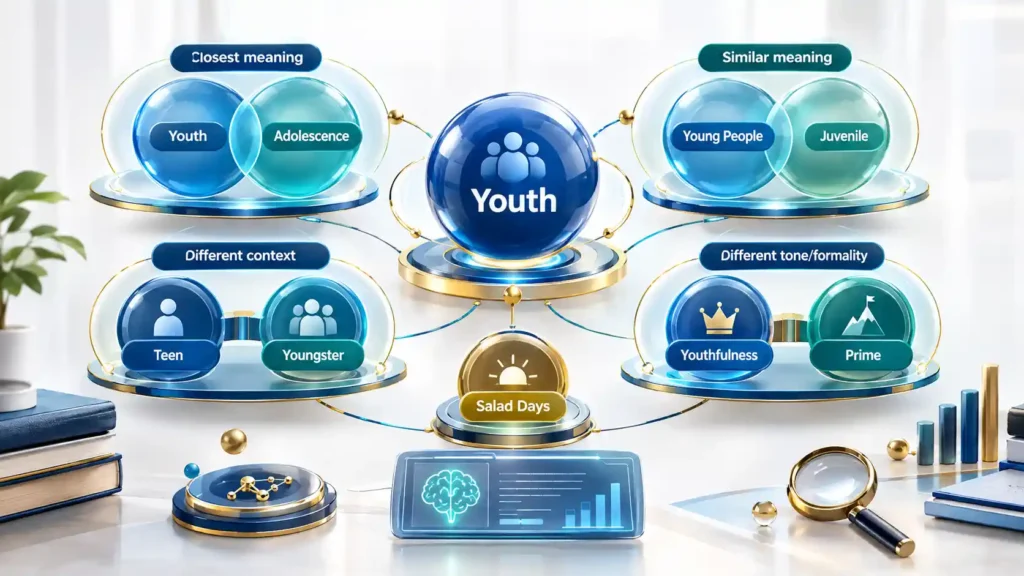
True exact synonyms are rare because words carry different registers and histories even when their core meaning overlaps. “Youth” and “adolescence” describe a similar stretch of life, but “adolescence” carries a clinical framing that “youth” doesn’t. Near-synonyms like these let a writer fine-tune tone: swapping “youth” for “adolescence” in a research paper signals precision; swapping it for “salad days” in a memoir signals nostalgia instead.
Words Commonly Confused with Youth
- Immaturity — a lack of emotional or mental development, not simply being young
- Youthfulness — the quality of looking or acting young, not the life stage itself
- Infancy — early childhood specifically, not the teenage/young-adult period
- Puberty — a biological process within adolescence, not a synonym for the broader stage
Antonyms of Youth
- Old age
- Maturity
- Adulthood
- Senescence
- Decline (in the sense of “the decline of one’s years”)
Common Phrases with Youth
- In her youth — during her young years
- Youth is wasted on the young — a proverb about not appreciating youth while you have it
- Fountain of youth — a mythical source of eternal youthfulness
- Youth movement — a wave of young people driving social or political change
- Youth culture — trends, values, and behaviors associated with young people
- Misspent youth — a youth spent unwisely
Frequently Asked Questions
What is another word for “youth”?
Common alternatives include adolescence, young people, and teenagers, depending on whether you mean the time period or the people.
What are 10 good synonyms?
Adolescence, young people, teenagers, youngsters, boyhood/girlhood, salad days, the rising generation, tender age, minority, and stripling.
What is a synonym for the word “juvenile”?
Youthful, adolescent, young, or minor, depending on context — “juvenile” itself is often used in legal or clinical writing.
What is the word for youth?
There’s no single perfect replacement, but “adolescence” is closest for the life stage, and “young people” is closest for the group.
What can I say instead of “youth”?
Depending on tone: “young people” for clarity, “adolescence” for precision, “salad days” for nostalgia, “youngsters” or “teens” for casual writing.
What is a fancy word for age (in the youthful sense)?
“Salad days” and “prime of life” are elevated, literary ways to refer to one’s youthful years.
Conclusion
Youth is a fluid word which could refer to a phase of life-a collection of people, or a characteristic. This is why only one single synonym will often not cover all of the uses of youth.
Go for “adolescence” when precision is at stake, and for “young people” when impartiality is the goal. When it’s a matter of tone and image rather than accuracy, use something like “salad days” or “bloom”. A word that’s used correctly doesn’t just sound different from something repeated it shows you which of the senses of “youth” it means.

About Sajjad Ahmed
Sajjad Ahmed is the author behind Guest Paster, where he writes about English vocabulary, synonyms, word meanings, and practical word usage.
His content is designed to help readers understand the differences between similar words, discover suitable alternatives, and use English vocabulary more effectively in everyday writing and communication.
Before publishing, Sajjad focuses on presenting word choices in a clear and easy-to-understand format, with relevant meanings, context, and examples where helpful.
Through Guest Paster, his goal is to make vocabulary learning simpler and provide useful language resources for students, writers, English learners, and anyone looking to expand their vocabulary.
Areas of Focus: English Vocabulary • Synonyms • Word Meanings • Word Usage • Language Learning
Author: Sajjad Ahmed
Website: Guest Paster