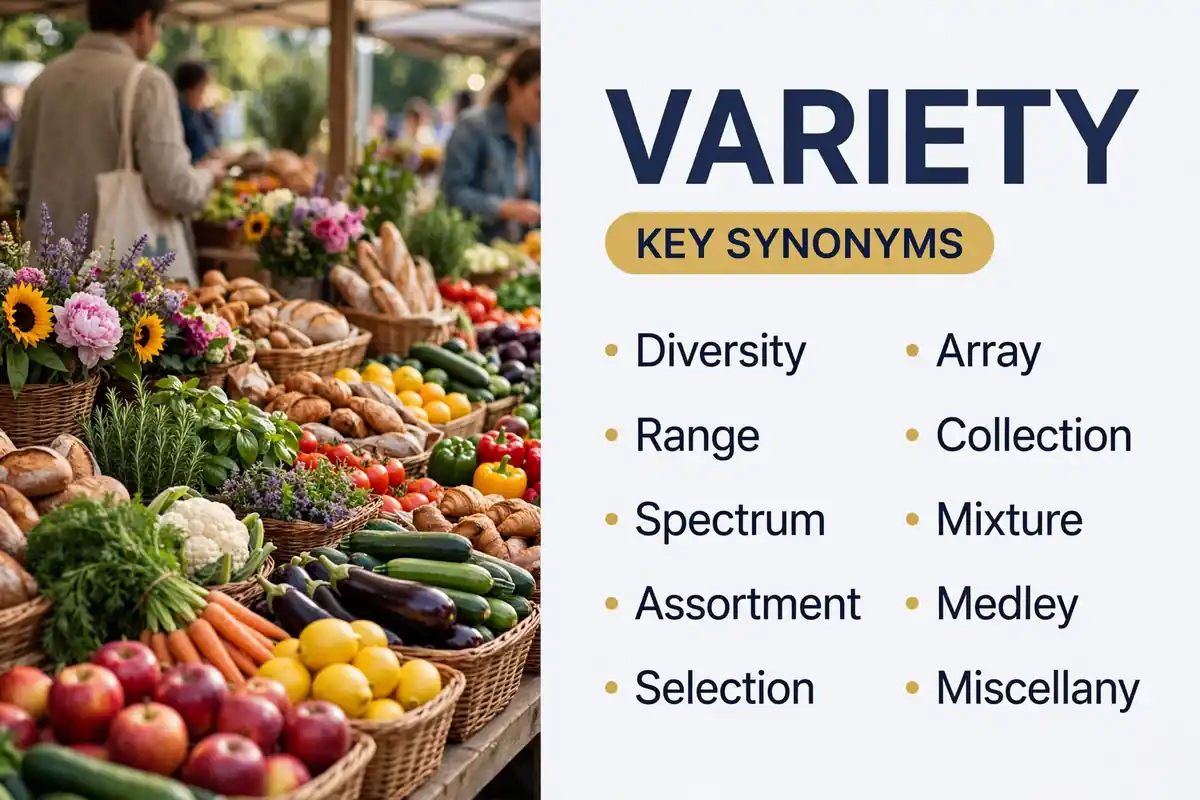
You write “a variety of options” in a report, and it sounds safe. You write it again in a menu, a playlist note and a garden plan and it starts to sound vague. The problem is not the word: variety covers too much at once, difference itself, a mixed assortment and a particular kind of a thing.
This guide sorts 15 variety synonyms by meaning, so you can name the exact kind of difference you mean. If the point is difference itself say diversity. If the point is a spread from low to high say range. And if the point is a mixed set say assortment.
Top 10 Variety Synonyms at a Glance
| # | Synonym | Meaning Difference |
|---|---|---|
| 1 | Diversity | Difference itself |
| 2 | Range | A spread, low to high |
| 3 | Spectrum | A continuous spread |
| 4 | Assortment | A mixed set together |
| 5 | Selection | Things chosen from a group |
| 6 | Array | An impressive display |
| 7 | Collection | Things gathered on purpose |
| 8 | Mixture | Different things combined |
| 9 | Medley | A lively mix |
| 10 | Miscellany | A mixed bunch, no theme |
Quick Facts About “Variety”
- Part of speech: a noun. You offer a variety, choose from a variety, or plant a variety of apple.
- Three core meanings: (1) difference itself, as in the variety of life in a forest, (2) a mixed assortment, as in a variety of snacks, (3) a particular kind or sort, as in a new variety of tomato.
- Count and noncount use: “a variety of” takes a plural noun, as in “a variety of books.” “A variety” alone can mean one kind, as in “this variety ripens early.”
- Register: neutral. Variety suits everyday speech, school writing, business reports, and science writing.
The Closest Synonym: Diversity
Diversity is the closest synonym for variety, because it covers the word’s most basic job: the fact or quality of being different. When a group, a place, or a set of ideas includes many different kinds, diversity names that difference directly.
Still, diversity is not identical to variety. It stresses difference itself, especially among people, backgrounds, or species. Variety is broader: it can also mean a mixed assortment, or one particular kind of plant.
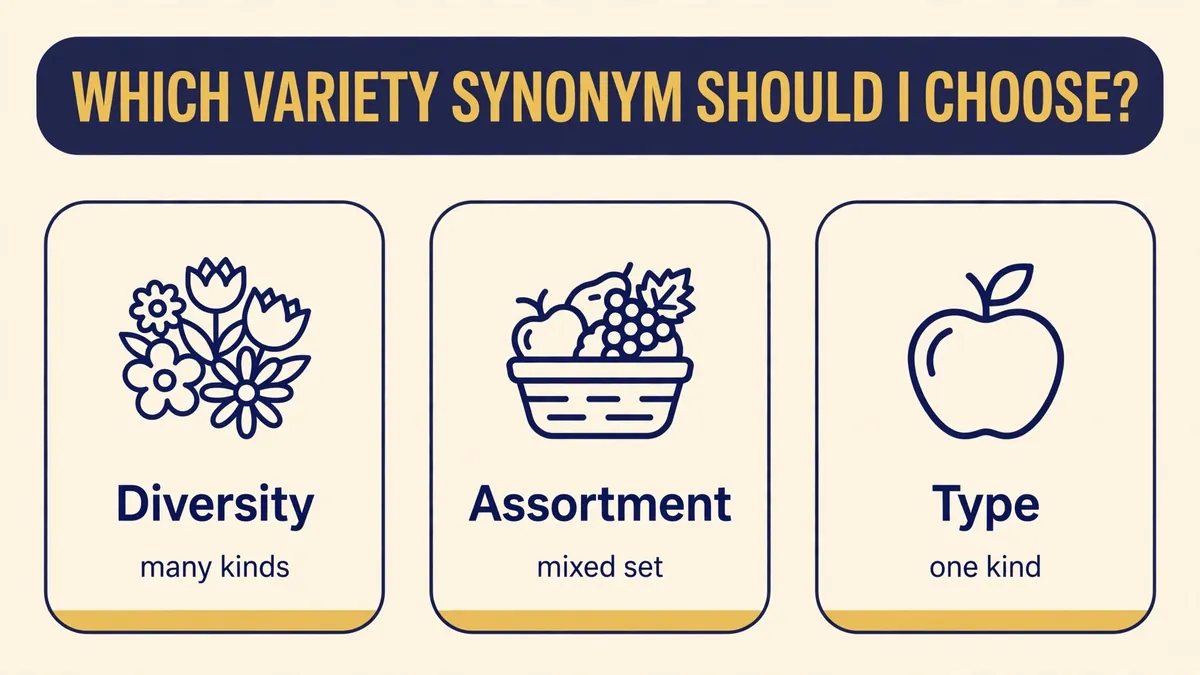
Choice test: for difference alone, diversity works. For a mixed set, use assortment or selection. For one kind, use sort or type.
Where “Variety” Comes From (Etymology)
According to Etymonline, the word is recorded in the 1540s with the sense of the fact or quality of being varied. It came through French variete and directly from Latin varietas, which covered difference and also a kind, species, or sort. That Latin word came from varius, meaning various. The sense of something different from others of the same kind is recorded from the 1610s.
Can You Swap Them Freely?
In short: only inside the same meaning group, and only when the sense matches. A kind word collapses in a sentence about difference itself, and a spread word in a sentence about a mixed snack box:
- ✅ “The festival celebrates the diversity of the city.” (difference itself ✔)
- ❌ “The festival celebrates the assortment of the city.” (assortment is a mixed set of things, not difference among people ✘, say diversity)
- ✅ “She planted a new variety of apple.” (one kind ✔, say sort or type)
- ❌ “She planted a new medley of apple.” (medley is a mix, not one kind ✘, say variety or sort)
Before you substitute, ask which sense you mean: difference, a set, a spread, or one kind.
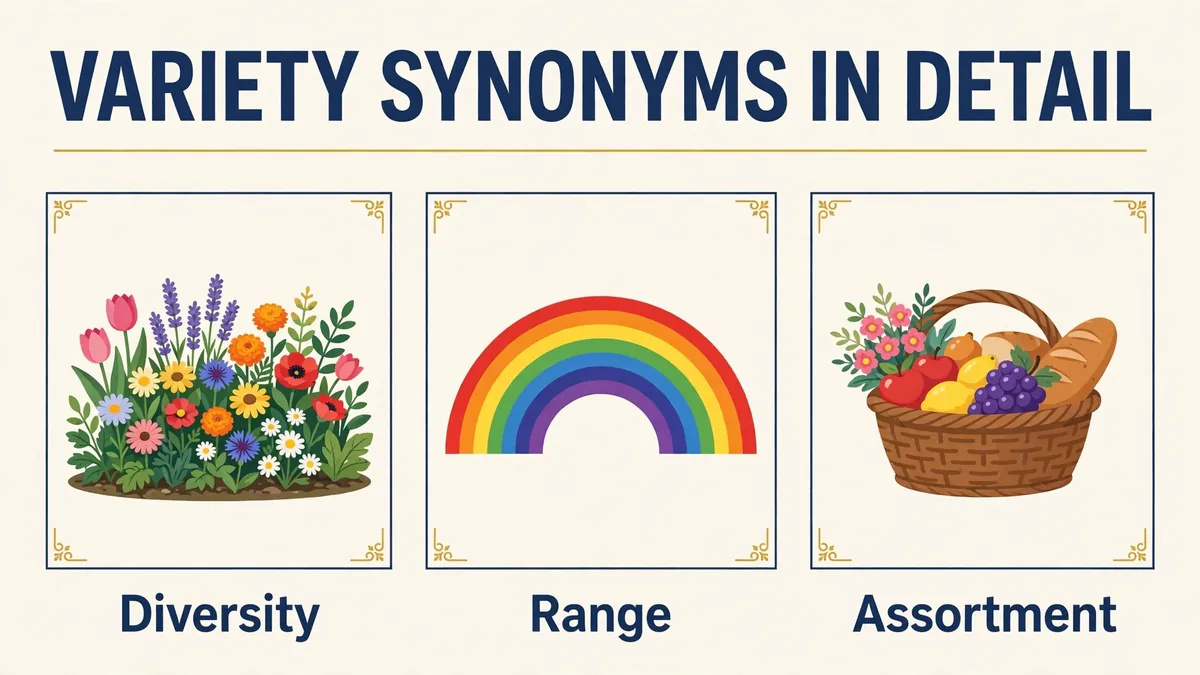
Variety Synonyms in Detail
Group 1: Diversity Itself
1. Diversity
- Meaning: The fact of including many different kinds, especially people, backgrounds, or species.
- Difference: The closest match for variety in its difference sense. It stresses difference itself.
- Best used for: Reports, essays, workplace writing, science writing.
- Formality: Neutral to formal · CEFR: C1 · Frequency: Very common
- Example (Work): “The team values diversity of experience, not just diversity of job titles.”
- Example (Nature): “The forest is prized for its diversity of birds, insects, and trees.”
- When NOT to use it: For a snack box or a shop display, where assortment or selection fits better.
2. Range
- Meaning: A spread of different things, amounts, or levels, from one end to another.
- Difference: Range stresses extent. It suits prices, ages, and sizes.
- Best used for: Shops, reports, school writing, product guides.
- Formality: Neutral · CEFR: B1 · Frequency: Very common
- Example (Shop): “The store stocks a wide range of shoes, from sandals to winter boots.”
- Example (School): “The test covers a range of topics, from fractions to simple graphs.”
- When NOT to use it: For one kind of plant, where sort or type fits better.
3. Spectrum
- Meaning: A continuous spread of different positions, colors, opinions, or levels, often between two extremes.
- Difference: Spectrum stresses a smooth, continuous scale. Range can list separate items; spectrum suggests a sliding scale.
- Best used for: Science, politics, health, essays.
- Formality: Neutral to formal · CEFR: C1 · Frequency: Common
- Example (Science): “The light covers a broad spectrum, from red to violet.”
- Example (Politics): “Voters across the political spectrum supported the new park.”
- When NOT to use it: For a mixed box of unrelated snacks, where assortment fits better.
Group 2: An Assortment of Things
4. Assortment
- Meaning: A mixed set of different things of the same general kind, gathered together.
- Difference: Assortment stresses a mixed set you can pick from. It is the everyday word for a mixed box or shelf.
- Best used for: Shops, food writing, gifts, everyday speech.
- Formality: Neutral · CEFR: B2 · Frequency: Very common
- Example (Food): “The box holds an assortment of chocolates, nuts, and dried fruit.”
- Example (Shop): “The market stall offers an assortment of jams in small jars.”
- When NOT to use it: For difference among people, where diversity fits better.
5. Selection
- Meaning: A set of things chosen from a larger group, often for quality or purpose.
- Difference: Selection stresses choice. Someone picked these items.
- Best used for: Shops, menus, catalogs, hiring, book lists.
- Formality: Neutral · CEFR: B1 · Frequency: Very common
- Example (Menu): “The menu offers a small selection of soups, salads, and grilled dishes.”
- Example (Shop): “The bookshop has a fine selection of novels for young readers.”
- When NOT to use it: For a random mixed bunch with no choosing, where miscellany fits better.
6. Array
- Meaning: An impressive, orderly, or striking display of different things.
- Difference: Array adds display and scale. It suits an impressive lineup, not a mixed pile.
- Best used for: Reports, journalism, product writing, formal descriptions.
- Formality: Neutral to formal · CEFR: C1 · Frequency: Common
- Example (Technology): “The lab uses an array of sensors to track weather changes.”
- Example (Food): “The table held an array of salads, breads, and cheeses for lunch.”
- When NOT to use it: For a casual mixed bunch, where assortment sounds more natural.
7. Collection
- Meaning: A group of things gathered together, often over time and on purpose.
- Difference: Collection stresses gathering and keeping. It suits stamps, books, and songs, not a snack box.
- Best used for: Hobbies, museums, music, libraries.
- Formality: Neutral · CEFR: B1 · Frequency: Very common
- Example (Music): “Her collection of folk songs spans five decades.”
- Example (Museum): “The museum added new coins to its collection this spring.”
- When NOT to use it: For a blended mix where items lose their separate form, where mixture fits better.
8. Mixture
- Meaning: Different things combined together, often so they blend or sit side by side.
- Difference: Mixture stresses combining. It suits ingredients, colors, and styles in one thing.
- Best used for: Cooking, science, art, everyday speech.
- Formality: Neutral · CEFR: B2 · Frequency: Very common
- Example (Cooking): “Stir the mixture of flour, eggs, and milk until it is smooth.”
- Example (Garden): “The border holds a mixture of roses, herbs, and tall grasses.”
- When NOT to use it: For a set of separate items you pick from, where selection fits better.
9. Medley
- Meaning: A lively, varied mix, often of music, food, performance, or vegetables.
- Difference: Medley adds energy and pleasure. It suits a cheerful mix, not a formal set.
- Best used for: Food writing, music, shows, menus.
- Formality: Neutral · CEFR: C1 · Frequency: Common
- Example (Food): “The grill serves a medley of peppers, zucchini, and mushrooms.”
- Example (Music): “The band closed with a medley of old pop songs.”
- When NOT to use it: In formal reports, where assortment or range sounds more measured.
10. Miscellany
- Meaning: A mixed bunch of different things with no single theme or order.
- Difference: Miscellany stresses randomness. It suits a drawer or box where items share little.
- Best used for: Writing, collections, humor, informal descriptions.
- Formality: Neutral to formal · CEFR: C1 · Frequency: Less common
- Example (Home): “The drawer held a miscellany of keys, buttons, and old tickets.”
- Example (Writing): “The book is a miscellany of essays, letters, and short notes.”
- When NOT to use it: For a carefully chosen set, where selection fits better.
Group 3: Mixed Collections and Kinds
11. Potpourri
- Meaning: A varied mix of different things, often scents, music, or ideas, gathered into one whole.
- Difference: Potpourri suggests a fragrant or artistic blend of unlike parts. It is more colorful than assortment and more literary than mixture.
- Best used for: Music, writing, home, arts.
- Formality: Neutral to formal · CEFR: C1 · Frequency: Less common
- Example (Music): “The concert was a potpourri of jazz, folk, and classical pieces.”
- Example (Home): “A bowl of potpourri scented the hallway with dried lavender and rose.”
- When NOT to use it: For one kind of plant, where sort or type fits better.
12. Blend
- Meaning: A combination in which different parts mix smoothly into one whole.
- Difference: Blend stresses smooth mixing. A mixture may stay separate; a blend feels joined.
- Best used for: Cooking, drinks, music, design.
- Formality: Neutral · CEFR: B2 · Frequency: Very common
- Example (Drinks): “The cafe sells a smooth blend of two coffee beans.”
- Example (Music): “The song is a blend of country guitar and soft pop vocals.”
- When NOT to use it: For separate items on a shelf, where assortment fits better.
13. Multitude
- Meaning: A very large number of different things or people.
- Difference: Multitude stresses sheer number. It suits crowds and options when the count impresses.
- Best used for: Formal writing, journalism, essays, speeches.
- Formality: Formal · CEFR: C1 · Frequency: Common
- Example (City): “The market offers a multitude of spices, teas, and dried fruits.”
- Example (Nature): “A multitude of birds visits the lake each spring.”
- When NOT to use it: For a small mixed set, where assortment is more honest.
14. Sort
- Meaning: A kind or type of a thing, as in a sort of apple, cheese, or problem.
- Difference: Sort is the everyday kind word. It names one kind, not difference in general or a mixed set.
- Best used for: Everyday speech, gardening, food, shopping.
- Formality: Neutral · CEFR: B1 · Frequency: Very common
- Example (Garden): “This sort of tomato ripens early and suits cool summers.”
- Example (Food): “What sort of cheese works best on this pasta?”
- When NOT to use it: For difference among people or ideas, where diversity fits better.
15. Type
- Meaning: A kind or class of a thing, often defined by shared features.
- Difference: Type is slightly more formal and classifying than sort. It suits science, products, and categories.
- Best used for: Science, products, reports, school writing.
- Formality: Neutral · CEFR: B1 · Frequency: Very common
- Example (Garden): “This type of apple stores well through winter.”
- Example (Technology): “What type of battery does this torch use?”
- When NOT to use it: For a mixed assortment, where assortment or selection fits better.
Best Alternatives by Context
Pick by the situation.
- Market stall case: A stall lists tomatoes, peppers, herbs, and bread on one table. For the mixed display, assortment wins. For the spread of prices, range wins. For one early-ripening tomato, sort wins.
- Menu case: A cafe menu needs a short, chosen list, so selection wins. For a cheerful plate of mixed vegetables, medley wins. For a smooth mix of two coffee beans, blend wins.
- Playlist case: A playlist moving smoothly from jazz to folk to pop is a medley when the mix feels lively, and a collection when the songs were gathered over years. For moods from calm to loud, spectrum wins.
- Garden case: Diversity wins for wildlife and plant life in general. Mixture wins for a border where roses, herbs, and grasses grow together. Type wins for one apple kind that stores well, and sort wins in everyday talk.
For nearby families, see interesting synonyms for holding attention, and bountiful synonyms for a plentiful supply.
Which Variety Synonym Should I Choose?
| Situation | Best pick | Why it wins |
|---|---|---|
| Difference itself | Diversity | Names difference directly |
| A spread from low to high | Range | Shows extent |
| A continuous scale | Spectrum | Smooth, between extremes |
| A mixed set to pick from | Assortment | A mixed set together |
| A chosen set | Selection | Choice is the point |
| An impressive display | Array | Orderly and striking |
| Things gathered over time | Collection | Gathering and keeping |
| Things combined or blended | Mixture | Combining is the point |
| A lively food or music mix | Medley | Cheerful and varied |
| A random mixed bunch | Miscellany | No single theme |
| A colorful artistic mix | Potpourri | Unlike parts, one whole |
| A smooth combined whole | Blend | Parts join smoothly |
| A very large number | Multitude | Sheer number impresses |
| One kind, everyday talk | Sort | Plain kind word |
| One kind, classifying talk | Type | Formal kind word |
Antonyms of Variety
1. Antonyms for variety as diversity or an assortment
| Antonym | Meaning Difference |
|---|---|
| Uniformity | Everything the same, no difference |
| Sameness | No difference between items |
| Monotony | Dull repetition, no change |
| Homogeneity | All of one kind, no mix |
| Singularity | Only one thing, no set |
| Standardization | Items forced to one standard |
2. Antonyms for variety as a kind or type
| Antonym | Meaning Difference |
|---|---|
| Uniformity | Only one standard kind allowed |
| Sameness | No distinct kind to choose |
| Homogeneity | All items of one kind only |
| Singularity | A single kind, nothing else |
| Monotony | No change of kind at all |
| Standardization | Kinds reduced to one standard |
Words Commonly Confused With Variety
Variety versus diversity is the closest pair to watch. Diversity names difference itself, especially among people, ideas, or species. Variety is broader and can also mean a mixed set or one kind. You praise the diversity of a team, but you plant a variety of apple.
Assortment versus selection matters for shops and menus. Assortment names a mixed set, chosen or not. Selection names a set picked on purpose. A gift box of mixed sweets is an assortment; a chef’s lunch list is a selection.
Sort versus type matters for kind talk. Sort is the everyday kind word, warm and plain. Type is the classifying word, slightly more formal and suited to science and products. At a market you ask what sort of cheese to buy; in a manual you read what type of battery a torch uses.
Substitution test failures: “The festival celebrates the assortment of the city” fails, because a city has people and cultures, not a snack box, so say “the diversity of the city.” “She planted a new medley of apple” fails, because medley is a mix, not one kind, so say “a new sort of apple.” “The drawer held a selection of keys, buttons, and old tickets” fails when nothing was chosen, so say “a miscellany of keys, buttons, and old tickets.”
American vs British English
Variety is spelled the same in American and British English, and so are all 15 synonyms here. One small point matters: the American variety store (a shop selling many cheap goods) is often called a discount store in Britain. This article uses American spelling throughout.
Collocations and Idioms With Variety
Only use combinations native speakers actually use:
- a wide variety: a large and varied set.
- a variety of: many different kinds of something.
- variety pack: a pack holding several different kinds.
- variety show: a stage or television show with many different acts.
- variety store: an American shop selling many kinds of cheap goods.
- variety is the spice of life: a saying that change and difference make life pleasant.
- a variety of reasons: many different reasons, not one cause.
Use a variety of with a plural noun, a wide variety of for a large set, and variety alone for one kind only in gardening, food, and product names.
Practice Exercises
Exercise 1: Menu-planning scenario set. You run a small cafe. Pick the best word from the brackets for each menu decision.
- The chef picks five dishes on purpose for the lunch menu. (assortment, selection, miscellany)
- The side plate mixes peppers, zucchini, and mushrooms in a cheerful way. (medley, multitude, spectrum)
- The coffee list moves smoothly from mild to strong, with no sharp jumps. (range, spectrum, potpourri)
- The market list names one early-ripening tomato kind for cool summers. (diversity, sort, blend)
- The dessert case holds a mixed box of sweets no one chose with a theme. (selection, assortment, miscellany)
Exercise 2: Spot the wrong word. Each sentence has one word that does not fit; name it and fix it.
- “The festival celebrates the assortment of the city.”
- “She planted a new medley of apple in the garden.”
- “The drawer held a selection of keys, buttons, and old tickets, though no one chose them.”
- “The shop stocks a diversity of shoes, from sandals to winter boots, at many prices.”
Answer key
- Exercise 1: (1) selection; (2) medley; (3) spectrum; (4) sort; (5) miscellany.
- Exercise 2: (1) assortment, use diversity; (2) medley, use sort; (3) selection, use miscellany; (4) diversity, use range.
Frequently Asked Questions
What is the best synonym for variety?
Diversity is the closest synonym when variety means difference itself, because it names that difference directly. For a mixed set, assortment is better. For a spread from low to high, range is better. For one kind, sort or type is better.
Can variety mean one kind of something?
Yes. In gardening, food, and product names, a variety is one kind among others, such as a variety of apple. In that sense, sort is the everyday replacement and type is the more formal one. Do not use assortment or medley there, because both name a mixed set, not a single kind.
What is the difference between variety and diversity?
Variety is the broader word: it can mean difference itself, a mixed assortment, or one particular kind. Diversity is narrower and means difference itself, especially among people, backgrounds, or species. When the point is difference among people or wildlife, diversity is sharper.
What is the difference between assortment and selection?
Assortment names a mixed set of different things, whether or not someone chose them with care. Selection names a set picked on purpose from a larger group, often for quality or fit. A gift box of mixed sweets is an assortment. A chef’s short lunch list is a selection. If choice is the point, use selection.
Is a variety of followed by a singular or plural noun?
A variety of is followed by a plural noun, such as a variety of books, songs, or reasons. The verb after it usually follows the plural noun in everyday use, as in “a variety of dishes are on offer.” The plural pattern is the common and safe choice here.
Which synonym should students use in essays?
In essays, prefer diversity for difference itself, range for a spread of options, and type for a kind in science writing. Reserve spectrum for continuous scales, multitude for very large numbers, and potpourri for artistic mixes. Avoid medley and miscellany in formal essays unless the mix itself is the point.
Conclusion
The right replacement for variety depends on which kind of difference you mean. Difference itself calls for diversity, a spread calls for range or spectrum, a mixed set calls for assortment or selection, a smooth mix calls for blend, and one kind calls for sort or type.
One last check: read the sentence aloud with the replacement in place. If it claims exactly what you meant, keep it. If not, swap again.

About Sajjad Ahmed
Sajjad Ahmed is the author behind Guest Paster, where he writes about English vocabulary, synonyms, word meanings, and practical word usage.
His content is designed to help readers understand the differences between similar words, discover suitable alternatives, and use English vocabulary more effectively in everyday writing and communication.
Before publishing, Sajjad focuses on presenting word choices in a clear and easy-to-understand format, with relevant meanings, context, and examples where helpful.
Through Guest Paster, his goal is to make vocabulary learning simpler and provide useful language resources for students, writers, English learners, and anyone looking to expand their vocabulary.
Areas of Focus: English Vocabulary • Synonyms • Word Meanings • Word Usage • Language Learning
Author: Sajjad Ahmed
Website: Guest Paster