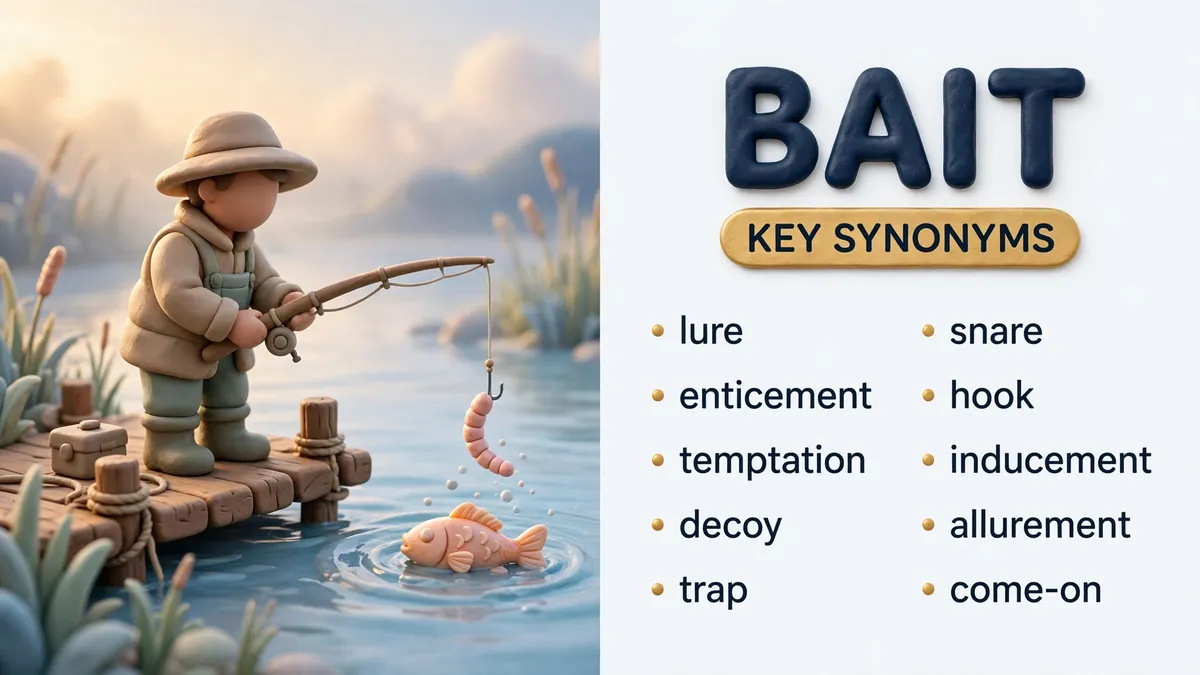
Bait is something that lures or tempts, and its closest synonym is lure. Dawn breaks over the lake as a fisherman threads a fat worm onto his hook. Below the surface, a perch circles the wriggling prize. The worm is the bait, the thing that tempts the fish to bite and the same word works far beyond the water. A free trial can be bait. A flashy headline can be bait.
A dare can be bait. The closest synonym is lure, which keeps the sense of drawing something in, while trap stresses the catch and temptation stresses the pull on your will.
This guide gives you 15 bait synonyms with meanings, examples, and honest limits so you can name the temptation without falling for it.
Top 10 Bait Synonyms at a Glance
| # | Synonym | Meaning Difference |
|---|---|---|
| 1 | Lure | The thing that draws someone in |
| 2 | Enticement | An attractive promise |
| 3 | Temptation | The pull on the will toward something unwise |
| 4 | Decoy | A fake used to mislead |
| 5 | Trap | The device or plan that catches |
| 6 | Snare | A hidden trap, often literary |
| 7 | Hook | The catching hardware, or the catchy part |
| 8 | Inducement | A formal offer that persuades |
| 9 | Allurement | The powerful pull of charm |
| 10 | Come-on | A casual, flirty invitation |
Quick Facts About “Bait”
- Part of speech: a noun and a verb.
- Core meaning: something used to lure or tempt, especially food put on a hook or in a trap.
- Three main senses: (1) food used to attract prey; (2) a tempting offer; (3) as a verb, to lure or to taunt.
- Register: neutral. Bait suits news reports, essays, fiction, and everyday speech.
- Common mistake: writing “baited breath.” The phrase is “bated breath,” from abated, meaning held back.
- Grammar note: as a noun it is countable (“several baits”) and also uncountable (“a box of bait”); as a verb it takes an object: bait the hook, bait the trap.
Where “Bait” Comes From (Etymology)
According to Etymonline, the noun bait meant “food put on a hook or trap to attract prey” around 1300. It came from Old Norse beita, “food, bait,” especially for fish, from beita, “to cause to bite,” from Proto-Germanic baitjan, the causative of bitan, “to bite,” which traces back to the PIE root bheid-, “to split.” The noun is a cousin of Old Norse beit, “pasture,” and Old English bat, “food.” The figurative sense, “a means of enticement,” is attested from around 1400.
The verb is older than the noun. Etymonline records bait as a verb around 1200 meaning “to torment or persecute someone,” and around 1300 meaning “to set a dog to bite and worry a confined animal for sport,” the old blood sport of bear-baiting. The fishing sense of the verb, “to put food on a line or in a trap,” appears around 1400, and “to lure by bait” from the 1590s. Merriam-Webster agrees: first known use of the verb in the 13th century, of the noun in the 14th.
That history explains why one word covers both a worm and a taunt. Bait began with biting, and both senses still bite.
The Closest Synonym: Lure
Lure is the closest synonym for bait: it names the same act of drawing something in with something attractive. Test the swap and it holds in both core senses. “The worm was good bait” becomes “The worm was a good lure” with no loss of sense. “The free trial was bait” becomes “The free trial was a lure” and still reads naturally.
Temptation runs a close second, yet it stresses the pull on the will rather than the thing itself. A temptation needs no object attached to it, while a lure is always the thing doing the attracting.
Choice test: the thing itself means lure, the pull means temptation, the closing means trap, and the sweetened offer means inducement.
Bait Synonyms in Details

Bait as a verb has two jobs: to put food on a hook or in a trap, and to provoke someone with taunts. The fifteen entries below are nouns; the taunting sense belongs to a different family, like provoke and tease.
Group 1: The Temptation, What Pulls You In
1. Lure
- Meaning: Something attractive that draws a person or animal in.
- Difference: The plainest swap, fitting both the object and the act.
- Best used for: Fishing, hunting, marketing, and stories.
- Formality: Neutral · CEFR: B2 · Frequency: Very common
- Example (Fishing): “The angler tied a bright lure to the line before dawn.”
- Example (Marketing): “A free dessert lured crowds to the new cafe.”
- When NOT to use it: When the thing is a trap that snaps shut, use trap instead.
2. Enticement
- Meaning: An attraction that promises pleasure or gain.
- Difference: It stresses the promise; lure stresses the drawing in.
- Best used for: Ads, offers, and formal writing.
- Formality: Neutral to formal · CEFR: B2 · Frequency: Common
- Example (Business): “The signing bonus was the enticement that sealed the deal.”
- Example (Travel): “Warm beaches were the enticement that sold the cruise.”
- When NOT to use it: For a literal fishing hook, use lure or bait.
3. Temptation
- Meaning: A strong pull toward something pleasant but unwise.
- Difference: It lives in the will, not the object, so it fits feelings better than tackle.
- Best used for: Moral choices, diets, spending, and everyday speech.
- Formality: Neutral · CEFR: B1 · Frequency: Very common
- Example (Home): “The cake on the counter was a temptation she could not ignore.”
- Example (Money): “A zero-interest card tempts careless spenders.”
- When NOT to use it: For the object on a hook, use lure.
Group 2: The Trap, What Closes Around You
4. Decoy
- Meaning: A fake thing used to draw attention away from the real one.
- Difference: A decoy pretends to be something else; bait promises something real.
- Best used for: Hunting, military writing, crime stories, and games.
- Formality: Neutral · CEFR: B2 · Frequency: Common
- Example (Hunting): “The hunter set out wooden ducks as decoys on the pond.”
- Example (Crime): “Police used a parked van as a decoy.”
- When NOT to use it: When the offer is genuine, use lure.
5. Trap
- Meaning: A device or plan that catches whoever walks into it.
- Difference: Trap stresses the catch; bait stresses the drawing in.
- Best used for: Pest control, crime, warnings, and figurative writing.
- Formality: Neutral · CEFR: A2 · Frequency: Very common
- Example (Home): “He set a trap in the pantry to catch the mice.”
- Example (Online): “The too-good-to-be-true job ad trapped job seekers.”
- When NOT to use it: For the attractive thing itself, use lure.
6. Snare
- Meaning: A loop that tightens around prey, or a hidden trap.
- Difference: Snare sounds older and more literary, and fits hidden dangers.
- Best used for: Literary writing, nature, and figurative warnings.
- Formality: Neutral to formal · CEFR: C1 · Frequency: Less common
- Example (Nature): “Rangers check the forest for illegal snares each spring.”
- Example (Money): “Debt is a snare for young earners.”
- When NOT to use it: In casual speech about a mouse trap, use trap.
7. Hook
- Meaning: A curved piece of metal that catches fish, or figuratively the thing that catches attention.
- Difference: Hook names the hardware; bait names what sits on it.
- Best used for: Fishing, music, marketing, and headlines.
- Formality: Neutral · CEFR: A2 · Frequency: Very common
- Example (Fishing): “He baited the hook with a live minnow.”
- Example (Music): “The song’s hook stays in your head for days.”
- When NOT to use it: For the food on the hook, use bait or worm.
Group 3: The Offer and the Hidden Trap
8. Inducement
- Meaning: Something offered to persuade a person to act.
- Difference: Inducement sounds formal and often means money or a reward; lure can be anything attractive.
- Best used for: Business, legal writing, and negotiations.
- Formality: Formal · CEFR: C1 · Frequency: Less common
- Example (Business): “The tax break was the inducement for the move.”
- Example (Work): “A bonus acted as an inducement to stay through the busy season.”
- When NOT to use it: In casual speech, use lure or offer.
9. Allurement
- Meaning: The quality of attracting someone powerfully, often with charm.
- Difference: Allurement is the pull itself and sounds literary; lure is the object doing the pulling.
- Best used for: Literary writing, romance, and formal essays.
- Formality: Formal · CEFR: C1 · Frequency: Rare
- Example (Literature): “The allurement of the open road called to her every spring.”
- Example (Travel): “The island’s allurement lay in its quiet beaches.”
- When NOT to use it: In everyday speech, use attraction or lure.
10. Come-on
- Meaning: An inviting remark or offer, often flirtatious, meant to attract someone.
- Difference: Come-on is casual, often flirting or sales patter; lure is neutral.
- Best used for: Dialogue, dating, and informal writing.
- Formality: Informal · CEFR: B2 · Frequency: Common
- Example (Dating): “His smooth come-on fell flat at the party.”
- Example (Sales): “The dealer’s come-on promised a car for almost nothing.”
- When NOT to use it: In formal writing, use inducement or invitation.
11. Sweetener
- Meaning: An extra benefit that makes an offer more attractive.
- Difference: A sweetener tops up a deal; bait is the main attraction.
- Best used for: Business, negotiations, and real estate.
- Formality: Neutral · CEFR: B2 · Frequency: Common
- Example (Business): “Free delivery was the sweetener that closed the sale.”
- Example (Real estate): “The seller added a sweetener: a year of free parking.”
- When NOT to use it: For a fishing lure, use lure.
12. Carrot
- Meaning: A reward offered to encourage someone, from a carrot dangled before a donkey.
- Difference: Carrot is always figurative, paired with stick, the threat behind it.
- Best used for: Politics, management, and opinion writing.
- Formality: Neutral · CEFR: B2 · Frequency: Common
- Example (Politics): “The grant acted as a carrot for towns that cut waste.”
- Example (Work): “A promotion was the carrot that kept the team working late.”
- When NOT to use it: For a literal fishing item, use bait or worm.
13. Draw
- Meaning: Something that pulls people to a place or event.
- Difference: Draw is about crowds and attention; bait targets one person.
- Best used for: Entertainment, tourism, and events.
- Formality: Neutral · CEFR: B2 · Frequency: Very common
- Example (Events): “The famous band was the big draw at the festival.”
- Example (Tourism): “The beach is the town’s main draw each summer.”
- When NOT to use it: For a trap or a trick, use lure or trap.
14. Bribe
- Meaning: Money or a gift offered to bend a decision dishonestly.
- Difference: A bribe is always improper; bait can be honest.
- Best used for: Crime, politics, and ethics discussions.
- Formality: Neutral · CEFR: B1 · Frequency: Very common
- Example (News): “The official was jailed for taking a bribe.”
- Example (Politics): “Voters saw the cash handout as a bribe.”
- When NOT to use it: For an honest free sample, use lure.
15. Honeypot
- Meaning: A trap set with something attractive to catch an intruder.
- Difference: A honeypot is deliberate and watched, often in cybersecurity; a trap can be accidental.
- Best used for: Cybersecurity, espionage, and crime writing.
- Formality: Neutral to formal · CEFR: C1 · Frequency: Less common
- Example (Tech): “The company set up a honeypot to study hackers.”
- Example (Crime): “Police used a honeypot account to catch the scammer.”
- When NOT to use it: In everyday speech, use trap.
Collocations and Idioms With Bait

Only combinations native speakers actually use:
- take the bait: to fall for the trick, as in “He took the bait and replied to the troll.”
- rise to the bait: to react to a provocation, as in “She refused to rise to the bait.”
- bait the hook: to put food on a hook, as in “Bait the hook before you cast.”
- bait and switch: advertising a cheap deal, then pushing a dearer one, as in “The store’s sale turned out to be a bait and switch.”
- clickbait: an online headline written to win clicks, as in “The article was pure clickbait.”
- swallow the bait: to accept the trick fully, as in “He swallowed the bait and signed the contract.”
Bait Online: Clickbait and Phishing
Online, bait shows up in two common traps. Clickbait is a headline that promises more than the story gives, and it works by teasing your curiosity. Phishing bait is a fake email or message that lures you to click a bad link or share a password. Both use the same trick as the worm on the hook: a tempting offer hides a cost. Check the sender and the link before you click, and treat any urgent free offer as bait until you prove it is real.
Can You Swap Them Freely?
In short: only inside the same meaning group, and only when the sense matches.
- ✅ “The worm was a good lure.” (the thing itself ✔)
- ❌ “The worm was a good temptation.” (temptation is the pull, not the object ✘, say lure)
- ✅ “The free trial was a temptation she could not resist.” (the pull on the will ✔)
- ✅ “The cheap price was a trap for careless buyers.” (the catch ✔)
- ❌ “The cheap price was a bribe for careless buyers.” (a bribe is improper payment ✘, say trap)
A lure promises something pleasant, while a trap hides a negative synonyms cost behind the offer. Before you substitute, ask which bait you mean: the thing, the pull, or the catch.
Words Commonly Confused With Bait
Bait versus lure is the pair to watch. Lure is the wider word. A flashing light can be a lure, a smell can be a lure, and a promise can be a lure, but none of them is bait. Bait is the thing itself, usually food on a hook or in a trap. A street performer’s music is a lure only.
Bait versus trap matters for the mechanism. Bait draws in, and trap closes. You bait a trap, which means you put the bait inside it. A worm is bait. A mousetrap is a trap. The two words work together, but they name different parts of the trick.
Bait versus bate is a spelling trap. “Bated breath” uses bate, a short form of abated, meaning held back or reduced. It describes waiting with your breath held in excitement. “Baited breath” is a common error: breath is not fishing tackle.
Bait versus bribe matters for honesty. A bribe is always improper, money or a gift offered to bend a decision. Bait can be honest: a free sample, a trial month, a worm on a hook.
The taunting verb deserves its own note. To bait a person is to provoke them, often with harsh synonyms words meant to sting. The synonyms for that sense are provoke, taunt, and tease, not lure or trap.
Substitution test failures: “Temptation, the worm on the hook was fresh” fails, because temptation is the pull, so say “Lure, the worm on the hook was fresh.” “Bribe, the shop offered a free sample” fails, because a bribe is improper, so say “Lure, the shop offered a free sample.”
Best Alternatives by Context
Advertisers build a lure the way they build a promote synonyms campaign. The table matches each scene to the word that fits best.
| Situation | Best pick | Why it wins |
|---|---|---|
| Fishing with a hook | Lure | The thing itself |
| A tempting offer in an ad | Enticement | The promise |
| A moral pull you should resist | Temptation | The will |
| A fake used to mislead | Decoy | Pretends |
| A plan that catches the careless | Trap | The catch |
| A reward that sweetens a deal | Sweetener | Added on top |
| A formal business incentive | Inducement | Formal |
| A cybersecurity trap | Honeypot | Watched and deliberate |
Which Bait Synonym Should I Choose?
| Situation | Best pick | Why it wins |
|---|---|---|
| The thing that draws someone in | Lure | Plainest swap |
| An attractive promise | Enticement | The promise |
| A pull on the will | Temptation | The feeling |
| A fake that misleads | Decoy | Pretends |
| The device that catches | Trap | The catch |
| A hidden, literary danger | Snare | Hidden |
| The hardware that hooks | Hook | The tool |
| A formal offer to persuade | Inducement | Formal |
| The powerful pull of charm | Allurement | The pull |
| A casual, flirty invitation | Come-on | Casual |
| An extra benefit on a deal | Sweetener | Added on top |
| A reward with a threat behind it | Carrot | Figurative |
| What pulls a crowd to an event | Draw | Crowds |
| An improper payment | Bribe | Dishonest |
| A watched trap for intruders | Honeypot | Deliberate |
Bait Opposites at a Glance
| Opposite | Meaning Difference |
|---|---|
| Deterrent | Something that discourages action |
| Repellent | Something that drives a person away |
| Disincentive | A reason not to act |
| Warning | A signal that stops you in time |
| Safeguard | Protection against a trick |
| Transparency | Open dealing, no hidden catch |
| Honesty | Straight dealing, no lure at all |
| Caution | Care that keeps you from biting |
Pick the opposite from the same sense. Deterrent undoes the pull of a lure, warning undoes the catch of a trap, and transparency undoes the trick behind a baited offer.
American vs British English
Bait is spelled and used the same in American and British English, and so are its synonyms here. “Bait and switch” is common on both sides of the Atlantic and clickbait is a global word.
One small difference is taste: British anglers talk about groundbait and maggots, while American anglers say live bait and cut bait. This article uses American spelling throughout.
Practice Exercises
Exercise 1: Odd one out. Pick the word that does NOT belong in each row.
- lure, enticement, temptation, deterrent
- decoy, trap, snare, sweetener
- bribe, carrot, inducement, hook
- come-on, allurement, draw, warning
Exercise 2: Replace bait with a sharper word. Choose a better synonym from this article.
- “The free dessert was the bait that filled the new cafe.”
- “The headline was pure bait, written only to win clicks.”
- “The discount was bait to get shoppers through the door.”
- “The police used a fake profile as bait to catch the scammer.”
Answer key
- Exercise 1: (1) deterrent; (2) sweetener; (3) hook; (4) warning.
- Exercise 2: (1) lure; (2) clickbait; (3) enticement; (4) honeypot.
Frequently Asked Questions
What is the best synonym for bait?
Lure is the best synonym, because it covers both the object on the hook and the act of drawing someone in. It passes the substitution test in fishing, marketing, and everyday speech. For the pull on the will, use temptation. For the closing mechanism, use trap.
What is the difference between bait and lure?
Bait is the thing itself, food on a hook or in a trap, while lure is the wider word for anything that draws someone in. A flashing light can be a lure, but it is not bait. Use bait for objects and lure when the attraction is a sound, a sight, or a promise.
What does “take the bait” mean?
To take the bait means to fall for a trick or a provocation. A fish takes the bait by biting the hook. A person takes the bait by replying to an insult or clicking a misleading headline. The phrase works in fishing, in arguments, and online.
Is bait the same as a trap?
No. Bait is the attractive thing that draws someone in, while a trap is the device or plan that catches them. You bait a trap, which means you put the bait inside it. A worm is bait. A mousetrap is a trap. The two words name different parts of the trick, so do not swap them.
What is the difference between bait and bate?
Bait means something used to lure or tempt, while bate is a short form of abated, meaning held back or reduced. The phrase is “bated breath,” waiting with your breath held in excitement. “Baited breath” is a common spelling error. The two words sound alike but share no meaning.
Which synonym should students use in essays?
In essays, use lure for the thing that attracts and temptation for the pull on the will. Use inducement for a formal offer and trap for a plan that catches the careless. Save allurement and honeypot for specialist writing, and avoid come-on in academic work.
Conclusion
The fisherman at dawn knew the bargain. His worm was honest bait: food on a hook, offered openly, with the risk plain to see. Most bait in daily life is less honest. A free trial hides a subscription, a headline hides a thin story, and a dare hides a bad choice.
Name the thing for what it is. Call the attraction a lure, the pull a temptation, and the closing mechanism a trap. When you can name the bait, you can decide whether to bite.

About Sajjad Ahmed
Sajjad Ahmed is the author behind Guest Paster, where he writes about English vocabulary, synonyms, word meanings, and practical word usage.
His content is designed to help readers understand the differences between similar words, discover suitable alternatives, and use English vocabulary more effectively in everyday writing and communication.
Before publishing, Sajjad focuses on presenting word choices in a clear and easy-to-understand format, with relevant meanings, context, and examples where helpful.
Through Guest Paster, his goal is to make vocabulary learning simpler and provide useful language resources for students, writers, English learners, and anyone looking to expand their vocabulary.
Areas of Focus: English Vocabulary • Synonyms • Word Meanings • Word Usage • Language Learning
Author: Sajjad Ahmed
Website: Guest Paster