
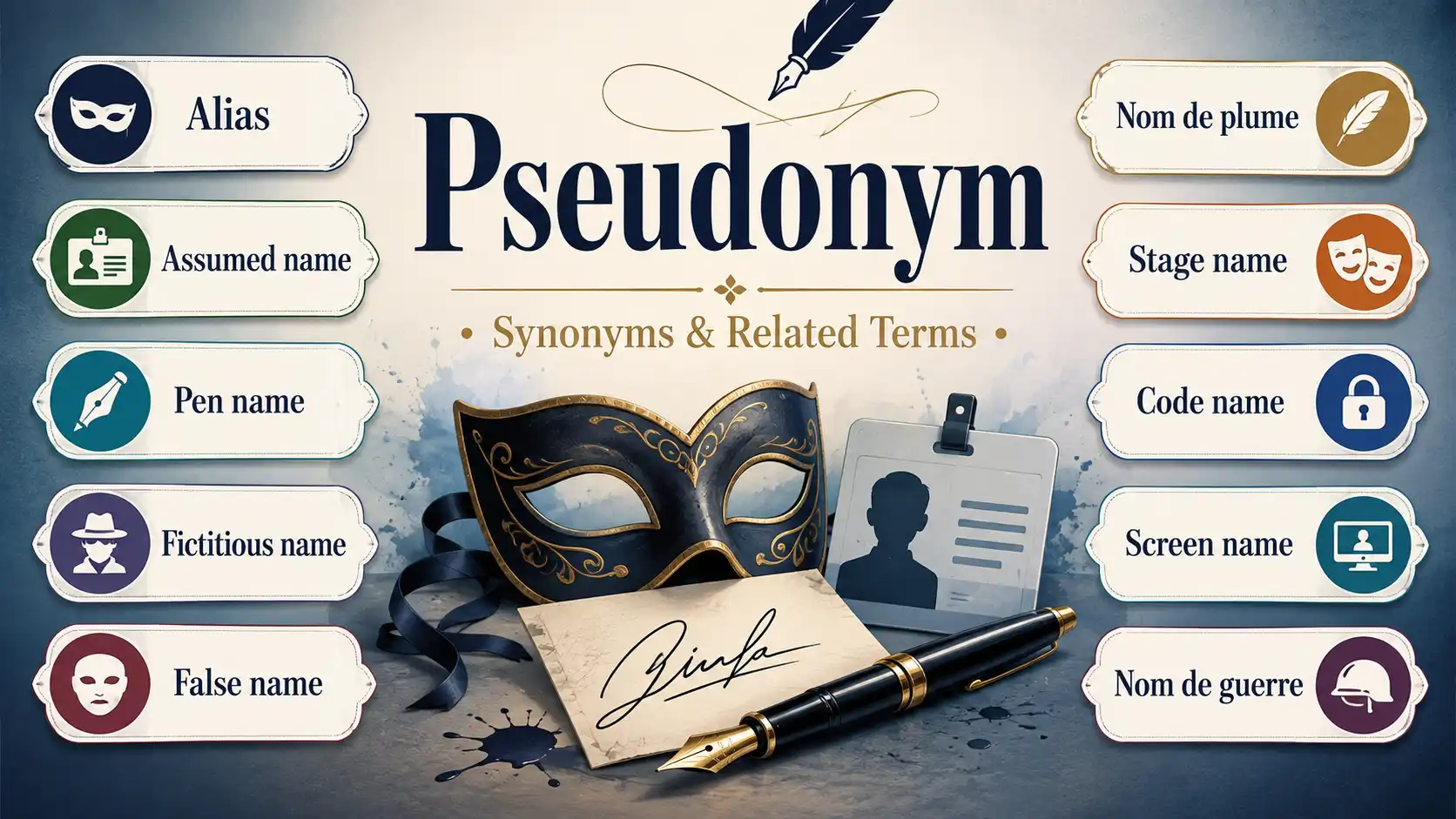
Synonyms for pseudonym include alias assumed name pen name fictitious name and nom de plume. A pseudonym is a made-up name that someone uses instead of their real name often for privacy, safety, creative identity or professional branding.
The best alternative depends on the situation and tone. A novelist may use a pen name, an actor may choose a stage name and someone protecting their identity may use an alias. For example: “The author published the mystery novel under the pseudonym Elena Frost.”
10 Best Synonyms for Pseudonym and Their Meanings
| Synonym | Simple Meaning |
| Alias | Another name used instead of a real name |
| Assumed name | A name deliberately adopted by someone |
| Pen name | A name used by a writer |
| Fictitious name | An invented name that is not the real one |
| False name | An untrue name often used to hide identity |
| Nom de plume | A literary name used by an author |
| Stage name | A professional name used by a performer |
| Code name | A secret name used for a person or project |
| Screen name | A name used online or in digital media |
| Nom de guerre | An assumed name used in political or military activity |
What Are Synonyms of Pseudonym?
Synonyms of pseudonym describe names used in place of a person’s real name. However they do not all carry the same meaning. Pen name is associated with writers while stage name belongs mainly to performers. Alias is broader and may sound secretive. The most natural choice depends on the person’s purpose, profession and desired tone.
Quick Facts About Pseudonym
Word: Pseudonym
Part of Speech: Noun
Simple Meaning: A name used instead of a person’s real name
Pronunciation: /ˈsuː.də.nɪm/
Syllables: 3 — pseu-do-nym
Origin: From Greek words meaning “false name” entering English through French
Formality: Neutral to formal; also common in academic and literary writing
Common Uses: Creative writing publishing research online identity privacy and professional performance
Example Sentence: The journalist used a pseudonym to protect the source’s identity.
Pseudonym Meaning and Usage
Basic Meaning
A pseudonym is a name that a person chooses and uses instead of their legal or real name. The person’s true identity may be publicly known, partly hidden or completely secret.
A writer, musician , actor , activist researcher or internet user may adopt a pseudonym. The purpose is not always deception. Many people use pseudonyms for artistic freedom, privacy, safety , memorability or professional branding.
Deeper Meaning
The word often suggests that the chosen name represents a separate public identity. A novelist’s pseudonym may become more famous than the novelist’s real name. In another situation a pseudonym may protect someone who is discussing a sensitive subject.
A pseudonym can therefore function as:
- A creative identity
- A privacy tool
- A professional brand
- A protective label
- A temporary identity
Emotional Tone
Pseudonym is generally neutral. It does not automatically suggest dishonesty. Its tone can become literary mysterious, protective or secretive depending on the context.
By contrast, a false name often sounds negative because it may suggest an intention to deceive. Pen name and stage name usually sound creative and professional.
Formality
Pseudonym is suitable for everyday explanations in journalism, academic writing, publishing and professional communication. In casual conversation people may use alias fake name or screen names although these alternatives are not always exact.
Real-Life Example
A teacher writing humorous novels might use a pseudonym so students do not immediately connect the books with the teacher’s professional identity.
Pseudonym Pronunciation
In American English pseudonym is pronounced:
/ˈsuː.də.nɪm/ — “SOO-duh-nim”
The first letter p is silent. The stress falls on the first syllable.
Pseudonym Meaning in Urdu
The general pseudonym meaning in Urdu is:
فرضی نام — farzi naam
This means an invented or assumed name.
For a writer’s pseudonym or pen name Urdu speakers may use:
قلمی نام — qalami naam
The phrase qalami naam specifically refers to a name used by an author poet or other writer.
Pseudonym in French
The French word for pseudonym is pseudonyme.
English originally adopted the word through French although its deeper roots are Greek. In both languages it refers to a name used in place of someone’s real name.
Pseudonym Meaning in Research
In research a pseudonym is a replacement name number or label assigned to a participant. It allows researchers to work with information without repeatedly showing the participant’s real identity.
For example a participant named Maria might appear in research notes as Participant 12 or Respondent A.
Pseudonymized information is not always fully anonymous. An authorized researcher may still be able to connect the replacement label to the real person through a separately protected identification key.
Pseudonym Examples
Well-known examples include:
- Mark Twain the pen name of Samuel Clemens
- George Eliot the pen name of Mary Ann Evans
- Dr. Seuss a professional name used by Theodor Seuss Geisel
A pseudonym does not need to be famous. A local columnist might write as The City Gardener while an online artist might publish work as LunaSketch.
Sample Pseudonym List
Here are ten sample-style pseudonyms:
Avery North Rowan Vale Mina Hart Theo Marsh Clara Voss Julian Reed Nora West Elias Stone Maya Rivers and Leo Ashford.
These are examples rather than guaranteed unique names. Before using a pseudonym professionally check that it is not strongly associated with another writer, performer, business or public figure.
Detailed Analysis of 22 Synonyms for Pseudonym
1. Alias
Relationship: Near synonym
Meaning: Another name by which a person is known.
Difference: An alias may be temporary, secret, informal or connected to suspicious activity. Pseudonym is more neutral and often creative.
Best Used For: General identity privacy records investigations or online activity.
Example: The blogger used the alias River Blue when discussing personal experiences.
2. Assumed Name
Relationship: Exact synonym
Meaning: A name that someone deliberately adopts instead of a real name.
Difference: Assumed name is direct and descriptive. Pseudonym sounds more formal and may suggest literary or professional use.
Best Used For: Formal explanations legal discussions privacy and general identity.
Example: She registered for the private support group under an assumed name.
3. Fictitious Name
Relationship: Exact synonym
Meaning: A name that has been invented rather than legally given.
Difference: Fictitious name emphasizes that the name is not real. Pseudonym focuses more on its use as an alternative identity.
Best Used For: Formal legal administrative and explanatory writing.
Example: The account was opened under a fictitious name.
4. Pen Name
Relationship: Near synonym
Meaning: A name used by an author instead of a real name.
Difference: Pen name applies specifically to writers. Pseudonym can be used by people in many professions.
Best Used For: Books articles poetry journalism and publishing.
Example: The novelist chose a pen name that was easier for readers to remember.
5. Nom de Plume
Relationship: Near synonym
Meaning: A French expression for a name used by a writer.
Difference: Nom de plume has a literary and slightly elegant tone. It is less common in everyday American English than pen names.
Best Used For: Literary criticism publishing history and formal writing.
Example: She released her first poetry collection under the nom de plume Celia Dawn.
6. False Name
Relationship: Near synonym
Meaning: A name that is not a person’s real name.
Difference: False name often suggests deception or wrongdoing. Pseudonym can be chosen for harmless professional or protective reasons.
Best Used For: Situations involving concealment, dishonesty or misleading identification.
Example: The caller gave a false name to avoid being identified.
7. Stage Name
Relationship: Contextual alternative
Meaning: A professional name used by an actor, singer, comedian or performer.
Difference: Stage name is limited to entertainment and public performance.
Best Used For: Acting music comedy dance and broadcasting.
Example: The singer selected a short stage name for concert posters.
8. Professional Name
Relationship: Contextual alternative
Meaning: A name used publicly in someone’s career.
Difference: A professional name may be a shortened legal name rather than a completely invented one.
Best Used For: Entertainment publishing business design and public-facing careers.
Example: She continues to use her professional name on all published artwork.
9. Performing Name
Relationship: Contextual alternative
Meaning: A name adopted for appearances or performances.
Difference: Performing name is more descriptive and less common than stage name.
Best Used For: Music theater dance live entertainment and broadcasting.
Example: His performing name appears on the festival schedule.
10. Screen Name
Relationship: Contextual alternative
Meaning: A name used on the internet or in digital communication.
Difference: A screen name identifies an online account and may not be intended to hide the user’s real identity.
Best Used For: Forums gaming platforms social media and chat services.
Example: Her screen name was inspired by her favorite constellation.
11. Username
Relationship: Contextual alternative
Meaning: The identifying name attached to an online account.
Difference: A username is a technical account label. It is not necessarily a separate personal identity.
Best Used For: Websites applications email services and online accounts.
Example: Choose a username that does not reveal private information.
12. Handle
Relationship: Contextual alternative
Meaning: An informal name used online on radio or within a group.
Difference: Handle is casual and strongly associated with digital platforms and informal communication.
Best Used For: Social media gaming radio communication and online communities.
Example: The photographer posts new work under the handle UrbanLight.
13. Online Alias
Relationship: Contextual alternative
Meaning: An alternative identity used on the internet.
Difference: Online alias emphasizes the digital setting while pseudonym can apply online or offline.
Best Used For: Social platforms communities games blogs and privacy discussions.
Example: He created an online alias for sharing his science-fiction stories.
14. Code Name
Relationship: Near synonym
Meaning: A secret name assigned to a person operation project or object.
Difference: A code name is usually created for secrecy or organization rather than public self-expression.
Best Used For: Military operations confidential projects security and product development.
Example: The team discussed the unfinished device under the code name Orion.
15. Cover Name
Relationship: Near synonym
Meaning: A name used to conceal someone’s real identity.
Difference: Cover name strongly suggests secrecy protection or undercover activity.
Best Used For: Intelligence work investigations security and confidential operations.
Example: The officer traveled using a carefully prepared cover name.
16. Nom de Guerre
Relationship: Contextual alternative
Meaning: An assumed name used during military political or revolutionary activity.
Difference: Nom de guerre belongs to a narrow historical or political context. It is not a general replacement for pseudonym.
Best Used For: History, politics, military writing and biography.
Example: The resistance leader became widely known by his nom de guerre.
17. Cryptonym
Relationship: Contextual alternative
Meaning: A secret name or coded label used to hide an identity.
Difference: Cryptonym is technical and uncommon in everyday speech. It often refers to intelligence or classified communication.
Best Used For: Intelligence studies history security and coded records.
Example: The agency assigned a cryptonym to the confidential source.
18. Allonym
Relationship: Contextual alternative
Meaning: Another person’s name adopted by a writer or creator.
Difference: A pseudonym is usually invented while an allonym is the real name of a different person.
Best Used For: Literary history authorship studies and specialized discussions.
Example: Scholars debated why the writer had published the essay under an allonym.
19. Literary Name
Relationship: Contextual alternative
Meaning: A chosen name used for writing or literary work.
Difference: Literary name is a descriptive phrase rather than a fixed technical term. It applies mainly to authors and then a fixed technical term. It applies mainly to authors and poets.
Best Used For: Simple explanations of authorship and publishing.
Example: The poet’s literary name appeared on every new collection.
20. Nickname
Relationship: Contextual alternative
Meaning: An informal or familiar name given to a person.
Difference: A nickname usually does not replace or conceal a real identity. It may be given by friends rather than chosen by the person.
Best Used For: Family friendship, school sports and informal communities.
Example: Everyone on the team knew Daniel by his nickname Flash.
21. Moniker
Relationship: Contextual alternative
Meaning: An informal name, nickname or label.
Difference: Moniker is casual and may refer to a real nickname rather than an invented identity.
Best Used For: Journalism entertainment writing and informal description.
Example: The chef earned the moniker Spice King from local customers.
22. Sobriquet
Relationship: Contextual alternative
Meaning: A descriptive nickname attached to a person.
Difference: A sobriquet is normally based on someone’s traits or reputation not created to hide a legal name.
Best Used For: Historical literary or formal descriptions of nicknames.
Example: The general received the sobriquet Iron Will because of his determination.
Synonyms for Pseudonym by Context
| Context | Best Choices |
| General identity | Alias assumed name fictitious name |
| Writing and publishing | Pen name nom de plume literary name |
| Acting and music | Stage name performing name professional name |
| Academic research | Participant code assumed identifier replacement name |
| Online communication | Screen name username handle online alias |
| Privacy and security | Cover name code name cryptonym |
| Political or military history | Nom de guerre code name |
| Informal conversation | Alias fake name nickname |
The phrase fake name is common in casual speech but it often sounds more negative than pseudonym and may imply dishonesty.
Exact vs. Similar Synonyms
Synonyms are rarely identical in every situation. Assumed name and fictitious name are the closest general replacements for pseudonym because both describe a name adopted in place of a real one. Alias is also close but it can sound more secretive or suspicious.
Other alternatives are limited by context. A pen name belongs to a writer, a stage name belongs to a performer and a screen name belongs to an online account. A code name usually protects confidential information rather than creating a public identity. Choosing the correct word therefore depends on the person’s purpose, the setting and whether the tone should sound creative, neutral , technical or secretive.
Antonyms and Contrasting Terms
Pseudonym has no perfect one-word antonym. The following terms express the contrasting idea of an authentic official or openly disclosed identity.
| Antonym or Contrast | Meaning | Example Sentence |
| Real name | The name a person actually uses as their identity | The publisher revealed the writer’s real name. |
| Legal name | A name officially recognized by law | Enter your legal name on the application. |
| Birth name | The name recorded or given at birth | The biography included the actor’s birth name. |
| Official name | A name formally accepted by an institution | Her official name appears on the certificate. |
| Registered name | A name entered in an official record | The registered name must match the identification document. |
| Full name | A person’s complete name | Please write your full name at the top of the form. |
| True identity | The actual identity behind another name | Reporters tried to discover the artist’s true identity. |
| Disclosed identity | An identity that has been openly revealed | The source agreed to a disclosed identity after the report was published. |
Common Collocations with Pseudonym
| Phrase | Meaning | Example Sentence |
| Use a pseudonym | Operate or publish under another name | The columnist chose to use a pseudonym. |
| Adopt a pseudonym | Begin using a selected alternative name | She adopted a pseudonym before releasing her first novel. |
| Choose a pseudonym | Select an alternative name | He chose a pseudonym that matched the tone of his stories. |
| Write under a pseudonym | Create written work using another name | The journalist wrote under a pseudonym for several years. |
| Published under a pseudonym | Release work using an assumed name | The author published the memoir under a pseudonym. |
| Be known by a pseudonym | Become recognized through another name | The street artist is known by a pseudonym. |
| Protect someone with a pseudonym | Hide a real identity for privacy or safety | The study protected each participant with a pseudonym. |
| Reveal a pseudonym | Disclose that a name is not the real one | The performer later revealed that the name was a pseudonym. |
Frequently Asked Questions
What is the closest synonym for pseudonym?
The closest general synonyms are assumed name, fictitious name and alias. For a writer pen name is usually the most natural choice. The correct alternative depends on whether the name is being used for creativity, privacy , professional branding or secrecy.
Is a pseudonym the same as being anonymous?
No. A pseudonym gives a person a consistent alternative name while anonymity means that the person’s identity is not provided. Someone using a pseudonym may still become well known and the connection to the person’s real identity may be public.
What does pseudonym mean in research?
In research a pseudonym is a replacement label used instead of a participant’s real name. It helps reduce unnecessary exposure of personal information. However authorized researchers may still be able to identify the participant through a separately stored code or record.
How do you choose a good pseudonym?
Choose a name that is memorable, easy to pronounce appropriate for your audience and suitable for your work. Check search engines publishing platforms and trademark databases to avoid confusion with established people or brands. Do not choose a name intended to impersonate someone.
Conclusion
Choosing the right synonym for pseudonym makes writing clearer and more precise. Alias works in general situations while pen name, stage name and screen name belong to specific contexts.
Consider purpose, tone profession and privacy before selecting the most natural alternative.

About Sajjad Ahmed
Sajjad Ahmed is the author behind Guest Paster, where he writes about English vocabulary, synonyms, word meanings, and practical word usage.
His content is designed to help readers understand the differences between similar words, discover suitable alternatives, and use English vocabulary more effectively in everyday writing and communication.
Before publishing, Sajjad focuses on presenting word choices in a clear and easy-to-understand format, with relevant meanings, context, and examples where helpful.
Through Guest Paster, his goal is to make vocabulary learning simpler and provide useful language resources for students, writers, English learners, and anyone looking to expand their vocabulary.
Areas of Focus: English Vocabulary • Synonyms • Word Meanings • Word Usage • Language Learning
Author: Sajjad Ahmed
Website: Guest Paster