The most common mistake with principle has nothing to do with its synonyms. Writers type principal when they mean principle and the error slips past spellcheck because both words are correct English. Principle spelled with le at the end, names a rule or belief that guides behavior.
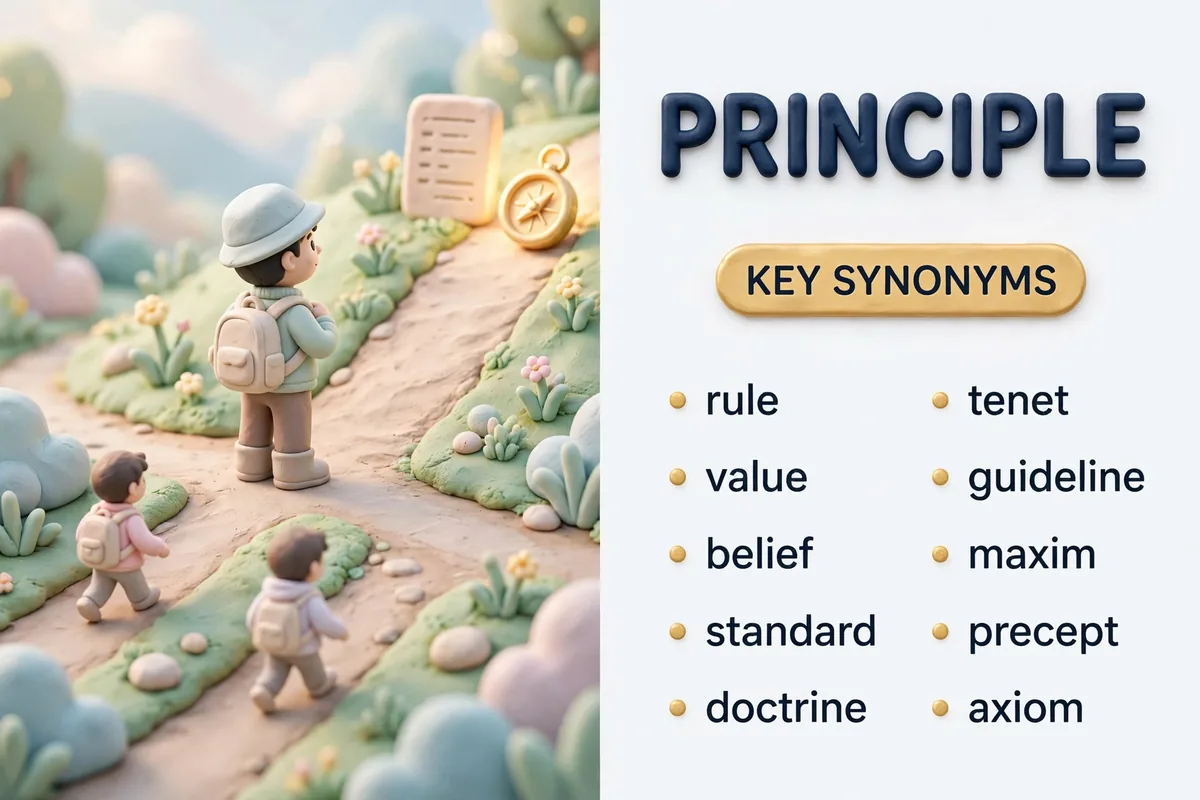
Principal spelled with pal, names a person in charge or the main thing. Remember it this way: the principal is your pal and a principle is a rule. The closest synonym is rule which swaps cleanly into most such sentences. Value fits a personal belief, axiom fits a scientific truth and doctrine fits a system of beliefs.
10 Principle Synonyms at a Glance
| # | Synonym | Meaning Difference |
|---|---|---|
| 1 | Rule | A guide for action |
| 2 | Value | What matters most |
| 3 | Belief | Something held to be true |
| 4 | Standard | A level expected |
| 5 | Doctrine | Taught beliefs |
| 6 | Tenet | A belief held by a group |
| 7 | Guideline | A suggested rule |
| 8 | Maxim | A short, wise rule for living |
| 9 | Precept | A rule for moral conduct |
| 10 | Axiom | Accepted without proof |
Quick Facts About “Principle”
- Part of speech: a noun. It has no verb form; the adjective is principled.
- Core meaning: a rule or belief that guides behavior; also, a fundamental truth.
- Three main senses: (1) a rule or belief that guides behavior; (2) a fundamental truth or law; (3) a code of conduct.
- Register: neutral to formal. Principle suits essays, speeches, and everyday speech.
- Common mistake: writing principal, the person in charge, for principle, the rule.
The Closest Synonym: Rule
Rule is the closest synonym for principle, because it carries the same core idea of a guide for behavior, without adding the weight of belief or faith. Test the swap and it holds. “Honesty is a guiding principle” becomes “Honesty is a guiding rule” with no loss of sense. “He follows the principle of treating others fairly” becomes “He follows the rule of treating others fairly.”
Rule is plainer than principle, and that plainness is its strength. Principle sounds loftier, more tied to conscience and character. Value runs a close second for the belief sense, yet it names what a person holds dear rather than the guide itself. Choice test: a guide means rule; a conviction means value; a truth that needs no proof means axiom.
Where “Principle” Comes From (Etymology)
According to Etymonline, principle entered English in the late 14th century meaning “origin, source, beginning,” a sense now obsolete, and also “rule of conduct; axiom, basic assumption.” It came from Anglo-French principle and Old French principe, from Latin principium, “a beginning, commencement, origin,” from princeps, “first man, chief leader,” from primus, “first,” plus the root of capere, “to take.” The English -l- came by analogy with words such as participle, and also principal. The sense of “a right rule of conduct” is recorded from the 1530s, and the scientific sense from 1802. Merriam-Webster records the first use in the 14th century.
That history explains the word’s dignity and its famous confusion. Principle began as a word about first things, the foundations on which the rest is built. Because principal shares the same Latin root princeps, the two words have sounded alike for centuries, and writers have mixed them ever since.
Principle Synonyms in Detail
Group 1: A Rule or Belief That Guides Behavior
1. Rule
- Meaning: A stated guide for how to act.
- Difference: The plainest swap, without the moral weight.
- Best used for: Everyday speech and school writing.
- Formality: Neutral · CEFR: A2 · Frequency: Very common
- Example (School): “The first lab rule is to wear safety goggles.”
- Example (Family): “Our house rule: no phones at dinner.”
- When NOT to use it: For a moral conviction, use principle.
2. Value
- Meaning: A belief about what matters most, such as honesty.
- Difference: A value names what is dear; a principle is the guide that follows.
- Best used for: Personal essays and mission statements.
- Formality: Neutral · CEFR: B1 · Frequency: Very common
- Example (Work): “Honesty is a core value here; every hire hears it on day one.”
- Example (Family): “She learned the value of hard work from her parents.”
- When NOT to use it: For a scientific law, use axiom.
3. Belief
- Meaning: Something accepted as true, often without proof.
- Difference: Belief is broader than principle.
- Best used for: Essays and opinion pieces.
- Formality: Neutral · CEFR: A2 · Frequency: Very common
- Example (Opinion): “His belief in second chances shapes every decision.”
- Example (History): “The belief in free speech guided the founders.”
- When NOT to use it: For a formal code, use code.
4. Standard
- Meaning: A level of quality or conduct expected of people.
- Difference: A standard measures performance; a principle guides choice.
- Best used for: Business and education writing.
- Formality: Neutral to formal · CEFR: B2 · Frequency: Very common
- Example (Work): “The hospital holds nurses to a high standard of care.”
- Example (School): “Teachers set a clear standard for honest work.”
- When NOT to use it: For a personal conviction, use principle.
5. Guideline
- Meaning: A suggested rule that points people in the right direction.
- Difference: A guideline advises; a principle commands.
- Best used for: Workplace manuals and health advice.
- Formality: Neutral · CEFR: B2 · Frequency: Very common
- Example (Health): “The new guidelines suggest eight hours of sleep for adults.”
- Example (Work): “Follow the brand guidelines on every client slide.”
- When NOT to use it: For a moral absolute, use principle.
6. Maxim
- Meaning: A short, wise saying that states a rule for living.
- Difference: A maxim is phrased to be remembered.
- Best used for: Speeches, essays, and quotations.
- Formality: Neutral to formal · CEFR: C1 · Frequency: Less common
- Example (Speech): “Her favorite maxim: do unto others as you would have them do unto you.”
- Example (Writing): “The maxim ‘honesty is the best policy’ still holds in business.”
- When NOT to use it: For a formal law, use law.
7. Precept
- Meaning: A rule for moral conduct, often from a teacher or a text.
- Difference: Precept sounds older and more formal, and often comes from authority.
- Best used for: Religious writing and philosophy.
- Formality: Formal · CEFR: C1 · Frequency: Less common
- Example (Philosophy): “The precept to harm no living thing guides the monk.”
- Example (Education): “The school’s oldest precept: character matters more than grades.”
- When NOT to use it: In casual speech, use rule instead.
Group 2: A Fundamental Truth or Law
8. Doctrine
- Meaning: Beliefs taught as true by a group.
- Difference: A doctrine belongs to a system.
- Best used for: Religious and political writing.
- Formality: Formal · CEFR: C1 · Frequency: Common
- Example (Religion): “The doctrine of grace shapes the church’s teaching on forgiveness.”
- Example (Politics): “The Monroe Doctrine set out America’s stance abroad.”
- When NOT to use it: For a single personal rule, use principle.
9. Tenet
- Meaning: A belief held by a group.
- Difference: A tenet is one belief; a doctrine is the whole set.
- Best used for: Academic and political essays.
- Formality: Formal · CEFR: C1 · Frequency: Less common
- Example (Religion): “One tenet of the faith is that all people are equal.”
- Example (Politics): “Free speech is a tenet the party refuses to give up.”
- When NOT to use it: For a scientific truth, use axiom.
10. Axiom
- Meaning: A statement accepted as true without proof.
- Difference: An axiom starts reasoning; it does not guide behavior.
- Best used for: Mathematics, science, and logic.
- Formality: Formal · CEFR: C1 · Frequency: Less common
- Example (Math): “Two points define a straight line, an axiom every geometry student learns.”
- Example (Science): “The axiom that energy is conserved underpins physics.”
- When NOT to use it: For a moral guide, use principle.
11. Law
- Meaning: A general truth of nature, or a rule enforced by a state.
- Difference: A scientific law always holds; a social law can be broken.
- Best used for: Science and legal writing.
- Formality: Neutral to formal · CEFR: A2 · Frequency: Very common
- Example (Science): “The law of gravity explains why the apple falls.”
- Example (Society): “The law requires every driver to wear a seat belt.”
- When NOT to use it: For a personal moral guide, use principle.
12. Canon
- Meaning: A rule accepted as correct, often in art or religion.
- Difference: A canon carries the weight of tradition.
- Best used for: Art history and literary criticism.
- Formality: Formal · CEFR: C1 · Frequency: Less common
- Example (Art): “The canon of classical sculpture still shapes how artists study form.”
- Example (Religion): “The church canon lists the books accepted as scripture.”
- When NOT to use it: In everyday speech, use rule instead.
Group 3: A Code of Conduct
13. Code
- Meaning: Rules a group agrees to follow.
- Difference: A code is written down and shared.
- Best used for: Professional ethics and workplace writing.
- Formality: Neutral · CEFR: B2 · Frequency: Very common
- Example (Work): “The company code forbids gifts from suppliers.”
- Example (Medicine): “Doctors swear to a code that puts patients first.”
- When NOT to use it: For a single personal belief, use principle.
14. Creed
- Meaning: Beliefs that define a person’s faith.
- Difference: A creed is declared aloud as a statement of faith.
- Best used for: Religious writing and personal essays.
- Formality: Formal · CEFR: C1 · Frequency: Less common
- Example (Religion): “The church creed is recited every Sunday morning.”
- Example (Business): “The founder’s creed: serve the customer first, and profit will follow.”
- When NOT to use it: For a scientific truth, use axiom.
15. Dogma
- Meaning: A belief laid down by authority.
- Difference: Dogma adds rigidity and resists questioning.
- Best used for: Religious and political writing.
- Formality: Formal · CEFR: C1 · Frequency: Less common
- Example (Politics): “The party’s dogma left no room for debate.”
- Example (Religion): “He challenged his church’s dogma and paid a heavy price.”
- When NOT to use it: For a positive personal guide, use principle, since dogma sounds negative.
Words Commonly Confused With Principle
Principle versus principal is the pair that causes the most trouble. The two words share the Latin root princeps, so they sound alike and spellcheck cannot save you. Principle, ending in -le, is always a noun meaning a rule or belief. Principal, ending in -pal, means the main person or thing: a school principal, the principal actor, the principal amount of a loan. The trick is simple: the principal is your pal, and a principle is a rule.
Test the pair. “The principal of the school spoke at assembly” names a person, so principal is correct. “Honesty is my guiding principle” names a rule, so principle is correct. Swap them and the sentence breaks.
Principle versus rule matters for weight. A rule can be small and practical, such as no phones at the table. A principle carries moral weight, such as honesty at all costs. Conscience calls for principle; a handbook calls for rule.
Principle versus law matters for force. A law is enforced by the state, and breaking it brings a fine or a jail term. A principle is enforced only by conscience. In science, a law describes what always happens. For the legal side, see our guide to lawyer synonyms.
Principle versus value matters for shape. A value names what a person holds dear, such as kindness. A principle turns that value into a guide for action, such as always tell the truth. Our guide to values synonyms.
Substitution test failures: “The principle of the school spoke at assembly” fails, because a principle is a rule, not a person, so say “principal.” “The tenet of gravity explains the falling apple” fails, because a tenet is a group belief, so say “law.”
Can You Swap Them Freely?
In short: only inside the same meaning group, and only when the sense matches.
- ✅ “Honesty is a guiding rule in our family.” (a guide for behavior ✔)
- ❌ “Honesty is a guiding axiom in our family.” (an axiom is a starting truth ✘, say rule)
- ✅ “The axiom that energy is conserved underpins physics.” (a starting truth ✔)
- ❌ “The doctrine that energy is conserved underpins physics.” (a doctrine is a taught set of beliefs ✘, say axiom)
- ✅ “One tenet of the faith is that all people are equal.” (a group belief ✔)
- ❌ “One guideline of the faith is that all people are equal.” (a guideline is a suggestion ✘, say tenet)
Before you substitute, ask which principle you mean: the rule, the truth, or the code. Match the synonym to the sense.
Best Alternatives by Context
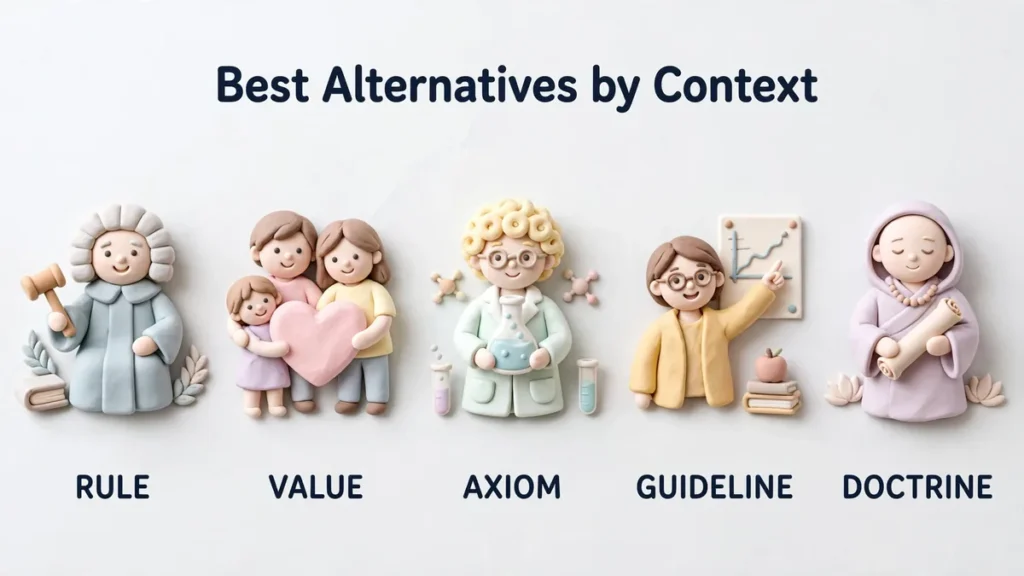
Six scenes, each with the best word.
Scene 1: You are writing a job application. Call honesty a principle, and show it with one example. A rule sounds too small; a value too vague.
Scene 2: You are writing a school essay about a historical figure. Name her guiding idea a doctrine when it belonged to a group, or a tenet when it was one belief among several. For the code she lived by, principle is right.
Scene 3: You are writing a company values page. Value is the natural word for each item, and principle is the word for how values turn into daily decisions. A code fits the document employees sign; a creed fits the founder’s statement.
Scene 4: You are writing a science report. The starting truth of your argument is an axiom, and the truth your experiment tests is a law. A rule fits the lab procedure; a guideline fits the safety advice.
Scene 5: You are writing a personal essay about a hard choice. You refused a shortcut because honesty mattered more than speed. Here principle is the only honest word, since the choice came from conscience, not from a handbook. Our guide to purpose synonyms can help you name what it was really about.
Scene 6: You are writing a speech for a graduation. The audience needs one idea to carry home. A maxim does that job best, because it is short enough to remember. “Honesty is the best policy” lands where a principle would need a paragraph.
Which Principle Synonym Should I Choose?
| Situation | Best pick | Why it wins |
|---|---|---|
| A stated guide for action | Rule | Plain |
| A belief about what matters | Value | What is dear |
| Something held to be true | Belief | Broad |
| A level expected | Standard | Measures it |
| Beliefs taught as truth | Doctrine | The system |
| One belief of a group | Tenet | One of several |
| A suggested rule | Guideline | Advises |
| A short rule for living | Maxim | Easy to remember |
| A rule for moral conduct | Precept | Formal |
| A truth accepted without proof | Axiom | The start |
| A general truth of nature | Law | Always holds |
| A standard of tradition | Canon | Carries history |
| A shared set of rules | Code | Written |
| A declared statement of faith | Creed | Declared |
| A belief accepted without question | Dogma | Rigid |
Collocations and Idioms With Principle
Only combinations native speakers actually use:
- in principle: in theory, as in “I agree in principle, but the cost worries me.”
- on principle: because of a rule you live by, as in “She refused on principle.”
- first principles: the basic truths of a subject, as in “He reasoned from first principles.”
- a matter of principle: a question of right and wrong, as in “It was a matter of principle.”
- guiding principle: the main rule that shapes decisions, as in “Honesty is our guiding principle.”
- a man of principle: a person who lives by strong rules, as in “He was a man of principle.”
- stick to your principles: to refuse to give them up, as in “She stuck to her principles.”
American vs British English
Principle is spelled and used the same in American and British English, and so are its synonyms here. One difference is the word principal itself.
In American English, the head of a school is the principal, which feeds the confusion with principle. In British English, the head of a school is usually the headteacher. This article uses American spelling throughout.
Principle Antonyms by Meaning
For the guiding-rule sense: what ignores or breaks a rule
| Opposite | How It Differs |
|---|---|
| Expediency | Choosing the easy path |
| Opportunism | Grabbing the advantage |
| Compromise | Giving ground to reach a deal |
| Corruption | Breaking rules |
| Lawlessness | Living with no rules |
For a moral guide, expediency is the cleanest opposite. Principle refuses the easy path; expediency takes it.
For the fundamental-truth sense: what is false or unproven
| Opposite | How It Differs |
|---|---|
| Fallacy | A false belief dressed as logic |
| Falsehood | A statement that is untrue |
| Error | A mistake in reasoning |
| Myth | A story without evidence |
For a truth that needs no proof, fallacy is the direct opposite. An axiom stands firm; a fallacy collapses under a close look.
For the code-of-conduct sense: what has no code at all
| Opposite | How It Differs |
|---|---|
| Anarchy | No rules, no order |
| Chaos | Disorder with no code |
| Unscrupulousness | Acting with no code |
| License | Freedom without restraint |
For a shared code, anarchy is the strongest opposite. A code holds a group together; anarchy pulls it apart.
Pick the opposite from the same sense. Expediency undoes a moral guide, fallacy undoes a truth, and anarchy undoes a shared code.
Practice Exercises
Exercise 1: Fill in the blank. Choose the best synonym from this word bank: rule, value, axiom, doctrine, guideline, maxim.
- The lab’s first ___ is to label every sample.
- Two points define a straight line, an ___ every geometry student learns.
- “Honesty is the best policy” is a ___ the shopkeeper lived by.
- The new health ___ suggest eight hours of sleep for adults.
- Kindness is a core ___ at the firm.
- The ___ of grace shapes the church’s teaching.
Exercise 2: Principle or principal? Choose the right word.
- The ___ of the school spoke at the morning assembly.
- She refused on ___ to sign a false statement.
- The ___ reason for the delay was heavy rain.
- Honesty is the guiding ___ of his whole career.
Answer key
- Exercise 1: (1) rule; (2) axiom; (3) maxim; (4) guidelines; (5) value; (6) doctrine.
- Exercise 2: (1) principal; (2) principle; (3) principal; (4) principle.
Frequently Asked Questions
What is the best synonym for principle?
Rule is the best synonym for the everyday sense, because it names a stated guide for how to act and passes the substitution test in most cases. For a conviction, use value. For a scientific truth, use axiom. Match the synonym to the sense.
What is the difference between principle and principal?
Principle, ending in le, is a noun meaning a rule or belief. Principal, ending in pal, means the main person or thing, such as a school principal. The trick is simple: the principal is your pal, and a principle is a rule.
Is principle the same as a rule?
Not quite. A rule is the plainest swap, and it fits small guides such as no phones at the table. A principle carries moral weight, such as honesty at all costs. Both guide behavior, yet principle sounds loftier. Use rule for handbooks and principle for conscience.
What does “in principle” mean?
In principle means in theory, before the details are settled. “I agree in principle” means you accept the idea, though the cost or the timing may still worry you. The phrase is common in business and law on both sides of the Atlantic.
What is the opposite of principle?
It depends on the sense. For a moral guide, the opposites are expediency and opportunism, which choose the easy path. For a fundamental truth, use fallacy or falsehood. And for a shared code, use anarchy or chaos. Pick from the same meaning group.
Which synonym should students use in essays?
In essays, use rule for a stated guide and value for a belief about what matters most, because both sound clear. Use axiom only in science, and save doctrine and tenet for religion or politics. Keep principle for the moral guide at the heart of your argument.
Conclusion
Stand at the crossroads above and the choice is yours. One path is easy, the other is honest, and the word you pick tells the reader which one you took.
Rule fits the sign on the wall, value fits the belief in your chest, axiom fits the truth your argument stands on.

About Sajjad Ahmed
Sajjad Ahmed is the author behind Guest Paster, where he writes about English vocabulary, synonyms, word meanings, and practical word usage.
His content is designed to help readers understand the differences between similar words, discover suitable alternatives, and use English vocabulary more effectively in everyday writing and communication.
Before publishing, Sajjad focuses on presenting word choices in a clear and easy-to-understand format, with relevant meanings, context, and examples where helpful.
Through Guest Paster, his goal is to make vocabulary learning simpler and provide useful language resources for students, writers, English learners, and anyone looking to expand their vocabulary.
Areas of Focus: English Vocabulary • Synonyms • Word Meanings • Word Usage • Language Learning
Author: Sajjad Ahmed
Website: Guest Paster