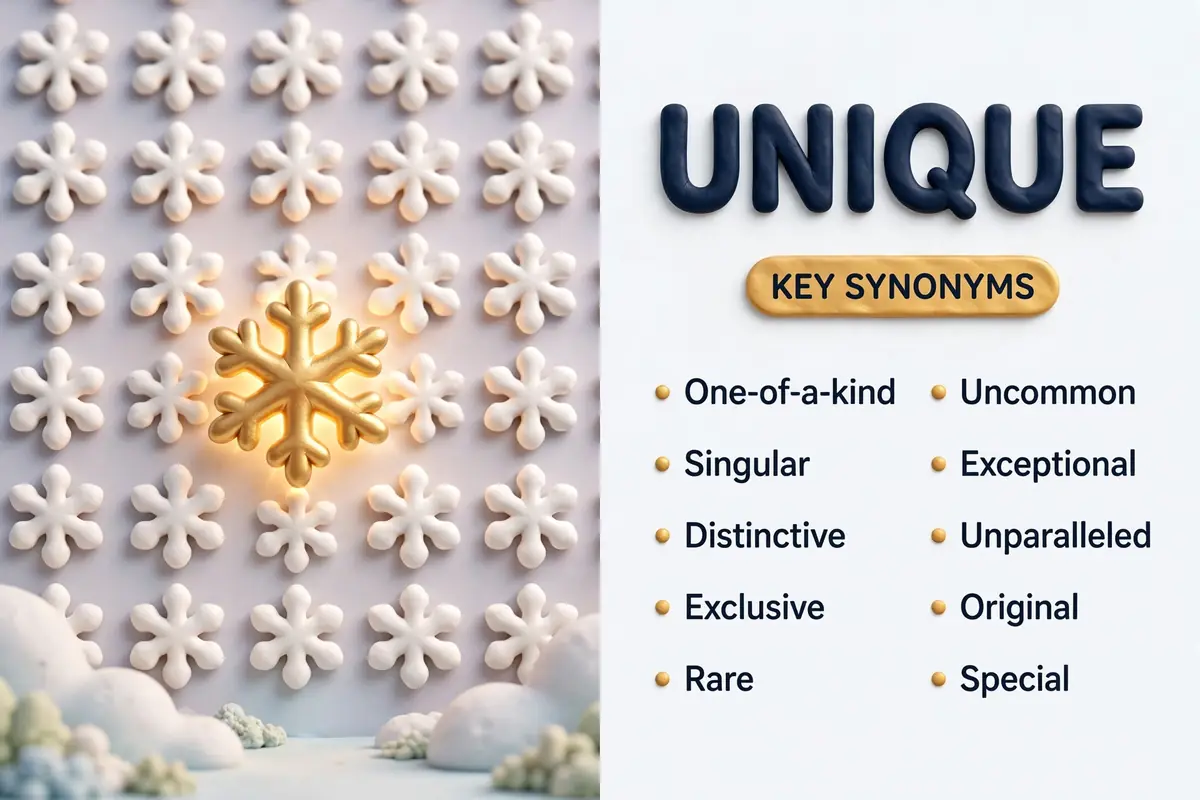
Unique means the only one of its kind, with no match anywhere. No two snowflakes share the same shape. A science teacher once showed her class two microscope photos and said “Every single one is unique.” The class gasped anyway, because the word carries wonder as well as fact. Use unique when something is the only one of its kind or when it stands out so sharply that nothing else compares.
The closest match is one-of-a-kind, which keeps the “only one” sense without the grammar debate. Singular suits a remarkable person, distinctive suits a recognizable style and rare suits something hard to find.
Top 10 Unique Synonyms at a Glance
| # | Synonym | Meaning Difference |
|---|---|---|
| 1 | One-of-a-kind | The only one that exists |
| 2 | Singular | Strikingly individual, hard to match |
| 3 | Distinctive | Easy to recognize at a glance |
| 4 | Exclusive | Limited to a few, not shared |
| 5 | Rare | Hard to find, seldom seen |
| 6 | Uncommon | Not usual, less often than most |
| 7 | Exceptional | Far above the usual standard |
| 8 | Unparalleled | With no equal anywhere |
| 9 | Original | Fresh, not copied from anything |
| 10 | Special | Pleasingly different, important to you |
Quick Facts About “Unique”
- Part of speech: an adjective.
- Core meaning: being the only one of its kind; also, very special or unusual.
- Three main senses: (1) the only one; (2) unusual or remarkable; (3) distinctive or characteristic of a person or thing.
- Register: neutral to slightly formal. Unique works in essays, reviews, ads, and everyday speech.
- Common mistake: calling everything unique. When ten hotels offer the same sea view, none of them is unique.
- Grammar note: unique is absolute in its strict sense, so “very unique” draws criticism in formal writing, although it is common in casual speech.
The Closest Synonym: One-of-a-Kind
One-of-a-kind is the closest synonym for unique: it keeps the strict “only one” sense with no extra baggage. A fingerprint is one of a kind. A snowflake is one of a kind. A letter written once, by hand, and never copied is one of a kind. The phrase passes the substitution test in every strict case where unique means the only one that exists.
Singular runs a close second, yet it leans toward striking character and can hint at strangeness. One-of-a-kind stays plain and exact. It works in a product listing, a wedding speech, and a science report without changing its meaning.
Choice test: no second copy exists, say one-of-a-kind; a remarkable person stands out, say singular; a style is easy to spot, say distinctive; something is scarce, say rare.
Where “Unique” Comes From (Etymology)
According to Etymonline, unique entered English around 1600 meaning “single, solitary,” from French unique (16th century), from Latin unicus, “only, single, sole, alone of its kind,” from unus, “one.” The meaning “forming the only one of its kind” is attested from the 1610s, while the looser sense “remarkable, uncommon” appears from the mid-19th century. Merriam-Webster records the first known use in 1601.
That history explains the modern tension around the word. Its old core is absolute, one of a kind, while its newer sense grades quality. So “very unique” feels natural to many speakers today and wrong to others. The word grew two jobs, and the argument follows it everywhere.
Can You Swap Them Freely?
In short: only inside the same meaning group, and only when the sense matches.
- ✅ “Her fingerprint is one-of-a-kind.” (only one exists ✔)
- ❌ “Her fingerprint is rare.” (rare means hard to find, not the only one ✘, say one-of-a-kind)
- ✅ “The chef’s distinctive style sets the restaurant apart.” (recognizable at a glance ✔)
- ❌ “The chef’s exclusive style sets the restaurant apart.” (exclusive is about access, not style ✘, say distinctive)
- ✅ “It was an exceptional performance.” (far above the usual standard ✔)
- ❌ “It was an unparalleled opportunity, and three other firms got the same deal.” (unparalleled means no equal ✘, say rare)
A word about “very unique” before the details. In formal writing, keep unique ungraded for the strict sense, since nothing can be more “only” than another. In casual speech, “very unique” is widely understood when unique means unusual. Merriam-Webster’s usage guide agrees: when unique means unusual or rare, phrases like “very unique” are standard. Match the register to the room.
Unique Synonyms in Details
Group 1: One of a Kind, the Only One
1. One-of-a-Kind
- Meaning: The only one of its kind in existence.
- Difference: The purest swap for unique in its strict sense.
- Best used for: People, places, objects, and experiences with no equal.
- Formality: Neutral · CEFR: B2 · Frequency: Common
- Example (Art): “The gallery owns a one-of-a-kind sketch Picasso drew on a napkin.”
- Example (Travel): “Our cabin sits on a one-of-a-kind stretch of coastline.”
- When NOT to use it: When several similar things exist, say rare or unusual instead.
2. Singular
- Meaning: Remarkably individual, standing apart from the rest.
- Difference: Adds a note of striking character, sometimes strangeness.
- Best used for: A remarkable person, talent, or achievement.
- Formality: Neutral to formal · CEFR: C1 · Frequency: Less common
- Example (Music): “Her singular voice stopped the whole hall mid-sentence.”
- Example (Science): “The team made a singular breakthrough after years of dead ends.”
- When NOT to use it: For a plain object with no equal, one-of-a-kind is plainer.
3. Distinctive
- Meaning: Easy to recognize because it differs from the rest.
- Difference: Distinctive is about the mark a thing leaves, not its rank.
- Best used for: Style, voice, design, and branding.
- Formality: Neutral · CEFR: B2 · Frequency: Common
- Example (Design): “The logo’s distinctive curve shows up on every bag.”
- Example (Music): “His distinctive laugh opens every episode.”
- When NOT to use it: For the only copy in existence, use one-of-a-kind.
4. Exclusive
- Meaning: Limited to one person or group, not shared with others.
- Difference: Exclusive is about access, not about being unlike everything else.
- Best used for: Clubs, offers, interviews, and access.
- Formality: Neutral · CEFR: B2 · Frequency: Very common
- Example (Business): “Members get exclusive access to the new collection.”
- Example (News): “The paper ran an exclusive interview with the mayor.”
- When NOT to use it: For a recognizable style or a rare object, use distinctive or rare.
5. Rare
- Meaning: Not found often, scarce.
- Difference: Rare counts how often a thing appears, while unique counts whether a second one exists.
- Best used for: Opportunities, collectibles, conditions, and chances.
- Formality: Neutral · CEFR: A2 · Frequency: Very common
- Example (Shopping): “The market sells rare first editions at fair prices.”
- Example (Health): “Doctors study the rare condition in a handful of patients.”
- When NOT to use it: For the only copy in the world, say one-of-a-kind.
6. Uncommon
- Meaning: Not usual, happening less often than most things.
- Difference: Softer than rare, and it fits habits and traits as well as objects.
- Best used for: Traits, habits, names, and weather.
- Formality: Neutral · CEFR: B2 · Frequency: Common
- Example (Names): “Uncommon names suit her; she picked Wren for her daughter.”
- Example (Weather): “Snow in April is uncommon here, though not unheard of.”
- When NOT to use it: For a one-time event with no equal, use singular or one-of-a-kind.
7. Exceptional
- Meaning: Far above the usual standard, outstanding.
- Difference: Exceptional grades quality, so it pairs naturally with very.
- Best used for: Performance, quality, service, and talent.
- Formality: Neutral to formal · CEFR: B2 · Frequency: Very common
- Example (Work): “Her exceptional report won the client in one meeting.”
- Example (School): “The teacher praised his exceptional essay on the solar system.”
- When NOT to use it: For the only example of its kind, use one-of-a-kind.
8. Unparalleled
- Meaning: With no equal anywhere, beyond comparison.
- Difference: The strongest claim in the set, so it needs proof behind it.
- Best used for: Records, achievements, and luxury claims.
- Formality: Formal · CEFR: C1 · Frequency: Less common
- Example (Sports): “Her unparalleled record of twelve titles still stands.”
- Example (Travel): “The hotel promises unparalleled views of the bay.”
- When NOT to use it: When others share the quality, say exceptional instead.
9. Original
- Meaning: New, fresh, not copied from anything else.
- Difference: Original points at the source, while distinctive points at the look.
- Best used for: Ideas, art, writing, and research.
- Formality: Neutral · CEFR: B1 · Frequency: Very common
- Example (Writing): “Her original plot twists keep readers guessing to the last page.”
- Example (Science): “The lab published original data on coral bleaching.”
- When NOT to use it: For a style that is recognizable but old, use distinctive.
10. Special
- Meaning: Different from the usual in a pleasing or important way.
- Difference: Special is the warmest and vaguest word here, so it fits feelings better than facts.
- Best used for: Occasions, people, gifts, and memories.
- Formality: Neutral · CEFR: A1 · Frequency: Very common
- Example (Family): “Grandma saved her special recipe for birthdays only.”
- Example (Events): “The town plans a special parade for its centenary.”
- When NOT to use it: In a formal report, pick distinctive or exceptional.
11. Unmatched
- Meaning: Not equaled by any other, the best of its kind.
- Difference: Close to unparalleled, but more at home in ads and reviews.
- Best used for: Products, service, and quality claims.
- Formality: Neutral · CEFR: C1 · Frequency: Common
- Example (Shopping): “The shop offers unmatched prices on handmade rugs.”
- Example (Work): “His unmatched eye for detail saved the launch.”
- When NOT to use it: For a person, singular or exceptional sounds warmer.
12. Inimitable
- Meaning: So distinctive that nobody can copy it.
- Difference: Inimitable points at the copy, not at the thing itself.
- Best used for: Style, voice, craft, and signature work.
- Formality: Formal · CEFR: C1 · Frequency: Less common
- Example (Writing): “Her inimitable voice fills every page of the memoir.”
- Example (Cooking): “The chef’s inimitable sauce keeps diners guessing.”
- When NOT to use it: In casual speech, use one-of-a-kind instead.
Group 2: Unusual or Remarkable in a Good Way
13. Extraordinary
- Meaning: Beyond what is ordinary, remarkable.
- Difference: Extraordinary carries surprise, while exceptional carries quality.
- Best used for: Events, feats, claims, and stories.
- Formality: Neutral · CEFR: B2 · Frequency: Very common
- Example (News): “Rescuers told an extraordinary story of survival.”
- Example (Nature): “The desert blooms after rain in an extraordinary display.”
- When NOT to use it: For steady high quality with no surprise, use exceptional.
14. Remarkable
- Meaning: Worth noticing, striking enough to remember.
- Difference: Remarkable is the mildest praise word here, warm and safe.
- Best used for: People, progress, recovery, and small wonders.
- Formality: Neutral · CEFR: B2 · Frequency: Very common
- Example (Health): “Her remarkable recovery surprised the whole ward.”
- Example (History): “The town keeps a remarkable archive of letters from 1910.”
- When NOT to use it: For the single best of its kind, use unparalleled.
Group 3: Distinctive, Characteristic of a Person or Thing
15. Peculiar
- Meaning: Strange in a way that marks something out.
- Difference: Peculiar can sound odd or even unfriendly, so it needs a kind context.
- Best used for: Habits, tastes, and local customs.
- Formality: Neutral · CEFR: B2 · Frequency: Common
- Example (Food): “The village keeps a peculiar custom of eating cake at breakfast.”
- Example (Home): “The old house has a peculiar smell of cedar and rain.”
- When NOT to use it: For praise, use distinctive or special instead.
Which Unique Synonym Should I Choose?
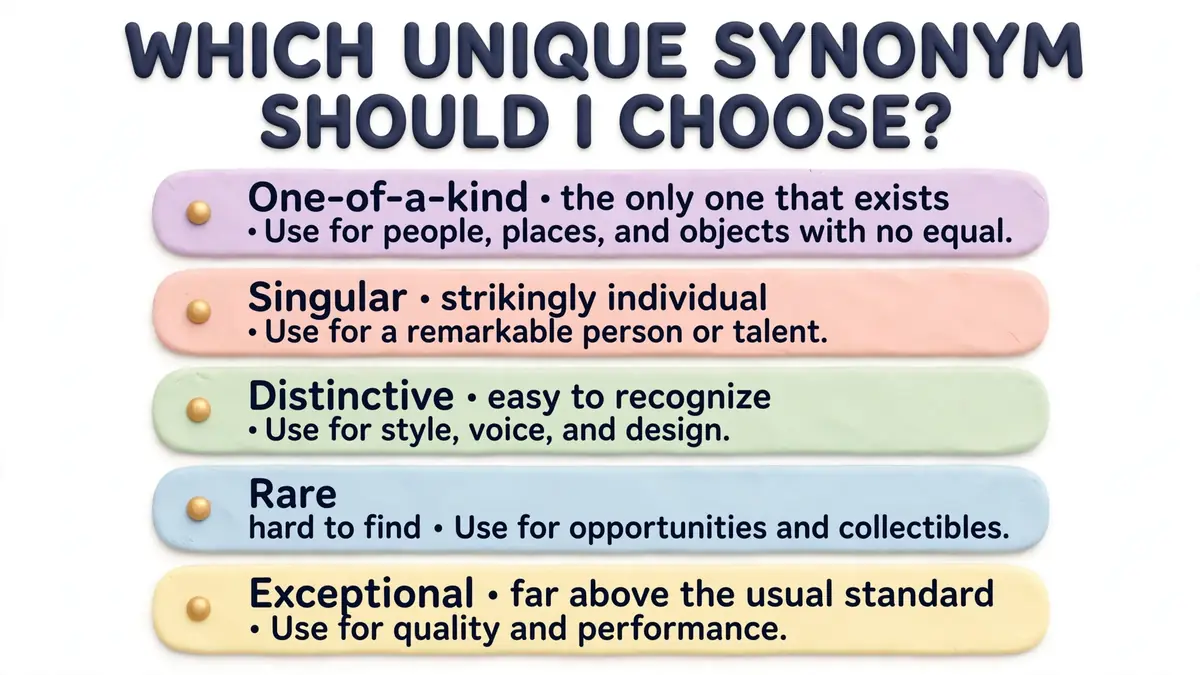
| Situation | Best pick | Why it wins |
|---|---|---|
| The only one that exists | One-of-a-kind | Means exactly that |
| A remarkable person or talent | Singular | Strikes the eye |
| Access limited to a few | Exclusive | About who gets in |
| A record with no equal | Unparalleled | Strongest claim |
| The best product or service | Unmatched | Confident, commercial |
| A style nobody can copy | Inimitable | Points at the copy |
| Something scarce | Rare | Counts how often |
| An unusual habit or trait | Uncommon | Soft and flexible |
| Quality far above standard | Exceptional | Grades the work |
| A surprising event or feat | Extraordinary | Carries wonder |
| Something worth remembering | Remarkable | Warm, safe praise |
| A recognizable look or sound | Distinctive | About the mark |
| A fresh idea, not copied | Original | Points at the source |
| A warm, important occasion | Special | Fits feelings |
| An odd but telling habit | Peculiar | Marks it out |
Best Alternatives by Context
Five everyday scenes, each with the word that fits best.
Scene 1: You are writing a college essay about a scientist. Call her singular for the person and unparalleled for the record she set. Keep one-of-a-kind for the single instrument she built by hand, since nothing like it exists in any other lab.
Scene 2: You are writing a product review. Praise the build with exceptional when the quality beats the price, and unmatched when no rival comes close on value. For a battery that lasts three days, reach for extraordinary synonyms and say the life is extraordinary, because the surprise is the story.
Scene 3: You are giving a wedding speech. The day itself is special, warm and full of feeling. The couple’s story, the way they met twice by accident in two cities, is one-of-a-kind. Save unparalleled for the cake, if the baker truly outdid every wedding before it.
Scene 4: You are writing a job application. Describe your approach as distinctive, so the reader can picture it, and your results as exceptional, so the numbers speak. A hiring manager remembers a distinctive method and an exceptional outcome far longer than a vague claim to be unique.
Scene 5: You are writing a travel blog about a small town. The chance to stay in the lighthouse keeper’s cottage is rare, so say so, and the town’s painted doors are distinctive. For the side trip that stole the show, an interesting synonyms detour through the old market makes the post fun to read.
Scene 6: You are naming a new product. Call the product one-of-a-kind only when no rival sells the same thing. Use distinctive for a look buyers can spot at once, and save exclusive for a deal that only a few buyers can get. A name that promises one-of-a-kind and then looks like every rival breaks trust fast.
Opposite Meanings: What Unique Is Not
Only-one sense, the opposites are:
- Common: found everywhere, nothing scarce about it.
- Ordinary: nothing sets it apart from the rest.
- Everyday: part of the routine, seen a hundred times.
- Ubiquitous: present in every place at once.
- Identical: exactly the same as another, twin for twin.
- Duplicate: a second copy, which ends the “only one” claim on the spot.
Remarkable sense, the opposites are:
- Run-of-the-mill: average and forgettable, the kind of thing you pass without a glance.
- Mediocre: below the standard you hoped for, neither good nor terrible.
- Unremarkable: nothing in it worth a second look.
- Commonplace: so familiar that it fades into the background.
- Ordinary: again the safe opposite, plain in every direction.
Distinctive sense, the opposites are:
- Generic: built to fit everyone, so it ends up fitting nobody.
- Standard: made to the usual pattern, with no surprise inside.
- Typical: what you would expect, and nothing more.
- Conventional: follows the rules, safe and predictable.
- Nondescript: hard to describe, because nothing about it stands out.
Pick the opposite from the same sense you used. Identical and duplicate undo the “only one” claim, mediocre and unremarkable undo the praise, and generic and nondescript undo the mark.
Collocations and Idioms With Unique
Only combinations native speakers actually use:
- unique opportunity: a chance that may not come again, as in “a unique opportunity to study abroad.”
- unique ability: a skill nobody else on the team has.
- unique style: a look or voice people recognize at once.
- unique selling point: the one feature that sets a product apart from its rivals.
- unique identifier: a code or number that belongs to one person or item only.
- unique to: “This orchid is unique to the island,” meaning it grows nowhere else.
- truly unique: the emphatic form, common in ads and speeches.
- unique perspective: a way of seeing things nobody else brings.
- one of a kind: the phrase form of unique, safe in every register.
- like no other: “a voice like no other,” praise that refuses comparison.
- in a league of its own: so far ahead that comparison fails.
- cut from a different cloth: built from different material, in character rather than in looks.
Words Commonly Confused With Unique
Unique versus rare is the pair to watch. Rare counts frequency. A rare coin may still have a thousand twins in collections around the world, while a unique coin has none. Scarcity is a number. Uniqueness is a fact.
Unique versus special matters for warmth. Special is warm and vague, and it fits feelings better than facts. A birthday can be special without being unique, since birthdays come every year. Save unique for the thing with no match.
Unique versus singular matters for tone. Singular can mean strange, as in “a singular habit” that hints at oddness. Unique stays neutral. When the person is simply remarkable, singular shines; when the thing is simply the only one, unique is the honest word.
Unique versus exclusive matters for access. Exclusive is about who gets in. An exclusive club may have ten thousand members, while a unique club has no rival at all. A velvet rope makes a place exclusive. Having no twin makes it unique.
Unique versus independent is a quieter mix-up. People sometimes reach for unique when they mean independent, as in “an independent voice.” An independent voice makes its own choices; a unique voice has no match. For that word, see our guide to independent synonyms.
The “very unique” debate, settled plainly: in formal writing, keep unique ungraded for the strict sense, since nothing can be more “only” than another. In casual speech, “very unique” is widely understood when unique means unusual. Merriam-Webster’s usage guide notes that when unique means unusual or rare, phrases like “very unique” are standard. Match the register to the room, and nobody will fault the choice.
Substitution test failures:
“Exclusive, the snowflake’s shape has no twin” fails, because exclusive is about access, so say “one-of-a-kind.” “Rare, the only copy of the letter in the world” fails, because rare means scarce, so say “one-of-a-kind.” “Special, the password is the only one that works” fails, because special is warm and vague, so say “unique.” “Unparalleled, the cafe’s cake is nice” fails, because unparalleled needs no equal, so say “remarkable.”
American vs British English
Unique is spelled and used the same in American and British English, and so are its synonyms here. The phrase “unique selling point” is common on both sides of the Atlantic.
One small difference is taste: British writers lean a little more on peculiar and singular, while American writers reach for special and one-of-a-kind more often. This article uses American spelling throughout.
Practice Exercises
Exercise 1: Choose the best synonym. Pick the one word that fits each sentence.
1. No other hotel in the city has a rooftop garden like this one. (a) rare (b) one-of-a-kind (c) common (d) typical
2. Her voice stopped the whole hall. Nobody sings like her. (a) singular (b) exclusive (c) generic (d) ordinary
3. Only members can enter the lounge. (a) distinctive (b) exclusive (c) peculiar (d) special
4. The startup’s logo is easy to spot in a crowd. (a) distinctive (b) rare (c) unparalleled (d) mediocre
5. The scientist’s results were far above the usual standard. (a) peculiar (b) exceptional (c) identical (d) common
Exercise 2: Spot the error. Each sentence misuses a word. Name the problem and fix it.
1. “The shop sells a unique coin, and it has three hundred twins in the vault.”
2. “Her very unique fingerprint opened the lock.” (formal report)
3. “The club is exclusive because no other club in town plays jazz.”
4. “His unparalleled essay earned a B minus.”
Answer key
1. Exercise 1: (1) b, one-of-a-kind; (2) a, singular; (3) b, exclusive; (4) a, distinctive; (5) b, exceptional.
2. Exercise 2: (1) Wrong, three hundred twins means it is not unique, say “rare”; (2) Wrong for formal writing, drop “very” or say “distinctive”; (3) Wrong word, the club has no rival, so say “unique”; (4) Wrong, unparalleled clashes with a middling grade, say “decent.”
Frequently Asked Questions
What is the best synonym for unique?
One-of-a-kind is the best synonym when unique means the only one that exists, because it carries the same strict sense with no extra baggage. For a remarkable person, use singular. For a recognizable style, use distinctive. Match the synonym to the sense you mean.
Is unique the same as rare?
No. Rare counts how often a thing appears, while unique counts whether a second one exists at all. A rare coin may have a thousand twins in collections, while a unique coin has none. Scarcity is a number; uniqueness is a fact.
Can I say “very unique”?
In casual speech, yes, when you mean unusual or remarkable. Merriam-Webster’s usage guide notes that “very unique” is standard in that sense. In formal writing, keep unique ungraded for the strict “only one” sense, since nothing can be more only than another.
What is the difference between unique and special?
Special is warm and vague, and it fits feelings better than facts, so a birthday can be special without being unique. Unique is exact: it says no match exists. Use special for occasions and people you love, and unique for the thing with no twin.
What is the opposite of unique?
It depends on the sense. For the only-one sense, the opposites are common, identical, and duplicate. For the remarkable sense, use ordinary, mediocre, or unremarkable. And for the distinctive sense, use generic, standard or nondescript. Pick from the same meaning group.
Which synonym should students use in essays?
In essays, use one-of-a-kind for the only example of its kind and singular for a remarkable person, because both sound clear and precise. Use exceptional for high quality and distinctive for a recognizable style. Save peculiar for habits, and avoid unparalleled unless you can prove no equal exists.
Conclusion
The snowflake in the teacher’s photo was unique because no other flake matched it, not because it was prettier than the rest. Hold that picture in mind.
When no second copy exists, say one-of-a-kind. When a person stands out, say singular. And when a style is easy to spot, say distinctive. The right word tells the reader exactly what kind of different you mean.

About Sajjad Ahmed
Sajjad Ahmed is the author behind Guest Paster, where he writes about English vocabulary, synonyms, word meanings, and practical word usage.
His content is designed to help readers understand the differences between similar words, discover suitable alternatives, and use English vocabulary more effectively in everyday writing and communication.
Before publishing, Sajjad focuses on presenting word choices in a clear and easy-to-understand format, with relevant meanings, context, and examples where helpful.
Through Guest Paster, his goal is to make vocabulary learning simpler and provide useful language resources for students, writers, English learners, and anyone looking to expand their vocabulary.
Areas of Focus: English Vocabulary • Synonyms • Word Meanings • Word Usage • Language Learning
Author: Sajjad Ahmed
Website: Guest Paster