Pretty is an adjective meaning pleasing to look at in a gentle, charming way; it is also an everyday adverb meaning fairly, as in “pretty good.” Alternatives matter because pretty can sound mild, dated, or too casual depending on who you are describing and where you are writing.
For most situations, choose attractive when you want a neutral, safe word, and lovely when you want warmth. If you mean something stronger than pretty, gorgeous or stunning fit better, and for the adverb sense, fairly or rather works in formal writing.
To choose, match the strength of the praise, the tone of the setting, and whether the thing is a person, a place, or an object.
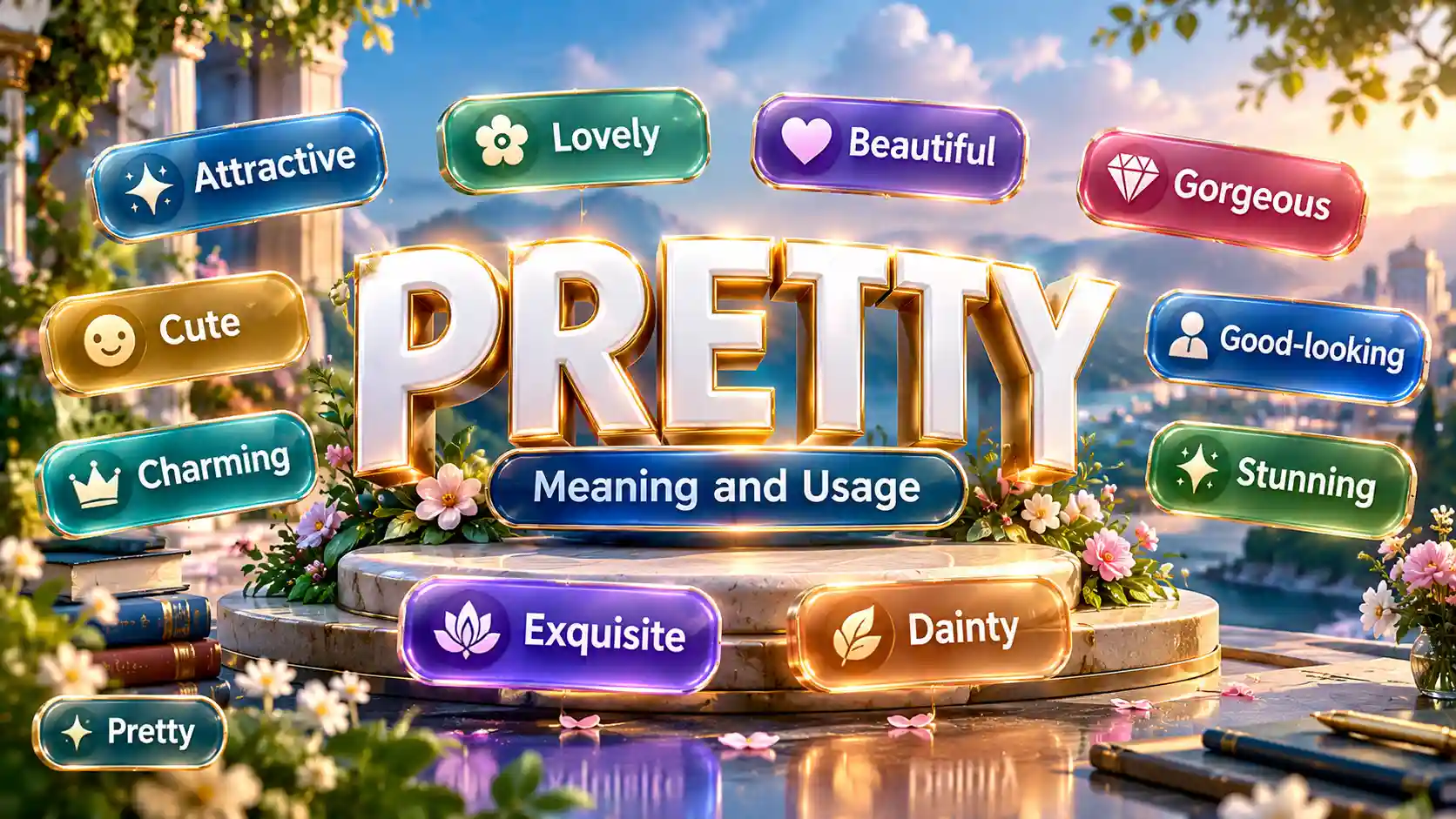
Alternative For Pretty Top 10 at a Glance
| # | Synonym | Meaning Difference |
| 1 | Attractive | Neutral and broader; less delicate |
| 2 | Lovely | Warmer; extends beyond looks |
| 3 | Beautiful | Stronger, more serious praise |
| 4 | Gorgeous | Enthusiastic and much more intense |
| 5 | Cute | Playful, youthful, small-scale charm |
| 6 | Charming | Appeal that includes manner or atmosphere |
| 7 | Good-looking | Plain, direct, about appearance |
| 8 | Stunning | Dramatic, strong first impression |
| 9 | Exquisite | Refined; suggests fine craftsmanship |
| 10 | Dainty | Delicate and small in scale |
Quick Facts About Pretty
| Attribute | Detail |
| Part of speech | Adjective, adverb, noun; verb in “pretty up” |
| Simple meaning | Pleasing to look at; also “fairly” |
| Pronunciation | PRIT-ee, /ˈprɪt.i/ |
| Syllables | 2 (pret-ty) |
| Word forms | prettier, prettiest, prettily, prettiness |
| Nouns for the quality | prettiness, loveliness, beauty |
| Formality | Neutral (adjective); informal (adverb) |
| Closest synonym | Attractive |
| Best used for | Light, gentle, pleasant appeal |
What Is the Closest Synonym for Pretty?
The closest synonym is attractive. It means having qualities that draw interest or admiration, most often physical appearance, but also design, features, and ideas. In a sentence about people, places, or objects, it can usually take pretty’s place without changing the core meaning: “a pretty courtyard” becomes “an attractive courtyard.”
The difference is temperature. Pretty carries a hint of delicacy and affection, while attractive is cooler and broader, which is why it also fits handsome men, buildings, and polished products. That neutrality makes it the safest all-round choice, and also the least warm: “She is attractive” reads like an observation, while “She is pretty” reads like a compliment.
Attractive also has a non-visual sense that pretty lacks, as in an attractive job offer, so context should make clear which sense you mean. When you want warmth back, switch to lovely.
Word Origin and Etymology
According to Etymonline, pretty traces back to Old English prættig, which meant cunning, skillful, artful, or wily. It comes from a noun meaning a trick or wile, shared with other Germanic languages, and its deeper origin is unknown. The same source notes that the link between the Old English and Middle English forms has some obscurity, since written evidence between the 13th and 14th centuries is limited to surnames.
By around 1400 the sense had widened to ingeniously made and then to pleasing to the aesthetic sense. The meaning of beautiful in a slight, delicate way is recorded from the mid-15th century. The noun use (“a pretty person or thing”) appears in the 18th century, and the verb phrase “pretty up” is recorded from 1916.
The adverb meaning fairly or moderately has been in general use since the late 16th century, per Dictionary.com. Older English used fair for the idea of beauty, which is why that word still turns up in literary writing.
Can These Synonyms Be Used Interchangeably?
Rarely in full, often in part. Words that look alike on a list differ in strength, warmth, and what they can describe, so the right swap depends on the sentence.
| Level | Words | Note |
| Usually | attractive, lovely, good-looking | Safe swaps in most sentences |
| Sometimes | charming, appealing, pleasing, cute, fetching | Depends on subject and tone |
| Rarely | beautiful, gorgeous, stunning, striking, exquisite, alluring | Raises the intensity of praise |
| Rarely | dainty, picturesque, adorable | Fit only certain subjects |
| Not everyday | comely, fair, winsome, pulchritudinous | Dated, literary, or ornate |
Multiple Meanings of Pretty
Pretty has three working senses besides the noun use. The main synonym list below covers the first, the adjective meaning attractive. The other two have their own sets, and they should never be mixed.
Meaning B: Adverb (“pretty good”)
Learner dictionaries such as Oxford Advanced Learner’s label this use “rather informal.” It softens an adjective, so the right synonym depends on how strong you want the sentence to be.
| # | Synonym | Difference from “pretty” |
| 1 | fairly | Neutral; suits formal writing |
| 2 | rather | Slightly stronger; less common in American English |
| 3 | quite | Strength varies by region |
| 4 | reasonably | Implies a decent, acceptable standard |
| 5 | moderately | Technical, measured tone |
| 6 | relatively | Compares against something else |
| 7 | somewhat | Lowers the degree slightly |
| 8 | kind of | Informal and spoken |
Meaning C: Verb Phrase (“pretty up”)
For making something look nicer, informal “pretty up” can become spruce up, smarten up, or beautify. These belong to a different word class from the adjective, so none of them appear in the main list.
Detailed Synonym Meanings and Examples Of Pretty

Every word below passed a substitution test: it can replace “pretty” in at least one real sentence without changing the core meaning. CEFR levels are approximate and follow common learner-dictionary placements, which can vary slightly between sources.
1. Attractive
Meaning: The neutral all-purpose choice, explained in full in the closest-synonym section above.
Difference from pretty: Broader and cooler; it also covers handsome men, buildings, and offers.
Best Used For: Neutral descriptions of people, products, and design.
Formality: Neutral
CEFR Level: B1
Frequency: Very Common
Examples:
- The hotel lobby is attractive without being flashy. (travel review)
- Her attractive handwriting made the invitations feel personal. (wedding planning)
When NOT to Use It: Skip it when you want warmth, because it can sound like a clinical assessment.
2. Lovely
Meaning: Pleasing and likable, often with warmth that goes beyond looks.
Difference from pretty: Warmer, and it extends to weather, gestures, and personality.
Best Used For: Friendly everyday talk and kind compliments.
Formality: Neutral
CEFR Level: A2
Frequency: Very Common
Examples:
- That’s a lovely coat; where did you find it? (shopping chat)
- The garden looks lovely after the rain. (everyday conversation)
When NOT to Use It: Avoid it in technical or analytical writing, where it says little about specific qualities.
3. Beautiful
Meaning: Giving deep pleasure to the senses or the mind.
Difference from pretty: Stronger and more serious; pretty suggests lighter appeal.
Best Used For: Landscapes, art, music, and sincere strong praise.
Formality: Neutral
CEFR Level: A1
Frequency: Very Common
Examples:
- The lake at dawn was more beautiful than any photo suggested. (travel)
- The restored library has a beautiful reading room. (architecture)
When NOT to Use It: Do not use it for modest things when you want gentle praise, because it can sound overstated.
4. Gorgeous
Meaning: Strikingly beautiful, with a note of enthusiasm.
Difference from pretty: Much stronger and more emotional.
Best Used For: Enthusiastic compliments about fashion, food, and weather.
Formality: Informal
CEFR Level: B2
Frequency: Common
Examples:
- Your sister looks gorgeous in that green dress. (social)
- We had gorgeous weather for the whole trip. (travel)
When NOT to Use It: Avoid it in formal reports or anywhere a restrained tone is needed.
5. Cute
Meaning: Pleasing in a youthful, small, or playful way.
Difference from pretty: Lighter, favoring charm over elegance.
Best Used For: Children, pets, small items, and playful compliments.
Formality: Informal
CEFR Level: B1
Frequency: Very Common
Examples:
- The café has cute little tables by the window. (lifestyle)
- Your daughter’s drawing is so cute. (family)
When NOT to Use It: Do not use it for adults in professional settings, where it can sound patronizing.
6. Charming
Meaning: Delightful, often through manner, character, or atmosphere.
Difference from pretty: Suggests appeal that wins you over, not only visible beauty.
Best Used For: Villages, cafés, manners, and vintage items.
Formality: Neutral
CEFR Level: B2
Frequency: Common
Examples:
- We stayed in a charming guesthouse above the bakery. (travel)
- He has a charming smile that puts clients at ease. (sales)
When NOT to Use It: Avoid it when you mean pure physical beauty, because it often implies personality or atmosphere.
7. Good-looking
Meaning: Having a physically pleasing appearance.
Difference from pretty: Plainer and more direct, and used for people alike.
Best Used For: Straightforward descriptions of people.
Formality: Neutral
CEFR Level: B1
Frequency: Common
Examples:
- The new coach is a good-looking man in his forties. (news-style description)
- They make a good-looking couple. (social)
When NOT to Use It: Do not use it for objects or places.
8. Appealing
Meaning: Attractive or interesting in a way that draws people in.
Difference from pretty: Emphasizes the pull on the viewer, not the beauty itself.
Best Used For: Design, packaging, products, and menus.
Formality: Neutral
CEFR Level: B2
Frequency: Common
Examples:
- The new label makes the tea more appealing on crowded shelves. (retail)
- The café menu looks appealing, with simple, fresh dishes. (dining)
When NOT to Use It: Skip it when you want to praise delicate beauty rather than describe a pull on the viewer.
9. Pleasing
Meaning: Giving quiet satisfaction to the eye or senses.
Difference from pretty: Calmer and more restrained; rarely used about people.
Best Used For: Design, color, layout, and formal descriptions.
Formality: Neutral to formal
CEFR Level: B2
Frequency: Common
Examples:
- The warm tones make the room pleasing to look at. (interior design)
- The report uses a pleasing layout with generous spacing. (business)
When NOT to Use It: Avoid it for people, where it sounds oddly detached.
10. Stunning
Meaning: Extremely attractive, to the point of amazing the viewer.
Difference from pretty: Far stronger; it implies a powerful first impression.
Best Used For: Dramatic views, events, and striking appearances.
Formality: Neutral
CEFR Level: B2
Frequency: Common
Examples:
- The view from the ridge was stunning. (travel)
- She looked stunning in a simple black gown. (event)
When NOT to Use It: Avoid it for mild appeal, where it will seem exaggerated.
11. Striking
Meaning: Attracting attention through strong or unusual looks.
Difference from pretty: Draws the eye with boldness rather than gentle charm.
Best Used For: People, design, and architecture.
Formality: Neutral
CEFR Level: C1
Frequency: Common
Examples:
- The gallery has a striking glass entrance. (architecture)
- Her striking green eyes were the first thing people noticed. (character description)
When NOT to Use It: Avoid it for soft, delicate prettiness, which striking tends to overpower.
12. Exquisite
Meaning: Extremely beautiful and finely made.
Difference from pretty: Far more refined and intense, and it implies fine craftsmanship.
Best Used For: Jewelry, art, embroidery, and fine details.
Formality: Neutral to formal
CEFR Level: C1
Frequency: Uncommon
Examples:
- The jeweler set a single pearl in an exquisite gold frame. (jewelry)
- The embroidery on the gown was exquisite. (fashion)
When NOT to Use It: Avoid it for casual compliments, where it sounds overly elevated.
13. Adorable
Meaning: So charming that it inspires affection.
Difference from pretty: Carries more emotional warmth than cute, and little about elegance.
Best Used For: Babies, animals, and small children.
Formality: Informal
CEFR Level: B2
Frequency: Common
Examples:
- The kitten curled up in the shoebox looked adorable. (pets)
- Her adorable lisp made everyone smile. (family)
When NOT to Use It: Do not use it for adults in serious or professional contexts.
14. Fetching
Meaning: Attractive in a way that catches the eye, usually in clothing or appearance.
Difference from pretty: Playful and slightly old-fashioned; it implies the look suits the person.
Best Used For: Outfits, hats, and accessories.
Formality: Neutral
CEFR Level: C2
Frequency: Uncommon
Examples:
- That red scarf is rather fetching on you. (fashion)
- She wore a fetching straw hat to the garden party. (event)
When NOT to Use It: Avoid it for landscapes or buildings, since it mainly describes how someone looks in something.
15. Dainty
Meaning: Delicate and small, with fine elegance.
Difference from pretty: Specifies delicacy of size and shape, not general appeal.
Best Used For: Jewelry, china, handwriting, and small hands.
Formality: Neutral
CEFR Level: C2
Frequency: Uncommon
Examples:
- She poured tea into dainty porcelain cups. (hospitality)
- The necklace has a dainty silver chain. (jewelry)
When NOT to Use It: Avoid it for large or bold things, since the word insists on delicacy.
16. Picturesque
Meaning: Attractive enough to make a good picture, used for scenery.
Difference from pretty: Limited to scenes and settings.
Best Used For: Villages, coastlines, and travel writing.
Formality: Neutral
CEFR Level: C1
Frequency: Uncommon
Examples:
- We drove through a picturesque village of stone cottages. (travel)
- The picturesque harbor appears on half the postcards in town. (tourism)
When NOT to Use It: Do not use it for people or individual objects.
17. Alluring
Meaning: Powerfully attractive in a tempting way.
Difference from pretty: Adds mystery and temptation, and is far more intense.
Best Used For: Romantic or atmospheric writing and descriptions of glamor.
Formality: Neutral
CEFR Level: C2
Frequency: Uncommon
Examples:
- She wore an alluring gown the color of red wine. (fashion writing)
- The alluring glow of the harbor lights drew us down the hill. (travel writing)
When NOT to Use It: Avoid it for children or for everyday, modest compliments.
18. Winsome
Meaning: Sweetly attractive in a way that wins affection.
Difference from pretty: Stresses innocence and an engaging manner.
Best Used For: Smiles, young characters, and literary description.
Formality: Neutral (literary)
CEFR Level: C2
Frequency: Rare
Examples:
- Her winsome smile won over the cautious committee. (workplace story)
- The picture book features a winsome fox. (children’s literature)
When NOT to Use It: Avoid it in casual speech, where it sounds precious.
19. Comely
Meaning: Pleasantly attractive in a wholesome, modest way.
Difference from pretty: Dated and literary, with an old-fashioned tone.
Best Used For: Historical fiction and period writing.
Formality: Formal (literary)
CEFR Level: C2
Frequency: Rare
Examples:
- The innkeeper’s comely daughter served the supper. (historical fiction)
- The painter called his model comely rather than beautiful. (art writing)
When NOT to Use It: Avoid it in modern conversation, where it sounds old-fashioned.
20. Fair
Meaning: Beautiful, in an older literary sense of the word.
Difference from pretty: As praise it is archaic; today the word mostly means just or light in coloring.
Best Used For: Poetry, fantasy, and historical prose.
Formality: Formal (literary)
CEFR Level: C2
Frequency: Rare (in this sense)
Examples:
- The ballad praised a fair maiden beside the river. (poetry)
- Travelers spoke of a fair city beyond the mountains. (fantasy)
When NOT to Use It: Avoid it in everyday writing, where readers will take it to mean just or reasonable.
21. Pulchritudinous
Meaning: A formal, rare word for physical beauty.
Difference from pretty: Ornate and sometimes humorous; the sound is bigger than the meaning.
Best Used For: Wordplay, vocabulary lists, and deliberate stylistic effect.
Formality: Formal
CEFR Level: C2
Frequency: Rare
Examples:
- The critic mocked the film’s pulchritudinous leads. (film review)
- He announced, with mock grandeur, that the sunset was pulchritudinous. (humor)
When NOT to Use It: Avoid it in sincere compliments, where it can sound mocking.
Best Alternatives by Context
Everyday conversation: lovely, cute, and gorgeous cover most friendly compliments. Lines such as “You look lovely,” “You’re so cute,” and “You look stunning” are natural ways to say someone looks pretty, each with a different level of warmth.
Formal and academic writing: attractive, appealing, and pleasing keep the tone measured. Wherever possible, name the quality that creates the effect, such as proportion, color, or symmetry, instead of relying on a single adjective.
Business communication: appealing suits products, packaging, and offers; pleasing suits layouts and visual design; attractive suits proposals, pricing, and candidates’ materials.
Creative writing: exquisite, winsome, comely, fair, dainty, alluring, and picturesque each bring a distinct flavor. For a rare or fancy word, winsome and comely are the most usable; pulchritudinous is best kept for humor.
Social media and aesthetic captions: gorgeous, stunning, adorable, and cute dominate informal posts, with picturesque and dainty giving a more curated, scenic feel. For a more sensual tone than beautiful, alluring fits, though it is not simply a stronger pretty.
What is higher than pretty? As a rough intensity ladder, pretty sits below lovely, which sits below beautiful, gorgeous, and stunning. This is a tendency, not a strict ranking, since tone and context shift each word.
Which Synonym Should I Choose?
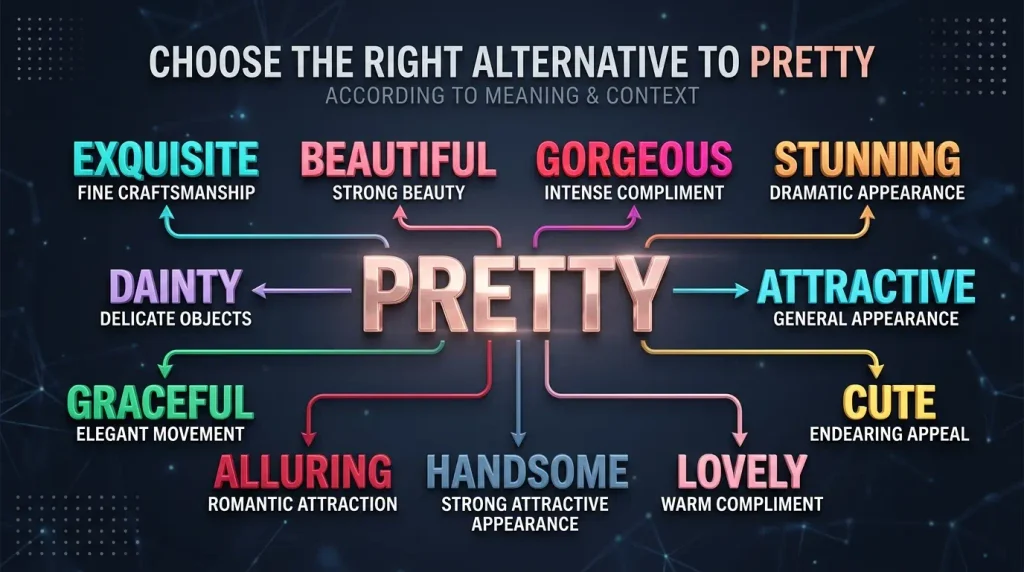
| Situation | Best Choice | Why |
| Neutral description of a person | attractive | Safe and balanced |
| Warm compliment to a friend | lovely | Kind without being intense |
| Describing a girl or young woman | lovely, cute | Warm and not overfamiliar |
| Describing a lady, politely | charming, lovely | Respectful and graceful |
| Describing a man | good-looking | Direct and neutral |
| Describing a young boy | cute, adorable | Playful and affectionate |
| Stronger than pretty | gorgeous, stunning | Higher intensity |
| Fine craftsmanship or art | exquisite | Signals refinement |
| Scenery and villages | picturesque | Built for settings |
| Product or design | appealing | Focuses on viewer pull |
| Tiny, delicate objects | dainty | Signals fine, small elegance |
| Literary or period flavor | winsome, comely | Old-world tone |
| “Pretty good” in formal writing | fairly | Neutral register |
Exact and Near Synonyms: What Is the Difference?
True synonyms are rare because two words seldom share the same strength, warmth, scope, and register at once. Take a village described four ways: a pretty village sounds pleasantly attractive, a beautiful one earns stronger admiration, a charming one adds atmosphere, and a stunning one implies real visual impact.
All four are grammatical, yet each makes a different judgment. Scope matters too: picturesque only describes scenes, and good-looking only describes living things.
Register adds a third layer, since comely and pulchritudinous say something about the speaker as much as the subject. Treat the list as a set of near synonyms and choose by the sentence, not by the dictionary.
Words Commonly Confused with Pretty
These words appear in the same conversations but failed the substitution test, so they are not true synonyms.
| Word | Why It Isn’t a Synonym |
| Handsome | Suggests stronger features; unusual for “pretty” |
| Elegant | Means refined style, not just pleasing looks |
| Graceful | Describes movement or form |
| Delicate | Means fine or fragile; many non-beauty uses |
| Glamorous | Implies luxury and allure |
| Captivating | Adds fascination beyond appearance |
| Pleasant | Mild and general; not specifically visual |
| Hot | Slang that shifts toward sexual attractiveness |
| Sexy | Means sexual appeal, not prettiness |
| Radiant | Describes glow or visible happiness |
| Chic | Means stylish, not simply attractive |
| Aesthetic | Relates to beauty; not a compliment |
| Sightly | Rare, nearly obsolete; attractive is more natural |
| Pulchritude | The noun form, not an adjective |
This also answers the common search for pretty synonyms in slang: informal words such as hot describe attractiveness, but they carry a different social tone and meaning than pretty.
Common Mistakes
| Mistake | Better | Why |
| “A pretty man” for a colleague | good-looking | Pretty can sound feminine or teasing |
| “Pretty significant” in an essay | fairly significant | Adverb pretty is informal |
| “A pretty job offer” | an attractive job offer | Pretty only describes looks |
| “Pulchritudinous” in a compliment | lovely | Sounds mocking, not sincere |
| “Homely charm” in American English | cozy charm | Homely means plain in the US |
Antonyms of Pretty
Meaning A: Attractive
| # | Antonym | Why It’s the Opposite |
| 1 | ugly | Direct opposite; strongly negative |
| 2 | unattractive | Neutral, polite opposite |
| 3 | plain | Lacks beauty without being unpleasant |
| 4 | homely | Plain-looking, in American usage |
| 5 | hideous | Extreme opposite; very ugly |
| 6 | unsightly | Unpleasant to look at |
| 7 | unlovely | Literary opposite of lovely |
Meaning B: Adverb “Fairly”
The degree sense has no strict antonym. These words sit at the opposite ends of the intensity scale.
| # | Contrast Word | Why It Contrasts |
| 1 | extremely | Far above “fairly” |
| 2 | very | Higher degree |
| 3 | slightly | Lower degree |
| 4 | barely | Almost none of the quality |
| 5 | hardly | Close to zero degree |
American vs British English
The spelling is the same in both varieties, and the appearance sense is shared. The differences sit in the surrounding words. Oxford Advanced Learners notes that quite often means “fairly” in British English but usually means “very” in North American English, so “quite pretty” can be read differently on each side of the Atlantic.
The same source says rather is not very common in North American English, where pretty fills that role, and that this adverb use also appears in informal British speech. Homely suggests cozy and welcoming in British English but plain-looking in American English, and lovely tends to feel more at home in everyday British talk.
Real-World Collocations and Phrases
Part A: Common Patterns
| Pattern | Examples |
| Verb + pretty | look pretty, seem pretty, make it pretty |
| Pretty + noun | pretty face, pretty dress, pretty smile, pretty garden |
| Adverb + pretty | very pretty, quite pretty, remarkably pretty |
| Pretty + preposition | pretty to look at, pretty in yellow |
| Degree use | pretty good, pretty sure, pretty close |
Part B: Idioms and Set Phrases
| Phrase | Meaning |
| pretty as a picture | very attractive |
| sitting pretty | in a fortunate, comfortable position |
| a pretty penny | a large sum of money |
| pretty much | almost; nearly all |
| pretty please | a coaxing request |
| not a pretty sight | unpleasant to see |
| not just a pretty face | attractive and also capable |
| come to a pretty pass | reach a bad state of affairs |
| pretty boy | a man seen as vain about looks |
Etymonline records a pretty penny from the early 18th century, pretty much from the 1660s, and pretty please from 1902. The adjective is also sometimes used ironically, as in “a pretty mess,” to describe something bad.
Practice Exercises
Fill in the Blanks
Word bank: attractive, adorable, picturesque, fairly, stunning
- The brochure for the seaside inn showed a ______ village with whitewashed cottages.
- The recruiter called the salary package ______ but not extraordinary.
- Your puppy is so ______!
- The bride looked absolutely ______ as she stepped into the candlelit hall.
- The meeting went ______ well, considering how little we had prepared.
Rewrite the Sentences
Replace “pretty” with a more suitable word.
- The packaging design is pretty, but the box is hard to open.
- That’s a pretty good result for a first attempt.
- She wore a pretty scarf to the interview.
Match the Words
| Word | Best Match |
| 1. comely | a. Delicate and small |
| 2. dainty | b. Very formal or humorous word for beautiful |
| 3. winsome | c. Dated, literary good looks |
| 4. picturesque | d. Sweetly engaging |
| 5. pulchritudinous | e. Scenic enough to paint or photograph |
Vocabulary Quiz
- Which is the most neutral, all-purpose alternative to pretty?
A. lovely B. attractive C. pulchritudinous D. adorable - Which word is stronger than pretty?
A. fairly B. dainty C. gorgeous D. plain - In “That’s pretty good,” pretty means:
A. beautiful B. fairly C. delicate D. clever - Which word sounds dated or literary?
A. cute B. comely C. good-looking D. appealing - Which is the best formal replacement for the adverb pretty in “The results were pretty strong”?
A. kind of B. fairly C. super D. sorta
Answer Key
Fill in the blanks: 1. picturesque, 2. attractive, 3. adorable, 4. stunning, 5. fairly.
Rewrite (sample answers): 1. appealing, 2. fairly good, 3. lovely (charming is also acceptable).
Match: 1-c, 2-a, 3-d, 4-e, 5-b.
Quiz: 1-B, 2-C, 3-B, 4-B, 5-B.
FAQ
What is the closest synonym for pretty?
The closest synonym for pretty is attractive. Both describe something pleasing to look at, and both work for people, places, and objects. Attractive is more neutral and slightly more formal, while pretty suggests delicate, gentle charm. For a warmer everyday alternative, lovely is a natural second choice.
Can I use beautiful instead of pretty?
Sometimes. Beautiful is stronger than pretty, so swapping it in raises the praise. It fits a stunning landscape or a striking person, but may sound exaggerated for a modest garden or a simple dress. Use beautiful when you mean deep admiration, and pretty when you mean pleasant, light appeal.
What does pretty mean?
As an adjective, pretty means pleasing to look at in a delicate, graceful, or charming way, without being dramatic. As an adverb, it means fairly or quite, as in pretty good. The two senses are separate in use, so check the sentence before choosing a synonym.
Is it pretty formal or informal?
Pretty is neutral to informal. It is fine in conversation, personal writing, and creative work, but formal or academic writing usually prefers attractive, aesthetically pleasing, or a more precise term. As an adverb meaning fairly, pretty is informal, so rather or fairly suits professional writing better.
What can I say instead of pretty when complimenting someone?
Choose by tone. Lovely and charming feel warm and polite, gorgeous and stunning show stronger admiration, and cute suits a playful or youthful compliment. In professional settings, it is usually wiser to compliment someone’s work rather than their appearance. Attractive stays neutral when you must describe looks.
What is the opposite of pretty?
The most direct opposites are ugly and unattractive. Plain and homely are milder, describing something unremarkable rather than unpleasant. Hideous and unsightly are much stronger. For the adverb sense meaning fairly, the contrast is with words such as extremely or barely, depending on the degree.
Conclusion
The right synonym does more than avoid repetition: it tells the reader how strongly you feel, how formal the moment is, and what kind of thing you are describing.
Choose attractive when you need neutrality, lovely when you want warmth, and gorgeous or stunning when pretty falls short. Pick fairly or rather when the sentence is really about degree. A well-chosen word lets the reader see exactly what you saw.

About Sajjad Ahmed
Sajjad Ahmed is the author behind Guest Paster, where he writes about English vocabulary, synonyms, word meanings, and practical word usage.
His content is designed to help readers understand the differences between similar words, discover suitable alternatives, and use English vocabulary more effectively in everyday writing and communication.
Before publishing, Sajjad focuses on presenting word choices in a clear and easy-to-understand format, with relevant meanings, context, and examples where helpful.
Through Guest Paster, his goal is to make vocabulary learning simpler and provide useful language resources for students, writers, English learners, and anyone looking to expand their vocabulary.
Areas of Focus: English Vocabulary • Synonyms • Word Meanings • Word Usage • Language Learning
Author: Sajjad Ahmed
Website: Guest Paster