
Conflicted is an adjective meaning torn between opposing feelings, wants or loyalties, usually followed by “about” or “over,” as in “I feel conflicted about leaving.” Alternatives help you sound more precise, more formal or less dramatic.
Ambivalent is the closest dictionary match and the best choice for formal or analytical writing, while torn is the warmer, more natural pick in everyday speech.
To choose, ask what is pulling at you: two feelings at once (ambivalent, mixed feelings), two options (torn, of two minds), or two sides of a group (divided).
Alternative of Conflicted
| # | Synonym | Meaning Difference |
| 1 | Ambivalent | Opposing attitudes at once; calm, analytical |
| 2 | Torn | Warmer; stresses a painful choice |
| 3 | Divided | Works for individuals and groups |
| 4 | Split | Casual; roughly equal pull each way |
| 5 | Mixed (feelings) | Describes feelings, not the person |
| 6 | Of two minds | Idiom; gentle, focused on the choice |
| 7 | Pulled in two directions | Adds outside demands to inner wishes |
| 8 | Contradictory | Clinical; feelings clash with each other |
| 9 | Wavering | Visible back-and-forth over time |
| 10 | At war with oneself | Far more intense and dramatic |
Quick Facts About Conflicted
- Part of speech: Adjective (also the past tense of the verb conflict)
- Simple meaning: Pulled between opposing feelings, wants, or loyalties
- Pronunciation: /kənˈflɪktɪd/
- Syllables: 3 (con-flict-ed)
- Word forms: conflict (noun, verb), conflicting (adjective), conflicted (adjective)
- Formality: Neutral
- Closest synonym: Ambivalent
- Best used for: Inner tension about a decision, relationship, or loyalty
- Rhymes: Inflicted and afflicted are perfect rhymes. Restricted, predicted, convicted, and depicted are near rhymes.
What Is the Closest Synonym for Conflicted?
The closest synonym is ambivalent: having opposing attitudes toward the same person, thing, or choice at the same time. It is the nearest dictionary match because Merriam-Webster itself explains conflicted through ambivalence and emotional conflict. In most sentences the two swap cleanly: “I feel conflicted about the promotion” and “I feel ambivalent about the promotion” say nearly the same thing.
The difference is temperature. Ambivalent names the coexistence of attitudes and can sound calm, even detached. Conflicted usually adds felt tension. If the strain is the point, torn is closer in feeling, so reach for it when you want warmth and ambivalent when you want precision.
Word Origin & Etymology
Conflicted grows out of conflict. English conflict arrived in the early 15th century from Latin confligere, “to strike together,” built from com- (together) and fligere (to strike). The early meaning was physical: a battle or armed encounter. Over time it stretched to quarrels, then to clashes of principles, then to struggles inside one mind.
Etymonline dates the psychological sense of “incompatible urges in one person” to 1859, and conflicted is the past-participle adjective that came from it. Separately, Merriam-Webster lists 1789 as the first known use of the adjective. The two sources track different things, the adjective’s first appearance and the psychological noun sense, so treat both dates as sourced facts rather than a single timeline. etymonlinemerriam-webster
The path is easy to picture: physical clash → quarrel → clash of principles → inner struggle → conflicted feelings.
Sources: Etymonline, Merriam-Webster (checked October 2026).
Can These Synonyms Be Used Interchangeably?
| Level | Words | Notes |
| Usually | ambivalent, torn, divided | Fit most sentences about feelings |
| Sometimes | split, mixed feelings, of two minds, pulled in two directions | Depends on tone and subject |
| Rarely | wavering, contradictory, double-minded, at war with oneself | Narrow scope or strong tone |
| No | undecided, uncertain, hesitant, indecisive | Drop the emotional tension |
Register matters as much as meaning. Ambivalent fits a report but sounds stiff in a text message. Split works with friends but is too casual for formal writing. At war with oneself turns a mild dilemma into a drama.
Detailed Synonym Meanings and Examples
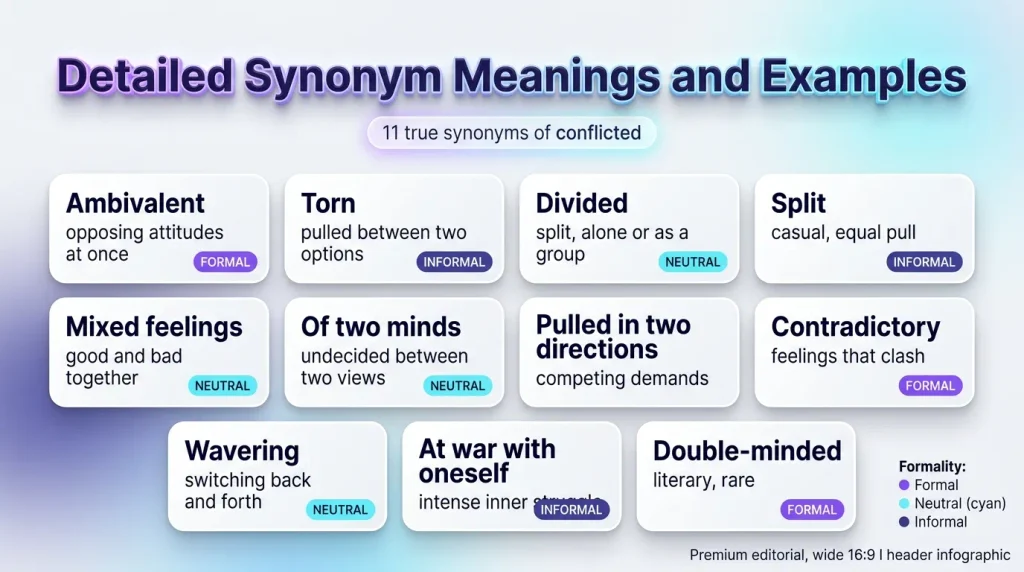
This list includes only words that can replace conflicted in at least one real sentence without changing its core meaning. Near-misses, including undecided, uncertain and hesitant are in the “Commonly Confused” section.
1. Ambivalent
Meaning: Defined above as the closest synonym; here, how to use it.
Difference from Conflicted: It highlights coexisting attitudes rather than the strain they cause.
Best Used For: Academic writing, journalism, measured professional statements.
Formality: Formal
CEFR Level: C1
Frequency: Common
Examples:
- “Voters remain ambivalent about the tax, backing its goals but doubting its design.” (journalism)
- “She was ambivalent about returning to the lab after a year away.” (workplace)
When NOT to Use It: Don’t use it to mean “indifferent,” or when you want to convey real anguish.
2. Torn
Meaning: Pulled between two options or desires, with no comfortable way to choose.
Difference from Conflicted: It is warmer and more physical, and often takes “between.”
Best Used For: Personal dilemmas, spoken English, storytelling.
Formality: Neutral
CEFR Level: B2
Frequency: Very Common
Examples:
- “I’m torn between taking the transfer and staying near my sister.” (everyday conversation)
- “Fans were torn after the coach’s final press conference.” (sports news)
When NOT to Use It: Skip it for trivial choices, where it sounds theatrical.
3. Divided
Meaning: Split in feeling or opinion between two sides, within one person or across a group.
Difference from Conflicted: It works for committees and teams as easily as for individuals.
Best Used For: Boardrooms, politics, loyalty dilemmas.
Formality: Neutral
CEFR Level: B2
Frequency: Very Common
Examples:
- “I’m divided about the offer: the salary is great, but the commute isn’t.” (everyday conversation)
- “The board remained divided over the merger.” (business)
When NOT to Use It: Avoid it for small decisions, where it sounds oddly heavy.
4. Split
Meaning: Pulled almost equally toward two options, with no clear lean.
Difference from Conflicted: It is blunter and more casual, and says little about emotional depth.
Best Used For: Informal talk and quick opinions.
Formality: Informal
CEFR Level: B2
Frequency: Common
Examples:
- “Honestly, I’m split between the two apartments.” (house-hunting chat)
- “Reviewers were split on the sequel.” (social media)
When NOT to Use It: Don’t use it for deep emotional tension or directly before “feelings.”
5. Mixed (Mixed Feelings)
Meaning: Made up of both positive and negative reactions at once.
Difference from Conflicted: It describes the feelings rather than the person, and sounds softer.
Best Used For: Reviews, everyday talk, workplace feedback.
Formality: Neutral
CEFR Level: B1
Frequency: Very Common
Examples:
- “We left the screening with mixed feelings about the ending.” (film talk)
- “My manager has mixed feelings about the new schedule.” (workplace)
When NOT to Use It: Don’t say a person is simply “mixed,” and avoid it for a painful dilemma, where it sounds too light.
6. Of Two Minds (In Two Minds)
Meaning: Unable to settle between two views or courses of action.
Difference from Conflicted: It is a gentle idiom that focuses on the choice, not the emotion.
Best Used For: Everyday reflection, workplace discussion.
Formality: Neutral
CEFR Level: C1
Frequency: Common
Examples:
- “I’m of two minds about selling the house.” (family decision)
- “Managers were in two minds about remote work.” (workplace)
When NOT to Use It: Don’t place it before a noun or pair it with “feelings”; it only works as a predicate phrase.
7. Pulled in Two Directions
Meaning: Drawn toward two competing demands, wishes, or loyalties at once.
Difference from Conflicted: It captures outside obligations as well as inner wishes.
Best Used For: Caregiving, careers, creative writing.
Formality: Neutral
CEFR Level: B2
Frequency: Common
Examples:
- “As a new manager and a new parent, she felt pulled in two directions.” (work and family)
- “He was pulled in two directions, between the band and law school.” (story)
When NOT to Use It: Don’t use it for simple doubt; it implies two real, competing claims on you.
8. Contradictory
Meaning: Pulling against one another, said of feelings, impulses, or signals.
Difference from Conflicted: It is more clinical and nearly always describes feelings, not a person.
Best Used For: Psychology, essays, research writing.
Formality: Formal
CEFR Level: C1
Frequency: Common
Examples:
- “She described contradictory impulses: relief at leaving and grief at what she’d left.” (memoir)
- “Interview subjects expressed contradictory feelings about the policy.” (research)
When NOT to Use It: Don’t say “I feel contradictory”; pair it with feelings, emotions, or impulses.
9. Wavering
Meaning: Switching back and forth in opinion or resolve over a period of time.
Difference from Conflicted: It highlights visible shifting rather than the inner pull itself.
Best Used For: Decisions under pressure, negotiations, narrative.
Formality: Neutral
CEFR Level: C1
Frequency: Uncommon
Examples:
- “He was wavering about the job until the final week.” (career)
- “Wavering voters decided the race.” (news)
When NOT to Use It: Avoid it for a steady, unchanging sense of being torn.
10. At War with Oneself
Meaning: Locked in an intense inner struggle between opposing impulses or values.
Difference from Conflicted: It is much stronger and implies anguish.
Best Used For: Fiction, memoir, dramatic description.
Formality: Neutral
CEFR Level: C1
Frequency: Uncommon
Examples:
- “Reading the letter, he was at war with himself, wanting to forgive but unable to forget.” (fiction)
- “The protagonist is at war with herself for most of the novel.” (book review)
When NOT to Use It: Don’t use it for ordinary choices like a job offer or a menu item.
11. Double-Minded
Meaning: Wavering between two opposing intentions or loyalties, often with a moral edge.
Difference from Conflicted: It is older and literary, with a faint tone of judgment.
Best Used For: Literary and reflective writing.
Formality: Formal
CEFR Level: C2
Frequency: Rare
Examples:
- “The poem’s narrator is double-minded, praising the city while plotting his escape.” (literary analysis)
- “She grew double-minded about the inheritance, wanting the money but dreading its strings.” (creative writing)
When NOT to Use It: Avoid it in everyday speech, where it sounds archaic.
Best Alternatives by Context
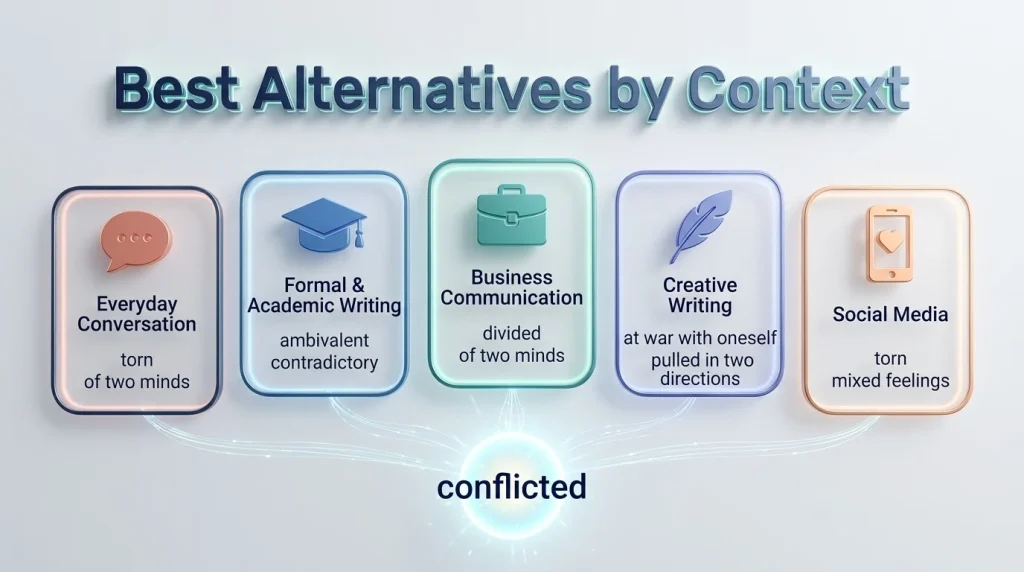
Everyday Conversation: Torn is the natural default, and of two minds adds a lighter touch.
Formal and Academic Writing: Ambivalent suits attitudes toward a person, policy, or idea, and contradictory suits feelings or findings that clash.
Business Communication: Divided works for a team that can’t agree, and of two minds gives a softer, more diplomatic tone. If nothing is pulling emotionally and a decision is simply pending, undecided is more accurate, though it is not a synonym (see below).
Creative Writing: At war with oneself and pulled in two directions give a character’s struggle weight. When the emotion runs deeper still, our guide to synonyms for profound offers words with more gravity.
Social Media: Torn and mixed feelings read naturally in short posts and reviews.
Which Synonym Should I Choose?
| Situation | Best Choice | Why |
| Two feelings at once | ambivalent | Names coexisting attitudes |
| Painful choice between options | torn | Conveys the strain |
| Competing loyalties or duties | pulled in two directions | Includes outside demands |
| A group that can’t agree | divided | Works for groups |
| Review with good and bad | mixed feelings | Light, balanced tone |
| Casual chat | of two minds | Idiomatic and relaxed |
| Dramatic fiction | at war with oneself | Intense inner struggle |
| No emotional pull, just no choice yet | undecided | Not a synonym; avoid conflicted |
| Crossword grid (4–10 letters) | torn, split, divided, ambivalent | Choose by letter count: 4, 5, 7, 10 |
Exact and Near Synonyms of Conflicted: Difference
True synonyms are rare because words that share a core meaning still differ in register, scope, and intensity. Ambivalent and conflicted come closest, yet ambivalent is cooler and conflicted carries tension. Torn leans toward a visible choice, and divided shifts the focus to groups.
Intensity moves the meaning too: mixed feelings is mild, conflicted is moderate, and at war with oneself is extreme. If the distress is closer to dread than doubt, our guide to synonyms for horrible may match the mood better than any word here.
Words Commonly Confused with Conflicted
These words overlap with conflicted but failed the substitution test.
| Word | Why It Isn’t a True Synonym |
| Undecided | Choice pending; no emotional pull implied |
| Uncertain | Lacks knowledge or confidence, not opposing pulls |
| Unsure | Milder doubt; no clash of feelings |
| Hesitant | Reluctant to act, not divided |
| Indecisive | A personality trait, not one situation |
| Irresolute | Weak resolve; formal and faintly judgmental |
| Vacillating | Habitual flip-flopping; sounds critical |
| Doubtful | Only the negative side; no opposing pull |
| Unsettled | Uneasy or disturbed; no clear two-way pull |
| Unresolved | Describes an issue left open, not a person |
| On the fence | Neutral and pending; not pulled both ways |
| Confused | Unclear thinking, not competing feelings |
| Conflicting | Describes things that clash, not people |
| Torn up | Means upset or distressed, not divided |
Common Mistakes
| Mistake | Better | Why |
| “The data is conflicted.” | “The data is conflicting.” | Things conflict; people feel conflicted |
| “I’m conflicted with the offer.” | “I’m conflicted about the offer.” | About or over is the usual preposition |
| “She’s ambivalent, so she doesn’t care.” | “She’s indifferent.” | Ambivalent means two attitudes, not none |
| “I’m torn about what to eat.” | “I can’t decide what to eat.” | Torn overstates a trivial choice |
| “The director is torn” (conflict of interest) | “The director has a conflict of interest.” | Torn is emotional, not professional |
Antonyms of Conflicted
| # | Antonym | Why It’s the Opposite |
| 1 | Decided | The choice is made |
| 2 | Certain | No doubt remains |
| 3 | Resolute | Firm purpose despite pressure |
| 4 | Convinced | Holds a settled belief |
| 5 | Single-minded | One goal, no competing pull |
| 6 | Wholehearted | Fully committed, nothing held back |
| 7 | Settled | Comfortable with the outcome |
| 8 | Unwavering | Commitment doesn’t shift |
American vs British English
The spelling and pronunciation of conflicted are the same in both varieties. The main difference is in the idiom: British English traditionally says in two minds, while American English says of two minds. Both are understood everywhere.
Real-World Collocations & Phrases
Part A: Common Combinations
- Verb + conflicted: feel conflicted, seem conflicted, remain conflicted
- Conflicted + noun: conflicted feelings, conflicted emotions, a conflicted character, conflicted loyalties
- Adverb + conflicted: deeply conflicted, still conflicted, genuinely conflicted
- Conflicted + preposition: conflicted about, conflicted over
Part B: Set Phrases
- of two minds / in two minds
- mixed feelings
- torn between
- pulled in two directions
- at war with oneself
Practice Exercises
Fill in the blanks (word bank: torn, divided, ambivalent, mixed, at war with himself)
- She felt ______ between the scholarship and staying close to family.
- The board stayed ______ over the merger.
- Researchers described participants’ ______ attitudes: supportive of the goal, wary of the cost.
- We left the theater with ______ feelings about the ending.
- Alone in the cabin, the hero was ______, desperate to leave yet unable to forgive his past.
Rewrite the sentences (replace conflicted)
- “I’m conflicted about telling her.” (use torn)
- “Voters were conflicted about the tax.” (use ambivalent)
- “The committee was conflicted over the budget.” (use divided)
Match the words to their best context
| Word | Context |
| A. torn | 1. Intense inner struggle in fiction |
| B. ambivalent | 2. Casual talk about a choice |
| C. divided | 3. Formal analysis of attitudes |
| D. wavering | 4. A group that can’t agree |
| E. at war with oneself | 5. Switching back and forth over time |
Vocabulary quiz
- Which word best suits a formal research paper describing attitudes? (a) torn (b) ambivalent (c) split (d) on the fence
- Which is NOT a true synonym of conflicted? (a) divided (b) torn (c) undecided (d) ambivalent
- Which is an antonym of conflicted? (a) resolute (b) torn (c) wavering (d) divided
- Which word best describes a board that can’t agree? (a) divided (b) mixed (c) at war with oneself (d) double-minded
- Which phrase is the most dramatic? (a) mixed (b) split (c) at war with oneself (d) divided
Answer key
- Fill in: 1. torn, 2. divided, 3. ambivalent, 4. mixed, 5. at war with himself
- Rewrite (sample answers): 1. “I’m torn about telling her.” 2. “Voters were ambivalent about the tax.” 3. “The committee was divided over the budget.”
- Match: A–2, B–3, C–4, D–5, E–1
- Quiz: 1. b, 2. c, 3. a, 4. a, 5. c
FAQ
What is the closest synonym for conflicted?
Ambivalent is the closest dictionary match for conflicted, since Merriam-Webster defines conflicted through ambivalence and emotional conflict. In everyday speech, torn is just as natural and slightly warmer. Use ambivalent for formal or analytical writing, and torn when you describe a painful choice between two options.
Can I use torn and conflicted interchangeably?
Usually, yes, but not always. Torn and divided fit most sentences about feelings, and “mixed feelings” covers the rest. Ambivalent works when you hold two attitudes at once, while on the fence only fits a pending decision. Undecided and hesitant drop the emotional tension, so they change the meaning.
What does “I feel conflicted” mean?
Feeling conflicted means you have two or more opposing thoughts, emotions, or wants at the same time and can’t comfortably settle on one. For example, you might be excited about a new job but sad to leave your team. The feeling is usually uncomfortable, though it doesn’t always signal a bad decision.
Is conflicted formal or informal?
Conflicted is neutral in register. It appears in everyday speech, news writing, and professional contexts without sounding stiff or casual. If you need something more formal, ambivalent suits academic and business writing, while torn is a safer choice for casual conversation, texts, and storytelling.
How do I use conflicted in a sentence?
Use conflicted with about or over, followed by the thing causing the tension: “She felt conflicted about accepting the promotion.” You can also use it before a noun, as in “conflicted feelings” or “a conflicted character.” Avoid using it for simple uncertainty, like not knowing which restaurant to pick.
What is the opposite of conflicted?
The most common opposites are decided, certain, and resolute. Use decided or certain for a settled opinion, and resolute for firm determination despite pressure. Wholehearted and single-minded describe feelings or effort with no internal competition, while unwavering stresses commitment that doesn’t shift over time.
Conclusion
Choosing the right word for an inner tug-of-war does more than vary your vocabulary. It tells readers whether you’re describing a quiet doubt, a split group, or a real struggle.
Match the word to the situation and the audience, and your meaning lands the way you intended.

About Sajjad Ahmed
Sajjad Ahmed is the author behind Guest Paster, where he writes about English vocabulary, synonyms, word meanings, and practical word usage.
His content is designed to help readers understand the differences between similar words, discover suitable alternatives, and use English vocabulary more effectively in everyday writing and communication.
Before publishing, Sajjad focuses on presenting word choices in a clear and easy-to-understand format, with relevant meanings, context, and examples where helpful.
Through Guest Paster, his goal is to make vocabulary learning simpler and provide useful language resources for students, writers, English learners, and anyone looking to expand their vocabulary.
Areas of Focus: English Vocabulary • Synonyms • Word Meanings • Word Usage • Language Learning
Author: Sajjad Ahmed
Website: Guest Paster