What Is “Lens”?
Lens is a noun for a curved piece of glass or plastic that bends and focuses light found in cameras, eyeglasses, telescopes, and the human eye. It also means a way of understanding something, as in “a historical lens.”
Because the word has two distinct senses, the best synonym depends on which one you mean.
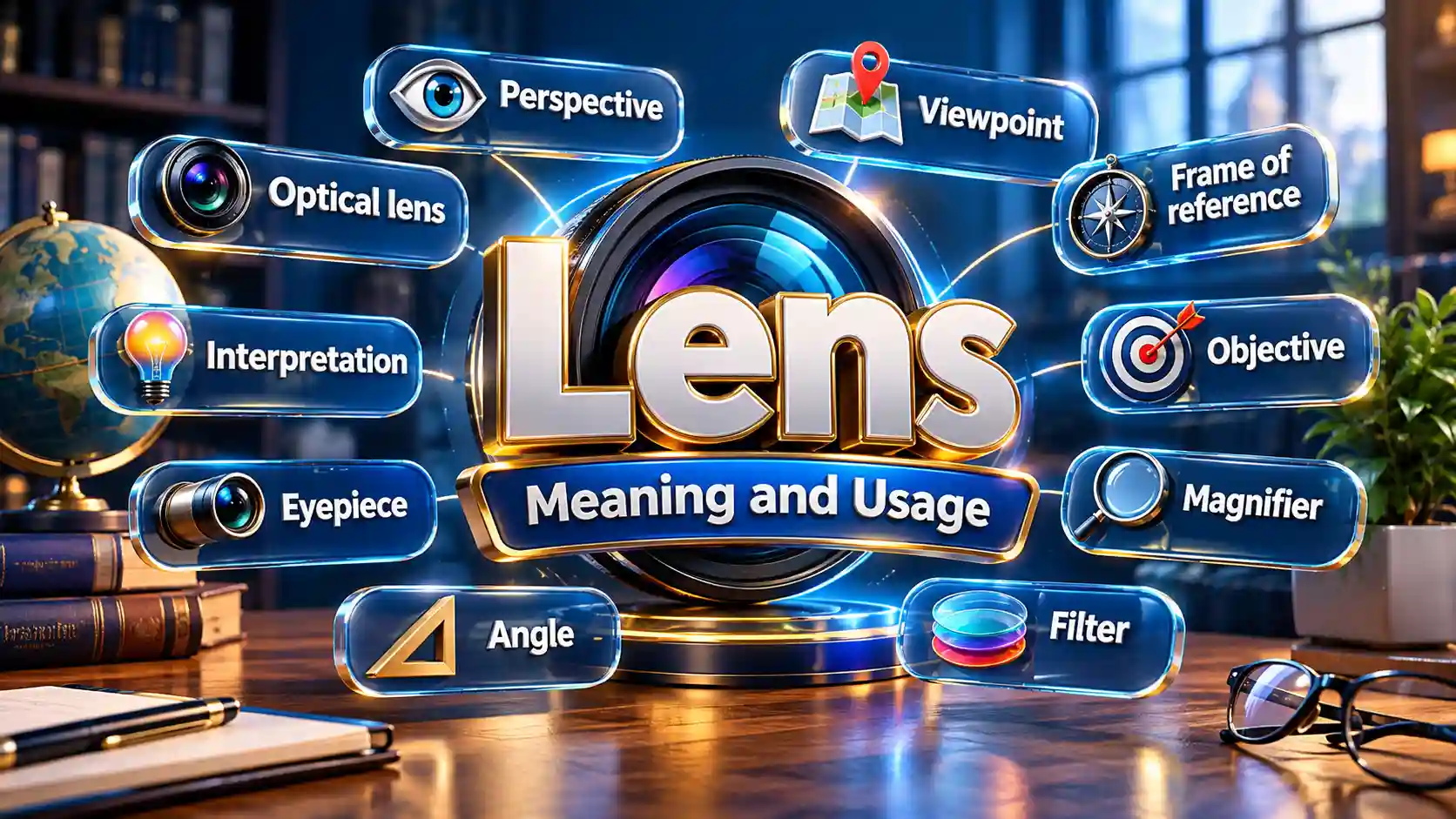
10 Best Synonyms for Lens
| # | Synonym | Meaning Difference | Best Used For | Formality |
| 1 | Optical lens | Same object, more technical and precise | Camera specs, physics | Technical |
| 2 | Perspective | A mental position, not a physical tool | Essays, opinion writing | Neutral/Formal |
| 3 | Viewpoint | A person’s stance rather than a tool of sight | Debates, commentary | Neutral |
| 4 | Frame of reference | The assumptions shaping understanding, not the lens itself | Academic, sociological writing | Formal |
| 5 | Objective | The lens nearest the viewed object (microscopes/telescopes) | Microscopy, optics | Technical |
| 6 | Magnifier | Describes function (enlarging), not the object | Everyday speech, classrooms | Neutral |
| 7 | Filter | Implies bias or alteration more strongly | Photography, media criticism | Neutral |
| 8 | Angle | A strategic way of presenting something | Journalism, marketing | Neutral/Informal |
| 9 | Eyepiece | The specific lens you look through in a scope | Astronomy, birdwatching | Technical |
| 10 | Interpretation | The result of viewing through a lens, not the lens | Literary and legal analysis | Formal |
Quick Facts About Lens
| Part of speech | Noun |
| Simple meaning | A curved piece of glass that bends light, or a way of understanding something |
| Pronunciation | LENZ |
| Syllables | 1 |
| Word forms | lenses (plural), lensed, lensless |
| Formality | Neutral |
| Closest synonym | Optical lens (physical) / Perspective (figurative) |
| Best used for | Photography, optics, academic and everyday writing |
What Is the Closest Synonym of Lens ?
There isn’t one closest synonym, there are two, split by meaning. For the physical object, optical lens is the closest match: it names exactly the same thing, just with more technical precision, so it’s a clean drop-in for camera, telescope, or eyewear contexts.
For the figurative sense, perspective is the closest match: both describe a way of processing information, though lens implies you’re looking through something (a tool), while perspective implies you’re standing at a mental position.
That small grammatical difference is why “through the lens of experience” reads naturally, but “through the perspective of experience” doesn’t.
Can These Synonyms Be Used Interchangeably?
Rarely, and only within the same sense.
- Usually interchangeable:optical lens and lens (physical sense) safe to swap almost anywhere.
- Sometimes interchangeable:perspective, viewpoint, and lens (figurative sense) swappable in general writing, but each shifts emphasis: lens = tool, perspective = mental position, viewpoint = personal stance.
- Rarely interchangeable:filter, angle, outlook these work only in specific figurative contexts (media, journalism, disposition) and sound off elsewhere.
- Not interchangeable:magnifier, prism, eyepiece with the figurative sense of lens; these are physical-only and will confuse readers if used metaphorically.
The deciding factor is always tone and context: formal academic writing favors frame of reference; casual writing favors angle or filter; technical writing favors optical lens or objective.
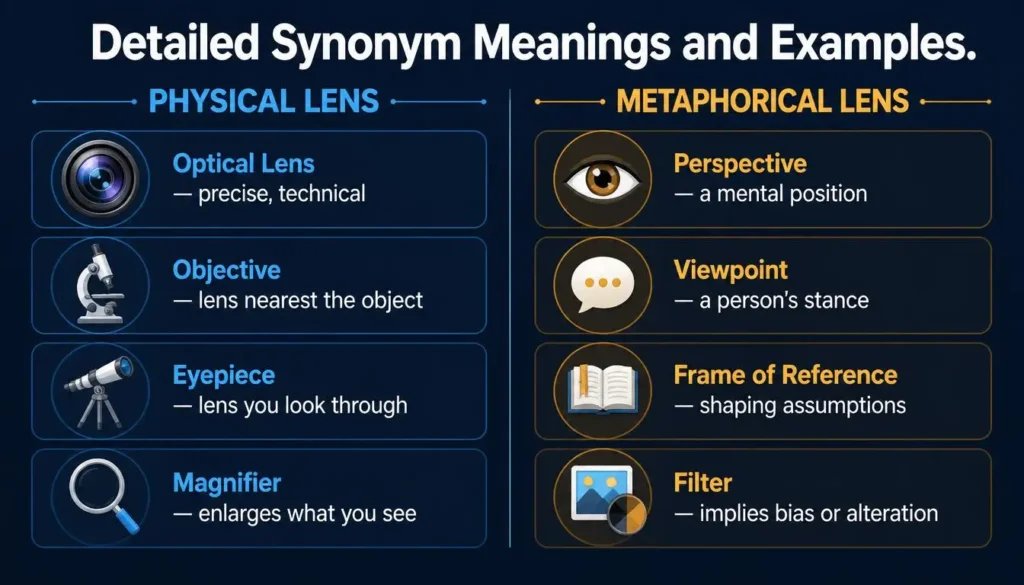
Detailed Synonym Meanings and Examples
1. Optical lens
Meaning: A precise technical term for the glass or plastic component that focuses light.
Difference: Identical meaning to lens, but removes ambiguity with the figurative sense.
Bestused for: Product specs, physics writing.
Formality: Technical.
Examples: “The camera’s optical lens produces almost no distortion at the edges.” / In a workplace memo: “Replace the optical lens assembly before the next production run.”
2. Objective
Meaning: The lens closest to the object being viewed, in microscopes or telescopes.
Difference: A specific type of lens, not a general synonym.
Best used for: Microscopy, scientific instruments.
Formality: Technical.
Examples: “Switch to the 40x objective to see the cell walls.” / In a lab report: “The objective was recalibrated after the drop-test.”
3. Eyepiece
Meaning: The lens you look through directly in a telescope, microscope, or binoculars.
Difference: Names a specific lens by its position, not lenses generally.
Best used for: Astronomy, birdwatching.
Formality: Technical.
Examples: “She adjusted the eyepiece until the moon’s craters snapped into focus.” / In a school science journal: “Our group cleaned the eyepiece before each observation.”
4. Magnifier
Meaning: A lens or device that enlarges what you’re looking at.
Difference: Names the function of a lens, not the object category.
Best used for: Everyday speech, reading small print.
Formality: Neutral.
Examples: “Grandpa keeps a magnifier in his desk drawer for reading labels.” / In casual conversation: “Do you have a magnifier? I can’t read this contract.”
5. Ocular
Meaning: Relating to the eye; also a formal noun for an eyepiece.
Difference: As an adjective it describes something related to vision rather than naming the lens itself.
Best used for: Medical and ophthalmology writing.
Formality: Technical/Medical.
Examples: “The exam checked for ocular pressure changes.” / In an essay on vision: “Ocular strain from screens is a growing workplace concern.”
6. Glass
Meaning: An informal, older term for a lens, especially in eyeglasses.
Difference: Refers to the material a lens is made from, used loosely to mean the object.
Best used for: Dialogue, casual or historical writing.
Formality: Informal.
Examples: “He polished his glass and squinted at the fine print.” / In storytelling: “The old sailor raised his glass to the horizon, tracking the ship.”
7. Prism
Meaning: A transparent object that refracts and splits light, distinct from a lens.
Difference: Not technically a lens bends light differently and serves another optical purpose.
Best used for: Optics, physics demonstrations, binoculars.
Formality: Technical.
Examples: “The binoculars use prisms to correct the upside-down image.” / In creative writing: “Grief became a prism, splitting every memory into fragments of color.”
8. Crystalline lens
Meaning: The precise anatomical term for the natural lens inside the human eye, another word for lens of the eye.
Difference: Names a specific biological lens, not lenses generally.
Best used for: Medical and anatomical writing.
Formality: Technical/Medical.
Examples: “The crystalline lens loses flexibility with age, which causes presbyopia.” / In a school biology essay: “Light passes through the cornea before reaching the crystalline lens.”
9. Corrective lens
Meaning: A lens designed to adjust vision, used in glasses or contacts.
Difference: Describes purpose (vision correction), not lenses in general.
Best used for: Optometry, prescriptions.
Formality: Technical.
Examples: “The optometrist prescribed a stronger corrective lens.” / In everyday conversation: “I switched from a corrective lens to contacts last year.”
10. Contact lens
Meaning: A thin corrective lens worn directly on the eye is a common synonym for lens glasses in casual speech.
Difference: Names a specific product category, not lenses broadly.
Best used for: Everyday conversation, healthcare.
Formality: Neutral.
Examples: “She put in her contact lens before the interview.” / In blogging: “Switching to a daily contact lens changed my morning routine completely.”
11. Perspective
Meaning: A particular way of thinking about or viewing something.
Difference: A mental position rather than a tool you look through.
Best used for: Essays, opinion writing, a strong choice for another word for lens in an essay.
Formality: Neutral/Formal.
Examples: “Studying abroad gave Maya a new perspective on her own culture.” / In a workplace review: “Let’s get the client’s perspective before finalizing the pitch.”
12. Viewpoint
Meaning: A person’s opinion or way of seeing a situation.
Difference: Emphasizes a stance someone holds, not an interpretive tool.
Best used for: Debates, commentary, discussion.
Formality: Neutral.
Examples: “The documentary presents multiple viewpoints on the housing crisis.” / In a school debate: “Defend your viewpoint using at least two sources.”
13. Standpoint
Meaning: A position from which something is considered or evaluated.
Difference: More static and formal than viewpoint; often paired with “from a ___ standpoint.”
Best used for: Business and analytical writing.
Formality: Formal.
Examples: “From a financial standpoint, the merger makes sense.” / In workplace emails: “From a legal standpoint, we should revise clause 4.”
14. Point of view
Meaning: The position from which something is observed or considered, literally or narratively.
Difference: More casual and more common in storytelling than lens.
Best used for: Fiction, conversation, film analysis.
Formality: Neutral.
Examples: “The novel is told from a child’s point of view.” / In casual conversation: “I get your point of view, but I still disagree.”
15. Vantage point
Meaning: A place or position offering a clear or advantageous view.
Difference: Often literal (physical location) before it’s figurative, unlike lens.
Best used for: Descriptive and travel writing.
Formality: Neutral/Formal.
Examples: “From the hill, the whole valley was visible as a perfect vantage point.” / In a blog post: “History offers a useful vantage point for judging present-day decisions.”
16. Frame of reference
Meaning: A set of ideas, assumptions, or experiences that shape understanding the go-to for theoretical lens synonyms.
Difference: Broader and more formal than lens; usually needs a rebuilt sentence.
Best used for: Research papers, sociology, cultural criticism.
Formality: Formal/Academic.
Examples: “The study examines gentrification through a frame of reference rooted in urban economics.” / In an essay: “Her frame of reference as a first-generation immigrant shapes how she reads American history.”
17. Conceptual framework
Meaning: The structure of ideas and theories guiding an analysis.
Difference: Academic and structural, describing a system of ideas rather than a single interpretive tool.
Best used for: Academic and research writing.
Formality: Formal/Academic.
Examples: “The paper’s conceptual framework draws on systems theory.” / In a thesis: “We built our conceptual framework around three competing models.”
18. Filter
Meaning: Something that changes, limits, or colors what you perceive.
Difference: Implies bias or alteration more strongly than lens does.
Best used for: Photography, social media, media criticism.
Formality: Neutral.
Examples: “We all see the world through our own filters.” / In blogging: “Nostalgia works like a filter, softening the sharp edges of memory.”
19. Angle
Meaning: A particular way of approaching or presenting something.
Difference: More casual than perspective; often implies a strategic choice.
Best used for: Journalism, marketing, everyday conversation.
Formality: Informal/Neutral.
Examples: “The reporter found a fresh angle on the old story.” / In workplace brainstorming: “What’s our angle for the product launch email?”
20. Outlook
Meaning: A person’s general attitude or way of seeing life or the future.
Difference: Broader and more emotional than lens; about disposition, not interpretation.
Best used for: Personal essays, forecasts, character writing.
Formality: Neutral/Formal.
Examples: “Her optimistic outlook helped the team push through the setback.” / In a business report: “The quarterly outlook remains positive.”
21. Interpretation
Meaning: An explanation or way of understanding something.
Difference: Describes the result of looking through a lens, not the lens itself.
Best used for: Literary analysis, legal writing, art criticism.
Formality: Formal.
Examples: “Her interpretation of the poem focused on loss and memory.” / In a school essay: “Two interpretations of the ending are equally valid.”
22. Window
Meaning: A gentler metaphor for a way of seeing into something.
Difference: Suggests openness and access rather than focus or distortion.
Best used for: Creative and reflective writing.
Formality: Neutral.
Examples: “His letters were a window into a vanished world.” / In storytelling: “The diary became a window into her grandmother’s youth.”
23. Focus
Meaning: The center of attention or the sharpness of understanding applied to something.
Difference: Names the result of a lens’s function (clarity), not the lens itself.
Best used for: Business communication, presentations.
Formality: Neutral.
Examples: “Our focus this quarter is retention, not acquisition.” / In a school presentation: “Keep the focus on your thesis statement.”
24. Optic
Meaning: An informal shorthand, often used loosely as an optic synonym for “lens” or “way of viewing” in media commentary.
Difference: More casual and more common in political/media writing than lens.
Best used for: News analysis, commentary.
Formality: Informal/Neutral.
Examples: “The optics of the announcement were bad, even if the policy was sound.” / In blogging: “From a public-relations optic, the delay was costly.”
Best Alternatives by Context
Everyday Conversation:glasses, contact lens, magnifier, point of view
Formal Writing:perspective, standpoint, viewpoint
Academic Writing:frame of reference, conceptual framework, theoretical lens (kept as-is when naming a specific theory), analytical perspective
Business Communication:angle, outlook, focus, standpoint
Creative Writing:filter, prism, window, vantage point
Social Media:filter, optic, angle
Which Synonym Should I Choose?
Start with one question: are you describing glass, or perception?
If it’s glass the object itself stays technical and precise: optical lens, objective, eyepiece, crystalline lens, or contact lens, depending on what kind of lens you mean.
If it’s perception, a way of understanding something matches the formality of your writing. Casual or journalistic writing wants angle or filter. Personal essays want perspective or outlook. Academic and research writing wants a frame of reference or conceptual framework. Fiction and reflective writing want a point of view, vantage point, or window.
When in doubt, perspective is the safest general-purpose substitute for the figurative sense, and optical lens is the safest for the physical sense both function as near drop-ins in most sentences.
Exact and Near Synonyms: Difference
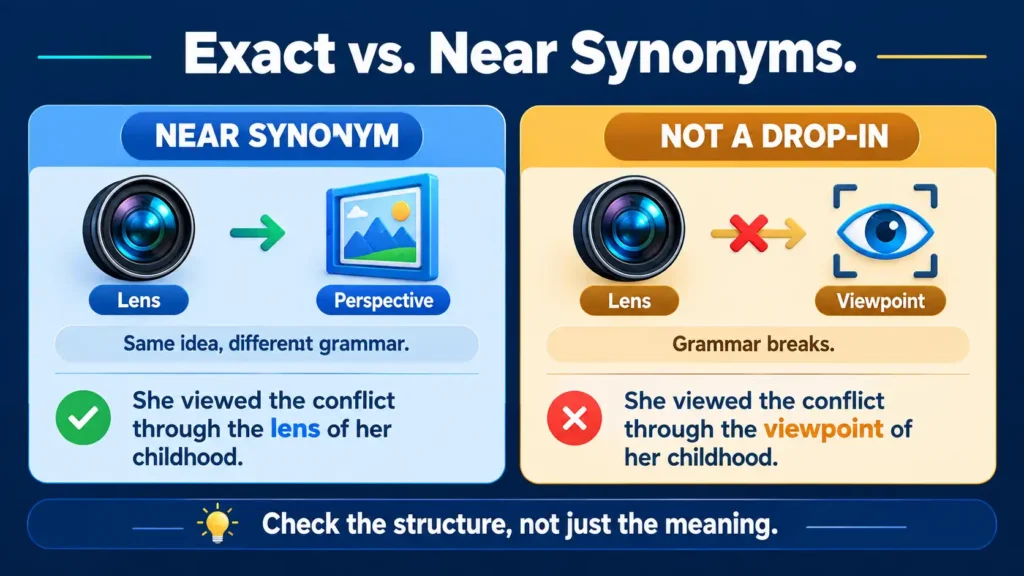
True exact synonyms are rare in English, and lens is a good example of why. Lens implies a tool or medium you look through that can distort, clarify, or magnify. Perspective implies a broader mental position where you stand, not what you look through. Viewpoint implies a stance or opinion someone holds.
Swap them and the grammar often breaks: “she viewed the conflict through the lens of her childhood” works, but “through the viewpoint of her childhood” doesn’t. That’s the line between a near synonym (same general idea, different grammar or connotation) and a genuinely interchangeable word. Before swapping, check whether the word still fits the sentence’s structure, not just its meaning.
Words Commonly Confused with Lens
Lense A common misspelling. The correct spelling is always lens.
Lentil The Latin word lens meant “lentil,” since early lenses were lentil-shaped. It’s the word’s origin, not a modern synonym.
Glass Refers to the material a lens is made from, not the shaped object itself; using it as a direct swap can be read as old-fashioned.
Spectacles Means the entire pair of eyeglasses, not a single lens.
Lens system The correct term for a group of lenses working together; “lense system” is a misspelling, not a variant.
Antonyms of Lens
| Antonym | Meaning |
| Distortion | A twisting or misrepresentation of what’s seen |
| Opacity / Opaque | Impossible to see through |
| Blur | Something unclear or indistinct |
| Obstruction | Something that blocks vision entirely |
| Naked eye | Vision without any lens or aid |
Common Phrases with Lens
Through a lens / through this lens From a particular point of view: “We examined the policy through this lens.”
Camera lens The glass component of a camera that focuses light.
Contact lens A thin corrective lens worn directly on the eye.
Lens cap A protective cover for a camera lens.
Lens flare Unwanted reflected light inside a camera lens.
Wide-angle lens / zoom lens Camera lenses defined by field of view or magnification range.
Lens of the eye The eye’s natural, crystalline lens.
Frequently Asked Questions
What is the synonym of viewpoint?
Common alternatives to viewpoint include perspective, standpoint, point of view, angle, and outlook. Standpoint leans formal and positional; angle leans casual and strategic.
What can I say instead of “through the lens”?
Try from the perspective of, through the eyes of, from the standpoint of, or as seen by. “Through the lens of history” becomes “from the perspective of history,” depending on tone.
What is lens in one word?
For the figurative sense, perspective. For the physical object, optic in technical contexts or glass informally. No single word covers both meanings at once.
What is another word for eye lens?
The medical term is crystalline lens. Plain-English alternatives are eye lens or ocular lens all refer specifically to the eye’s natural lens, not camera or eyeglass lenses.
What’s a fancy word for view?
Try perspective, vantage point, panorama (for physical scenery), or frame of reference for a more academic tone.
What are 5 synonym words for lens?
The five most broadly useful are perspective, viewpoint, optical lens, frame of reference, and angle covering both the physical and figurative senses.
Conclusion
Choosing the right synonym for lens comes down to one question: glass or perception? For glass, use optical lens, magnifier, or objective. For perception, reach for perspective, viewpoint, or frame of reference.
The best writers swap words to add precision, not just to avoid repetition. A lens focuses light. A perspective shapes understanding. Each word carries its own weight.

About Sajjad Ahmed
Sajjad Ahmed is the author behind Guest Paster, where he writes about English vocabulary, synonyms, word meanings, and practical word usage.
His content is designed to help readers understand the differences between similar words, discover suitable alternatives, and use English vocabulary more effectively in everyday writing and communication.
Before publishing, Sajjad focuses on presenting word choices in a clear and easy-to-understand format, with relevant meanings, context, and examples where helpful.
Through Guest Paster, his goal is to make vocabulary learning simpler and provide useful language resources for students, writers, English learners, and anyone looking to expand their vocabulary.
Areas of Focus: English Vocabulary • Synonyms • Word Meanings • Word Usage • Language Learning
Author: Sajjad Ahmed
Website: Guest Paster