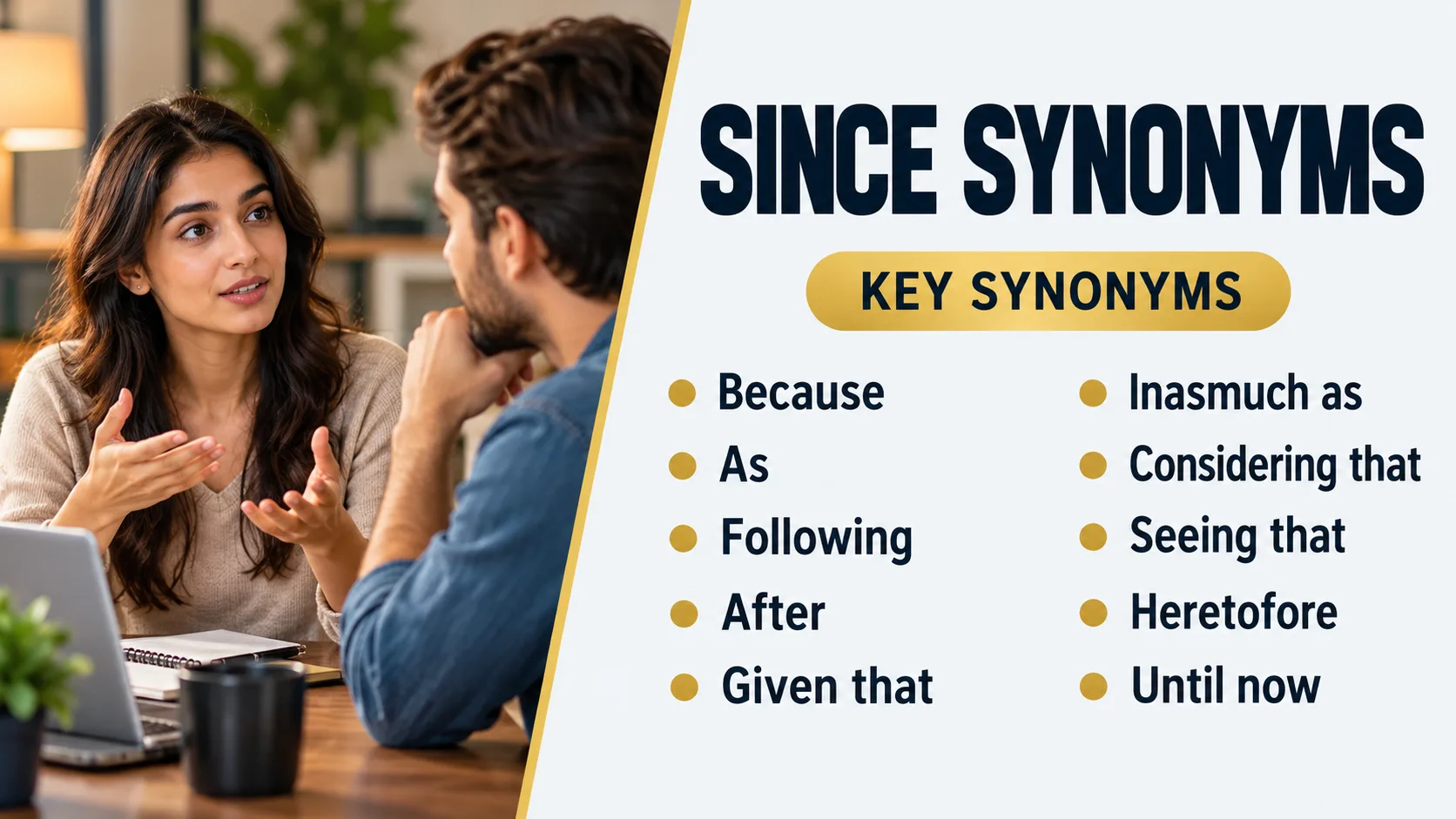
Since has two jobs. As a conjunction it means “because” (Since it rained, we stayed in); as a conjunction, preposition, or adverb it means “from then until now” (I’ve lived here since 2019). For a reason, because is the safest swap, and given that suits reasons your reader already knows.
For time, ever since is the closest match, and since then works once the starting point is clear. Alternatives matter because since can leave readers unsure which meaning you intend, so decide on the meaning first, then choose a word that fits your tone.
Top 10 at a Glance
These are the 10 strongest entries from the 20 words that pass the accuracy test in the detailed section below.
| # | Synonym | Meaning Difference |
|---|---|---|
| 1 | because | Direct reason; stresses “why” |
| 2 | as | Light reason; can be misread as “while” |
| 3 | given that | Formal; reason treated as accepted fact |
| 4 | seeing that | Conversational; reason is obvious |
| 5 | now that | Reason has only just become true |
| 6 | inasmuch as | Formal; mostly legal or academic writing |
| 7 | ever since | Time: unbroken continuity up to now |
| 8 | since then | Time: starting point already stated |
| 9 | from then on | Time: narrative turning point, no “up to now” |
| 10 | subsequently | Time: later; formal, sequence only |
Quick Facts About Since
- Part of speech: conjunction, preposition, and adverb
- Simple meaning: (1) because; (2) from a past point until now or until another stated point
- Pronunciation: /sɪns/ (rhymes with “prince”)
- Syllables: 1
- Word forms: invariable (no plural or tense forms); common set phrases are ever since, since then, and long since
- Formality: neutral
- Closest synonym: because (reason meaning); ever since (time meaning)
- Best used for: marking a starting point in time, or giving a reason the reader can already infer
What Is the Closest Synonym for Since?
For the reason meaning, the closest synonym is because.
Because is a conjunction that introduces the cause of something: The flight was delayed because the crew arrived late. It is the closest match for three reasons:
- It covers the most common sense of since.
- It works in every register, from texting to a journal article.
- It cannot be misread as a time word.
The real difference is emphasis. Because presents the reason as the new, important information, so it answers the question “why?” Since tends to present the reason as background. Compare “We’re closing early because the power is out” (the reason is the news) with “Since the power is out, we’re closing early” (the reason is already obvious).
For the time meaning, see Sections 5.5 and 6, where ever since takes the lead.
Word Origin & Etymology
According to Etymonline, since appears in the early 15th century as synnes or sinnes, a contraction of sithenes. That form came from sithen plus an adverbial genitive ending, from Old English siððan (“afterward, after that”), originally sið ðan, built from sið (“after”) and a weakened form of ðam (“that”).
The time meaning came first. Etymonline records the conjunction sense “from the time when” from the late 14th century, and shows the “because” sense growing out of it (“from the time when,” hence “as a consequence of the fact that”).
The preposition is recorded from the 1510s, and long since (“before now, ago”) from the late 15th century. The modern spelling replaced syns and synnes in the 16th century. Etymonline also notes that Scots syne is the same word without the adverbial ending, which is why auld lang syne is often glossed as “old long since.”
Can These Synonyms Be Used Interchangeably?
- Usually: because, as, and given that can swap for the reason meaning in neutral writing, with small shifts in emphasis.
- Sometimes: seeing that, considering that, now that, and on the grounds that fit only when their extra shade of meaning matches your sentence (a reason just discovered, or a formal justification).
- Rarely: for and ’cause are tied to literary and spoken registers, so they rarely transfer between contexts.
- No: a reason word can never replace since in its time meaning, and a time word can never replace it in its reason meaning. “I’ve lived here because 2019” and “Ever since it was late, we left” are both wrong.
Multiple Meanings Handling
Because since carries two distinct meanings, the synonyms are kept in separate sets, and Section 6 labels each entry.
- Set A: “because” (reason). because, as, given that, seeing that, seeing as, considering that, now that, inasmuch as, for, owing to the fact that, on the grounds that, ’cause, in that.
- Set B: “from then until now” (time). ever since, since then, from then on, from…onward, subsequently, thereafter, sith.
Detailed Synonym Meanings and Examples
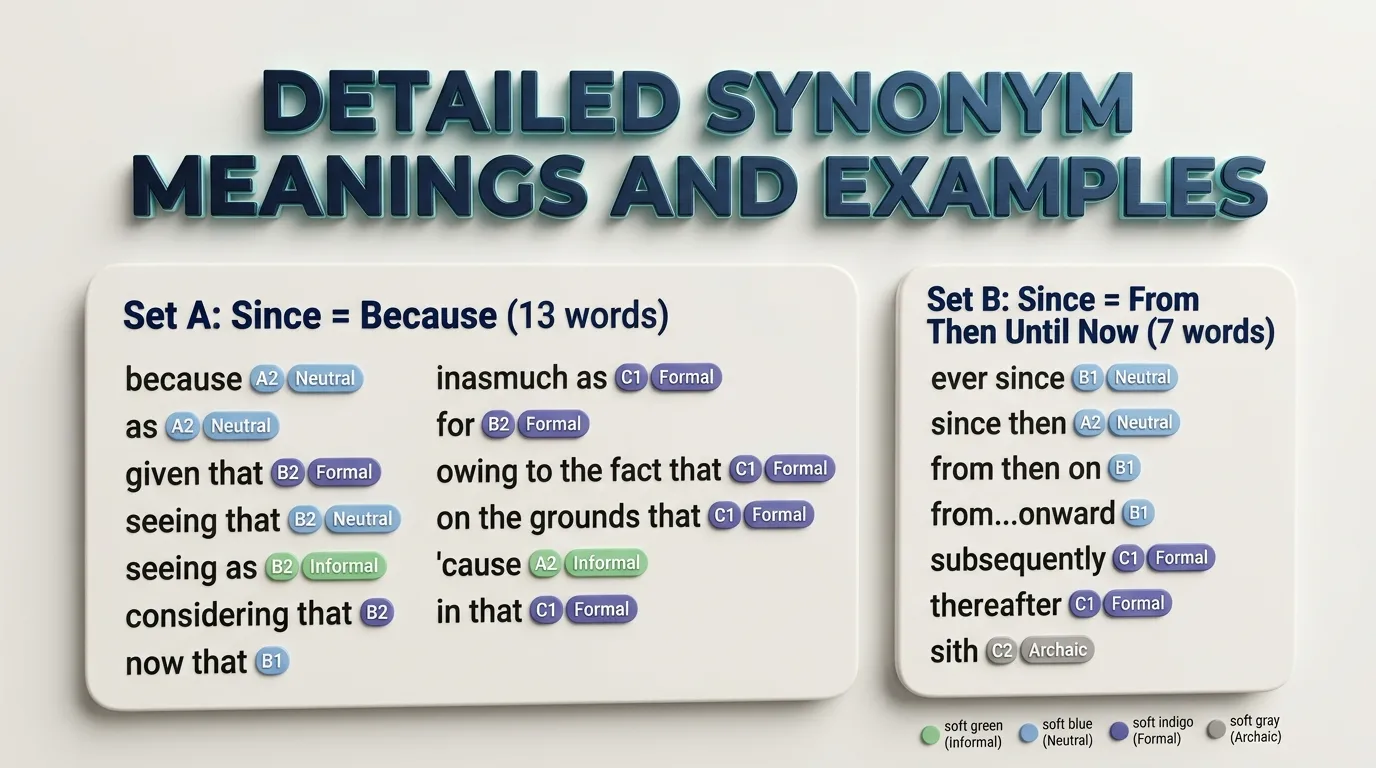
Set A: Since meaning “because”
1. Because
Meaning: The closest match, fully defined in Section 4.
Difference from since: It makes the reason the main information instead of background.
Best Used For: Everyday speech, essays, reports, and anywhere the reason is new to the reader.
Formality: Neutral
CEFR Level: A2
Frequency: Very Common
Examples:
- We postponed the launch because the payment gateway failed testing. (workplace)
- She skipped lunch because the queue stretched out the door. (everyday)
When NOT to Use It: Skip it when the reason is already known to the reader, because since or given that sounds smoother there.
2. As
Meaning: Introduces a reason lightly, as background to the main clause.
Difference from since: It shares the “known reason” feel but can also mean “while.”
Best Used For: Neutral writing and short sentences with an obvious cause.
Formality: Neutral
CEFR Level: A2
Frequency: Very Common
Examples:
- As the shop was closed, we ate at the station café. (travel)
- As you asked for a summary, I’ve kept the report to one page. (workplace)
When NOT to Use It: Avoid it when the clause could also read as a time marker, since “as he spoke, the lights failed” is ambiguous.
3. Given that
Meaning: Treats the reason as an accepted fact that the conclusion rests on.
Difference from since: It is more formal and more argument-driven.
Best Used For: Academic, business, and reasoned arguments.
Formality: Formal
CEFR Level: B2
Frequency: Common
Examples:
- Given that the grant covers only two years, the study design must stay small. (academic)
- Given that most customers order online, we should expand the delivery team. (retail)
When NOT to Use It: Don’t use it when the reason is new or surprising, because because is clearer.
4. Seeing that
Meaning: Introduces a reason that is obvious from the situation.
Difference from since: It is more conversational, with an “as we can all see” feel.
Best Used For: Practical decisions and friendly or informal professional writing.
Formality: Neutral
CEFR Level: B2
Frequency: Common
Examples:
- Seeing that nobody has replied, I’ll send the draft again. (workplace)
- Seeing that it’s your birthday, dinner is on me. (everyday)
When NOT to Use It: It sounds too casual for formal academic or legal writing.
5. Seeing as
Meaning: A spoken variant of seeing that, introducing an obvious reason.
Difference from since: It is noticeably more casual and mostly belongs to speech.
Best Used For: Conversation, chat, and relaxed emails.
Formality: Informal
CEFR Level: B2
Frequency: Common
Examples:
- Seeing as you’re up, can you grab the post? (home)
- Seeing as the train’s cancelled, we’ll take the bus. (travel)
When NOT to Use It: Keep it out of essays, reports, and anything a stranger will judge.
6. Considering that
Meaning: Introduces a factor taken into account as the reason.
Difference from since: It hints at weighing circumstances, and it can also signal a surprising contrast, which since cannot.
Best Used For: Planning and decision-making sentences.
Formality: Neutral
CEFR Level: B2
Frequency: Common
Examples:
- Considering that the lease ends in March, we should start viewing flats now. (housing)
- Considering that fuel prices keep rising, the company switched suppliers. (business)
When NOT to Use It: Avoid it for plain mechanical cause, because “considering” suggests a weighing you may not intend.
7. Now that
Meaning: Gives a reason that has only just become true.
Difference from since: It carries a “change has happened” idea that since lacks.
Best Used For: Plans and requests that follow a recent change.
Formality: Neutral
CEFR Level: B1
Frequency: Very Common
Examples:
- Now that the roadworks are finished, the commute takes twenty minutes. (daily life)
- Now that the certificate has expired, the lab can’t run those tests. (compliance)
When NOT to Use It: Don’t use it for reasons that were true all along.
8. Inasmuch as
Meaning: A formal link meaning “because,” and in some sentences “to the extent that.”
Difference from since: It is far more formal and sometimes carries the “extent” meaning.
Best Used For: Legal, academic, and formal argument.
Formality: Formal
CEFR Level: C1
Frequency: Rare
Examples:
- The ruling is significant inasmuch as it settles the dispute over liability. (legal)
- The method is useful inasmuch as it saves reviewers time. (academic)
When NOT to Use It: It sounds stiff in speech and everyday emails.
9. For
Meaning: A literary conjunction that gives the reason after the main clause.
Difference from since: It can only follow the main clause, and it sounds old-fashioned.
Best Used For: Fiction, poetry, and deliberately elevated prose.
Formality: Formal
CEFR Level: B2
Frequency: Uncommon
Examples:
- We cannot stay long, for the tide is turning. (creative writing)
- She declined the interview, for the terms allowed no follow-up questions. (editorial)
When NOT to Use It: Don’t open a sentence with it, and avoid it where readers may take it for the preposition for.
10. Owing to the fact that
Meaning: A wordy, formal way of stating a cause (also written due to the fact that or in view of the fact that).
Difference from since: It is heavier and longer, and a single word can usually do the same job.
Best Used For: Official notices and formal reports where a full phrase fits the register.
Formality: Formal
CEFR Level: C1
Frequency: Uncommon
Examples:
- Owing to the fact that supplies arrived late, the opening was delayed. (retail)
- Owing to the fact that two inspectors were absent, the audit was extended. (finance)
When NOT to Use It: Skip it wherever concision matters, because because says the same thing in one word.
11. On the grounds that
Meaning: Introduces the stated justification for a decision.
Difference from since: It frames the reason as an official or argued justification.
Best Used For: Rulings, rejections, and formal decisions.
Formality: Formal
CEFR Level: C1
Frequency: Uncommon
Examples:
- The claim was rejected on the grounds that the form arrived late. (insurance)
- She declined the offer on the grounds that the hours were too long. (workplace)
When NOT to Use It: Don’t use it for casual explanations that aren’t presented as justification.
12. ‘Cause
Meaning: A short spoken form of because (also written cos).
Difference from since: It has the same meaning but belongs only to informal speech and messages.
Best Used For: Texts, chat, and casual dialogue.
Formality: Informal
CEFR Level: A2
Frequency: Very Common (in speech)
Examples:
- I’m taking the bus ’cause it’s pouring. (chat)
- Call me ’cause I won’t hear the notification. (social media)
When NOT to Use It: Never use it in essays, reports, or work emails.
13. In that
Meaning: A formal link naming the specific respect in which a statement is true.
Difference from since: It explains “in what way,” so it is narrower than since.
Best Used For: Describing qualities and limitations of ideas, designs, or studies.
Formality: Formal
CEFR Level: C1
Frequency: Uncommon
Examples:
- The study is limited in that it covers a single hospital. (research)
- The design is elegant in that it has no moving parts. (engineering)
When NOT to Use It: Don’t use it to explain events or actions, since “we left in that it rained” is wrong.
Set B: Since meaning “from then until now”
14. Ever since
Meaning: Continuously from a past point up to now (or up to another stated time).
Difference from since: It adds emphasis on unbroken continuity.
Best Used For: Stories, habits, and changes that started at a clear moment.
Formality: Neutral
CEFR Level: B1
Frequency: Very Common
Examples:
- Ever since the firmware update, the app drains the battery overnight. (tech support)
- She has kept the same landline number ever since she opened the bakery. (small business)
When NOT to Use It: Don’t use it when you mean “because,” where it would read as a time word.
15. Since then
Meaning: From a moment already mentioned until now.
Difference from since: It points back to a starting point stated earlier in the text.
Best Used For: Follow-up sentences after you’ve named an event or date.
Formality: Neutral
CEFR Level: A2
Frequency: Very Common
Examples:
- The shop reopened in May, and sales have doubled since then. (retail)
- I bought my first laptop in 2012, and I’ve upgraded twice since then. (everyday)
When NOT to Use It: Don’t use it unless a starting point has already been named.
16. From then on
Meaning: Beginning at that moment and continuing afterward.
Difference from since: It lacks the “up to now” force and suits stories told in the past.
Best Used For: Narrative and past-tense accounts of lasting change.
Formality: Neutral
CEFR Level: B1
Frequency: Common
Examples:
- After the audit, the team logged every expense from then on. (workplace)
- She won that first match, and from then on she trained daily. (sports)
When NOT to Use It: Don’t use it with a present-perfect sentence or a bare date, where ever since fits better.
17. From…onward
Meaning: Starting at a stated point and continuing forward.
Difference from since: It needs onward or onwards to express the continuing span that since carries on its own.
Best Used For: Schedules, timetables, and clear restatements of a time span.
Formality: Neutral
CEFR Level: B1
Frequency: Common
Examples:
- The gallery has been closed from Tuesday onward for installation. (arts venue)
- Staff have worked hybrid from 2021 onward. (workplace)
When NOT to Use It: Don’t use bare from, since “I’ve worked here from 2018” is ungrammatical without onward.
18. Subsequently
Meaning: At a later time, after something already mentioned.
Difference from since: It marks sequence only, with no sense of continuing up to now.
Best Used For: Reports, histories, and formal summaries.
Formality: Formal
CEFR Level: C1
Frequency: Common
Examples:
- The firm acquired a rival and has subsequently doubled its staff. (business)
- The article was published in 2020 and subsequently revised. (academic)
When NOT to Use It: Avoid it when you want to stress that something has continued until now.
19. Thereafter
Meaning: After that point, in a formal register.
Difference from since: It is more legal and literary, and the period it covers can stretch indefinitely.
Best Used For: Contracts, legal prose, and formal narrative.
Formality: Formal
CEFR Level: C1
Frequency: Uncommon
Examples:
- The tenant paid in full in April and monthly thereafter. (legal)
- The company launched in 2015 and grew steadily thereafter. (business)
When NOT to Use It: It sounds out of place in casual speech or friendly emails.
20. Sith
Meaning: An obsolete word for since in the sense of “after that time” (its longer form is sithence).
Difference from since: It is archaic and found only in older texts or deliberate period style.
Best Used For: Historical fiction and period dialogue.
Formality: Formal
CEFR Level: C2
Frequency: Rare
Examples:
- He has not been seen sith that day. (historical fiction)
- Sith you ask, I will answer plainly. (period dialogue)
When NOT to Use It: Don’t use it in modern writing unless you want the archaic effect on purpose.
Best Alternatives by Context
- Everyday conversation: because, as, seeing as, and ’cause for reasons; ever since and since then for time.
- Formal writing: given that and inasmuch as for reasons; subsequently and thereafter for time.
- Academic writing: given that, in that, and owing to the fact that for reasons. If you’re hunting for another word for since in an essay, given that is the safest upgrade, and subsequently is the best time word.
- Business communication: given that, now that, and considering that for reasons; since then for updates.
- Creative writing: for and sith for a period tone; from then on for narrative.
- Social media: ’cause for reasons; ever since for stories.
Choosing by length (useful for crosswords). Count squares before you commit. The short options from this guide are as (2), for (3), and sith (4), with cos (3) as the informal spelling of ’cause. There is no everyday four-letter modern synonym; sith is the archaic one. Longer options include because (7) and ever since (9 letters, two words). Which one fits depends on whether the clue points to the reason meaning or the time meaning.
Which Synonym Should I Choose?
| Situation | Best Choice | Why |
|---|---|---|
| Giving a new reason | because | Makes the reason the focus |
| Reason already obvious | as | Light and neutral |
| Formal essay or argument | given that | Treats reason as accepted fact |
| Something just changed | now that | Signals the new situation |
| Legal or academic prose | inasmuch as | Fits a formal register |
| Texting a friend | ’cause | Matches casual speech |
| Unbroken time up to now | ever since | Stresses continuity |
| Starting point already named | since then | Refers back clearly |
| Formal timeline | subsequently | Sequence without continuity |
| Contract or legal narrative | thereafter | Legal, formal tone |
Exact and Near Synonyms: Difference
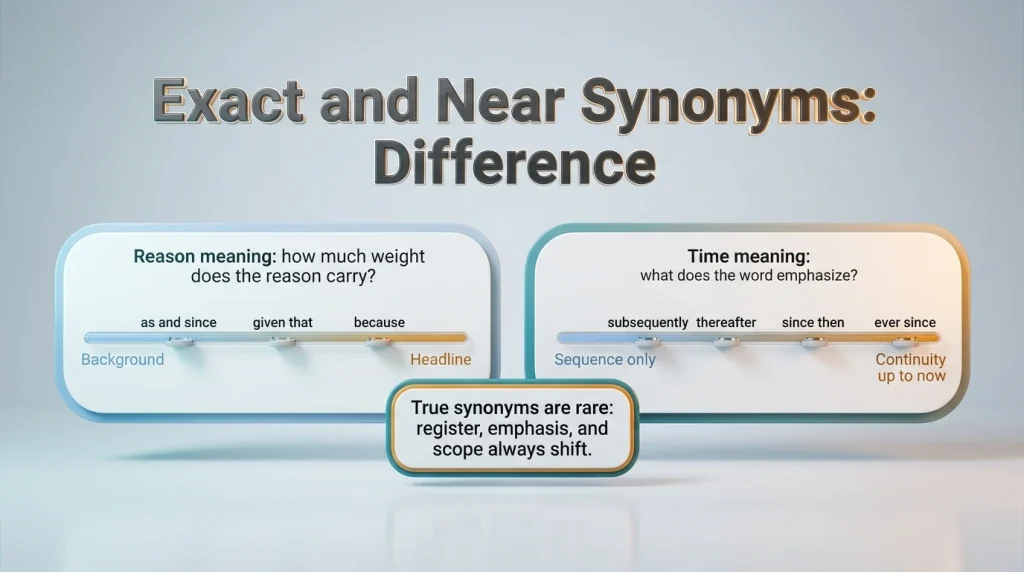
True synonyms are rare because two words that mean “the same thing” almost always differ in register, emphasis, or scope. Since, as, and because all introduce a reason, but they shift the weight of the sentence. Because makes the reason the headline, while since and as tuck it into the background. Given that goes a step further, treating the reason as a premise the reader should accept.
The time words follow the same pattern. Ever since stresses continuity, since then needs a prior anchor, and subsequently drops the link to the present entirely. Treat each as a near synonym with a job of its own. Once you know whether your reason is new or known, and whether your time period is still running, the choice usually becomes clear.
Clean sentence structure helps here too. A since clause is a dependent clause, so it needs an independent clause beside it (see our guide to synonyms for independent for more on that word). If your essay needs stronger vocabulary elsewhere, synonyms for profound and synonyms for extraordinary cover two common upgrades, and synonyms for harsh helps when tone is the issue.
Words Commonly Confused with Since
These words often appear in the same sentences but fail the substitution test, so they are not true synonyms.
- After / following / subsequent to: mark sequence but not “continuing until now,” so “I’ve lived here after 2019” is wrong.
- As of: names an effective date, not a stretch of time lived through.
- Until now / heretofore: point to an endpoint or the whole period before now, the opposite direction from since.
- Ago: follows a time expression (“five years ago”) and can’t open a clause the way since does.
- From (bare): can’t pair with the present perfect (“I’ve worked here from June” is wrong).
- For (duration): takes a length of time, while since takes a starting point.
- Dating back to / back to: attach an origin to a noun instead of linking two clauses.
- Until / till: mark where a period ends, so they run opposite to since.
- While / whereas / during: express simultaneity or contrast, not cause or a starting point.
- So / therefore / thus / hence: show a result, not the reason, so they reverse the logic.
- Because of / due to: prepositions that need a noun, so they can’t introduce a clause.
- As long as / once: express a condition or sequence, not a reason.
Common Mistakes
| Mistake | Better | Why |
|---|---|---|
| “I’ve lived here since five years.” | “I’ve lived here for five years.” | Since needs a starting point, not a duration |
| “Since I joined, we’ve grown.” (unclear) | “Ever since I joined, we’ve grown.” | Removes the reason-or-time ambiguity |
| “Following it was late, we left.” | “Because it was late, we left.” | Time words can’t express a cause |
| “Inasmuch as it’s late, let’s go.” | “Since it’s late, let’s go.” | Too formal for a casual remark |
| “‘Cause the data was limited, the study failed.” | “Because the data was limited, the study failed.” | Slang doesn’t belong in academic prose |
Antonyms of Since
Standard dictionaries rarely list true antonyms for since, so these are the closest opposites for each meaning.
Time meaning (a starting point versus an endpoint)
| # | Antonym | Why It’s the Opposite |
|---|---|---|
| 1 | until | Marks where a period ends |
| 2 | till | Informal form of until |
| 3 | up until | Stresses the endpoint |
| 4 | before | Points to earlier than a moment |
| 5 | prior to | Formal form of before |
Reason meaning (a cause versus a contrast)
| # | Antonym | Why It’s the Opposite |
|---|---|---|
| 1 | although | Introduces contrast, not cause |
| 2 | though | Casual form of although |
| 3 | even though | Stresses the contrast |
| 4 | despite the fact that | Formal contrast |
| 5 | in spite of the fact that | Formal contrast |
Real-World Collocations & Phrases
Part A: Collocations
- Adverb + since: ever since, long since, only since, not since
- Verb phrase + since: has not changed since, has been closed since, have known him since
- Since + time point: since Monday, since 2019, since childhood, since last winter
- Since + preposition: since before the war, since after the merger
Part B: Set phrases and idioms
- “Since when?”: expresses disbelief (“Since when do you cook?”). Etymonline dates it to 1907.
- “Long since”: means “a long time before now” (the shop has long since closed).
- “Since time immemorial”: describes something that has lasted beyond memory.
- “The best thing since sliced bread”: a well-known idiom for something excellent.
- “Since the year dot”: British, informal for “for an extremely long time.”
- “Auld lang syne”: the Scots phrase from the New Year song, with syne being the Scots form of since.
Practice Exercises
Fill in the blanks (choose from: because, now that, ever since, subsequently, given that)
- ______ the fee is already included, you needn’t pay again.
- She has run every morning ______ she moved to the coast.
- ______ the deadline has moved, we can finally test properly.
- The firm merged in 2018 and ______ opened two offices abroad.
- We left early ______ the road was icy.
Rewrite the sentences (replace since)
- Since the contract expired, we cannot renew it.
- She has played guitar since childhood.
- He joined in 2015 and has since become a manager.
Match the words
| Word | Meaning |
| 1. given that | A. continuously from a past point |
| 2. ever since | B. at a later time |
| 3. inasmuch as | C. a reason accepted as fact |
| 4. now that | D. formal “because,” used in writing |
| 5. subsequently | E. a reason that has just become true |
Vocabulary quiz
- Which word most reliably avoids confusion with the time meaning of since?
a) as b) because c) while d) after - Which fits best: “I’ve lived here ______ 2019.”
a) because b) given that c) ever since d) inasmuch as - Which suits a formal, legal-style sentence?
a) ’cause b) seeing as c) inasmuch as d) now that - “______ you’re here, could you help me?” Which is best?
a) Now that b) Subsequently c) Thereafter d) Sith - Which is NOT a synonym of since meaning “because”?
a) given that b) as c) seeing that d) after
Answer key
- Fill in the blanks: 1. given that; 2. ever since; 3. now that; 4. subsequently; 5. because.
- Rewrite (sample answers): 1. Given that the contract has expired, we cannot renew it. 2. She has played guitar ever since childhood. 3. He joined in 2015 and has subsequently become a manager.
- Match: 1-C, 2-A, 3-D, 4-E, 5-B.
- Quiz: 1-b, 2-c, 3-c, 4-a, 5-d.
FAQ
What is the closest synonym for since?
The closest synonym depends on the meaning. When since means “because,” use because; as and given that also work. When it means “from then until now,” ever since is the closest match, with since then and from then on as natural options when the starting point is already clear.
Can I use “as” instead of since?
Often yes, when since means “because”: “As it was late, we left” works. But as can also mean “while,” so the sentence may become ambiguous. Use because when the reason must be unmistakable. As never replaces since in its time meaning: “I’ve lived here as 2019” is wrong.
What does since mean?
Since has two main meanings. As a time word, it marks the starting point of a period that continues to now or to another point: “I’ve worked here since June.” As a conjunction of reason, it means “because” and presents a cause the reader usually already knows: “Since it’s raining, we’ll stay in.”
Is since formal or informal?
Since is neutral and fits both speech and writing. For a more formal reason, choose given that or inasmuch as; for formal time references, subsequently or thereafter. In casual speech or texts, ’cause is the usual shortened form of because. Because itself suits nearly every register.
How do I use since correctly in a sentence?
Use since with a starting point, not a length of time: “since Monday,” not “since three days.” For durations, use for: “for three days.” When since means “because,” it commonly opens the sentence; check that readers couldn’t mistake it for a time marker.
What is the opposite of since?
Since rarely has a listed antonym, but there are useful opposites. For the time meaning, until, till, and before point to an endpoint instead of a starting point. For the reason meaning, although, though, and even though introduce a contrast instead of a cause: “Although it rained, we went out.”
Conclusion
Choosing the right word for since comes down to one question: are you giving a reason or marking a point in time? Once that is settled, tone does the rest.
Because and ever since cover most needs, while given that, subsequently, and the other options let you fit a formal report, a casual message, or a story. A deliberate choice makes your sentences clearer and keeps readers from guessing which meaning you intended.

About Sajjad Ahmed
Sajjad Ahmed is the author behind Guest Paster, where he writes about English vocabulary, synonyms, word meanings, and practical word usage.
His content is designed to help readers understand the differences between similar words, discover suitable alternatives, and use English vocabulary more effectively in everyday writing and communication.
Before publishing, Sajjad focuses on presenting word choices in a clear and easy-to-understand format, with relevant meanings, context, and examples where helpful.
Through Guest Paster, his goal is to make vocabulary learning simpler and provide useful language resources for students, writers, English learners, and anyone looking to expand their vocabulary.
Areas of Focus: English Vocabulary • Synonyms • Word Meanings • Word Usage • Language Learning
Author: Sajjad Ahmed
Website: Guest Paster