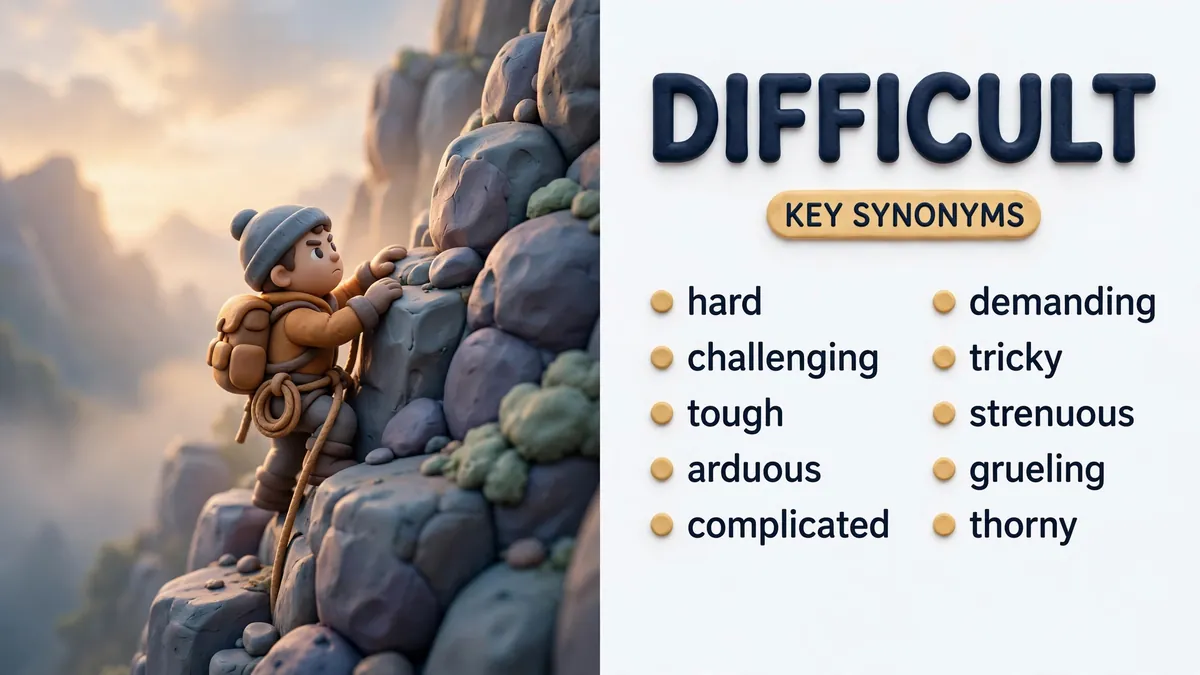
What do you write when hard feels too plain and complicated feels too long? That gap is exactly where difficult lives, and hard is its closest synonym, swapping cleanly into most sentences about tasks, ideas, and people.
Challenging suits a task that tests skill, tricky suits a problem with a hidden catch, and arduous suits work that wears you down. This guide gives you 15 difficult synonyms with meanings, examples, and honest limits, so your next sentence names the exact kind of hard you mean.
Another Word For Difficult Synonyms
| # | Synonym | Meaning Difference |
|---|---|---|
| 1 | Hard | Not easy, the plainest swap |
| 2 | Challenging | Tests your skill or nerve |
| 3 | Tough | Hard to bear or to beat |
| 4 | Arduous | Long, steep, and tiring |
| 5 | Complicated | Full of many tangled parts |
| 6 | Demanding | Asks a lot of you |
| 7 | Tricky | Has a hidden catch |
| 8 | Strenuous | Needs great physical effort |
| 9 | Grueling | Punishingly hard over time |
| 10 | Thorny | Full of awkward problems |
Quick Facts About “Difficult”
- Part of speech: an adjective. The noun is difficulty.
- Core meaning: not easy to do, understand, or deal with.
- Three main senses: (1) hard to do, needing effort; (2) hard to understand or solve; (3) hard to deal with, of a person or situation.
- Register: neutral. Difficult fits essays, reports, and everyday conversation.
- Common mistake: using difficult for anything unpleasant. A sad day is not difficult, and a rude person is harsh.
The Closest Synonym: Hard
Hard is the closest synonym for difficult, because it covers the same three senses in the plainest form. Test the swap and it holds. “The exam was difficult” becomes “The exam was hard” with no loss of sense. “She faced a difficult choice” becomes “She faced a hard choice.” “He is a difficult man to work with” becomes “He is a hard man to work with.”
Hard wins on range and ease: it works for tasks, ideas, people, and times, while difficult sounds a touch more formal. Challenging runs second for tasks that test you.
Where “Difficult” Comes From (Etymology)
According to Etymonline, difficult entered English around 1400 meaning “not easy, requiring or dependent on effort; troublesome, arduous,” apparently as a back-formation from difficulty. The noun difficulty dates from the late 14th century, from Anglo-French difficulté and Latin difficultatem, “difficulty, distress, poverty,” from difficilis, “hard.” That Latin word joins dis-, “not, away from,” with facilis, “easy to do,” from facere, “to do.” Of persons, “hard to please,” from the 1580s. Merriam-Webster records the same core senses, including “hard to deal with, manage, or overcome.”
The word is built from a denial: take facilis, easy, add dis- to cancel it, and you get a word that refuses ease. That history explains why difficult feels so broad: it can cover a steep climb, a tangled puzzle, and a stubborn colleague with one word.
Difficult Synonyms in Detail

Group 1: Hard to Do, Needing Effort and Endurance
1. Hard
- Meaning: Not easy to do, understand, or bear.
- Difference: The plainest swap for difficult.
- Best used for: Exams, tasks, choices, and people.
- Formality: Neutral · CEFR: A2 · Frequency: Very common
- Example (Exam): “The maths test was hard.”
- Example (Choice): “It was a hard decision, and she slept on it.”
- When NOT to use it: For a solid surface, say “a hard floor,” never “a difficult floor.”
2. Challenging
- Meaning: Testing your skill, strength, or nerve.
- Difference: Adds a positive edge: meeting it proves something.
- Best used for: Jobs, courses, hikes, and goals.
- Formality: Neutral · CEFR: B2 · Frequency: Very common
- Example (Job): “The new role was challenging, and it stretched her.”
- Example (Course): “A challenging course keeps students awake.”
- When NOT to use it: For a person who resists you, use difficult or stubborn.
3. Tough
- Meaning: Hard to bear, to do, or to beat.
- Difference: Stresses endurance and grit.
- Best used for: Times, opponents, questions, and decisions.
- Formality: Neutral, slightly informal · CEFR: B1 · Frequency: Very common
- Example (Times): “It was a tough year for the shop.”
- Example (Match): “Their next opponent is tough to beat.”
- When NOT to use it: In formal writing, use difficult or demanding instead.
4. Arduous
- Meaning: Needing long, hard effort over a steep path.
- Difference: Stresses the length of the climb.
- Best used for: Journeys, climbs, training, and research.
- Formality: Neutral to formal · CEFR: C1 · Frequency: Less common
- Example (Climb): “The arduous climb to the pass took nine hours.”
- Example (Research): “Writing the history meant an arduous trawl through the archives.”
- When NOT to use it: For a short, sharp task, use hard or tricky.
5. Strenuous
- Meaning: Needing great physical effort.
- Difference: About the body: muscles, breath, and stamina.
- Best used for: Exercise, labour, hikes, and workouts.
- Formality: Neutral to formal · CEFR: C1 · Frequency: Common
- Example (Hike): “The strenuous trail left fit walkers breathless.”
- Example (Work): “Strenuous lifting is part of the warehouse job.”
- When NOT to use it: For a mental puzzle, use complicated or perplexing.
6. Grueling
- Meaning: Extremely tiring and punishing over time.
- Difference: Adds suffering over hours.
- Best used for: Marathons, shifts, schedules, and trials.
- Formality: Neutral · CEFR: C1 · Frequency: Common
- Example (Race): “The grueling marathon broke runners in the last six miles.”
- Example (Shift): “A grueling night shift leaves nurses drained.”
- When NOT to use it: For a short task, use hard or tough.
7. Laborious
- Meaning: Needing much hard work, step by step.
- Difference: Stresses slow, heavy, often dull effort.
- Best used for: Manual work, copying, digging, and editing.
- Formality: Neutral to formal · CEFR: C1 · Frequency: Less common
- Example (Garden): “Clearing the plot was laborious work.”
- Example (Edit): “The laborious edit took three full passes.”
- When NOT to use it: For a task that tests skill, use challenging instead.
8. Demanding
- Meaning: Asking a lot of your time, energy, or attention.
- Difference: Points at what the task takes from you.
- Best used for: Jobs, bosses, courses, and toddlers.
- Formality: Neutral · CEFR: B2 · Frequency: Very common
- Example (Job): “Nursing is a demanding job with long hours.”
- Example (Course): “The demanding course expects three essays.”
- When NOT to use it: For a problem with a hidden catch, use tricky.
9. Burdensome
- Meaning: Heavy to carry, in work or in worry.
- Difference: Stresses the weight on your shoulders.
- Best used for: Debt, duty, paperwork, and grief.
- Formality: Formal · CEFR: C1 · Frequency: Less common
- Example (Debt): “The burdensome loan shaped every choice the family made.”
- Example (Rules): “Farmers called the new forms burdensome.”
- When NOT to use it: For a puzzle or a test, use complicated or challenging.
Group 2: Hard to Understand or Solve
10. Complicated
- Meaning: Made of many parts that tangle together.
- Difference: About structure: many pieces, many steps.
- Best used for: Forms, machines, plots, and rules.
- Formality: Neutral · CEFR: B2 · Frequency: Very common
- Example (Form): “The tax form was complicated, with twelve pages.”
- Example (Plot): “A complicated plot can still work.”
- When NOT to use it: For simple but tiring work, use arduous or laborious.
11. Tricky
- Meaning: Hard because of a hidden catch.
- Difference: Warns of a small trap that careless hands fall into.
- Best used for: Questions, repairs, negotiations, and recipes.
- Formality: Neutral, slightly informal · CEFR: B2 · Frequency: Very common
- Example (Question): “The tricky question turned on one word.”
- Example (Repair): “Fitting the new lock was tricky, and the screws slipped.”
- When NOT to use it: For long, heavy effort, use arduous or grueling.
12. Perplexing
- Meaning: Confusing, leaving you unsure what to think.
- Difference: Stresses the mind stuck in a fog.
- Best used for: Results, behaviour, riddles, and mysteries.
- Formality: Neutral to formal · CEFR: C1 · Frequency: Less common
- Example (Result): “The perplexing result sent the team back.”
- Example (Choice): “His sudden silence perplexed his oldest friends.”
- When NOT to use it: For physical effort, use strenuous or laborious.
13. Thorny
- Meaning: Full of awkward problems at every turn.
- Difference: Suits issues with no clean answer.
- Best used for: Politics, ethics, negotiations, and debates.
- Formality: Neutral to formal · CEFR: C1 · Frequency: Less common
- Example (Issue): “The thorny issue of water rights divided the valley.”
- Example (Debate): “A thorny question opened the town meeting.”
- When NOT to use it: For merely tiring work, use arduous or grueling.
Group 3: Hard to Deal With, of People and Opposition
14. Stubborn
- Meaning: Refusing to change your mind or your course.
- Difference: Names the resistance: the person will not budge.
- Best used for: People, habits, stains, and negotiations.
- Formality: Neutral · CEFR: B2 · Frequency: Very common
- Example (Person): “Her stubborn father refused every offer of help.”
- Example (Stain): “A stubborn stain survived three washes and a scrub.”
- When NOT to use it: For a task that needs effort, use arduous or demanding.
15. Formidable
- Meaning: So strong it inspires respect and fear.
- Difference: Adds awe: the opponent is hard before you start.
- Best used for: Opponents, tasks, reputations, and challenges.
- Formality: Formal · CEFR: C1 · Frequency: Common
- Example (Opponent): “The champion was a formidable opponent.”
- Example (Task): “Cleaning the old house was a formidable task.”
- When NOT to use it: For a small everyday hassle, use tricky or hard.
Best Alternatives by Context
A demanding job and a tricky puzzle both count as difficult, yet they ask for different words. Match the word to the moment with the table below.
| Situation | Best pick | Why it wins |
|---|---|---|
| An exam or homework set | Hard | The plain word, no extra shade |
| A job that tests your skill | Challenging | The test is the point |
| A long climb or research slog | Arduous | The length is the hardship |
| A workout or a heavy lift | Strenuous | The body does the work |
| A twelve-hour shift or marathon | Grueling | The effort punishes you over time |
| A form with twelve pages | Complicated | The parts tangle together |
| A question with a hidden catch | Tricky | The trap is small and easy to miss |
| A boss who asks too much | Demanding | The ask itself is the problem |
| A debt or a heavy duty | Burdensome | The weight is what hurts |
| A person who will not budge | Stubborn | The resistance is the point |
Two calls deserve a second look. A demanding job asks for your hours, while hardworking synonyms describe the person who meets that ask day after day. A goal that tests you calls for effort with purpose, and our guide to strive synonyms covers the verbs of reaching it.
Words Commonly Confused With Difficult
Difficult versus hard is the closest call in this guide. The split comes from the other senses of hard: it also means solid, as in a hard floor, and firm, as in a hard stare. Difficult never means solid. Use hard as the safe default, and save difficult for formal writing.
Difficult versus complicated matters for what makes the thing hard. Complicated means many parts tangle together, so a twelve-page tax form is complicated. A task can still be difficult with one part: lifting a heavy stone is simple and difficult at once. Use complicated for tangled structure, and difficult for effort.
Difficult versus harsh matters for the kind of person. A difficult person resists cooperation and will not budge. A harsh person speaks cruelly, judges without mercy, and leaves people stung. The words overlap in a bad boss, yet they blame different faults. Our guide to harsh synonyms covers that colder side.
Difficult versus tricky matters for the trap. Tricky warns of a hidden catch, a small detail that flips the answer. Difficult warns of effort, length, or resistance. A repair can be both, and a maths question can be tricky without being difficult.
Difficult versus strict matters for who sets the rule. Strict describes rules and the people who enforce them, as in a strict teacher with a firm deadline. Difficult describes the experience of meeting the demand. A strict teacher can set an easy test, and a kind one can set a difficult one.
Difficult versus impossible matters for honesty. Impossible means it cannot be done. Difficult means it can be done with effort. Calling a hard climb impossible insults every climber who finished it.
Substitution test failures:
“The difficult floor hurt my knees” fails, because a floor is hard in the solid sense, so say “hard.” “The difficult tax form had only one box” fails, because one box cannot tangle, so say “hard.” “Her difficult praise left him in tears” fails, because praise that wounds is harsh, so say “harsh.” “The difficult stain came out in one wash” fails, because a stain that yields was never difficult.
Can You Swap Them Freely?
In short: only inside the same meaning group, when the sense matches.
- ✅ “The exam was hard.” (a task that needs effort ✔)
- ✅ “The exam was difficult.” (same sense ✔)
- ❌ “The exam was thorny.” (thorny is about issues, not tests ✘, say hard)
- ✅ “The climb was arduous.” (long, steep effort ✔)
- ❌ “The climb was perplexing.” (perplexing is about confusion ✘, say arduous)
- ✅ “The question was tricky.” (a hidden catch ✔)
- ❌ “The question was grueling.” (grueling is about punishing effort ✘, say tricky)
- ✅ “Her father was stubborn.” (refusing to budge ✔)
- ❌ “Her father was complicated.” (complicated is about tangled parts ✘)
- ✅ “The loan was burdensome.” (a heavy weight to carry ✔)
- ❌ “The loan was strenuous.” (strenuous is about the body ✘)
Before you substitute, ask what makes it hard: the effort, the puzzle, or the person.
Collocations and Idioms With Difficult
Only combinations native speakers actually use:
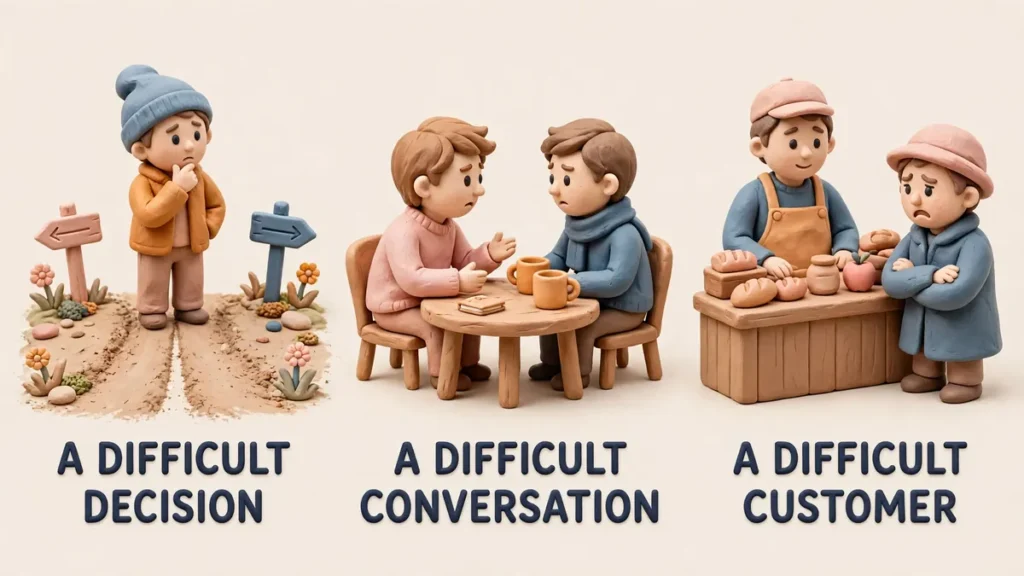
- a difficult decision: as in “Leaving the job was a difficult decision, and she took a month to make it.”
- a difficult conversation: as in “They sat down for a difficult conversation about the budget.”
- a difficult customer: as in “The shop trains staff to stay calm with a difficult customer.”
- a difficult time: as in “The family went through a difficult time after the flood.”
- difficult circumstances: as in “She finished her degree in difficult circumstances, working nights to pay for it.”
- find something difficult: as in “Many learners find spelling difficult at first.”
- make life difficult: as in “The new rules made life difficult for small traders.”
- difficult to please: as in “The critic was difficult to please, and few restaurants earned her praise.”
Which Difficult Synonym Should I Choose?
| Situation | Best pick | Why it wins |
|---|---|---|
| A task that needs effort | Hard | The plain word |
| A task that tests your skill | Challenging | The test is the point |
| A time that is hard to bear | Tough | The grit |
| A long, steep effort | Arduous | The length |
| A form with many tangled parts | Complicated | The structure |
| A job that asks too much | Demanding | The ask |
| A problem with a hidden catch | Tricky | The trap |
| A workout that drains the body | Strenuous | The muscles |
| A shift that punishes you over time | Grueling | The suffering |
| An issue with no clean answer | Thorny | The pricks |
| A debt or a heavy duty | Burdensome | The weight |
| Slow, heavy, step-by-step work | Laborious | The grind |
| A result that leaves you confused | Perplexing | The fog |
| A person who will not budge | Stubborn | The resistance |
| An opponent who inspires awe | Formidable | The fear and respect |
Difficult Opposites: Easy Answers for Every Sense
| Difficult word | Opposite | What changes |
|---|---|---|
| Hard | Easy | No effort is needed |
| Challenging | Simple | No skill is tested |
| Tough | Gentle | Nothing hard to bear |
| Arduous | Effortless | The climb flattens out |
| Complicated | Straightforward | The parts fall into place |
| Demanding | Undemanding | Little is asked of you |
| Tricky | Clear-cut | No hidden catch |
| Strenuous | Light | The body rests |
| Grueling | Relaxing | The strain lifts |
| Thorny | Smooth | No awkward pricks |
| Stubborn | Cooperative | The person yields |
Easy is the plain opposite for everyday writing, while effortless suits the doing sense and simple suits the understanding sense. Cooperative fits a person, since a cooperative colleague bends where a stubborn one breaks the meeting. Pair the opposite with the same sense.
American vs British English
Difficult is spelled and used the same in American and British English, and so are its synonyms here. “Go through a difficult patch” is more British, while Americans more often say “a rough patch.”
Grueling keeps its American spelling with one l in the US; British writers often double it to gruelling. This article uses American spelling throughout.
Practice Exercises
Exercise 1: Odd one out. In each set, one word does not belong. Name it and say why.
- hard, arduous, strenuous, simple
- tricky, perplexing, complicated, effortless
- stubborn, formidable, cooperative, thorny
- grueling, laborious, burdensome, relaxing
- demanding, challenging, tough, easy
Exercise 2: Replace with a sharper word. Each sentence uses difficult where a sharper synonym fits better. Replace it and say why.
- “The difficult climb to the pass took nine hours.”
- “The difficult question turned on one word in the middle.”
- “Her difficult father refused every offer of help.”
- “The difficult tax form had twelve pages.”
- “A difficult night shift leaves nurses drained.”
Answer key
- Exercise 1: (1) simple: the rest mean hard to do; (2) effortless: the rest mean hard to solve; (3) cooperative: the rest describe resistance; (4) relaxing: the rest mean heavy effort; (5) easy: the rest mean hard to meet.
- Exercise 2: (1) arduous: the climb is long and steep; (2) tricky: the question hides a catch; (3) stubborn: the father refuses to budge; (4) complicated: the form has many parts; (5) grueling: the shift punishes over hours.
Frequently Asked Questions
What is the best synonym of difficult?
Hard is the best synonym for difficult in most sentences, because it covers the same three senses, tasks, ideas, and people, in the plainest form. Challenging fits a task that tests skill, tricky fits a problem with a hidden catch, and arduous fits long, wearing work.
What is the difference between difficult and hard?
Almost none in most sentences, since hard swaps cleanly into nearly every use of difficult. The split comes from the other senses of hard: it also means solid, as in a hard floor, and firm, as in a hard stare. Difficult never means solid, so use hard in speech and difficult in formal writing.
Is difficult the same as complicated?
No. Complicated means made of many parts that tangle together, so a tax form with twelve pages is complicated. A task can still be difficult with only one part: lifting a heavy stone is simple and difficult at once. Use complicated for tangled structure, and difficult for effort, length, or resistance.
What is the Antonym of difficult?
It depends on the sense. For a task that needs effort, the opposite is easy, which asks for nothing. For a problem to solve, use simple, and for a long effort, use effortless. And for a person, the opposite is cooperative, since a cooperative colleague bends where a stubborn one holds firm.
Can difficult describe a person?
Yes. A difficult person is hard to deal with, not hard to understand: they argue every point, resist change, and will not budge. It is a polite way to name resistance without calling someone rude. A harsh person is different, since harsh means cruel in manner, so keep the two apart.
Which synonym should students use in essays?
In essays, use difficult itself for the general claim, and hard only in quoted speech or informal notes. Pick challenging for a task that tests skill, complicated for a problem with many parts, and arduous for long research. Save perplexing, thorny, and formidable for formal writing, where their precision earns its place.
Conclusion
Picture the climber again, halfway up the cliff at dawn. The rock is hard, the route is arduous, and the next move is tricky. Three words, three kinds of hard. Pick the word that matches your kind of difficult, and the sentence will hold.

About Sajjad Ahmed
Sajjad Ahmed is the author behind Guest Paster, where he writes about English vocabulary, synonyms, word meanings, and practical word usage.
His content is designed to help readers understand the differences between similar words, discover suitable alternatives, and use English vocabulary more effectively in everyday writing and communication.
Before publishing, Sajjad focuses on presenting word choices in a clear and easy-to-understand format, with relevant meanings, context, and examples where helpful.
Through Guest Paster, his goal is to make vocabulary learning simpler and provide useful language resources for students, writers, English learners, and anyone looking to expand their vocabulary.
Areas of Focus: English Vocabulary • Synonyms • Word Meanings • Word Usage • Language Learning
Author: Sajjad Ahmed
Website: Guest Paster