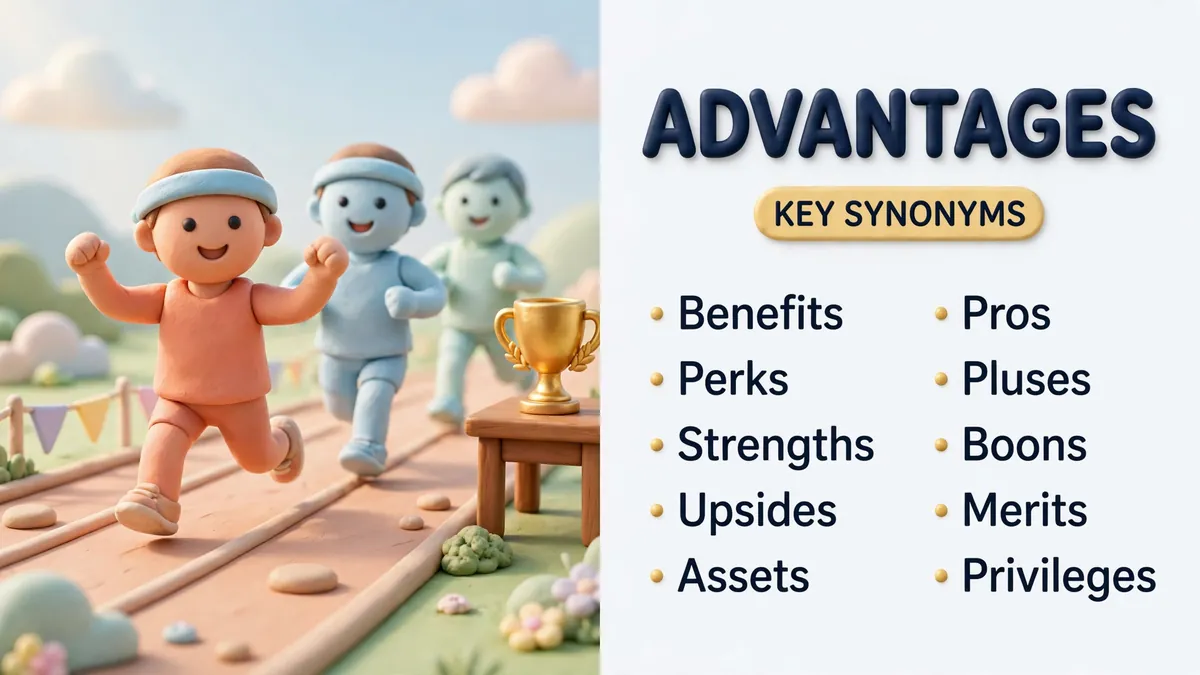
Two job offers land on the same morning. One pays a little more. The other offers flexible hours, a shorter commute, and a training budget you can actually use. The salary looks bigger, but which offer has the better advantages?
That is why this word matters: an advantage is anything that puts you ahead, from a higher salary to a shorter airport queue. This guide sorts 15 advantages synonyms by meaning so you can pick the word that fits.
If you mean a good thing you receive, say benefits. If you mean a small extra on top, say perks. And if you mean the lead itself, say edge.
Advantages Synonyms at a Glance
| # | Synonym | Meaning Difference |
|---|---|---|
| 1 | Benefits | Good things you receive |
| 2 | Perks | Small extras on top |
| 3 | Strengths | Qualities that give you power |
| 4 | Upsides | Good points of a choice |
| 5 | Assets | Valuable things you hold |
| 6 | Pros | Points in favor of something |
| 7 | Pluses | Extra good points, counted |
| 8 | Boons | Gifts that help you |
| 9 | Merits | Worth earned by quality or action |
| 10 | Privileges | Special rights not everyone has |
Quick Facts About “Advantages”
- Part of speech: a noun, the plural of advantage. Advantage is also a rare formal verb, but the noun is far more common.
- Three core meanings: (1) a condition that puts you in a better position than someone else, (2) a benefit or good thing you get, (3) in sport, the lead itself, as in tennis, where “advantage” is the point after deuce.
- Countable: you can count advantages, as in “three clear advantages.”
- Register: neutral, suiting everyday speech, school writing, business reports, and formal essays alike.
The Closest Synonym: Benefits
Benefits is the closest synonym for advantages, because it covers the word’s most common job: naming the good things you get from a choice, a job, a product, or a situation. When a job ad lists health cover, paid leave, and a pension, those are benefits. When a new phone saves you time and money, those savings are benefits too.
Still, benefits is not identical to advantages. Benefits are things you receive, while an advantage is a position: it says you stand ahead of someone else. A free gym pass is a benefit; a five-minute office commute is an advantage. Benefits are counted as items; advantages are compared.
Choice test: a good thing received means benefits. A small extra means perks. A quality that makes you strong means strengths. The lead over a rival means edge.
Where “Advantages” Comes From (Etymology)
According to Etymonline, advantage entered English in the early 14th century as “avantage,” the position of being ahead of another person. It came from the Old French word “avantage,” used in the 12th century for advantage, profit, and superiority.
That French word came from “avant,” meaning before, probably through an unrecorded Late or Medieval Latin form built on Latin “abante,” meaning from before, from “ab” (from) plus “ante” (before, in front of). The letter d is a 16th-century addition, added by analogy with Latin words beginning with ad. The sense of any condition that favors success dates from the late 15th century, and “take advantage of” dates from the late 14th century. Merriam-Webster lists the same core senses: a superiority of position, a benefit, and the lead in a contest.
Can You Swap Them Freely?
In short: only inside the same meaning group, and only when the sense matches.
- ✅ “The new job offers better benefits, including paid leave.” (good things received ✔)
- ❌ “The new job offers better perks, including paid leave.” (perks are small extras, not the main deal ✘, say benefits)
- ✅ “Our edge over rivals is faster delivery.” (the lead itself ✔)
- ❌ “Our privilege over rivals is faster delivery.” (privilege is a special right, not a lead ✘, say edge)
Before you substitute, ask which sense you mean: a good thing, a strength, or the lead.
Advantages Synonyms in Detail
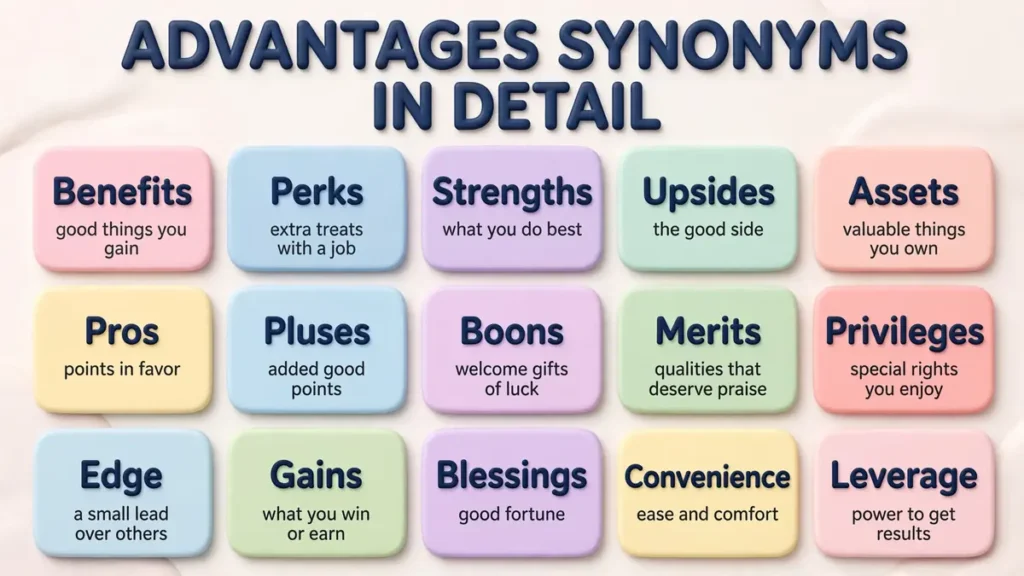
Group 1: The Good Things You Get
1. Benefits
- Meaning: Good things you receive from a job, a choice, a product, or a situation.
- Difference: The closest match for advantages, and the safest default.
- Best used for: Jobs, products, health, business.
- Formality: Neutral · CEFR: B1 · Frequency: Very common
- Example (Jobs): “The job offers strong benefits, including health cover and paid leave.”
- Example (Exercise): “Walking daily has clear benefits for heart and mood.”
- When NOT to use it: For the lead over a rival, where edge fits better.
2. Perks
- Meaning: Small, pleasant extras that come with a job or a deal.
- Difference: Perks are extras, never the main deal. A salary is not a perk; free lunch is.
- Best used for: Jobs, offices, shopping, casual speech.
- Formality: Informal · CEFR: B2 · Frequency: Common
- Example (Jobs): “The office perks include free coffee and a games room.”
- Example (Shopping): “The card’s perks include cashback and delivery.”
- When NOT to use it: For major benefits like health cover, where benefits fits better.
3. Strengths
- Meaning: Qualities or skills that make a person, team, or product strong.
- Difference: Strengths live inside the person or thing, while benefits are things received.
- Best used for: Resumes, interviews, sports.
- Formality: Neutral · CEFR: B1 · Frequency: Very common
- Example (Interview): “Her strengths are clear thinking and calm under pressure.”
- Example (Sports): “The team’s strengths are speed and defense.”
- When NOT to use it: For things you receive, where benefits fits better.
4. Upsides
- Meaning: The good points of a choice, weighed against the bad points.
- Difference: Upsides only make sense beside downsides.
- Best used for: Decisions, reviews, business.
- Formality: Neutral · CEFR: B2 · Frequency: Common
- Example (Moving): “The upsides of the new flat are space and light; the downside is the rent.”
- Example (Phones): “The smaller phone’s upsides are price and size.”
- When NOT to use it: For one good thing alone, where benefit fits better.
5. Assets
- Meaning: Valuable things a person or a company owns, from skills to property.
- Difference: Assets are things you hold and can use, often with a money value.
- Best used for: Business, finance, property, resumes.
- Formality: Neutral to formal · CEFR: B2 · Frequency: Common
- Example (Business): “The firm’s main assets are its brand and its skilled staff.”
- Example (Personal): “Her language skills are a real asset in this job.”
- When NOT to use it: For a simple good point, where benefit or upside fits better.
Group 2: The Scorecard Words
6. Pros
- Meaning: Points in favor of something, used when weighing a decision.
- Difference: Pros belong to a list, almost always paired with cons.
- Best used for: Decisions, reviews, debates.
- Formality: Neutral · CEFR: B1 · Frequency: Very common
- Example (Shopping): “The pros of the used car are price and low tax.”
- Example (School): “We listed the pros and cons of starting early.”
- When NOT to use it: With no decision to weigh, where benefit fits better.
7. Pluses
- Meaning: Extra good points, counted one by one in casual speech.
- Difference: Pluses are counted like marks on a scorecard, lighter than pros.
- Best used for: Everyday speech, reviews, casual writing.
- Formality: Informal · CEFR: B2 · Frequency: Common
- Example (Travel): “The hotel’s pluses are the pool and the free breakfast.”
- Example (Jobs): “Flexible hours are a big plus for parents.”
- When NOT to use it: In a formal report, where advantages sounds more serious.
8. Boons
- Meaning: A gift or blessing that brings real help, often when badly needed.
- Difference: Boons feel generous and welcome, with a warm, old-fashioned tone.
- Best used for: News, essays, formal writing.
- Formality: Formal · CEFR: C1 · Frequency: Less common
- Example (Farming): “The rain was a boon to farmers after the dry summer.”
- Example (School): “The new library is a boon to students with no books.”
- When NOT to use it: In plain speech, where benefit sounds more natural.
9. Merits
- Meaning: Worth or value earned by quality, effort, or good action.
- Difference: Merits must be earned, while benefits can simply be given.
- Best used for: Essays, law, formal writing.
- Formality: Formal · CEFR: C1 · Frequency: Common
- Example (School): “The essay won the prize on its own merits.”
- Example (Court): “The judge weighed the merits of each side’s case.”
- When NOT to use it: For a free extra like a discount, where perk fits better.
10. Privileges
- Meaning: Special rights or chances given to some people, not all.
- Difference: Privileges are granted by someone in power, and they can be taken away.
- Best used for: Law, society, formal writing.
- Formality: Formal · CEFR: B2 · Frequency: Common
- Example (School): “Older students enjoy the privilege of using the library late.”
- Example (Work): “Working from home is a privilege here, not a right.”
- When NOT to use it: For a natural lead like speed, where edge fits better.
Group 3: The Edge You Hold
11. Edge
- Meaning: A slight lead over rivals, or a quality that puts you ahead.
- Difference: Edge is the sharpest word for the lead itself, often paired with “competitive.”
- Best used for: Business, sports, news.
- Formality: Neutral · CEFR: B2 · Frequency: Common
- Example (Business): “Fast delivery gives the shop an edge over its rivals.”
- Example (Sports): “The home team has the edge in fitness this season.”
- When NOT to use it: For a thing you receive, where benefit fits better.
12. Gains
- Meaning: Things won or earned, often money, points, or progress.
- Difference: Gains are results after effort, while benefits can arrive without effort.
- Best used for: Finance, fitness, business, news.
- Formality: Neutral · CEFR: B2 · Frequency: Very common
- Example (Finance): “The fund made steady gains over the year.”
- Example (Fitness): “His strength gains showed after three months.”
- When NOT to use it: For a job extra like free lunch, where perk fits better.
13. Blessings
- Meaning: Good things that feel like gifts, often bringing comfort or relief.
- Difference: Blessings carry warmth and gratitude, and suit personal writing.
- Best used for: Personal writing, speeches, essays.
- Formality: Neutral · CEFR: B2 · Frequency: Common
- Example (Family): “Good health is one of life’s greatest blessings.”
- Example (Travel): “A quiet hotel room after a long flight felt like a blessing.”
- When NOT to use it: In a business report, where benefits sounds more professional.
14. Convenience
- Meaning: The quality of making life easier, saving time or effort.
- Difference: Convenience is about ease, not about value or reward.
- Best used for: Shopping, travel, products.
- Formality: Neutral · CEFR: B2 · Frequency: Very common
- Example (Shopping): “Online shopping wins on convenience, not on price.”
- Example (Travel): “The hotel’s convenience is its location next to the station.”
- When NOT to use it: For a money saving, where gain fits better.
15. Leverage
- Meaning: Power or influence you can use to get a better result.
- Difference: Leverage is power used on purpose in a deal or a negotiation.
- Best used for: Business, negotiations, finance.
- Formality: Formal · CEFR: C1 · Frequency: Common
- Example (Jobs): “Two offers gave her leverage to ask for a higher salary.”
- Example (Business): “The firm used its size as leverage in the talks.”
- When NOT to use it: For a simple good point, where benefit fits better.
Best Alternatives by Context
Pick by what matters most, not by which word sounds fanciest.
If you care about what you receive, say benefits. A job, a phone plan, or a gym membership is judged by its benefits: the things that land in your hands. For why one option beats another, see quality synonyms.
If you care about the small extras, say perks. Perks are the free coffee, the early Friday finish, and the staff discount. They sweeten a deal but never carry it.
If you care about the lead itself, say edge. In business and sport, the edge is the thin margin that decides the winner. A faster website, a lower price, or a stronger serve can all be an edge.
If you care about weighing a choice, say pros and upsides. List the pros beside the cons and the upsides beside the downsides, and the better choice usually shows itself. For the reason behind the choice, see purpose synonyms, and for the work that turns an edge into a win, see efficient synonyms.
If you care about earned worth, say merits. A prize, a grade, or a court case is judged on its merits, never on its perks. Merits answer one question: did it earn it?
Which Advantages Synonym Should I Choose?

| Situation | Best pick | Why it wins |
|---|---|---|
| Good things from a job | Benefits | The standard, complete word |
| Small extras on top | Perks | Extras, not the main deal |
| Qualities that make you strong | Strengths | Power from inside |
| Good points of a choice | Upsides | Weighed against downsides |
| Valuable things you hold | Assets | Worth you can use |
| Points in favor, in a list | Pros | Paired with cons |
| Extra good points, counted | Pluses | Light, countable, casual |
| A welcome gift in hard times | Boons | Warm and generous |
| Worth earned by quality | Merits | Earned, not given |
| A special right for some | Privileges | Granted, can be removed |
| The lead over a rival | Edge | Sharp, competitive, direct |
| Results after effort | Gains | Won, not handed over |
| A good thing that brings comfort | Blessings | Warm and personal |
| Saving time and effort | Convenience | Ease is the point |
| Power used in a deal | Leverage | Influence with a purpose |
Antonyms of Advantages
Antonyms for advantages as good things you receive
| Antonym | Meaning Difference |
|---|---|
| Drawbacks | Bad points that count against something |
| Downsides | The bad side of a choice |
| Disadvantages | Conditions that put you behind |
| Costs | What you pay or lose |
| Burdens | Heavy loads you must carry |
Advantages as strengths and the lead you hold
| Antonym | Meaning Difference |
|---|---|
| Weaknesses | Qualities that hold you back |
| Shortcomings | Faults that limit success |
| Handicaps | Conditions that put you at a loss |
| Liabilities | Things that work against you |
| Setbacks | Losses that slow progress |
Antonyms for advantages as earned worth and special rights
| Antonym | Meaning Difference |
|---|---|
| Demerits | Marks against quality or conduct |
| Disqualifications | Losses of the right to take part |
| Restrictions | Limits on what you may do |
| Exclusions | Being kept out of a group or a chance |
| Forfeits | Things lost by a rule or a mistake |
Words Commonly Confused With Advantages
Benefits versus perks is the pair to watch. Benefits are the main good things you receive, such as health cover or paid leave. Perks are small extras on top, such as free coffee. A job with great benefits is a good job; a job with great perks but poor benefits is a poor deal in a nice wrapper.
Edge versus advantage matters for the lead sense. Edge is the sharpest word for a small lead over a rival, as in “competitive edge.” Advantage is broader: it can mean the lead, the good thing, or the favorable condition. Use edge when the margin is thin and the contest is close.
Merits versus benefits matters for earned worth. Merits are earned by quality or effort, so a prize is judged on its merits. Benefits are received, so a job is judged by its benefits.
Privileges versus rights matters for the special-rights sense. A privilege is granted and can be taken away, such as late library access. A right is owed to you and cannot be removed so easily. Calling a right a privilege understates it; calling a privilege a right overstates it.
Substitution test failures: “The new job offers better perks, including paid leave” fails, because perks are small extras, so say “the job offers better benefits.” “Our privilege over rivals is faster delivery” fails, because privilege is a special right, so say “our edge over rivals is faster delivery.” “The rain was a benefit to farmers after the dry summer” works but sounds flat, because a boon carries the welcome-relief sense.
American vs British English
Advantages is spelled the same in American and British English, and so are most of its synonyms. One difference is perks: British job ads often say “benefits” where American ads say “perks and benefits.” This article uses American spelling throughout.
Collocations and Idioms With Advantages
Only combinations native speakers actually use:
- take advantage of: use a chance or a person for your own gain.
- have the advantage of: be in a better position.
- to your advantage: in a way that helps you.
- competitive advantage: a lead over rivals in business.
- unfair advantage: a lead gained by breaking the rules.
- the advantage of hindsight: seeing clearly only after the event.
- turn something to your advantage: make a bad situation work for you.
Note: with a chance, take advantage of is neutral, but with a person it sounds selfish.
Practice Exercises
Exercise 1: Fill in the blank. Choose the best word from the brackets.
- The job’s ___ include health cover, paid leave, and a pension. (perks, benefits, pluses)
- Free coffee and a games room are nice ___, but they do not make a bad salary fair. (benefits, perks, merits)
- Faster delivery gives the small shop a real ___ over rivals. (privilege, edge, blessing)
- The essay won the prize on its own ___, not on the writer’s name. (merits, gains, assets)
- The rain after the dry summer was a ___ to the farmers. (boon, perk, leverage)
Exercise 2: True or false? Say whether each sentence uses the word correctly.
- “Her language skills are a real asset in this job.” (True or False?)
- “Working from home is a right here, so it can never be removed.” (True or False?)
- “The hotel’s pluses are the pool and the free breakfast.” (True or False?)
- “Two job offers gave her leverage to ask for a higher salary.” (True or False?)
- “The fund made steady perks over the year.” (True or False?)
Answer key
- Exercise 1: (1) benefits; (2) perks; (3) edge; (4) merits; (5) boon.
- Exercise 2: (1) True; (2) False, it is a privilege, not a right; (3) True; (4) True; (5) False, say gains, not perks.
Frequently Asked Questions
What is the best synonym for advantages?
Benefits is the closest synonym when advantages means the good things you receive, because it covers jobs, products, and choices in plain language. For the lead over a rival, edge fits best. For small extras, perks fits. Pick from the group that matches.
What is the difference between benefits and perks?
Benefits are the main good things you receive, such as health cover or paid leave, and they can decide whether a job is worth taking. Perks are small extras on top, such as free coffee. Perks sweeten a deal, but benefits carry it, so never swap them.
Can advantages mean a lead in sports?
Yes. In tennis, “advantage” is the point after deuce, and the next point wins the game. In wider sport, an advantage is any lead, such as home ground or better fitness. The same sense works in business as a competitive advantage.
Is edge better than advantage in business writing?
Edge is better when the lead is small and the contest is close, because it sounds sharp and direct, as in “competitive edge.” Advantage is better for the whole favorable position, including benefits and conditions. Use edge for the margin and advantage for the full picture.
What is the opposite of advantages?
It depends on the meaning. For good things received, the opposites are drawbacks and disadvantages. For strengths and the lead, the opposites are weaknesses and setbacks. And for earned worth, the opposites are demerits and disqualifications. Pick from the same meaning group.
Which synonym should students use in essays?
In essays, prefer benefits for things received, merits for earned worth, and edge for a lead. Use boons and blessings only when the warm tone fits. Keep perks and pluses for casual writing, since they sound too light for a formal essay. Benefits is the safest choice when unsure.
Conclusion
Benefits name what you receive, perks name the extras, and edge names the lead. Upsides and pros weigh a choice, merits judge earned worth, and leverage turns power into a result.
One last check: read the sentence aloud with the replacement. If it says what you meant, keep it.

About Sajjad Ahmed
Sajjad Ahmed is the author behind Guest Paster, where he writes about English vocabulary, synonyms, word meanings, and practical word usage.
His content is designed to help readers understand the differences between similar words, discover suitable alternatives, and use English vocabulary more effectively in everyday writing and communication.
Before publishing, Sajjad focuses on presenting word choices in a clear and easy-to-understand format, with relevant meanings, context, and examples where helpful.
Through Guest Paster, his goal is to make vocabulary learning simpler and provide useful language resources for students, writers, English learners, and anyone looking to expand their vocabulary.
Areas of Focus: English Vocabulary • Synonyms • Word Meanings • Word Usage • Language Learning
Author: Sajjad Ahmed
Website: Guest Paster