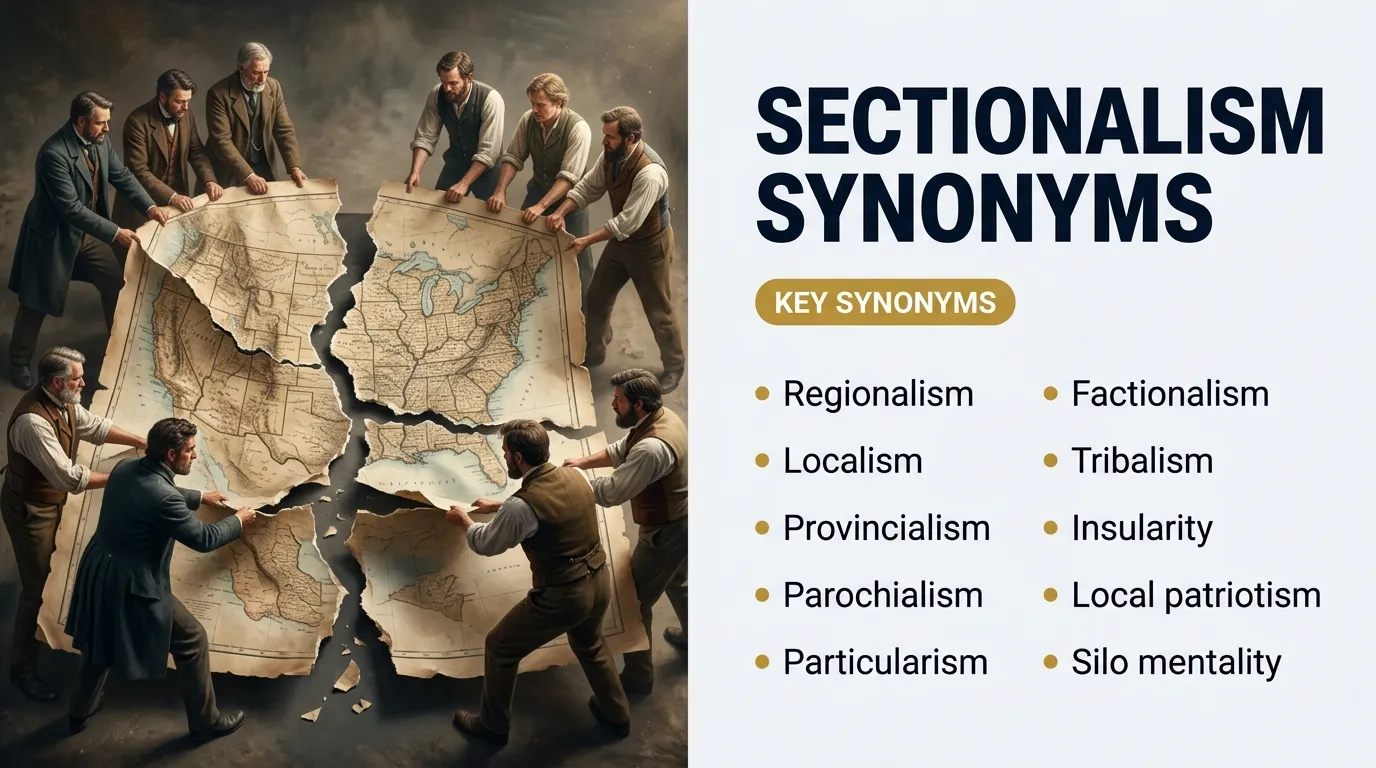
Sectionalism is a noun for excessive loyalty to the interests of one region, section, or group over those of the whole country or organization, most famously in the years before the American Civil War.
People look for alternatives because the word is narrow and political. For region-based loyalty, regionalism is the safest choice; for a narrow, local outlook, use provincialism or parochialism; for rival camps inside one party or workplace, factionalism fits better.
Choose by asking what the loyalty is tied to: land, mindset, or group. If you mean religion, you want sectarianism, which is a different word with a different meaning.
Top 10 at a Glance
| # | Synonym | Meaning Difference |
| 1 | Regionalism | Loyalty to a region; more neutral |
| 2 | Localism | Favors the immediate area, smaller scale |
| 3 | Provincialism | Narrow outlook, not just divided loyalty |
| 4 | Parochialism | Concern limited to small, local issues |
| 5 | Particularism | Each unit insists on its own interests |
| 6 | Factionalism | Rival camps, not geography |
| 7 | Tribalism | Identity-driven loyalty to “our side” |
| 8 | Insularity | Closed off from outside ideas |
| 9 | Local patriotism | Warmer, older phrase for the same pull |
| 10 | Silo mentality | Plain-English workplace version |
Quick Facts About Sectionalism
- Part of speech: noun
- Simple meaning: putting one region’s or group’s interests above the whole
- Pronunciation: /ˈsɛkʃənəlˌɪzəm/ (as listed by Vocabulary.com)
- Syllables: sec-tion-al-ism (4)
- Word forms: sectionalisms (plural), sectional (adjective), sectionally (adverb), sectionalize (verb)
- Formality: formal; mostly historical, political, and academic writing
- Closest synonym: regionalism
- Best used for: region-based political division, especially in U.S. history
- Meaning in Urdu: علاقائیت or علاقہ پرستی. Sectarianism is a different word, usually rendered as فرقہ واریت.
What Is the Closest Synonym for Sectionalism?
The closest synonym is regionalism: political or cultural loyalty to one region’s interests, often placed ahead of the wider nation’s. Merriam-Webster defines sectionalism as exaggerated devotion to a region’s interests, and regionalism is the one common word that keeps that region-based core. Vocabulary.com lists localism and provincialism as synonyms, and both work in some sentences, but each shifts the scale or the focus.
The main difference is tone. Sectionalism almost always sounds critical, while regionalism can be neutral or even positive (it also names regional styles in art, language, and literature). When you need the same disapproving edge, add a modifier (“damaging regionalism”) or switch to parochialism.
Word Origin and Etymology
Etymonline dates sectionalism to 1836 in American English, formed from sectional plus the suffix -ism. It first meant sectional prejudice or spirit, the clashing of sectional interests, and was in frequent use from 1856. Merriam-Webster gives a later first known use, 1847, so the two sources differ by about a decade. The safe summary is that the word took shape in American political speech in the 1830s and 1840s and became common in the 1850s.
The parent word sectional is dated 1806 by both Etymonline and Merriam-Webster. Etymonline notes that it was especially tied to particular regions of a country and loomed large in U.S. political vocabulary before the Civil War. Webster’s 1913 dictionary glossed sectionalism as local patriotism as distinguished from national patriotism. Over time the meaning widened from that sharp prewar sense to the general idea of confining one’s interests to a local sphere. Merriam-Webster also lists the verb sectionalize, meaning to cause something to become characterized by sectionalism.
The word is still alive. Merriam-Webster’s current usage examples include a 2026 piece on Civil War–era politics, 2021 commentary on geographic divides in the American party system, and 2022 reporting on how schools teach the causes of the Civil War.
Can These Synonyms Be Used Interchangeably?
Rarely word-for-word. Most alternatives shift the focus from region to mindset, group, or workplace.
| Level | Words | Note |
| Usually | Regionalism, localism | Same scale; regionalism is more neutral |
| Sometimes | Provincialism, parochialism, insularity | Focus on narrow outlook |
| Sometimes | Particularism, sectional loyalty, sectional spirit | Formal or historical flavor |
| Sometimes | Local patriotism, regional bias | Warmer or plainer wording |
| Sometimes | Factionalism, tribalism, territorialism | Group-based, not place-based |
| Rarely | Clannishness, silo mentality | Small circles and workplaces only |
| No | Sectarianism, separatism, nationalism | Different meaning |
Detailed Synonym Meanings and Examples
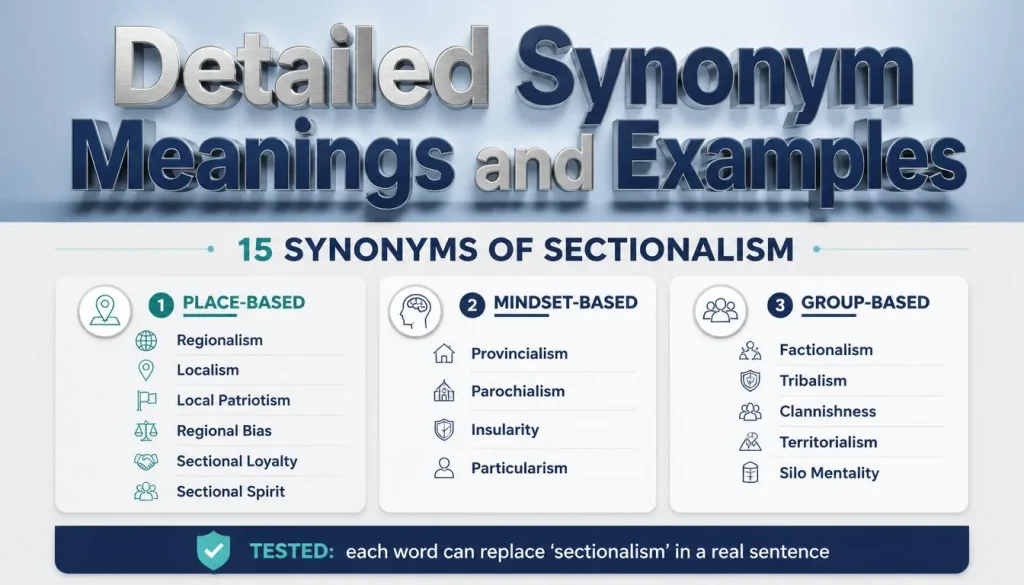
Every word below passed one test: it can replace “sectionalism” in at least one real sentence without changing the core meaning. CEFR and frequency labels are editorial estimates based on typical usage, not official ratings.
1. Regionalism
Meaning: Covered in full in the closest-synonym section above.
Difference from Sectionalism: Less accusatory; it can simply describe regional loyalty without condemning it.
Best Used For: politics, policy, journalism, history.
Formality: Formal | CEFR Level: C1 | Frequency: Uncommon
Examples:
- Analysts warned that regionalism in the budget talks was starving poorer provinces of shared funds. (policy journalism)
- Voters in the border counties were tired of regionalism crowding out national priorities. (local politics)
When NOT to Use It: Skip it when you mean regional art or dialect and want to avoid sounding critical.
2. Localism
Meaning: A preference for the concerns, customs, or people of one’s own immediate area.
Difference from Sectionalism: Smaller in scale, a town or district rather than a large section of a country.
Best Used For: local government, campaigns, community debates.
Formality: Neutral | CEFR Level: C2 | Frequency: Uncommon
Examples:
- The council’s localism meant no one would back a rail link that mainly served the next town. (local government)
- Her campaign leaned on fierce localism, promising nothing to anyone outside the valley. (election campaign)
When NOT to Use It: Avoid it for nation-level splits, and remember some policy writers use it as a positive term.
3. Provincialism
Meaning: A narrow outlook that comes from knowing and valuing only one’s own district.
Difference from Sectionalism: It criticizes a limited mindset, not political rivalry between sections.
Best Used For: cultural criticism, essays, character description.
Formality: Formal | CEFR Level: C2 | Frequency: Uncommon
Examples:
- The critic dismissed the festival as provincialism dressed up as civic pride. (cultural criticism)
- His provincialism showed whenever he treated the capital’s habits as the only correct ones. (office conversation)
When NOT to Use It: Don’t use it for organized political blocs fighting over resources.
4. Parochialism
Meaning: Concern restricted to a small area or a narrow set of issues.
Difference from Sectionalism: It stresses small-mindedness about wider issues, not loyalty to a named section.
Best Used For: municipal planning, academic critique, policy debates.
Formality: Formal | CEFR Level: C2 | Frequency: Rare
Examples:
- The committee’s parochialism blocked a regional water plan every town needed. (municipal planning)
- Reviewers faulted the journal for parochialism in choosing which research counted as important. (academic publishing)
When NOT to Use It: Skip it when the problem is rival camps rather than narrow focus.
5. Particularism
Meaning: The insistence that each state, group, or community should follow its own interests or rules.
Difference from Sectionalism: More theoretical; it describes a principle and can attach to any special interest, not only a region.
Best Used For: political theory, history, diplomacy.
Formality: Formal | CEFR Level: C2 | Frequency: Rare
Examples:
- Historians often discuss the particularism of the small German states before unification. (history)
- Negotiators saw each member’s particularism as the main obstacle to a joint position. (diplomacy)
When NOT to Use It: Avoid it in everyday writing, where it will confuse most readers.
6. Factionalism
Meaning: The splitting of a group into rival camps that pursue their own aims.
Difference from Sectionalism: Built on shared interests or loyalties, not geography.
Best Used For: parties, boards, committees, movements.
Formality: Neutral to formal | CEFR Level: C2 | Frequency: Uncommon
Examples:
- Factionalism inside the ruling party delayed the vote for months. (politics)
- Factionalism on the parents’ board turned a bake sale into a feud. (community organization)
When NOT to Use It: Don’t use it when the divide is purely between regions.
7. Tribalism
Meaning: Strong loyalty to one’s own group that can override fairness toward outsiders.
Difference from Sectionalism: Rooted in identity and “us versus them,” not in place.
Best Used For: social media, political commentary, workplace culture.
Formality: Neutral | CEFR Level: C1 | Frequency: Common
Examples:
- Online tribalism rewards people for defending their side instead of checking facts. (social media)
- Tribalism in the newsroom meant each desk hid its best stories from the others. (workplace)
When NOT to Use It: Avoid it as a negative label for real tribal communities, which can read as insulting.
8. Insularity
Meaning: An inward-looking attitude that shuts out outside ideas and people.
Difference from Sectionalism: Describes isolation of thinking, not active promotion of one section’s interests.
Best Used For: organizations, political parties, professional circles.
Formality: Formal | CEFR Level: C2 | Frequency: Uncommon
Examples:
- Critics blamed the party’s insularity for its failure to understand rural voters. (politics)
- The firm’s insularity kept it blind to how competitors were changing. (business)
When NOT to Use It: Don’t use it for open rivalry between two named regions.
9. Clannishness
Meaning: The habit of sticking closely to one’s own circle and keeping outsiders out.
Difference from Sectionalism: Social and personal, rather than political or regional.
Best Used For: workplaces, small communities, informal complaints.
Formality: Neutral | CEFR Level: C2 | Frequency: Rare
Examples:
- New hires complained about the clannishness of the long-serving engineers. (workplace)
- The clannishness of the village committee made newcomers feel unwelcome. (community)
When NOT to Use It: Avoid it in formal political analysis, where it sounds too personal.
10. Silo Mentality
Meaning: A business term for teams that guard information and goals inside their own unit.
Difference from Sectionalism: Everyday workplace language, with no political history attached.
Best Used For: management, consulting, internal reports.
Formality: Neutral | CEFR Level: C1 | Frequency: Uncommon
Examples:
- Our silo mentality is why the same customer received three different invoices. (customer service)
- The merger failed to break the silo mentality between the two sales teams. (mergers)
When NOT to Use It: Skip it in formal historical or political writing.
11. Territorialism
Meaning: The instinct to guard one’s own turf, whether land, authority, or accounts.
Difference from Sectionalism: Emphasizes defending what you hold, not favoring one’s section in general.
Best Used For: agencies, sales teams, institutional rivalry.
Formality: Neutral | CEFR Level: C2 | Frequency: Rare
Examples:
- Territorialism between the two agencies slowed the investigation. (government)
- Sales territorialism meant reps hoarded leads instead of passing them on. (retail)
When NOT to Use It: Don’t use it for animal behavior, where “territoriality” is the usual term.
12. Local Patriotism
Meaning: Pride in and loyalty to one’s own district that outweighs loyalty to the nation.
Difference from Sectionalism: Warmer and more old-fashioned; it names the feeling, not the damage.
Best Used For: historical writing and speeches.
Formality: Formal | CEFR Level: C2 | Frequency: Rare
Examples:
- Historians describe how local patriotism sometimes outweighed national loyalty in the 1850s. (history writing)
- His speech wrapped the county’s grievances in warm local patriotism. (political speech)
When NOT to Use It: Avoid it when you want to criticize, since it sounds positive.
13. Regional Bias
Meaning: A plain-English phrase for favoring one’s own region when making decisions.
Difference from Sectionalism: Describes a single biased choice, not a whole political movement.
Best Used For: news reports, funding decisions, everyday explanations.
Formality: Neutral | CEFR Level: B2 | Frequency: Uncommon
Examples:
- The grant panel faced accusations of regional bias after funding only coastal projects. (public funding)
- Readers noticed regional bias in the paper’s coverage of the capital. (media)
When NOT to Use It: Don’t use it for a long-running historical trend, where “sectionalism” is stronger.
14. Sectional Loyalty
Meaning: Fidelity felt toward one’s own region or section, named without a verdict.
Difference from Sectionalism: A neutral, descriptive label; the “excessive” judgment is missing.
Best Used For: neutral historical narration, sociology.
Formality: Neutral to formal | CEFR Level: C1 | Frequency: Rare
Examples:
- Sectional loyalty sometimes cut across party lines in the 1850s. (history writing)
- The memoir describes a fierce sectional loyalty his family never questioned. (memoir review)
When NOT to Use It: Skip it when you want to signal that the devotion is harmful.
15. Sectional Spirit
Meaning: The older phrase for collective regional feeling, pride mixed with mutual suspicion.
Difference from Sectionalism: Carries a 19th-century flavor and stresses sentiment over structure.
Best Used For: historical essays, period-style prose.
Formality: Formal | CEFR Level: C2 | Frequency: Rare
Examples:
- Historians still debate how far a sectional spirit made conflict unavoidable by the 1850s. (historical essay)
- The monument was meant to soothe a sectional spirit that outlived the war. (commemorative writing)
When NOT to Use It: Avoid it in modern news or policy writing, where it sounds archaic.
Best Alternatives by Context
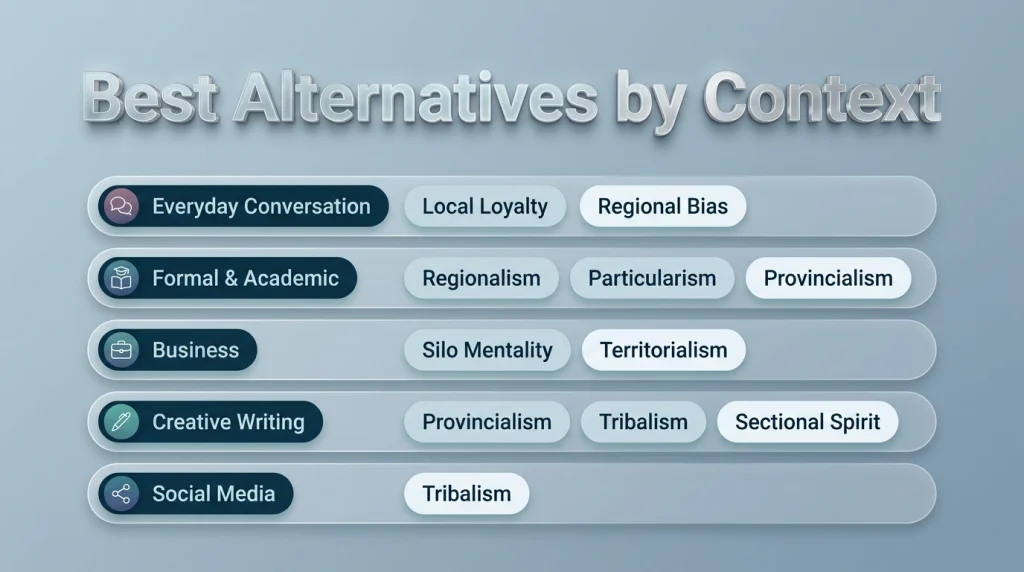
- Everyday conversation: local loyalty, regional bias, or clannishness for small-circle cases.
- Formal and academic writing: regionalism, particularism, or provincialism, depending on whether you mean loyalty, principle, or outlook.
- Business communication: silo mentality or territorialism. Both fit workplace reality better than any political term. If you are describing a teammate who stands apart from the group, our guide to synonyms for independent may help.
- Creative writing: provincialism for character flaws, tribalism for conflict between groups, sectional spirit for period fiction.
- Social media: tribalism, since it matches how online groups talk about “sides.”
Which Synonym Should I Choose?
| Situation | Best Choice | Why |
| North–South tension in U.S. history | Sectionalism | Matches the historical term |
| Region-based loyalty, neutral tone | Regionalism | Same meaning, less accusatory |
| Criticizing a narrow local outlook | Provincialism | Targets mindset, not politics |
| Council blocking regional projects | Parochialism | Stresses small-area concerns |
| Rival camps inside a party | Factionalism | About groups, not geography |
| Teams hoarding information at work | Silo mentality | Plain and business-friendly |
| Online “our side” loyalty | Tribalism | Fits identity-driven groups |
| Formal political theory | Particularism | Precise, academic term |
| Religious division | Sectarianism | Different word for faith-based splits |
Exact and Near Synonyms: Difference
True synonyms are rare because words rarely share the same scale, tone, and setting. Sectionalism bundles three ideas at once: a geographic section, loyalty to it, and a judgment that the loyalty has gone too far. Each near synonym keeps only part of that bundle. Regionalism keeps the place and the loyalty but drops the criticism. Parochialism keeps the criticism but loosens the geography. Factionalism drops geography entirely and keeps only the rivalry.
Register matters too. Particularism sounds at home in a political-theory seminar, while silo mentality sounds at home in a Monday meeting. Pick the word your reader expects in that setting, then add a short clarifying phrase if the distinction matters. The same care applies to other loaded words; compare how synonyms for conflicted and synonyms for harsh each change tone when you swap one word for another.
Words Commonly Confused with Sectionalism
The biggest trap is sectarianism. The two words look alike, but sectionalism is built from section, while sectarianism is built from sect. Its core meaning is rigid attachment to a particular sect, most often religious. Merriam-Webster also lists a looser sense of sectarian, limited in character or scope, which is one reason the words get mixed up. Even so, region is the center of sectionalism and sect is the center of sectarianism. Words close to sectarianism include denominationalism, partisanship, and, in religious settings, bigotry.
| Word | Why It’s Not a True Synonym |
| Sectarianism | About sects, usually religious, not regions |
| Partisanship | Broader: loyalty to any side or party |
| Partiality | Broader: any bias, not tied to sections |
| Separatism | Wants to break away, not just favor |
| Secessionism | Describes the act of leaving a union |
| Sectional rivalry | Names the conflict, not the loyalty |
| Departmentalism | Often means division into departments |
| Cliquishness | Social exclusion, too small in scale |
| Balkanization | A process of fragmentation, not an attitude |
| Chauvinism | Excessive pride in nation or group |
| Cronyism | Favoring friends, not a region |
Common Mistakes
| Mistake | Better | Why |
| “Sectionalism between the two sects” | Sectarianism | The conflict is religious, not regional |
| “He voted for separatism in the budget” | Regionalism | Separatism means wanting to leave |
| “Our team’s sectionalism” | Silo mentality | Sectionalism sounds oddly historical at work |
| “Sectionalism for my hometown” | Hometown pride | Sectionalism is critical, not affectionate |
| “Sectionalism inside the party” | Factionalism | The split is by group, not region |
Antonyms of Sectionalism
| # | Antonym | Why It’s the Opposite |
| 1 | Nationalism | Loyalty to the whole nation |
| 2 | Unionism | Loyalty to the Union (U.S. history) |
| 3 | Cosmopolitanism | Comfort with many places and cultures |
| 4 | Universalism | Concern for everyone, not one section |
| 5 | Internationalism | Cooperation across national borders |
| 6 | National unity | Sections pulling together, not apart |
American vs British English
The spelling is the same in both varieties. The difference is usage: Etymonline records sectionalism as American English, and Merriam-Webster’s examples show it most at home in discussions of U.S. history and politics. In other contexts, regionalism, localism, and parochialism are the more natural everyday choices.
Real-World Collocations and Phrases
Part A: Common Patterns
| Pattern | Examples |
| Verb + sectionalism | fuel, deepen, overcome sectionalism |
| Adjective + sectionalism | growing, geographic, political sectionalism |
| Sectionalism + verb | sectionalism grew, deepened, divided |
| Sectionalism + preposition | sectionalism between, over, within |
| Related: sectional + noun | sectional interests |
Part B: Set Phrases Around the Idea
Sectionalism itself has no well-established idioms, so the phrases below describe the same behavior in everyday English.
- Turf war: a fight over who controls a territory or responsibility.
- Silo mentality: teams guarding their own information and goals.
- Us versus them: a split between insiders and outsiders.
- Parochial interests: concerns limited to one small area.
- NIMBY (“not in my backyard”): opposing a project near home that one supports elsewhere.
Practice Exercises
Fill in the Blanks
Word bank: sectionalism, parochialism, silo mentality, factionalism, tribalism.
- Growing ______ in the 1850s pushed the North and South further apart.
- The committee’s ______ meant no one would back a plan that helped the next town.
- Marketing and finance never shared data because of a deep ______.
- ______ inside the party split it into three rival camps.
- Online ______ rewards people for defending their side at any cost.
Rewrite the Sentences
- “Sectionalism in the budget talks stalled every compromise.” (Use a more neutral synonym.)
- “The firm’s silo mentality hurt customers.” (Use a formal synonym for rivalry over turf.)
- “Sectionalism among the party’s wings split the vote.” (Use a synonym about groups, not places.)
Match the Words
Match each word to its meaning.
- Regionalism
- Provincialism
- Factionalism
- Silo mentality
- Particularism
A. Division into rival camps | B. Insistence that each group follow its own interests | C. Narrow outlook from knowing only one place | D. Teams guarding information in their own unit | E. Loyalty to a specific region
Vocabulary Quiz
- Which word best fits an organization where teams hoard information? (a) Nationalism (b) Silo mentality (c) Cosmopolitanism (d) Regionalism
- Which is NOT a true synonym of sectionalism? (a) Parochialism (b) Localism (c) Sectarianism (d) Regionalism
- Which is the closest synonym for political loyalty to a region? (a) Regionalism (b) Separatism (c) Nationalism (d) Partisanship
- Which is a standard opposite in a U.S. history context? (a) Nationalism (b) Factionalism (c) Localism (d) Insularity
- Which suits a narrow outlook from knowing only one place? (a) Provincialism (b) Unionism (c) Universalism (d) Internationalism
Answer Key
- Fill in the blanks: 1. sectionalism; 2. parochialism; 3. silo mentality; 4. Factionalism; 5. tribalism.
- Rewrite (sample answers): 1. “Regionalism in the budget talks stalled every compromise.” 2. “The firm’s territorialism hurt customers.” 3. “Factionalism among the party’s wings split the vote.”
- Match: Regionalism–E; Provincialism–C; Factionalism–A; Silo mentality–D; Particularism–B.
- Quiz: 1. b; 2. c; 3. a; 4. a; 5. a.
FAQ
What is the closest synonym for sectionalism?
Regionalism is the closest synonym for sectionalism in most situations. Both describe loyalty to one region’s interests, though regionalism can also be neutral, even positive, while sectionalism usually sounds critical. If you want the same negative edge, choose parochialism or provincialism, depending on whether you mean narrow focus or narrow outlook.
Can sectionalism and sectarianism be used interchangeably?
No, not safely. Sectionalism is loyalty to a region or section, while sectarianism is rigid attachment to a sect, usually religious. They overlap only when both describe putting one group’s interests above the whole. In most writing they point to different problems, so swapping them can change your meaning completely.
What is the meaning of sectionalism in Urdu?
In Urdu, sectionalism is usually expressed as علاقائیت or علاقہ پرستی, meaning excessive loyalty to one region over the whole country. In English, the word covers any strong favoring of a region’s or section’s interests, especially in U.S. history before the Civil War. It is not the same as sectarianism (فرقہ واریت).
Is sectionalism a formal word?
Yes, it leans formal and academic. You will mostly see it in history, political science, and serious journalism rather than casual conversation. In everyday speech, you might say regional bias or local loyalty instead. Sectionalism also carries a mildly negative tone, so it suits critical or analytical writing best.
How do I use sectionalism in a sentence?
Use it as a usually uncountable noun for region-based loyalty, as in: “Growing sectionalism made compromise between the North and South harder.” It works best when the subject is a region, a state, or a geographic bloc. For a company department or political party, factionalism or silo mentality will sound more natural.
What is the opposite of sectionalism?
A standard opposite is nationalism, meaning loyalty to the whole nation rather than one region. In American history, unionism also plays that role. For a broader, non-political contrast, cosmopolitanism and universalism describe outlooks that look beyond any single place or group.
Conclusion
Choosing between these words is really choosing what you want your reader to notice: the place, the mindset, or the group. Regionalism keeps the focus on geography, provincialism on a narrow outlook, factionalism on rival camps, and silo mentality on everyday workplace friction.
Matching the word to the setting makes your writing sound precise and keeps readers from stumbling over a term that points somewhere you did not intend. When the word you need is about faith rather than region, switch to sectarianism and keep the two ideas apart.

About Sajjad Ahmed
Sajjad Ahmed is the author behind Guest Paster, where he writes about English vocabulary, synonyms, word meanings, and practical word usage.
His content is designed to help readers understand the differences between similar words, discover suitable alternatives, and use English vocabulary more effectively in everyday writing and communication.
Before publishing, Sajjad focuses on presenting word choices in a clear and easy-to-understand format, with relevant meanings, context, and examples where helpful.
Through Guest Paster, his goal is to make vocabulary learning simpler and provide useful language resources for students, writers, English learners, and anyone looking to expand their vocabulary.
Areas of Focus: English Vocabulary • Synonyms • Word Meanings • Word Usage • Language Learning
Author: Sajjad Ahmed
Website: Guest Paster