Trying to find another word for with? The best alternative would depend on what “with” means in your sentence. Possibility to be represented as company tool-method possession added item or surrounding situation, therefore no single synonym works everywhere.
Together with and along side are also alternatives for accompaniment. For methods and tools try using or by means of. Incorporating works for parts of a larger whole, while highlighting a notable feature.
Below you will find eighteen synonyms for “with”, including definitions, examples, formality levels and guidance on selecting the correct word for your sentence.
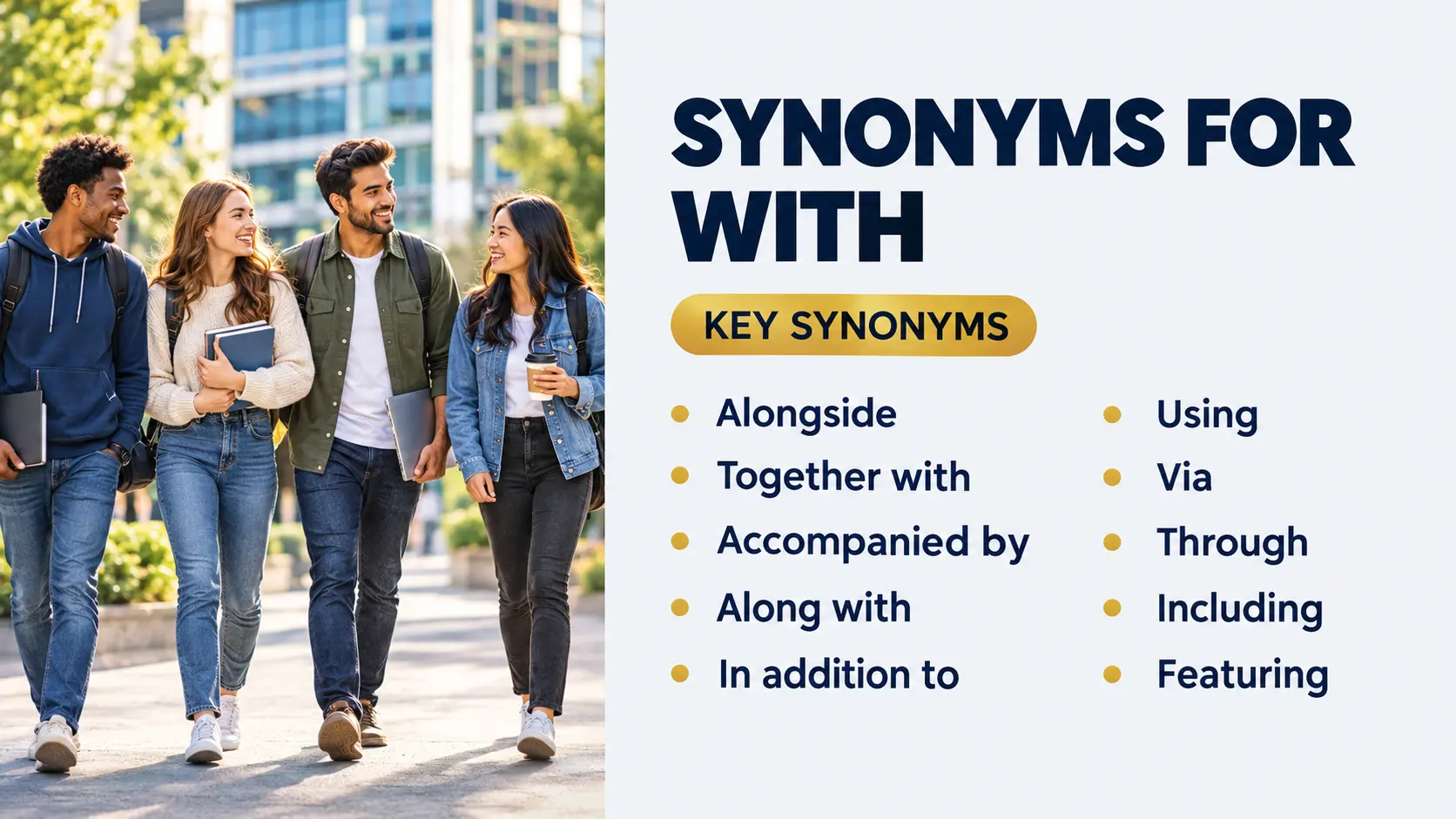
Top 10 Synonyms for With at a Glance
| Synonym | Best Meaning or Use |
| Alongside | Next to or working together |
| Together with | Accompanied by or combined with |
| Accompanied by | Joined or attended by |
| Along with | Together with or in addition to |
| In addition to | As an extra item or point |
| Using | Employing a tool or method |
| Via | Through a route or channel |
| Through | By a process or medium |
| Including | Containing as part of a whole |
| Featuring | Displaying as a notable feature |
Quick Facts About With
- Part of speech: Preposition
- Simple meaning: Connects someone or something to company, a tool, a feature, a manner, a circumstance, or an addition
- Pronunciation: /wɪð/ or /wɪθ/
- Syllables: One
- Formality: Neutral
- Word form: With itself does not change form
- Common uses: Accompaniment, tools, possession, features, manner, addition, and circumstances
- Useful accompaniment alternatives: Together with, along with, alongside
Words such as within, without, withhold, withdraw, and withstand are separate words, not grammatical forms of with.
What Is the Closest Synonym for With?
No single synonym can replace with in every sentence, because the word has several different meanings.
For the accompaniment sense, together with is one of the closest alternatives:
- She arrived with her manager.
- She arrived together with her manager.
The meaning stays similar, although together with sounds slightly more deliberate or formal.
For other meanings, you need a different alternative:
- He cut the paper with scissors. → He cut the paper using scissors.
- A package with free accessories. → A package including free accessories.
- A hotel with a rooftop pool. → A hotel featuring a rooftop pool.
The best synonym depends on the relationship with expresses in the sentence.
Meaning of With
With is a highly flexible preposition. It can describe several relationships between people, objects, actions, and circumstances.
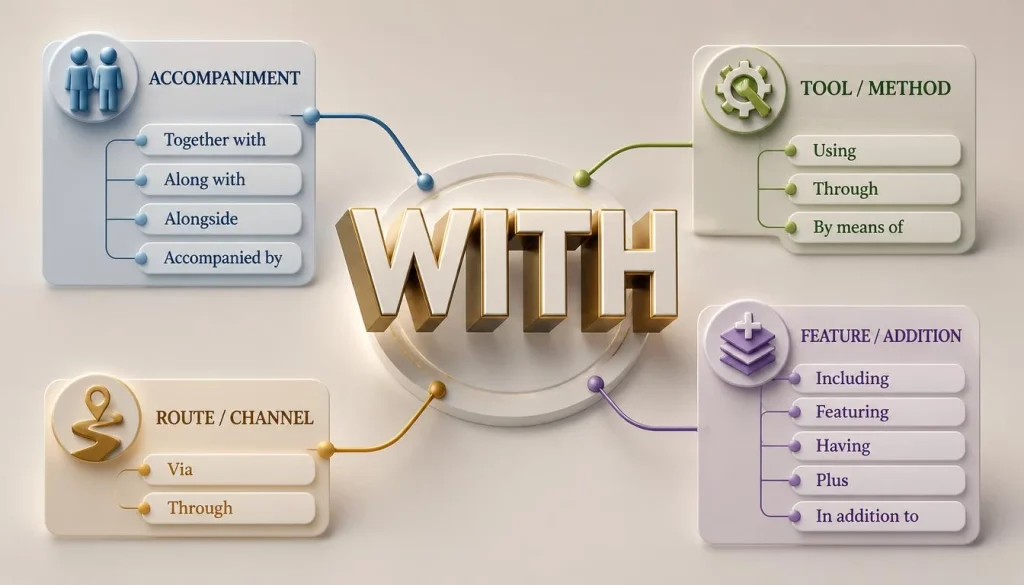
1. Accompaniment
It shows that someone or something is together with another person or thing.
Example: She travelled with her sister.
Possible alternatives: together with, along with, accompanied by, alongside
2. Tool or Means
It identifies the tool, method, or resource used to perform an action.
Example: He opened the box with a knife.
Possible alternatives: using, by means of
3. Possession or Feature
It shows that a person or thing has a particular feature.
Example: They bought a house with a large garden.
Possible alternatives: having, featuring
4. Addition or Inclusion
It indicates that something else is included or added.
Example: The package comes with free delivery.
Possible alternatives: including, along with, plus, in addition to
5. Surrounding Circumstance
It connects an action with the situation in which it occurs.
Example: They continued working with heavy traffic outside.
Depending on the sentence, amid may express the surrounding circumstance more precisely.
Can Synonyms for With Be Used Interchangeably?
Not always. With covers several meanings, while most of its alternatives apply to only one or two of them.
- Together with works for accompaniment.
- Using works for tools and methods.
- Via describes a route or channel.
- Including shows that something forms part of a larger whole.
- Featuring highlights a notable characteristic.
- Amid describes being surrounded by a situation or atmosphere.
Compare:
- Correct: She travelled with her brother.
- Possible: She travelled together with her brother.
- Incorrect: She travelled using her brother.
Similarly:
- Correct: He cut the bread with a knife.
- Possible: He cut the bread using a knife.
- Incorrect: He cut the bread alongside a knife.
Always identify what with means before replacing it.
18 Synonyms for With, With Meanings and Examples
1. Alongside
Meaning: Next to someone or something, or working in cooperation with them.
Difference from with: Alongside adds the idea of physical proximity, parallel activity, or cooperation.
Best used for: Position, teamwork, partnerships, parallel activities
Formality: Neutral
Examples:
- The new analyst will work alongside the sales team.
- A walking path runs alongside the river.
When not to use it: Avoid it when with identifies a tool. You cut bread with a knife, not alongside a knife.
2. Together With
Meaning: In combination or company with another person or thing.
Difference from with: It makes the connection between two elements more explicit and often sounds slightly more formal.
Best used for: Accompaniment, announcements, reports, combined information
Formality: Neutral to formal
Examples:
- The principal, together with two teachers, welcomed the visitors.
- The rent, together with utilities, comes to $1,450 a month.
Usage note: When together with adds information after the subject, the verb agrees with the main subject, not with the added phrase. For example: The teacher, together with her students, was present.
When not to use it: It usually cannot replace with when with introduces an instrument or tool.
3. Accompanied By
Meaning: Joined, attended, or supported by another person or thing.
Difference from with: It emphasizes that someone or something comes along with the main person or item.
Best used for: Official visits, travel, supervision, supporting documents
Formality: Formal
Examples:
- Children must be accompanied by an adult.
- The application must be accompanied by proof of identity.
When not to use it: Avoid it when describing an ordinary feature or possession.
4. In the Company Of
Meaning: In someone’s presence, especially in a social situation.
Difference from with: It focuses more strongly on spending time in another person’s presence.
Best used for: Social situations, biographies, narratives, literary writing
Formality: Formal
Examples:
- He spent the evening in the company of old friends.
- She felt relaxed in the company of her family.
When not to use it: It is too wordy for instructions and technical writing.
5. Along With
Meaning: Together with or in addition to something.
Difference from with: It often gives the second item the sense of being added to the first.
Best used for: Lists, packages, additions, everyday accompaniment
Formality: Neutral
Examples:
- The laptop ships along with a charger.
- Along with the rain came a sudden drop in temperature.
Quick tip: Like together with, along with does not make the subject plural. Say “The manager, along with his team, is attending,” not “are attending.”
When not to use it: Avoid it when with identifies an instrument being actively used.
6. Among
Meaning: Within, surrounded by, or as part of a group.
Difference from with: Among focuses on someone’s or something’s position inside a group, not on simple accompaniment.
Best used for: Groups, crowds, distribution, shared attitudes
Formality: Neutral
Examples:
- She disappeared among the commuters.
- The prize money was shared among the winners.
When not to use it: Do not use among when you simply mean that one person accompanies another. It also needs a group of three or more, or an undefined crowd.
7. Using
Meaning: Employing a tool, method, or resource to perform an action.
Difference from with: Using explicitly identifies something as the instrument or method.
Best used for: Instructions, technology, tools, methods
Formality: Neutral
Examples:
- Stir the sauce using a wooden spoon.
- He repaired the leak using a wrench and tape.
When not to use it: It does not express companionship.
8. Via
Meaning: By way of a route, channel, or medium.
Difference from with: Via emphasizes how something travels, is transmitted, or reaches its destination.
Best used for: Travel routes, email, payments, digital channels, deliveries
Formality: Neutral
Examples:
- We flew to Chicago via Denver.
- Send the completed form via the client portal.
When not to use it: Avoid via for a handheld instrument such as a knife, hammer, or pencil.
9. Through
Meaning: By means of a process, medium, experience, or channel.
Difference from with: Through emphasizes the process or pathway that produces a result.
Best used for: Processes, communication, learning, experience
Formality: Neutral
Examples:
- She learned the trade through years of practice.
- Tickets are available through the official website.
When not to use it: It does not normally express simple physical companionship.
10. By Means Of
Meaning: Through the use of a particular method, instrument, or process.
Difference from with: This phrase states the method more explicitly and formally.
Best used for: Academic, legal, scientific, and technical writing
Formality: Formal
Examples:
- The samples were identified by means of DNA testing.
- Access is granted by means of a security code.
When not to use it: It can sound unnecessarily stiff in casual conversation.
11. Including
Meaning: Containing someone or something as part of a larger group, amount, or whole.
Difference from with: Including clearly establishes a part-to-whole relationship.
Best used for: Prices, packages, lists, specifications, contents
Formality: Neutral
Examples:
- The fee is $200, including materials and lunch.
- Five staff members, including the manager, signed the letter.
Quick tip: Including introduces examples that are part of a larger group. It should not be used to list everything in full.
When not to use it: It is not a natural substitute when two people are simply accompanying each other.
12. Featuring
Meaning: Having or presenting something as a noticeable or important feature.
Difference from with: Featuring highlights the item rather than merely saying it is present.
Best used for: Products, properties, events, entertainment, marketing
Formality: Neutral
Examples:
- The apartment features a balcony overlooking the park.
- The festival ends with a concert featuring local musicians.
When not to use it: Avoid it for ordinary accompaniment or when the feature does not deserve emphasis.
13. Having
Meaning: Possessing or containing a particular feature or quality.
Difference from with: Having directly expresses possession or the presence of a characteristic.
Best used for: Descriptions, qualities, conditions, possession
Formality: Neutral to formal
Examples:
- She is a teacher having more than ten years of experience.
- The hotel, having a rooftop pool, attracts many families.
Quick tip: In everyday English, with or who has usually sounds more natural than having in this sense. Use having when you want a slightly more formal, descriptive tone.
When not to use it: It is not a substitute for with when another person is independently accompanying the subject.
14. Plus
Meaning: And also; in addition to.
Difference from with: Plus has an additive, concise, and often conversational tone.
Best used for: Prices, casual lists, advertising, spoken English
Formality: Informal to neutral
Examples:
- The ticket costs $40 plus tax.
- We need volunteers, plus someone to bring the chairs.
When not to use it: Better alternatives exist in formal academic or legal writing.
15. In Addition To
Meaning: As an extra person, thing, fact, or requirement.
Difference from with: It explicitly marks something as additional.
Best used for: Essays, reports, formal lists, academic writing
Formality: Formal
Examples:
- In addition to her degree, she holds a teaching certificate.
- The role requires weekend work in addition to regular hours.
When not to use it: It does not replace with when with identifies a tool, manner, or companion.
16. Amid
Meaning: Surrounded by or occurring in the middle of a situation, activity, or atmosphere.
Difference from with: Amid emphasizes the circumstances surrounding an event.
Best used for: News, narratives, difficult circumstances, atmosphere
Formality: Neutral to formal
Examples:
- The minister resigned amid growing criticism.
- They continued working amid the noise outside.
When not to use it: It does not express simple accompaniment or an instrument.
17. Beside
Meaning: At the side of or next to someone or something.
Difference from with: Beside describes physical position rather than general association or cooperation.
Best used for: Seating, placement, scenes, physical location
Formality: Neutral
Examples:
- He sat beside his grandfather during the ceremony.
- Place the lamp beside the reading chair.
Quick tip: Don’t confuse beside (next to) with besides (in addition to, apart from).
When not to use it: Do not use it when with means cooperation rather than physical proximity.
18. Coupled With
Meaning: Combined with another factor so that the two contribute to a result.
Difference from with: It emphasizes the combined effect of two factors.
Best used for: Analysis, reports, causes, business writing
Formality: Formal
Examples:
- High demand, coupled with limited supply, pushed prices higher.
- Her experience, coupled with her calm manner, made her a strong candidate.
When not to use it: It is unnecessarily formal for ordinary companionship.
Best Alternatives to With by Context
Everyday Conversation
Use along with or together with when talking about accompaniment or additions.
Example: She came along with her sister.
However, plain with is often still the most natural option in everyday conversation.
Formal Writing
Choose the alternative that expresses the exact relationship:
- In addition to: for added information
- Accompanied by: for accompaniment or supporting material
- By means of: for a method
- Coupled with: for combined factors
Academic Writing
Useful alternatives include:
- In addition to: adding another point
- By means of: explaining a method
- Through: explaining a process
- Coupled with: connecting contributing factors
- Including: identifying members of a larger group
Avoid replacing with merely to make a sentence sound more sophisticated. Precision matters more than variety.
Business Communication
- Via for channels
- Including for deliverables or prices
- Alongside for partnerships
- Coupled with for combined business factors
- In addition to for extra requirements
Creative Writing
Words such as amid, beside, and in the company of add more detail than plain with.
Example:
- Plain: She waited with the crowd.
- More descriptive: She waited amid the restless crowd.
Social Media and Marketing
Plus, featuring, and including keep short promotional copy concise and easy to scan.
Example: New menu featuring three vegan dishes, plus a weekend special.
Which Synonym for With Should I Choose?
| Situation | Best Alternative | Why |
| Arriving with a colleague | Together with | Expresses accompaniment |
| Child with an adult | Accompanied by | Shows supervision |
| Cutting with scissors | Using | Identifies the tool |
| Sending something through email | Via | Identifies the channel |
| Price with materials included | Including | Shows part of the total |
| Adding another point in an essay | In addition to | Formal and precise |
| Product with a special feature | Featuring | Highlights the feature |
| Sitting next to someone | Beside | Shows physical position |
| Two factors creating one result | Coupled with | Emphasizes combined effect |
| Surrounded by activity | Amid | Describes circumstances |
Exact and Near Synonyms for With
True synonyms for with are hard to find, because with performs several grammatical and semantic roles. Most alternatives are therefore near synonyms, not exact replacements.
- Using narrows with to an instrument or method.
- Via narrows it to a route or channel.
- Among places someone or something within a group.
- Beside specifies physical position.
- Amid creates the sense of being surrounded by circumstances.
- Including establishes a part-to-whole relationship.
- Featuring emphasizes a notable characteristic.
This is why replacing with is mainly a meaning decision, not a simple vocabulary swap.
Words Commonly Confused with With
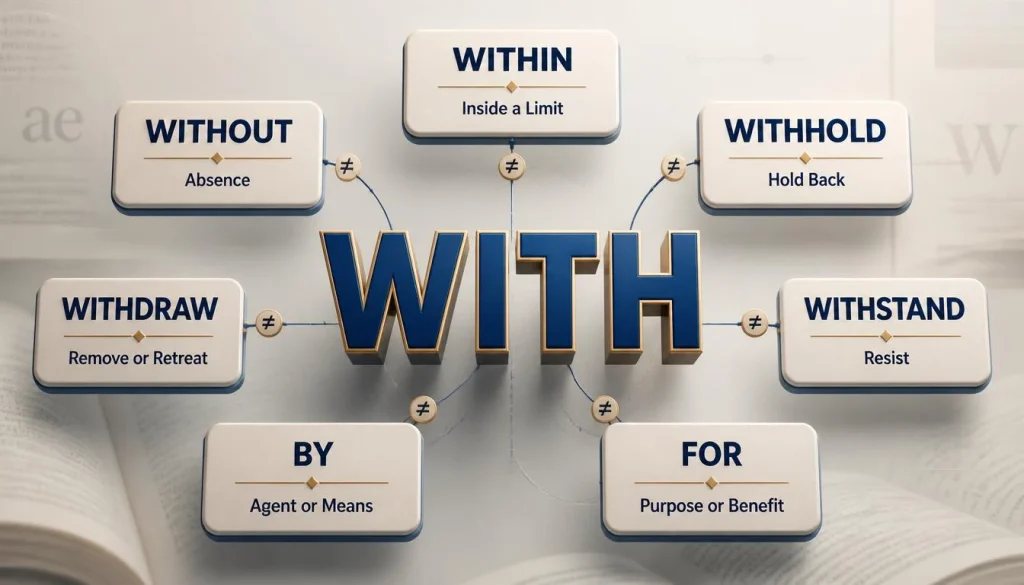
Several words begin with with- or appear in related searches but are not synonyms for with.
Within
Within means inside a place, boundary, limit, or period.
Example: Please reply within seven days.
It does not mean accompaniment.
Without
Without expresses absence and is often the most direct opposite of with.
Example: She left without her phone.
Withhold
Withhold is a verb meaning to hold something back or refuse to provide it.
Example: The company may withhold payment until the work is complete.
Withdraw
Withdraw means to remove, retreat, or take something back.
Example: He decided to withdraw his application.
Withstand
Withstand means to resist or survive something successfully.
Example: The bridge was designed to withstand strong winds.
By
By can identify an agent, method, location, or deadline, but it cannot generally replace with.
Compare:
- The book was written by Maya.
- Maya wrote the note with a pencil.
For
For commonly expresses purpose, benefit, duration, or intended recipient, not accompaniment.
Example: This gift is for you.
Common Mistakes When Replacing With
Mistake 1
Incorrect: I went to the market via my brother.
Correct: I went to the market with my brother.
Why: Via identifies a route or channel, not a human companion.
Mistake 2
Incorrect: She sat among her best friend.
Correct: She sat with her best friend.
Why: Among refers to being within or surrounded by a group, not simple one-person accompaniment.
Mistake 3
Incorrect: She came plus her sister.
Correct: She came with her sister. (or: She came along with her sister.)
Why: Plus adds items or amounts. It does not show that one person is accompanying another.
Mistake 4
Incorrect: He came within his brother to the office.
Correct: He came with his brother to the office.
Why: Within expresses an internal boundary or limit, not accompaniment.
Mistake 5
Incorrect: She opened the package alongside a knife.
Correct: She opened the package with a knife.
Alternative: She opened the package using a knife.
Why: Alongside suggests physical position or cooperation, not an instrument.
Antonyms of With
The best opposite depends on the meaning of with, but without is usually the most direct antonym when with expresses presence or possession.
| Antonym | Meaning |
| Without | In the absence of |
| Sans | Without; often stylistic or informal in modern usage |
| Minus | With something removed |
| Lacking | Not having something needed |
| Devoid of | Completely lacking something |
| Free of | Not containing or affected by something |
| Bereft of | Deprived of or lacking something, often valued |
Examples:
- Coffee with sugar → Coffee without sugar
- A room with windows → A room devoid of windows
- Price with tax → Price minus the tax
Not every antonym works in every context, so choose according to meaning.
With in American and British English
The spelling of with is the same in American and British English, and its basic grammatical functions are shared. Differences appear mainly in the expressions around it.
| Expression | Typical American use | Typical British use |
| Meeting someone | meet with someone (for a planned meeting) | meet someone |
| Talking | talk with or talk to someone | talk to someone is more common |
| Comparing | compared with or compared to | compared with or compared to |
These are tendencies, not strict rules, and both forms are understood everywhere. They rarely change the basic meaning of with.
Common Collocations with With
Learning common combinations is often more useful than trying to replace with in every sentence.
Verb + With
- agree with someone
- begin with an introduction
- come with a warranty
- cope with pressure
- deal with a problem
- end with a summary
- go with the flow
Adjective + With
- angry with someone
- consistent with the data
- familiar with the system
- filled with water
- pleased with the result
- popular with students
With + Noun
- with care
- with confidence
- with ease
- with luck
- with pleasure
- with respect
- with time
Formal Phrases Containing With
- with regard to
- with respect to
- in accordance with
- in line with
- with a view to
- compared with
Idioms and Expressions with With
With Open Arms
Meaning: Warmly and willingly.
Example: Her family welcomed her home with open arms.
With Flying Colors
Meaning: Very successfully.
Example: She passed the examination with flying colors.
With Bells On
Meaning: Eagerly or enthusiastically.
Example: I’ll be at the celebration with bells on.
With All Your Heart
Meaning: Completely and sincerely.
Example: He supported the project with all his heart.
Bear With Me
Meaning: Please be patient.
Example: Bear with me while I check the details.
Out With It
Meaning: Say what you have been reluctant to say.
Example: Out with it. What happened?
With One Voice
Meaning: In complete agreement.
Example: The committee spoke with one voice.
Practice Exercises
Fill in the Blanks
Choose from: together with, using, via, in addition to, beside
- She arrived ______ her assistant.
- Cut the paper ______ the scissors on the desk.
- The report was sent ______ the shared drive.
- ______ the main report, please attach the budget file.
- He sat ______ his grandfather during the ceremony.
Rewrite the Sentences
Rewrite each sentence using the word in brackets.
- I travelled with my sister. (accompanied by)
- She opened the parcel with a kitchen knife. (using)
- The hotel has a rooftop pool. (featuring)
Match the Words
Match each word with its closest meaning.
- Alongside
- Via
- Amid
- Featuring
- Plus
a. By way of a channel b. Displaying as a highlight c. And also; extra d. Side by side or cooperating e. Surrounded by a situation
Quick Vocabulary Quiz
1. Which word best replaces with in “He wrote with a pencil”?
a) Among b) Using c) Amid d) Featuring
2. Which phrase is suitable for formally adding another point?
a) Plus b) Alongside c) In addition to d) Beside
3. Which word describes being within or surrounded by a group?
a) Beside b) Among c) Via d) Having
4. Which phrase can identify a method in formal technical or academic writing?
a) Plus b) With bells on c) By means of d) Along with
5. What is the most direct opposite of with in the sense of presence?
a) Within b) Withhold c) Without d) Through
Answer Key
Fill in the blanks: 1. together with; 2. using; 3. via; 4. In addition to; 5. beside
Possible rewrites:
- I was accompanied by my sister.
- She opened the parcel using a kitchen knife.
- The hotel features a rooftop pool.
Matching: 1–d, 2–a, 3–e, 4–b, 5–c
Quiz: 1–b, 2–c, 3–b, 4–c, 5–c
Frequently Asked Questions
What is the closest synonym for with?
No single synonym for with works in every context. For accompaniment, together with and along with are close alternatives. For tools, using may work better, while including or featuring can fit sentences about contents or characteristics.
What are some common synonyms for with?
Common alternatives include together with, along with, alongside, accompanied by, using, via, through, including, featuring, beside, and in addition to. The correct choice depends on what with means in the sentence.
What is a formal synonym for with?
The best formal alternative depends on context. Use in addition to for additions, accompanied by for accompaniment, by means of for methods, and coupled with when two factors combine to produce an effect.
What is another word for with in an essay?
In academic or formal writing, alternatives include in addition to, through, including, by means of, and coupled with. However, with itself is neutral and perfectly acceptable in formal writing, so replace it only when another expression is more precise.
Can synonyms for with be used interchangeably?
No. With can express company, tools, methods, possession, additions, manner, and circumstances. Most alternatives cover only one of these meanings. Check the intended relationship before replacing the word.
What does with mean?
With is a preposition used to connect someone or something with a companion, instrument, feature, manner, circumstance, or additional item.
Examples include:
- travelling with a friend
- cutting with scissors
- a house with a garden
- speaking with confidence
How do you use with in a sentence?
Place with before the person, object, feature, or quality being connected to the rest of the sentence.
Examples:
- She spoke with the manager.
- He opened the door with a key.
- We booked a room with a sea view.
- She answered with confidence.
What is the opposite of with?
Without is the most direct opposite of with when the meaning involves presence, possession, or accompaniment. Other context-dependent opposites include minus, lacking, devoid of, and free of.
Conclusion
The best synonym for with depends on the relationship you want to express. Use together with or along with for accompaniment, using for a tool, via for a route or channel, including for part of a larger whole, and featuring for a notable characteristic.
Instead of replacing with simply to avoid repetition, first identify its meaning in the sentence. A more specific alternative can improve clarity, but plain with is often already the most natural choice.

About Sajjad Ahmed
Sajjad Ahmed is the author behind Guest Paster, where he writes about English vocabulary, synonyms, word meanings, and practical word usage.
His content is designed to help readers understand the differences between similar words, discover suitable alternatives, and use English vocabulary more effectively in everyday writing and communication.
Before publishing, Sajjad focuses on presenting word choices in a clear and easy-to-understand format, with relevant meanings, context, and examples where helpful.
Through Guest Paster, his goal is to make vocabulary learning simpler and provide useful language resources for students, writers, English learners, and anyone looking to expand their vocabulary.
Areas of Focus: English Vocabulary • Synonyms • Word Meanings • Word Usage • Language Learning
Author: Sajjad Ahmed
Website: Guest Paster