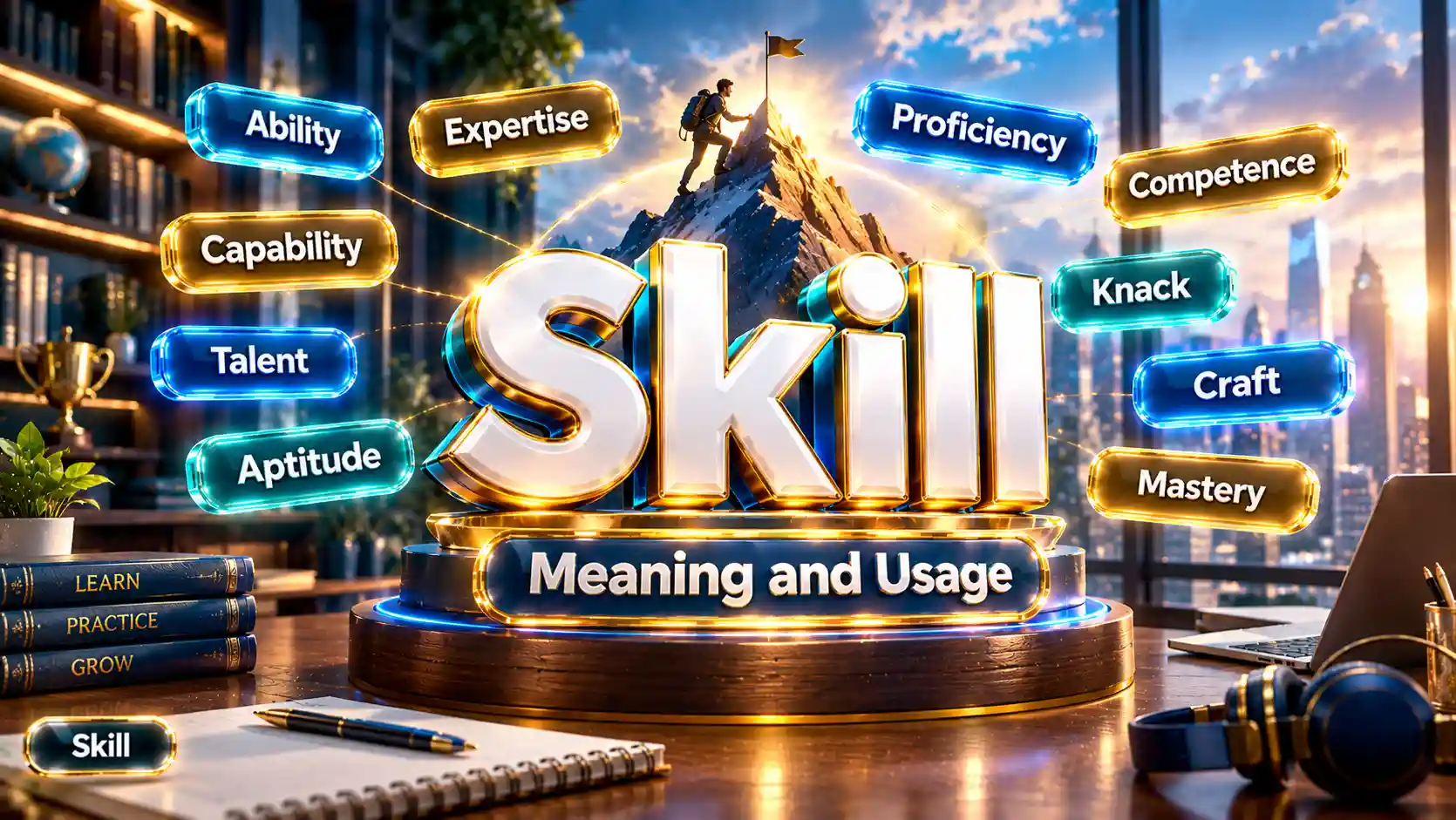
The best all-purpose synonym for skill is ability. For expertise use a deep specialism of knowledge, proficiency a tangible measure (such as language or software) competence a benchmark to meet, and knack for an intuitive flair. Your the best choice will dependon whether you intend something acquired versus natural, basic vs advanced, formal vs informal.
Ability to accomplish tasks proficiently, typically acquired through education/training/experience. It’s one of the most frequently repeated words in resumes, job postings and performance evaluations, and substituting it for another term without understanding the implications can result in a change in meaning.
Below is a guide showing which alternative applies best under what circumstances.
Another Word For Skill Synonyms at a Glance
| Synonym | How it differs from “skill” | Register |
| Ability | Broader capacity, learned or innate | Neutral |
| Expertise | Deep, specialized authority | Formal |
| Proficiency | Measured, benchmarked level | Formal |
| Competence | Meets the required standard | Neutral/formal |
| Capability | Capacity or potential, often organizational | Formal |
| Talent | Leans natural or creative | Neutral |
| Aptitude | Readiness to learn, not yet mastery | Formal |
| Knack | Easy, intuitive, informal | Informal |
| Craft | Practiced skill in making or creating | Neutral |
| Mastery | Top-tier command | Neutral/formal |
Quick Facts About “Skill”
- Part of speech: noun (countable and uncountable)
- Core meaning: the ability to do something well, gained through training or experience
- Pronunciation: /skɪl/ (same in UK and US English)
- Syllables: 1
- Word forms: skills, skilled, skillful (US) / skilful (UK), skillfully, unskilled
- Formality: neutral, suitable in any register
- Closest synonym: ability
What Is the Closest Synonym of Skill?
Ability is the closest and safest substitute. Both words can describe someone who can do something well:
- Her writing skill impressed the editor.
- Her writing ability impressed the editor.
The difference is emphasis. Skill points to something developed through practice, while ability is wider and can include natural capacity. Choose skill when training matters and ability when you want the general idea.
Where “Skill” Comes From
Skill entered English from Old Norse skil, meaning “discernment” or “distinction,” the power to tell one thing from another. In Middle English it also carried senses of reason and knowledge. The modern meaning of practical ability developed from there, which explains why skill still blends knowing with doing.
Can Skill Synonyms Be Used Interchangeably?
Only sometimes. Before swapping a word, ask four questions:
- Learned or natural? Talent, gift, and flair lean natural. Proficiency and technique lean learned.
- Basic or advanced? Expertise, mastery, and prowess signal high levels. Competence signals adequacy.
- Actual or potential? Aptitude and capability can describe what someone could do, not only what they have shown.
- Formal or casual? Knack and know-how are relaxed. Proficiency and competency belong in formal documents.
The Different Senses of “Skill”
| Sense | Example | Best synonyms |
| A learned, practiced ability | “Data-analysis skills” | ability, proficiency, competence, technique |
| Level of performance (uncountable) | “She negotiated with great skill.” | finesse, mastery, expertise |
| A job-relevant capability | “Core skills for this role” | competencies, capabilities, know-how |
| A natural gift (older or looser use) | “A skill for languages” | talent, flair, aptitude, gift |
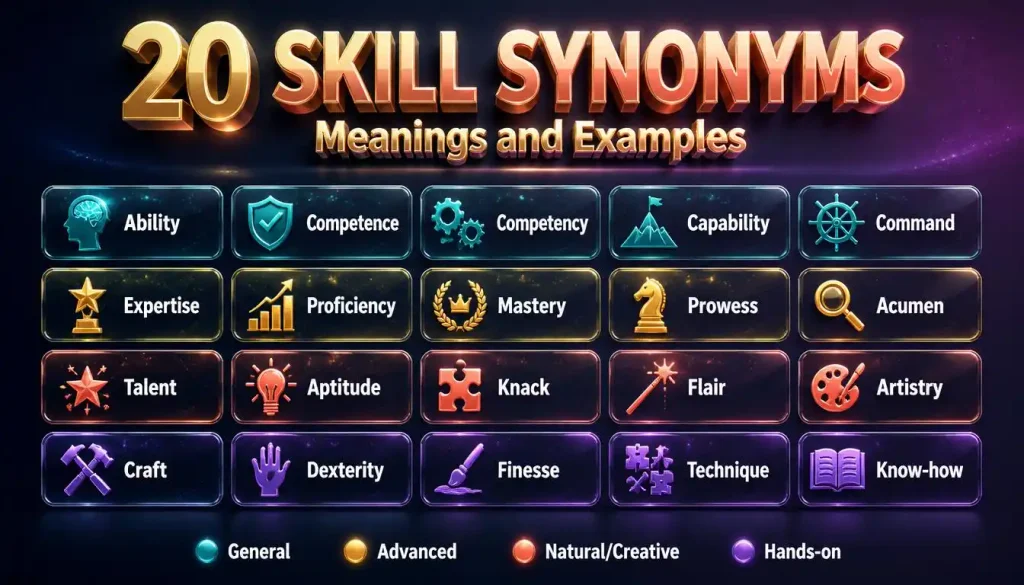
Skill Synonyms With Meanings and Examples
1. Ability
Meaning: The mental or physical power to do something.
Vs. skill: Broader, and not necessarily trained.
Use for: General descriptions, interviews, academic writing.
Example: “Her ability to turn messy survey data into a clear story won her the analyst role.”
Avoid when: You want to stress practiced technique.
2. Expertise
Meaning: Deep, specialized knowledge or skill in a field.
Vs. skill: Implies authority and a high level.
Use for: Professional bios, consulting, senior résumés.
Example: “We brought in outside expertise on accessibility audits before launch.”
Avoid when: Describing beginner-level or casual abilities.
3. Proficiency
Meaning: A developed, often measurable level of competence.
Vs. skill: Suggests a benchmark or grade.
Use for: Languages, software, certifications.
Example: “Applicants must show proficiency in SQL and one dashboard tool.”
Avoid when: The ability is vague or unassessed.
4. Competence
Meaning: Being able to perform to an expected standard.
Vs. skill: Focuses on sufficiency, not excellence.
Use for: Reviews, training, regulated professions.
Example: “The audit confirmed each technician’s competence with the new equipment.”
Avoid when: You want to praise exceptional ability.
5. Competency
Meaning: A specific skill or knowledge area required for a role.
Vs. skill: More bureaucratic and job-framework oriented.
Use for: HR documents, job descriptions, training maps.
Example: “Core competencies include stakeholder communication and budgeting.”
Avoid when: Writing casually.
6. Capability
Meaning: The capacity to do something, sometimes not yet fully used.
Vs. skill: Emphasizes potential or capacity, especially for teams and systems.
Use for: Business, technology, planning.
Example: “Our support team now has the capability to handle tickets in six languages.”
Avoid when: You mean proven, practiced skill.
7. Talent
Meaning: A natural or notable aptitude, often creative.
Vs. skill: Suggests an innate edge.
Use for: Arts, sports, creative hiring.
Example: “The studio is known for spotting young animation talent online.”
Avoid when: The ability clearly came from training.
8. Aptitude
Meaning: Natural or developing readiness to learn something.
Vs. skill: Points to future capability.
Use for: Education, career testing, training programs.
Example: “Aptitude tests screen for how quickly a trainee can learn to code.”
Avoid when: Describing established, proven ability.
9. Knack
Meaning: An easy, intuitive way of doing something well.
Vs. skill: Informal and effortless in tone.
Use for: Conversation, light praise.
Example: “He has a knack for writing prompts that get usable answers on the first try.”
Avoid when: Writing formal documents or résumés.
10. Craft
Meaning: Practiced skill in making or creating something.
Vs. skill: Implies discipline, care, and tradition.
Use for: Trades, writing, design, handmade work.
Example: “Ceramicists spend years refining their craft.”
Avoid when: The skill is abstract, such as strategic thinking.
11. Artistry
Meaning: Creative skill with aesthetic judgment.
Vs. skill: Adds imagination and expression.
Use for: Music, design, cooking, film.
Example: “The game’s artistry shows in its hand-painted environments.”
Avoid when: The task is routine or purely functional.
12. Dexterity
Meaning: Precise, controlled skill, often with the hands.
Vs. skill: Emphasizes coordination and nimbleness (it can also be mental).
Use for: Surgery, repair, instruments, sport.
Example: “Replacing a phone’s ribbon cable takes steady dexterity.”
Avoid when: Describing strategic or knowledge-based ability.
13. Finesse
Meaning: Delicate, graceful skill in handling something.
Vs. skill: Adds subtlety and polish.
Use for: Negotiation, diplomacy, performance.
Example: “She announced the budget cuts with finesse.”
Avoid when: Raw power is the point.
14. Prowess
Meaning: Impressive, superior ability in a field.
Vs. skill: Stronger and more admiring.
Use for: Sports, competitive work, formal praise.
Example: “The striker’s scoring prowess earned him a national call-up.”
Avoid when: The ability is modest.
15. Acumen
Meaning: Sharp judgment and quick insight.
Vs. skill: Mental and decision-focused, not manual.
Use for: Business, finance, politics.
Example: “Her commercial acumen turned a side project into a company.”
Avoid when: Describing physical or mechanical skill.
16. Mastery
Meaning: Complete command of a subject or technique.
Vs. skill: Marks the top of the scale.
Use for: Arts, technical fields, long study.
Example: “Mastery of a new language takes years of daily use.”
Avoid when: Describing beginners or intermediates.
17. Command
Meaning: Confident control of a subject or ability.
Vs. skill: Implies authority over the material.
Use for: Languages, subject knowledge, public speaking.
Example: “The interpreter has an excellent command of French and Arabic.”
Avoid when: The ability is partial.
18. Know-how
Meaning: Practical knowledge of how to get something done.
Vs. skill: Informal, procedural.
Use for: Startups, trades, technical work.
Example: “Any hardware startup needs manufacturing know-how.”
Avoid when: Writing formal or legal text.
19. Flair
Meaning: A natural, stylish way of doing something.
Vs. skill: Adds personality and style.
Use for: Design, cooking, presentation.
Example: “She has a flair for color in packaging design.”
Avoid when: The task is purely technical.
20. Technique
Meaning: A specific method for doing something well.
Vs. skill: Describes how, not overall ability.
Use for: Sport, medicine, art, instruction.
Example: “The workshop covers sterile technique.”
Avoid when: You mean general ability.
Best Alternatives by Context
| Context | Strong choices |
| Everyday conversation | ability, knack, talent, flair |
| Formal writing | expertise, proficiency, competence, capability |
| Academic writing | aptitude, competence, proficiency, mastery |
| Business | expertise, competency, acumen, capability |
| Creative writing | craft, artistry, finesse, flair |
| Social media and captions | knack, talent, know-how, prowess |
Which Synonym Should I Choose?
| Situation | Best choice | Why |
| Résumé summary | expertise | Signals depth |
| Skills section heading | Skills | Clear and ATS-friendly (see below) |
| Language level | proficiency | Matches standard scales |
| Performance review | competence | Standard HR wording |
| Casual compliment | knack | Warm and natural |
| Hiring for potential | aptitude | Points to learning ability |
| Creative portfolio | craft | Values process |
| Business judgment | acumen | Highlights insight |
| Technical documentation | capability | Fits systems and teams |
Writing About Skills in 2026
Skills language is changing fast. The World Economic Forum’s Future of Jobs Report 2025 projected that about 39% of workers’ core skills would change by 2030, with analytical thinking among the most sought-after. As employers shift toward skills-based hiring, you’ll see “upskilling,” “reskilling,” and “skills-first” more often. Two practical tips:
- Be specific. “Proficiency in Python, SQL, and Tableau” beats “strong technical expertise.”
- Keep “Skills” as your résumé section heading. Applicant tracking systems and recruiters search for that exact word. Use synonyms inside bullet points, not in the heading.
Words Often Confused With Skill
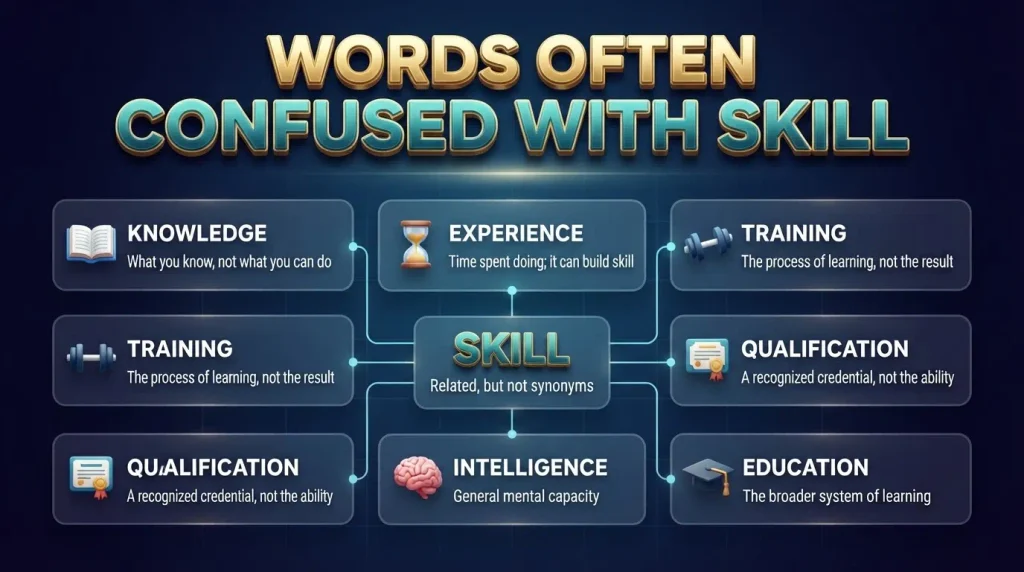
- Knowledge: what you know, not what you can do
- Experience: time spent doing something, which can build skill
- Training: the process of learning, not the result
- Qualification: a recognized credential, not the ability itself
- Intelligence: general mental capacity
- Education: the broader process or system of learning
Common Mistakes
| Mistake | Better | Why |
| “Basic expertise” | basic skill | Expertise implies a high level |
| “Natural proficiency” | natural aptitude | Proficiency implies developed, assessed ability |
| “Knack” on a formal résumé | proficiency | Too informal |
| “Aptitude” for proven ability | competence | Aptitude is potential |
| “Craft” for abstract skills | ability | Craft implies making |
| “Knowledge” as a synonym | skill and knowledge | Knowing is not doing |
Antonyms of Skill
| Antonym | Meaning |
| incompetence | lack of ability to do a task adequately |
| ineptitude | clumsy or unskilled performance |
| inability | being unable to do something |
| inexperience | lack of practical exposure |
| clumsiness | lack of coordination or grace |
| amateurishness | lack of professional-level skill |
American vs. British English
The noun skill is spelled the same in both. The difference is in the adjective: American English uses skillful and British English uses skilful. Pronunciation is the same.
Common Collocations and Phrases
- Verb + skill: develop, acquire, master, practice, sharpen, demonstrate, transfer skills
- Adjective + skill: technical, interpersonal, transferable, core, specialist, practical skills
- Skill + noun: skill set, skill gap, skill level, skill development
- Prepositions: skill in negotiation, skill at writing, skill with tools
- Phrases: soft skills, hard skills, people skills, upskilling, reskilling
Practice Exercises
Fill in the blank (ability, expertise, proficiency, knack, dexterity):
- The recruiter asked for ______ in Spanish.
- Threading the tiny screw took real ______.
- We hired her for her tax-law ______.
- He has a ______ for explaining hard ideas simply.
- Her ______ to stay calm under pressure impressed the panel.
Rewrite with a more precise word:
- “She has real skill at reading financial statements.” (hint: judgment)
- “He has a natural skill for music.” (hint: potential)
- “The team has the skill to scale the product.” (hint: capacity)
Quick quiz:
- Which word suggests potential to learn? (aptitude)
- Which is most informal? (knack)
- Which signals the highest level? (mastery)
- Which suits an HR framework? (competency)
Answers: Fill-in: 1 proficiency, 2 dexterity, 3 expertise, 4 knack, 5 ability. Rewrites: 1 acumen, 2 aptitude, 3 capability. Quiz: aptitude, knack, mastery, competency.
Frequently Asked Questions
What is a fancy word for skill?
Expertise or mastery work in formal writing. Prowess and virtuosity are fancier but narrower.
What is another word for skills on a resume?
Use expertise, proficiencies, competencies, or capabilities inside your bullets, but keep “Skills” as the section heading.
What are five good synonyms for skill?
Ability, expertise, proficiency, competence, and capability.
What is a strong synonym for skills?
Expertise for depth, proficiency for measured level, mastery for the highest level.
What can I say instead of skill in an interview?
Ability is safe. Add specifics: “I have strong analytical ability and proficiency in Excel and SQL.”
Is there a 3-letter synonym for skill?
Art, as in “the art of negotiation.” It works only in certain phrases.
What are skill synonyms by letter count?
- 4 letters: gift
- 5 letters: knack, craft, flair
- 6 letters: talent, acumen
- 7 letters: ability, command, mastery, finesse, prowess
What are synonyms for “skills and abilities”?
Competencies, capabilities, strengths, proficiencies, talents, and aptitudes.
Are “skill” and “talent” the same?
No. Talent leans natural, while skill is built through practice. Many great performers have both.
Conclusion
Pick the word that tells readers what kind of capability you mean and how developed it is. Use ability for clarity, expertise for depth, proficiency for measured levels, competence for standards, and knack for a light touch.

About Sajjad Ahmed
Sajjad Ahmed is the author behind Guest Paster, where he writes about English vocabulary, synonyms, word meanings, and practical word usage.
His content is designed to help readers understand the differences between similar words, discover suitable alternatives, and use English vocabulary more effectively in everyday writing and communication.
Before publishing, Sajjad focuses on presenting word choices in a clear and easy-to-understand format, with relevant meanings, context, and examples where helpful.
Through Guest Paster, his goal is to make vocabulary learning simpler and provide useful language resources for students, writers, English learners, and anyone looking to expand their vocabulary.
Areas of Focus: English Vocabulary • Synonyms • Word Meanings • Word Usage • Language Learning
Author: Sajjad Ahmed
Website: Guest Paster