The writer at the corner table orders a second coffee, opens her laptop and checks the calendar: Lisbon this month, Valencia the next then a small town in Georgia. Her home is a suitcase, her office is any cafe with strong Wi-Fi and her address changes with the seasons.
Roaming is the closest synonym for the wandering life she leads, swapping cleanly into most sentences about people, tribes and habits that never settle. Wandering suits a slow, aimless drift, itinerant suits work that travels and footloose suits modern freedom of carrying no ties.
This guide gives you 15 nomadic synonyms with meanings, examples and honest limits so your next sentence names the exact kind of moving you mean.
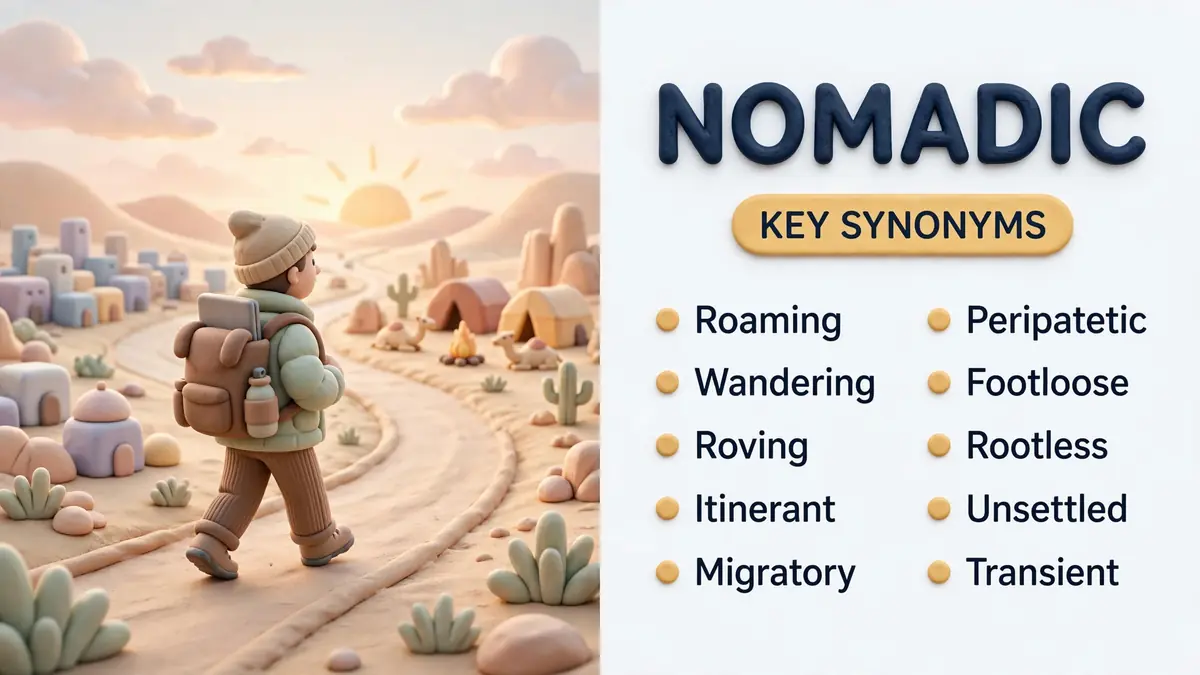
Nomadic Synonyms at a Glance
| # | Synonym | Meaning Difference |
|---|---|---|
| 1 | Roaming | Free movement, no fixed route |
| 2 | Wandering | Slow drift, often no goal |
| 3 | Roving | Moving about, looking or searching |
| 4 | Itinerant | Travelling for work |
| 5 | Migratory | Moving with the seasons |
| 6 | Peripatetic | Walking about while working |
| 7 | Footloose | Free of ties, free to travel |
| 8 | Rootless | No home base or roots |
| 9 | Unsettled | Not fixed in place or state |
| 10 | Transient | A short stay in one place |
Quick Facts About “Nomadic”
- Part of speech: an adjective. The noun is nomad, and the adverb is nomadically.
- Core meaning: wandering from place to place, without a fixed home.
- Three main senses: (1) wandering without a fixed home, of tribes and herders; (2) the modern roaming lifestyle, of digital nomads; (3) figurative, restless or unsettled in mind or habit.
- Register: neutral. Nomadic fits news reports, essays, travel writing, and everyday conversation.
- Common mistake: calling any traveller nomadic. A tourist on a two-week holiday is not nomadic.
The Closest Synonym: Roaming
Roaming is the closest synonym for nomadic, because it covers the same ground in the plainest form: movement without a fixed home or a fixed route. Test the swap and it holds. “She led a nomadic life” becomes “She led a roaming life” with no loss of sense. “Nomadic herders crossed the steppe” becomes “Roaming herders crossed the steppe.” “His nomadic years took him through six countries” becomes “His roaming years took him through six countries.”
Roaming wins on range: it works for people, animals, tribes, and habits, while nomadic sounds more formal and more tied to a way of life. Wandering runs second for slow, aimless movement, and itinerant runs second when the travel is for work.
Where “Nomadic” Comes From (Etymology)
According to Etymonline, nomadic entered English in 1800, meaning “wandering, roving, leading the life of a nomad,” formed from nomad plus -ic. The noun nomad is older, from the 1550s, taken from French nomade, from Latin Nomas, “wandering groups in Arabia,” and from Greek nomas, “roaming, roving, wandering,” of moving to find pasturage for flocks. That Greek word is related to nomos, “pasture, pasturage, grazing,” literally “land allotted.” Merriam-Webster traces the word to Greek nomadikós, “of a shepherd or herdsman, pastoral,” and dates the first known use to around 1818.
The root tells the story: a nomad was first a herder following grass, not a traveller chasing novelty. That history is why nomadic still means a life shaped by movement, whether it follows seasons, work, or a restless mind.
Can You Swap Them Freely?
In short: only inside the same meaning group, when the sense matches.
- ✅ “The roaming herders crossed the steppe.” (people moving with their flocks ✔)
- ✅ “The nomadic herders crossed the steppe.” (same sense ✔)
- ✅ “She lives a footloose life, moving every few months.” (free of ties ✔)
- ❌ “She lives a vagrant life, moving every few months.” (vagrant suggests homelessness and hardship ✘, say footloose)
- ✅ “The itinerant teacher worked in three towns.” (travel for work ✔)
- ❌ “The itinerant teenager drifted through Europe.” (no work is involved ✘, say wandering)
- ✅ “His restless mind never settled on one idea.” (figurative, unsettled ✔)
- ❌ “His migratory mind never settled on one idea.” (migratory is about seasonal movement ✘, say restless)
- ✅ “They spent a transient summer in the city.” (a short stay ✔)
Before you substitute, ask what kind of moving it is.
Nomadic Synonyms in Detail
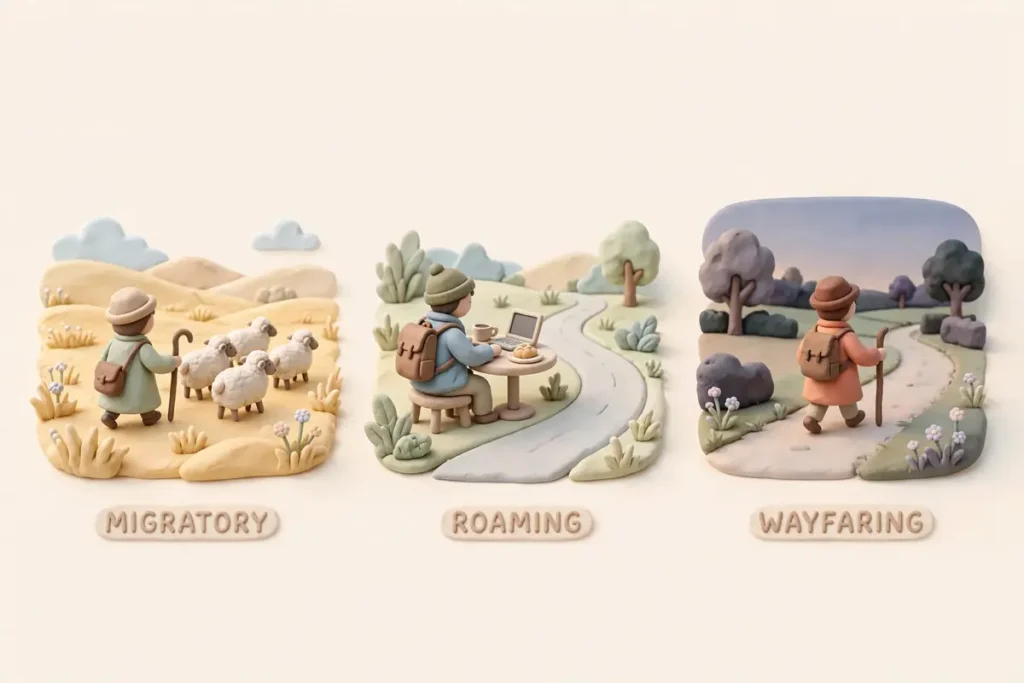
Group 1: Wandering Without a Fixed Home
1. Roaming
- Meaning: Moving freely, with no fixed route or home.
- Difference: The plainest swap for nomadic.
- Best used for: People, tribes, herders, animals, and habits.
- Formality: Neutral · CEFR: B2 · Frequency: Very common
- Example (Herders): “Roaming herders followed the grass.”
- Example (Years): “Her roaming years took her through six countries.”
- When NOT to use it: For a phone signal between networks, say “roaming charges,” never a roaming life.
2. Wandering
- Meaning: Moving slowly, often without a clear goal.
- Difference: Adds aimlessness: the journey matters more.
- Best used for: Travellers, thoughts, lives, and attention.
- Formality: Neutral · CEFR: B1 · Frequency: Very common
- Example (Traveller): “A wandering musician played in a different town each week.”
- Example (Mind): “His wandering mind drifted from the lecture to the window.”
- When NOT to use it: For a planned seasonal move, use migratory instead.
3. Roving
- Meaning: Moving over a wide area, often looking or searching.
- Difference: Suggests a wide sweep with a loose purpose.
- Best used for: Reporters, eyes, bands, and patrols.
- Formality: Neutral · CEFR: B2 · Frequency: Common
- Example (Reporter): “The roving reporter filed stories from small towns.”
- Example (Eye): “Her roving eye took in the whole market in one glance.”
- When NOT to use it: For a settled way of life, use nomadic itself.
4. Itinerant
- Meaning: Travelling from place to place for work.
- Difference: The work is the reason for the travel.
- Best used for: Teachers, workers, traders, preachers, and performers.
- Formality: Neutral to formal · CEFR: C1 · Frequency: Less common
- Example (Teacher): “The itinerant teacher taught in three villages each term.”
- Example (Trader): “Itinerant traders carried cloth between towns.”
- When NOT to use it: For travel with no work involved, use wandering or roaming.
5. Migratory
- Meaning: Moving with the seasons, in a regular pattern.
- Difference: The pattern is the point: the move repeats yearly.
- Best used for: Birds, animals, peoples, workers, and herds.
- Formality: Neutral to formal · CEFR: C1 · Frequency: Common
- Example (Birds): “Migratory birds crossed the sea before the first frost.”
- Example (Workers): “Migratory workers followed the harvest.”
- When NOT to use it: For a free, unplanned life, use roaming instead.
6. Peripatetic
- Meaning: Walking from place to place, often while working.
- Difference: A literary word with a walking pace.
- Best used for: Teachers, philosophers, and walkers.
- Formality: Formal, literary · CEFR: C2 · Frequency: Less common
- Example (Teacher): “The peripatetic tutor walked between farmhouses each week.”
- Example (Life): “His peripatetic life suited a man who thought on foot.”
- When NOT to use it: In plain writing, use itinerant or roaming.
7. Wayfaring
- Meaning: Travelling on foot, especially over long distances.
- Difference: Old-fashioned and poetic, with the road in view.
- Best used for: Travellers, strangers, songs, and stories.
- Formality: Formal, literary · CEFR: C2 · Frequency: Less common
- Example (Stranger): “A wayfaring stranger stopped at the farmhouse for water.”
- Example (Song): “The wayfaring song told of roads and far towns.”
- When NOT to use it: For modern travel by plane or car, use roaming instead.
8. Vagrant
- Meaning: Wandering without a home, often without work or support.
- Difference: Carries hardship and blame: this is not a chosen life.
- Best used for: Cautionary writing, legal contexts, and social history.
- Formality: Formal · CEFR: C1 · Frequency: Less common
- Example (History): “Vagrant labourers slept in barns along the harvest road.”
- Example (Law): “The old vagrancy laws punished people with no fixed address.”
- When NOT to use it: For a chosen roaming life, use footloose or nomadic.
Group 2: A Modern Life Without Ties
9. Footloose
- Meaning: Free of ties, free to travel as you please.
- Difference: The freedom is the point.
- Best used for: Young travellers, freelancers, and digital nomads.
- Formality: Neutral, slightly informal · CEFR: B2 · Frequency: Common
- Example (Freelancer): “Footloose and thirty, she worked from a new city each month.”
- Example (Years): “His footloose years ended when the twins were born.”
- When NOT to use it: For traditional herding peoples, use nomadic or migratory.
10. Rootless
- Meaning: Without a home base or settled place.
- Difference: Stresses what is missing: no roots.
- Best used for: Exiles, movers, childhoods, and modern lives.
- Formality: Neutral · CEFR: C1 · Frequency: Common
- Example (Childhood): “A rootless childhood gave her friends in twelve cities.”
- Example (Life): “His rootless life suited the work, yet he missed neighbours.”
- When NOT to use it: For a cheerful choice to travel, use footloose instead.
11. Transient
- Meaning: Lasting only a short time in one place.
- Difference: About time, not distance: the stay is brief.
- Best used for: Guests, workers, populations, and phases of life.
- Formality: Neutral to formal · CEFR: C1 · Frequency: Common
- Example (Guests): “The hostel served transient guests, most gone in a week.”
- Example (Phase): “A transient summer in the city taught her to travel light.”
- When NOT to use it: For a lifelong way of life, use nomadic instead.
12. Drifting
- Meaning: Moving slowly without direction, carried by events.
- Difference: Suggests no plan and sometimes no purpose.
- Best used for: Lives, careers, minds, and boats.
- Formality: Neutral · CEFR: B2 · Frequency: Very common
- Example (Life): “After college he spent a drifting year between jobs and cities.”
- Example (Mind): “Her drifting thoughts settled only when the train pulled in.”
- When NOT to use it: For a purposeful seasonal move, use migratory instead.
Group 3: Restless in Mind and Habit
13. Unsettled
- Meaning: Not fixed in one place, job, or state of mind.
- Difference: Covers the address and the mood: nothing has settled.
- Best used for: Lives, minds, weather, and times.
- Formality: Neutral · CEFR: B2 · Frequency: Very common
- Example (Life): “An unsettled life kept her suitcase packed by the door.”
- Example (Mind): “An unsettled mind kept him awake past midnight.”
- When NOT to use it: For a cheerful traveller, use footloose instead.
14. Restless
- Meaning: Unable to rest, always wanting to move.
- Difference: About the urge inside, not the road outside.
- Best used for: Minds, spirits, sleepers, and travellers.
- Formality: Neutral · CEFR: B2 · Frequency: Very common
- Example (Spirit): “A restless spirit drove him to a new town each spring.”
- Example (Night): “She spent a restless night, packing and unpacking the same bag.”
- When NOT to use it: For a tribe, use nomadic itself.
15. Shifting
- Meaning: Changing place or position again and again.
- Difference: Stresses the repeated change, not the travel itself.
- Best used for: Habits, loyalties, sands, and work patterns.
- Formality: Neutral · CEFR: B2 · Frequency: Very common
- Example (Habits): “His shifting habits made a fixed routine impossible.”
- Example (Work): “Shifting contracts kept her moving between three cities.”
- When NOT to use it: For a person, use roaming or unsettled.
Best Alternatives by Context
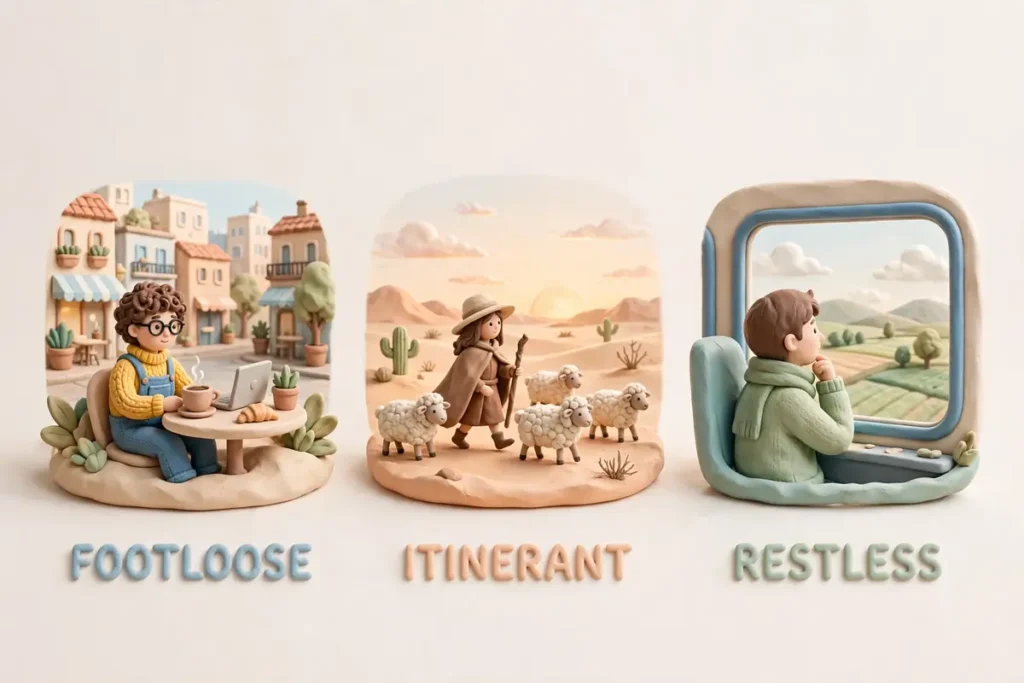
A herder crossing the steppe and a freelancer changing cities each month both live nomadic lives, yet they ask for different words.
| Situation | Best pick | Why it wins |
|---|---|---|
| A tribe or herders moving with flocks | Migratory | The seasonal pattern |
| A traveller with no fixed route | Roaming | The plain word |
| A slow, aimless wanderer | Wandering | No goal |
| Work that travels from town to town | Itinerant | The job drives it |
| A freelancer free of ties | Footloose | The cheerful freedom |
| A childhood with no home base | Rootless | The missing roots |
| A short stay before moving on | Transient | The brief time |
| A mind that cannot settle | Restless | The urge inside |
Two calls deserve a second look. A freelancer who works from anywhere has chosen a life free of ties, and our guide to independent synonyms covers that self-reliant side. A writer in a new city still has to find her way, and our guide to navigate synonyms covers the verbs of finding a path.
Words Commonly Confused With Nomadic
Nomadic versus migratory matters for the pattern. Migratory means moving in a regular pattern, often with the seasons, as birds do. Nomadic means moving without a fixed home, and the route may change each year. One names the pattern, the other names the lack of a home.
Nomadic versus vagrant matters for dignity. A vagrant wanders without a home or support, and the word carries pity or blame. A nomad follows a way of life, whether herding or working online. Never call a digital nomad vagrant.
Nomadic versus restless matters for inside versus outside. Restless describes a feeling, an urge to move that lives in the mind. Nomadic describes a life others can see. A restless person may never leave home, and a nomadic herder may feel calm on the road.
Nomadic versus itinerant matters for the reason. Itinerant means travelling for work, so a teacher or trader is itinerant. Nomadic is wider: it covers peoples and whole ways of life, with or without a job at the centre. An itinerant worker is often nomadic, yet a nomadic tribe is not itinerant.
Nomad versus nomadic matters for grammar. Nomad is the noun, the person who wanders. Nomadic is the adjective, describing a life, a tribe, or a habit. Write “she is a nomad” for the person and “she leads a nomadic life” for the life. Never use “nomad” as an adjective.
Nomadic versus homeless matters for honesty. Homeless means having no home and usually no choice. Nomadic means living without a fixed home, often by choice or tradition. Swapping them hides the difference between a way of life and a hardship.
Substitution test failures:
“The nomadic birds returned each March” fails as a plain swap, because birds follow a pattern, so say “migratory.” “The nomadic beggar slept under the bridge” fails, because the word softens hardship, so say “vagrant” or “homeless.” “Her nomadic attention span lasted five minutes” fails, because attention wanders, so say “wandering.” “The nomadic teacher taught in three villages” works, yet “itinerant” is sharper.
Which Nomadic Synonym Should I Choose?
| Situation | Best pick | Why it wins |
|---|---|---|
| A tribe or herders on the move | Migratory | The pattern |
| Free movement, no fixed route | Roaming | The plain word |
| A slow, aimless wanderer | Wandering | The missing goal |
| Travel driven by work | Itinerant | The job |
| A hard life without a home | Vagrant | The hardship |
| A freelancer free of ties | Footloose | The freedom |
| A life with no home base | Rootless | No roots |
| A short stay, soon gone | Transient | Brief time |
| A life or mind not yet settled | Unsettled | Not settled |
| An urge that will not rest | Restless | The feeling |
Nomadic Opposites: Settled Words for a Restless Word
| Nomadic word | Opposite | What changes |
|---|---|---|
| Roaming | Settled | A home base appears |
| Itinerant | Permanent | The job stays in one place |
| Migratory | Resident | The seasons stop calling |
| Peripatetic | Sedentary | The walking ends, the sitting begins |
| Footloose | Tied down | Duties and roots take hold |
| Rootless | Rooted | A home and neighbours appear |
| Unsettled | Settled | Life finds its place |
| Restless | Content | The urge to move quiets down |
Settled is the plain opposite for everyday writing, while sedentary suits the walking sense and permanent suits the work sense. To name the act of putting down roots, see our guide to establish synonyms.
Collocations and Idioms With Nomadic
Only combinations native speakers actually use:
- a nomadic lifestyle: as in “She chose a nomadic lifestyle, working from a new city monthly.”
- a nomadic tribe: as in “The nomadic tribe moved camp before the rains.”
- nomadic herders: as in “Nomadic herders guided their flocks across the steppe.”
- lead a nomadic life: as in “For ten years he led a nomadic life, never staying long.”
- nomadic peoples: as in “Nomadic peoples have crossed these grasslands for centuries.”
- a digital nomad: as in “As a digital nomad, she needs only a laptop and Wi-Fi.”
- nomadic habits: as in “His nomadic habits survived long after he bought a house.”
American vs British English
Nomadic is spelled and used the same in American and British English, and so are its synonyms here. “Travelling” with two ls is the British spelling, while Americans write “traveling” with one l, so the verb inside your sentence shifts even when nomadic does not. One word to avoid: “Romani” is sometimes used as a loose synonym, yet it is outdated and offensive, so never use it. This article uses American spelling throughout.
Practice Exercises
Exercise 1: Match the sentence to the synonym. Each sentence fits one word from the list. Name it and say why.
- “The teacher taught in three villages each term.”
- “Birds crossed the sea before the first frost, following the same route as last year.”
- “She worked from a new city each month, free of ties.”
- “His mind never settled on one idea, and sleep would not come.”
- “Guests stayed a week at most, then moved on to the next town.”
Exercise 2: Correct the mistake. Each sentence uses a nomadic synonym wrongly. Fix it and say why.
- “The vagrant freelancer worked from a beach cafe in Lisbon.”
- “Her migratory mind drifted from the lecture to the window.”
- “The itinerant teenager drifted through Europe with no job at all.”
- “The nomadic birds returned each March to the same nesting ground.”
- “A wayfaring salesman drove between twelve cities.”
Answer key
- Exercise 1: (1) itinerant: work drives the travel; (2) migratory: the move repeats with the seasons; (3) footloose: freedom from ties; (4) restless: the urge lives in the mind; (5) transient: the stay is brief.
- Exercise 2: (1) footloose: the freelancer chose the life; (2) wandering: a mind drifts without a goal; (3) wandering: with no work involved, itinerant is wrong; (4) migratory: birds follow a repeating pattern; (5) roaming: a salesman in a van is not on foot.
Frequently Asked Questions
What is the best synonym for nomadic?
Roaming is the best synonym for nomadic in most sentences, because it covers free movement without a fixed home in the plainest form. Wandering fits a slow, aimless drift, itinerant fits travel driven by work, and footloose fits a modern life with no ties.
What is the difference between nomadic and migratory?
Migratory means moving in a regular, repeating pattern, often with the seasons, as birds and harvest workers do. Nomadic means living without a fixed home, and the route may change each year. Migratory names the pattern; nomadic names the lack of a settled home.
Is a digital nomad really nomadic?
Yes, in the modern sense. A digital nomad works online and moves from place to place without a fixed home, which matches the core meaning. The difference is the reason: traditional nomads often follow herds or seasons, while digital nomads follow work or choice, with a laptop instead of livestock.
What is the Antonym of nomadic?
It depends on the sense. For a life on the move, the opposite is settled, as in a settled life with a home base. For work that travels, use permanent. And for a walking life, use sedentary and for a restless mind, use content.
Can nomadic describe a mind or a habit?
Yes, in the figurative sense. A nomadic mind drifts from idea to idea, and nomadic habits keep changing place or pattern. Restless is often sharper for a mind, since it names the urge inside, while unsettled suits a life that has not found its place yet.
Is vagrant a synonym for nomadic?
Only in the loosest sense, and it is best avoided. Vagrant means wandering without a home or support, and it carries pity or blame, often in legal or social contexts. Nomadic describes a way of life, chosen or traditional, so keep the two apart.
Conclusion
Back at the corner table, the writer closes her laptop, pays for the coffee, and walks out into a street she learned only last week. Tomorrow the road calls again, and the suitcase is already packed.
Call her roaming, footloose, or nomadic: the word you pick says as much about the life as the road does.