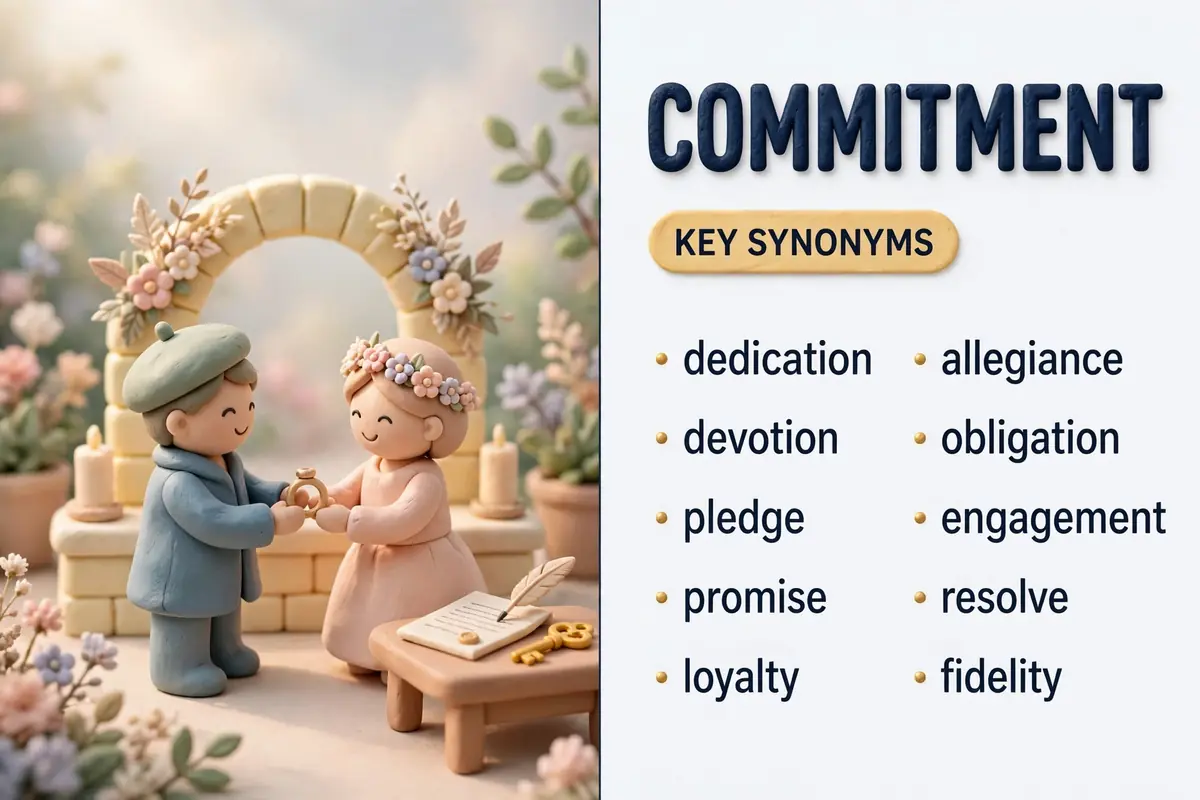
Two people stand at a small altar, rings in their hands and speak in plain sentences. “I will stay. I will show up. And I will keep working at this, even on the hard days.” The room hears a promise, yet the words point further than one afternoon. A commitment is a promise that keeps working after the ceremony ends.
It lives in signed contracts, teams that train through winter and study plans that survive a bad week. Dedication is the closest synonym and it carries that same steady energy. This guide compares 15 commitment synonyms with meanings, examples and honest limits so you can pick the word that fits your sentence.
Commitment Synonyms
| # | Synonym | Meaning Difference |
|---|---|---|
| 1 | Dedication | Steady hard work for a person, task, or cause |
| 2 | Devotion | Deep love and loyalty shown through care |
| 3 | Pledge | A formal promise, spoken aloud |
| 4 | Promise | A spoken assurance something will be done |
| 5 | Loyalty | Faithfulness to a person, team, or cause |
| 6 | Allegiance | Loyalty owed to a leader, country, or cause |
| 7 | Obligation | A duty that binds you, like it or not |
| 8 | Engagement | A formal agreement to marry, or take part |
| 9 | Resolve | Firm inner decision that does not bend |
| 10 | Fidelity | Faithfulness kept over time |
Quick Facts About “Commitment”
- Part of speech: a noun. The verb is commit, the adjective is committed, and committedly is rare.
- Core meaning: a promise or firm decision to do something, to stay loyal, or to keep working at it.
- Three main senses: (1) a pledge or promise; (2) a duty that binds you; (3) the inner resolve to keep going.
- Register: neutral to formal, fitting business, law, relationships, sports, and everyday talk.
- Common mistake: treating commitment as a feeling only. It also names the duty itself and the act of pledging, so a signed contract counts even when nobody feels warm about it.
The Closest Synonym: Dedication
Dedication is the closest synonym for commitment, because it covers the same ground in the fullest form: a promise backed by steady effort over time. Test the swap and it holds. “Her commitment to the team never wavered” becomes “Her dedication to the team never wavered.” “The project needs real commitment” becomes “The project needs real dedication.”
Dedication wins on effort: it fits work, study, sport, and craft, anywhere the promise shows up as daily action. Devotion runs second when love leads, and a pledge fits better for a public vow. The resolve behind any lasting promise is determination, and our guide to determine synonyms covers the words for that drive.
Where “Commitment” Comes From (Etymology)
According to Etymonline, commitment appeared in the 1610s, meaning “action of officially consigning to the custody of the state,” formed from commit plus ment, with Anglo-French commettement behind it. The pledge and promise sense is attested from 1793, while “an obligation, an engagement” dates to 1864. Commit comes from Latin committere, from com, “with, together,” plus mittere, “to release, let go, send, throw.” Commit is attested from the 1530s in the sense of “trust oneself completely to.” Merriam-Webster defines commitment as an agreement or pledge to do something in the future, and as being obligated or emotionally impelled.
The history explains the weight. It began with handing something over to official custody, then grew into a promise, then a duty, and finally the inner decision to stay.
Commitment Synonyms in Detail

Group 1: A Promise You Make and Keep
1. Dedication
- Meaning: Steady hard work and attention given to a task or cause over time.
- Difference: The closest match, because it adds visible effort to the promise.
- Best used for: Work, study, sport, and craft.
- Formality: Neutral · CEFR: B2 · Frequency: Very common
- Example (Work): “Her dedication kept the team on schedule.”
- Example (Study): “His dedication to practice showed in every exam result.”
- When NOT to use it: For a spoken vow, use pledge instead.
2. Devotion
- Meaning: Deep love and loyalty, shown through care.
- Difference: Warmer than dedication, with love at the centre.
- Best used for: Family, partners, faith, and pets.
- Formality: Neutral to formal · CEFR: B2 · Frequency: Very common
- Example (Family): “Her devotion shaped every choice she made.”
- Example (Faith): “His devotion to the church community never faded.”
- When NOT to use it: For a contract, use obligation instead.
3. Pledge
- Meaning: A formal promise, often spoken aloud or written down.
- Difference: The public face of commitment, made in front of witnesses.
- Best used for: Ceremonies, campaigns, and donations.
- Formality: Formal · CEFR: B2 · Frequency: Common
- Example (Ceremony): “They made a pledge to stand by each other.”
- Example (Campaign): “The company took a pledge to cut its waste in half.”
- When NOT to use it: For inner resolve, use resolve instead.
4. Promise
- Meaning: A spoken assurance that something will be done or will happen.
- Difference: The simplest and most everyday word in this group.
- Best used for: Daily speech, vows, and plans.
- Formality: Neutral · CEFR: A2 · Frequency: Very common
- Example (Daily): “She made a promise to call every Sunday.”
- Example (Vow): “He kept his promise and finished the course.”
- When NOT to use it: For a legal duty, use obligation instead.
5. Fidelity
- Meaning: Faithfulness kept over time, in love, duty, or belief.
- Difference: The most enduring word here, about never breaking faith.
- Best used for: Marriage, friendship, and duty.
- Formality: Formal · CEFR: C1 · Frequency: Common
- Example (Marriage): “Their fidelity lasted fifty years.”
- Example (Duty): “Fidelity to the truth guided every report she wrote.”
- When NOT to use it: For a short task, use dedication instead.
6. Faithfulness
- Meaning: Staying loyal and true to a person, promise, or belief.
- Difference: Close to fidelity, yet plainer and more everyday.
- Best used for: Relationships, friendships, and steady service.
- Formality: Neutral · CEFR: B2 · Frequency: Common
- Example (Friendship): “His faithfulness won deep trust.”
- Example (Service): “Her faithfulness to the clinic’s patients never slipped.”
- When NOT to use it: For a public vow, use pledge instead.
Group 2: Duty, Loyalty, and Obligation
7. Loyalty
- Meaning: Faithfulness to a person, team, brand, or cause.
- Difference: The bond matters more than the task.
- Best used for: Teams, friends, employers, and brands.
- Formality: Neutral · CEFR: B2 · Frequency: Very common
- Example (Team): “Loyalty kept him from taking the rival offer.”
- Example (Brand): “Customer loyalty grew as the service stayed reliable.”
- When NOT to use it: For a duty you dislike, use obligation instead.
8. Allegiance
- Meaning: Loyalty owed to a leader, country, or cause.
- Difference: The grandest word here, with duty and honor in it.
- Best used for: Nations, flags, leaders, and movements.
- Formality: Formal · CEFR: C1 · Frequency: Common
- Example (Country): “Citizens pledged allegiance at the ceremony.”
- Example (Cause): “Her allegiance to the movement never wavered.”
- When NOT to use it: For a friend, use loyalty instead.
9. Obligation
- Meaning: A duty that binds you, whether you chose it gladly or not.
- Difference: The only word here where the feeling can be absent.
- Best used for: Law, contracts, debts, and family duties.
- Formality: Neutral to formal · CEFR: B2 · Frequency: Very common
- Example (Law): “The contract created an obligation to deliver.”
- Example (Family): “She felt an obligation to care for her aging father.”
- When NOT to use it: For love freely given, use devotion instead.
10. Engagement
- Meaning: A formal agreement to marry, or to take part in something.
- Difference: Two senses in one word: a wedding promise and active involvement.
- Best used for: Weddings, projects, and audiences.
- Formality: Formal · CEFR: B2 · Frequency: Very common
- Example (Wedding): “Their engagement was announced at dinner.”
- Example (Project): “Her engagement with the community shaped the plan.”
- When NOT to use it: For a private decision, use resolve instead.
Group 3: The Resolve Inside You
11. Resolve
- Meaning: A firm inner decision that does not bend under pressure.
- Difference: The promise lives inside you, not on paper.
- Best used for: Goals, habits, recovery, and hard choices.
- Formality: Neutral to formal · CEFR: B2 · Frequency: Very common
- Example (Goal): “Her resolve held through the hardest week.”
- Example (Sport): “His resolve carried him through the final mile.”
- When NOT to use it: For a legal duty, use obligation instead.
12. Determination
- Meaning: The quality of refusing to give up on a goal.
- Difference: The engine of commitment, focused on finishing.
- Best used for: Study, sport, business, and personal goals.
- Formality: Neutral · CEFR: B2 · Frequency: Very common
- Example (Study): “Her determination turned a weak start into a strong grade.”
- Example (Business): “His determination kept the small shop open through hard years.”
- When NOT to use it: For loyalty to a person, use loyalty instead.
13. Earnestness
- Meaning: Sincere and serious intent, without pretense or games.
- Difference: The tone of the promise matters here, not just its strength.
- Best used for: Apologies, proposals, speeches, and honest talk.
- Formality: Formal · CEFR: C1 · Frequency: Less common
- Example (Speech): “The earnestness in his voice quieted the room.”
- Example (Proposal): “She answered with earnestness, not flattery.”
- When NOT to use it: For a long grind, use dedication instead.
14. Attachment
- Meaning: A strong emotional bond that ties you to a person or thing.
- Difference: The heart holds on, even when the mind doubts.
- Best used for: Family, places, pets, and teams.
- Formality: Neutral · CEFR: B2 · Frequency: Common
- Example (Place): “His attachment kept him from selling the old house.”
- Example (Team): “Her attachment to the club went back to childhood.”
- When NOT to use it: For a duty, use obligation instead.
15. Steadfastness
- Meaning: Staying firm and unchanging through difficulty and time.
- Difference: The oldest-fashioned word here, about standing still when storms hit.
- Best used for: Faith, friendship, principles, and long trials.
- Formality: Formal, literary · CEFR: C1 · Frequency: Less common
- Example (Faith): “Her steadfastness carried her through grief.”
- Example (Principle): “His steadfastness on honest pricing earned respect.”
- When NOT to use it: In plain speech, use loyalty instead.
Words Commonly Confused With Commitment
Commitment versus promise matters for time. A promise is words spoken in a moment. A commitment is the promise plus the months of keeping it. You can make a promise in a second and break it the next day, yet a broken commitment costs far more, because people counted on it.
Commitment versus obligation matters for the heart. An obligation binds you whether you want it or not, like a tax bill. A commitment usually carries willingness inside it. You may honor an obligation with a sigh, yet a commitment asks for your whole self.
Commitment versus engagement matters for the setting. Engagement names a wedding promise or active involvement. Commitment covers both and far more, from a gym routine to a mortgage. A wedding engagement is one kind of commitment, not the whole word.
Commitment versus loyalty matters for the object. Loyalty points at a person, team, or cause you stand by. Commitment points at the promise or task itself. You can stay loyal to a friend and still break a commitment to meet her on Tuesday.
Commitment versus dedication matters for proof. Dedication is commitment made visible through daily work. A commitment can sit quietly in a signed paper for years, while dedication shows up every morning, in the hours and the effort.
Commitment versus devotion matters for warmth. Devotion always carries love, while commitment can be cold and contractual. A soldier may show commitment to duty without devotion, and a mother may show devotion without signing a paper. A promise needs staying power, and our guide to power synonyms covers the words for that strength.
Do They All Mean the Same Thing?
In short: only inside the same meaning group.
- ✅ “Her dedication to the clinic never slipped.” (steady effort over time ✔)
- ✅ “They made a pledge at the altar.” (a spoken vow ✔)
- ❌ “They made an obligation at the altar.” (an obligation is a binding duty, not a spoken vow ✘, say pledge)
- ✅ “His resolve held through the final mile.” (inner grit ✔)
- ❌ “His allegiance held through the final mile.” (allegiance is loyalty to a cause, not inner grit ✘, say resolve)
- ✅ “Citizens pledged allegiance to the flag.” (loyalty owed to a country ✔)
Before you substitute, ask which kind of commitment it is: a spoken vow, a duty, a loyalty, or an inner decision.
Best Alternatives by Context
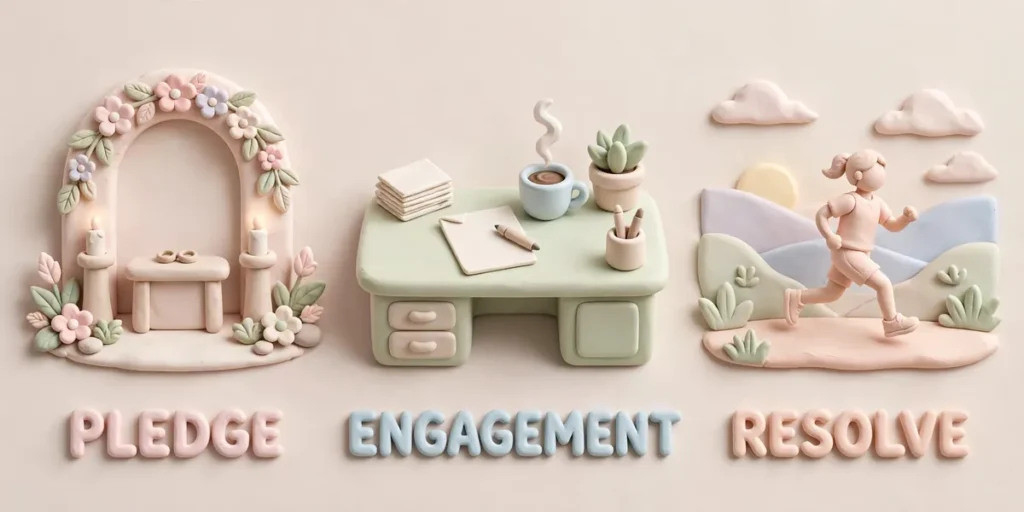
At a wedding. Two people exchange rings and speak their vows aloud. Pledge fits best, because the promise is formal and public, made before witnesses. Fidelity follows for the years after, when keeping the vow matters more than speaking it.
In a job interview. A hiring manager asks what you will bring to the role. Dedication answers it, because it promises steady work, not just good intentions. Loyalty helps too, yet dedication proves itself in hours and results.
On a sports team. A coach wants players who train through winter and show up hurt. Resolve names the inner grit, while dedication names the daily practice. A team commitment works only when both show up, and our guide to teamwork synonyms covers the words for that shared effort.
In a contract. A builder signs to finish a school by September. Obligation is the right word, because the duty binds whether the builder feels inspired or not. Promise sounds too soft for a courtroom, and devotion sounds wrong.
In a friendship. A friend drives across town at midnight because you called. Loyalty fits, because the bond, not the task, drives the act. Faithfulness works too, for the friend who has done it for twenty years.
In a personal goal. A runner trains before dawn for a marathon in spring. Determination carries the story, because the goal needs a daily refusal to quit. Earnestness would sound strange here, since nobody needs a sincere tone to run laps.
Which Commitment Synonym Should I Choose?
| Situation | Best pick | Why it wins |
|---|---|---|
| Steady work over time | Dedication | The visible effort |
| Love shown through care | Devotion | The warmth |
| A formal spoken vow | Pledge | The public promise |
| An everyday assurance | Promise | The simplest word |
| Faith kept for years | Fidelity | The endurance |
| Loyalty to a person or team | Loyalty | The bond |
| Loyalty to a country or cause | Allegiance | The duty and honor |
| A binding duty | Obligation | The legal weight |
| A wedding promise | Engagement | The formal agreement |
| Inner firmness | Resolve | The unbent decision |
| Refusing to give up | Determination | The finishing drive |
| Sincere serious intent | Earnestness | The honest tone |
| An emotional bond | Attachment | The heart holding on |
| Standing firm through trials | Steadfastness | The unchanging stand |
| Steady loyalty in service | Faithfulness | The plain truth |
Collocations and Idioms With Commitment
Only combinations native speakers actually use:
- commitment to: as in “Her commitment to the team never wavered.”
- make a commitment: as in “He made a commitment to train every morning.”
- honor a commitment: as in “She honored her commitment and finished the course.”
- lifelong commitment: as in “Marriage is a lifelong commitment.”
- long-term commitment: as in “A mortgage is a long-term commitment.”
- total commitment: as in “The role demands total commitment.”
- commitment ceremony: as in “They held a commitment ceremony.”
- show commitment: as in “Show commitment by turning up, week after week.”
- commitment issues: as in “He jokes about commitment issues, then avoids every plan.”
- deep commitment: as in “Her deep commitment inspired the volunteers.”
What Commitment Is Not: Opposites by Sense
Promises broken. Betrayal breaks a trust that was given. Disloyalty turns away from the person or cause you once stood by. Infidelity breaks faith in a marriage or close bond. Each one names a commitment that failed.
No duty at all. Freedom means no binding tie holds you. Independence means you answer to yourself alone. Indifference means you simply do not care. None of these is a broken promise, only the absence of any promise.
Giving up. Abandonment leaves a person or duty behind. Withdrawal pulls back from a promise already made. Desertion walks away from a post, a partner, or a cause. These words describe the moment a commitment ends.
For everyday writing, the plain opposite is a lack of commitment. Freedom suits the duty sense, and betrayal suits the broken promise.
American vs British English
Commitment is spelled and used the same in American and British English, and so are its synonyms here. One small difference sits nearby: Americans write “organize” where Britons write “organise,” yet commitment itself never changes.
Steadfastness and earnestness appear more often in formal British writing, yet both are correct on either side of the Atlantic. This article uses American spelling throughout.
Practice Exercises
Exercise 1: Fill in the blank. Choose the best word from the list: dedication, pledge, obligation, resolve, allegiance, devotion.
- “Citizens swore ______ to the flag at the ceremony.”
- “Her ______ to the clinic showed in ten years of nights.”
- “The contract created an ______ to deliver by June.”
- “They made a ______ at the altar to stand by each other.”
- “His ______ held through the final mile.”
- “Her ______ to her children shaped every choice she made.”
Exercise 2: Match the word to its sense. Write the letter of the sense next to each word.
Words: (a) fidelity (b) engagement (c) attachment (d) earnestness (e) steadfastness
Senses: (1) a wedding promise or active involvement (2) sincere and serious intent (3) staying firm through difficulty and time (4) faithfulness kept over years (5) an emotional bond that ties you somewhere
Answer key
- Exercise 1: (1) allegiance: loyalty owed to a country; (2) dedication: steady work over years; (3) obligation: a binding duty; (4) pledge: a formal spoken vow; (5) resolve: inner firmness; (6) devotion: love shown through care.
- Exercise 2: (a) 4: fidelity is faithfulness kept over years; (b) 1: engagement is a wedding promise; (c) 5: attachment is an emotional bond; (d) 2: earnestness is sincere intent; (e) 3: steadfastness is staying firm.
Frequently Asked Questions
What is the best synonym for commitment?
Dedication is the best synonym for commitment in most sentences, because it covers a promise backed by steady effort over time. Devotion fits when love leads, pledge fits a vow, and obligation fits a duty. The right choice depends on whether the sentence needs effort, warmth, ceremony, or law.
What is the difference between commitment and dedication?
Commitment names the promise or duty itself, while dedication names the steady work that proves it. A signed contract can be a commitment with no effort yet shown. Dedication appears every morning in hours, practice, and attention. Think of commitment as the vow and dedication as the daily proof.
Can commitment describe a feeling?
Yes, but only in one of its senses. Commitment can name the inner resolve to keep going, and that resolve feels real. The word also names duties and pledges with no feeling at all, like a contract clause. Context decides whether the sentence talks about the heart or the paperwork.
What is the opposite of commitment?
It depends on the sense. For a broken promise, the opposite is betrayal, a trust given and then broken. For a duty, the opposite is freedom, since no tie binds you. And for giving up entirely, use abandonment, and for not caring at all, use indifference.
Is commitment the same as loyalty?
No, though the two words overlap often. Loyalty points at a person, team, or cause you stand by through thick and thin. Commitment points at the promise or task itself, like a training plan or a contract. You can stay loyal to a friend and still break a commitment to meet her on Tuesday.
Can commitment be used in business writing?
Yes, and business writing is one of its most natural homes. Managers talk about commitment to quality, commitment to deadlines, and commitment to customers. The word sounds professional without sounding stiff. In contracts, obligation often works better, naming a binding duty with legal weight.
Conclusion
Back at the altar, the rings are on, the vows are spoken, and guests drift toward cake and dancing. The ceremony took ten minutes. The commitment starts now, in the mornings that follow, in contracts signed, teams trained, and plans kept through hard weeks.
A promise is easy to speak. Keeping it is the work, and the word you choose tells your reader whether you mean the vow, the duty, or the resolve inside.

About Sajjad Ahmed
Sajjad Ahmed is the author behind Guest Paster, where he writes about English vocabulary, synonyms, word meanings, and practical word usage.
His content is designed to help readers understand the differences between similar words, discover suitable alternatives, and use English vocabulary more effectively in everyday writing and communication.
Before publishing, Sajjad focuses on presenting word choices in a clear and easy-to-understand format, with relevant meanings, context, and examples where helpful.
Through Guest Paster, his goal is to make vocabulary learning simpler and provide useful language resources for students, writers, English learners, and anyone looking to expand their vocabulary.
Areas of Focus: English Vocabulary • Synonyms • Word Meanings • Word Usage • Language Learning
Author: Sajjad Ahmed
Website: Guest Paster