
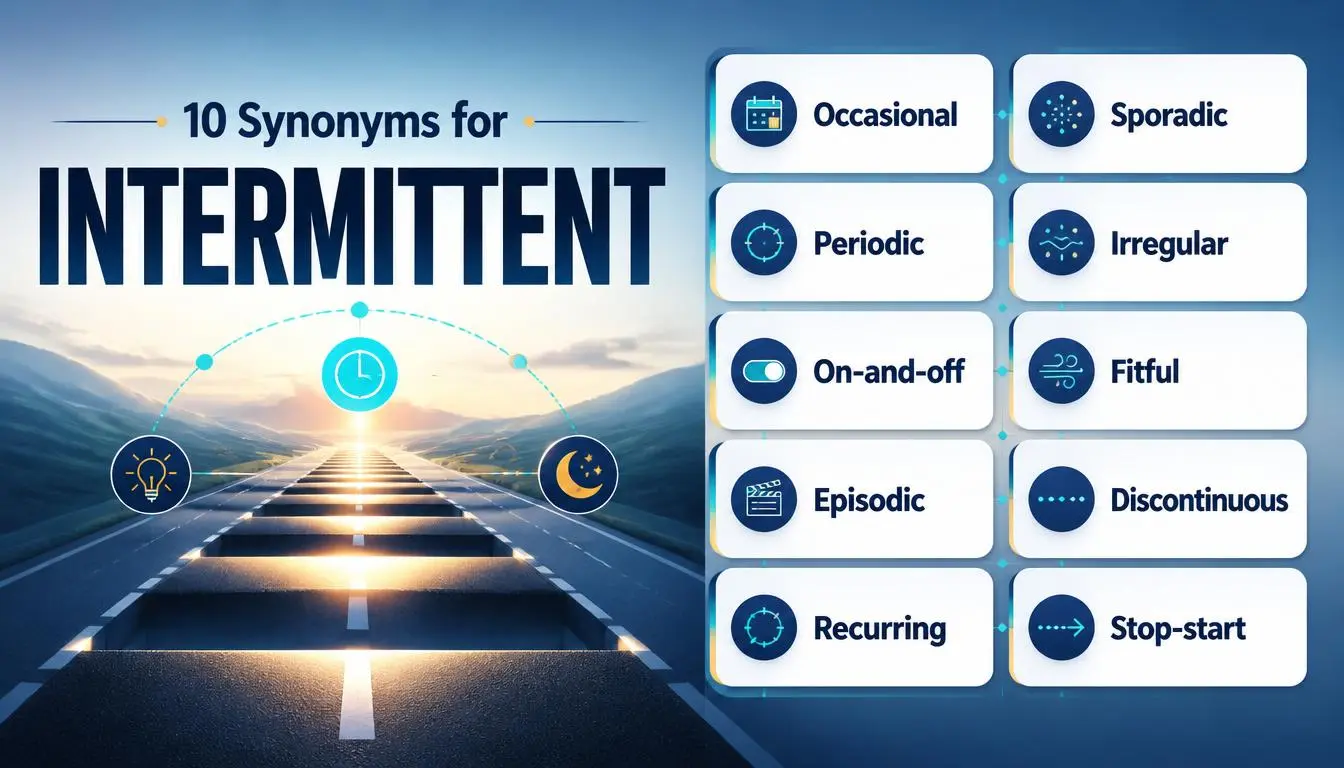
Synonyms for intermittent include on-and-off, occasional, sporadic, periodic, recurring, recurrent, irregular, fitful, episodic, discontinuous, spasmodic and stop-start. However these words are not interchangeable in every situation.
Intermittent describes something that is not continuous. It happens for a period, stops, and may begin again later. For example intermittent rain falls for a while, stops and then returns.
The best synonym depends on what you want to emphasize. On-and-off highlights repeated stopping and starting, sporadic suggests unpredictability, periodic suggests intervals, and occasional means something happens only from time to time.
12 Best Synonyms for Intermittent
| Synonym | Simple Meaning | Best Used When |
|---|---|---|
| On-and-off | Repeatedly stopping and starting | Something repeatedly disappears and returns |
| Occasional | Happening from time to time | Frequency is low |
| Sporadic | Happening irregularly or unpredictably | Timing is scattered or unpredictable |
| Periodic | Happening again at intervals | Events repeat over time |
| Recurring | Happening again repeatedly | A problem or event keeps returning |
| Recurrent | Returning repeatedly | Formal, medical, or technical contexts |
| Irregular | Not following a steady pattern | Timing or frequency lacks consistency |
| Fitful | Happening in short, uneven periods | Sleep, progress, wind, or activity |
| Episodic | Occurring in separate episodes | Symptoms or events have distinct episodes |
| Discontinuous | Not forming one continuous sequence | Formal, academic, or technical writing |
| Spasmodic | Occurring in sudden, irregular bursts | Activity happens in brief bursts |
| Stop-start | Frequently stopping and beginning again | Informal descriptions of progress or movement |
Quick Facts About Intermittent
Word: Intermittent
Part of Speech: Adjective
Simple Meaning: Stopping and starting again or occurring at intervals
Pronunciation: /ˌɪn.tɚˈmɪt.ənt/
Syllables: 4 — in-ter-mit-tent
Formality: Neutral to formal
Common Uses: Everyday, professional, academic, medical, weather, and technical English
Related Words: Intermittently, intermittence, intermittent
Example: The area experienced intermittent rain throughout the afternoon.
Intermittent Meaning in Simple English
If something is intermittent, it does not continue without a break.
Imagine rain beginning at noon, stopping for twenty minutes, returning again, and then stopping once more. The rain is intermittent because there are dry periods between the showers.
The same idea applies to many situations.
An intermittent signal disappears and comes back. Intermittent pain is felt during some periods but not others. An intermittent mechanical fault may appear, disappear, and later return.
The important idea is interruption or gaps in continuity.
Detailed Synonyms for Intermittent
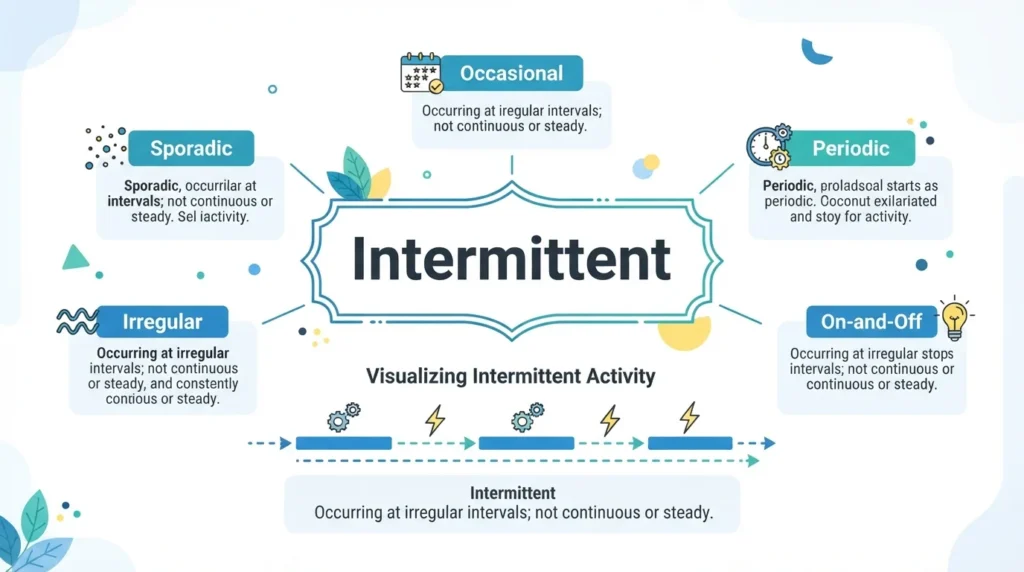
1. On-and-Off
Meaning: Repeatedly stopping and starting.
On-and-off is one of the closest everyday alternatives to intermittent. It communicates the same basic stop-and-start pattern but sounds more conversational.
Best used for: Rain, pain, relationships, technical problems, symptoms, work, and everyday situations.
Example: We had on-and-off rain throughout the morning.
Difference: Intermittent sounds more neutral or formal, while on-and-off sounds natural in casual speech.
2. Occasional
Meaning: Happening sometimes, but not often.
Occasional works when the main idea is frequency rather than repeated interruption.
Best used for: Visits, showers, delays, problems, events, mistakes, or activities.
Example: The forecast calls for occasional showers this evening.
Difference: Something occasional happens only sometimes. Something intermittent specifically involves periods when it is happening and periods when it is not.
3. Sporadic
Meaning: Happening at scattered, irregular, or unpredictable times.
Sporadic is useful when an event appears unpredictably rather than following a clear pattern.
Best used for: Rainfall, communication, errors, violence, symptoms, outages, or activity.
Example: Sporadic thunderstorms developed during the evening.
Difference: Sporadic strongly emphasizes unpredictability. Intermittent emphasizes breaks or interruptions and does not necessarily mean the timing is unpredictable.
4. Periodic
Meaning: Happening again at intervals.
Periodic often suggests that something returns after a certain amount of time.
Best used for: Inspections, maintenance, reviews, signals, measurements, checks, or repeated events.
Example: The equipment requires periodic safety inspections.
Difference: Periodic may suggest a regular or expected interval. Intermittent does not require a regular schedule.
5. Recurring
Meaning: Happening again after stopping or ending.
Recurring is especially useful when a situation, problem, event, or theme repeatedly returns.
Best used for: Problems, payments, symptoms, errors, meetings, events, or themes.
Example: A recurring network problem caused several service interruptions.
Difference: Recurring emphasizes repetition. It does not necessarily mean that something repeatedly starts and stops within the same period.
6. Recurrent
Meaning: Returning or happening repeatedly.
Recurrent is similar to recurring but often sounds more formal.
Best used for: Medical symptoms, infections, technical problems, scientific observations, or repeated events.
Example: The patient reported recurrent episodes of dizziness.
Difference: Recurrent emphasizes repeated return, while intermittent emphasizes periods of activity separated by gaps.
7. Irregular
Meaning: Not following a steady or predictable pattern.
Irregular is appropriate when consistency is the main issue.
Best used for: Schedules, rainfall, signals, sleep patterns, attendance, or activity.
Example: Irregular rainfall made agricultural planning difficult.
Difference: Irregular means that the pattern is inconsistent. Intermittent specifically means that something is interrupted by periods when it is absent.
8. Fitful
Meaning: Happening in short, uneven periods.
Fitful often carries a sense of restlessness, unevenness, or poor continuity.
Best used for: Sleep, progress, movement, wind, light, or attempts at an activity.
Example: She managed only fitful sleep before the early flight.
Difference: Fitful suggests uneven or restless periods rather than simply stopping and restarting.
9. Episodic
Meaning: Occurring in separate episodes.
Episodic is common when something can be divided into distinct periods or episodes.
Best used for: Symptoms, medical conditions, emotional experiences, scientific observations, or events.
Example: The patient described episodic headaches over several months.
Difference: Episodic highlights separate episodes. Intermittent simply indicates that something does not continue without interruption.
10. Discontinuous
Meaning: Not forming an uninterrupted or continuous sequence.
Discontinuous is a more formal alternative and is especially useful in academic and technical contexts.
Best used for: Scientific, mathematical, engineering, technical, or academic writing.
Example: Researchers observed a discontinuous pattern of growth.
Difference: Discontinuous describes a lack of continuity but does not always imply repeated recurrence.
11. Spasmodic
Meaning: Happening in sudden, irregular bursts.
Spasmodic is appropriate when an activity occurs briefly and unevenly rather than steadily.
Best used for: Effort, movement, coughing, activity, progress, or attempts.
Example: Spasmodic efforts to repair the damaged road continued through winter.
Difference: Spasmodic suggests irregular bursts and can sound stronger or more abrupt than intermittent.
12. Stop-Start
Meaning: Frequently stopping and beginning again.
Stop-start is an informal adjective commonly used for movement, work, progress, or processes that repeatedly lose momentum.
Best used for: Traffic, projects, journeys, work, machinery, or progress.
Example: Stop-start traffic turned the short trip into an hour-long journey.
Difference: Stop-start often implies disruption or poor flow, while intermittent is more neutral.
What Is the Closest Synonym of Intermittent ?
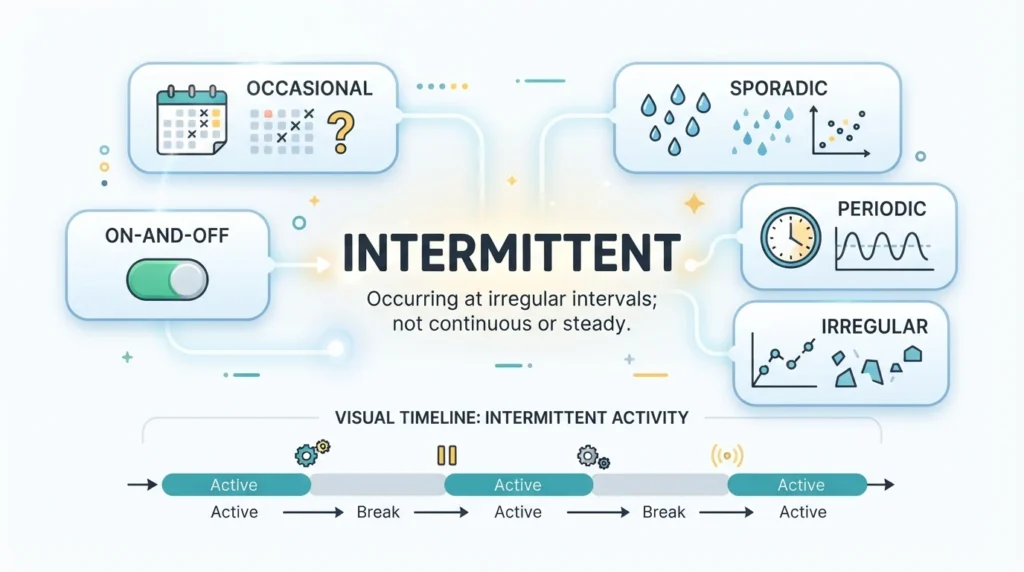
In everyday English, on-and-off is often the closest synonym for intermittent because both describe something that repeatedly stops and starts.
For example:
Intermittent rain continued throughout the afternoon.
can naturally become:
On-and-off rain continued throughout the afternoon.
However, there is no single synonym that works perfectly in every context.
Use sporadic when unpredictability matters, periodic when repeated intervals matter, occasional when low frequency matters, and episodic when something occurs in separate episodes.
Exact Synonyms vs. Similar Words
Very few words have exactly the same meaning as intermittent in every sentence.
Some alternatives are close synonyms, while others overlap with only part of its meaning.
| Word | What It Emphasizes |
|---|---|
| Intermittent | Breaks in continuity |
| On-and-off | Repeated starting and stopping |
| Occasional | Low frequency |
| Sporadic | Unpredictability |
| Periodic | Repeated intervals |
| Recurring | Repeated return |
| Irregular | Lack of consistency |
| Episodic | Separate episodes |
| Fitful | Uneven short periods |
| Spasmodic | Sudden irregular bursts |
Consider these examples:
Intermittent rain means rain that stops and starts.
Occasional rain suggests rain that happens only sometimes.
Sporadic rain suggests scattered or unpredictable rainfall.
Periodic rain suggests rain returning at intervals.
All four phrases are possible, but they do not communicate exactly the same idea.
Other Words Similar to Intermittent
Some words can replace intermittent only in particular situations.
Infrequent means not happening often and works when frequency is the main point.
Interrupted means temporarily stopped, usually because something caused the interruption.
Broken can describe something divided by pauses, as in broken sleep.
Patchy describes something uneven in coverage, quality, or availability, such as patchy internet service.
Scattered describes things distributed across different places or times, especially showers, clouds, incidents, or reports.
Erratic means inconsistent and unpredictable and is usually stronger than intermittent.
These are useful contextual alternatives, but they should not automatically replace intermittent in every sentence.
Synonyms for Intermittent by Context
Everyday Conversation
The most natural choices in everyday English are:
- On-and-off
- Occasional
- Irregular
- Sporadic
Instead of:
We experienced intermittent rain all morning.
You might say:
We had on-and-off rain all morning.
Formal and Professional Writing
Useful alternatives include:
- Periodic
- Sporadic
- Recurring
- Recurrent
- Irregular
- Discontinuous
For example:
The system experienced sporadic service interruptions during maintenance.
Academic and Technical Writing
More precise choices include:
- Periodic
- Discontinuous
- Episodic
- Recurrent
- Irregular
The correct word depends on whether the writer wants to emphasize intervals, discontinuity, separate episodes, repetition, or inconsistency.
Medical Writing
In medical contexts, the correct synonym depends heavily on the symptom pattern.
Episodic works when symptoms occur in clearly separated episodes.
Recurrent works when symptoms repeatedly return.
Sporadic may describe symptoms that appear unpredictably.
Occasional works when symptoms occur only sometimes.
For example, intermittent pain may sometimes be described as episodic pain when there are clearly separated periods of pain.
Weather
Useful alternatives for weather include:
- Occasional
- Sporadic
- Scattered
- On-and-off
- Periodic
Intermittent showers usually describes rain that stops and starts during a period.
Scattered showers, however, often emphasizes distribution across different locations rather than repeated stopping and starting in one place.
Technology and Equipment
Common alternatives include:
- Sporadic
- Irregular
- On-and-off
- Recurring
- Erratic
An intermittent connection repeatedly disappears and returns.
An erratic connection may also behave unpredictably in speed, strength, or reliability.
Intermittent vs. Occasional
Intermittent emphasizes interruption.
Occasional emphasizes frequency.
Compare:
She experiences intermittent pain.
The pain comes and goes.
She experiences occasional pain.
The pain happens sometimes, but the sentence does not necessarily suggest repeated stopping and starting.
Intermittent vs. Sporadic
Intermittent means something is not continuous.
Sporadic adds the idea that occurrences are irregular or unpredictable.
Compare:
The building experienced intermittent power outages.
Power repeatedly went off and returned.
The building experienced sporadic power outages.
The outages happened unpredictably.
Intermittent vs. Periodic
Intermittent does not require regular timing.
Periodic generally means something returns at intervals and may suggest a repeated pattern.
Compare:
The machine makes an intermittent noise.
The noise stops and returns.
The machine undergoes periodic inspections.
The inspections take place repeatedly at certain intervals.
Intermittent vs. Recurring
Intermittent emphasizes breaks within a pattern.
Recurring emphasizes something returning again.
A recurring error may appear every few weeks.
An intermittent error may appear and disappear while a device or system is being used.
Antonyms of Intermittent
The opposite of intermittent is something that continues without interruption or follows a steady pattern.
| Antonym | Meaning | Example |
|---|---|---|
| Continuous | Continuing without stopping | Continuous rain fell throughout the night. |
| Constant | Present or happening all the time | A constant humming sound came from the machine. |
| Uninterrupted | Continuing without a break | The backup system provided uninterrupted power. |
| Steady | Continuing at a consistent level | A steady wind blew throughout the afternoon. |
| Persistent | Continuing for a long period | Persistent rain caused local flooding. |
| Sustained | Continuing for an extended period | The company reported sustained growth. |
| Incessant | Continuing with little or no pause | The incessant noise made concentration difficult. |
Continuous is usually the clearest direct opposite when intermittent means “not continuous.”
Common Collocations With Intermittent
Certain nouns frequently appear with intermittent because they naturally describe things that can come and go.
| Phrase | Meaning |
|---|---|
| Intermittent rain | Rain that repeatedly stops and starts |
| Intermittent pain | Pain that comes and goes |
| Intermittent noise | Sound that is not continuously present |
| Intermittent signal | A signal that repeatedly disappears and returns |
| Intermittent power | Electricity that is not continuously available |
| Intermittent service | Service that repeatedly becomes unavailable |
| Intermittent connection | A connection that repeatedly works and fails |
| Intermittent symptoms | Symptoms that appear and disappear |
| Intermittent fault | A technical problem that appears only at certain times |
| Intermittent light | Light that appears with gaps or interruptions |
Intermittent in a Sentence
Here are natural examples of intermittent in different contexts:
- Intermittent rain made the outdoor event difficult to plan.
- The laptop developed an intermittent Wi-Fi connection.
- She experienced intermittent discomfort throughout the afternoon.
- Intermittent sunlight appeared between the clouds.
- The mechanic struggled to locate the intermittent electrical fault.
- The storm caused intermittent power outages across the region.
- An intermittent buzzing sound came from the air-conditioning unit.
- The patient reported intermittent symptoms during the previous week.
- Intermittent communication made it difficult for the teams to coordinate.
- The hikers continued despite intermittent showers.
Synonyms for Intermittently
Intermittently is the adverb form of intermittent. It means with interruptions, at intervals, or in a stop-and-start manner.
Useful synonyms and alternatives include:
- Periodically
- Occasionally
- Sporadically
- Irregularly
- On and off
- From time to time
- At intervals
Example:
It rained intermittently throughout the afternoon.
Possible alternatives include:
It rained on and off throughout the afternoon.
or:
It rained sporadically throughout the afternoon.
The second version adds a stronger sense of unpredictability.
Common Mistakes When Choosing a Synonym
A common mistake is assuming that every synonym for intermittent carries exactly the same meaning.
For example, replacing intermittent with periodic can accidentally suggest a regular schedule. Replacing it with sporadic may suggest unpredictability. Replacing it with occasional can shift the focus from interruption to frequency.
Another mistake is choosing an unnecessarily technical word. Discontinuous may work well in scientific writing, but on-and-off is usually much more natural in everyday conversation.
The best synonym should match both the meaning and the tone of the sentence.
Conclusion
The best synonym for intermittent depends on the type of stop-and-start pattern you are describing.
Use on-and-off when something repeatedly stops and starts, occasional when something happens only sometimes, sporadic when it occurs unpredictably, and periodic when it returns at intervals. Recurring and recurrent emphasize repeated return, while episodic works well for clearly separated episodes.
Instead of choosing a synonym simply because it appears in a thesaurus, consider what the sentence needs to communicate: frequency, regularity, unpredictability, repetition, or interruption. That small distinction will help you choose a more precise and natural word.
Frequently Asked Questions
What does intermittent mean?
Intermittent means stopping and starting or occurring at intervals rather than continuously. Intermittent rain, for example, falls for a period, stops, and later begins again.
What is the closest synonym for intermittent?
On-and-off is often the closest everyday synonym because it directly expresses repeated stopping and starting. In formal writing, the best alternative depends on the context.
What are two synonyms for intermittent?
Two useful synonyms are sporadic and occasional. Sporadic suggests irregular or unpredictable occurrences, while occasional means happening only from time to time.
What is another word for intermittent rain?
Depending on the weather pattern, you might use on-and-off rain, occasional rain, sporadic rain, or scattered showers. Each phrase emphasizes a slightly different pattern.
What is the difference between intermittent and sporadic?
Intermittent emphasizes that something stops and starts. Sporadic emphasizes irregular or unpredictable timing.
What does intermittently mean?
Intermittently means at intervals or with breaks in between. Synonyms include periodically, occasionally, sporadically, irregularly, and on and off.
What does intermittence mean?
Intermittence is the noun related to intermittent. It refers to the condition or pattern of stopping and starting instead of continuing steadily.
Is intermittent the same as occasional?
Not exactly. Occasional means happening sometimes, while intermittent specifically emphasizes interruption or periods when something stops and later returns.

About Sajjad Ahmed
Sajjad Ahmed is the author behind Guest Paster, where he writes about English vocabulary, synonyms, word meanings, and practical word usage.
His content is designed to help readers understand the differences between similar words, discover suitable alternatives, and use English vocabulary more effectively in everyday writing and communication.
Before publishing, Sajjad focuses on presenting word choices in a clear and easy-to-understand format, with relevant meanings, context, and examples where helpful.
Through Guest Paster, his goal is to make vocabulary learning simpler and provide useful language resources for students, writers, English learners, and anyone looking to expand their vocabulary.
Areas of Focus: English Vocabulary • Synonyms • Word Meanings • Word Usage • Language Learning
Author: Sajjad Ahmed
Website: Guest Paster