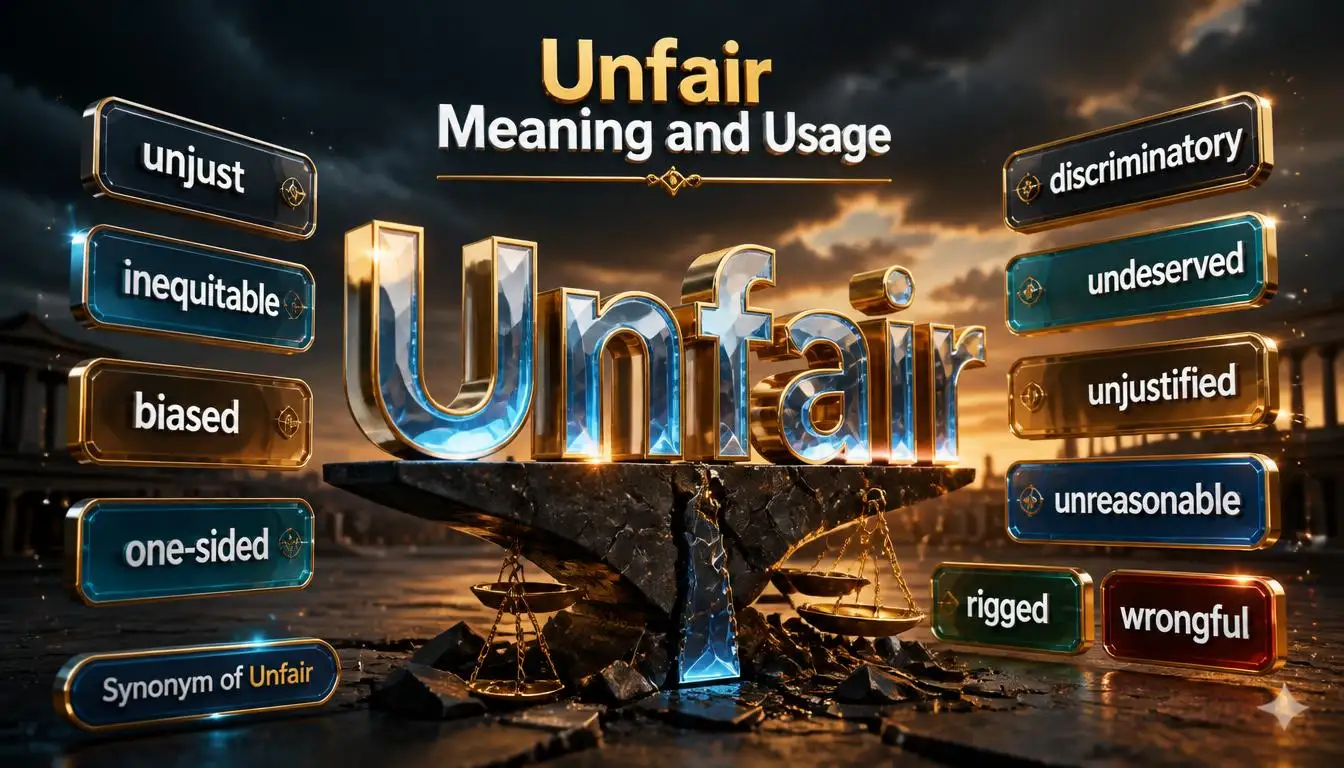
What Is the Best Synonym of Unfair?
Unfair is a term used to describe an unfair treatment, rules or outcome that doesn’t provide everyone with the same opportunity for success and honesty. It appears in everything from playground disputes to employment tribunal hearings.
Because the word is wide and often too mushy to convey meaning, alternatives matter so that readers can understand whether problems stem from bias, poor rule-making or harsh consequences. In general and for most formal writing unjust is the closest word we can use.
For a preference or an unfair decision, biased tends to be more pointed. So how do you decide? Simply ask what exactly was wrong: a biased judge, unequal treatment, breaking the rules or an outcome no one earned.
Another Word For Unfair
These ten are the strongest entries from the full list of 24 in the detailed section below.
| # | Synonym | Meaning Difference |
|---|---|---|
| 1 | unjust | Adds moral weight; fits laws, verdicts |
| 2 | inequitable | Formal; focuses on uneven distribution |
| 3 | biased | Points to a person’s leaning |
| 4 | one-sided | Only one party benefits or speaks |
| 5 | discriminatory | Cause is group membership |
| 6 | undeserved | Person didn’t earn the outcome |
| 7 | unjustified | No adequate reason given |
| 8 | unreasonable | Beyond what a sensible person accepts |
| 9 | rigged | Accuses someone of fixing the result |
| 10 | wrongful | Legal term, mostly dismissal and termination |
Quick Facts About Unfair
| Attribute | Detail |
|---|---|
| Part of speech | Adjective |
| Simple meaning | Not applying the same standard to everyone |
| Pronunciation | US /ʌnˈfɛr/, UK /ʌnˈfeə/ |
| Syllables | 2 (un·fair) |
| Word forms | unfairly (adverb), unfairness (noun) |
| Formality | Neutral |
| Closest synonym | unjust |
| Best used for | Everyday complaints, rules, treatment, outcomes |
What Is the Closest Synonym for Unfair?
The closest synonym is unjust. It describes something contrary to justice: a law, verdict, punishment, or system that offends a basic sense of what people are owed. Where unfair can be mild, unjust is almost never casual. Complaining that a café ran out of oat milk is “unfair” at most; calling it “unjust” would sound like a joke. Because it carries moral and legal weight, it also shows up in fixed legal terms such as unjust enrichment.
Use it when the situation involves rights, punishment, or power. Compare: “It’s unfair that I got the late shift again” (everyday) versus “Docking wages for a fault the company caused is unjust” (principle at stake). If you can’t point to something a person was entitled to, stay with unfair.
Word Origin and Etymology
Unfair is built from the English prefix un- (“not”) and fair. According to Etymonline’s entries, fair descends from an Old English word, fæger, meaning pleasing to look at; unfair originally meant the opposite, something unattractive.
Over the medieval period fair shifted from “beautiful” toward “honest, just, free of favoritism,” and the moral sense of unfair (“not just”) was established in English by the early modern period. No more precise date is claimed here; the OED or Etymonline gives the dated first citations if you need them.
Can These Synonyms Be Used Interchangeably?
Rarely without adjusting for context. The table groups the 24 synonyms by how safely they swap for unfair.
| Swap Level | Words | Note |
|---|---|---|
| Usually | unjust, inequitable, unjustified, undeserved, unreasonable | Safe in most serious writing |
| Sometimes (people) | biased, partial, prejudiced, discriminatory | Only when a person or policy is at fault |
| Sometimes (balance) | one-sided, unequal, uneven, unbalanced, lopsided, skewed, slanted | Describe the shape, not the morality |
| Rarely | rigged, underhanded, unsportsmanlike, unconscionable, uncalled-for, iniquitous, wrongful, unmerited | Each fits one narrow scenario |
| No | harsh, cruel, arbitrary, illegal | Fail the swap test; see Section 10 |
Tone matters as much as meaning. Rigged and lopsided belong to speech and commentary; inequitable and iniquitous belong to reports, rulings, and formal essays. Intensity matters too: unfair to unjust to iniquitous climbs from complaint to condemnation. Swapping in a stronger word than the situation deserves reads as exaggeration.
Detailed Synonym of Unfair, Meanings and Examples
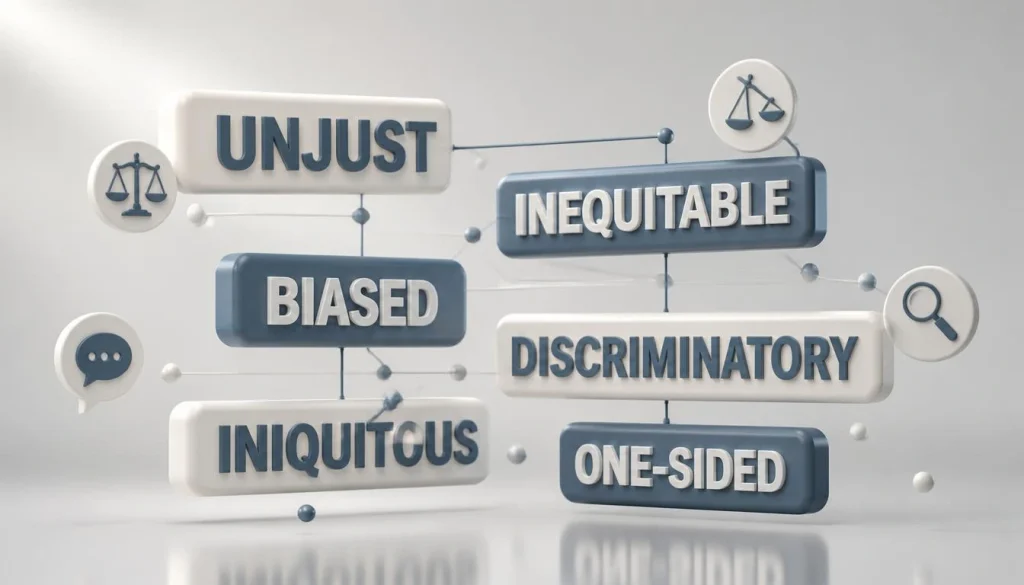
Each word below passed a substitution test: it can replace unfair in at least one real sentence without changing the core meaning. CEFR levels and frequency labels are approximate teaching guides, not official corpus figures.
1. Unjust
Meaning: Covered in full in the closest-synonym section above.
Difference from Unfair: Heavier and more principled; it doesn’t stretch to petty gripes.
Best Used For: Laws, sentences, wages, institutions.
Formality: Formal
CEFR Level: C1
Frequency: Common
Examples:
- The union argued that withholding holiday pay for a late delivery was unjust. (workplace)
- Residents called the parking fine unjust because the signs were hidden behind a tree. (local council)
When NOT to Use It: Skip it for small annoyances like losing a board game.
2. Inequitable
Meaning: Failing to share resources, burdens, or opportunities in proportion to need or merit.
Difference from Unfair: Focuses on distribution, so it sounds analytical rather than emotional.
Best Used For: Policy, funding, education, finance.
Formality: Formal
CEFR Level: C2
Frequency: Uncommon
Examples:
- Tenants challenged the lease as inequitable because only the landlord could end it early. (property law)
- The school board admitted the old catchment map gave inequitable access to science labs. (education)
When NOT to Use It: It sounds stiff in casual conversation.
3. Biased
Meaning: Leaning for or against someone without good grounds.
Difference from Unfair: Locates the problem in a person, source, or system’s leaning, not in the outcome.
Best Used For: Referees, judges, reporting, data, algorithms.
Formality: Neutral
CEFR Level: B2
Frequency: Very Common
Examples:
- The referee seemed biased toward the home side, waving away two clear fouls. (sport)
- Reviewers flagged the survey as biased because it only reached people who already used the app. (research)
When NOT to Use It: Don’t use it when no one’s judgement is at fault, such as a result that was merely harsh.
4. Partial
Meaning: Taking one side in a dispute rather than standing apart from it.
Difference from Unfair: Describes a judge’s or decision-maker’s stance, and risks being read as “incomplete.”
Best Used For: Judges, arbitrators, mediators, committee chairs.
Formality: Formal
CEFR Level: C1
Frequency: Uncommon (in this sense)
Examples:
- Members called the chair partial after she let only one team speak. (committee)
- A mediator who is partial to one party defeats the point of mediation. (dispute resolution)
When NOT to Use It: Avoid it where readers might hear “incomplete,” as in “a partial report.”
5. One-Sided
Meaning: Giving weight to only one view or party.
Difference from Unfair: Describes the structure of the thing, without assuming bad intent.
Best Used For: Contracts, arguments, coverage, relationships.
Formality: Neutral
CEFR Level: B2
Frequency: Common
Examples:
- The contract was one-sided: the supplier carried every penalty and none of the benefits. (business)
- Her one-sided account left out the neighbor’s complaint entirely. (everyday)
When NOT to Use It: Don’t use it when identical rules were applied to everyone but someone still lost out.
6. Prejudiced
Meaning: Holding a settled opinion about a person or group before knowing the facts.
Difference from Unfair: A sharper accusation than biased, aimed at attitudes rather than outcomes.
Best Used For: Attitudes toward groups or individuals.
Formality: Neutral
CEFR Level: C1
Frequency: Common
Examples:
- The hiring manager was prejudiced against career-changers and set their CVs aside unread. (hiring)
- He admitted he’d been prejudiced against the town long before he moved there. (personal)
When NOT to Use It: Don’t apply it to a rule or policy; discriminatory fits those better.
7. Discriminatory
Meaning: Treating people differently because of a group they belong to.
Difference from Unfair: Names the cause, which is group membership, and signals possible legal trouble.
Best Used For: Hiring, housing, pricing, policy, law.
Formality: Formal
CEFR Level: C1
Frequency: Common
Examples:
- The tenants’ association called the screening policy discriminatory. (housing)
- An age cap on applicants can be discriminatory even when nobody meant it that way. (HR)
When NOT to Use It: Don’t use it when the poor treatment had nothing to do with who the person is.
8. Unequal
Meaning: Differing in amount, status, or opportunity.
Difference from Unfair: Purely descriptive; the reader decides whether it is wrong.
Best Used For: Pay, access, bargaining power.
Formality: Neutral
CEFR Level: B2
Frequency: Very Common
Examples:
- Unequal pay for identical work pushed three analysts to resign. (workplace)
- The two sides had unequal bargaining power, so the “negotiation” was really an ultimatum. (negotiation)
When NOT to Use It: Don’t use it when treating people identically would itself be the unfair thing.
9. Lopsided
Meaning: Weighted heavily toward one side.
Difference from Unfair: Informal and visual; it stresses the imbalance of the result.
Best Used For: Scores, trades, chore splits, deals.
Formality: Informal
CEFR Level: C2
Frequency: Uncommon
Examples:
- Everyone knew the trade was lopsided in the other team’s favor. (sports business)
- The roommates admitted the chore split was lopsided, since one of them did nearly all the cooking. (household)
When NOT to Use It: Don’t use it in formal writing, or when the imbalance is harmless, as in a lopsided cake.
10. Unreasonable
Meaning: Going beyond what a sensible person would accept.
Difference from Unfair: Judges the size of the demand, not whether people were treated equally.
Best Used For: Deadlines, fees, demands, expectations.
Formality: Neutral
CEFR Level: B2
Frequency: Very Common
Examples:
- Asking for a forty-page report by 9 a.m. the next day is unreasonable. (workplace)
- The landlord’s late fee was unreasonable for a payment that was one day overdue. (renting)
When NOT to Use It: Don’t use it when a rule is merely strict but applied evenly.
11. Undeserved
Meaning: Not earned by anything the person did.
Difference from Unfair: Asks whether the person merited the result, ignoring the process.
Best Used For: Blame, punishment, praise, criticism.
Formality: Neutral
CEFR Level: C1
Frequency: Common
Examples:
- Her undeserved reputation for laziness followed her from team to team. (workplace)
- The goalkeeper took undeserved criticism for a goal that began with a defender’s error. (sport)
When NOT to Use It: Don’t use it for rules, systems, or policies, which can’t “deserve” anything.
12. Unjustified
Meaning: Lacking an adequate reason or evidence.
Difference from Unfair: Emphasizes the missing explanation, which makes it easy to defend in writing.
Best Used For: Accusations, price rises, dismissals, closures.
Formality: Formal
CEFR Level: C1
Frequency: Common
Examples:
- Staff called the sudden fee increase unjustified because no cost had changed. (retail)
- The inspector’s report described the factory closure as unjustified. (industry)
When NOT to Use It: Don’t use it when a reason exists and people just dislike it.
13. Unmerited
Meaning: Not warranted by someone’s actual record or effort.
Difference from Unfair: A bookish cousin of undeserved, most at home with praise and rewards.
Best Used For: Awards, promotions, formal criticism.
Formality: Formal
CEFR Level: C2
Frequency: Rare
Examples:
- He collected unmerited praise for a plan his deputy had written. (office)
- The critic dismissed the prize as unmerited. (arts)
When NOT to Use It: Skip it in spoken conversation, where it sounds affected.
14. Iniquitous
Meaning: Deeply immoral in a way that offends basic ideas of right.
Difference from Unfair: Far stronger; it condemns rather than complains.
Best Used For: Systems, taxes, historical practices.
Formality: Formal
CEFR Level: C2
Frequency: Rare
Examples:
- Historians described the old tenancy system as iniquitous. (history)
- Opponents called the bridge toll iniquitous for night-shift workers with no other route. (local politics)
When NOT to Use It: Don’t use it for everyday disputes; the scale is wrong.
15. Wrongful
Meaning: Contrary to law or right, mainly in fixed legal phrases.
Difference from Unfair: A term of art. In UK law, wrongful dismissal (breach of contract) and unfair dismissal (a statutory claim) are different claims.
Best Used For: Employment law, HR, legal news.
Formality: Formal
CEFR Level: C2
Frequency: Common (in set phrases)
Examples:
- Her lawyer argued the dismissal was wrongful because the contract required notice. (employment law)
- The company settled the wrongful termination claim before trial. (HR)
When NOT to Use It: Don’t use it for ordinary complaints outside legal-style phrases.
16. Underhanded
Meaning: Done secretly or deceitfully to gain an edge.
Difference from Unfair: The unfairness comes from sneaky methods, so it implies intent.
Best Used For: Tactics, bidding, office politics.
Formality: Neutral
CEFR Level: C2
Frequency: Uncommon
Examples:
- Leaking a rival’s quote to the client before the pitch was an underhanded move. (business)
- Rivals accused the developer of underhanded tactics to win the permit. (property)
When NOT to Use It: Don’t use it when the unfairness was an accident.
17. Unsportsmanlike
Meaning: Breaking the spirit of fair play in a game or contest.
Difference from Unfair: Limited to competition, and in some sports it is also an official penalty category.
Best Used For: Sport, school contests, games.
Formality: Neutral
CEFR Level: C2
Frequency: Uncommon
Examples:
- The coach was whistled for unsportsmanlike conduct after arguing with the umpire. (sport)
- Celebrating in the losing team’s faces felt unsportsmanlike. (school sports)
When NOT to Use It: Don’t use it away from games, for example about pay or the law.
18. Rigged
Meaning: Secretly arranged so the result is decided in advance.
Difference from Unfair: An accusation of fixing; stronger and more informal.
Best Used For: Raffles, elections, contests, online games.
Formality: Informal
CEFR Level: C2
Frequency: Common
Examples:
- The raffle felt rigged when the organizer’s cousin won twice. (community event)
- Players quit the online game, convinced the matchmaking was rigged. (gaming)
When NOT to Use It: Don’t use it for a merely disappointing result, because it accuses someone of cheating.
19. Slanted
Meaning: Presented so as to favor one view.
Difference from Unfair: Describes framing and word choice rather than treatment of people.
Best Used For: News, textbooks, survey wording.
Formality: Neutral
CEFR Level: C2
Frequency: Uncommon
Examples:
- The slanted headline left out the council’s response. (news)
- A slanted survey question nudged respondents toward “yes.” (research)
When NOT to Use It: Don’t use it for how a person was treated.
20. Skewed
Meaning: Pulled away from the true or balanced picture.
Difference from Unfair: Suits data and perspective; the distortion can be accidental.
Best Used For: Statistics, samples, grading curves.
Formality: Neutral
CEFR Level: C2
Frequency: Common
Examples:
- Because only unhappy customers replied, the results were skewed. (market research)
- A skewed grading curve penalized students in the larger lecture section. (university)
When NOT to Use It: Don’t use it if you mean deliberate cheating, since skew can be innocent.
21. Uneven
Meaning: Applied or spread inconsistently.
Difference from Unfair: Softer; it notes inconsistency without outrage.
Best Used For: Enforcement, treatment, competition.
Formality: Neutral
CEFR Level: B2
Frequency: Common
Examples:
- Enforcement of the dress code was uneven: some teams were corrected and others ignored. (workplace)
- Small shops faced an uneven playing field against chains with their own delivery fleets. (retail)
When NOT to Use It: Don’t use it when you want to express moral anger.
22. Unbalanced
Meaning: Giving more weight or room to one side than another.
Difference from Unfair: Describes how a panel, report, or program is arranged, and is milder than one-sided.
Best Used For: Media coverage, panels, agendas.
Formality: Neutral
CEFR Level: B2
Frequency: Common
Examples:
- The panel was unbalanced, with five speakers for the proposal and one against. (conference)
- Viewers complained about unbalanced coverage of the strike. (media)
When NOT to Use It: Don’t use it for individuals, where it can suggest mental instability.
23. Uncalled-For
Meaning: Not warranted by the situation, especially a remark or reaction.
Difference from Unfair: Fits words and behavior, flagging needless harshness.
Best Used For: Comments, criticism, outbursts.
Formality: Neutral
CEFR Level: C1
Frequency: Common
Examples:
- That comment about her accent was uncalled-for. (social)
- Shouting at the intern over a typo was uncalled-for. (workplace)
When NOT to Use It: Don’t use it for policies, rules, or systems.
24. Unconscionable
Meaning: So excessive or one-sided that it shocks ordinary conscience.
Difference from Unfair: Extreme; in contract law it also names a recognized doctrine about grossly lopsided terms.
Best Used For: Contract terms, price gouging, serious wrongdoing.
Formality: Formal
CEFR Level: C2
Frequency: Uncommon
Examples:
- A clause letting the vendor change the price after signing was unconscionable. (contract law)
- Charging stranded travelers triple for bottled water struck many as unconscionable. (consumer news)
When NOT to Use It: Don’t use it for mild unfairness; it is heavy artillery.
Best Alternatives by Context
Everyday Conversation
Plain unfair usually wins. For a rude remark, uncalled-for is more precise; for a split that favors one person, lopsided sounds natural.
Formal Writing
Unjust for principle, unjustified for decisions that lack a reason, inequitable for uneven sharing.
Academic Writing
Biased for sources and methods, skewed for data, inequitable for access to resources.
Business Communication
Unreasonable for demands and fees, one-sided for contract terms. Both stay professional without sounding accusatory.
Legal Writing
Many legal phrases are fixed, so check the statute or clause before swapping. Where there is room, unconscionable fits extreme contract terms, inequitable fits equity-style arguments, wrongful fits dismissal, and discriminatory fits group-based treatment.
Creative Writing
Iniquitous gives a period or moral tone; underhanded suits a villain’s methods.
Social Media
Rigged is the natural slang for a contest or system that feels fixed; lopsided works for scores and trades. Reserve both for opinions, not facts you can’t back up.
Which Synonym Should I Choose?
| Situation | Best Choice | Why |
|---|---|---|
| Referee favors one side | biased | Names the person’s leaning |
| Contract helps only one party | one-sided | Plain and precise |
| Pay or access differs | unequal / inequitable | Descriptive vs. formal |
| Blamed for something not done | undeserved | Focuses on desert |
| Absurd demand or fee | unreasonable | Judges the demand itself |
| Policy targets a group | discriminatory | Names the cause |
| Law or verdict feels immoral | unjust | Carries moral weight |
| Very unfair, shocking terms | unconscionable / iniquitous | Strongest formal options |
| Contest decided in advance | rigged | Alleges fixing |
| Sneaky tactics | underhanded | Implies deceit |
| Fired without proper reason | wrongful / unfair dismissal | Use the legal term |
| Distorted statistics | skewed | Fits data |
For crossword solvers: fit depends on the clue, so treat these as candidates by letter count, not guaranteed answers.
| Letters | Candidates |
|---|---|
| 6 | unjust, biased, uneven, rigged, skewed |
| 7 | partial, unequal, slanted |
| 8 | wrongful, lopsided, one-sided |
| 9 | unmerited |
| 10 | prejudiced, undeserved, iniquitous, unbalanced |
| 11 | inequitable, unjustified, underhanded |
| 12 | unreasonable |
| 14 | discriminatory |
Exact and Near Synonyms: Difference
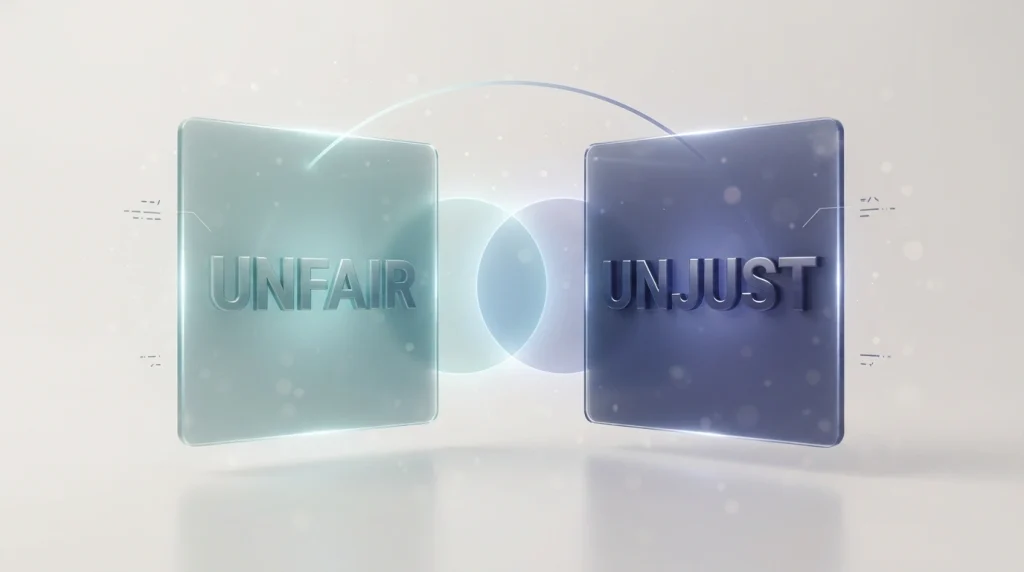
English has very few true synonyms, because two words rarely match on meaning, tone, and scope at once. The words for unfair vary along three axes.
Severity. Unfair, unjust, and iniquitous form a rising scale. Moving up it changes how serious the speaker sounds, not just the vocabulary.
Target. Some words judge people (biased, prejudiced, partial), some judge outcomes (undeserved, unmerited), and some judge arrangements (unequal, lopsided, unbalanced). Calling a referee lopsided or a score prejudiced misses the target.
Register. Rigged and lopsided are conversational; inequitable and unconscionable are written. Choosing the wrong register is the most common reason a correct synonym still sounds off.
Words Commonly Confused with Unfair
These words look related but failed the substitution test, so they are not synonyms.
- Harsh: describes severity, not whether treatment was equal; a fair penalty can still be harsh.
- Cruel: implies intent to cause suffering, which unfair treatment doesn’t require.
- Arbitrary: means decided without a rule or reason; it can be unfair, but a consistent rule can be unfair too.
- Unlucky / unfortunate: bad luck involves no wrongdoing or unequal standard.
- Illegal / unlawful: a legal status; plenty of unfair things are legal.
- Unethical / immoral: about right and wrong in conduct, not about equal treatment.
- Injustice, inequity, discrimination, unfairness: nouns, so they can’t replace the adjective directly.
- Raw deal, mistreatment: noun phrases for unfair treatment rather than replacements for the adjective.
- Partial (as in incomplete): a different meaning of the same word.
Common Mistakes
| Mistake | Better | Why |
|---|---|---|
| “It’s unjust the café ran out of oat milk.” | unfair, or just “annoying” | Unjust implies moral weight |
| “The referee was inequitable.” | biased | Inequitable describes distribution |
| “The report was partial.” | one-sided or incomplete | Partial is ambiguous |
| Treating wrongful and unfair dismissal as identical (UK) | Use the claim’s legal term | They are separate claims |
| “The exam was rigged” about a hard test | unfair or harsh | Rigged accuses someone of fixing |
Antonyms of Unfair
| # | Antonym | Why It’s the Opposite |
|---|---|---|
| 1 | fair | Direct opposite; same standard for all |
| 2 | just | Matches what people are owed |
| 3 | equitable | Shares fairly, in proportion to need |
| 4 | impartial | Takes no side |
| 5 | unbiased | Free of leaning or prejudgement |
| 6 | even-handed | Treats all parties alike |
| 7 | above-board | Honest and open, not sneaky |
American vs British English
The spelling of unfair is identical in both varieties; pronunciation differs slightly (US /ʌnˈfɛr/, UK /ʌnˈfeə/). The differences show up around the word. British English uses unfair dismissal as the standard employment-law term, while American usage leans on wrongful termination.
Not cricket and stitch-up are British idioms for unfair play and a fixed outcome, while the fix is in is more American. Expect spelling differences in surrounding words, such as favour/favor and penalised/penalized.
Real-World Collocations and Phrases
Part A: Common Patterns
Verb + unfair: feel unfair, seem unfair, consider unfair, deem unfair, find unfair
Unfair + noun: unfair advantage, unfair dismissal, unfair competition, unfair treatment, unfair contract terms, unfair criticism, unfair comparison
Adverb + unfair: grossly unfair, deeply unfair, patently unfair, fundamentally unfair, manifestly unfair
Unfair + preposition: unfair to someone, unfair on someone (more British), unfair for someone to do something
Part B: Set Phrases and Idioms
- Below the belt (also “a hit below the belt”): an attack that breaks the rules of fair fighting.
- A raw deal: unfair treatment in an arrangement.
- The deck is stacked against someone: the circumstances favor others from the start.
- An uneven (or level) playing field: unequal (or equal) conditions for competitors.
- A cheap shot: an unfair, often personal, attack.
- Not cricket: British, slightly dated; unfair or dishonorable behavior.
- A stitch-up: British; a result arranged in advance to disadvantage someone.
- The fix is in: American; the outcome has been secretly arranged.
- Double standard: applying different rules to similar cases.
- All’s fair in love and war: the proverb that anything goes in love or conflict.
- “No fair!”: the classic exclamation, especially from children.
Practice Exercises
Fill in the Blanks
Word bank: biased, one-sided, rigged, unreasonable, discriminatory
- The referee was clearly ______ toward the home team.
- A two-hour deadline for a forty-page report is ______.
- After the same ticket won three weeks running, people whispered the draw was ______.
- The contract was ______: only the supplier could cancel it.
- A policy that bars applicants over fifty is ______.
Rewrite the Sentences
Replace “unfair” with a more precise word or phrase.
- The ref made an unfair decision because he supports the other team.
- My boss gave me an unfair deadline.
- It was unfair that I got blamed for something I didn’t do.
Match the Words
- inequitable
- rigged
- undeserved
- underhanded
- unsportsmanlike
A. Blame for a mistake you didn’t make
B. Mocking the losing team after the final whistle
C. Leaking a rival’s price before bids close
D. A contest whose winner was settled in advance
E. A funding formula that gives one school far more per pupil than another
Vocabulary Quiz
- Which word best describes survey results that lean away from the truth because of who answered? (A) rigged (B) skewed (C) wrongful (D) unsportsmanlike
- Which is the standard UK statutory phrase for dismissal without a fair reason? (A) wrongful dismissal (B) unfair dismissal (C) unjust dismissal (D) inequitable dismissal
- Which word accuses someone of fixing a result in advance? (A) uneven (B) slanted (C) rigged (D) partial
- Which synonym is limited mainly to games and competition? (A) unsportsmanlike (B) unreasonable (C) uncalled-for (D) unmerited
- Which synonym carries the strongest everyday moral weight? (A) lopsided (B) unjust (C) uneven (D) slanted
Answer Key
Fill in the blanks: 1. biased; 2. unreasonable; 3. rigged; 4. one-sided; 5. discriminatory.
Rewrite (sample answers): 1. The ref made a biased decision because he supports the other team. 2. My boss gave me an unreasonable deadline. 3. I took undeserved blame for something I didn’t do (or: It was unjust that I got blamed…).
Match: 1-E, 2-D, 3-A, 4-C, 5-B.
Quiz: 1-B, 2-B, 3-C, 4-A, 5-B.
FAQ
What is another term for being unfair?
The common nouns are unfairness, injustice, inequity, bias, and favoritism. Use discrimination only when the cause is group membership.
How do you say “unfair” in a professional way?
Choose by cause: inequitable for uneven sharing, unjustified for decisions lacking a reason, unreasonable for excessive demands, and one-sided for terms favoring a single party. These sound measured rather than emotional.
What is another word for “unfairness”?
Injustice is the closest, followed by inequity and partiality. For a person’s behavior, favoritism or bias is more exact.
What is another word for biased or unfair?
Prejudiced, partial, one-sided, and slanted all fit, depending on whether you mean a person’s attitude, a judge’s stance, a structure, or a presentation.
What is a better word for unfair?
The better word names the specific problem. Biased points at a judge, undeserved at the result, unreasonable at the demand, and unjust at a principle.
What are 5 strong synonyms?
Unjust, inequitable, biased, one-sided, and unjustified cover most situations well.
Conclusion
Choosing the exact word for unfair does more than vary your vocabulary: it tells readers what went wrong and how seriously to take it.
A precise word lets a complaint become an argument, because it names the cause (bias, missing reason, unequal sharing) instead of leaving the reader to guess. Before you reach for a synonym, decide whether you’re judging a person, an outcome, or an arrangement, and let that decision, plus the formality of the setting, pick the word for you.

About Sajjad Ahmed
Sajjad Ahmed is the author behind Guest Paster, where he writes about English vocabulary, synonyms, word meanings, and practical word usage.
His content is designed to help readers understand the differences between similar words, discover suitable alternatives, and use English vocabulary more effectively in everyday writing and communication.
Before publishing, Sajjad focuses on presenting word choices in a clear and easy-to-understand format, with relevant meanings, context, and examples where helpful.
Through Guest Paster, his goal is to make vocabulary learning simpler and provide useful language resources for students, writers, English learners, and anyone looking to expand their vocabulary.
Areas of Focus: English Vocabulary • Synonyms • Word Meanings • Word Usage • Language Learning
Author: Sajjad Ahmed
Website: Guest Paster