What Is the Best Synonym for Curious?
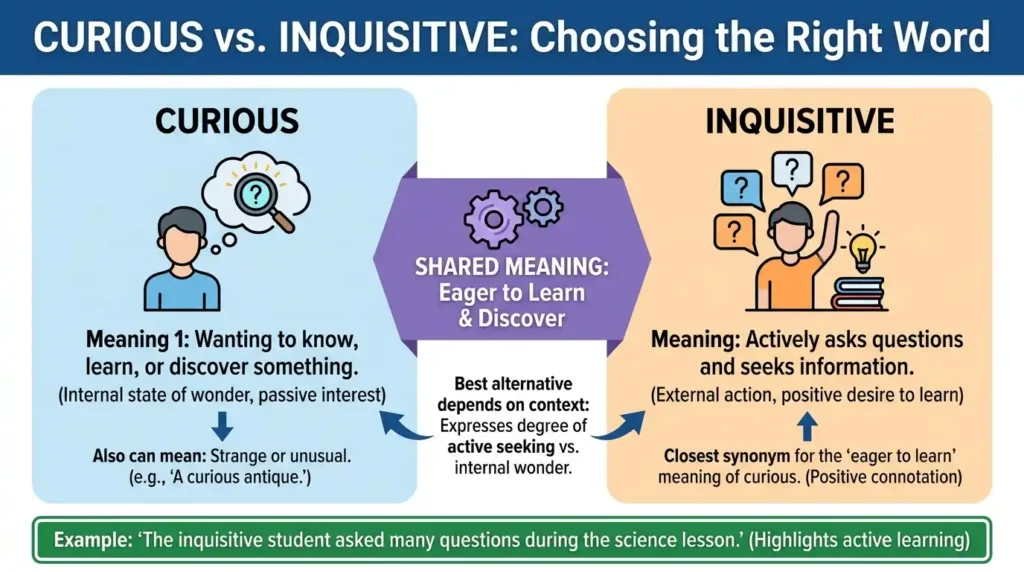
According to my research Inquisitive is the closest synonym for curious in many situations. Curious means wanting to know, learn or discover something. Inquisitive has almost the same meaning but it often describes someone who actively asks questions and seeks information.
Use inquisitive when you want to show a positive desire to learn. For example, “The inquisitive student asked many questions during the science lesson.” The word curious can also mean strange or unusual, so the best synonym depends on the context.
Choosing the right alternative helps you express whether you mean interested, eager to learn, or simply unusual.
Best Synonyms for Curious
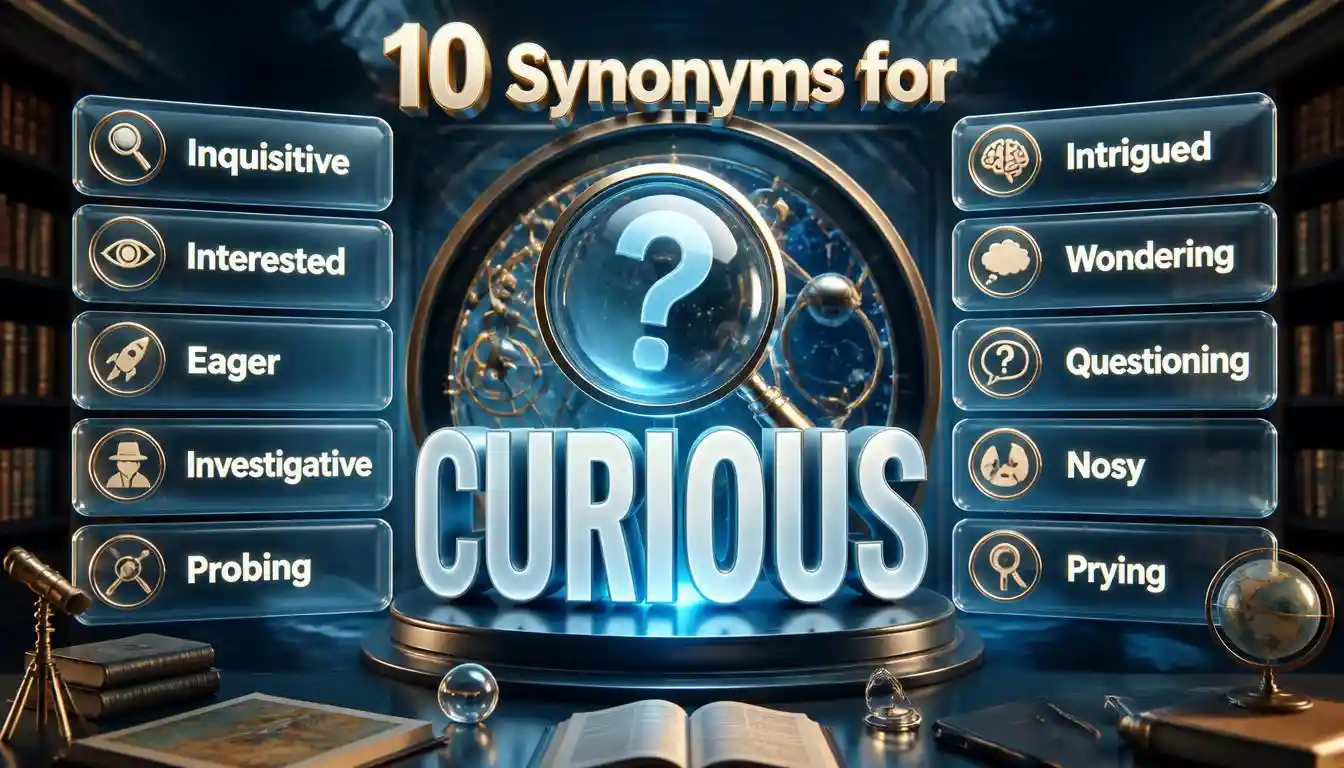
| # | Synonym | Relationship | Main Difference | Best Used For |
| 1 | Inquisitive | Exact Synonym | Strong focus on asking questions and learning | People who seek knowledge |
| 2 | Interested | Near Synonym | Shows attention or concern rather than active questioning | General attention |
| 3 | Eager | Near Synonym | Shows excitement to know or experience something | Learning or trying something new |
| 4 | Investigative | Near Synonym | Suggests careful searching and examination | Research and discovery |
| 5 | Probing | Near Synonym | Suggests deep questioning | Detailed investigation |
| 6 | Intrigued | Near Synonym | Shows fascination or strong interest | Something unusual or interesting |
| 7 | Wondering | Near Synonym | Shows a desire to know an answer | Everyday thoughts and questions |
| 8 | Questioning | Near Synonym | Focuses on asking or examining ideas | Learning and discussion |
| 9 | Nosy | Contextual Alternative | Shows too much interest in others’ private matters | Negative curiosity |
| 10 | Prying | Contextual Alternative | Suggests unwanted investigation | Personal information |
Quick Facts About Curious
| Feature | Information |
| Word | Curious |
| Part of Speech | Adjective |
| Simple Meaning | Wanting to know or learn something; also meaning strange or unusual |
| Pronunciation | KYUR-ee-us |
| IPA | /ˈkjʊr.i.əs/ |
| Syllables | 3 (cu-ri-ous) |
| Origin | From Latin curiosus, meaning careful or eager to know |
| Word Forms | curious, curiously, curiosity |
| Formality Level | Neutral |
| Common Usage | Learning, questions, discoveries, unusual things, personal interest |
Exact vs Similar Synonyms
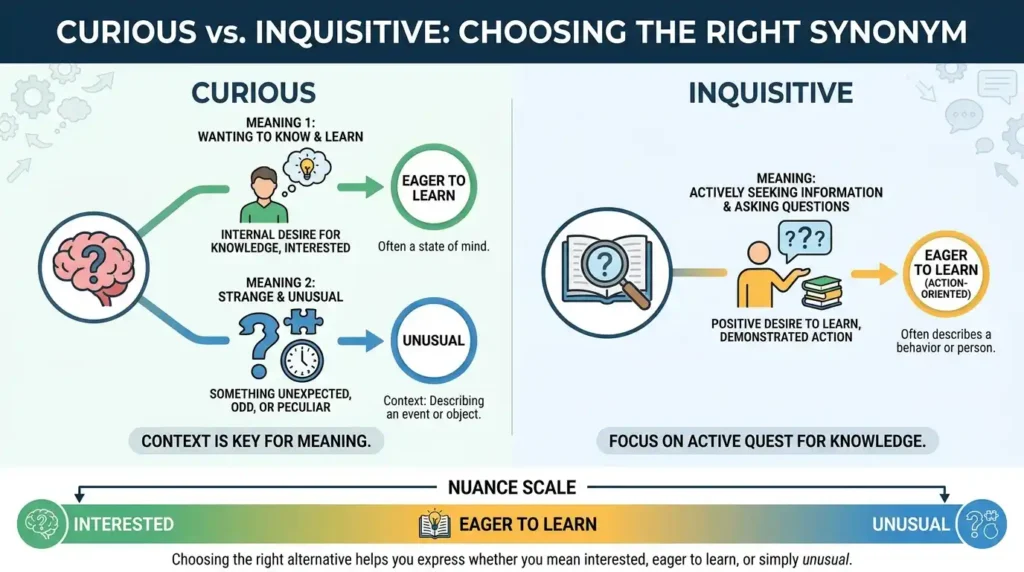
Synonyms are not always perfect replacements. Some words share the same basic idea but differ in feeling, strength or situation. Inquisitive is close to curious because both describe a desire to learn.
However, inquisitive usually sounds more positive and suggests active questioning. Interested is broader because someone can be interested without asking questions. Nosy and prying relate to curiosity but usually have a negative meaning because they involve unwanted attention.
Context matters because “curious” can describe a person who wants knowledge or something that is strange and unusual.
Meaning and Usage of Curious
Basic Meaning
Curious means wanting to know, learn, or discover something. A curious person asks questions, explores ideas, and tries to understand the world around them.
Examples:
- The curious child asked how airplanes fly.
- She was curious about the new technology.
The word can describe a positive desire for knowledge and discovery.
Different Meanings of Curious
The word curious has two main meanings.
1. Wanting to Learn or Know Something
This is the most common meaning.
It describes someone who wants information or wants to understand something.
Examples:
- I’m curious about how this machine works.
- The students were curious about the experiment.
In this meaning, curious is usually positive.
2. Strange or Unusual
Curious can also mean unusual, unexpected, or interesting in a strange way.
Examples:
- That is a curious way to solve the problem.
- We noticed a curious smell coming from the room.
In this meaning, curious does not mean wanting knowledge.
How People Use Curious
Everyday Conversation
People often use curious when they want to ask questions politely.
Examples:
- I’m curious, why did you choose that career?
- I was curious to see what happened next.
Formal Writing
Curious works well in formal writing when discussing interest, research, or discovery.
Examples:
- Curious researchers explored the effects of the new material.
- The study examined why people are curious about unknown topics.
Academic Writing
Academic writing often uses curiosity, inquisitive, or investigative when discussing learning and research.
Examples:
- Curiosity encourages scientific discovery.
- Inquisitive students often perform deeper research.
Creative Writing
Writers use curious to describe characters who explore mysteries or unusual events.
Examples:
- The curious traveler entered the abandoned house.
- A curious sound came from behind the old door.
30 Synonyms and Alternatives for Curious
1. Inquisitive
Relationship:
Exact Synonym
Meaning:
Inquisitive means eager to learn, ask questions, and discover information.
Difference:
Inquisitive is slightly stronger than curious because it suggests active investigation.
Best Used For:
People who enjoy learning and asking questions.
Examples:
- The inquisitive student wanted to understand every step of the process.
- Her inquisitive nature helped her become a great researcher.
2. Interested
Relationship:
Near Synonym
Meaning:
Interested means wanting to know more about something or paying attention to it.
Difference:
Interested is broader than curious. A person can be interested without actively asking questions.
Best Used For:
General attention or attraction toward something.
Examples:
- He is interested in learning another language.
- Many people are interested in space exploration.
3. Intrigued
Relationship:
Near Synonym
Meaning:
Intrigued means strongly interested because something is unusual, surprising, or fascinating.
Difference:
Intrigued focuses on fascination, while curious focuses on wanting information.
Best Used For:
Mysteries, unusual ideas, and surprising situations.
Examples:
- She was intrigued by the strange painting.
- The scientist was intrigued by the unexpected results.
4. Eager
Relationship:
Near Synonym
Meaning:
Eager means excited and ready to do or learn something.
Difference:
Eager shows enthusiasm, while curious focuses on wanting knowledge.
Best Used For:
New experiences, learning, and opportunities.
Examples:
- The students were eager to start the experiment.
- He was eager to learn new skills.
5. Investigative
Relationship:
Near Synonym
Meaning:
Investigative means carefully searching for facts or information.
Difference:
Investigative is more systematic and professional than curious.
Best Used For:
Research, journalism, and scientific work.
Examples:
- The investigative reporter uncovered new information.
- Her investigative approach solved the problem.
6. Probing
Relationship:
Near Synonym
Meaning:
Probing means asking deep questions or examining something carefully.
Difference:
Probing suggests a deeper search than ordinary curiosity.
Best Used For:
Interviews, research, and detailed analysis.
Examples:
- The journalist asked probing questions.
- Researchers conducted a probing analysis of the issue.
7. Questioning
Relationship:
Near Synonym
Meaning:
Questioning means showing a desire to examine, challenge, or understand something.
Difference:
Questioning can suggest doubt, while curious usually suggests interest.
Best Used For:
Discussion, learning, and critical thinking.
Examples:
- She has a questioning mind and examines every idea carefully.
- His questioning attitude led to new discoveries.
8. Wondering
Relationship:
Near Synonym
Meaning:
Wondering means thinking about something because you want to know the answer.
Difference:
Wondering is often temporary, while curious can describe a lasting personality trait.
Best Used For:
Everyday thoughts and questions.
Examples:
- I was wondering why the meeting was canceled.
- She wondered what was inside the box.
9. Fascinated
Relationship:
Near Synonym
Meaning:
Fascinated means extremely interested or attracted by something.
Difference:
Fascinated is stronger than curious because it shows deep interest.
Best Used For:
Amazing discoveries or captivating subjects.
Examples:
- The children were fascinated by the magician.
- She became fascinated with ancient history.
10. Absorbed
Relationship:
Contextual Alternative
Meaning:
Absorbed means fully focused on something.
Difference:
It describes attention rather than the desire to discover.
Best Used For:
Activities, books, learning, or tasks.
Examples:
- He was absorbed in the science project.
- She became absorbed in the mystery novel.
11. Interested in
Relationship:
Near Synonym
Meaning:
Interested in means having attention, care, or a desire to know more about something.
Difference:
It is less focused on asking questions than curious. Someone can be interested without wanting more details.
Best Used For:
General hobbies, subjects, and activities.
Examples:
- She is interested in learning about marine life.
- Many students are interested in technology.
12. Attentive
Relationship:
Contextual Alternative
Meaning:
Attentive means paying close attention to something.
Difference:
Attentive describes focus, not necessarily a desire to discover new information.
Best Used For:
Learning, listening, and careful observation.
Examples:
- The attentive student noticed the small mistake.
- He was attentive during the safety training.
13. Observant
Relationship:
Near Synonym
Meaning:
Observant means good at noticing details and changes.
Difference:
An observant person notices things, while a curious person usually wants to understand them.
Best Used For:
People who study situations carefully.
Examples:
- The observant detective noticed the missing clue.
- She is very observant and notices small details.
14. Exploratory
Relationship:
Contextual Alternative
Meaning:
Exploratory means involving searching, discovering, or examining something new.
Difference:
It describes an activity or approach rather than a person’s curiosity.
Best Used For:
Research, travel, and discovery.
Examples:
- The team began an exploratory study of the region.
- They took an exploratory journey into the forest.
15. Searching
Relationship:
Contextual Alternative
Meaning:
Searching means looking carefully for information or answers.
Difference:
It describes the action of looking, not the feeling of curiosity.
Best Used For:
Research and problem-solving.
Examples:
- The scientist used a searching approach to find answers.
- His searching questions revealed new information.
16. Studious
Relationship:
Contextual Alternative
Meaning:
Studious means dedicated to learning and studying.
Difference:
A studious person may love learning, but they are not always curious.
Best Used For:
Students and academic situations.
Examples:
- The studious student spent hours reading.
- Her studious habits improved her grades.
17. Inquiring
Relationship:
Exact Synonym
Meaning:
Inquiring means seeking information by asking questions.
Difference:
Inquiring is often used for active questioning, while curious is broader.
Best Used For:
Learning, research, and professional communication.
Examples:
- The inquiring student asked about the experiment.
- She made an inquiring phone call about the service.
18. Questioning
Relationship:
Near Synonym
Meaning:
Questioning means showing a desire to understand or examine something.
Difference:
Questioning can suggest doubt or criticism, while curious usually sounds more positive.
Best Used For:
Critical thinking and discussions.
Examples:
- His questioning attitude helped improve the plan.
- She has a questioning mind.
19. Analytical
Relationship:
Contextual Alternative
Meaning:
Analytical means examining information carefully to understand it.
Difference:
Analytical describes thinking ability rather than simple curiosity.
Best Used For:
Science, business, and problem-solving.
Examples:
- Her analytical skills helped solve the case.
- He takes an analytical approach to problems.
20. Perceptive
Relationship:
Contextual Alternative
Meaning:
Perceptive means able to notice and understand things quickly.
Difference:
Perceptive focuses on understanding, not wanting to discover.
Best Used For:
People who notice hidden details.
Examples:
- The perceptive teacher understood the student’s problem.
- She made a perceptive observation.
21. Wondering
Relationship:
Near Synonym
Meaning:
Wondering means thinking about something because you want to know more.
Difference:
It usually describes a temporary thought, not a personality trait.
Best Used For:
Casual questions and everyday situations.
Examples:
- I’m wondering what happened yesterday.
- He was wondering why the lights were off.
22. Fascinated
Relationship:
Near Synonym
Meaning:
Fascinated means extremely interested in something.
Difference:
It describes strong interest after discovering something attractive or unusual.
Best Used For:
Amazing ideas, discoveries, and experiences.
Examples:
- She was fascinated by astronomy.
- The child was fascinated by the colorful insects.
23. Captivated
Relationship:
Contextual Alternative
Meaning:
Captivated means completely attracted or interested.
Difference:
It focuses on being strongly attracted rather than wanting answers.
Best Used For:
Stories, performances, and experiences.
Examples:
- The audience was captivated by the performance.
- He was captivated by the beautiful artwork.
24. Enthralled
Relationship:
Contextual Alternative
Meaning:
Enthralled means deeply interested or fascinated.
Difference:
It shows stronger attraction than curiosity.
Best Used For:
Creative writing and emotional descriptions.
Examples:
- The children were enthralled by the story.
- She was enthralled by the ancient ruins.
25. Nosey / Nosy
Relationship:
Contextual Alternative
Meaning:
Nosy means too interested in other people’s private matters.
Difference:
Unlike curious, nosy usually has a negative meaning.
Best Used For:
Describing unwanted curiosity.
Examples:
- My neighbor is always nosy about other people’s lives.
- Don’t be nosy; respect their privacy.
26. Prying
Relationship:
Contextual Alternative
Meaning:
Prying means trying to discover information that is private or not meant to be shared.
Difference:
Prying suggests inappropriate curiosity.
Best Used For:
Negative situations involving personal questions.
Examples:
- He kept prying into her personal life.
- The reporter was accused of prying.
27. Meddlesome
Relationship:
Contextual Alternative
Meaning:
Meddlesome means interfering in situations that do not involve you.
Difference:
It is not a true synonym because it describes unwanted involvement.
Best Used For:
Negative descriptions of behavior.
Examples:
- His meddlesome actions created problems.
- She disliked her meddlesome neighbor.
28. Curious-Minded
Relationship:
Exact Synonym
Meaning:
Curious-minded means having a natural desire to learn and explore.
Difference:
It directly describes a person’s personality.
Best Used For:
Education and personal development.
Examples:
- Curious-minded students often become creative thinkers.
- A curious-minded person enjoys discovering new ideas.
29. Open-minded
Relationship:
Contextual Alternative
Meaning:
Open-minded means willing to consider new ideas.
Difference:
Open-mindedness is about acceptance, not necessarily wanting information.
Best Used For:
Opinions, discussions, and learning.
Examples:
- She is open-minded about different cultures.
- An open-minded approach encourages creativity.
30. Adventurous
Relationship:
Contextual Alternative
Meaning:
Adventurous means willing to try new experiences.
Difference:
Adventure involves action and risk, while curiosity involves wanting knowledge.
Best Used For:
Travel, exploration, and experiences.
Examples:
- His adventurous spirit led him around the world.
- She has an adventurous personality.
Best Alternatives by Context
Everyday Use
Best choices:
- Curious
- Inquisitive
- Interested
- Wondering
These words sound natural when talking about questions, hobbies, and learning.
Formal Writing
Best choices:
- Inquisitive
- Investigative
- Probing
- Inquiring
These words work well in professional and academic contexts.
Academic Writing
Best choices:
- Investigative
- Analytical
- Inquisitive
- Questioning
These describe learning, research, and critical thinking.
Creative Writing
Best choices:
- Intrigued
- Fascinated
- Captivated
- Foreboding (for unusual situations)
These create stronger emotions and descriptions.
Words Commonly Confused with Curious
Nosy
Difference:
Nosy means being interested in other people’s private information in an unwanted way. Curious is usually positive.
Example:
- She was curious about the new project.
- He was nosy about his neighbor’s personal life.
Interested
Difference:
Interested means paying attention or caring about something. Curious usually includes wanting to discover or understand more.
Example:
- I am interested in history.
- I am curious about how ancient people lived.
Strange
Difference:
Curious can mean unusual, but it does not always mean strange. Strange only describes something uncommon.
Example:
- That is a curious invention.
- That is a strange noise.
Inquisitive
Difference:
Inquisitive is very close to curious but often suggests active questioning.
Example:
- The inquisitive student asked many questions.
Suspicious
Difference:
Suspicious means believing something may be wrong or dishonest. Curious means wanting to know.
Example:
- She was curious about the results.
- He was suspicious of the explanation.
Antonyms of Curious
| Antonym | Simple Meaning | Example Sentence |
| Uninterested | Not wanting to know or learn more | He seemed uninterested in the discussion. |
| Indifferent | Not caring about something | She was indifferent to the changes. |
| Unconcerned | Not worried or interested | He was unconcerned about the results. |
| Apathetic | Showing little interest or emotion | The apathetic student rarely participated. |
| Ignorant | Lacking knowledge or awareness | Ignorant decisions can cause problems. |
| Unaware | Not knowing about something | She was unaware of the new rules. |
| Closed-minded | Not willing to consider new ideas | A closed-minded person avoids different opinions. |
| Passive | Not actively interested or involved | He remained passive during the discussion. |
Common Collocations with Curious
| Collocation | Meaning | Example Sentence |
| Curious about | Wanting to know more about something | I am curious about how this machine works. |
| Curious to know | Wanting information or an answer | She was curious to know the final result. |
| Curious mind | A person who enjoys learning and exploring ideas | A curious mind often finds creative solutions. |
| Curious nature | A personality that seeks knowledge | His curious nature led him to research history. |
| Curious question | A question asked to learn more | The child asked a curious question about space. |
| Curious look | A facial expression showing interest or uncertainty | She gave him a curious look. |
| Curious behavior | Actions that seem unusual or interesting | The animal showed curious behavior. |
| Curious case | A situation that is unusual or interesting | The detective studied the curious case carefully. |
Frequently Asked Questions
What does curious mean?
Curious means wanting to know, learn, or discover something. It can describe a person who asks questions and explores ideas. It can also mean unusual or strange in some situations.
What is another word for curious?
Common alternatives for curious include inquisitive, interested, intrigued, questioning, investigative, and eager. The best choice depends on whether you mean wanting knowledge, showing interest, or describing something unusual.
What is the closest synonym for curious?
Inquisitive is one of the closest synonyms for curious because both describe a desire to learn and discover information. Inquisitive often suggests more active questioning.
Are curious and inquisitive the same?
Curious and inquisitive have very similar meanings, but inquisitive usually sounds more focused on asking questions and investigating. Curious is broader and can also describe unusual things.
Can curious have a negative meaning?
Yes. Curious is usually positive when it means wanting to learn. However, it can become negative when it describes unwanted interest in private matters, although words like nosy and prying are stronger negative choices.
Is curious formal or informal?
Curious is a neutral word. People use it in everyday conversations, professional writing, academic discussions, and creative writing.
Conclusion
Choosing the right synonym for curious helps you express the exact type of interest you mean. Words like inquisitive, interested and intrigued describe different levels of curiosity while nosy and prying show unwanted attention.
Context matters because the best alternative depends on tone, purpose and situation. Understanding these differences improves your vocabulary, writing and communication skills.

About Sajjad Ahmed
Sajjad Ahmed is the author behind Guest Paster, where he writes about English vocabulary, synonyms, word meanings, and practical word usage.
His content is designed to help readers understand the differences between similar words, discover suitable alternatives, and use English vocabulary more effectively in everyday writing and communication.
Before publishing, Sajjad focuses on presenting word choices in a clear and easy-to-understand format, with relevant meanings, context, and examples where helpful.
Through Guest Paster, his goal is to make vocabulary learning simpler and provide useful language resources for students, writers, English learners, and anyone looking to expand their vocabulary.
Areas of Focus: English Vocabulary • Synonyms • Word Meanings • Word Usage • Language Learning
Author: Sajjad Ahmed
Website: Guest Paster