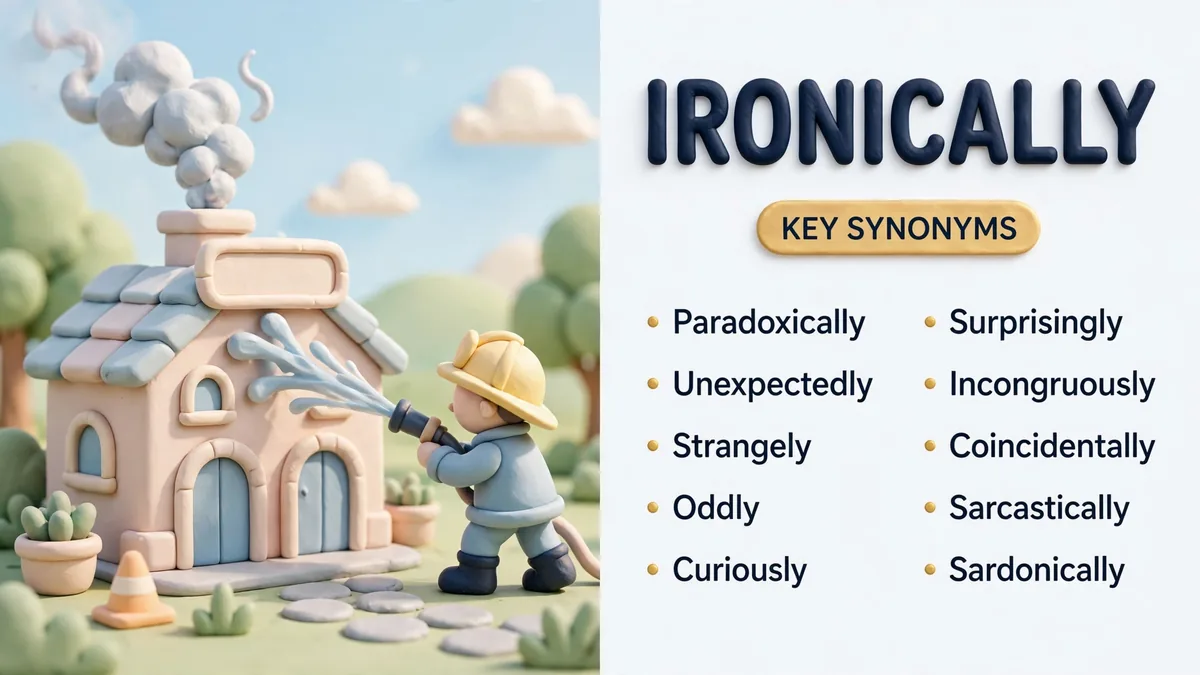
The fire station caught fire. Firefighters who spend every shift racing to other people’s emergencies had to call for help at their own building, and the local news could not resist the word. Ironically, the fire station burned down.
That one sentence works because the outcome is the opposite of what the building exists for, and that flip is the heart of the word. Use ironically when reality turns against expectation, not merely when two things happen at once. The closest match is paradoxically, for a neat contradiction.
Sarcastically fits when the words carry a mocking tone. Unexpectedly fits when the surprise has no twist at all.
Synonyms Of Ironically at a Glance
| # | Synonym | Meaning Difference |
|---|---|---|
| 1 | Paradoxically | The opposite of what logic expects |
| 2 | Unexpectedly | A surprise with no twist |
| 3 | Strangely | Odd and hard to explain |
| 4 | Oddly | Peculiar, slightly off |
| 5 | Curiously | Strange in a way that invites a second look |
| 6 | Surprisingly | More than you expected |
| 7 | Incongruously | Out of place, clashing with the setting |
| 8 | Coincidentally | Two things happening at once, by chance |
| 9 | Sarcastically | Said with mocking, opposite meaning |
| 10 | Sardonically | Mocking with a bitter edge |
Quick Facts About “Ironically”
- Part of speech: an adverb, built from the adjective ironic plus the ending ly.
- Core meaning: in a way that is the opposite of what you would expect.
- Two main uses: (1) situational irony, when events turn against expectation; (2) verbal irony, when the words said mean the opposite.
- Register: neutral. Ironically suits news, essays, novels, and everyday speech.
- Common mistake: using it for a mere coincidence. Two things happening at once is not irony unless the timing itself turns the meaning upside down.
The Closest Synonym: Paradoxically
Paradoxically is the closest synonym for ironically: it names a contradiction that logic cannot smooth out. A paradox is a statement that seems self-contradictory yet may still be true. When a hospital stay makes a patient sicker, or more choices make a decision harder, the situation is paradoxical.
Still, paradoxically is not identical to ironically. Paradoxically is sharper, more formal, and happiest with abstract ideas, while ironically is broader and at home in everyday stories. A fire station catching fire is ironic, not paradoxical, because the twist is about purpose, not logic.
Choice test: a clash of logic means paradoxically, a twist of fate means ironically, plain surprise means unexpectedly, and a mocking tone means sarcastically.
Can You Swap Them Freely?
In short: only inside the same meaning group, and only when the sense matches.
- ✅ “Ironically, the fire station burned down.” (the outcome mocks the purpose ✔)
- ❌ “Coincidentally, the fire station burned down.” (coincidence is chance, not a twist ✘, say ironically)
- ✅ “Paradoxically, the more choices we had, the harder it was to choose.” (a logical contradiction ✔)
- ❌ “Sarcastically, the fire station burned down.” (sarcasm is a tone of voice, not an event ✘, say ironically)
- ✅ “Unexpectedly, the meeting ended early.” (a plain surprise ✔)
Before you substitute, ask what kind of surprise you mean: a twist of fate, a clash of logic, a plain shock, or a mocking tone. Most surprises are just surprises.
Where “Ironically” Comes From (Etymology)
According to Etymonline, irony entered English around 1500 as a figure of speech in which the intended meaning is the opposite of the literal meaning, often a covert sarcasm under a serious pretense. It came from Latin ironia, from Greek eironeia, meaning dissimulation or assumed ignorance, from eiron, a dissembler, perhaps related to eirein, to speak. In Greek the word described affected ignorance, famously the method of Socrates, who exposed an opponent’s ignorance by pretending to seek instruction.
The figurative sense we use today, a condition opposite to what might be expected, dates from the 1640s, sometimes called the irony of fate or the irony of circumstances. Ironically is simply ironic plus ly. Merriam-Webster records the first known use of ironically in 1576, defined as it is ironic, curious, or surprising.
Ironically Synonyms in Detail
Group 1: When the Opposite of What You Expect Happens
1. Paradoxically
- Meaning: In a way that seems self-contradictory yet may be true.
- Difference: The sharpest match for a logical clash.
- Best used for: Essays, philosophy, science writing, opinion pieces.
- Formality: Formal · CEFR: C1 · Frequency: Common
- Example (Science): “Paradoxically, the treatment meant to calm the patient made her restless.”
- Example (Essays): “Paradoxically, more free time left him with less time for reading.”
- When NOT to use it: For a funny real-life twist, where ironically sounds more natural.
2. Unexpectedly
- Meaning: In a way nobody saw coming.
- Difference: Plain surprise, with no contradiction needed.
- Best used for: News, stories, everyday speech, work emails.
- Formality: Neutral · CEFR: B1 · Frequency: Very common
- Example (News): “The bus arrived unexpectedly early, and she caught the first train.”
- Example (Sports): “He unexpectedly beat the club champion at chess.”
- When NOT to use it: When the outcome opposes the purpose, use ironically.
3. Strangely
- Meaning: In an odd way that is hard to explain.
- Difference: Strangely stresses weirdness, not the flip.
- Best used for: Stories, mystery writing, personal essays.
- Formality: Neutral · CEFR: B2 · Frequency: Very common
- Example (Home): “Strangely, the lights came on the moment she left the room.”
- Example (Animals): “Strangely, the dog refused to enter the house.”
- When NOT to use it: When the event fits its purpose, where strangely would mislead.
4. Oddly
- Meaning: In a peculiar way that feels slightly off.
- Difference: Lighter than strangely, often with a small shrug.
- Best used for: Casual speech, fiction, blog writing.
- Formality: Neutral · CEFR: B1 · Frequency: Very common
- Example (School): “Oddly, the quietest student spoke first in the debate.”
- Example (Weather): “Oddly enough, the rain stopped as the picnic ended.”
- When NOT to use it: For a sharp contradiction, where oddly is too weak.
5. Curiously
- Meaning: In a way that invites a second look.
- Difference: Curiously adds wonder. The speaker is intrigued, not shocked.
- Best used for: Essays, travel writing, nature writing.
- Formality: Neutral to formal · CEFR: B2 · Frequency: Common
- Example (Travel): “Curiously, the old map showed a road that no longer exists.”
- Example (Animals): “Curiously, the shyest cat in the shelter chose the loudest child.”
- When NOT to use it: When the twist is bitter, where curiously sounds too gentle.
6. Surprisingly
- Meaning: In a way that goes beyond what was expected.
- Difference: Surprisingly measures the size of the surprise, not the twist.
- Best used for: News, reviews, everyday speech, product writing.
- Formality: Neutral · CEFR: A2 · Frequency: Very common
- Example (Shopping): “Surprisingly, the cheap headphones sounded better than the expensive pair.”
- Example (Food): “Surprisingly, the new cafe was empty on Saturday morning.”
- When NOT to use it: When the result mocks the purpose, use ironically.
7. Incongruously
- Meaning: In a way that clashes with its surroundings.
- Difference: The mismatch is visual, like a tuxedo at a beach party.
- Best used for: Formal writing, art and film criticism, essays.
- Formality: Formal · CEFR: C1 · Frequency: Less common
- Example (Art): “Incongruously, a grand piano stood in the middle of the barn.”
- Example (Sports): “Incongruously, the marathon runner wore a suit to the party.”
- When NOT to use it: In everyday speech, where oddly sounds natural.
8. Coincidentally
- Meaning: By chance, with two things happening at once.
- Difference: Chance only, with no twist. People reach for it by mistake when they mean ironically.
- Best used for: News, everyday speech, when timing is the point.
- Formality: Neutral · CEFR: B2 · Frequency: Common
- Example (Family): “Coincidentally, both sisters booked the same flight home.”
- Example (Home): “Coincidentally, the plumber arrived the day the tap fixed itself.”
- When NOT to use it: When the timing mocks the purpose, use ironically.
Group 2: When the Words Themselves Carry Irony
9. Sarcastically
- Meaning: Said with words that mean the opposite, to mock.
- Difference: Sarcasm is a tone and an intent. Irony can happen with no speaker.
- Best used for: Dialogue, comedy, fiction, casual speech.
- Formality: Neutral · CEFR: B2 · Frequency: Common
- Example (Weather): “‘Oh, brilliant,’ she said sarcastically, as the rain ruined the picnic.”
- Example (Traffic): “He thanked the traffic sarcastically for making him late.”
- When NOT to use it: For events with no speaker, use ironically.
10. Sardonically
- Meaning: Said with mockery that carries a bitter edge.
- Difference: Harsher and colder than sarcastically. The speaker is not amused.
- Best used for: Novels, opinion writing, drama.
- Formality: Formal · CEFR: C1 · Frequency: Less common
- Example (Home): “‘Nice work,’ he said sardonically, staring at the broken vase.”
- Example (Work): “She smiled sardonically when the manager praised her rejected plan.”
- When NOT to use it: For light teasing, use sarcastically or wryly.
11. Satirically
- Meaning: Written or said to mock a person or an idea with humor.
- Difference: Satire aims at a target and wants change; sarcasm aims at a person and wants a sting.
- Best used for: Opinion pieces, comedy, essays, plays.
- Formality: Neutral to formal · CEFR: C1 · Frequency: Less common
- Example (News): “The columnist wrote satirically about the town’s new parking rules.”
- Example (Theatre): “Satirically, the play showed a mayor who banned umbrellas.”
- When NOT to use it: For a single spoken line, use sarcastically.
12. Wryly
- Meaning: Said with dry, twisted humor.
- Difference: Wry humor is quiet and sideways. It grins rather than shouts.
- Best used for: Fiction, memoirs, casual writing, dialogue.
- Formality: Neutral · CEFR: C1 · Frequency: Less common
- Example (Moving): “‘Of course it rained on moving day,’ she noted wryly.”
- Example (Weather): “He observed wryly that his umbrella had stayed dry.”
- When NOT to use it: For a bitter attack, use sardonically.
13. Mockingly
- Meaning: Said or done in a way that copies something to ridicule it.
- Difference: Mockery imitates. Sarcasm inverts meaning; mockery repeats words in a silly voice.
- Best used for: Fiction, school stories, drama, dialogue.
- Formality: Neutral · CEFR: B2 · Frequency: Common
- Example (School): “Mockingly, he repeated the coach’s pep talk word for word.”
- Example (Advertising): “The children sang the jingle mockingly as the ad played.”
- When NOT to use it: For a written argument, use satirically.
Group 3: When Fate Takes the Twist
14. In a twist of fate
- Meaning: Because fate turned events in an unexpected direction.
- Difference: A phrase, not one word. It names destiny, not the speaker’s tone.
- Best used for: Stories, news features, memoirs, novels.
- Formality: Neutral · CEFR: B2 · Frequency: Common
- Example (Heroism): “In a twist of fate, the lifeguard who saved the swimmer could not swim as a child.”
- Example (Fire): “In a twist of fate, the fire station needed rescuing itself.”
- When NOT to use it: In a formal essay, use paradoxically.
15. As fate would have it
- Meaning: As luck or destiny arranged it.
- Difference: Gentler than a twist of fate. It accepts the outcome.
- Best used for: Novels, personal essays, storytelling, speeches.
- Formality: Neutral · CEFR: B2 · Frequency: Common
- Example (Travel): “As fate would have it, the two old friends met again at the same airport.”
- Example (Driving): “As fate would have it, the driving instructor failed his own test.”
- When NOT to use it: When you need a short adverb, use ironically.
Which Ironically Synonym Should I Choose?
| Situation | Best pick | Why it wins |
|---|---|---|
| A contradiction of logic | Paradoxically | Names the clash |
| A plain surprise, no twist | Unexpectedly | Honest shock |
| Something odd and hard to explain | Strangely | Weirdness is the point |
| A small peculiar detail | Oddly | Light, quick, casual |
| A fact that invites a second look | Curiously | Wonder, not shock |
| A result bigger than the guess | Surprisingly | Measures the surprise |
| Something that clashes with its setting | Incongruously | The clash is visible |
| Two things happening at once | Coincidentally | Timing, not a twist |
| Mocking words that mean the opposite | Sarcastically | Tone and intent |
| Mockery with a bitter edge | Sardonically | Cold and scornful |
| Public mockery that wants change | Satirically | Aims at a target |
| Dry, sideways humor | Wryly | A quiet grin |
| Imitation meant to ridicule | Mockingly | Copies to mock |
| A story with a turning point | In a twist of fate | Destiny takes over |
| A gentle, fated ending | As fate would have it | Accepts the outcome |
Best Alternatives by Context
Five everyday scenes, each with the word that fits best.
Scene 1: You are writing a school essay about a novel. Say paradoxically when the hero’s strength becomes his weakness, and incongruously for a ballroom in a barn. Keep ironically for the twists of fate, when the plan defeats itself.
Scene 2: You are telling friends a funny story at dinner. The twist lands best with ironically itself: the driving instructor failed his own test. For your own dry comment, say wryly. Save sardonically for the friend who is not amused.
Scene 3: You are writing a news report about a town scheme. Say unexpectedly when the turnout beats the forecast, and coincidentally when two events share a date by chance. Keep ironically for the outcome that mocks the purpose, like a safety campaign that causes an accident. When a whole town decides to embrace synonyms a new recycling rule and the bins overflow on day one, the story writes itself.
Scene 4: You are writing a work email about a product. A gadget made synonyms for one job that fails at that very job is ironic, so say so plainly. For a delay nobody predicted, say unexpectedly, and never write sarcastically in a work email: the tone reads as an attack. For a report on quality synonyms, surprisingly fits when the cheap option beats the expensive one.
Scene 5: You are writing a short story with a bitter character. Give her sardonically for her sharpest lines and mockingly when she imitates the hero to ridicule him. End the story with in a twist of fate, letting destiny close the door the character opened.
What Is the Opposite of Ironically?
| Opposite | Meaning Difference |
|---|---|
| Expectedly | Just as everyone predicted |
| Predictably | Following the usual pattern |
| Naturally | In the way things normally go |
| Logically | Following reason, step by step |
| Fittingly | Exactly as the situation calls for |
| Appropriately | Suited to the occasion |
| Sincerely | Said with honest feeling, no hidden meaning |
| Earnestly | Serious and genuine |
| Straightforwardly | Direct, with no twist at all |
| Unsurprisingly | With no surprise in it |
Pick the Antonyms from the same sense you used. For events, expectedly and predictably undo the twist. For words, sincerely and earnestly undo the mockery. Fittingly is the warmest of the set.
Words Commonly Confused With Ironically
Ironically versus coincidentally is the pair to watch. A coincidence is two things happening at the same time by chance. Irony needs the twist: the outcome turns against the purpose. Two sisters booking the same flight is a coincidence; a fire station burning down is irony. If the timing does not mock the meaning, do not say ironically.
Ironically versus sarcastically matters for tone. Sarcasm is a way of speaking: the words mean the opposite of what they say, and the speaker means the sting. Irony can happen with no speaker at all. Keep sarcastically for dialogue and ironically for events.
Ironically versus unfortunately matters for feeling. Unfortunately says something sad happened. Ironically says something happened that turns the meaning upside down. A cancelled picnic is unfortunate; a picnic ruined by rain on the one day the forecast promised sunshine is ironic. Sadness alone is never enough.
Ironically versus paradoxically matters for the kind of clash. Paradoxically fits a contradiction of logic, as in more choices making a decision harder. Ironically fits a twist of fate, as in the driving instructor failing his own test.
Substitution test failures: “Coincidentally, the fire station burned down” fails, because coincidence is chance, so say “ironically.” “Sarcastically, the meeting ended early” fails, because sarcasm is a tone of voice, so say “unexpectedly.” “Ironically, it rained on my birthday” fails when the rain is only sad, so say “unfortunately.” “Ironically, more choices made the decision harder” sounds loose, because paradoxically names the logical clash better.
Collocations and Idioms With Ironically
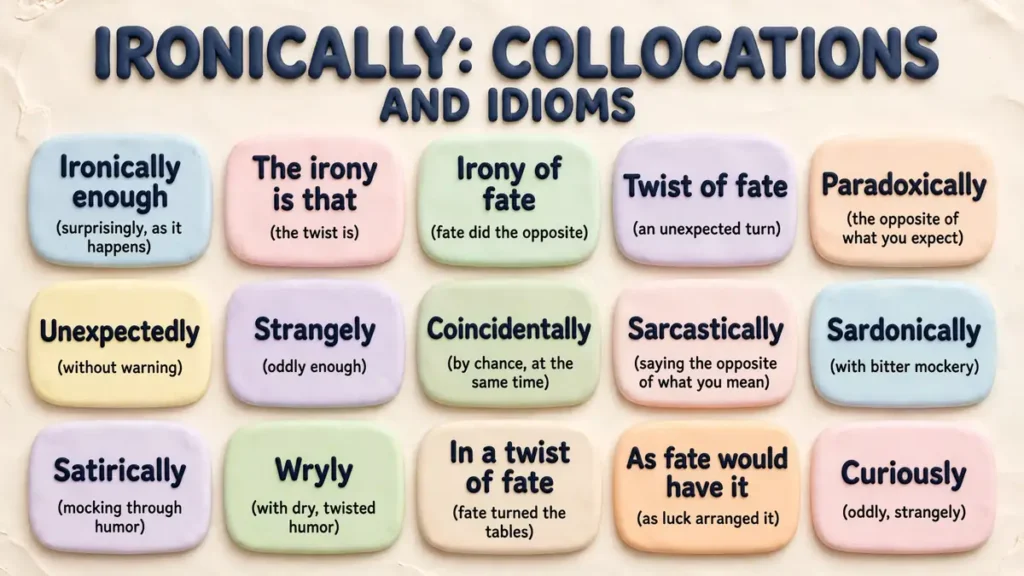
Only combinations native speakers actually use:
- ironically enough: the soft opener, as in “Ironically enough, the fire station burned down.”
- the irony is that…: the classic setup for the twist that follows.
- in a twist of irony: the storyteller’s phrase, as in “In a twist of irony, the lifeguard could not swim.”
- irony of fate: the formal phrase for a twist dealt by destiny.
- twist of fate: the same idea in plainer words.
- the joke was on him: the laughter turned back on the joker.
- the fire station burned down: the classic textbook example of situational irony.
One note on the long-running debate about a famous song called “Ironic”: people often point out that its examples are coincidences, not irony. If the example is only a coincidence, the word does not fit.
American vs British English
Ironically is spelled and used the same in American and British English, and so are its synonyms here. The phrase “ironically enough” is common on both sides of the Atlantic. One small difference is tone: British writers lean a little more on wryly and sardonically, while American writers reach for sarcastically more often. This article uses American spelling throughout.
Practice Exercises
Exercise 1: Fill in the blank. Choose the best word from the bank: paradoxically, unexpectedly, sarcastically, coincidentally, wryly.
- ___, the more choices we had, the harder it was to choose.
- The bus arrived ___ early, and she caught the first train.
- “Oh, brilliant,” she said ___, as the rain ruined the picnic.
- ___, both sisters booked the same flight home.
- “Of course it rained on moving day,” she noted ___.
Exercise 2: Correct or incorrect? Say whether each sentence uses ironically correctly. Fix the wrong ones.
- “Ironically, the fire station burned down.”
- “Ironically, both sisters booked the same flight home.”
- “Ironically, the meeting ended early.”
- “Ironically, the driving instructor failed his own test.”
Answer key
- Exercise 1: (1) Paradoxically; (2) unexpectedly; (3) sarcastically; (4) Coincidentally; (5) wryly.
- Exercise 2: (1) Correct; (2) Incorrect, a shared flight is a coincidence, say “Coincidentally”; (3) Incorrect, an early finish is a plain surprise, say “Unexpectedly”; (4) Correct.
Frequently Asked Questions
What is the best synonym for ironically?
Paradoxically is the best synonym when the clash is one of logic, because it names a self-contradiction directly. For a twist of fate, ironically itself stays the best word. For plain surprise, use unexpectedly. Match the synonym to the kind of surprise.
Is ironically the same as coincidentally?
No. A coincidence is two things happening at the same time by chance, like two sisters booking the same flight. Irony needs the twist: the outcome turns against the purpose, like a fire station burning down. If the timing does not mock the meaning, say coincidentally.
Can ironically mean sarcastically?
Only when the irony lives in the words themselves. Sarcastically means the speaker says the opposite of what they mean, in order to mock. Ironically can describe events with no speaker at all. Use sarcastically for dialogue and tone, and ironically for twists of fate.
What is the difference between ironically and paradoxically?
Paradoxically fits a contradiction of logic, such as more choices making a decision harder. Ironically fits a twist of fate, such as a driving instructor failing his own test. One clashes with reason; the other clashes with purpose. Paradoxically is also the more formal word.
What is the opposite of ironically?
It depends on the sense. For events, the opposites are expectedly and predictably. For words, the opposites are sincerely and earnestly. Fittingly is the warmest choice: it says the outcome deserved its ending. Pick from the same meaning group as the sense you used.
Which synonym should students use in essays?
In essays, prefer paradoxically for logical contradictions and ironically for twists of fate, because both sound clear and academic. Use unexpectedly for plain surprises and incongruously for a visible mismatch. Save sarcastically and sardonically for fiction and dialogue, and keep coincidentally for chance timing.
Conclusion
The fire station, the driving test, the lifeguard who could not swim: each twist works because the outcome turns against the purpose. Keep ironically for those moments, paradoxically for clashes of logic, and unexpectedly for plain surprises. The right word shows the reader why the surprise stung.

About Sajjad Ahmed
Sajjad Ahmed is the author behind Guest Paster, where he writes about English vocabulary, synonyms, word meanings, and practical word usage.
His content is designed to help readers understand the differences between similar words, discover suitable alternatives, and use English vocabulary more effectively in everyday writing and communication.
Before publishing, Sajjad focuses on presenting word choices in a clear and easy-to-understand format, with relevant meanings, context, and examples where helpful.
Through Guest Paster, his goal is to make vocabulary learning simpler and provide useful language resources for students, writers, English learners, and anyone looking to expand their vocabulary.
Areas of Focus: English Vocabulary • Synonyms • Word Meanings • Word Usage • Language Learning
Author: Sajjad Ahmed
Website: Guest Paster