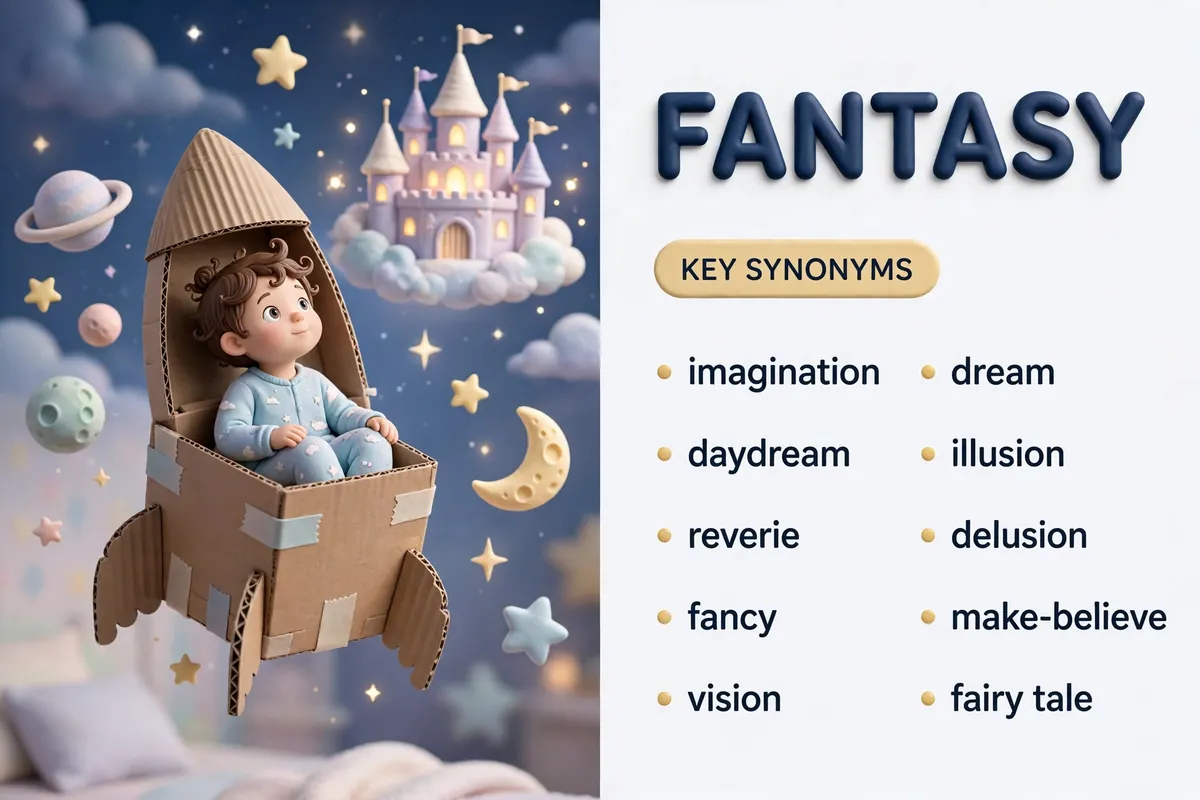
What do you call the world inside your head when the real one feels too small? Is it a daydream, a vision, or a fantasy? The word fantasy covers all three, and that breadth is why it trips writers up. A fantasy can be a pleasant daydream, a whole genre of dragons and quests, or a belief with no grip on reality.
The closest match is daydream, because it carries the same sense of a pleasant imagined scene. Imagination names the power behind it, while illusion and delusion belong to beliefs that mislead.
This guide gives you 15 fantasy synonyms, each with its meaning, its limits, and two real examples, so your pick says precisely what you mean.
Top Fantasy Synonyms at a Glance
| # | Synonym | Meaning Difference |
|---|---|---|
| 1 | Imagination | The power that creates imagined scenes |
| 2 | Daydream | A pleasant waking dream |
| 3 | Reverie | A dreamy, lost-in-thought state |
| 4 | Fancy | A playful or fanciful imagining |
| 5 | Vision | A vivid future picture |
| 6 | Dream | A hope or an imagined goal |
| 7 | Illusion | Looks real, but is not |
| 8 | Delusion | A false belief, held firmly |
| 9 | Make-believe | Playful pretending |
| 10 | Fairy tale | A wonder-filled story |
Quick Facts About “Fantasy”
- Part of speech: a noun. It also works as an adjective, as in fantasy football, and rarely as a verb meaning to imagine.
- Core meaning: something imagined, especially a daydream or an invented world, often far from reality.
- Three main uses: (1) imagination and daydreaming; (2) fiction, games, and worldbuilding; (3) a false or fanciful belief.
- Register: neutral. Fantasy suits novels, essays, and everyday speech.
- Common mistake: using fantasy for any pleasant hope. A realistic goal is a dream, not a fantasy.
Where “Fantasy” Comes From (Etymology)
According to Etymonline, fantasy entered English in the early 14th century meaning an illusory appearance. It came through Old French fantaisie and Latin phantasia, from Greek phantasia, meaning the power of imagination, an appearance, an image, or a perception. That Greek word came from phantazesthai, to picture to oneself, from phantos, visible, from phainein, to show or to bring to light. The root means shining, so at its oldest level fantasy is something brought into the light of the mind.
A whimsical notion or illusion is attested before 1400, and fantastic imagination by the 1530s. The daydream sense is from 1926, and the fiction genre sense from 1939. Early English also used fantasie and phantasy, and the shorter form fantsy once meant an inclination or liking.
Merriam-Webster records the first known use of the noun in the 14th century, and defines it as the power of creating especially unrealistic mental images, and as a creation of the imagination, such as imaginative fiction with strange settings.
The Closest Synonym: Daydream
Daydream is the closest synonym for fantasy: it names the same pleasant imagined scene, built while you are awake. Test the swap and it holds. “Her fantasy is to be a film star” becomes “Her daydream is to be a film star” with no loss of sense. “He lived in a fantasy” becomes “He lived in a daydream” and still reads naturally.
Imagination is the near miss. It names the faculty, the power that does the imagining, not the imagined thing itself. “Her imagination was to be a film star” fails, because a power cannot be a goal.
Choice test: a pleasant waking scene means daydream, the power behind it means imagination, and a belief that misleads means illusion or delusion.
Can You Swap Them Freely?
In short: only inside the same meaning group, and only when the sense matches.
- ✅ “Her daydream is to open a small bakery by the sea.” (a pleasant scene ✔)
- ❌ “Her imagination is to open a small bakery by the sea.” (a power, not a goal ✘, say daydream)
- ✅ “The novel is pure fantasy, full of dragons and hidden kingdoms.” (the genre ✔)
- ❌ “The novel is pure delusion, full of dragons and hidden kingdoms.” (a false belief, not a genre ✘, say fantasy)
- ✅ “He mistook the mirage for an oasis.” (a false appearance ✔)
Before you substitute, ask which fantasy you mean: the daydream, the genre, or the false belief. Most mix-ups come from crossing those three groups.
Fantasy Synonyms in Detail

Group 1: Imagination, Daydreams, and Make-Believe
1. Imagination
- Meaning: The mind’s power to form new ideas, images, or scenes.
- Difference: Imagination is the faculty; fantasy is often its product.
- Best Used For: Education, parenting, creativity writing.
- Formality: Neutral · CEFR: B2 · Frequency: Very common
- Example (School): “A good storyteller feeds a child’s imagination with strange worlds.”
- Example (Work): “The designer used her imagination to turn a plain courtyard into a garden.”
- When NOT to Use It: For the imagined scene itself, use daydream.
2. Daydream
- Meaning: A pleasant series of thoughts about something you wish for, while awake.
- Difference: The closest match: a fantasy you enjoy on purpose.
- Best Used For: Everyday speech, fiction, memoirs, personal essays.
- Formality: Neutral · CEFR: B1 · Frequency: Very common
- Example (School): “During the long maths lesson, her daydream carried her to a beach house.”
- Example (Work): “His daydream of quitting the office kept him smiling through the meeting.”
- When NOT to Use It: For a belief that misleads, use illusion.
3. Reverie
- Meaning: A state of being pleasantly lost in your own thoughts.
- Difference: Reverie stresses the dreamy state, not the content.
- Best Used For: Literary fiction, poetry, reflective essays.
- Formality: Formal · CEFR: C1 · Frequency: Less common
- Example (Travel): “She fell into a reverie on the train.”
- Example (Home): “The old song pulled him into a reverie about summers past.”
- When NOT to Use It: In everyday speech, where daydream sounds natural.
4. Fancy
- Meaning: The free play of creative imagination, often light or playful.
- Difference: Fancy is fantasy’s older twin, and it leans playful, while fantasy can turn dark.
- Best used for: Literary writing, art, historical fiction, playful prose.
- Formality: Neutral to formal · CEFR: B2 · Frequency: Common
- Example (Art): “The painter’s fancy filled the canvas with floating fish.”
- Example (Home): “He took a fancy to building a treehouse for the children.”
- When NOT to use it: For a genre label or a false belief, use fantasy.
5. Vision
- Meaning: A vivid mental picture, often of a future you hope for.
- Difference: A vision has shape and direction; a fantasy can stay vague.
- Best used for: Business writing, speeches, memoirs, goal-setting.
- Formality: Neutral · CEFR: B2 · Frequency: Very common
- Example (Work): “Her vision of a neighborhood library began with one shelf of books.”
- Example (Sports): “The coach shared his vision of a team that never gave up.”
- When NOT to use it: For a belief with no grip on reality, use illusion.
6. Dream
- Meaning: A hope or ambition, or an imagined scene during sleep.
- Difference: A dream can be realistic; a fantasy keeps a gap from what is possible.
- Best used for: Speeches, essays, everyday speech, songwriting.
- Formality: Neutral · CEFR: A2 · Frequency: Very common
- Example (School): “Her dream of becoming a doctor started with a borrowed textbook.”
- Example (Family): “They saved for years to chase the dream of a house.”
- When NOT to use it: When the hope is plainly impossible, fantasy is honest.
7. Illusion
- Meaning: Something that appears real but is not, or a false idea.
- Difference: An illusion deceives the senses or the mind, though the person may see through it.
- Best used for: Psychology, art, magic writing, opinion pieces.
- Formality: Neutral · CEFR: B2 · Frequency: Very common
- Example (Travel): “The shimmering lake on the hot road was only an illusion.”
- Example (Work): “The idea that one advert can fix a weak product is an illusion.”
- When NOT to use it: For a pleasant daydream, use daydream.
8. Delusion
- Meaning: A false belief held firmly despite clear evidence against it.
- Difference: A delusion is held with conviction; an illusion can be a passing trick of the eye.
- Best used for: Psychology, health writing, serious essays, news.
- Formality: Formal · CEFR: C1 · Frequency: Common
- Example (News): “The belief that the town could grow without water was a delusion shared by the council.”
- Example (Health): “His delusion that strangers followed him worried his family.”
- When NOT to use it: For a harmless daydream, use daydream.
9. Make-believe
- Meaning: Pretending that something imagined is real, usually in play.
- Difference: Make-believe is active and playful; a daydream happens quietly in the head.
- Best used for: Parenting, children’s writing, theatre, games.
- Formality: Neutral · CEFR: B1 · Frequency: Common
- Example (Home): “The children turned the sofa into a pirate ship.”
- Example (School): “In make-believe, the cardboard box became a castle.”
- When NOT to use it: For an adult’s false belief, use delusion.
Group 2: The Genre and the Invented World
10. Fairy tale
- Meaning: A wonder-filled story, or a tale too good to be true.
- Difference: Fairy tale names the story form; fantasy is the wider genre.
- Best used for: Book reviews, children’s writing, film writing, storytelling.
- Formality: Neutral · CEFR: B1 · Frequency: Very common
- Example (Books): “The novel reads like a fairy tale, with a brave girl and a talking forest.”
- Example (News): “Their rise from a small shop to a big brand sounds like a fairy tale.”
- When NOT to use it: For a private daydream, use daydream.
11. Invention
- Meaning: Something imagined or created, often a fanciful design.
- Difference: Invention stresses the making; fantasy stresses the imagining.
- Best used for: Art history, design writing, literary criticism.
- Formality: Neutral · CEFR: B2 · Frequency: Very common
- Example (Art): “The garden was a fantasy of delicate tracery, an invention of the architect.”
- Example (Books): “The author’s best invention was a city above the clouds.”
- When NOT to use it: For a daydream or a false belief, use daydream.
12. Phantasy
- Meaning: An old spelling of fantasy, still used in some literary and psychoanalytic writing.
- Difference: Phantasy is the same word in older dress, and modern readers may find it strange.
- Best used for: Historical writing, literary criticism, psychoanalytic texts.
- Formality: Formal · CEFR: C1 · Frequency: Rare
- Example (Books): “In the old romance, the knight’s phantasy of a hidden kingdom drove the plot.”
- Example (Essays): “Freud used phantasy for the scenes his patients described.”
- When NOT to use it: In modern writing, use fantasy.
Group 3: False Beliefs and Things That Are Not Real
13. Hallucination
- Meaning: Seeing or hearing something that is not there, often from illness or drugs.
- Difference: A hallucination is a sensory event; a fantasy is a thought you can choose.
- Best used for: Health writing, medical essays, fiction with care.
- Formality: Neutral to formal · CEFR: C1 · Frequency: Common
- Example (Health): “Fever can bring hallucinations that vanish as it breaks.”
- Example (Books): “The novelist used a hallucination to show how grief bends what the hero sees.”
- When NOT to use it: For an ordinary daydream, use daydream.
14. Mirage
- Meaning: An unreal image, often of water in a desert, or a hope that vanishes on approach.
- Difference: A mirage promises something just out of reach; an illusion can sit anywhere.
- Best used for: Travel writing, poetry, business writing, essays.
- Formality: Neutral · CEFR: B2 · Frequency: Common
- Example (Travel): “The oasis turned out to be a mirage, and the travelers walked on.”
- Example (Work): “Quick riches proved a mirage for the investors who chased the rumor.”
- When NOT to use it: For a story genre, use fantasy.
15. Pipe dream
- Meaning: A hope or plan that is unlikely ever to happen.
- Difference: A pipe dream is a plan judged impossible; a daydream is a pleasure, not a plan.
- Best used for: Everyday speech, business writing, opinion pieces.
- Formality: Neutral · CEFR: B2 · Frequency: Common
- Example (Work): “Opening a shop with no savings was a pipe dream, so she started with a market stall.”
- Example (Sports): “Winning the league in their first season was a pipe dream.”
- When NOT to use it: For a pleasant imagined scene, use daydream.
Collocations and Idioms With Fantasy
Only combinations native speakers actually use:
- fantasy world: an invented world, as in “She escaped into a fantasy world of dragons and quests.”
- live in a fantasy world: to ignore reality, as in “He lives in a fantasy world where bills never arrive.”
- pure fantasy: wholly imagined, as in “His plans are pure fantasy.”
- flights of fantasy: wild imaginings, as in “The novel is full of flights of fantasy.”
- fantasy football: a game where players manage imaginary teams, as in “He spends Sundays checking his fantasy football team.”
One note on usage: “fantasy world” works for both the genre and the daydream, so the sentence around it must show which one you mean.
Best Alternatives by Context

Genre writers lean on lore synonyms for the invented history behind a quest, and reach for extraordinary synonyms when the wonders need a name.
| Situation | Best pick | Why it wins |
|---|---|---|
| A pleasant waking scene | Daydream | Warm |
| The power that imagines | Imagination | The faculty |
| Playful pretending by children | Make-believe | Active and joyful |
| A wonder-filled story | Fairy tale | The story form |
| A false belief held firmly | Delusion | Conviction |
| A plan judged impossible | Pipe dream | A plan |
Which Fantasy Synonym Should I Choose?
| Situation | Best pick | Why it wins |
|---|---|---|
| A pleasant waking scene | Daydream | Warm |
| The power behind the scene | Imagination | The faculty |
| A dreamy, lost-in-thought mood | Reverie | Soft |
| Light, playful imagining | Fancy | Playful |
| A vivid future picture | Vision | Clear |
| A hope that could come true | Dream | Realistic |
| Pretending in play | Make-believe | Active |
| A wonder-filled story | Fairy tale | The story form |
| A fanciful design | Invention | The making |
| An old literary spelling | Phantasy | Historical |
| A trick of the senses | Illusion | Deceives |
| A belief against the evidence | Delusion | Conviction |
| A sight or sound that is not there | Hallucination | Sensory |
| A hope that fades on approach | Mirage | Vanishes |
| An impossible plan | Pipe dream | Impossible |
Antonyms of Fantasy by Meaning
For the daydream sense: what is real and present
| Opposite | Meaning Difference |
|---|---|
| Reality | What is actually true, not imagined |
| Fact | Something known to be true |
| Actuality | The state of things as they really are |
| Truth | What matches the facts |
When the fantasy is a pleasant scene in the head, reality is the cleanest opposite. A daydream ends where reality begins.
For the genre sense: writing that stays with the real world
| Opposite | Meaning Difference |
|---|---|
| Realism | Art that shows life as it really is |
| Nonfiction | Writing based on facts, not invention |
| Documentary | A factual record, often on film |
A fantasy novel invents its world. Realism refuses to invent, and nonfiction reports what happened.
For the false-belief sense: beliefs that hold up
| Opposite | Meaning Difference |
|---|---|
| Truth | What the evidence supports |
| Certainty | A belief with no room for doubt |
| Fact | Something verified and known |
| Sanity | Clear thinking, grounded in reality |
When the fantasy is a belief that misleads, truth is the direct opposite. Certainty fits when the belief is firm.
Words Commonly Confused With Fantasy
Fantasy versus dream is the pair to watch. A dream can be realistic: a dream job, a dream house, a dream of becoming a doctor. A fantasy keeps a gap from reality. “Her dream of becoming a doctor” works because medical school is a real path. When a plan sounds interesting synonyms but has no grounding, call it a fantasy, not a goal.
Fantasy versus imagination matters because imagination is the power and fantasy is often the product. A child with a strong imagination builds rich fantasies. Mixing them up gives you sentences like “Her imagination is to be a film star,” which fails the substitution test.
Fantasy versus illusion matters for who is fooled. An illusion deceives the senses or the mind, like a mirage on a hot road. A fantasy is usually enjoyed on purpose: the dreamer knows it is imagined. A pleasant scene you choose is a fantasy; a false appearance that tricks you is an illusion.
Fantasy versus delusion matters for conviction. A delusion is held firmly despite the evidence, and it can cause real harm. A fantasy is a daydream you can step out of.
Substitution test failures: “Her imagination is to be a film star” fails, because imagination is a power, so say “Her daydream is to be a film star.” “The novel is pure delusion” fails, because delusion is a belief, so say “The novel is pure fantasy.” “His hallucination of a beach house kept him smiling” fails, because a hallucination is sensory and unwilled, so say “His daydream of a beach house kept him smiling.”
American vs British English
Fantasy is spelled and used the same in American and British English, and so are its synonyms here. The old variant phantasy appears in both, though it is rare today. British readers often say “fantasy fiction” where Americans say “fantasy” alone. “
Fantasy football” is far more common in American English, where it names a huge game. This article uses American spelling throughout.
Practice Exercises
Exercise 1: Match each synonym to the sentence it fits. Synonyms: (a) daydream (b) mirage (c) make-believe (d) delusion (e) reverie 1. The children turned the garden into a kingdom in their ___ game. 2. On the train, she drifted into a quiet ___ about her childhood home. 3. His ___ of a beach house carried him through the dull meeting. 4. The shimmering lake on the desert road was only a ___. 5. The belief that the town could grow without water was a ___ shared by the whole council.
Exercise 2: Rewrite each sentence. Replace fantasy with a better word from this article. 1. “Her fantasy is to open a small bakery by the sea.” 2. “The novel is pure fantasy, full of dragons and hidden kingdoms.” 3. “His fantasy that strangers were following him worried his family.”
Answer key 1. Exercise 1: (1) c, make-believe; (2) e, reverie; (3) a, daydream; (4) b, mirage; (5) d, delusion. 2. Exercise 2: (1) daydream; (2) fairy tale; (3) delusion.
Frequently Asked Questions
What is the best synonym for fantasy?
Daydream is the best synonym for the everyday sense, because it names the same pleasant imagined scene and passes the substitution test. For the power behind the scene, use imagination. For a false belief, use illusion or delusion. Match the synonym to the meaning group you mean.
Is fantasy the same as a dream?
No. A dream can be realistic, like a dream job or a dream of becoming a doctor. A fantasy keeps a gap from reality, like a castle in the clouds. Use dream when the hope has a real path, and fantasy when the scene stays imagined.
Can fantasy mean a genre of fiction?
Yes. Since 1939, fantasy has named a genre of fiction with strange settings and invented worlds, including novels, films, and games. In that sense, fairy tale is the closest synonym for a story, and fantasy fiction is the full genre label.
What is the difference between fantasy and illusion?
A fantasy is usually enjoyed on purpose, and the dreamer knows it is imagined. An illusion deceives the senses or the mind, like a mirage on a hot road. A pleasant scene you choose is a fantasy; a false appearance that tricks you is an illusion.
What is the opposite of fantasy?
It depends on the sense. For a daydream, the opposite is reality. For the genre, the opposites are realism and nonfiction. And for a false belief, the opposite is truth. Pick the opposite from the same meaning group as the sense you used.
Which synonym should students use in essays?
In essays, use daydream for a pleasant imagined scene and imagination for the power that creates it. Use vision for a vivid picture of the future, and illusion for a belief that misleads. Save delusion and hallucination for serious contexts.
Conclusion
A fantasy can be a daydream, a genre full of dragons, or a belief with no grip on reality. Daydream carries the pleasure, imagination names the power and illusion warns that something is not real.

About Sajjad Ahmed
Sajjad Ahmed is the author behind Guest Paster, where he writes about English vocabulary, synonyms, word meanings, and practical word usage.
His content is designed to help readers understand the differences between similar words, discover suitable alternatives, and use English vocabulary more effectively in everyday writing and communication.
Before publishing, Sajjad focuses on presenting word choices in a clear and easy-to-understand format, with relevant meanings, context, and examples where helpful.
Through Guest Paster, his goal is to make vocabulary learning simpler and provide useful language resources for students, writers, English learners, and anyone looking to expand their vocabulary.
Areas of Focus: English Vocabulary • Synonyms • Word Meanings • Word Usage • Language Learning
Author: Sajjad Ahmed
Website: Guest Paster