Want to search for synonyms of this? The alternatives could be “it”, this one, the present, the current and so on depending upon the sentence. But there is no word that can substitute for this in every case.
That is because this can be used as both a determiner, pronoun and adverb, and each has its own set of alternatives. Using the incorrect synonym will alter either the meaning or the grammar of a sentence.
Here is a list of some of the best synonyms and alternatives to “this” along with meanings, examples (formal/informal), Antonyms, common mistakes & suggestions on how to pick the correct word.
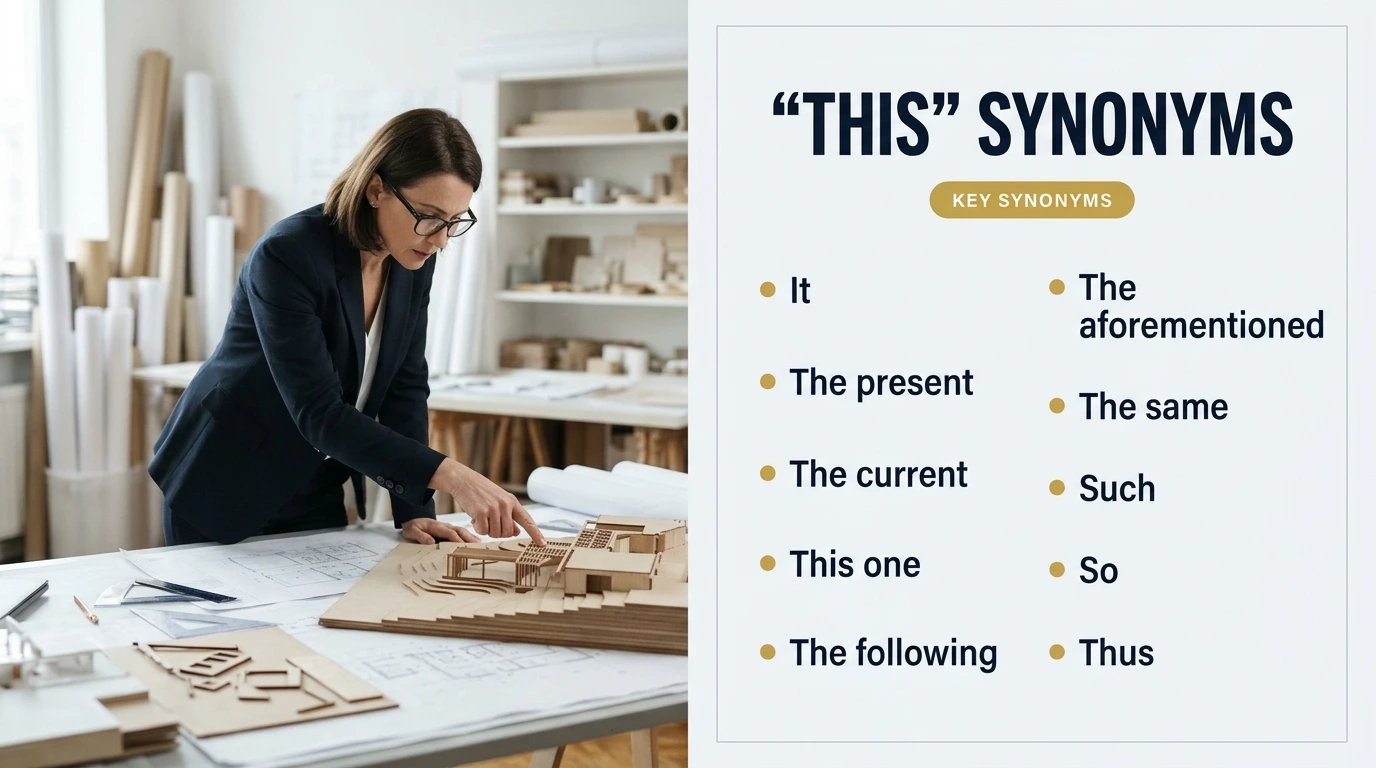
Top 10 Synonyms and Alternatives for This
| Alternative | Best Meaning or Use | Example |
| It | Refers back to something already known | The plan failed, but it taught us a lot. |
| The present | Current document, study, or matter | The present study examines sleep habits. |
| The current | Existing or valid now | The current policy expires in June. |
| This one | A particular choice from several options | I prefer this one. |
| The following | Something coming next | Read the following instructions. |
| The aforementioned | Something mentioned earlier | The aforementioned agreement remains valid. |
| The same | The identical thing already mentioned | Use the same method again. |
| Such | Something of the type just described | Such behavior is unacceptable. |
| So | To this degree or extent | I didn’t expect it to be so difficult. |
| Thus | In this way, usually formal | Positioned thus, the device remains stable. |
Quick answer: If this stands alone and refers to something already clear, it is often the closest natural replacement. In academic phrases such as this study, the present study or the current study may work better. There is no single synonym that can replace this in every sentence.
Quick Facts About This
- Part of speech: Demonstrative determiner, pronoun, and sometimes adverb
- Simple meaning: Points to something near, current, specific, or just mentioned
- Pronunciation: /ðɪs/
- Syllables: One
- Plural form: These
- Formality: Neutral
- Opposite demonstrative: That
- Best pronoun alternative: It, depending on context
- Useful formal alternatives: The present, the current
- Best degree alternative: So
What Is the Closest Synonym for This?
There is no universal synonym for this because its grammatical role changes from sentence to sentence.
When this stands alone as a pronoun and refers to an idea, event, or situation that is already clear, it is often the closest alternative:
- The meeting was cancelled. This surprised everyone.
- The meeting was cancelled. It surprised everyone.
However, it cannot replace this before a noun:
- This method works well. ✓
- It method works well. ✗
In formal or academic writing, the present can sometimes replace this before nouns:
- This study examines consumer behavior.
- The present study examines consumer behavior.
For something valid or happening now, the current may be more precise:
- This policy expires next month.
- The current policy expires next month.
The safest rule is simple: choose the replacement according to the job that this performs in the sentence, not just because the words look similar.
What Does This Mean?
This is a proximal demonstrative. It points toward a person, object, idea, time, situation, or degree that feels close to the speaker or writer.
Compare:
- This book is mine. — a nearby or specifically identified book
- This is important. — an idea or situation already identified
- This week has been busy. — the current week
- I didn’t know it was this difficult. — degree or extent
These meanings overlap, but they do not accept the same replacements.
Different Meanings of This and Their Alternatives
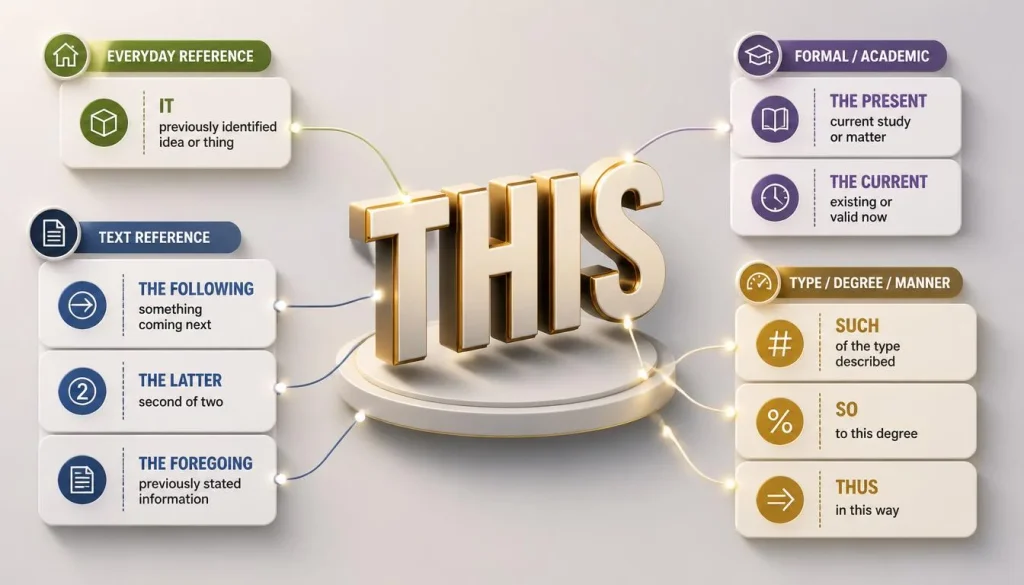
1. A Nearby or Specific Item
Examples:
- this book
- this chair
- this option
Useful alternatives include:
this one, this particular, this very
2. Something Current
Examples:
- this week
- this policy
- this study
Depending on meaning, alternatives include:
the current, the present, today’s
3. An Idea or Situation Already Mentioned
Example:
The server failed overnight. This delayed the launch.
Possible alternatives include:
it, this failure, this problem, this delay, the latter — depending on exactly what you mean.
4. A Textual Reference
For material mentioned earlier or coming next, useful expressions include:
the aforementioned, the above, the following, the foregoing, what follows
5. Degree or Manner
Examples:
- this tall
- this far
- like this
Depending on the sentence, use:
so, that, thus
This is why lists of “synonyms for this” can be misleading. A word that works perfectly in one meaning may be impossible in another.
Synonyms for This with Meanings and Examples
1. It
Meaning: A pronoun referring to a thing, event, situation, or idea that has already been identified.
Difference from this: It maintains the reference without the pointing emphasis of this.
Best for: Everyday English, essays, explanations, and avoiding repetitive sentence openings.
Formality: Neutral
Examples:
- The printer stopped working, but it was fixed before lunch.
- The proposal was rejected. It will need to be revised.
Avoid it when: The previous sentence contains several possible referents. In that case, name the thing directly.
2. The Present
Meaning: The document, study, discussion, situation, or matter currently being considered.
Difference from this: More formal and especially useful in academic or professional writing.
Best for: Studies, reports, papers, investigations, and formal discussions.
Examples:
- The present study examines how sleep affects memory.
- The present report summarizes the project’s results.
Avoid it when: Pointing to ordinary physical objects. You would not normally say the present pen to mean this pen.
3. The Current
Meaning: Existing, happening, or valid now.
Difference from this: Emphasizes time and often suggests that another version existed before or may exist later.
Best for: Policies, versions, prices, situations, systems, and periods.
Examples:
- The current policy allows employees to work remotely twice a week.
- The current version fixes several security issues.
Avoid it when: You simply want to point to a physical object.
4. This One
Meaning: A particular item selected from a visible or understood group.
Difference from this: Makes the act of selection clearer.
Best for: Shopping, comparisons, choices, and everyday conversation.
Examples:
- I don’t want the larger bag; I’ll take this one.
- Of the three designs, this one is the easiest to read.
Avoid it when: Referring to a broad abstract idea rather than an identifiable choice.
5. The Following
Meaning: Something that comes next in a text, explanation, or sequence.
Difference from this: Clearly points forward.
Best for: Lists, instructions, questions, examples, and documents.
Examples:
- Please submit the following documents with your application.
- Consider the following example.
Avoid it when: Referring to something already discussed.
6. The Aforementioned
Meaning: A person, thing, or matter already mentioned earlier.
Difference from this: Much more formal and specifically backward-looking.
Best for: Legal documents, formal reports, and official writing.
Examples:
- The aforementioned tenant must provide proof of insurance.
- Payment for the aforementioned services is due within 30 days.
Avoid it when: Writing conversationally. It usually sounds unnecessarily bureaucratic in emails, blog posts, or everyday speech.
7. The Same
Meaning: The identical thing, method, person, or action previously mentioned.
Difference from this: Emphasizes identity rather than proximity.
Best for: Repeated processes, comparisons, and instructions.
Examples:
- Apply the same method to the second sample.
- If the error returns, follow the same steps.
Avoid it when: The second item is only similar rather than identical.
8. Such
Meaning: Of the type or kind just described.
Difference from this: Refers to a category or type instead of simply pointing to one item.
Best for: Generalizations, formal explanations, and argumentative writing.
Examples:
- Such behavior can damage workplace trust.
- Such delays are uncommon during summer.
Compare:
- This mistake caused the problem. — one specific mistake
- Such mistakes can cause problems. — mistakes of that kind
9. So
Meaning: To the degree or extent being described.
Difference from this: Replaces this only when this expresses degree.
Best for: Size, intensity, amount, distance, or degree.
Examples:
- I didn’t expect the test to be so difficult.
- Why is the room so cold?
Compare:
- I didn’t know it was this difficult.
- I didn’t know it was so difficult.
Avoid it when: This is functioning as a determiner or pronoun.
10. Thus
Meaning: In this way or manner.
Difference from this: Formal and restricted mainly to manner expressions rather than ordinary pointing.
Best for: Academic, technical, or formal explanations.
Examples:
- Positioned thus, the frame remains stable.
- The system has performed well thus far.
Avoid it when: This comes before a noun. Thus report or thus method is not grammatical.
11. That
Meaning: A demonstrative normally pointing to something more distant.
Difference from this: That is usually a contrast or opposite rather than a true synonym, but the two overlap in some degree expressions.
Examples:
- I didn’t realize the building was that tall.
- Don’t stand that close to the edge.
For physical pointing, however, the distinction matters:
- this chair = near
- that chair = farther away
12. The Above
Meaning: Information, text, figures, or an item located earlier on the page or screen.
Best for: Reports, forms, emails, and documentation.
Examples:
- Please review the above figures before approving the budget.
- Contact us at the above address.
Avoid it when: Speaking, where there may be no visible page position.
13. The Given
Meaning: Something supplied, stated, or specified for the task being discussed.
Best for: Mathematics, science, research, and technical instructions.
Examples:
- Solve the problem using the given equation.
- Analyze the given data set.
It is usually too technical for ordinary conversation.
14. This Particular
Meaning: One specific item singled out from a larger group.
Difference from this: Adds emphasis and contrast.
Examples:
- This particular model uses less energy.
- Why was this particular route selected?
Use it when the distinction between one item and similar alternatives actually matters.
15. This Very
Meaning: The exact person, object, place, or moment being identified.
Difference from this: Adds strong emphasis.
Examples:
- The agreement was signed in this very room.
- She called me this very morning.
It works well in storytelling and persuasive writing but can sound dramatic in technical prose.
16. The Latter
Meaning: The second of two things previously mentioned.
Best for: Comparisons and structured formal writing.
Example:
- We considered leasing and purchasing; the latter offered better long-term value.
Important: Use the latter only when two choices have been mentioned. With three or more items, name the intended item directly.
17. The Foregoing
Meaning: The facts, arguments, clauses, or information stated previously.
Best for: Legal and highly formal writing.
Example:
- Based on the foregoing, the committee recommends further review.
For ordinary writing, a specific noun is usually clearer.
18. What Follows
Meaning: The information that comes next.
Best for: Introductions, reports, books, and structured explanations.
Examples:
- What follows is a summary of the investigation.
- Pay close attention to what follows.
Unlike the aforementioned or the foregoing, this expression points forward.
Best Alternatives for This by Context
| Context | Best Alternatives |
| Everyday conversation | it, this one |
| Academic writing | the present, the current, specific summary nouns |
| Formal writing | the present, the one in question, the aforementioned |
| Business writing | the current, the following, the above |
| Legal writing | the aforementioned, said, the foregoing, the instant |
| Choosing an object | this one |
| Referring to a type | such |
| Degree or intensity | so, that |
| Formal manner | thus |
| Referring to second of two items | the latter |
| Introducing upcoming material | the following, what follows |
Another Word for This in an Essay
If you’re searching for a synonym for this in an essay, replacing the word is not always the best solution. Often, the stronger edit is to tell the reader exactly what this refers to.
Weak:
This shows that customer demand is falling.
Better:
This trend shows that customer demand is falling.
More formal:
These findings indicate that customer demand is falling.
Instead of repeatedly beginning sentences with This, try specific nouns such as:
- this finding
- this result
- this trend
- this pattern
- this evidence
- this change
- this argument
- this approach
- this distinction
- this increase
- this decline
- this problem
These phrases are often clearer than replacing this with a more complicated synonym.
Alternatives for This Study
For this study, useful alternatives include:
- the present study
- the current study
- the present investigation
- the current research
- this research
- this analysis
- our study
- our analysis
Choose according to context rather than rotating them simply to avoid repetition.
For example:
The present study examines the relationship between sleep and concentration.
sounds natural in academic prose, while:
The aforementioned study examines…
may sound unnecessarily legalistic unless you are referring to a different study already mentioned.
Alternatives for This Shows
If you are really searching for alternatives to this shows, replacing shows or naming the subject usually gives better results.
Instead of:
This shows that the strategy worked.
Try:
- This finding demonstrates that the strategy worked.
- The results indicate that the strategy worked.
- The evidence suggests that the strategy worked.
- This pattern illustrates the effect of the strategy.
- The data reveals a measurable improvement.
The best choice depends on how strong the evidence actually is. For example, suggests is more cautious than demonstrates.
Alternatives for This Is Because
Instead of repeatedly writing this is because, you can sometimes use:
- because
- since
- as
- for this reason
- this results from
- this stems from
- this occurs because
Example:
Wordy:
This is because of the fact that demand decreased.
Better:
This is because demand decreased.
More concise:
This stems from lower demand.
The goal is clarity, not simply replacing one phrase with another longer phrase.
Alternatives for This Word and This Sentence
When discussing language itself, more precise nouns often work better.
For this word, consider:
- the term
- the expression
- the word
- the lexical item
For this sentence, consider:
- the sentence
- the statement
- the clause
- the passage
Again, these are phrase-level alternatives rather than direct synonyms for this.
Can These Synonyms Be Used Interchangeably?
No.
The main reason is grammar. This performs several different jobs, and each alternative covers only part of its meaning.
Consider:
This report explains the problem.
Here this comes before a noun. You might write:
The present report explains the problem.
But not:
It report explains the problem. ✗
Now consider:
This surprised me.
Here this stands alone. Depending on context:
It surprised me. ✓
Finally:
I didn’t expect the box to be this heavy.
Here this expresses degree:
I didn’t expect the box to be so heavy. ✓
Before choosing a synonym, identify whether this is pointing, modifying a noun, referring back to an idea, identifying something current, or expressing degree.
Exact and Near Synonyms: What’s the Difference?
Strictly speaking, this has very few exact synonyms.
It is a demonstrative, meaning its interpretation depends on context: what the speaker is pointing to, what has just been mentioned, what is nearby, or what is happening now.
Most words on a this synonyms list are therefore functional or near alternatives, not perfect substitutes.
For example:
- it preserves reference but loses the pointing emphasis
- the present adds formality
- the current emphasizes time
- the aforementioned points specifically backward in a document
- what follows points forward
- such refers to a type or class
- so expresses degree
- thus expresses manner in formal English
The best synonym is therefore the one that preserves the meaning you need in that particular sentence.
Words Commonly Confused with This
Some related words frequently appear in searches for this synonyms even though they are not direct substitutes.
These
These is the plural form of this, not a synonym.
- this book
- these books
That
That is another demonstrative, but it normally indicates greater distance.
- this chair — near
- that chair — farther away
Those
Those is the plural counterpart of that.
The
The identifies a known noun but does not carry the same sense of proximity or pointing.
Compare:
- this report
- the report
Both may identify the same document, but their emphasis differs.
Therefore, Hence, and Consequently
These words express a result or consequence. They cannot replace this as a pronoun or determiner.
Correct:
The road was closed; therefore, we took another route.
Incorrect:
Therefore book belongs to me.
Common Mistakes When Replacing This
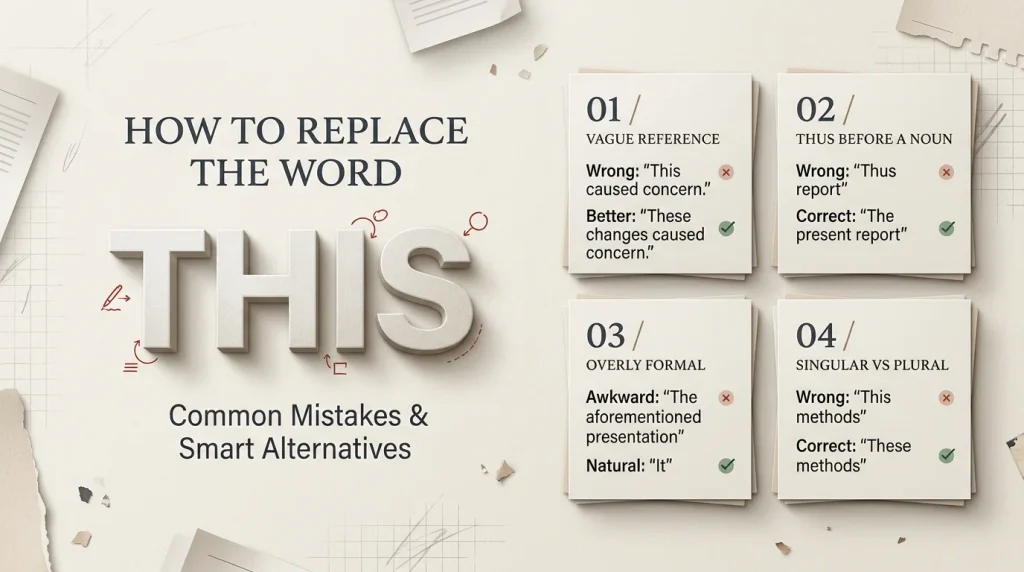
1. Leaving This Too Vague
Weak:
Costs increased and customer demand fell. This caused concern.
What caused concern: the costs, demand, or both?
Better:
Costs increased and customer demand fell. These changes caused concern.
A clear summary noun removes ambiguity.
2. Using Thus Before a Noun
Incorrect:
Thus report explains the problem.
Correct:
This report explains the problem.
Or:
The present report explains the problem.
Thus is not a determiner.
3. Using Legal Language in Everyday Writing
Awkward:
I sent the presentation yesterday. Please review the aforementioned presentation.
Natural:
I sent the presentation yesterday. Please review it.
Formal vocabulary is useful only when the context requires it.
4. Using The Latter for More Than Two Items
Unclear:
We compared Python, Go, and Rust and selected the latter.
Better:
We compared Python, Go, and Rust and selected Rust.
The latter traditionally identifies the second of two previously mentioned alternatives.
5. Using This with Plural Nouns
Incorrect:
This methods produced similar results.
Correct:
These methods produced similar results.
Remember:
this = singular
these = plural
Antonyms of This
The most direct opposite of this is that, because this usually indicates proximity while that indicates greater distance.
| Word | Contrast with This |
| That | Farther rather than near |
| Those | Distant plural counterpart |
| The other | A different option |
| Another | A different item |
| The opposite | Contrary thing or position |
Example:
This book is beside me; that book is on the shelf.
For plural nouns:
These books are mine; those books are yours.
Common Collocations with This
Learning common combinations can be more useful than memorizing isolated synonyms.
This + Noun
- this time
- this week
- this morning
- this way
- this case
- this point
- this stage
- this study
- this method
- this approach
- this issue
- this type
- this kind
Common Sentence Starters
- this shows that
- this means that
- this suggests that
- this indicates that
- this is because
- this is why
- this raises the question
Prepositional Phrases
- in this case
- at this point
- by this time
- for this reason
- in this context
- in this sense
- despite this
- because of this
Verb + This
- consider this
- remember this
- try this
- note this
- look at this
- address this
- resolve this
Common Phrases and Idioms with This
This and That
Means various small things, activities, or topics.
We spent the afternoon talking about this and that.
This Is It
Signals that an important or decisive moment has arrived.
The doors opened, and she thought, this is it.
This Time Around
Means on the present occasion, especially compared with an earlier attempt.
This time around, we tested the system before launch.
It Came to This
Means a situation eventually reached a particular, often unfortunate, point.
Nobody expected the disagreement to come to this.
American vs British English
This has the same standard spelling and basic grammatical function in American and British English. In most contexts, the alternatives discussed in this guide work in both varieties.
Differences are more likely to appear in surrounding expressions, regional speech habits, or preferences in formal writing than in the word this itself.
For general writing, you do not need a separate American or British synonym list. Focus instead on grammar, clarity, formality, and context.
How to Choose the Right Synonym for This
Before replacing this, ask three questions:
1. What exactly am I referring to?
If the answer is unclear, name it:
this → this finding / this problem / this change
2. What grammatical job is this doing?
Before a noun:
the present, the current, this particular
Standing alone:
it, or a specific noun phrase
Expressing degree:
so
3. What tone does the sentence need?
Casual:
it, this one
Academic:
the present, the current, this finding
Business:
the current, the following, the above
Legal:
the aforementioned, said, the foregoing
Choosing by meaning + grammar + tone is far more reliable than simply picking the first synonym from a thesaurus.
Practice Exercises
Choose the best option: the present, this one, it, the following, so
- ______ study examines how sleep affects memory.
- I don’t want the black jacket; I prefer ______.
- The software crashed overnight. ______ delayed the launch.
- Please submit ______ documents: your ID and proof of address.
- I didn’t expect the exam to be ______ difficult.
Answers
- The present
- this one
- It
- the following
- so
Frequently Asked Questions
What is the closest synonym for this?
There is no single synonym that works everywhere. It is often the closest alternative when this stands alone and refers to something already identified, while the present or the current can work before nouns in formal contexts.
Can I always replace this with it?
No. It can replace some pronoun uses of this, but it cannot be placed before a noun. For example, It surprised me may replace This surprised me, but it report cannot replace this report.
What is another word for this in an essay?
Depending on the sentence, use the present, the current, it, the latter, or—often better—a specific noun such as this finding, this result, this trend, this evidence, or this argument.
What can I use instead of this shows?
Try this finding demonstrates, the results indicate, the evidence suggests, this pattern illustrates, or the data reveals, depending on the strength and type of evidence.
What can I use instead of this study?
Common academic alternatives include the present study, the current study, the present investigation, this research, our study, and our analysis.
Is this a formal word?
This itself is neutral and works in both casual and formal English. The alternatives change the tone: the present sounds academic, while the aforementioned and the foregoing are much more formal.
When should I avoid starting a sentence with this?
Starting with this is grammatically acceptable, but avoid a bare this when readers might not know what it refers to. Instead of This proves…, consider This finding suggests… or another specific noun phrase.
What is the opposite of this?
The closest direct opposite is that. This normally points to something nearer or more immediate, while that points to something more distant. The plural contrast is these vs. those.
Conclusion
Finding the right synonym for this is less about avoiding repetition and more about making your meaning precise. It works well for a clear back-reference, the present and the current suit many formal contexts, this one identifies a choice, such describes a type, and so expresses degree.
In essays and professional writing, however, the strongest solution is often not another synonym at all. If this could leave the reader wondering “this what?”, name the idea directly: this finding, this trend, this change, this problem, or another specific noun. That small change makes your writing clearer, more natural, and easier to understand.

About Sajjad Ahmed
Sajjad Ahmed is the author behind Guest Paster, where he writes about English vocabulary, synonyms, word meanings, and practical word usage.
His content is designed to help readers understand the differences between similar words, discover suitable alternatives, and use English vocabulary more effectively in everyday writing and communication.
Before publishing, Sajjad focuses on presenting word choices in a clear and easy-to-understand format, with relevant meanings, context, and examples where helpful.
Through Guest Paster, his goal is to make vocabulary learning simpler and provide useful language resources for students, writers, English learners, and anyone looking to expand their vocabulary.
Areas of Focus: English Vocabulary • Synonyms • Word Meanings • Word Usage • Language Learning
Author: Sajjad Ahmed
Website: Guest Paster