Many learners mix up two very different uses of cross. They hear “cross the road” and think the word always means going from one side to the other. Then they hear “do not cross me” and the same word suddenly means something sharp and personal.
The mistake is natural because cross really does both jobs and a third one too, when you cross out a wrong answer. This guide sorts 15 cross synonyms by meaning so you can pick the word that fits, whether you mean angry, going across or crossing something out.
Another Word For Cross Synonyms at a Glance
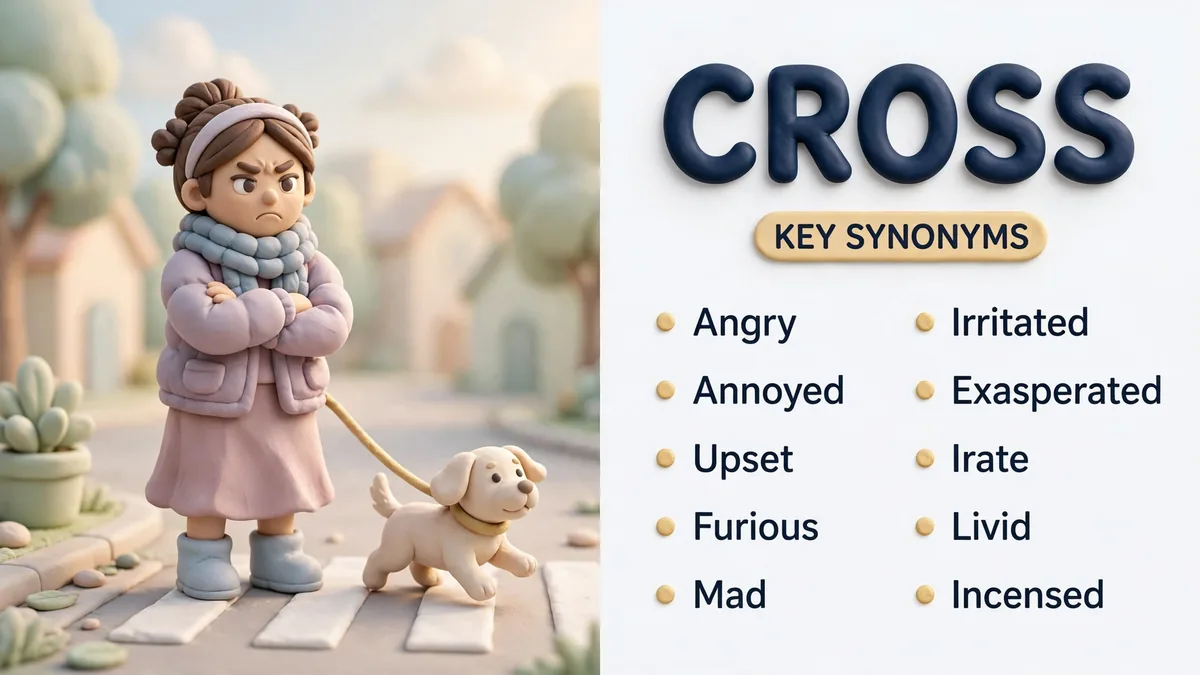
| # | Synonym | Meaning Difference |
|---|---|---|
| 1 | Angry | Feeling strong displeasure |
| 2 | Annoyed | Mildly irritated by something small |
| 3 | Upset | Emotionally disturbed or hurt |
| 4 | Furious | Extremely angry, almost out of control |
| 5 | Mad | Very angry, common in American English |
| 6 | Irritated | Bothered by a repeated annoyance |
| 7 | Exasperated | Tired of dealing with a problem |
| 8 | Irate | Angry in a formal, forceful way |
| 9 | Livid | So angry your face changes color |
| 10 | Incensed | Angry because something feels unfair |
Quick Facts About “Cross”
- Part of speech: an adjective for angry, a verb for going across or crossing out, and a noun for two lines meeting.
- Three core meanings: (1) angry, (2) to go from one side to the other, (3) to cancel or block, as in cross out.
- Register: the angry sense is everyday speech, stronger in British English. The going-across sense is neutral.
- Gradable: a little cross or very cross; cross one road or a whole country.
Where “Cross” Comes From (Etymology)
According to Etymonline, cross as a noun entered Old English as “cros” in the mid-10th century. It came through Old Norse forms from Old Irish “cros,” and that form came from Latin “crux,” meaning a stake or a cross. It began as a physical object, two pieces of wood joined at right angles.
The adjective came later. Etymonline dates it to the 1520s, in part as a shortening of “across.” Adverse or opposed dates from the 1560s, and peevish or ill-tempered persons from the 1630s. That past explains the angry sense: a cross person stands against you.
The verb “to go across” is recorded from around 1400, “to cancel by drawing a line over” from the mid-15th century, and “to thwart or obstruct” from the 1550s. Merriam-Webster confirms the same range: the adjective means marked by typically transitory bad temper, and the verb means to extend across or over, to traverse, to go from one side to the other, and to cancel by marking a cross on.
The Closest Synonym: Angry
Angry is the closest synonym for cross, because it covers the word’s most common everyday job: naming a bad temper that flares up and then passes. When a teacher is cross with a late class, she is angry with them. In most short sentences you can swap them.
Still, angry is not identical to cross. Angry is the plainer, wider word, and it works in every English-speaking country. Cross is softer and shorter lived, and it sounds more British than American. A cross person is annoyed and out of sorts, often for a clear reason, while an angry person can be mildly annoyed or furious. Cross adds a grumpy, peevish edge.
Choice test: a bad temper that will pass means angry or cross, a slow repeated annoyance means irritated, a burst of rage means furious, and going across means traverse or pass over.
Cross Synonyms in Detail
Group 1: Cross as angry (adjective)
1. Angry
- Meaning: Feeling strong displeasure because something unfair or wrong has happened.
- Difference: The closest match for cross, and the safest default in every country.
- Best used for: Everyday speech and school writing.
- Formality: Neutral · CEFR: A2 · Frequency: Very common
- Example (Family): “Dad was angry about the broken vase.”
- Example (Work): “She felt angry after her idea was used without credit.”
- When NOT to use it: For going across, where traverse fits better.
2. Annoyed
- Meaning: Mildly irritated by something small, such as noise or delay.
- Difference: Annoyed is lighter than angry.
- Best used for: Everyday complaints and casual conversation.
- Formality: Neutral · CEFR: B1 · Frequency: Very common
- Example (Travel): “He was annoyed by the long ticket queue.”
- Example (School): “The students felt annoyed when the bell rang late.”
- When NOT to use it: For real rage, where furious fits better.
3. Upset
- Meaning: Emotionally disturbed, a mix of sadness, worry, and anger.
- Difference: Upset is broader than angry.
- Best used for: Family talk and careful writing about feelings.
- Formality: Neutral · CEFR: B1 · Frequency: Very common
- Example (Family): “She was upset when her best friend moved away.”
- Example (School): “The class felt upset after the trip was cancelled.”
- When NOT to use it: For cold anger, where irate sounds exact.
4. Furious
- Meaning: Extremely angry, with a force that is hard to hide.
- Difference: Furious is far stronger than cross.
- Best used for: Stories, news, and drama.
- Formality: Neutral · CEFR: B2 · Frequency: Common
- Example (Work): “The manager was furious when the report arrived late.”
- Example (Sports): “Fans were furious after the referee gave the wrong call.”
- When NOT to use it: For a small irritation, use annoyed.
5. Mad
- Meaning: Very angry, in the common American sense of the word.
- Difference: Mad is the everyday American choice.
- Best used for: American conversation and casual writing.
- Formality: Informal · CEFR: A2 · Frequency: Very common
- Example (Family): “Mom got mad when we tracked mud through the kitchen.”
- Example (Friends): “He was mad at his brother for borrowing his bike.”
- When NOT to use it: In British formal writing, use angry.
6. Irritated
- Meaning: Bothered by something that keeps happening, such as a noise.
- Difference: Irritated points to a trigger that repeats.
- Best used for: Work emails and complaints.
- Formality: Neutral · CEFR: B2 · Frequency: Common
- Example (Work): “She felt irritated by the phone ringing all day.”
- Example (Home): “He grew irritated as the dripping tap kept him awake.”
- When NOT to use it: For a single strong shock, use furious.
7. Exasperated
- Meaning: Worn down by a problem that will not go away.
- Difference: Exasperated adds patience running out.
- Best used for: Parents, teachers, and essays.
- Formality: Neutral to formal · CEFR: C1 · Frequency: Common
- Example (School): “The teacher sounded exasperated after repeating the rule.”
- Example (Family): “Dad felt exasperated when the car broke down again.”
- When NOT to use it: For sudden anger, use angry.
8. Irate
- Meaning: Angry in a formal, forceful way, often in a complaint.
- Difference: Irate sounds official and controlled.
- Best used for: Formal complaints and news reports.
- Formality: Formal · CEFR: C1 · Frequency: Less common
- Example (Work): “An irate customer demanded a refund.”
- Example (News): “Irate residents packed the town hall meeting.”
- When NOT to use it: In casual talk, use mad.
9. Livid
- Meaning: So angry that your face turns pale or flushed.
- Difference: Livid paints a picture.
- Best used for: Stories and vivid descriptions.
- Formality: Neutral · CEFR: C1 · Frequency: Less common
- Example (Family): “Grandma was livid when she saw the broken window.”
- Example (School): “The coach was livid after the team ignored the plan.”
- When NOT to use it: For a mild mood, use annoyed.
10. Incensed
- Meaning: Angry because something feels deeply unfair or insulting.
- Difference: Incensed adds a moral edge.
- Best used for: Editorials and formal writing.
- Formality: Formal · CEFR: C1 · Frequency: Less common
- Example (Work): “Staff felt incensed when their pay was cut.”
- Example (News): “Voters were incensed by the broken promise.”
- When NOT to use it: For a small annoyance, use annoyed.
Group 2: Cross as going across (verb)
11. Traverse
- Meaning: To travel across a place, often a long stretch of land.
- Difference: Traverse is formal and steady.
- Best used for: Travel writing and formal essays.
- Formality: Formal · CEFR: C1 · Frequency: Less common
- Example (Travel): “The explorers traversed the desert in twelve days.”
- Example (Geography): “The river traverses the valley before it reaches the sea.”
- When NOT to use it: For a short road crossing, use cross.
12. Span
- Meaning: To stretch across a space, like a bridge over a river.
- Difference: Span can describe a bridge, a career, or a period of time.
- Best used for: Engineering, history, and formal writing.
- Formality: Neutral to formal · CEFR: B2 · Frequency: Common
- Example (Travel): “The bridge spans the river between the two towns.”
- Example (History): “Her career spans four decades of change.”
- When NOT to use it: For a person crossing a road, use cross.
13. Pass over
- Meaning: To go across or above something, moving from one side to the other.
- Difference: Pass over is a plain phrase.
- Best used for: Everyday speech and directions.
- Formality: Neutral · CEFR: B1 · Frequency: Common
- Example (Travel): “The road passes over the hill and down to the lake.”
- Example (School): “The plane passed over the school just after noon.”
- When NOT to use it: When you mean to ignore a point, say skip.
Group 3: Cross as crossing out and blocking (verb)
14. Cross out
- Meaning: To draw a line through words so they no longer count.
- Difference: Cross out is physical and exact.
- Best used for: Editing, lists, and exams.
- Formality: Neutral · CEFR: B2 · Frequency: Common
- Example (School): “Cross out the wrong answer and write the correct one.”
- Example (Work): “She crossed out her old phone number on the form.”
- When NOT to use it: For deleting a computer file, use delete.
15. Thwart
- Meaning: To stop a plan or a person from succeeding.
- Difference: Thwart is formal and deliberate.
- Best used for: News, history, and formal essays.
- Formality: Formal · CEFR: C1 · Frequency: Less common
- Example (News): “Heavy rain thwarted the rescue plan again.”
- Example (Sports): “The goalkeeper thwarted every shot in the second half.”
- When NOT to use it: For a small delay, use slow down.
Can You Swap Them Freely?
In short: only inside the same meaning group, and only when the sense matches.
- ✅ “The teacher was angry with the late class.” (a bad temper ✔)
- ❌ “The teacher was traverse with the late class.” (traverse is movement, not a mood ✘, say angry)
- ✅ “We traversed the valley before sunset.” (going across a place ✔)
- ❌ “We crossed out the valley before sunset.” (cross out means cancel, not travel ✘, say traversed)
- ✅ “Please cross out the wrong answer.” (cancelling with a line ✔)
- ❌ “Please thwart the wrong answer.” (thwart blocks a plan, not a word ✘, say cross out)
Ask which job cross is doing: a mood, a movement, or a cancellation.
Best Alternatives by Context

Pick by the situation, not by the first synonym on a list.
When a child breaks a rule at home, say cross, angry, or mad. A parent who is cross sounds firm but fair, and the mood usually passes by dinner.
When a customer complains in writing, say irate or incensed. Both suit formal letters, because they show a strong feeling with a clear cause. Irate fits one angry customer. Incensed fits a group that feels treated unfairly.
When a small annoyance repeats all day, say annoyed, irritated, or exasperated. Annoyed fits a late bus. Irritated fits a ringing phone. Exasperated fits the fifth time you explain the same rule.
When you describe a journey, say traverse, span, or pass over. Traverse fits a long desert crossing. Span fits a bridge or a career. Pass over fits a road or a plane moving above a place.
When you fix a written mistake, say cross out. It is the exact word for a line drawn through text, and teachers use it in exams. For a computer file, delete is better. For a blocked plan, thwart is the word.
When you write about a team, choose the mood word with care. A cross teammate is annoyed for a moment. For words that describe working together well, see teamwork synonyms, and for words that describe the people around you, see society synonyms and group synonyms.
Which Cross Synonym Should I Choose?
| Situation | Best pick | Why it wins |
|---|---|---|
| A bad temper that will pass | Angry | Plain and universal |
| A small, quick irritation | Annoyed | Light and short lived |
| Hurt feelings mixed with anger | Upset | Covers sadness too |
| A burst of rage | Furious | Strong and hard to hide |
| American casual anger | Mad | Everyday and direct |
| A repeated small annoyance | Irritated | Points to the trigger |
| Patience running out | Exasperated | Anger plus exhaustion |
| A formal complaint | Irate | Official and forceful |
| Anger you can see on a face | Livid | Vivid and physical |
| Anger at unfair treatment | Incensed | Adds a moral edge |
| A long, hard journey | Traverse | Formal and steady |
| A bridge or a long career | Span | About reach |
| Moving above or across a place | Pass over | Plain and simple |
| Cancelling words with a line | Cross out | Exact and physical |
| Blocking a plan on purpose | Thwart | Formal and deliberate |
Words Commonly Confused With Cross
Cross versus across is the pair to watch. Cross is a verb or an adjective: you cross a road, or you feel cross. Across is a preposition or an adverb: you walk across a road. You never say “I across the road.” If a verb is needed, use cross; if a direction word is needed, use across.
Cross versus mad matters across the Atlantic. In American English, mad usually means angry, as in “Mom got mad.” In British English, mad can also mean reckless. A British reader may hear the wrong meaning, so in British formal writing, angry is safer.
Cross out versus delete matters for editing. Cross out means drawing a line through words on paper, so the old words stay visible. Delete means removing text or a file on a screen, so it disappears. A teacher tells students to cross out a wrong answer.
Angry versus upset matters for feelings. Angry means strong displeasure, often aimed at a person or an action. Upset is wider: it can mean sad, worried, or hurt, with anger as only one part. A cancelled trip upsets a class.
Traverse versus cross matters for journeys. Traverse is formal and suits long, hard travel, such as a desert. Cross is plain and suits a road, a river, or a room.
Substitution test failures: “The teacher was traverse with the class” fails, because traverse is movement, so say “the teacher was angry with the class.” “We crossed out the valley” fails, because cross out means cancel, so say “we traversed the valley.” “Please thwart the wrong answer” fails, because thwart blocks a plan, so say “please cross out the wrong answer.” “I across the road” fails, because across is not a verb, so say “I crossed the road.”
Opposites of Cross by Meaning
1. When cross means angry, the opposites are calm and kind words.
- Pleased: happy with what happened, the direct opposite of a bad temper.
- Calm: steady and untroubled, with no anger rising at all.
- Content: quietly satisfied and at ease.
- Cheerful: bright and in good spirits, the opposite of grumpy.
- Patient: willing to wait without anger.
2. When cross means going across, the opposites are words about staying put.
- Stay: remain where you are, instead of crossing.
- Remain: stay in the same place, with no crossing at all.
- Linger: delay on one side, rather than crossing.
- Retreat: go back the way you came.
3. When cross means crossing out or blocking, the opposites are words about allowing and keeping.
- Approve: accept something, instead of striking it out.
- Allow: let a plan go ahead, instead of thwarting it.
- Keep: hold on to words or a plan, instead of crossing them out.
- Support: help a plan succeed.
Collocations and Idioms With Cross
Only combinations native speakers use:
- cross my heart: a promise to tell the truth.
- cross the line: go too far, past what is fair or acceptable.
- cross paths: meet someone by chance.
- cross swords: argue or fight with someone.
- cross your fingers: hope for good luck.
- cross the finish line: complete a race or a long task.
- cross that bridge when you come to it: deal with a problem when it arrives.
- a cross to bear: a hard burden you must carry.
- do not cross me: a warning not to oppose me.
- cross-examine: to question a witness closely.
Use cross the line when someone breaks a rule, and cross paths only for a chance meeting.
American vs British English
Cross as angry is chiefly British. A British teacher says “I am cross with you,” and every pupil understands. An American teacher is more likely to say “I am mad at you” or “I am angry with you.” Americans do use cross, but it sounds old-fashioned to many of them.
The going-across sense works the same everywhere. Cross out is also shared, though Americans often say “cross off” for a list item, while Britons say “cross out.” This article uses American spelling throughout.
Practice Exercises
Exercise 1: Choose the best word. Pick one word from the bank: angry, annoyed, furious, traverse, cross out.
- The teacher was ___ when the class talked through the whole lesson.
- Explorers had to ___ the desert before the summer heat arrived.
- She was ___ by the dripping tap, which kept her awake all night.
- Please ___ the wrong date on the form and write the new one.
- Fans were ___ after the referee gave the wrong call in the final minute.
Exercise 2: Rewrite the sentence. Fix each sentence by replacing the wrong word.
- The teacher was traverse with the late class.
- We crossed out the river in a small boat.
- I across the street to buy bread.
- Please thwart the wrong answer on your test paper.
Answer key
- Exercise 1: (1) angry; (2) traverse; (3) annoyed; (4) cross out; (5) furious.
- Exercise 2: (1) The teacher was angry with the late class; (2) We crossed the river in a small boat; (3) I crossed the street to buy bread; (4) Please cross out the wrong answer on your test paper.
Frequently Asked Questions
What is the best synonym for cross?
Angry is the best synonym when cross means a bad temper, because it works in every country and covers the most common use. For going across, traverse fits a long journey. For cancelling words, cross out is exact. Match the synonym to the meaning you need.
Is cross the same as angry?
Cross and angry are close, but they are not quite the same. Angry is the wider, plainer word and works everywhere. Cross is softer, shorter lived, and chiefly British, with a grumpy edge. A cross teacher is annoyed for a moment, while an angry teacher may face something more serious.
Can cross mean to go across something?
Yes, cross can mean to go from one side to the other. You cross a road, a river, or a room. Traverse fits a long journey, span fits a bridge, and pass over fits movement above a place. The going-across sense is a verb, while the angry sense is an adjective.
What does cross out mean?
Cross out means to draw a line through words, a name, or a number so they no longer count. Teachers use it in exams, and editors use it on drafts. The old words stay visible under the line. For a computer file, delete is better, because the text disappears.
What is the opposite of cross?
It depends on the meaning. For the angry sense, the opposites are calm, pleased, and patient. For going across, the opposites are stay, remain, and retreat. And for crossing out, the opposites are approve, allow, and support. Pick the opposite from the same meaning group.
Which synonym should students use in essays?
In essays, prefer angry for a bad temper, irritated for a repeated annoyance, and exasperated when patience runs out. Use traverse for long journeys and thwart for a blocked plan. Save mad for casual American writing. Avoid livid and incensed unless the strong tone fits the topic, and keep cross itself for British-style passages.
Conclusion
Cross is a small word with three large jobs, each needing its own synonym. Angry names the mood, traverse names the journey, and cross out names the correction. Pick the word that matches the job, and keep the one that fits.

About Sajjad Ahmed
Sajjad Ahmed is the author behind Guest Paster, where he writes about English vocabulary, synonyms, word meanings, and practical word usage.
His content is designed to help readers understand the differences between similar words, discover suitable alternatives, and use English vocabulary more effectively in everyday writing and communication.
Before publishing, Sajjad focuses on presenting word choices in a clear and easy-to-understand format, with relevant meanings, context, and examples where helpful.
Through Guest Paster, his goal is to make vocabulary learning simpler and provide useful language resources for students, writers, English learners, and anyone looking to expand their vocabulary.
Areas of Focus: English Vocabulary • Synonyms • Word Meanings • Word Usage • Language Learning
Author: Sajjad Ahmed
Website: Guest Paster