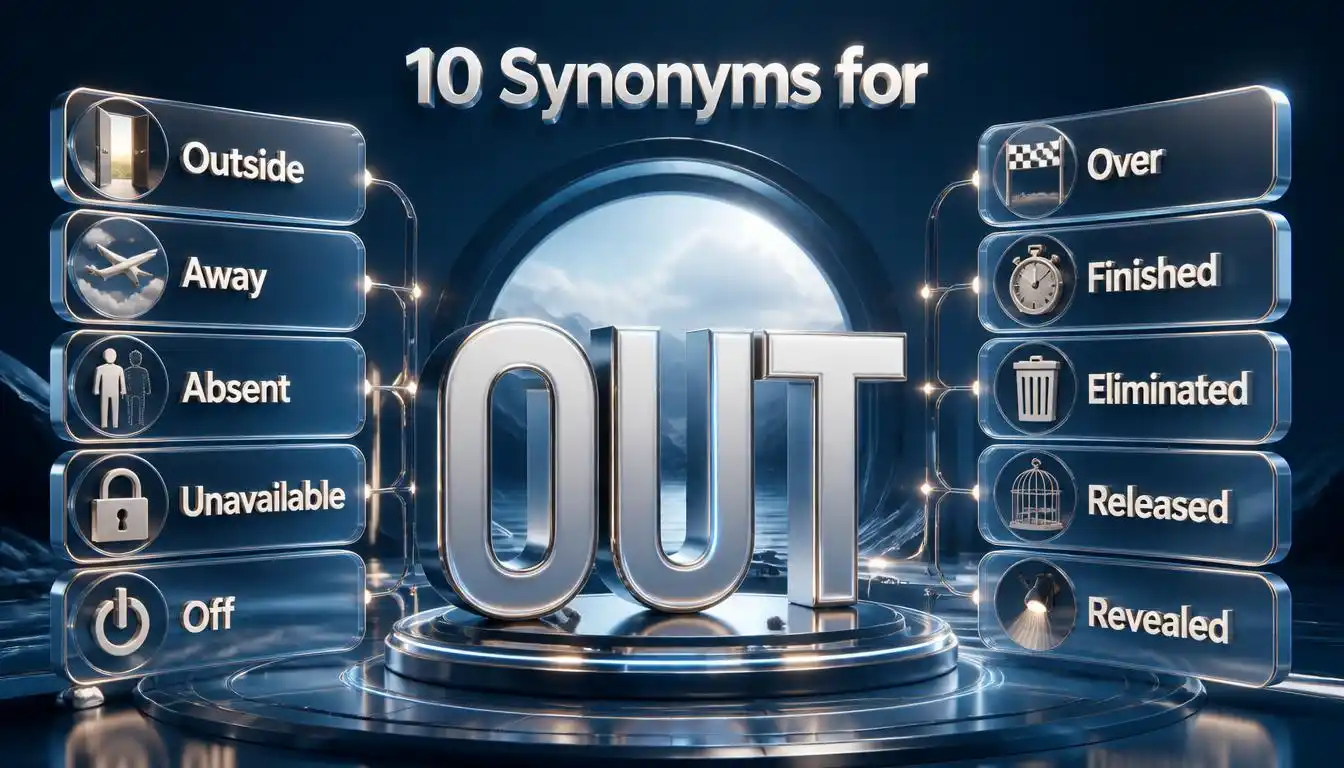
The best synonym for out depends on what the word means in the sentence. Common alternatives include outside, away, absent, unavailable, depleted, off, extinguished, over, eliminated, unconscious, public, released, wrong, visible and unfashionable.
For example, out in “The children are out” can mean outside, while “The power is out” means off or down. In “The secret is out,” better alternatives include public, revealed, or known.
Best Synonyms for Out at a Glance
| If “out” means… | Best alternatives | Example |
|---|---|---|
| Not inside | outside, outdoors | The children are outside. |
| Away or absent | away, absent, gone | Maria is away today. |
| Used up | depleted, exhausted, gone | Our supply is depleted. |
| Unavailable | unavailable, sold out, unavailable for use | The item is unavailable. |
| Not operating | off, down, inactive | The system is down. |
| No longer burning | extinguished, quenched, put out | The fire was extinguished. |
| Finished | over, ended, concluded | The meeting is over. |
| Eliminated | eliminated, defeated, knocked out | The team was eliminated. |
| Unconscious | unconscious, unresponsive | He was unconscious briefly. |
| Public or revealed | public, revealed, disclosed, known | The secret became public. |
| Newly available | released, published, available | The album has been released. |
| Incorrect | wrong, inaccurate, off | The calculation is wrong. |
| Visible or appearing | visible, showing, in view | The stars are visible. |
| Unfashionable | outdated, dated, unfashionable | That style is outdated. |
| Not possible or acceptable | impossible, unacceptable, ruled out | That option is ruled out. |
| Blooming | flowering, blooming, open | The roses are blooming. |
| Intending or determined | intent, determined, aiming | She is determined to win. |
What Does “Out” Mean?
Out is a flexible English word that can function as an adverb, adjective, noun, verb, preposition, and part of many phrasal verbs and expressions.
Its meaning changes according to context.
Compare these sentences:
- The children are out.
- The lights are out.
- The fire is out.
- School is out.
- That player is out.
- The secret is out.
- The new album is out.
- That style is out.
Although every sentence contains the same word, out expresses a different idea each time.
That is why choosing a synonym requires more than finding another word in a thesaurus. You need to understand what out means in the specific sentence.
Synonyms for Out by Meaning
1. Out Meaning Outside
When out means not inside a building, room, or enclosed place, the closest alternatives are:
- outside
- outdoors
- in the open
- exterior
Examples:
The children are out playing.
Better:
The children are outside playing.
Or:
The children are playing outdoors.
Outside is usually the closest replacement when physical location is the intended meaning.
However, it is not interchangeable with out in every grammatical construction.
For example:
Get out.
and:
Get outside.
are similar, but the second sentence specifically directs someone to an outdoor location.
2. Out Meaning Away or Absent
When someone is out, it can mean that the person is away from home, work, an office, or another expected location.
Useful alternatives include:
- away
- absent
- gone
- unavailable
- not here
Example:
Sarah is out today.
Possible replacements:
Sarah is away today.
Sarah is absent today.
Away sounds natural in everyday communication.
Absent is more formal and works particularly well for work, school, meetings, and official records.
3. Out Meaning Used Up
When a supply is out, nothing remains.
Useful alternatives include:
- depleted
- exhausted
- used up
- gone
- finished
- empty
Example:
We are out of printer paper.
Better:
Our supply of printer paper is depleted.
In ordinary conversation, however, used up or gone may sound more natural.
The printer paper is all gone.
Notice that this meaning often appears in the phrase out of, so replacing the entire expression may require changing the sentence structure.
4. Out Meaning Unavailable or Out of Stock
When a product, service, resource, or option is no longer available, alternatives include:
- unavailable
- sold out
- out of stock
- unavailable for purchase
- no longer available
Example:
The black version is out.
Clearer:
The black version is unavailable.
For retail products:
The black version is out of stock.
Use sold out when all available tickets, products, or spaces have been purchased.
5. Out Meaning Not Working
When electricity, equipment, internet service, or another system is out, it usually means that it is not operating.
Useful alternatives include:
- off
- down
- inactive
- disconnected
- unavailable
- not working
Examples:
The power is out.
Better:
The power is off.
Or:
The power supply is down.
The internet is out.
Better:
The internet is down.
Down is especially common for websites, servers, networks, and communication systems.
6. Out Meaning Extinguished
When a fire, flame, or candle is out, it is no longer burning.
Useful alternatives include:
- extinguished
- quenched
- put out
- no longer burning
Example:
The fire is out.
More formal:
The fire has been extinguished.
For candles and flames, extinguished is often an accurate replacement.
However, do not normally use extinguished for electrical lights.
The lights are out.
is more naturally rewritten as:
The lights are off.
7. Out Meaning Finished or Ended
When an event, period, session, or activity is out, the meaning may be finished or ended.
Useful alternatives include:
- over
- finished
- ended
- concluded
- complete
Example:
School is out for the summer.
Possible rewrite:
School has ended for the summer.
Another example:
Time is out.
Depending on context:
Time is over.
or:
Time has expired.
The most natural synonym depends on what has finished.
8. Out Meaning Eliminated
In sports, games, competitions, and contests, out often means eliminated or no longer participating.
Useful alternatives include:
- eliminated
- defeated
- knocked out
- removed
- disqualified
Example:
Brazil is out of the tournament.
Better:
Brazil has been eliminated from the tournament.
In some competitions, knocked out is the more natural phrase.
9. Out Meaning Unconscious
Informally, out can mean unconscious or deeply asleep.
Useful alternatives include:
- unconscious
- unresponsive
- knocked out
- asleep
- fast asleep
Example:
He was out for several minutes.
Clearer:
He was unconscious for several minutes.
If the person was simply sleeping:
He was fast asleep.
Because out can be ambiguous here, a more precise replacement is often better.
10. Out Meaning Public, Revealed, or Known
When information is out, it may mean that it has become public or is no longer secret.
Useful alternatives include:
- public
- revealed
- disclosed
- known
- exposed
- announced
Example:
The secret is out.
Possible rewrites:
The secret has been revealed.
The information is now public.
Everyone knows the secret.
These are related alternatives, but the most natural one depends on the sentence.
11. Out Meaning Released or Available
When a book, movie, album, game, product, or report is out, it may mean that it has been released or is now available.
Useful alternatives include:
- released
- published
- available
- launched
- issued
Example:
Their new album is out.
More formal:
Their new album has been released.
For a book:
Her new book is now available.
For software:
The latest version has been released.
12. Out Meaning Wrong or Inaccurate
Out can sometimes mean incorrect, inaccurate, or different from the correct amount.
Useful alternatives include:
- wrong
- inaccurate
- incorrect
- off
- mistaken
Example:
Our calculations were out.
Clearer:
Our calculations were inaccurate.
Or more conversationally:
Our calculations were off.
This is an important meaning because outside or away would obviously not work as replacements.
13. Out Meaning Visible or Appearing
In some contexts, out means visible, appearing, or present where it can be seen.
Useful alternatives include:
- visible
- showing
- in view
- exposed
- appearing
Example:
The stars are out tonight.
Possible rewrite:
The stars are visible tonight.
This sense demonstrates why sentence context matters. The stars are not “outside” in the ordinary sense of the word.
14. Out Meaning Unfashionable
When a fashion, style, practice, or trend is out, it is no longer popular.
Useful alternatives include:
- unfashionable
- outdated
- dated
- old-fashioned
- out of style
- unpopular
Example:
That hairstyle is out.
Better:
That hairstyle is outdated.
Or:
That hairstyle is no longer fashionable.
The opposite expression is often in, meaning fashionable or popular.
15. Out Meaning Not Possible or Acceptable
Sometimes out indicates that an option is not possible, acceptable, or under consideration.
Useful alternatives include:
- impossible
- unacceptable
- excluded
- ruled out
- not an option
Example:
Canceling the project is out.
Clearer:
Canceling the project is not an option.
Or:
Canceling the project has been ruled out.
16. Out Meaning in Bloom
Flowers can be described as out when they are blooming or open.
Useful alternatives include:
- blooming
- flowering
- open
- in bloom
Example:
The roses are out.
Clearer:
The roses are blooming.
This meaning is less common in everyday American English than some of the others, but it remains a valid use.
17. Out Meaning Determined or Intending
In expressions such as out to win or out to prove something, the word expresses intention or determination.
Useful alternatives include:
- determined
- intent
- aiming
- planning
- seeking
Example:
She is out to prove them wrong.
Possible rewrite:
She is determined to prove them wrong.
This is not a direct one-word substitution. The sentence normally needs restructuring.
Can These Synonyms Directly Replace “Out”?
Not every synonym can be dropped into the exact position occupied by out.
Use this guide:
| Alternative | Replacement type | Example |
|---|---|---|
| outside | Often direct | The kids are out → The kids are outside. |
| away | Sometimes direct | James is out → James is away. |
| absent | Usually needs context | James is out today → James is absent today. |
| unavailable | Often needs restructuring | The product is out → The product is unavailable. |
| off | Often direct for devices/lights | The lights are out → The lights are off. |
| down | Often direct for systems | The server is out → The server is down. |
| extinguished | Direct for fires/flames | The fire is out → The fire is extinguished. |
| over | Sometimes direct | School is out → School is over. |
| eliminated | Usually needs restructuring | Spain is out → Spain was eliminated. |
| unconscious | Often grammatical | He was out → He was unconscious. |
| public | Usually needs restructuring | The secret is out → The secret is public. |
| released | Usually needs restructuring | The album is out → The album was released. |
| wrong | Context dependent | The figures are out → The figures are wrong. |
| visible | Context dependent | The stars are out → The stars are visible. |
| outdated | Context dependent | That style is out → That style is outdated. |
A synonym can express the same general idea without being grammatically interchangeable.
“Out” in Common Sentences
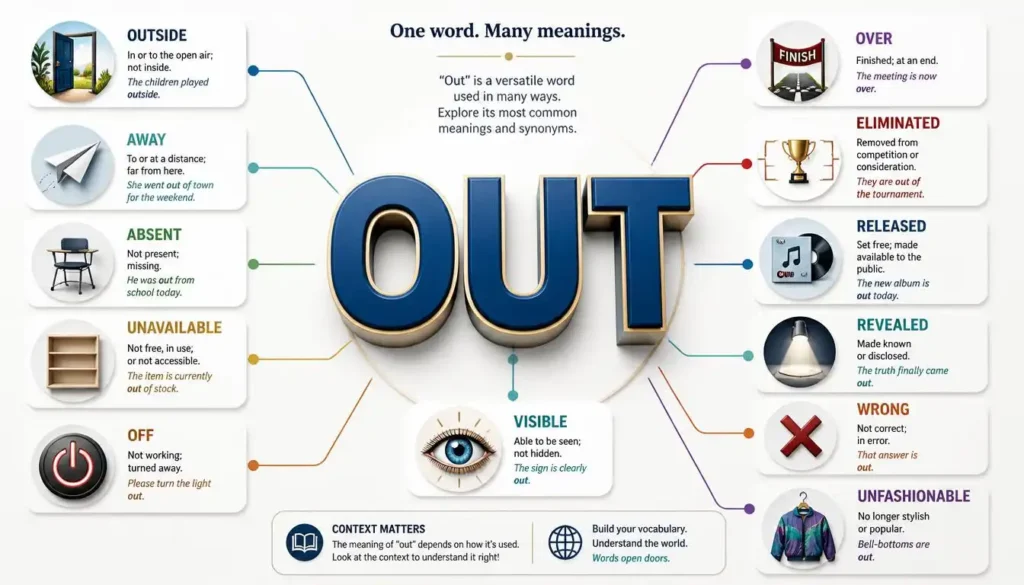
Here are some quick examples showing how the best replacement changes with context.
| Original sentence | Meaning | Better version |
|---|---|---|
| Sarah is out today. | absent | Sarah is away today. |
| The children are out. | outside | The children are outside. |
| The lights are out. | not operating | The lights are off. |
| The power is out. | unavailable | The power is down. |
| The fire is out. | extinguished | The fire has been extinguished. |
| We are out of milk. | none remains | We have no milk left. |
| That item is out of stock. | unavailable | That item is unavailable. |
| School is out. | finished | School is over. |
| Our team is out. | eliminated | Our team has been eliminated. |
| He was out for a minute. | unconscious | He was unconscious for a minute. |
| The secret is out. | revealed | The secret has been revealed. |
| Her new book is out. | released | Her new book has been released. |
| Your calculation is out. | incorrect | Your calculation is wrong. |
| The stars are out. | visible | The stars are visible. |
| That look is out. | unfashionable | That look is outdated. |
Out as a Noun
Out can also function as a noun.
One meaning is an opportunity to escape, avoid, or leave a difficult situation.
Example:
The contract gives the company an out.
Possible alternatives include:
- escape
- way out
- exit
- alternative
- loophole
A natural rewrite would be:
The contract gives the company a way out.
In baseball, an out also has a specific technical meaning referring to the retirement of a batter or runner. In that context, ordinary synonyms such as outside or away do not apply.
Out as a Verb
Out can occasionally function as a verb, particularly when referring to revealing information about someone that was previously private.
Possible alternatives include:
- reveal
- expose
- disclose
- identify publicly
Because this use can involve sensitive personal information, the best replacement should accurately reflect the context rather than simply treating the words as interchangeable.
Out vs. Out Of
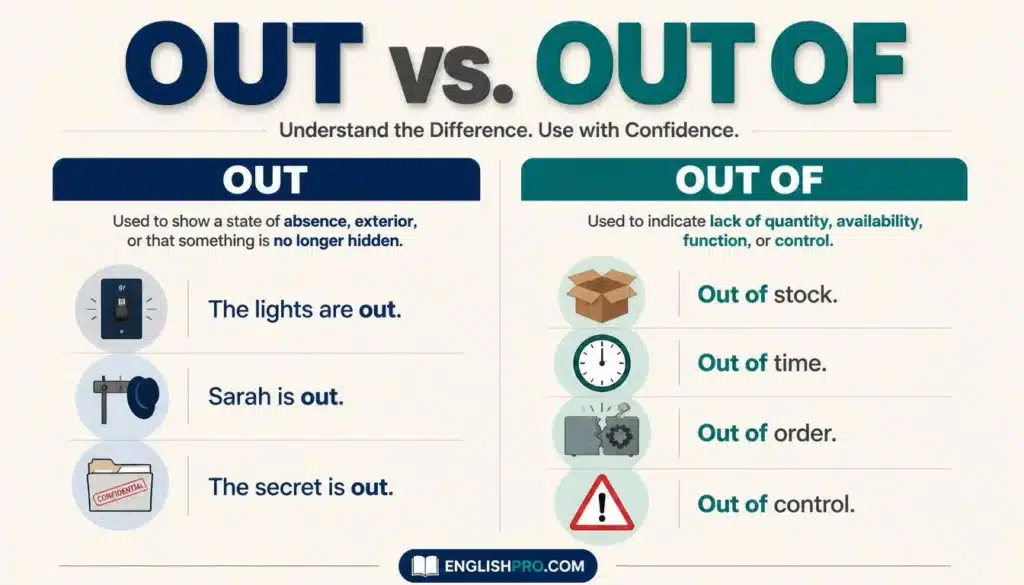
Out and out of are closely related, but they are not always grammatically interchangeable.
Compare:
The children are out.
Here, out can mean outside or away.
But:
We are out of sugar.
Here, out of expresses that none remains.
Possible rewrites include:
We have no sugar left.
Our sugar supply is depleted.
Other common out of expressions include:
- out of stock
- out of time
- out of order
- out of date
- out of control
- out of place
- out of touch
- out of work
- out of reach
In many of these expressions, replacing only the word out would not produce a natural sentence. The complete phrase must be considered.
Common Expressions With Out
Out of Stock
Means unavailable because no units remain.
Alternatives:
- unavailable
- sold out
- temporarily unavailable
- depleted
Out of Order
Means not functioning properly.
Alternatives:
- broken
- malfunctioning
- not working
- defective
Out of Date
Means no longer current.
Alternatives:
- outdated
- obsolete
- old-fashioned
- expired
Out of Control
Means no longer properly controlled.
Alternatives:
- uncontrolled
- unmanageable
- chaotic
- uncontrollable
Out of Place
Means unsuitable or not fitting the surroundings.
Alternatives:
- inappropriate
- unsuitable
- misplaced
- incongruous
Out of Touch
Can mean lacking communication or being unaware of current ideas or trends.
Alternatives:
- disconnected
- uninformed
- unaware
- behind the times
Out of Time
Means no time remains.
Alternatives:
- time has expired
- no time left
- past the deadline
Out of Work
Usually means unemployed.
Alternatives:
- unemployed
- jobless
- between jobs
Synonyms for “Sit Out”
The phrase sit out usually means choosing not to participate or being unable to participate.
Depending on context, alternatives include:
- skip
- abstain from
- remain out
- withdraw from
- not participate
- miss
- stay on the sidelines
Example:
She decided to sit out the final round.
Possible rewrite:
She decided not to participate in the final round.
For sports:
The injured player will sit out tonight’s game.
Better:
The injured player will miss tonight’s game.
Antonyms of Out
The opposite of out also depends on meaning.
Common antonyms include:
- in
- inside
- indoors
- present
- available
- active
- operating
- burning
- included
- fashionable
- correct
- hidden
- private
For example:
She is out of the office.
Opposite:
She is in the office.
But:
That style is out.
Opposite:
That style is in.
And:
The lights are out.
Opposite:
The lights are on.
There is no single antonym that works for every use of out.
Frequently Asked Questions
What is another word for out?
Common synonyms for out include outside, away, absent, unavailable, off, extinguished, over, eliminated, public, released, wrong, visible, and unfashionable. The correct choice depends on what out means in the sentence.
What are the best synonyms for out?
Some of the most useful alternatives are outside, away, absent, gone, unavailable, depleted, off, down, extinguished, over, finished, eliminated, unconscious, public, revealed, released, outdated, and wrong.
What is another word for “out of stock”?
Good alternatives include unavailable, sold out, temporarily unavailable, and depleted.
What is another word for “the power is out”?
Natural alternatives include:
- the power is off
- the power is down
- there is a power outage
- electricity is unavailable
What is another word for “the secret is out”?
You can say:
- the secret has been revealed
- the information is public
- the truth is known
- the secret has been disclosed
What is another word for “the fire is out”?
The closest formal alternative is extinguished.
For example:
The fire has been extinguished.
What is another word for “out” meaning absent?
Useful alternatives include away, absent, gone, unavailable, and not present.
What is another word for “out” meaning finished?
Depending on the sentence, use over, finished, ended, concluded, complete, or expired.
What is another word for “out” meaning unfashionable?
Use unfashionable, outdated, dated, old-fashioned, or out of style.
What does “I’m out” mean?
I’m out can have several meanings. It may mean:
- I’m leaving.
- I’m not participating.
- I have none left.
- I disagree and won’t continue.
- I’m eliminated.
The surrounding conversation determines the intended meaning.
How to Choose the Right Synonym for Out
Before replacing out, ask one simple question:
What does “out” mean in this sentence?
If it refers to location, use outside or away.
And If it refers to absence, use away or absent.
If nothing remains, use depleted, used up, or gone.
And If a machine or system is not working, use off or down.
If a fire is no longer burning, use extinguished.
And If an event has finished, use over or ended.
If someone has left a competition, use eliminated.
And If information is no longer secret, use revealed or public.
If a product or piece of media has become available, use released.
And If something is inaccurate, use wrong or incorrect.
If a style is no longer fashionable, use outdated or unfashionable.
The best synonym is not necessarily the word that looks closest in a thesaurus. It is the word that preserves the intended meaning and sounds natural in the sentence.
Conclusion
Out has many meanings, so it does not have one universal synonym.
Depending on context, the best alternative may be outside, away, absent, unavailable, off, down, extinguished, over, eliminated, unconscious, revealed, released, wrong, visible, or unfashionable.
Instead of replacing out mechanically, identify its meaning first. This makes your writing clearer, more accurate, and more natural.
For physical location outside is often the closest choice. And if use for absence then use away or absent. For systems that stop working use off or down. And if use for finished events use over or ended. For revealed information, use public or revealed.
Choosing synonyms by meaning rather than by word alone is the most reliable way to improve vocabulary and avoid awkward substitutions.

About Sajjad Ahmed
Sajjad Ahmed is the author behind Guest Paster, where he writes about English vocabulary, synonyms, word meanings, and practical word usage.
His content is designed to help readers understand the differences between similar words, discover suitable alternatives, and use English vocabulary more effectively in everyday writing and communication.
Before publishing, Sajjad focuses on presenting word choices in a clear and easy-to-understand format, with relevant meanings, context, and examples where helpful.
Through Guest Paster, his goal is to make vocabulary learning simpler and provide useful language resources for students, writers, English learners, and anyone looking to expand their vocabulary.
Areas of Focus: English Vocabulary • Synonyms • Word Meanings • Word Usage • Language Learning
Author: Sajjad Ahmed
Website: Guest Paster