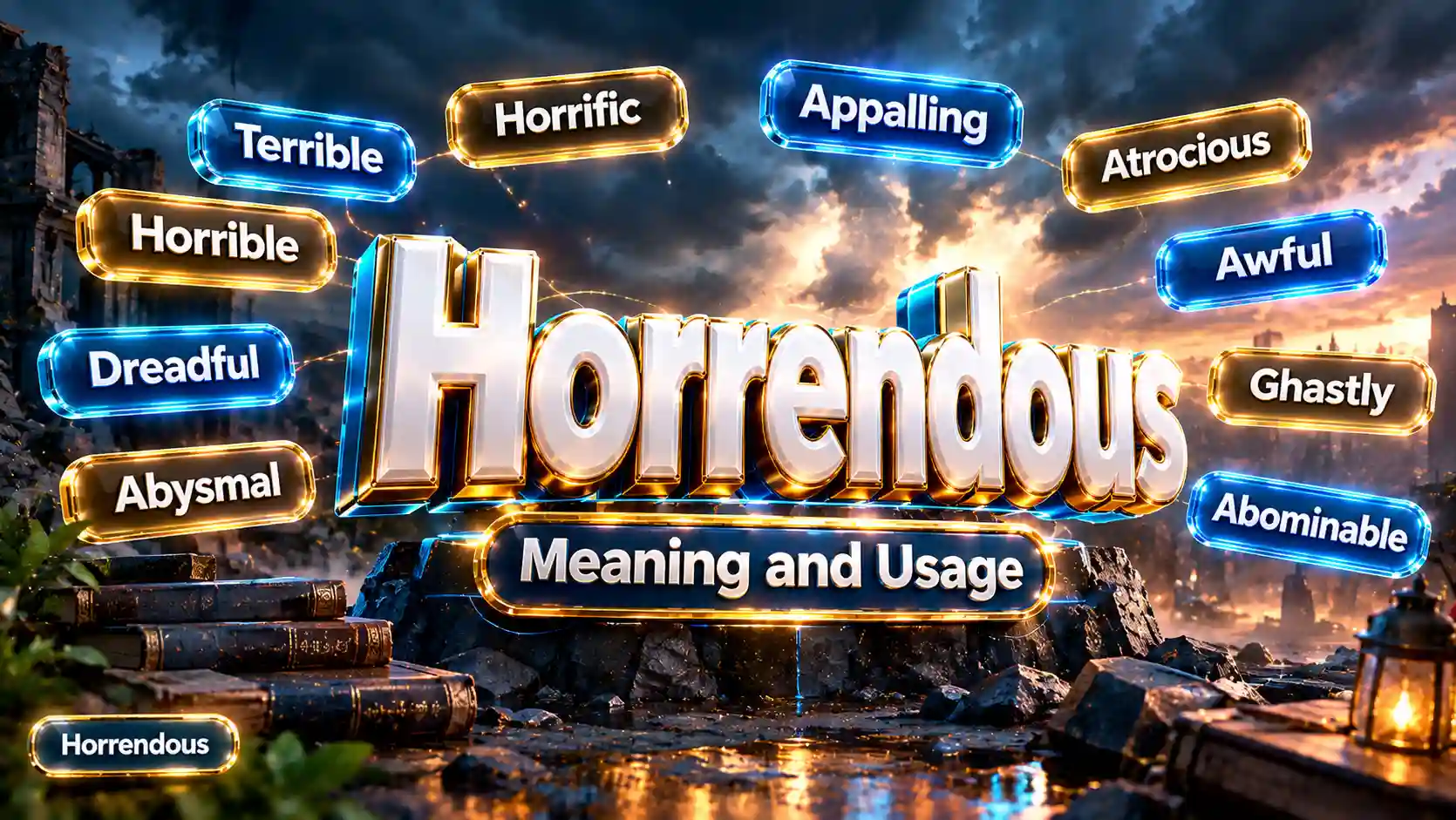
Horrendous (adjective) means extremely bad, or shocking enough to create a sense of horror. People use it for everything from atrocities to terrible traffic — which is exactly why alternatives matter: the word itself can sound over-dramatic or repetitive when you lean on it too often.
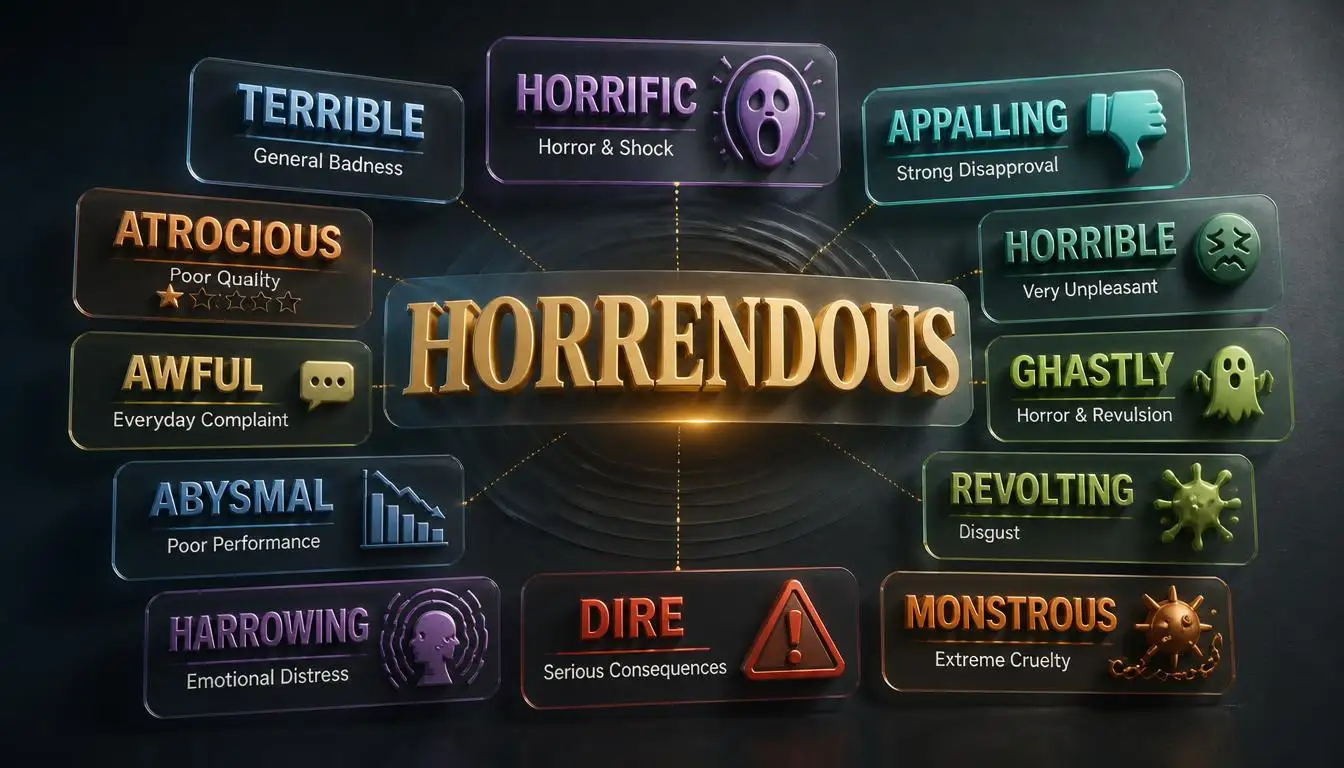
For serious events, horrific is probably the closest match. For daily complaints about quality, awful or terrible fits more naturally, and appalling suits formal criticism.
To choose the right one, ask yourself: are you describing true horror, or just really bad quality? Match the word’s weight and formality to your audience.
Another Word For Horrendous
| # | Synonym | Meaning Difference |
|---|---|---|
| 1 | Horrific | Closest match; keeps genuine horror intact |
| 2 | Horrifying | Focuses on the horror felt |
| 3 | Appalling | Shocked disapproval of standards or behavior |
| 4 | Atrocious | Very poor quality; casual strength |
| 5 | Terrible | Broad, milder everyday “very bad” |
| 6 | Awful | Conversational and less dramatic |
| 7 | Horrible | Plain, all-purpose; fits people too |
| 8 | Dreadful | Polite, slightly dated, British-leaning |
| 9 | Abysmal | Pure quality failure, no horror |
| 10 | Ghastly | Macabre or distasteful; British flavor |
The full list below covers 24 words that passed a substitution test, so these ten are only the strongest entries.
Quick Facts About Horrendous
| Fact | Detail |
|---|---|
| Part of speech | Adjective |
| Simple meaning | Extremely bad, or shocking enough to cause horror |
| Pronunciation | huh-REN-dus (stress on the second syllable) |
| Syllables | 3 (hor-ren-dous) |
| Word forms | horrendously (adverb); horrendousness (noun, rare) |
| Formality | Neutral; informal when exaggerating |
| Closest synonym | Horrific |
| Best used for | Serious events and strong complaints |
What Is the Closest Synonym for Horrendous?
The closest synonym is horrific. In dictionary terms, it describes something that causes horror: a shocking, frightening, or disturbing event. It shares its Latin root with horrendous, and in serious contexts the two are nearly swappable.
The difference shows up in everyday speech. Horrendous has drifted into hyperbole, so people say “horrendous traffic” without meaning anything frightening. Horrific resists that drift. If you write “the horrific crash on the ring road,” readers picture suffering. If you write “the horrific queue at the bakery,” it reads as a joke or an overstatement.
Rule of thumb: choose horrific when a real person was harmed or truly frightened, and choose something milder, such as awful or atrocious, when the problem is quality or inconvenience.
Horrendous Etymology: Where the Word Comes From
According to the Online Etymology Dictionary (Etymonline), horrendous comes from Latin horrendus, meaning “dreadful” or “to be shuddered at.” That Latin form belongs to the verb horrere, “to bristle” or “to shudder,” the same source behind horror. The word entered English in the 17th century.
Its original sense was literal: something so frightening it made you shudder. Over time, speakers began applying it to ordinary disappointments such as bad weather, bad service, or a bad day. That is why one word now covers both a war crime and a late train.
Can These Synonyms Be Used Interchangeably?
| Level | Words | Note |
|---|---|---|
| Usually | terrible, awful, horrible | Everyday complaints; only intensity changes |
| Sometimes | horrific, appalling, dreadful, atrocious | Depends on horror versus poor quality |
| Rarely | heinous, execrable, harrowing, diabolical | Each fits a narrow context |
| No | heinous for slow Wi-Fi | Mismatched scale sounds absurd |
Tone and formality do most of the sorting. Lousy and awful belong in conversation, appalling and deplorable in reports and formal complaints, and heinous almost exclusively in courts and crime reporting. Swapping across those lines does not change the dictionary meaning, but it changes how seriously readers take you.
Two Meanings of Horrendous, Two Synonym Sets
Horrendous has two distinct senses, so its synonyms split into two groups. Each word below sits most naturally in one group, though several can stretch into the other with the right context.
Sense A: causing horror or revulsion (a horrendous crime, a horrendous scene). Best-fitting synonyms: horrific, horrifying, ghastly, frightful, hideous, heinous, monstrous, harrowing, gruesome, abominable, shocking.
Sense B: extremely bad in quality or experience (horrendous service, horrendous weather). Best-fitting synonyms: terrible, awful, horrible, dreadful, appalling, atrocious, abysmal, dire, deplorable, execrable, woeful, lousy, diabolical.
Detailed Synonym Meanings and Examples
1. Horrific
Meaning: Defined in full in the closest-synonym section above; this entry covers how it behaves in practice.
Difference from Horrendous: It keeps the sense of genuine horror that horrendous often loses in casual use.
Best Used For: Accidents, crimes, injuries, and disasters (Sense A).
Formality: Neutral
CEFR Level: C1
Frequency: Common
Examples:
- Witnesses described the horrific pile-up on the motorway. (news report)
- The documentary opens with a viewer warning before its horrific footage. (broadcasting)
When NOT to Use It: Skip it for small inconveniences like a slow queue, where it sounds melodramatic.
2. Horrifying
Meaning: Making a person feel horror as they see or learn of something.
Difference from Horrendous: It focuses on the reaction produced rather than the badness of the thing itself.
Best Used For: Discoveries, revelations, and reactions (Sense A).
Formality: Neutral
CEFR Level: C1
Frequency: Common
Examples:
- It was horrifying to learn that the smoke alarms had never been tested. (property management)
- The audit uncovered a horrifying gap in the supplier’s safety records. (workplace)
When NOT to Use It: Avoid it for plain quality complaints like “horrifying service” unless you want comic exaggeration.
3. Appalling
Meaning: So bad that it provokes dismay, disgust, or outrage.
Difference from Horrendous: It carries moral or standards-based outrage more than fear.
Best Used For: Conditions, behavior, neglect, and failures (Sense B).
Formality: Neutral
CEFR Level: C1
Frequency: Common
Examples:
- Inspectors found appalling conditions in the staff kitchen. (workplace inspection)
- Her appalling behavior at the meeting cost the firm a long-standing client. (business)
When NOT to Use It: Do not use it for graphic physical gore, where horrific or gruesome is stronger.
4. Atrocious
Meaning: Extremely poor in quality, or shockingly cruel.
Difference from Horrendous: In everyday use it leans toward quality failure, making it a close match for the casual sense of horrendous.
Best Used For: Handwriting, weather, service, and performance (Sense B).
Formality: Neutral
CEFR Level: C2
Frequency: Common
Examples:
- The hotel’s Wi-Fi was atrocious all week. (travel review)
- His atrocious spelling made the report hard to follow. (office)
When NOT to Use It: Skip it when you mean fear or horror rather than failure or cruelty.
5. Terrible
Meaning: Very bad, severe, or unpleasant.
Difference from Horrendous: It is broader and milder, saying “bad” without evoking horror.
Best Used For: General complaints, mistakes, pain, and bad news (Sense B).
Formality: Neutral
CEFR Level: A2
Frequency: Very Common
Examples:
- I had a terrible night’s sleep before the interview. (everyday)
- The terrible storm kept the ferry in port for two days. (weather)
When NOT to Use It: It reads as an ordinary complaint, so avoid it when you need real force.
6. Awful
Meaning: Very unpleasant or very bad.
Difference from Horrendous: It is more conversational and carries less drama.
Best Used For: Casual speech, reviews, and personal feelings (Sense B).
Formality: Neutral
CEFR Level: B1
Frequency: Very Common
Examples:
- The coffee at the station kiosk was awful. (retail)
- I felt awful about missing her recital. (personal)
When NOT to Use It: In formal findings, a more measured word like appalling or deplorable sounds more credible.
7. Horrible
Meaning: Very unpleasant, nasty, or shocking.
Difference from Horrendous: It is the plain, everyday option with less dramatic weight, and it fits people and behavior well.
Best Used For: People, smells, weather, and behavior (Sense B).
Formality: Neutral
CEFR Level: B1
Frequency: Very Common
Examples:
- The landlord was horrible about returning our deposit. (renting)
- A horrible smell was coming from the loading dock. (warehouse)
When NOT to Use It: It can sound childish in official reports, where appalling is more suitable.
8. Dreadful
Meaning: Extremely bad or unpleasant; in older use, inspiring dread.
Difference from Horrendous: It sounds slightly old-fashioned and British, polite but still emphatic.
Best Used For: Understated complaints about weather, quality, and manners (Sense B).
Formality: Neutral
CEFR Level: B2
Frequency: Common
Examples:
- The train service was dreadful again this morning. (commuting)
- She gave a dreadful performance of the aria. (arts review)
When NOT to Use It: Avoid it in punchy modern ad copy, where it can sound dated.
9. Ghastly
Meaning: Horrifying or shockingly unpleasant, with a pale, deathly or distasteful feel.
Difference from Horrendous: It adds a visual, macabre note that horrendous lacks, and it often appears in playful British exaggeration.
Best Used For: Grim scenes, and humorous complaints about taste or mess (Sense A).
Formality: Neutral
CEFR Level: C2
Frequency: Uncommon
Examples:
- The ghastly scene at the crash site stayed with the paramedic for years. (emergency services)
- We spent a ghastly weekend stripping the old wallpaper. (home renovation)
When NOT to Use It: It reads as theatrical in plain business writing.
10. Frightful
Meaning: Very bad or intense; originally, causing fright.
Difference from Horrendous: It is dated and British-flavored, and it usually signals light exaggeration rather than real alarm.
Best Used For: Old-fashioned or humorous tone (Sense A).
Formality: Neutral
CEFR Level: C2
Frequency: Uncommon
Examples:
- The kitchen was in a frightful state after the party. (household)
- There was a frightful row over the budget at the board meeting. (office)
When NOT to Use It: Do not use it when you want serious, modern gravity.
11. Abysmal
Meaning: Extremely poor; hopelessly bad.
Difference from Horrendous: It measures failure only and never suggests horror.
Best Used For: Results, performance, ratings, and skill (Sense B).
Formality: Neutral
CEFR Level: C2
Frequency: Common
Examples:
- Sales in the third quarter were abysmal. (business)
- The team’s abysmal defending cost them the match. (sports)
When NOT to Use It: Do not use it for frightening or gory events.
12. Dire
Meaning: Extremely serious, urgent, or bad.
Difference from Horrendous: It signals dangerous consequences, not just unpleasantness.
Best Used For: Warnings, shortages, forecasts, and need (Sense B).
Formality: Neutral
CEFR Level: C2
Frequency: Common
Examples:
- The engineer’s report warned of dire consequences if the bridge stayed open. (civil engineering)
- The clinic is in dire need of volunteers this winter. (nonprofit)
When NOT to Use It: Skip it when something is merely poor and carries no real threat.
13. Shocking
Meaning: Causing surprise together with disgust or offense.
Difference from Horrendous: It stresses the jolt of finding out rather than lasting horror.
Best Used For: Revelations, behavior, prices, and news (Sense A).
Formality: Neutral
CEFR Level: B2
Frequency: Common
Examples:
- It is shocking that the contract never mentioned the cancellation fee. (business)
- The shocking footage spread across social media within hours. (news)
When NOT to Use It: Avoid it for steady, ongoing poor quality, because shock implies surprise.
14. Hideous
Meaning: Extremely ugly or repulsive; also, shockingly dreadful.
Difference from Horrendous: It is strongly visual, tied to appearance, though it extends to deeds.
Best Used For: Appearance, design, and terrible crimes (Sense A).
Formality: Neutral
CEFR Level: C1
Frequency: Common
Examples:
- The hideous orange carpet had to go before we listed the house. (real estate)
- The court heard details of a hideous attack on a night-shift worker. (courtroom reporting)
When NOT to Use It: It sounds odd for abstract problems like slow service, where looks are irrelevant.
15. Abominable
Meaning: Deserving hatred; extremely unpleasant.
Difference from Horrendous: It carries moral disgust and a formal, slightly literary air.
Best Used For: Formal condemnation, and British-style remarks about weather (Sense A).
Formality: Formal
CEFR Level: C2
Frequency: Uncommon
Examples:
- The abominable treatment of the prisoners prompted a public inquiry. (legal)
- We drove home through abominable weather. (travel)
When NOT to Use It: Avoid it in casual chat, where it sounds stagey.
16. Heinous
Meaning: Wicked and shockingly evil.
Difference from Horrendous: It applies almost only to crimes and moral acts, never to quality or everyday experience.
Best Used For: Crime reporting and legal contexts (Sense A).
Formality: Formal
CEFR Level: C2
Frequency: Uncommon
Examples:
- The judge called it a heinous offense against a defenseless victim. (courtroom)
- Prosecutors stressed the heinous nature of the attack. (journalism)
When NOT to Use It: Never use it for bad service or weather, because it cannot carry ordinary complaints.
17. Monstrous
Meaning: Shockingly cruel or wrong.
Difference from Horrendous: It implies something inhuman, aimed at a decision or act rather than a situation.
Best Used For: Cruel acts, injustices, and scandals (Sense A).
Formality: Neutral
CEFR Level: C2
Frequency: Uncommon
Examples:
- Denying her the medication was a monstrous decision. (healthcare ethics)
- Critics called the plan to close the shelter monstrous. (local politics)
When NOT to Use It: It can also mean “enormous,” so avoid it where readers might take it as size rather than cruelty.
18. Harrowing
Meaning: Deeply distressing to witness or live through.
Difference from Horrendous: It describes the emotional toll of an ordeal rather than the badness of an object.
Best Used For: Journeys, testimonies, memoirs, and rescues (Sense A).
Formality: Neutral
CEFR Level: C2
Frequency: Common
Examples:
- Survivors gave harrowing accounts of the flood. (journalism)
- Her memoir covers a harrowing three weeks at sea. (publishing)
When NOT to Use It: Do not use it for things that are merely bad, since it implies suffering or fear.
19. Gruesome
Meaning: Causing horror or disgust through violent or grisly detail.
Difference from Horrendous: It zeroes in on graphic physical detail.
Best Used For: Crime scenes, injuries, and horror fiction (Sense A).
Formality: Neutral
CEFR Level: C1
Frequency: Common
Examples:
- Detectives found a gruesome scene in the cellar. (crime fiction)
- The museum warns that some exhibits are gruesome. (tourism)
When NOT to Use It: Skip it for non-physical problems such as poor customer service.
20. Deplorable
Meaning: Deserving strong disapproval or regret.
Difference from Horrendous: It judges standards and ethics in a formal tone, with no fear involved.
Best Used For: Conditions, conduct, neglect, and formal complaints (Sense B).
Formality: Formal
CEFR Level: C2
Frequency: Common
Examples:
- Tenants complained about the deplorable state of the stairwell. (housing)
- The company’s deplorable safety record led to a heavy fine. (regulation)
When NOT to Use It: It sounds stiff in casual speech.
21. Execrable
Meaning: Extremely bad; detestable.
Difference from Horrendous: It is a high-register word of contempt, used for quality rather than fear.
Best Used For: Criticism of writing, food, and acting (Sense B).
Formality: Formal
CEFR Level: C2
Frequency: Rare
Examples:
- The play’s dialogue was execrable. (theater review)
- He served execrable coffee in chipped cups. (hospitality review)
When NOT to Use It: Avoid it in plain talk or with readers who may not know the word.
22. Woeful
Meaning: Very bad or deplorable, especially of performance.
Difference from Horrendous: It blends pity with criticism and is common in British sports and business talk.
Best Used For: Performance, records, and knowledge gaps (Sense B).
Formality: Neutral
CEFR Level: C2
Frequency: Uncommon
Examples:
- The side’s woeful finishing cost them the title. (sports)
- Her knowledge of the product line was woeful. (sales)
When NOT to Use It: Do not use it for horror or violence.
23. Lousy
Meaning: Very bad or of poor quality, in an informal register.
Difference from Horrendous: It is casual and blunt, stripping away any sense of horror.
Best Used For: Chat, texts, informal reviews, and mood (Sense B).
Formality: Informal
CEFR Level: C1
Frequency: Common
Examples:
- I had a lousy morning because the bus never came. (everyday)
- That’s a lousy deal for the customer. (retail)
When NOT to Use It: Keep it out of formal writing.
24. Diabolical
Meaning: In British informal use, outrageously bad.
Difference from Horrendous: It is a British colloquial exaggeration, separate from its “devilish” meaning.
Best Used For: Sports commentary and banter (Sense B).
Formality: Informal
CEFR Level: C2
Frequency: Uncommon
Examples:
- The referee’s decision was diabolical. (sports)
- The roadworks on the high street are diabolical. (local chat)
When NOT to Use It: Avoid it with American readers, who are more likely to read it as “devilish” or “cunning.”
Best Alternatives by Context
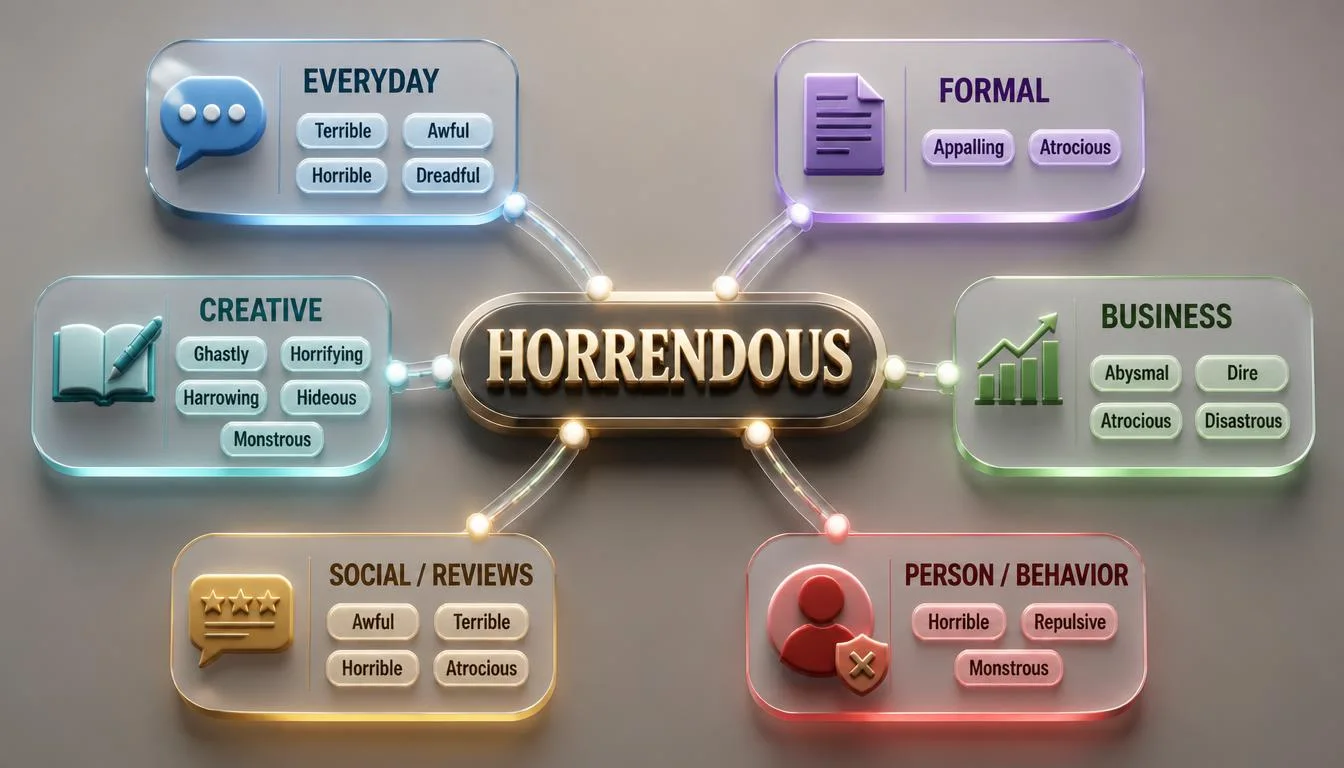
Everyday conversation
Reach for awful, terrible, or lousy. They sound natural out loud and avoid overstating a minor problem.
Formal writing and complaints
Appalling and deplorable convey disapproval without sounding emotional. Use heinous only for serious crimes.
Business communication
Abysmal suits results and metrics, and dire suits forecasts and urgent needs. Both stay professional because they describe outcomes rather than feelings.
Creative writing
Ghastly, gruesome, and harrowing give scenes a distinct texture. Horrendous tends to tell readers a thing is bad, while these words help them picture why.
Social media
Awful, lousy, and atrocious work well in reviews and posts. Horrendous itself is also at home here, which makes alternatives useful when you want to avoid repeating it.
Describing a person
For a horrendous person, horrible or awful suit rudeness and unkindness, while monstrous is reserved for genuinely cruel behavior. Describe the actions rather than labeling the person when you can, since it reads as fairer and more precise.
Which Synonym Should I Choose?
| Situation | Best Choice | Why |
|---|---|---|
| Serious accident or disaster | Horrific | Keeps the weight of real harm |
| Bad restaurant or hotel review | Atrocious | Strong but about quality |
| Text to a friend | Awful | Natural and conversational |
| Formal complaint letter | Appalling | Firm without sounding emotional |
| Poor quarterly results | Abysmal | Measures failure, not fear |
| Court or crime reporting | Heinous | Signals moral condemnation |
| Survivor’s story | Harrowing | Captures the ordeal’s emotional toll |
| British sports banter | Diabolical | Playful local exaggeration |
Exact vs Near Synonyms: What’s the Difference?
True synonyms are rare because words rarely match in meaning, tone, and scope all at once. Horrendous shows this clearly. Terrible and horrendous overlap heavily in speech, yet only one of them comfortably describes a massacre. Register matters too: lousy and execrable both mean “very bad,” but they belong to entirely different rooms.
Scope is the other shifting factor. Heinous narrows to wicked deeds, abysmal narrows to poor performance, and gruesome narrows to graphic physical detail. A near synonym earns its place by being more precise than the original, so the best replacement is often the one that says exactly what horrendous only gestures at.
Words Commonly Confused with Horrendous
These words look related but failed the substitution test, so they are not true synonyms.
| Word | Why It Isn’t a True Synonym |
|---|---|
| Horrified | Describes a person’s feeling, not the thing |
| Terrifying | Centers on fear, not badness or disgust |
| Scary | Informal fear; misses disgust and poor quality |
| Disgusting | Stresses revulsion, not scale or severity |
| Egregious | Means flagrantly wrong; fits errors, not weather |
| Grim | Bleak or gloomy, not extreme |
| Tragic | Implies sorrow and loss, not just badness |
| Bad | Too weak and too broad |
| Tremendous | Sounds similar but now means large or excellent |
Common Mistakes When Replacing Horrendous
| Mistake | Better | Why |
|---|---|---|
| “Heinous Wi-Fi” | Atrocious Wi-Fi | Heinous is for evil acts |
| “I was horrendous by the news” | I was horrified | Horrified describes people’s feelings |
| “Abominable service” in a text to a friend | Awful service | Too formal for casual chat |
| “Diabolical” in a US business email | Appalling | Americans may read it as devilish |
| “Horrific sales figures” | Abysmal sales figures | Horrific implies suffering, not poor results |
Horrendous Antonyms: Opposite Words
Sense A: causing horror or revulsion
| # | Antonym | Why It’s the Opposite |
|---|---|---|
| 1 | Delightful | Gives pleasure instead of dread |
| 2 | Pleasant | Mildly agreeable, not disturbing |
| 3 | Soothing | Calms rather than distresses |
| 4 | Reassuring | Eases fear rather than causing it |
| 5 | Comforting | Offers relief instead of shock |
| 6 | Heartwarming | Stirs warmth instead of revulsion |
| 7 | Charming | Attractive and appealing |
Sense B: extremely bad in quality
| # | Antonym | Why It’s the Opposite |
|---|---|---|
| 1 | Excellent | Very high quality |
| 2 | Superb | Outstanding in standard |
| 3 | Outstanding | Far above the usual level |
| 4 | Splendid | Impressively good |
| 5 | First-rate | Top quality |
| 6 | Wonderful | Very good, enjoyable |
| 7 | Brilliant | Exceptionally good |
American vs British English
Horrendous is spelled the same in both varieties and is equally common. Pronunciation is close, with the stress on the second syllable and only slight vowel differences in the first. The real differences are in its neighbors: dreadful, ghastly, frightful, woeful, and especially diabolical have a distinctly British flavor, while American writing tends to favor terrible, awful, and lousy. In American English, diabolical usually keeps its “devilish” meaning.
Collocations and Phrases with Horrendous
Part A: Common collocations
- Verb + horrendous: suffer horrendous injuries, endure horrendous conditions, witness horrendous scenes
- Horrendous + noun: horrendous traffic, horrendous accident, horrendous crime, horrendous weather
- Adverb + horrendous: absolutely horrendous, utterly horrendous, truly horrendous
- Horrendous + preposition: horrendous for (small businesses), horrendous to (watch)
Part B: Set phrases and related idioms
Horrendous does not anchor any fixed idioms of its own, so this section sticks to established phrases that express the same idea of “very bad”:
- a nightmare
- the pits
- a train wreck
- a horror show
- a fate worse than death
Practice Exercises
Fill in the blanks
Word bank: horrific, abysmal, appalling, lousy, heinous.
- The council condemned the ______ conditions in the care home.
- After a ______ night’s sleep, he skipped the gym.
- The court heard details of the ______ crime.
- Our website’s load times were ______ during the sale.
- Rescuers described the ______ scene after the collapse.
Rewrite the sentences
Replace “horrendous” with a better-fitting word.
- The traffic this morning was horrendous. (casual speech)
- The report revealed horrendous conditions in the warehouse. (formal)
- She survived a horrendous ordeal at sea. (emphasize emotional toll)
Match the words
| Word | Best-fit description |
|---|---|
| 1. Heinous | A. Casual, blunt complaint |
| 2. Abysmal | B. Deeply distressing ordeal |
| 3. Gruesome | C. Wicked crimes |
| 4. Lousy | D. Graphic, grisly detail |
| 5. Harrowing | E. Very poor results |
Vocabulary quiz
- Which word is closest to horrendous in a news story about a disaster? (a) lousy (b) horrific (c) mild (d) woeful
- Which word is used almost only for crimes? (a) heinous (b) lousy (c) awful (d) dire
- Best choice for a formal complaint about housing? (a) lousy (b) deplorable (c) frightful (d) diabolical
- Which word describes poor sales figures without suggesting horror? (a) harrowing (b) gruesome (c) abysmal (d) ghastly
- Which is an antonym of horrendous in the sense of “very poor service”? (a) excellent (b) appalling (c) atrocious (d) dreadful
Answer key
Fill in the blanks: 1. appalling, 2. lousy, 3. heinous, 4. abysmal, 5. horrific.
Rewrite (suggested): 1. awful or terrible; 2. appalling or deplorable; 3. harrowing.
Match: 1-C, 2-E, 3-D, 4-A, 5-B.
Quiz: 1. b, 2. a, 3. b, 4. c, 5. a.
FAQ
What is the closest synonym for horrendous?
Horrific is the closest match when you mean something that causes genuine horror or shock. For everyday “very bad quality” situations, awful or terrible are the more natural choices.
Can I use horrendous in formal writing?
Yes, but sparingly. Horrendous can sound over-dramatic in formal contexts. Appalling, deplorable, or abominable usually fit formal criticism better, while horrendous works when you want deliberate emphasis.
What is the difference between horrendous and horrific?
Horrendous means extremely bad and is often used for poor quality (a horrendous mistake). Horrific specifically means causing horror or shock (a horrific accident). They overlap, but horrific always carries the sense of horror.
What is a less dramatic alternative to horrendous for everyday complaints?
Use awful or terrible for general complaints — they are the natural everyday defaults. Lousy works in informal conversation when you want a casual tone.
Is horrendous stronger than terrible?
Yes. Terrible is the milder, everyday default for “very bad.” Horrendous adds a sense of shock or horror, so reserve it for situations that genuinely deserve that weight.
What is the opposite of horrendous?
It depends on the sense: wonderful, superb, or delightful for the “extremely bad quality” sense; comforting or reassuring when horrendous describes something frightening.
Conclusion
Choosing the right synonym is a small decision that shapes how seriously readers take you. A precise word tells them whether you mean real horror, a failed service, or a bad Monday, and it spares you from sounding either dramatic or dismissive.
Next time horrendous comes to mind, pause for a second and ask what the situation actually needs.

About Sajjad Ahmed
Sajjad Ahmed is the author behind Guest Paster, where he writes about English vocabulary, synonyms, word meanings, and practical word usage.
His content is designed to help readers understand the differences between similar words, discover suitable alternatives, and use English vocabulary more effectively in everyday writing and communication.
Before publishing, Sajjad focuses on presenting word choices in a clear and easy-to-understand format, with relevant meanings, context, and examples where helpful.
Through Guest Paster, his goal is to make vocabulary learning simpler and provide useful language resources for students, writers, English learners, and anyone looking to expand their vocabulary.
Areas of Focus: English Vocabulary • Synonyms • Word Meanings • Word Usage • Language Learning
Author: Sajjad Ahmed
Website: Guest Paster