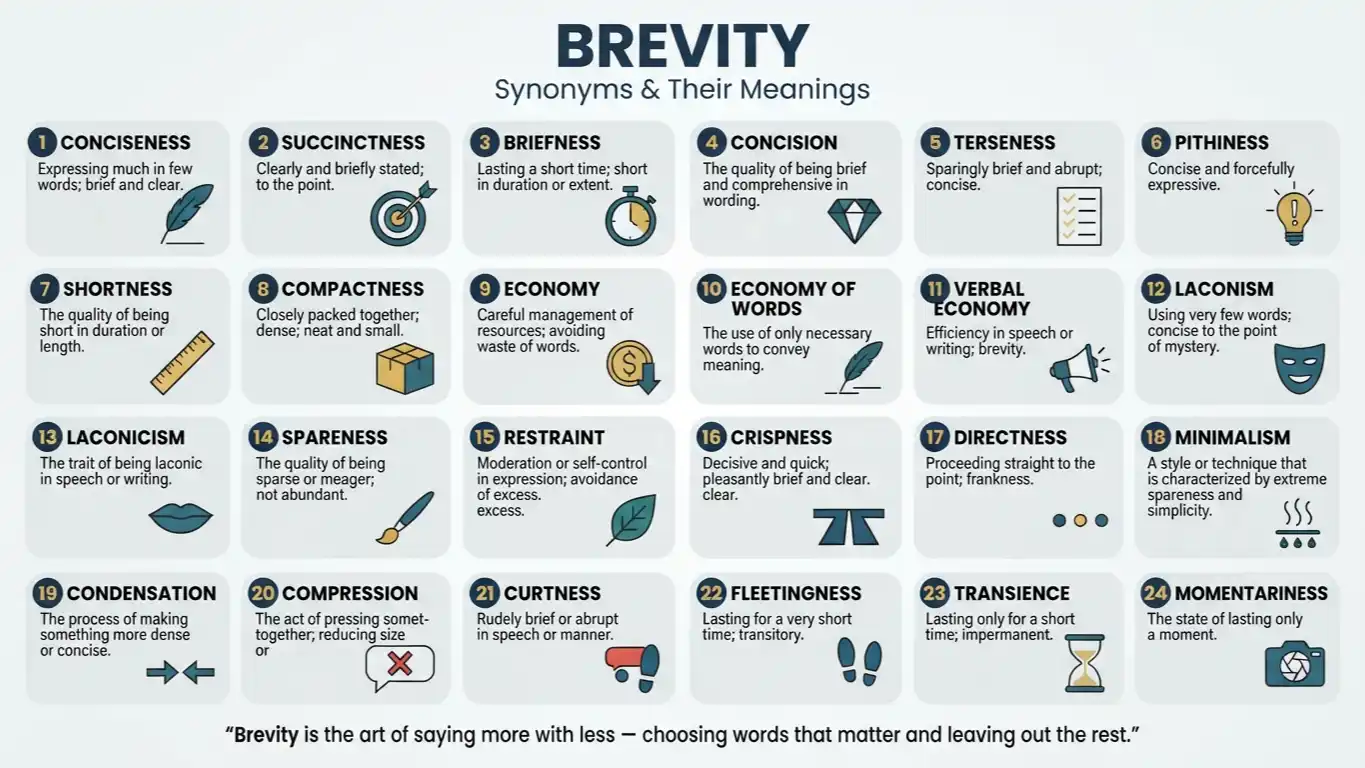
The best synonyms for brevity are conciseness, succinctness, briefness, terseness, and pithiness. Brevity means expressing something in few words or lasting for only a short time. The right synonym depends on context and tone: conciseness sounds positive and clear, while terseness may suggest an unfriendly lack of detail. For example, “The brevity of her report made it easy to understand” could naturally become “The conciseness of her report made it easy to understand.”
10 Best Synonyms for Brevity and Their Meanings
| Synonym | Simple Meaning |
| Conciseness | Clear expression using few words |
| Succinctness | Complete meaning stated briefly |
| Briefness | The quality of being short |
| Terseness | Very short expression, sometimes unfriendly |
| Pithiness | Brief language containing strong meaning |
| Concision | The quality of being concise |
| Shortness | Limited length or duration |
| Compactness | Much meaning placed in little space |
| Economy | Careful use of words without waste |
| Laconism | Extremely brief speech or writing |
What Are Synonyms of Brevity?
Synonyms of brevity describe shortness in language, length, or duration. However, they do not all carry the same feeling. Conciseness suggests clarity and efficiency, while curtness suggests rude or impatient speech. The best choice depends on whether the shortness is helpful, skillful, neutral, or unpleasant.
Quick Facts About Brevity
Word: Brevity
Part of Speech: Noun
Simple Meaning: The quality of being brief or lasting a short time
Pronunciation: /ˈbrɛvəti/
Syllables: 3 — brev-i-ty
Origin: From Latin brevitas, meaning “shortness”
Formality: Neutral to formal
Common Uses: Academic, professional, creative, and everyday writing
Example Sentence: The teacher praised the brevity and clarity of Mia’s answer.
Brevity Meaning and Usage
Basic Meaning
Brevity is the quality of being short. It most often refers to speech or writing that uses only a small number of words.
For example:
The brevity of his email made the request easy to understand.
Here, brevity means that the email was short and direct.
Deeper Meaning
Brevity is not simply the act of removing words. Effective brevity keeps the necessary meaning while avoiding repetition, unnecessary explanation, and distracting detail.
A one-word answer may be brief, but it is not always useful. True brevity often combines shortness with clarity.
Compare these examples:
- Too little information: “No.”
- Brief but helpful: “No, the meeting has been moved to Friday.”
The second answer still shows brevity, but it gives the reader enough information.
Brevity in Speech and Writing
The word commonly appears in discussions of:
- Speeches
- Emails
- Reports
- Instructions
- Essays
- News headlines
- Business presentations
- Creative writing
In professional and academic settings, brevity is usually considered a strength when it improves clarity. However, too much brevity can make a message sound cold, incomplete, or abrupt.
Brevity as Short Duration
Brevity can also describe something that lasts for a short time.
Everyone was surprised by the brevity of the ceremony.
In this sentence, the ceremony itself was short. The word does not refer to the number of words spoken.
Emotional Tone and Formality
Brevity usually has a neutral or positive tone. It often suggests efficiency, discipline, or respect for the reader’s time.
However, its tone depends on context:
- “The brevity of the instructions was helpful.” — positive
- “The brevity of his reply seemed unfriendly.” — negative
- “She explained the decision with admirable brevity.” — strongly positive
The word is more common in formal writing than in casual conversation. In everyday speech, people are more likely to say shortness or describe something as brief.
Brevity Is the Soul of Wit
“Brevity is the soul of wit” is a famous line from William Shakespeare’s Hamlet. It means that intelligent or humorous expression is often most effective when it is concise.
The phrase is commonly used to encourage speakers and writers to avoid unnecessary words. It does not mean that every message should be extremely short. Instead, it suggests that strong ideas often become more powerful when expressed clearly and efficiently.
Brevity and Brief
Brevity and brief belong to the same word family, but they serve different grammatical roles.
- Brevity is a noun: “I appreciated the brevity of the speech.”
- Brief is usually an adjective: “She gave a brief speech.”
- Brief can also be a verb: “The officer will brief the team.”
- Briefly is an adverb: “He spoke briefly.”
There is no common verb form of brevity. Depending on the meaning, use verbs such as shorten, condense, summarize, or abridge.
Detailed Analysis of Synonyms for Brevity
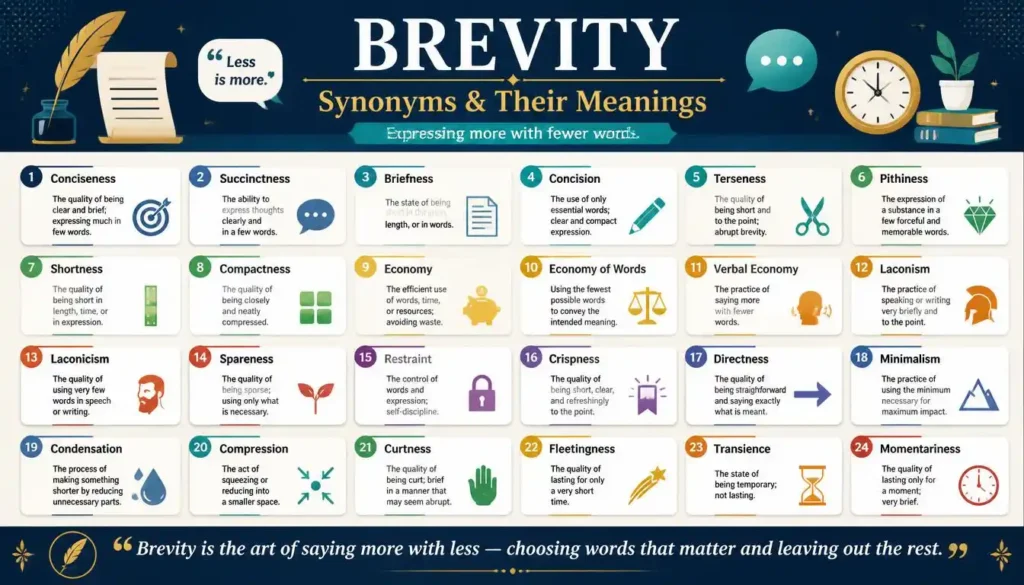
1. Conciseness
Relationship: Exact synonym
Meaning: The quality of expressing an idea clearly in few words.
Difference: Conciseness strongly suggests that unnecessary words have been removed without losing important meaning. It is usually more positive than brevity.
Best Used For: Essays, reports, instructions, presentations, and professional communication.
Example: The conciseness of the final paragraph made its argument especially powerful.
2. Succinctness
Relationship: Exact synonym
Meaning: The quality of expressing something completely and clearly in a small number of words.
Difference: Succinctness emphasizes completeness as well as shortness. A succinct statement is brief but still contains the necessary information.
Best Used For: Summaries, definitions, explanations, speeches, and formal writing.
Example: The editor admired the succinctness of her explanation.
3. Briefness
Relationship: Exact synonym
Meaning: The quality of being short in length, speech, writing, or time.
Difference: Briefness is more general and less elegant than brevity. It is correct but less common in polished formal writing.
Best Used For: General descriptions of short messages, events, or periods.
Example: The briefness of the interview surprised every applicant.
4. Concision
Relationship: Exact synonym
Meaning: The quality of using few words while remaining clear.
Difference: Concision is almost identical to conciseness, but it is less common in everyday American English. It often appears in discussions of writing style.
Best Used For: Editing, rhetoric, literary criticism, and academic writing.
Example: Her revised introduction gained both clarity and concision.
5. Terseness
Relationship: Near synonym
Meaning: The quality of using very few words.
Difference: Terseness can imply that a message is too short, unfriendly, or impatient. Brevity does not automatically carry this negative tone.
Best Used For: Short replies, commands, dialogue, or communication that feels emotionally cold.
Example: The terseness of his response suggested that he was annoyed.
6. Pithiness
Relationship: Near synonym
Meaning: The quality of expressing an important or clever idea in a few memorable words.
Difference: Pithiness emphasizes strength and substance. A pithy sentence is not only brief but also meaningful, striking, or clever.
Best Used For: Quotations, slogans, speeches, headlines, and witty observations.
Example: The pithiness of the slogan helped customers remember it.
7. Shortness
Relationship: Near synonym
Meaning: The state of having limited length or duration.
Difference: Shortness is broader and more ordinary than brevity. It can describe physical length, time, height, supply, or language.
Best Used For: Everyday descriptions of short events, texts, distances, or periods.
Example: The shortness of the presentation left time for several questions.
8. Compactness
Relationship: Contextual alternative
Meaning: The quality of containing much material in a small amount of space.
Difference: Compactness focuses on efficient arrangement rather than shortness alone. A compact explanation may contain many ideas in a tightly organized form.
Best Used For: Technical writing, summaries, design, reference materials, and structured information.
Example: The compactness of the guide makes it useful for travelers.
9. Economy
Relationship: Contextual alternative
Meaning: Careful use of words, effort, or resources without waste.
Difference: When related to language, economy describes disciplined word choice. Unlike brevity, it emphasizes efficiency rather than simple shortness.
Best Used For: Literary analysis, editing, speeches, and descriptions of writing style.
Example: The author tells the entire story with remarkable economy.
10. Economy of Words
Relationship: Contextual alternative
Meaning: The practice of communicating effectively without unnecessary language.
Difference: This phrase is more specific than brevity. It directly refers to efficient word use and does not normally describe a short event or period.
Best Used For: Writing advice, criticism, editing, and public speaking.
Example: Her economy of words gave every sentence greater importance.
11. Verbal Economy
Relationship: Contextual alternative
Meaning: The efficient use of spoken or written language.
Difference: Verbal economy focuses on technique. It suggests that a person carefully selects words to achieve the greatest effect with the least waste.
Best Used For: Rhetoric, literary criticism, professional writing, and communication training.
Example: The speaker used verbal economy without making the lesson feel incomplete.
12. Laconism
Relationship: Near synonym
Meaning: The habit or style of speaking with very few words.
Difference: Laconism usually describes an extremely brief style of expression. It may sound clever, controlled, distant, or severe.
Best Used For: Literary analysis, historical writing, and descriptions of speaking styles.
Example: His famous laconism made even his compliments sound serious.
13. Laconicism
Relationship: Near synonym
Meaning: Extreme briefness in speech or writing.
Difference: Laconicism has nearly the same meaning as laconism. It is rare and more formal than brevity.
Best Used For: Academic discussion, rhetoric, and literary commentary.
Example: The character’s laconicism creates an air of mystery.
14. Spareness
Relationship: Contextual alternative
Meaning: The quality of using very little decoration, detail, or language.
Difference: Spareness suggests simplicity and restraint. It can describe writing, art, music, design, or physical surroundings.
Best Used For: Creative writing, visual design, poetry, and artistic criticism.
Example: The spareness of the poem allows its central image to stand out.
15. Restraint
Relationship: Contextual alternative
Meaning: Controlled and limited expression.
Difference: Restraint emphasizes self-control rather than length. A writer may show restraint by avoiding exaggerated detail, strong emotion, or unnecessary explanation.
Best Used For: Formal writing, criticism, emotional communication, and artistic description.
Example: The journalist described the tragedy with dignity and restraint.
16. Crispness
Relationship: Contextual alternative
Meaning: A clear, sharp, and efficient quality in language.
Difference: Crispness suggests energetic clarity. A crisp sentence is often brief, but its main qualities are sharp structure and easy understanding.
Best Used For: Business communication, journalism, advertising, and presentations.
Example: The crispness of the opening paragraph immediately gained the reader’s attention.
17. Directness
Relationship: Contextual alternative
Meaning: The quality of stating an idea plainly without delay or avoidance.
Difference: Directness concerns how openly a message reaches its point. Direct language can be brief, but it does not have to be.
Best Used For: Instructions, workplace communication, feedback, requests, and serious conversations.
Example: I appreciated the directness of her answer, even though the news was disappointing.
18. Minimalism
Relationship: Contextual alternative
Meaning: A style based on using only the most necessary elements.
Difference: Minimalism is a broader artistic or practical approach. In writing, it may produce brevity, but it also involves simplicity of detail, structure, and style.
Best Used For: Creative writing, design, art, architecture, and lifestyle discussions.
Example: The novel’s minimalism gives its quiet moments unusual force.
19. Condensation
Relationship: Contextual alternative
Meaning: The process or result of reducing material into a shorter form.
Difference: Condensation focuses on shortening existing information. Brevity describes the quality of the final result.
Best Used For: Summaries, edited reports, shortened books, and study materials.
Example: The booklet is a useful condensation of the full research report.
20. Compression
Relationship: Contextual alternative
Meaning: The act of placing information into a smaller or shorter form.
Difference: Compression suggests that a large amount of meaning has been packed into limited space. It can also imply that some explanation has been removed.
Best Used For: Poetry, technical communication, summaries, and literary criticism.
Example: The poem’s compression requires readers to consider every word carefully.
21. Curtness
Relationship: Contextual alternative
Meaning: Rude or unfriendly briefness in speech.
Difference: Curtness is clearly negative. It describes communication that is so short that it seems impatient, dismissive, or impolite.
Best Used For: Complaints, dialogue, workplace tension, and descriptions of behavior.
Example: The curtness of the receptionist’s reply made the visitor uncomfortable.
22. Fleetingness
Relationship: Contextual alternative
Meaning: The quality of lasting for only a very short time.
Difference: Fleetingness applies to the time-related sense of brevity. It often carries an emotional or poetic sense that something disappeared quickly.
Best Used For: Memories, emotions, beauty, opportunities, and creative writing.
Example: The photograph captures the fleetingness of early childhood.
23. Transience
Relationship: Contextual alternative
Meaning: The state of existing or lasting for a limited time.
Difference: Transience emphasizes impermanence rather than mere shortness. It often sounds philosophical, academic, or literary.
Best Used For: Essays about life, culture, nature, travel, or temporary experiences.
Example: The novel explores the transience of fame and public attention.
24. Momentariness
Relationship: Contextual alternative
Meaning: The quality of lasting only for a moment.
Difference: Momentariness is rare and applies only to duration. Unlike brevity, it is not normally used to describe concise language.
Best Used For: Formal, philosophical, or literary descriptions of extremely short experiences.
Example: The momentariness of the silence made it easy to overlook.
Synonyms for Brevity by Context
Everyday Conversation
In casual speech, the most natural choices are:
- Shortness for limited length or time
- Briefness for something that does not last long
- Directness for plain communication
- Curtness for unfriendly short replies
Example:
I liked the shortness of the video because it explained the idea quickly.
Formal and Professional Writing
Useful formal alternatives include:
- Conciseness
- Succinctness
- Concision
- Economy
- Compactness
Example:
The conciseness of the proposal made it easier for the board to review.
Academic Writing
Academic writers may use:
- Conciseness when praising clear expression
- Succinctness for complete but brief explanations
- Concision when discussing style
- Compression when many ideas are packed into little space
- Laconism when analyzing an extremely brief manner of speaking
Example:
The study is notable for the succinctness of its final analysis.
Business Communication
In business settings, the strongest choices are:
- Conciseness
- Directness
- Crispness
- Economy of words
- Compactness
Example:
Greater conciseness would make the weekly update easier to scan.
Creative Writing
Creative and literary contexts may favor:
- Pithiness
- Spareness
- Restraint
- Compression
- Laconism
- Fleetingness, when referring to short duration
Example:
The spareness of the dialogue increases the tension between the characters.
Exact Synonyms vs. Similar Synonyms
No synonym matches brevity in every sentence. Conciseness, succinctness, and concision are the closest alternatives when brevity means clear expression in few words. Briefness and shortness are broader because they can describe either language or duration.
Tone also changes the best choice. Pithiness praises language that is brief and meaningful. Terseness may suggest an overly short response, while curtness directly suggests rudeness. For short-lived experiences, fleetingness or transience may be more suitable than language-based synonyms. Choosing correctly requires attention to meaning, setting, and emotional tone.
Antonyms of Brevity
| Antonym | Meaning | Example Sentence |
| Lengthiness | The quality of being excessively long | The lengthiness of the report discouraged several readers. |
| Wordiness | The use of more words than necessary | Wordiness weakened the otherwise useful explanation. |
| Verbosity | The formal quality of using too many words | The professor warned that verbosity could hide the main argument. |
| Prolixity | Excessive length in speech or writing | The essay’s prolixity made its conclusion difficult to find. |
| Long-windedness | A tendency to speak or write for too long | His long-windedness often caused meetings to run late. |
| Elaboration | The addition of more explanation or detail | The complex topic required further elaboration. |
| Extensiveness | The quality of covering a large amount of material | The extensiveness of the review made it a valuable reference. |
| Duration | The length of time something continues | The duration of the ceremony was almost three hours. |
Common Collocations With Brevity
| Phrase | Meaning | Example Sentence |
| Admirable brevity | Shortness that deserves praise | She answered the difficult question with admirable brevity. |
| Remarkable brevity | An unusually short length or duration | The case was resolved with remarkable brevity. |
| Refreshing brevity | Pleasantly short communication | The guide’s refreshing brevity makes it easy to use. |
| For the sake of brevity | To keep something short | For the sake of brevity, the report excludes minor details. |
| Brevity and clarity | Shortness combined with easy understanding | Strong instructions require both brevity and clarity. |
| Brevity of expression | The use of few words | His brevity of expression gives the dialogue a serious tone. |
| Brevity of the meeting | The short duration of a meeting | The brevity of the meeting allowed everyone to return to work early. |
| Wit and brevity | Cleverness combined with concise expression | Her speeches are known for their wit and brevity. |
Frequently Asked Questions
What is the closest synonym for brevity?
Conciseness is usually the closest synonym when brevity refers to speech or writing. Both words describe the use of few words, but conciseness more strongly suggests that the message remains clear, complete, and free from unnecessary detail.
Is brevity a positive word?
Brevity is usually positive or neutral. It can suggest efficiency, clarity, and respect for someone’s time. However, brevity may seem negative when a message is so short that it feels incomplete, uncaring, dismissive, or rude.
What is the verb form of brevity?
There is no standard verb form of brevity. Use a verb that matches the intended meaning, such as shorten, condense, summarize, abridge, or reduce. For example, “Please condense the report” means to make it shorter.
How can brevity be used in a sentence?
A natural example is: “The manager appreciated the brevity of the weekly update.” In this sentence, brevity refers to the update’s short and efficient style. It can also describe time, as in “We were surprised by the brevity of the event.”
Conclusion
Choosing the right synonym for brevity makes communication more accurate. Conciseness suggests clear efficiency, pithiness adds strength, and terseness may signal an unfriendly tone.
Always consider whether you are describing language, duration, style, or emotion before selecting an alternative.

About Sajjad Ahmed
Sajjad Ahmed is the author behind Guest Paster, where he writes about English vocabulary, synonyms, word meanings, and practical word usage.
His content is designed to help readers understand the differences between similar words, discover suitable alternatives, and use English vocabulary more effectively in everyday writing and communication.
Before publishing, Sajjad focuses on presenting word choices in a clear and easy-to-understand format, with relevant meanings, context, and examples where helpful.
Through Guest Paster, his goal is to make vocabulary learning simpler and provide useful language resources for students, writers, English learners, and anyone looking to expand their vocabulary.
Areas of Focus: English Vocabulary • Synonyms • Word Meanings • Word Usage • Language Learning
Author: Sajjad Ahmed
Website: Guest Paster