

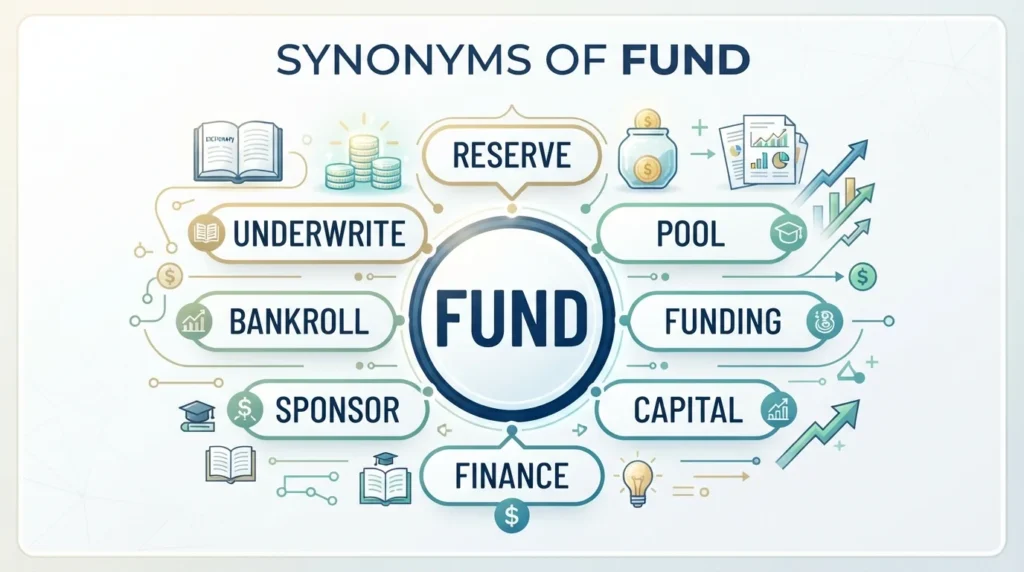
Synonyms for fund include reserve, funding, capital, finance, sponsor, bankroll and underwrite. The best choice depends on whether fund means money saved for a purpose or the act of providing financial support.
For example, “fund the project” can become “finance the project,” while “emergency fund” can become “emergency reserve.”
Best Synonyms for Fund and Their Meanings
| Word | Best Used For | Example |
|---|---|---|
| Reserve | Saved money | Emergency reserve |
| Capital | Business money | Growth capital |
| Finance | Providing money | Finance a project |
| Sponsor | Supporting events | Sponsor a charity |
| Underwrite | Formal financial support | Underwrite research |
| Bankroll | Informal payment | Bankroll a movie |
Another Word for Fund
Another word for fund depends on meaning. Reserve, capital, pool and account describe money kept for a purpose, while finance, sponsor and underwrite describe providing money.
Quick Facts About Fund
Word: Fund
Part of Speech: Noun and verb
Simple Meaning: Money kept for a purpose; or to provide money for something
Pronunciation: /fʌnd/
Syllables: 1
Origin: From Latin fundus meaning “bottom” or “foundation” through French fonds
Formality: Neutral; often formal in business finance and academic writing
Common Uses: Everyday conversation professional writing academic writing financial communication
Example Sentence: The organization created a fund to help local students pay for school.
How to Choose the Right Synonym for Fund
Choose based on the purpose: – Saving money → reserve – Business growth → capital – Providing money → finance – Public support → sponsor – Formal guarantee → underwrite
Fund Meaning and Usage
The word fund has several closely connected meanings. Understanding these meanings makes it easier to choose an accurate synonym.
1. Fund as a Noun: Money Set Aside for a Purpose
A fund can be an amount or pool of money saved, collected or managed for a specific reason.
Example:
The town created an emergency fund for storm repairs.
In this sense good alternatives include reserve pool account funding and sometimes budget.
The word has a neutral tone and is common in banking charities, schools , governments, businesses and personal finance.
2. Funds as Money or Financial Resources
The plural funds often means money that is available to spend.
Example:
We do not have enough funds to complete the project.
Here another word for funds or money might be money cash resources capital or financing depending on the situation.
For example capital works especially well in business while cash sounds more everyday and direct.
3. Fund as a Verb: Provide Money
As a verb fund means to give or supply money so that an activity organization project or person can continue.
Example:
The university will fund the new science program.
Possible replacements include finance bankroll sponsor subsidize underwrite support and back.
The emotional tone of the fund is usually neutral. It states that financial support is being provided without necessarily explaining why.
Detailed Analysis of 26 Synonyms for Fund

Because fund can be both a noun and a verb the alternatives below are grouped by meaning and part of speech.
Noun Synonyms for Fund
1. Reserve
Relationship: Near synonym
Meaning: Money saved for a future need or unexpected expense.
Difference: A fund may be used regularly while a reserve is usually kept until it is needed.
Best Used For: Savings emergencies businesses and financial planning.
Example: The company keeps a reserve for unexpected repair costs.
2. Pool
Relationship: Near synonym
Meaning: Money or resources gathered together for shared use.
Difference: Pool emphasizes that contributions have been combined from one or more sources.
Best Used For: Group projects, investments organizations and shared expenses.
Example: The neighbors created a pool of money for playground repairs.
3. Funding
Relationship: Near synonym
Meaning: Money supplied for a project organization or activity.
Difference: Funding usually describes financial support being provided rather than a separate store of money.
Best Used For: Research education government programs, charities and projects.
Example: The program received additional funding this year.
4. Account
Relationship: Contextual alternative
Meaning: A financial record or place where money is kept and managed.
Difference: An account is the structure used to hold money while a fund refers more directly to the money or financial pool itself.
Best Used For: Banking savings trusts and organizational finances.
Example: Donations are placed in a separate account.
5. Capital
Relationship: Contextual alternative
Meaning: Money or other financial assets used to start, operate or grow a business.
Difference: Capital usually has a business or investment purpose while a fund can exist for almost any purpose.
Best Used For: Business investing economics and entrepreneurship.
Example: The owners need more capital to expand the factory.
6. Resources
Relationship: Contextual alternative
Meaning: Money materials, people or other useful assets that are available.
Difference: Resources are broader than funds. It can include things other than money.
Best Used For: Organizations education government and project planning.
Example: The school lacks the resources needed for the new program.
7. Treasury
Relationship: Contextual alternative
Meaning: Money held and managed by a government or organization.
Difference: A treasury usually refers to a larger or officially managed store of financial assets.
Best Used For: Governments clubs institutions and formal financial writing.
Example: The payment came from the organization’s treasury.
8. Endowment
Relationship: Contextual alternative
Meaning: Money or property donated to support an institution over a long period.
Difference: An endowment is a specific type of fund often invested so that its earnings can support an institution.
Best Used For: Universities, museums, hospitals and charities.
Example: The university’s endowment helps support scholarships.
9. Bankroll
Relationship: Contextual alternative
Meaning: A supply of money available to a person, business or activity.
Difference: Bankroll is more informal and can suggest money available for a particular venture.
Best Used For: Informal conversation entertainment and business discussions.
Example: The project required a larger bankroll than expected.
10. Kitty
Relationship: Contextual alternative
Meaning: A shared amount of money collected by a small group.
Difference: Kitty is much more informal than fund.
Best Used For: Clubs, friends, coworkers games and shared expenses.
Example: Everyone added five dollars to the office kitty.
11. Pot
Relationship: Contextual alternative
Meaning: An amount of money collected or available for a shared purpose or prize.
Difference: Pot is informal and is common when money has been gathered together.
Best Used For: Competitions shared expenses prizes and casual conversation.
Example: The winners will divide the prize pot.
12. Budget
Relationship: Contextual alternative
Meaning: An amount of money planned or allowed for a particular purpose.
Difference: A budget is technically a spending plan or limit not simply a collection of money.
Best Used For: Projects households companies and government spending.
Example: Our travel budget cannot cover another hotel night.
13. Money
Relationship: Contextual alternative
Meaning: Currency or financial value used to pay for goods, services and expenses.
Difference: Money is much broader. A fund is usually money organized or reserved for a particular purpose.
Best Used For: Everyday speech and general writing.
Example: The organization needs more money to continue its work.
Verb Synonyms for Fund
14. Finance
Relationship: Exact synonym in many contexts
Meaning: To provide money for an activity purchase or project.
Difference: Finance often sounds slightly more formal and may involve loans or planned financial arrangements.
Best Used For: Business projects purchases and formal writing.
Example: The bank agreed to finance the expansion.
15. Bankroll
Relationship: Near synonym
Meaning: To provide the money needed for an activity or venture.
Difference: Bankroll is more informal and may suggest that one person or organization is paying most of the cost.
Best Used For: Informal business writing and conversation.
Example: A private investor bankrolled the film.
16. Sponsor
Relationship: Near synonym
Meaning: To provide financial or other support to a person, event organization or activity.
Difference: Sponsorship often comes with public recognition advertising or a connection to the sponsored activity.
Best Used For: Events, sports charities, media and community programs.
Example: Several local businesses sponsored the festival.
17. Underwrite
Relationship: Near synonym
Meaning: To provide guarantee or accept financial responsibility for something.
Difference: Underwrite is more formal and is common in insurance banking investment and major events.
Best Used For: Finance insurance nonprofit work and formal business communication.
Example: The foundation agreed to underwrite the exhibition.
18. Subsidize
Relationship: Contextual alternative
Meaning: To pay part of the cost of something so that it costs less for others.
Difference: Funding can cover any amount while subsidizing usually means covering only part of the cost.
Best Used For: Government programs transportation education and public services.
Example: The city subsidizes bus fares for students.
19. Support
Relationship: Contextual alternative
Meaning: To give money or other help to a person, organization or cause.
Difference: Support is broader because the help does not have to be financial.
Best Used For: Charities programs causes and general communication.
Example: Local donations support the community center.
20. Back
Relationship: Contextual alternative
Meaning: To give financial or practical support to a person’s idea or project.
Difference: Back is less formal and can mean support without providing money.
Best Used For: Business ventures, campaigns, projects and conversation.
Example: Several investors backed the new company.
21. Pay For
Relationship: Near synonym
Meaning: To provide the money needed to cover a cost.
Difference: Pay for is simpler and more direct but does not always suggest long-term financial support.
Best Used For: Everyday conversation and straightforward writing.
Example: The grant will pay for new laboratory equipment.
22. Invest In
Relationship: Contextual alternative
Meaning: To put money into something with the hope of gaining future value or benefits.
Difference: Funding does not require a financial return while investing often suggests an expected benefit or return.
Best Used For: Businesses property education and long-term projects.
Example: The company plans to invest in cleaner technology.
23. Endow
Relationship: Contextual alternative
Meaning: To give money or property that provides lasting financial support.
Difference: Endow usually describes permanent or long-term support rather than ordinary funding.
Best Used For: Universities scholarships charities and institutions.
Example: The family endowed a scholarship for engineering students.
24. Capitalize
Relationship: Contextual alternative
Meaning: To provide a company or organization with financial capital.
Difference: Capitalize is a specialized business term and does not replace funds in everyday situations.
Best Used For: Corporate finance banking and investment.
Example: Investors helped capitalize the new business.
25. Contribute To
Relationship: Contextual alternative
Meaning: To give some money toward a larger total.
Difference: Someone who funds something may provide all or much of the money; someone who contributes usually supplies only part.
Best Used For: Charities group projects events and shared costs.
Example: Several families contributed to the scholarship program.
26. Provide Financing For
Relationship: Exact paraphrase
Meaning: To supply the money required for something.
Difference: This phrase is longer and more formal than fund but expresses almost the same idea in financial contexts.
Best Used For: Business reports contracts banking and professional writing.
Example: The lender will provide financing for the construction project.
Synonyms for Fund by Context
Everyday Conversation
For casual speech simple alternatives usually sound most natural:
- Money — general financial resources
- Cash — money that is readily available
- Kitty — informal shared money
- Pot — informal collection of money
- Pay for — simple alternative to fund as a verb
- Bankroll — informal way to say someone is financing something
Business Communication
Business writing often needs more precise financial language:
- Capital — money used to operate or grow a company
- Financing — money arranged for a purchase or project
- Reserve — money held for future needs
- Finance — provide money for a project or purchase
- Underwrite — guarantee or provide financial backing
- Capitalize — provide a business with capital
Formal and Professional Writing
Useful formal choices include:
- Funding
- Reserve
- Endowment
- Treasury
- Finance
- Subsidize
- Underwrite
The right word depends on where the money comes from and how it will be used.
Academic Writing
Academic contexts often use:
- Funding for money given to research or programs
- Resources when discussing money and other support together
- Financial support when clarity matters more than brevity
- Finance when describing the act of providing money
- Endowment for long-term institutional support
Exact vs. Similar Synonyms for Fund
Few synonyms for fund are interchangeable in every sentence. Finance is one of the closest verb synonyms: “fund the project” and “finance the project” often communicate almost the same idea. As nouns reserve pool and funding overlap with fund but each adds a different shade of meaning. A reserve is usually saved for later while a pool emphasizes money collected together. Funding often refers to money being supplied rather than the account holding it. Capital is more specialized because it usually relates to business or investment. Tone matters too: kitty and pot are informal while underwrite endowment and capital sound more professional or technical.
Antonyms of Fund
A noun such as fund does not have one natural opposite. The clearest antonyms apply to fund as a verb meaning “provide financial support.”
| Antonym | Meaning | Example Sentence |
| Defund | Remove financial support | The council voted to defund the unused program. |
| Withhold funding | Keep money from being provided | The agency may withhold funding until the requirements are met. |
| Withdraw funding | Stop financial support that was previously provided | The sponsor withdrew funding from the project. |
| Cut funding | Reduce the money being provided | The organization had to cut funding for several activities. |
| Reduce funding | Lower the amount of financial support | Officials decided to reduce funding next year. |
| Deny funding | Refuse a request for financial support | The committee denied funding for the proposal. |
| Discontinue funding | End ongoing financial support | The foundation discontinued funding after the program closed. |
| Refuse to finance | Choose not to provide money | The bank refused to finance the purchase. |
Common Collocations With Fund
| Phrase | Meaning | Example Sentence |
| Emergency fund | Money saved for unexpected costs | She keeps an emergency fund for major repairs. |
| Reserve fund | Money held for future needs | The association used its reserve fund to replace the roof. |
| Investment fund | Money pooled and invested | He puts part of his savings into an investment fund. |
| Pension fund | Money set aside to provide retirement benefits | The pension fund supports retired employees. |
| Relief fund | Money collected to help people after hardship or disaster | Donations went into a local relief fund. |
| Fund a project | Provide money for a planned activity | The company agreed to fund the project. |
| Fund research | Provide money for scientific or academic study | The grant will fund research into renewable energy. |
| Raise funds | Collect money for a purpose | Students raised funds for the school library. |
Frequently Asked Questions
What is a fancy word for money?
A more formal word for money depends on the situation. Funds and financial resources work in general professional writing. Capital is appropriate for business or investment while financing describes money provided for a project purchase or activity.
What does fund mean in slang?
Fund itself is not a major American slang word for money. In informal conversation however a shared fund might be called a kitty or pot. When fund is used as a verb it simply means paying for or financially supporting something.
What is fund in simple words?
A fund is money saved, collected or set aside for a particular reason. For example an emergency fund is money saved for unexpected costs. As a verb fund means to give money so that a project organization or activity can operate.
What is another name for funding?
Depending on the context another name for funding can be financing financial support backing capital or resources. Financing works especially well for businesses and purchases while financial support is a clear general alternative for organizations research and community programs.
What does Gen Z call money?
There is no single Gen Z word for money. Informal terms can include cash bread bands and racks though slang varies by community and changes over time. In normal writing money funds cash or capital will usually be clearer.
What is a cool name for money?
For casual language cash is simple and widely understood. More playful slang includes bread or dough while bankroll can describe a supply of money. For professional writing avoid slang and choose funds, capital resources or financing instead.
Conclusion
Choosing the right synonym for fund makes your writing clearer and more precise. Reserve pool funding, capital finance and sponsor can all be useful but they are not identical.
Always consider whether a fund means stored money available resources or the act of providing financial support.

About Sajjad Ahmed
Sajjad Ahmed is the author behind Guest Paster, where he writes about English vocabulary, synonyms, word meanings, and practical word usage.
His content is designed to help readers understand the differences between similar words, discover suitable alternatives, and use English vocabulary more effectively in everyday writing and communication.
Before publishing, Sajjad focuses on presenting word choices in a clear and easy-to-understand format, with relevant meanings, context, and examples where helpful.
Through Guest Paster, his goal is to make vocabulary learning simpler and provide useful language resources for students, writers, English learners, and anyone looking to expand their vocabulary.
Areas of Focus: English Vocabulary • Synonyms • Word Meanings • Word Usage • Language Learning
Author: Sajjad Ahmed
Website: Guest Paster