What Is a City?
Cities are defined as large urban areas where people live, work and interact through established infrastructure (transportation systems), businesses, public services (education, health care) transportation networks and cultural activities.
Cities are much bigger than towns and villages, often with a role in commerce, education, government, entertainment etc. Selecting the right city synonym can help improve your writing for academic, professional and creative purposes.
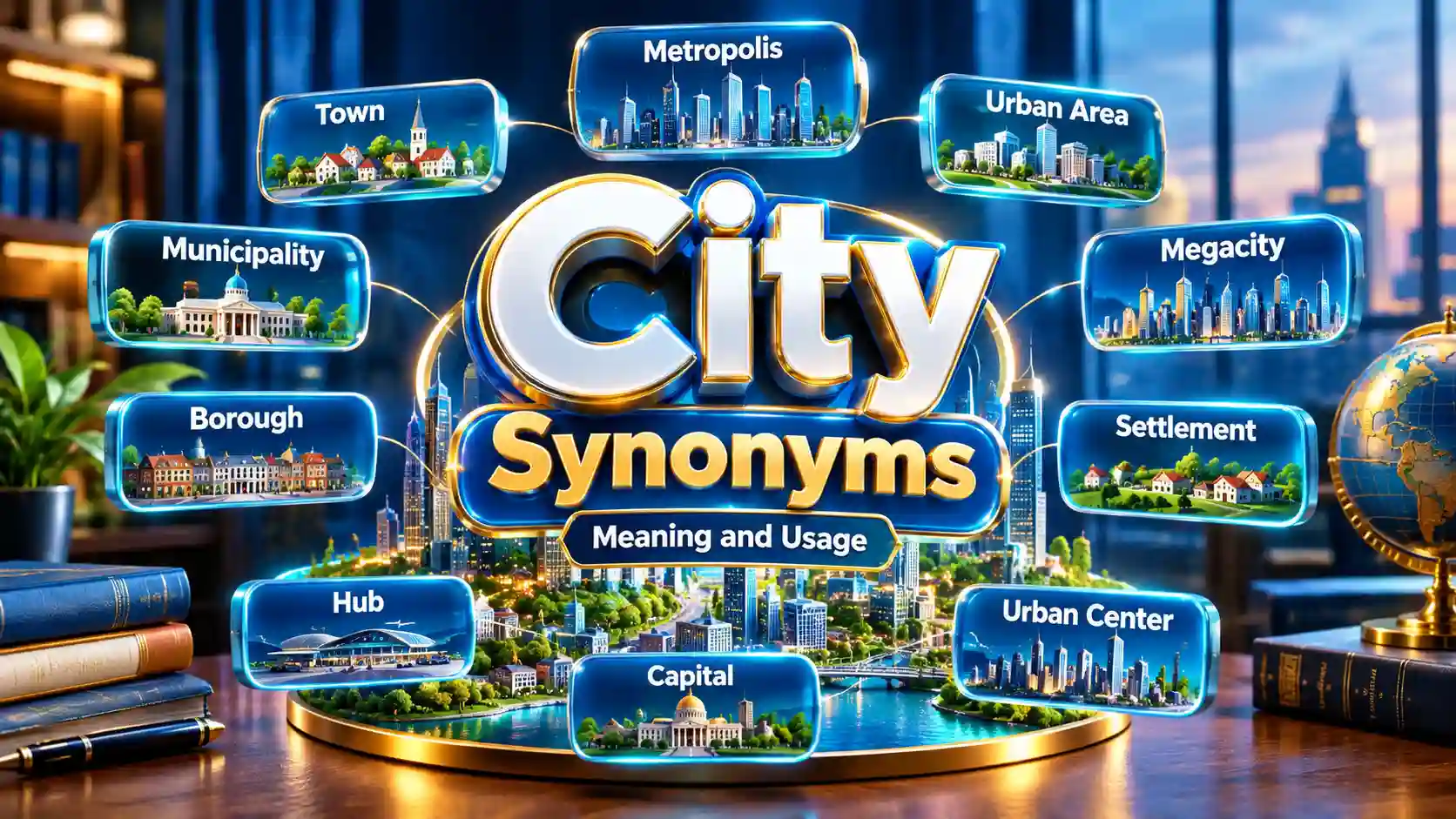
10 Best Synonyms for City
| # | Synonym | Meaning Difference | Best Used For | Formality |
| 1 | Town | A smaller urban area compared with a city | Everyday speech, general descriptions | Neutral |
| 2 | Metropolis | A very large and important city | Major global cities | Formal |
| 3 | Urban Area | A developed region with high population density | Geography, research, reports | Formal |
| 4 | Municipality | A city or town governed by local authorities | Government and legal writing | Formal |
| 5 | Borough | A section or administrative area of a city | Specific regions in some countries | Formal |
| 6 | Megacity | A city with an extremely large population | Population studies, geography | Formal |
| 7 | Settlement | A place where people establish a community | Historical or geographical writing | Neutral |
| 8 | Hub | A city considered a center of activity | Business, technology, travel | Neutral |
| 9 | Capital | A city where a country or region’s government operates | Political contexts | Formal |
| 10 | Urban Center | A city viewed as a center of development and activity | Academic and professional writing | Formal |
Quick Facts About City
Word: City
Part of Speech: Noun
Simple Meaning:
A large and developed place where many people live, work, and access services.
Pronunciation:
/ˈsɪt.i/
Syllables:
Two syllables — cit-y
Word Forms:
- City (noun)
- Cities (plural noun)
- Urban (adjective)
- Urbanization (noun)
Formality:
Neutral. The word works in everyday conversation, academic writing, journalism, and professional communication.
Closest Synonym:
Metropolis is one of the closest synonyms when referring to a large and important city, but it usually suggests greater size, influence, and economic importance.
Best Used For:
- Describing large populated places
- Talking about government, business, culture, and infrastructure
- Comparing urban and rural areas
What Is the Closest Synonym for City?
The closest synonym for city depends on the meaning you want to express. In most situations, metropolis is considered one of the nearest alternatives because it refers to a large, important, and highly developed city. However, it is not always a perfect replacement.
A city can refer to any officially recognized urban area, whether small or large. A metropolis, on the other hand, usually suggests a major city with a large population, strong economy, cultural influence, and regional importance.
Example:
- New York is a city.
(A general statement about an urban place.) - New York is a global metropolis.
(Emphasizes its international importance and influence.)
Other close alternatives include:
- Urban area — focuses on the developed environment rather than the official city status.
- Municipality — focuses on government boundaries.
- Urban center — highlights economic and social activity.
So, choose metropolis when you want to emphasize size and importance, but use city when you need a general and accurate term.
Can These Synonyms Be Used Interchangeably?
Not all synonyms for city can replace each other in every situation. Although many words describe populated places, they carry different meanings related to size, purpose, location, and tone.
Usually Interchangeable
Some words can replace city in general descriptions:
| Word | Example |
| Town | I grew up in a small town. |
| Urban area | The urban area has expanded rapidly. |
| Urban center | The urban center attracts thousands of workers. |
These alternatives work when the exact size or administrative status is not important.
Sometimes Interchangeable
Some words work only in specific contexts:
Metropolis
Can replace city when talking about a large and influential place.
✅ Correct:
Tokyo is a major metropolis.
❌ Less suitable:
My hometown village is a metropolis.
Hub
Works when describing a place that is important for activity.
Example:
Dubai is a business hub.
Here, hub focuses on economic importance rather than simply being a city.
Capital
Only works for cities that are official government centers.
Example:
Islamabad is the capital of Pakistan.
Not every city is a capital.
Rarely Interchangeable
Some terms have specialized meanings:
- Municipality → focuses on government administration.
- Borough → refers to a specific administrative division.
- Settlement → can include villages and small communities.
Replacing city with these words may change the meaning.
Detailed Synonym Meanings and Examples
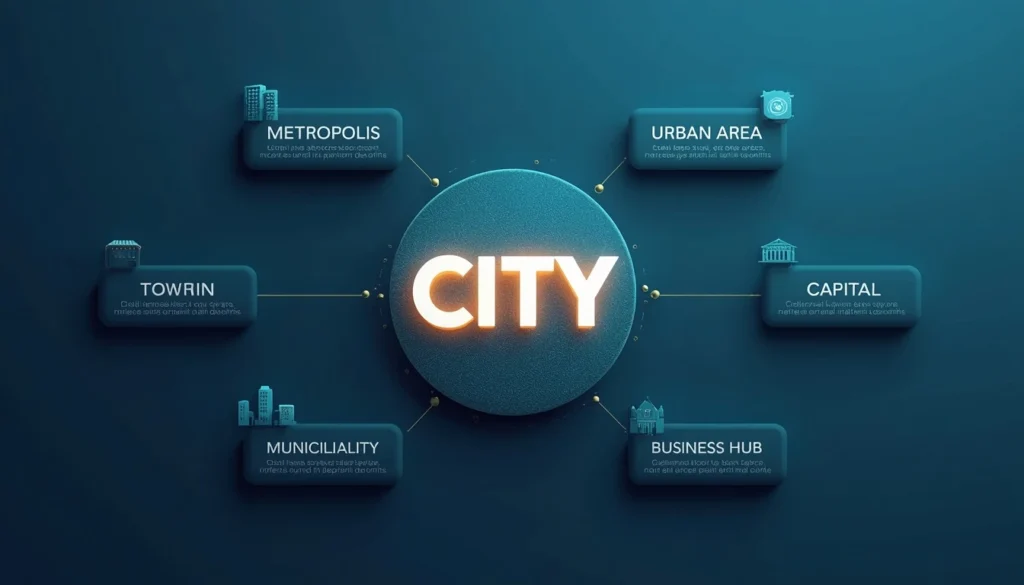
1. Town
Meaning:
A populated place that is usually smaller than a city but larger than a village.
Difference from City:
A town generally has fewer residents, less infrastructure, and a smaller economic role.
Best Used For:
Everyday conversations, travel descriptions, local discussions.
Formality:
Neutral
Examples:
- I moved from a small town to a busy city for work.
- The town has beautiful markets and historic buildings.
2. Metropolis
Meaning:
A very large city that serves as an important economic, cultural, or political center.
Difference from City:
A metropolis suggests greater size, influence, and importance.
Best Used For:
- Geography articles
- Travel writing
- Describing global cities
Formality:
Formal
Examples:
- London is a global metropolis with millions of residents.
- The small village transformed into a modern metropolis over decades.
3. Urban Area
Meaning:
A developed region with dense population, buildings, and infrastructure.
Difference from City:
An urban area describes the physical environment and may include surrounding communities.
Best Used For:
- Research papers
- Geography
- Statistics
Formality:
Formal
Examples:
- The urban area has experienced rapid population growth.
- Governments study urban areas to improve transportation systems.
4. Municipality
Meaning:
A city, town, or district managed by a local government.
Difference from City:
It focuses on administrative control rather than the physical place.
Best Used For:
- Legal documents
- Government communication
Formality:
Formal
Examples:
- The municipality introduced new recycling policies.
- Each municipality manages its own public services.
5. Borough
Meaning:
An administrative division within a city or a separate local government area.
Difference from City:
A borough is usually only a part of a larger city.
Best Used For:
- Specific geographic areas
- Administrative discussions
Formality:
Formal
Examples:
- Each borough has its own local responsibilities.
- The borough contains several historic neighborhoods.
6. Megacity
Meaning:
A city with an extremely large population, usually more than 10 million people.
Difference from City:
A megacity emphasizes population size.
Best Used For:
- Population studies
- Urban planning
Formality:
Formal
Examples:
- Megacities face challenges such as traffic and pollution.
- Researchers analyze how megacities manage growth.
7. Settlement
Meaning:
A place where people establish a permanent community.
Difference from City:
A settlement can be much smaller than a city.
Best Used For:
- History
- Geography
- Archaeology
Formality:
Neutral
Examples:
- The ancient settlement developed near a river.
- Early settlements formed thousands of years ago.
8. Hub
Meaning:
A central place where important activities happen.
Difference from City:
A hub focuses on importance or function, not population.
Best Used For:
- Business
- Technology
- Transportation
Formality:
Neutral
Examples:
- Silicon Valley became a technology hub.
- The city is a major transportation hub.
9. Capital
Meaning:
The official city where a country’s or region’s government operates.
Difference from City:
A capital has political importance.
Best Used For:
- Government writing
- International topics
Formality:
Formal
Examples:
- Paris is the capital of France.
- The capital attracts government workers and visitors.
10. Urban Center
Meaning:
A developed city area that acts as a center for business, culture, or services.
Difference from City:
It emphasizes activity rather than official boundaries.
Best Used For:
- Academic writing
- Reports
Formality:
Formal
Examples:
- The urban center provides employment opportunities.
- Many people move toward urban centers for better facilities.
11. Township
Meaning:
A small town or organized community, often used for residential areas or local administrative regions.
Difference from City:
A township is usually smaller and less developed than a city.
Best Used For:
- Local descriptions
- Regional discussions
- Community planning
Formality:
Neutral
Examples:
- The township has grown rapidly because of new industries.
- Many families moved to the nearby township for affordable housing.
12. Village
Meaning:
A small community, usually located in a rural area.
Difference from City:
A village is much smaller and usually has fewer services and facilities.
Best Used For:
- Rural descriptions
- Travel writing
- Historical contexts
Formality:
Neutral
Examples:
- She was born in a peaceful village surrounded by mountains.
- The village depends mainly on farming.
13. Community
Meaning:
A group of people living in the same area or sharing common interests.
Difference from City:
A community describes people and relationships rather than the physical urban area.
Best Used For:
- Social discussions
- Development topics
- Local stories
Formality:
Neutral
Examples:
- The local community organized a clean-up campaign.
- The city has a diverse community of residents.
14. District
Meaning:
A specific administrative area that may contain cities, towns, or villages.
Difference from City:
A district is a larger administrative division, not necessarily one urban place.
Best Used For:
- Government documents
- Geography
- Statistics
Formality:
Formal
Examples:
- The district includes several small towns.
- Officials announced new development plans for the district.
15. Region
Meaning:
A larger geographical area containing multiple settlements.
Difference from City:
A region covers a wider area and may include many cities.
Best Used For:
- Geography
- Economic studies
- Historical writing
Formality:
Neutral/Formal
Examples:
- The region is known for its cultural diversity.
- Several cities in the region cooperate on environmental projects.
16. Locale
Meaning:
A particular place or location, often emphasizing its character or atmosphere.
Difference from City:
A locale can be any type of place, not necessarily an urban area.
Best Used For:
- Creative writing
- Travel articles
- Storytelling
Formality:
Neutral
Examples:
- The coastal locale attracts many tourists.
- The novel is set in a mysterious mountain locale.
17. Place
Meaning:
A general word for any location where people or activities exist.
Difference from City:
A place is much broader and can refer to cities, villages, buildings, or areas.
Best Used For:
- Everyday conversation
- General descriptions
Formality:
Neutral
Examples:
- This city is a wonderful place to live.
- I visited many beautiful places during my trip.
18. Urban Community
Meaning:
A population group living in a developed city environment.
Difference from City:
It focuses on residents rather than the physical city itself.
Best Used For:
- Sociology
- Research
- Development studies
Formality:
Formal
Examples:
- Urban communities often face housing challenges.
- The project supports vulnerable urban communities.
19. Commercial Center
Meaning:
A place where business, trade, and economic activities are concentrated.
Difference from City:
A commercial center describes a function of a city rather than the entire city.
Best Used For:
- Business writing
- Economic discussions
Formality:
Formal
Examples:
- The area became a commercial center for international companies.
- The city developed into a regional commercial center.
20. Downtown
Meaning:
The central business or activity area of a city.
Difference from City:
Downtown refers only to a part of a city.
Best Used For:
- Travel descriptions
- Everyday speech
Formality:
Neutral
Examples:
- Many offices are located downtown.
- Tourists often visit downtown attractions.
21. Cityscape
Meaning:
The visible appearance or layout of a city, including buildings and streets.
Difference from City:
It describes the visual character of a city, not the city itself.
Best Used For:
- Photography
- Architecture
- Creative writing
Formality:
Neutral
Examples:
- The cityscape changed dramatically after new skyscrapers were built.
- The photographer captured the modern cityscape beautifully.
22. Megalopolis
Meaning:
A large urban area formed by connected cities and metropolitan regions.
Difference from City:
A megalopolis includes multiple cities linked together.
Best Used For:
- Urban studies
- Geography
Formality:
Formal
Examples:
- The region developed into a massive megalopolis.
- Experts study transportation problems in megalopolises.
23. Metropolitan Area
Meaning:
A major city together with its surrounding suburbs and connected communities.
Difference from City:
It includes areas beyond the official city boundaries.
Best Used For:
- Statistics
- Urban planning
- Government reports
Formality:
Formal
Examples:
- The metropolitan area has millions of residents.
- Housing demand is increasing across the metropolitan area.
24. Cosmopolis
Meaning:
A city with a diverse international population and global character.
Difference from City:
It emphasizes cultural diversity and worldwide connections.
Best Used For:
- Literature
- Cultural discussions
Formality:
Formal
Examples:
- The city became a cosmopolis where cultures meet.
- Modern cosmopolises attract people from around the world.
25. Colony
Meaning:
A settlement established by a group of people, historically often connected with migration or control.
Difference from City:
A colony is not necessarily urban and has historical or political meanings.
Best Used For:
- History
- Historical geography
Formality:
Formal
Examples:
- The colony expanded into a major settlement.
- Historians studied the development of the early colony.
Best Alternatives by Context
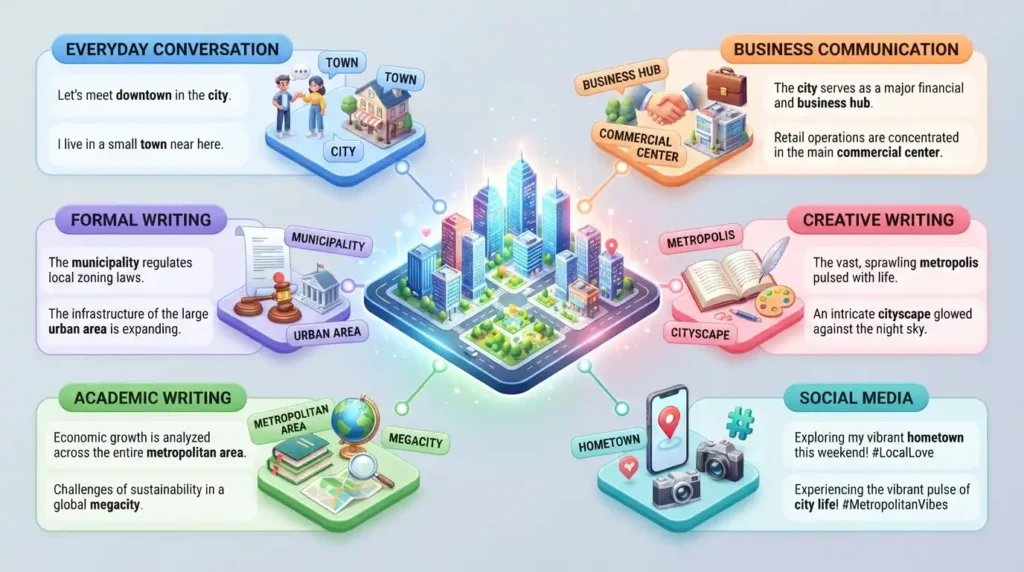
Everyday Conversation
For normal conversations, use simple and natural words:
| Situation | Best Choice |
| General location | City |
| Smaller urban place | Town |
| Friendly description | Place |
| Local area | Community |
| Central area | Downtown |
Example:
I moved to a new city last year.
I live in a small town near the mountains.
Formal Writing
For professional or official writing:
| Word | Suitable For |
| Municipality | Government documents |
| Urban area | Research reports |
| Metropolitan area | Population studies |
| Urban center | Development topics |
| District | Administrative writing |
Example:
The metropolitan area has experienced significant economic growth.
Academic Writing
In IELTS essays, research papers, and university assignments:
Recommended words:
- Urban area
- Metropolis
- Metropolitan area
- Megacity
- Urban center
Example:
Rapid urbanization has transformed many metropolitan areas worldwide.
Business Communication
Useful alternatives:
- Commercial center
- Business hub
- Economic center
- Metropolitan area
Example:
The city has become a major business hub for technology companies.
Creative Writing
For storytelling and descriptive writing:
Use:
- Metropolis
- Cityscape
- Cosmopolis
- Locale
- Urban landscape
Example:
The neon-lit metropolis never slept, filled with endless movement and energy.
Social Media
For captions and casual posts:
Use:
- City life
- Urban jungle
- Downtown
- Hometown
- My city
Example:
Exploring the hidden gems of my hometown.
Which Synonym Should I Choose?
Choosing the right synonym for city depends on the meaning, audience, and situation. Although many words describe populated places, each one creates a different impression.
Use “City” for General Meaning
The word city is the safest and most widely understood option.
Use it when:
- Talking about a normal urban place
- Writing general information
- The size or importance is not the main focus
Example:
I live in a city near the coast.
Use “Metropolis” for Size and Importance
Choose metropolis when you want to show that a city is large, influential, or globally recognized.
Best for:
- Travel writing
- News articles
- Creative descriptions
Example:
Dubai has developed into a modern metropolis.
Use “Town” for Smaller Places
Choose town when the place is smaller than a typical city.
Best for:
- Personal stories
- Everyday conversation
Example:
My grandparents live in a quiet town.
Use “Urban Area” for Research and Data
Choose urban area when discussing population, development, or geography.
Best for:
- Academic essays
- Reports
- Statistics
Example:
Urban areas continue to attract younger populations.
Use “Hub” for Importance and Activity
Choose hub when you want to highlight a city’s role in a specific field.
Examples:
- Financial hub
- Technology hub
- Cultural hub
- Transportation hub
Example:
The city is becoming a global technology hub.
Use “Capital” Only for Government Centers
A capital is not simply a large city. It is the official seat of government.
Example:
Canberra is the capital of Australia.
Do not use:
Sydney is the capital of Australia.
Exact and Near Synonyms: Difference
Synonyms are words with similar meanings, but they are rarely identical. Most alternatives have small differences in meaning, emotion, or usage.
For example:
| Word | Meaning Focus |
| City | General urban place |
| Metropolis | Large and influential city |
| Town | Smaller urban settlement |
| Hub | Center of activity |
| Municipality | Government structure |
| Urban area | Developed geographical region |
A writer chooses a synonym based on the message they want to communicate.
Example:
Sentence 1:
London is a city.
This gives basic information.
Sentence 2:
London is a global metropolis.
This highlights influence, economy, and international importance.
Sentence 3:
London is a cultural hub.
This focuses on arts, events, and creativity.
The location is the same, but the meaning changes.
Words Commonly Confused with City
Some words are related to city but are not true synonyms.
1. Country
Meaning:
A nation with its own government and territory.
Incorrect:
Paris is a country.
Correct:
France is a country.
2. State
Meaning:
A political division within a country.
Example:
California is a state in the United States.
A city may exist inside a state.
3. Neighborhood
Meaning:
A smaller area inside a city.
Example:
Downtown is a neighborhood of the city.
A neighborhood is part of a city, not another word for city.
4. Suburb
Meaning:
A residential area located outside or near a city.
Example:
Many families live in suburbs outside the city.
5. Village
A village is related to settlements but usually describes a much smaller rural community.
Example:
The village has fewer facilities than the nearby city.
6. Downtown
Downtown means the central area of a city, not the entire city.
Example:
The downtown area has many offices.
Antonyms of City
True opposites of city depend on the context. Since a city is a large urban settlement, its opposites usually describe smaller or less developed places.
| Antonym | Meaning |
| Village | Small rural settlement |
| Countryside | Rural land outside urban areas |
| Rural area | Less populated region |
| Hamlet | Very small settlement |
| Wilderness | Natural area without urban development |
| Desert | Uninhabited or sparsely populated land |
Examples:
- Many people are moving from rural areas to cities.
- The countryside is quieter than the busy city.
Common Phrases with City
1. Big City
Meaning:
A large urban area with many people and facilities.
Example:
Living in a big city offers many career opportunities.
2. City Life
Meaning:
The lifestyle and experiences of living in an urban area.
Example:
She enjoys the energy of city life.
3. City Center
Meaning:
The central part of a city.
Example:
The hotel is located near the city center.
4. City Limits
Meaning:
The official boundaries of a city.
Example:
The factory is outside the city limits.
5. Smart City
Meaning:
A city that uses technology to improve services and living conditions.
Example:
Many governments are investing in smart city projects.
6. Ghost City
Meaning:
A deserted or mostly empty urban area.
Example:
The abandoned development became known as a ghost city.
7. Capital City
Meaning:
The official government city of a country.
Example:
Islamabad is the capital city of Pakistan.
8. Inner City
Meaning:
The central urban area, often with older neighborhoods.
Example:
The inner city has experienced major redevelopment.
Frequently Asked Questions
1. What are synonyms for cities?
Common synonyms for cities include:
- Urban areas
- Metropolises
- Towns
- Urban centers
- Municipalities
- Megacities
- Metropolitan areas
The best choice depends on size and context.
2. What are synonyms for town?
Synonyms for town include:
- Settlement
- Township
- Community
- Borough
- Village (in some contexts)
- Municipality
However, these words may describe different sizes or administrative structures.
3. What’s a fancy word for place?
Some elegant alternatives for place include:
- Locale
- Destination
- Setting
- Region
- Location
- Environment
The best option depends on whether you describe geography, travel, or storytelling.
4. What’s another way to say big city?
Alternatives for big city include:
- Metropolis
- Megacity
- Urban center
- Metropolitan area
- Cosmopolis
5. What is a fancy name for a city?
Fancy or descriptive words for a city include:
- Metropolis
- Cosmopolis
- Urban center
- Cityscape
- Urban hub
6. What are 10 good synonyms?
Ten useful alternatives for city are:
- Town
- Metropolis
- Urban area
- Municipality
- Urban center
- Megacity
- Hub
- Capital
- Metropolitan area
- Settlement
Conclusion
Choosing the right synonym for city helps you communicate with more accuracy and style. While simple words like city and town work well in everyday conversations, more specific alternatives such as metropolis, urban center, and metropolitan area add precision in academic, professional, and creative writing.
Synonyms are not just replacements; they carry different meanings, emotions, and levels of formality. Understanding these differences allows writers, students, and speakers to choose the word that perfectly matches their message.
Whether you are preparing an IELTS essay, writing an article, creating content, or improving your vocabulary, selecting the right alternative for city can make your communication clearer and more effective.

About Sajjad Ahmed
Sajjad Ahmed is the author behind Guest Paster, where he writes about English vocabulary, synonyms, word meanings, and practical word usage.
His content is designed to help readers understand the differences between similar words, discover suitable alternatives, and use English vocabulary more effectively in everyday writing and communication.
Before publishing, Sajjad focuses on presenting word choices in a clear and easy-to-understand format, with relevant meanings, context, and examples where helpful.
Through Guest Paster, his goal is to make vocabulary learning simpler and provide useful language resources for students, writers, English learners, and anyone looking to expand their vocabulary.
Areas of Focus: English Vocabulary • Synonyms • Word Meanings • Word Usage • Language Learning
Author: Sajjad Ahmed
Website: Guest Paster