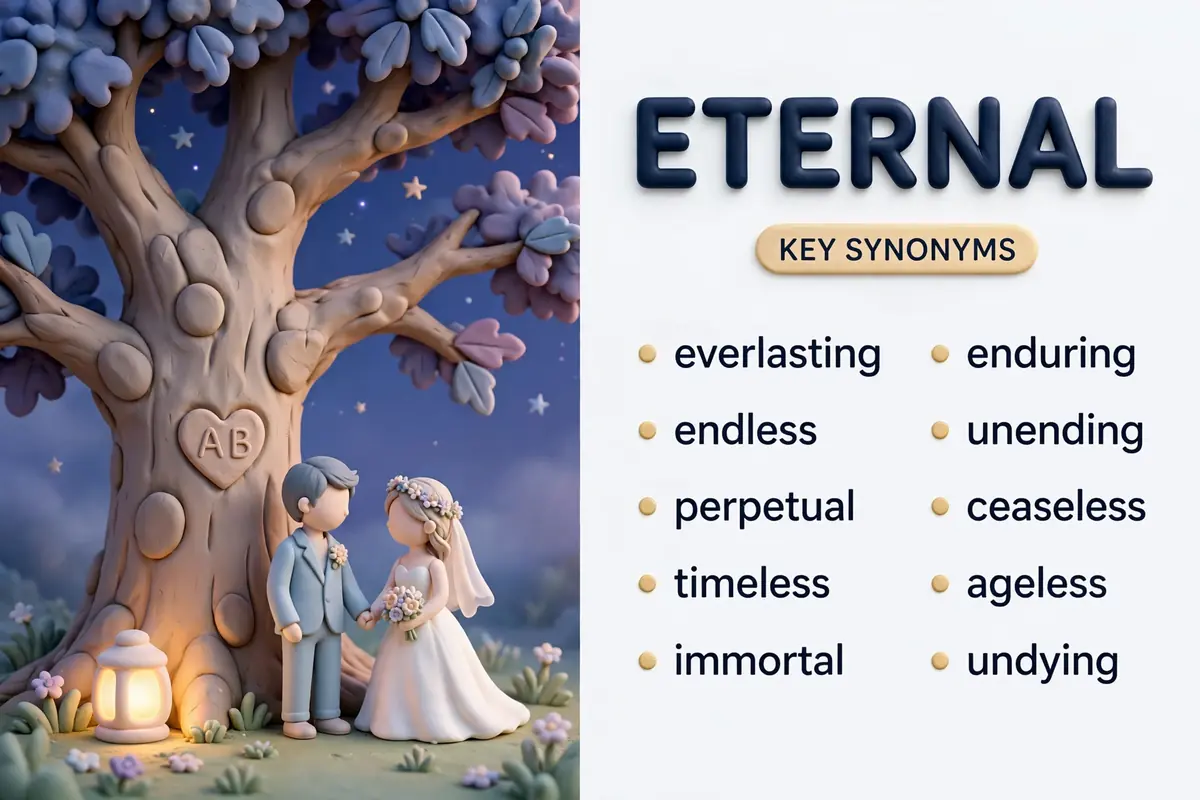
In 1962 two teenagers carved their initials into an oak tree in a village green. The bark has grown thick around the letters. The teenagers are grandparents now the village has changed and the tree still stands. That is the promise inside eternal: something that does not end and does not give way to time.
The closest synonym is everlasting which swaps cleanly into most sentences about love, memory and faith. Timeless suits things that never go out of date immortal suits what death cannot touch and endless suits what simply keeps going.
This guide gives you 15 eternal synonyms with meanings, examples and honest limits, so you can pick the word that lasts
Top 10 Eternal Synonyms at a Glance
| # | Synonym | Meaning Difference |
|---|---|---|
| 1 | Everlasting | Lasting forever |
| 2 | Endless | With no end in sight |
| 3 | Perpetual | Without a break |
| 4 | Timeless | Never out of date |
| 5 | Immortal | Living forever |
| 6 | Enduring | Lasting through hardship |
| 7 | Unending | Never stopping |
| 8 | Ceaseless | Without any pause |
| 9 | Ageless | Never showing age |
| 10 | Undying | A feeling that never dies |
Quick Facts About “Eternal”
- Part of speech: an adjective. The noun is eternity, and the adverb is eternally.
- Core meaning: lasting forever, without beginning or end; also, seeming to last forever.
- Three main senses: (1) lasting forever; (2) beyond time or death; (3) lasting a very long time.
- Register: neutral to formal. Eternal suits vows, poetry, speeches, and essays.
- Common mistake: using eternal for anything merely long, such as a meeting. A meeting feels endless, not eternal.
The Closest Synonym: Everlasting
Everlasting is the closest synonym for eternal, because it carries the same core idea of lasting forever, without adding the coldness of a dictionary definition. Test the swap and it holds. “Their eternal love survived every hardship” becomes “Their everlasting love survived every hardship” with no loss of sense. “He prayed for eternal life” becomes “He prayed for everlasting life.”
Everlasting is the warmer of the two, at home in vows, hymns, and love letters, where eternal can sound grand and distant. Timeless runs second for things that never date, yet says nothing about duration. Choice test: a promise means everlasting; a classic means timeless; a life beyond death means immortal.
Where “Eternal” Comes From (Etymology)
According to Etymonline, eternal entered English in the late 14th century from Old French eternel, or directly from Late Latin aeternalis, from Latin aeternus, “of an age, lasting, enduring, permanent, everlasting, endless.” The Latin word was a contraction of aeviternus, “of great age,” from aevum, “age,” which traces back to the Proto-Indo-European root aiw-, “vital force, life; long life, eternity.”
Etymonline notes eternal has been used since Middle English for things with no beginning and no end, and for things with a beginning but no end. A parallel Middle English form, eterne, came from Latin aeternus. The noun phrase the Eternal, meaning God, is attested from the 1580s. Merriam-Webster records the first known use of the adjective in the 14th century.
This history explains the word’s gravity. Eternal began as a word about age itself, a span of time so long it stops being a span at all. The long memory inside it suits the old stories a culture keeps retelling, the kind of tales our guide to lore synonyms explores in full.
Can You Swap Them Freely?
In short: only inside the same meaning group, when the sense matches.
- ✅ “Their everlasting love survived every hardship.” (a bond with no end ✅)
- ❌ “Their endless love survived every hardship.” (sounds like a complaint —, say everlasting)
- ✅ “The black dress is timeless, as elegant now as it was decades ago.” (never out of date ✅)
- ❌ “The black dress is immortal, as elegant now as it was decades ago.” (immortal means never dying —)
- ✅ “Ceaseless waves wore the cliff smooth over centuries.” (without any pause ✅)
- ❌ “Ceaseless vows were exchanged beneath the old oak.” (vows are not a process —)
Before you substitute, ask which forever you mean: a bond, a quality beyond time, or a process that never pauses.
Eternal Synonyms in Detail
Group 1: No End in Time
1. Everlasting
Meaning: Lasting forever, with no end.
Difference: The warmest word in this group, closest to eternal itself.
Best used for: Wedding vows, love letters, hymns, and promises.
Formality: Neutral to formal · CEFR: B2 · Frequency: Common
Example (Wedding): “They exchanged everlasting vows beneath the old oak tree.”
Example (Faith): “The hymn sings of everlasting life and hope.”
When NOT to use it: For a process that keeps running, use perpetual instead.
2. Endless
Meaning: With no end in sight.
Difference: Endless describes how something feels to the person waiting, not its true length.
Best used for: Journeys, patience, and complaints.
Formality: Neutral · CEFR: B2 · Frequency: Very common
Example (Travel): “The endless road crossed the desert for hours.”
Example (Work): “Her endless patience with new students became legend.”
When NOT to use it: For a solemn promise, use everlasting; endless can sound like a complaint.
3. Unending
Meaning: Never coming to a stop.
Difference: Unending stresses flow, like a river or a song.
Best used for: Stories, applause, and devotion.
Formality: Neutral · CEFR: C1 · Frequency: Common
Example (Story): “The storyteller held the children with an unending chain of tales.”
Example (Music): “Unending applause filled the hall long after the final note.”
When NOT to use it: For a fixed quality such as beauty, use timeless instead.
4. Perpetual
Meaning: Continuing without a break.
Difference: Perpetual suggests a mechanism or habit, not one unbroken stretch.
Best used for: Machines, motion, and noise.
Formality: Formal · CEFR: C1 · Frequency: Common
Example (Science): “The old clock ticked with perpetual motion, year after year.”
Example (City): “The perpetual hum of traffic never quite stops at midnight.”
When NOT to use it: For love or faith, use everlasting; perpetual sounds mechanical.
5. Ceaseless
Meaning: Without any pause or rest.
Difference: Ceaseless adds force to the idea of never stopping.
Best used for: Effort, rain, waves, and wind.
Formality: Formal · CEFR: C1 · Frequency: Less common
Example (Sea): “Ceaseless waves wore the cliff smooth over centuries.”
Example (Effort): “Her ceaseless work built the charity from nothing into a lifeline.”
When NOT to use it: For a quiet quality such as grace, use timeless instead.
Group 2: Beyond Time and Death
6. Timeless
Meaning: Unaffected by time, as good now as ever.
Difference: Timeless is about quality that never dates, not about duration.
Best used for: Art, design, music, and classics.
Formality: Neutral · CEFR: B2 · Frequency: Very common
Example (Design): “The black dress is timeless, elegant now as it was decades ago.”
Example (Music): “A timeless melody still fills the hall when the band plays it.”
When NOT to use it: For a promise of forever, use everlasting; timeless says nothing about duration.
7. Immortal
Meaning: Living forever, never dying.
Difference: Immortal belongs to beings, gods, heroes, and works that outlive their makers.
Best used for: Literature, legend, and lasting fame.
Formality: Neutral to formal · CEFR: B2 · Frequency: Common
Example (Literature): “Shakespeare’s lines made his young lovers immortal.”
Example (Myth): “The gods drank nectar and stayed immortal while kingdoms fell.”
When NOT to use it: For a long marriage, use enduring; immortal is about death, not time.
8. Ageless
Meaning: Never showing the marks of age.
Difference: Ageless describes how something looks or feels, not how long it lasts.
Best used for: Beauty, energy, and style.
Formality: Neutral · CEFR: B2 · Frequency: Common
Example (Person): “Her ageless smile lit the room, as it had forty years before.”
Example (Place): “The ageless hills looked the same as they had in her childhood.”
When NOT to use it: For a legal promise, use permanent; ageless is about appearance.
9. Undying
Meaning: A feeling or quality that never dies.
Difference: Undying is almost always emotional, tied to love, loyalty, or thanks.
Best used for: Love, loyalty, and gratitude.
Formality: Neutral to formal · CEFR: C1 · Frequency: Common
Example (Love): “His undying love carried her through the long illness.”
Example (Loyalty): “The soldiers swore undying loyalty to their captain.”
When NOT to use it: For a machine, use perpetual; undying belongs to feelings.
10. Sempiternal
Meaning: Eternal and unchanging, having no end.
Difference: The rarest word here, a literary cousin of eternal.
Best used for: Poetry, philosophy, and theology.
Formality: Very formal · CEFR: C2 · Frequency: Rare
Example (Poetry): “The sempiternal stars watched over the sleeping valley.”
Example (Philosophy): “He wrote of sempiternal truths beyond human time.”
When NOT to use it: In everyday speech, use eternal; most readers will not know sempiternal.
Group 3: Lasting a Very Long Time
11. Enduring
Meaning: Lasting through hardship and time.
Difference: Enduring implies survival, tested by years and still standing.
Best used for: Marriages, monuments, and reputations.
Formality: Neutral to formal · CEFR: B2 · Frequency: Very common
Example (Marriage): “Their enduring marriage survived war and fifty winters.”
Example (Art): “The enduring appeal of the novel surprises every new generation.”
When NOT to use it: For a promise of forever, use everlasting; enduring claims only a very long time.
12. Permanent
Meaning: Intended to last, not to change.
Difference: Permanent is practical, a matter of intent rather than poetry.
Best used for: Records, ink, and decisions.
Formality: Neutral · CEFR: B1 · Frequency: Very common
Example (School): “Use a permanent marker for the labels on the storage boxes.”
Example (Life): “They moved into their permanent home last spring.”
When NOT to use it: For love or faith, use everlasting; permanent sounds like paperwork.
13. Infinite
Meaning: Without any limit, beyond measure.
Difference: Infinite is about boundlessness, in space or amount as much as in time.
Best used for: Space, patience, and mathematics.
Formality: Neutral to formal · CEFR: B2 · Frequency: Very common
Example (Math): “The line stretches on to infinite points, with no final one.”
Example (Patience): “She answered the same question with infinite patience.”
When NOT to use it: For a wedding vow, use everlasting; infinite sounds like a measurement.
14. Lasting
Meaning: Continuing for a long time, with real effect.
Difference: Lasting is the plainest word here, honest and unshowy.
Best used for: Impressions, friendships, and peace.
Formality: Neutral · CEFR: A2 · Frequency: Very common
Example (Friendship): “A lasting friendship began that summer and holds to this day.”
Example (Peace): “The treaty brought a lasting peace to the valley.”
When NOT to use it: For a claim of forever, use eternal; lasting promises only a long time.
15. Abiding
Meaning: Continuing over time, steady and faithful.
Difference: Abiding carries quiet devotion, a love or faith that stays.
Best used for: Love, faith, and memory.
Formality: Formal · CEFR: C1 · Frequency: Less common
Example (Faith): “An abiding faith steadied her through grief.”
Example (Memory): “An abiding memory of his grandmother’s kitchen stayed with him.”
When NOT to use it: For a monument, use enduring instead.
Words Commonly Confused With Eternal
Eternal versus everlasting is the closest call in this guide. The two words share the same core meaning and swap cleanly in most sentences. Everlasting is warmer, common in vows and hymns, while eternal is broader and more formal, at home in philosophy and theology. A wedding vow leans toward everlasting; a discussion of the soul, toward eternal.
Eternal versus endless matters for feeling. Endless describes the experience of no end, not the fact of it. A road can be endless to a tired driver and still end at the next town. Eternal claims the thing truly has no end, so never use it for a wait, a queue, or a speech that merely drags.
Eternal versus immortal matters for what the word touches. Immortal means never dying, and it belongs to beings: gods, heroes, and souls. Eternal means never ending, and it belongs to time, love, and truth. An immortal soul lives forever, and eternal life is the time it lives in.
Eternal versus perpetual matters for process. Perpetual describes something that keeps renewing itself, like a flame relit each morning. A perpetual flame can burn for a century and still be put out, while an eternal flame, in the solemn sense, is meant never to go out at all.
Substitution test failures: “The eternal meeting finally ended at six” fails, because a meeting has an end, so say “endless.” “Her eternal patience ran out by noon” fails, because patience that runs out was never eternal, so say “endless.” “The eternal flame was switched off for repairs” fails in the solemn sense, since an eternal flame is never put out, so say “perpetual.”
Best Alternatives by Context
Six scenes, each with the best word.
Scene 1: You are writing wedding vows. Call the promise everlasting, and let undying carry the feeling behind it. Eternal is true too, yet grander than a vow needs, and endless would turn a promise into a complaint.
Scene 2: You are writing about a classic novel or film. Call it timeless, the word for work that never dates. Immortal suits the author’s fame, not the book.
Scene 3: You are writing a eulogy or a memorial. Call the memory enduring and the rest eternal. “Eternal rest” is the phrase mourners have used for centuries, and “an enduring memory” is the promise the living make. For gentler ways to say goodbye, our guide to farewell synonyms covers the full range.
Scene 4: You are writing a science essay. The motion that never stops is perpetual, and the space with no edge is infinite. Keep eternal for the philosophy, not the measurement.
Scene 5: You are writing a speech about a leader’s legacy. Call the legacy enduring, because it survived tests and still stands. For the force behind it, our guide to power synonyms can help you name what made it last.
Scene 6: You are writing a poem about the night sky. Reach for sempiternal or ageless. The stars deserve a word with music in it.
Which Eternal Synonym Should I Choose?
| Situation | Best pick | Why it wins |
|---|---|---|
| A promise or a bond with no end | Everlasting | Warm and true |
| Something that feels like it never ends | Endless | The feeling |
| A flow that never stops | Unending | The motion |
| A system that keeps renewing itself | Perpetual | The mechanism |
| Effort or force without a pause | Ceaseless | The intensity |
| A classic that never dates | Timeless | The quality |
| A being that never dies | Immortal | Beyond death |
| Beauty or spirit untouched by age | Ageless | The look |
| A feeling that never dies | Undying | The emotion |
| A poetic or philosophical truth | Sempiternal | The music |
| A bond tested by years | Enduring | It survived |
| A decision meant to stand | Permanent | The intent |
| Something beyond all measure | Infinite | No limit |
| A plain long effect | Lasting | Honest and simple |
| A steady, faithful love | Abiding | Quiet devotion |
Eternal Opposites: What Ends Against What Lasts

| Opposite | How It Differs |
|---|---|
| Temporary | Lasts only for a set time |
| Fleeting | Passes in a moment |
| Transient | Here now, gone soon |
| Momentary | One brief moment |
| Ephemeral | Beautiful, then gone |
| Short-lived | Ends quickly |
| Mortal | Bound by death |
| Finite | Has a limit |
For a love that never ends, temporary is the cleanest opposite: a temporary love has a season, then passes. Fleeting suits a moment of beauty, like a sunset, while ephemeral suits things lovely precisely because they do not last. Mortal stands against immortal, not eternal, so use it only when death is the point. Finite is the thinker’s opposite, for anything with a boundary.
Collocations and Idioms With Eternal
Only combinations native speakers actually use:
- eternal life: life without end, as in “He prayed for eternal life.”
- eternal love: love that never ends, as in “Their eternal love became a family legend.”
- eternal youth: staying young forever, as in “She searched for the secret of eternal youth.”
- eternal flame: a flame kept burning without end, as in “An eternal flame burns at the memorial.”
- eternal rest: peaceful rest after death, as in “May she find eternal rest.”
- eternal gratitude: thanks that never fades, as in “I owe you my eternal gratitude.”
- the Eternal City: Rome, as in “They spent a week wandering the Eternal City.”
- eternal triangle: a love triangle, as in “The play turns on an eternal triangle.”
- eternal sunshine: lasting happiness, from Alexander Pope’s line “eternal sunshine of the spotless mind.”
- eternal optimist: someone who always expects the best, as in “She is an eternal optimist, even in hard years.”
American vs British English
Eternal is spelled and used the same in American and British English, and so are its synonyms here. The phrase eternal triangle turns up more often in British newspapers, while American writers more often say love triangle outright. Eternal rest appears on headstones on both sides of the Atlantic.
Practice Exercises
Exercise 1: Pick the better synonym. Choose the best word from this word bank: everlasting, timeless, endless, immortal, perpetual.
- The couple exchanged ___ vows beneath the old oak tree.
- The black dress is ___, elegant in every decade.
- The ___ road crossed the desert for hours without a single turn.
- Shakespeare’s lines made his young lovers ___.
- The old clock ticked with ___ motion, year after year.
Exercise 2: True or false? Say whether eternal can swap into each sentence without changing the meaning.
- “The eternal meeting finally ended at six.”
- “Their eternal love survived every hardship.”
- “She answered with eternal patience, every single time.”
- “An eternal flame burns at the memorial.”
Answer key
- Exercise 1: (1) everlasting; (2) timeless; (3) endless; (4) immortal; (5) perpetual.
- Exercise 2: (1) False, say endless; (2) True; (3) False, say infinite; (4) True.
Frequently Asked Questions
What is the best synonym for eternal?
Everlasting is the best synonym for the everyday sense, because it names a bond or promise with no end and passes the substitution test in most cases. For a classic that never dates, use timeless, and for a being that never dies, use immortal.
What is the difference between eternal and everlasting?
The two words are nearly identical, and they swap cleanly in most sentences. Everlasting is warmer, common in vows, hymns, and love letters. Eternal is broader and more formal, at home in philosophy and theology. A wedding vow leans toward everlasting, a discussion of the soul toward eternal.
Is eternal the same as endless?
Not quite. Endless describes the feeling of no end, while eternal claims the thing truly has no end. A road can feel endless to a tired driver and still end at the next town. Use endless for waits and journeys, and save eternal for love, faith, and truths.
What is the opposite of eternal?
It depends on the sense. For a bond or promise, the opposite is temporary, which lasts only for a set time. For a moment of beauty, use fleeting or ephemeral. And for a being, use mortal, and for anything with a boundary, use finite.
Can eternal describe a person?
Yes, in set phrases. An eternal optimist is someone who always expects the best. An ageless person looks untouched by time, and an immortal hero lives forever in story. You would not call an ordinary person eternal, since a person has a life span.
Which synonym should students use in essays?
In essays, use everlasting for promises and bonds, and timeless for art and classic works, because both sound clear. Use enduring for anything tested by years, such as a marriage. Save sempiternal for poetry, and keep eternal for the solemn claim at the heart of your argument.
Conclusion
Stand beneath the old oak and look at the initials in its bark. The teenagers who carved them are grandparents now, and the tree still stands.
Everlasting fits the vow, timeless fits the classic, enduring fits the bond that survived the years, and eternal fits the claim that some things never end. Pick the word that matches your kind of forever, and the sentence will hold.

About Sajjad Ahmed
Sajjad Ahmed is the author behind Guest Paster, where he writes about English vocabulary, synonyms, word meanings, and practical word usage.
His content is designed to help readers understand the differences between similar words, discover suitable alternatives, and use English vocabulary more effectively in everyday writing and communication.
Before publishing, Sajjad focuses on presenting word choices in a clear and easy-to-understand format, with relevant meanings, context, and examples where helpful.
Through Guest Paster, his goal is to make vocabulary learning simpler and provide useful language resources for students, writers, English learners, and anyone looking to expand their vocabulary.
Areas of Focus: English Vocabulary • Synonyms • Word Meanings • Word Usage • Language Learning
Author: Sajjad Ahmed
Website: Guest Paster