Muse (noun, /mjuːz/) means a person or personified force regarded as the source of an artist’s inspiration, from poets to painters to designers. Because the word carries classical, slightly formal overtones, alternatives matter: the right substitute keeps your meaning precise without sounding stiff or vague.
For most everyday contexts, inspiration is the closest and safest synonym. For the verb to muse (to think deeply and quietly), ponder is the best match. Choose by asking one question: am I naming the person who sparks creativity, or the spark itself?
Top 10 at a Glance
| # | Synonym | Meaning Difference |
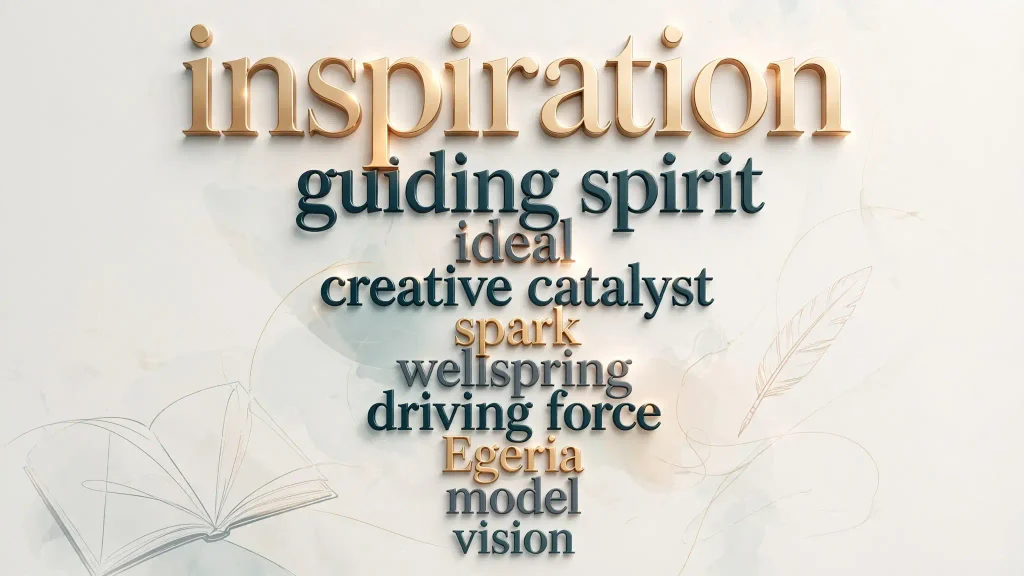
| 1 | inspiration | Closest match; broader, can mean the feeling too |
| 2 | guiding spirit | Stresses long-term direction, not one flash |
| 3 | ideal | Embodied perfection that stirs creative striving |
| 4 | creative catalyst | Emphasizes triggering output, like chemistry |
| 5 | spark | Small and sudden; a muse endures, a spark flashes |
| 6 | wellspring | Rich, renewable supply of inspiring influence |
| 7 | driving force | Momentum and willpower more than dreamy influence |
| 8 | Egeria | Woman who privately advises and inspires; literary |
| 9 | model | Concrete art-world term: one who poses |
| 10 | vision | The idealized mental image driving the work |
Quick Facts About “Muse”
- Part of speech: Noun (also a verb, to muse, covered separately in Section 5.5)
- Simple meaning: A person regarded as the source of an artist’s creative inspiration
- Pronunciation: /mjuːz/ (rhymes with fuse)
- Syllables: 1
- Word forms: muses (plural noun); verb forms: muses, musing, mused
- Formality: Neutral to slightly formal; literary flavor
- Closest synonym: inspiration
- Best used for: Arts, literature, music, design, and fashion contexts where someone sparks another’s creativity
What Is the Closest Synonym for “Muse”?
Inspiration — the person, thing, or force that fills someone with creative ideas and the urge to make something; also the resulting state of being creatively stirred. It is the only synonym that covers nearly every context where muse works, from casual speech (“she’s my inspiration”) to formal writing, without sounding forced or archaic.
Where muse specifically pictures a person as the wellspring, inspiration is broader: it can name the person, the trigger, or the feeling itself.
Word Origin & Etymology
- Origin language: Greek → Latin → Old French → Middle English
- Original meaning: Greek Mousa (“the Muse,” also “music, song”), ultimately from the Proto-Indo-European root men- (“to think”) — fittingly, the Muses were the divinized faculties of poetic thought itself.
- How the meaning evolved: In Greek myth the nine Muses — daughters of Zeus and Mnemosyne, protectors of the arts — were invoked by poets. The lowercase sense, “an inspiring goddess of a particular poet,” i.e., a human source of artistic inspiration, developed from this by the late 14th century (Etymonline).
- First recorded usage: Noun, late 14th century; the transferred “human inspirer” sense is also late 14th century (Etymonline). Merriam-Webster dates the noun’s first known use to the 14th century.
- Source: Etymonline; Merriam-Webster.
- A twist worth knowing: the verb to muse (to ponder) is not etymologically related to the noun at all (Merriam-Webster). The verb comes from Old French muser (12th century), “to ponder, dream, wonder; loiter, waste time” — of uncertain origin, possibly “to stand with one’s nose in the air,” from muse, “muzzle,” from Gallo-Roman musa, “snout” (Etymonline). Two different words that happened to converge in spelling.
- Relatives: museum (“place of the Muses”), music, amuse (from Old French amuser, literally “to cause to muse,” as a distraction), bemuse (“to put into a musing state”), and Greek amousos (“without Muses,” hence “uneducated”).
Can These Synonyms Be Used Interchangeably?
Sometimes — with care. Inspiration, guiding spirit, and source of inspiration swap in almost anywhere. But most alternatives shift the tone or scope: Egeria and afflatus are formal and literary; spark is casual and brief; model belongs to visual art; divine inspiration claims a sacred source.
In formal writing, prefer impetus, Egeria, or paragon; in conversation, stick with inspiration or spark. Never force a literary word into casual chat — it reads as showing off rather than precise.
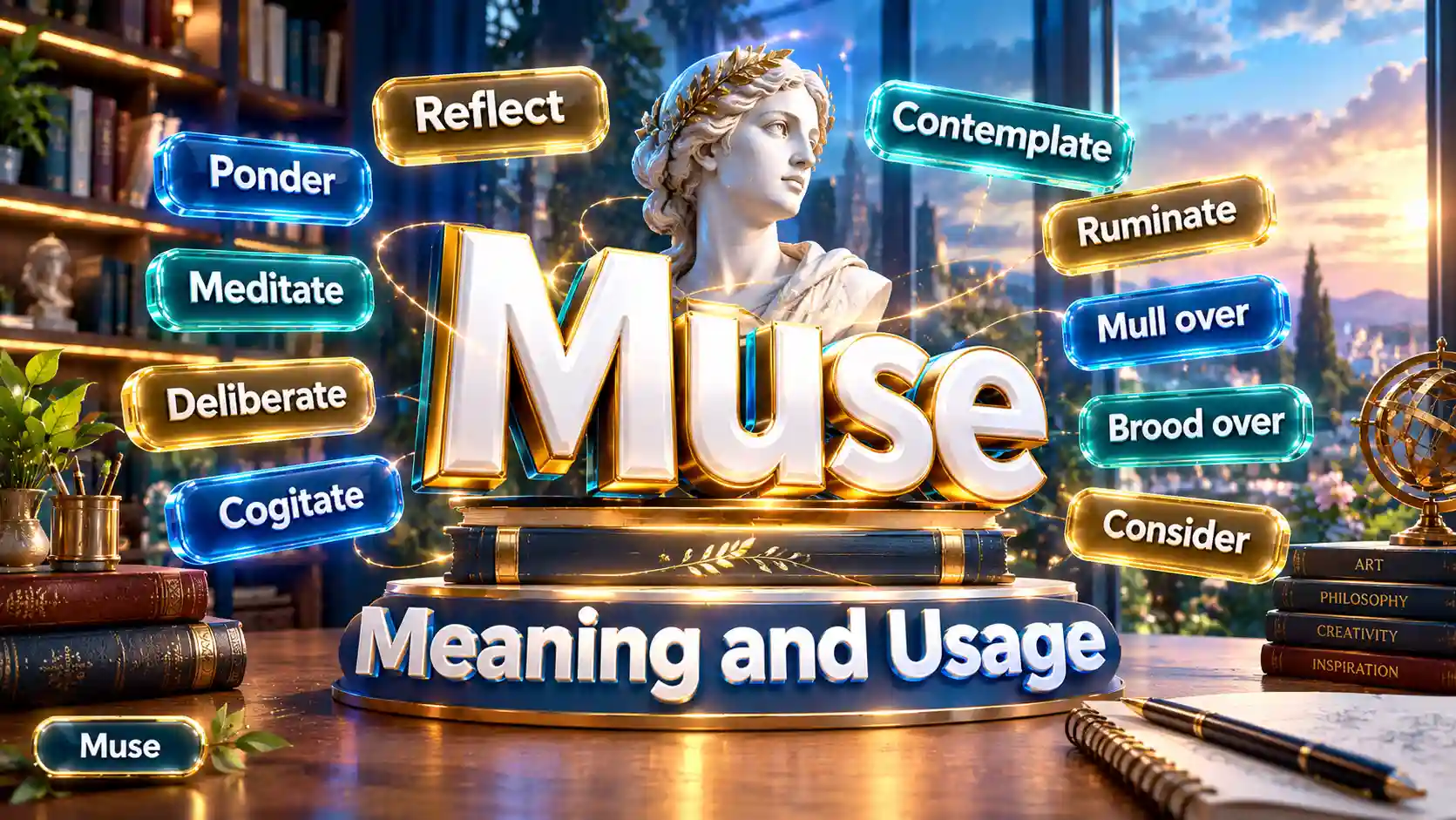
The Verb “To Muse”: A Separate Synonym Set
Muse is also a verb meaning to be absorbed in thought. Its synonyms form a fully separate set — never mix these with the noun above. Merriam-Webster distinguishes it neatly: where ponder weighs a problem and ruminate goes over the same matter repeatedly, muse suggests “a more or less focused daydreaming, as in remembrance.”
| # | Synonym | Difference from “to muse” |
| 1 | ponder | Closest; more deliberate weighing of a question |
| 2 | reflect | Calmer, often looking back on experience |
| 3 | contemplate | Deeper, more sustained and serious thought |
| 4 | ruminate | Chewing the same thought over repeatedly |
| 5 | meditate | Focused inward thought, often spiritual |
| 6 | deliberate | Careful thought aimed at a decision |
| 7 | cogitate | Formal, almost jokingly intellectual pondering |
| 8 | mull over | Informal; turning an idea around slowly |
| 9 | brood over | Darker, worried, stuck thinking |
| 10 | consider | Practical thinking toward a judgment |
| 11 | wonder | Curious, open-ended, less focused |
| 12 | daydream | Fanciful drifting; least purposeful of all |
| 13 | speculate | Thinking toward theories or guesses |
| 14 | noodle over | Informal slang; idle, playful thinking |
Detailed Synonym Meanings and Examples
1. Inspiration
Meaning: The person or force that fills someone with creative ideas and the urge to make something — fully defined in Section 4 above.
Difference from muse: Muse pictures a person as the wellspring; inspiration can also name the trigger or the feeling itself.
Best Used For: Everyday conversation, interviews, writing about any creative field.
Formality: Neutral
CEFR Level: B2
Frequency: Very Common
Examples:
- “My grandmother’s stories were his inspiration for the novel.” [family discussion]
- “She called the sea her inspiration and painted it for forty years.” [artist interview]
When NOT to Use It: When you want the classical, person-specific charge of muse — inspiration is broader and less intimate.
2. Guiding Spirit
Meaning: A person whose influence quietly steers another’s creative direction over time.
Difference from muse: Suggests ongoing direction rather than a single flash of ideas.
Best Used For: Biographies, documentaries, artist profiles.
Formality: Neutral
CEFR Level: C1
Frequency: Common
Examples:
- “Her late teacher remained the guiding spirit of every exhibition she curated.” [documentary narration]
- “He described his grandmother as the guiding spirit behind his music.” [memoir]
When NOT to Use It: For a brief or casual spark — it implies a lasting relationship.
3. Creative Catalyst
Meaning: Someone whose presence speeds up or triggers another person’s creative output.
Difference from muse: Emphasizes the triggering effect, like chemistry, rather than admiration.
Best Used For: Business and innovation writing, artist statements, team profiles.
Formality: Neutral
CEFR Level: C1
Frequency: Common
Examples:
- “The new art director proved a creative catalyst for the whole studio.” [workplace profile]
- “Moving to Lisbon was a creative catalyst for their second album.” [band interview]
When NOT to Use It: In romantic or classical contexts — it sounds technical.
4. Source of Inspiration
Meaning: The origin point from which someone’s creative ideas flow.
Difference from muse: A plain descriptive phrase; it lacks the mythic charge.
Best Used For: Essays, speeches, clear explanatory writing.
Formality: Neutral
CEFR Level: B2
Frequency: Common
Examples:
- “Folk tales were her chief source of inspiration.” [literary essay]
- “He thanked his hometown as his source of inspiration.” [acceptance speech]
When NOT to Use It: When you want color or brevity — it is wordy and flat.
5. Wellspring
Meaning: A rich, seemingly inexhaustible supply of inspiring influence.
Difference from muse: Stresses abundance and continuity — a muse you can draw on again and again.
Best Used For: Literary criticism, speeches, eulogies.
Formality: Neutral
CEFR Level: C1
Frequency: Uncommon
Examples:
- “Her childhood in Kerala became a wellspring for her fiction.” [book review]
- “He was a wellspring of encouragement for young poets.” [eulogy]
When NOT to Use It: For someone who sparked one single work — it implies ongoing supply.
6. Ideal
Meaning: A person embodied as a standard of perfection that stirs others to create.
Difference from muse: Focuses on perfection and aspiration rather than the personal bond.
Best Used For: Art history, discussions of beauty, formal praise.
Formality: Neutral
CEFR Level: B2
Frequency: Very Common
Examples:
- “For the Pre-Raphaelites, she became the ideal of natural beauty.” [art lecture]
- “He painted her not as she was but as his ideal.” [novel]
When NOT to Use It: When the relationship is warm and human — ideal can sound cold and distant.
7. Model
Meaning: A person who poses for, or is depicted by, an artist.
Difference from muse: Concrete and professional — a model sits; a muse inspires (one person can be both).
Best Used For: Visual-art contexts: painting, sculpture, photography.
Formality: Neutral
CEFR Level: A2
Frequency: Very Common
Examples:
- “His wife was both his model and his muse for a decade.”


- “The model held the pose while the students sketched.” [art class]
When NOT to Use It: For writers or musicians — it belongs to visual art.
8. Egeria
Meaning: A woman who privately advises and inspires a powerful or creative man, from the Roman nymph who counseled King Numa.
Difference from muse: Implies behind-the-scenes counsel, not just artistic spark.
Best Used For: Formal biographies, literary essays, political profiles.
Formality: Formal
CEFR Level: C2
Frequency: Rare
Examples:
- “She was the Egeria behind three prime ministers’ cultural policies.” [biography]
- “Every great novelist, the critic argued, has an Egeria.” [literary essay]
When NOT to Use It: In casual speech — almost no one will know the word.
9. Driving Force
Meaning: The person whose energy pushes a creative endeavor forward.
Difference from muse: Stresses momentum and willpower over dreamy inspiration.
Best Used For: Collaboration profiles, project histories, obituaries.
Formality: Neutral
CEFR Level: B2
Frequency: Common
Examples:
- “His sister was the driving force behind the community theater.” [local interview]
- “She was the driving force that got the mural finished on time.” [news obituary]
When NOT to Use It: For quiet, passive inspiration — it implies active pushing.
10. Impetus
Meaning: The influence that gives creative action its initial momentum.
Difference from muse: Formal and abstract — the push itself more than the person giving it.
Best Used For: Academic and formal writing, reports, theses.
Formality: Formal
CEFR Level: C1
Frequency: Uncommon
Examples:
- “Her travels provided the impetus for the poetry sequence.” [thesis]
- “The festival gave fresh impetus to local crafts.” [cultural report]
When NOT to Use It: In conversation — it sounds stiff and Latinate.
11. Spark
Meaning: The small, sudden trigger that ignites a larger creative fire.
Difference from muse: Tiny and momentary — a muse endures, a spark flashes.
Best Used For: Casual speech, captions, social media.
Formality: Neutral
CEFR Level: B1
Frequency: Very Common
Examples:
- “That street performer was the spark for my whole photo series.” [chat with a friend]
- “One old song was the spark. ✨” [social caption]
When NOT to Use It: For a lifelong inspiring relationship — it understates duration.
12. Stimulus
Meaning: Something that provokes a creative response.
Difference from muse: Clinical and neutral — no warmth, admiration, or artistry implied.
Best Used For: Psychology, formal analysis, lectures.
Formality: Formal
CEFR Level: C1
Frequency: Uncommon
Examples:
- “Novel stimuli measurably improved the group’s creative output.” [research paper]
- “Travel acted as a stimulus for his late style.” [art lecture]
When NOT to Use It: In heartfelt or romantic contexts — it sounds like a lab term.
13. Poetic Inspiration
Meaning: The inspiring influence at work specifically in the writing of poetry.
Difference from muse: Narrows the idea to verse — precise when the art form is poetry.
Best Used For: Literary contexts, dedications, reviews.
Formality: Neutral
CEFR Level: B2
Frequency: Common
Examples:
- “To L., my poetic inspiration, without whom these pages are empty.” [book dedication]
- “The sonnets draw their poetic inspiration from the Italian countryside.” [review]
When NOT to Use It: For painters, designers, or musicians — name their art form instead.
14. Afflatus
Meaning: A sudden, powerful rush of creative impulse, once thought divinely sent.
Difference from muse: Names the surge of inspiration itself, not the person carrying it.
Best Used For: Formal literary essays and criticism.
Formality: Formal
CEFR Level: C2
Frequency: Rare
Examples:
- “He wrote the ode in a single afflatus one October night.” [literary essay]
- “Skillful, the critics agreed, but the novel lacked afflatus.” [criticism]
When NOT to Use It: Anywhere casual — it will baffle most readers.
15. Divine Inspiration
Meaning: Creative influence felt as coming from a god or higher power.
Difference from muse: Spiritualizes the source — heaven, not a person, does the inspiring.
Best Used For: Religious writing, classical contexts, spiritual memoirs.
Formality: Neutral
CEFR Level: B2
Frequency: Common
Examples:
- “He described the hymn as divine inspiration rather than composition.” [sermon]
- “She credited divine inspiration for her charity’s founding.” [biography]
When NOT to Use It: For a human partner or friend — it claims a sacred source.
16. Vision
Meaning: An idealized image of a person that haunts and drives an artist’s work.
Difference from muse: Emphasizes the mental image — the muse as seen in the mind’s eye.
Best Used For: Romantic and literary writing, poetry analysis.
Formality: Neutral
CEFR Level: B2
Frequency: Very Common
Examples:
- “She remained his vision of grace long after they parted.” [novel]
- “The ‘dark lady’ of the sonnets is Shakespeare’s troubling vision.” [poetry class]
When NOT to Use It: In practical or business contexts — it sounds dreamy.
17. Paragon
Meaning: A person held up as a perfect example others aspire to equal.
Difference from muse: About excellence as a public standard, not the private spark of creating.
Best Used For: Formal praise, art history, ceremonial speech.
Formality: Formal
CEFR Level: C1
Frequency: Uncommon
Examples:
- “She was a paragon of dedication for every apprentice in the workshop.” [award speech]
- “The film presents him as a paragon of quiet courage.” [review]
When NOT to Use It: For the intimate artist-muse bond — it is public and evaluative.
18. Lodestar
Meaning: A guiding ideal that gives direction to creative ambition, like a star to steer by.
Difference from muse: Poetic and navigational — direction rather than spark.
Best Used For: Literary essays, commencement addresses, poetry.
Formality: Formal
CEFR Level: C2
Frequency: Rare
Examples:
- “Truth remained his lodestar through forty years of reporting.” [profile]
- “Let curiosity be your lodestar, she told the graduates.” [commencement speech]
When NOT to Use It: In everyday speech — it sounds archaic.
19. Guardian Spirit
Meaning: A protective, watchful presence believed to inspire and safeguard creativity.
Difference from muse: Adds protection and care — less about art, more about shelter.
Best Used For: Spiritual or reflective writing, memoirs.
Formality: Neutral
CEFR Level: B2
Frequency: Uncommon
Examples:
- “She felt her late mother’s guardian spirit in every performance.” [memoir]
- “The old theater was his guardian spirit, he always joked.” [interview]
When NOT to Use It: As a plain substitute in art criticism — the protective nuance distracts.
20. Inspirer
Meaning: A person who fills others with the urge to create or act.
Difference from muse: The plainest agent-noun available — all function, no mythology.
Best Used For: Clear formal prose, historical writing.
Formality: Neutral
CEFR Level: C1
Frequency: Uncommon
Examples:
- “The coach was an inspirer of generations of young runners.” [sports profile]
- “She was the inspirer of the town’s library movement.” [local history]
When NOT to Use It: When you want warmth or beauty — it is serviceable but flat.
21. Mainspring
Meaning: The chief motive force driving a creative life or work, like the coiled spring powering a watch.
Difference from muse: A mechanical metaphor — power and drive rather than enchantment.
Best Used For: Literary biographies, formal essays.
Formality: Formal
CEFR Level: C1
Frequency: Rare
Examples:
- “Curiosity was the mainspring of her long scientific career.” [biography]
- “Love of place remained the mainspring of his fiction.” [critical essay]
When NOT to Use It: In casual conversation — the metaphor feels antique.
22. Femme Inspiratrice
Meaning: A French borrowing for a woman whose style or presence inspires artists and designers.
Difference from muse: A fashion-and-arts journalism term — chic, specific, and gendered.
Best Used For: Fashion writing, cultural journalism.
Formality: Formal
CEFR Level: C2
Frequency: Rare
Examples:
- “The actress became the house’s femme inspiratrice for the season.” [fashion magazine]
- “Every atelier, it seems, needs its femme inspiratrice.” [cultural profile]
When NOT to Use It: Outside arts or fashion contexts — or for a man.
Best Alternatives by Context
- Everyday Conversation: inspiration (“She’s my biggest inspiration”), spark (“That trip was the spark I needed”). Plain, warm, instantly understood.
- Formal Writing: impetus, Egeria, paragon. Elevated and precise; Egeria suits profiles of influential women, impetus suits abstract analysis.
- Academic Writing: afflatus, stimulus, ideal. Discipline-appropriate: stimulus for psychology, ideal for aesthetics, afflatus for literary studies.
- Business Communication: creative catalyst, driving force. Note: muse itself is rare here — these carry the meaning without the artistic baggage.
- Creative Writing: muse, guiding spirit, wellspring, lodestar. This is the word’s home turf; lean into the imagery.
- Social Media: my muse, spark, inspiration. Short, vivid, personal — “my muse” as a caption needs no explanation.
Which Synonym Should I Choose?
| Situation | Best Choice | Why |
| Thanking someone who sparked your art | inspiration | Warm, universal, never misunderstood |
| Dedicating a poem | muse / poetic inspiration | Classical precision suits the form |
| Describing a painter’s sitter | model | The accurate art-world term |
| Formal essay on artistic influence | Egeria / impetus | Elevated register, exact shades |
| Instagram caption | my muse / spark | Short, vivid, instantly personal |
| Workplace innovation context | creative catalyst | Professional tone, no artistic baggage |
Exact and Near Synonyms: The Difference
True synonyms are rare because every substitute shifts something: register (Egeria is literary, spark is casual), scope (afflatus names the surge, not the person; model names the sitter, not the spark), or connotation (paragon evaluates, lodestar guides, wellspring promises abundance).
Inspiration comes nearest to exact because it shares the core — the animating source of creative work — while staying neutral on all three axes. Treat the rest as precision tools: each is “more exact” than muse only inside its own context, and vaguer outside it.
Words Commonly Confused with “Muse”
These failed the substitution test — each overlaps with muse in some way but changes the core meaning. Use them deliberately, not interchangeably.
- encourager — offers general support; needn’t spark anything artistic.
- galvanizer — jolts people into action; a muse sustains inspiration instead.
- motivator — drives action of any kind; far broader than artistic influence.
- mentor — teaches and guides; a muse need never instruct.
- patron — funds or materially supports; money is not inspiration.
- beloved — a loved one; love alone doesn’t make someone a muse.
- mistress — a romantic partner; the role is romantic, not inspiring.
- heroine — the central female figure of a work; a muse inspires the work itself.
- noodle — informal verb “to noodle over” loosely matches to muse (ponder); never the noun.
- sibyl — a prophetess; implies foretelling, not artistic influence.
- goddess (figurative) — implies worship; worship differs from inspiration.
- prime mover — initiates events; philosophical and impersonal.
- anima — Jungian inner feminine image; a technical term, not everyday speech.
- genius (tutelary sense) — an archaic attendant spirit; obscure outside old texts.
- enchantress — implies magical seduction rather than creative influence.
Common Mistakes
- Mistake: “My manager is my muse.” → Better: “My manager is my mentor.” → Why: A muse inspires creative work; a boss who guides your career is a mentor, not a muse.
- Mistake: Calling a girlfriend “my muse” purely as a pet name. → Better: Reserve it for when she genuinely sparks your creativity. → Why: Without the inspiration element it’s just a fancy “babe” and can sound hollow.
- Mistake: “He’s such a noodle” (meaning an inspiring person). → Better: “He’s my inspiration.” → Why: Noodle never works as a noun synonym; the verb “to noodle over” only loosely matches to muse as “ponder.”
- Mistake: Texting a friend “I finally felt the afflatus.” → Better: “I finally felt inspired.” → Why: Afflatus is rare and literary; in casual chat it reads as showing off.
- Mistake: Writing “muse” when you mean “amuse.” → Better: muse = inspire or ponder; amuse = entertain. → Why: One letter changes the meaning entirely.
Antonyms of “Muse”

| # | Antonym | Why It’s the Opposite |
| 1 | deterrent | Discourages action instead of inspiring it |
| 2 | wet blanket | Dampens others’ enthusiasm and energy |
| 3 | killjoy | Destroys the joy behind creative work |
| 4 | discouragement | The opposing force to inspiration itself |
| 5 | hindrance | Holds creativity back rather than freeing it |
| 6 | distraction | Pulls focus away from creative work |
| 7 | creative block | The state of being unable to create |
Antonyms of the verb “to muse” (to ponder):
| # | Antonym | Why It’s the Opposite |
| 1 | ignore | Refuses thought instead of sustaining it |
| 2 | dismiss | Pushes the thought away deliberately |
| 3 | disregard | Pays no attention at all |
| 4 | overlook | Fails to notice what musing would examine |
| 5 | neglect | Leaves the matter entirely unconsidered |
Real-World Collocations & Phrases
Part A — Structural patterns
- Verb + muse: invoke one’s muse (“She invoked her muse before every draft”); serve as someone’s muse (“He served as her muse for twenty years”); find one’s muse (“The trip helped him find his muse again”); lose one’s muse (“After the breakup, he felt he’d lost his muse”); court one’s muse (“She courted her muse with long morning walks”).
- Adjective + muse: unlikely muse (“A tax inspector became his unlikely muse”); unwilling muse (“She was his unwilling muse and hated the attention”); lifelong muse (“His lifelong muse appears in every novel”); personal muse (“He thanked his personal muse in the liner notes”).
- Muse + preposition: muse for (“a muse for Picasso”); muse of (“the muse of poetry,” “muse of lyric verse”).
- Noun adjunct: designer muse (“the designer’s muse for the spring line”); poet’s muse (“the poet’s muse remained anonymous”).
Part B — Idioms and set phrases (all genuinely attested)
- “Invoke the Muse” — the classical epic opening (“Sing, O Muse”), still used to mean calling on inspiration before a big creative effort.
- “The nine Muses” — Calliope, Clio, Erato, Euterpe, Melpomene, Polyhymnia, Terpsichore, Thalia, Urania; shorthand for the arts collectively.
- “Waiting for the muse” — the writers’ cliché for postponing work until inspiration strikes (usually given as advice against doing so).
- “Muse on / over” — the verb’s natural prepositions: “She mused on her childhood”; “He mused over the offer.”
Practice Exercises
A. Fill in the blanks (5)
- The young painter called his wife his ______, crediting her for every canvas.
- After weeks without ideas, the novelist waited for his ______ to return.
- She ______ over the letter for an hour before replying.
- The designer’s ______ for the collection was 1970s street photography.
- In Greek myth, Calliope was the ______ of epic poetry.
B. Rewrite the sentences (3)
- “She gave him ideas for his songs.” → Rewrite using a stronger noun.
- “He thought about the offer quietly for a long time.” → Rewrite using the verb muse or a close synonym.
- “The teacher helped the students want to paint.” → Rewrite using inspire or inspiration.
C. Match the words (5 pairs)
Match each word to its meaning:
| Word | Meaning | |
| 1. Egeria | a. A sudden divine creative impulse | |
| 2. afflatus | b. A rich, endless supply of inspiration | |
| 3. impetus | c. A woman who privately inspires a powerful man | |
| 4. wellspring | d. A guiding ideal for creative ambition | |
| 5. lodestar | e. Momentum behind creative action |
D. Vocabulary quiz (5 MCQ)
- Which is the closest synonym for “muse” (noun)?
- a) mentor
- b) inspiration
- c) patron
- d) critic
- “Egeria” specifically refers to:
- a) a male advisor
- b) a woman who privately inspires a powerful man
- c) a Greek goddess of dance
- d) a type of poem
- Which word fails as a synonym because it means a financial supporter?
- a) model
- b) patron
- c) ideal
- d) spark
- The verb “to muse” most nearly means:
- a) to entertain
- b) to ponder
- c) to confuse
- d) to criticize
- Which of these is an antonym of “muse”?
- a) catalyst
- b) deterrent
- c) vision
- d) paragon
E. Answer key
- A: 1. muse · 2. inspiration (muse also accepted) · 3. mused · 4. inspiration · 5. Muse
- B (sample answers): 1. “She was the inspiration behind his songs.” / “She was his muse.” · 2. “He mused over the offer for a long time.” · 3. “The teacher inspired the students to paint.”
- C: 1–c · 2–a · 3–e · 4–b · 5–d
- D: 1–b · 2–b · 3–b · 4–b · 5–b
FAQ
What’s a better word for muse?
Inspiration works in almost every context and is understood by everyone. Use muse itself when you want the classical, slightly romantic flavor — for example in a dedication or an artist’s statement.
What is a muse in slang?
There is no established slang meaning of muse. People sometimes use it loosely for a crush who inspires them, but that is just the standard “inspirer” sense stretched thin — not true slang. Don’t treat it as having a separate street definition.
What words are similar to muse?
Guiding spirit, ideal, creative catalyst, wellspring, spark, driving force, and vision are the most useful. Each shifts the nuance slightly — see Section 6 for exactly how.
What is another word for “muse” as a person?
Inspirer is the plainest; Egeria is the most literary (a woman who privately advises and inspires); model fits when the person poses for visual art.
Can I call my girlfriend a muse?
Yes — it’s a compliment meaning she inspires your creativity. Just make sure it’s true: calling someone your muse implies she genuinely sparks your work, not merely that you adore her. Used lightly as a pet name, it can sound grandiose.
What are 10 good synonyms?
Inspiration, guiding spirit, ideal, creative catalyst, spark, wellspring, driving force, impetus, model, and vision — the ten in the “Top 10 at a Glance” table above.
Conclusion
Choosing well among these words is less about sounding impressive than about being exact: spark for the fleeting trigger, wellspring for the inexhaustible source, Egeria for the quiet counselor, inspiration for everything in between.
The right synonym tells your reader not just what you mean, but how it felt — and that precision is what turns vocabulary from decoration into communication.

About Sajjad Ahmed
Sajjad Ahmed is the author behind Guest Paster, where he writes about English vocabulary, synonyms, word meanings, and practical word usage.
His content is designed to help readers understand the differences between similar words, discover suitable alternatives, and use English vocabulary more effectively in everyday writing and communication.
Before publishing, Sajjad focuses on presenting word choices in a clear and easy-to-understand format, with relevant meanings, context, and examples where helpful.
Through Guest Paster, his goal is to make vocabulary learning simpler and provide useful language resources for students, writers, English learners, and anyone looking to expand their vocabulary.
Areas of Focus: English Vocabulary • Synonyms • Word Meanings • Word Usage • Language Learning
Author: Sajjad Ahmed
Website: Guest Paster