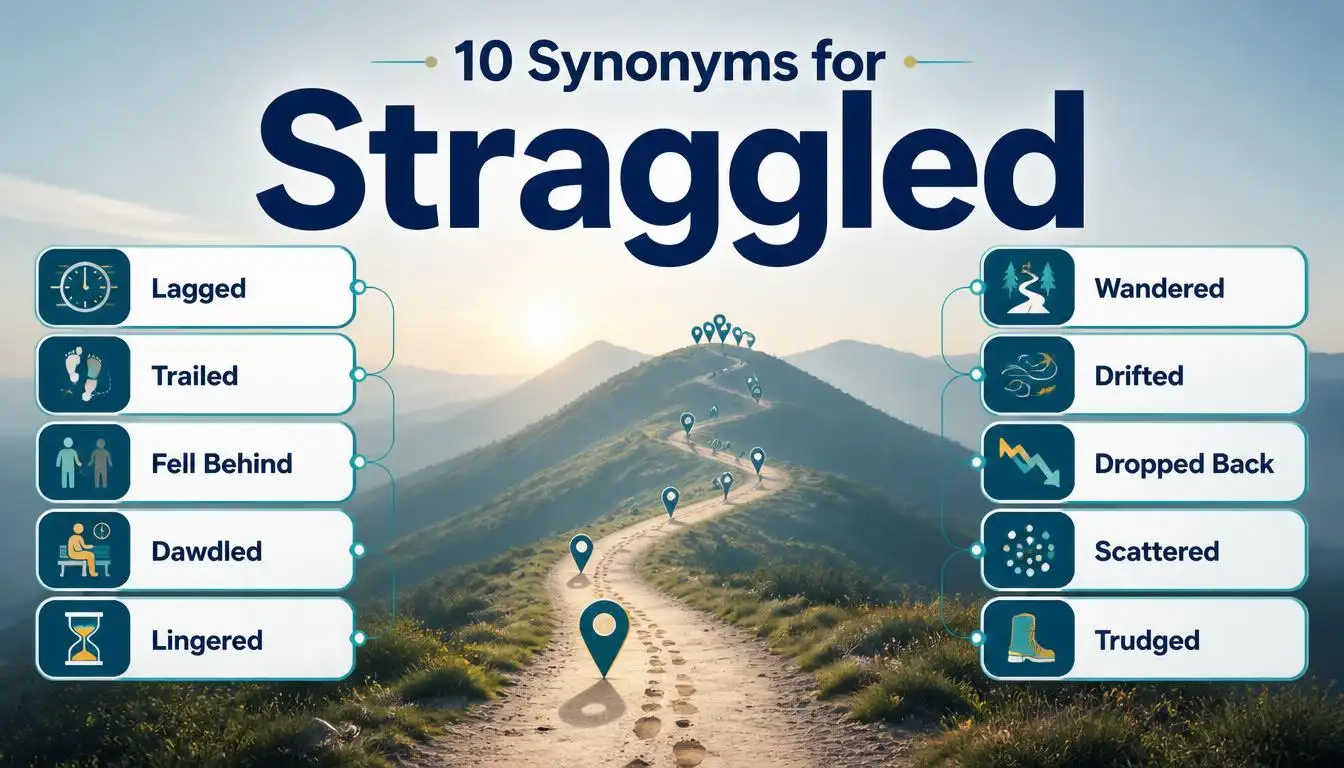
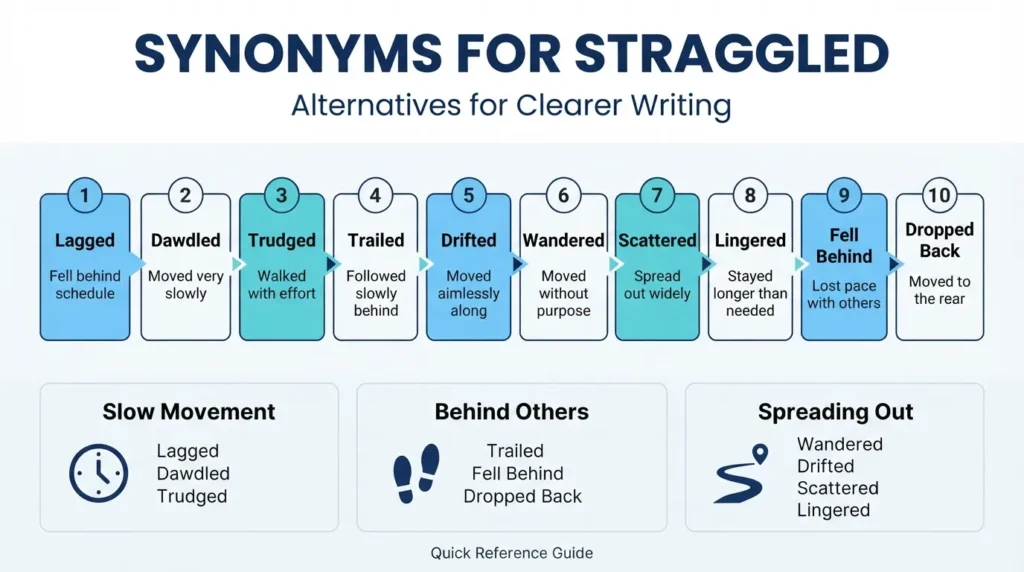
Synonyms for straggled include lagged, trailed, dawdled, lingered and wandered depending on the sentence. Straggled is the past tense of straggle and usually means moved slowly behind others, became separated from a group or spread in an uneven scattered way. The best synonym depends on what caused the separation and the tone you want.
For example: Two hikers straggled behind the rest of the group.
A natural replacement would be: Two hikers lagged behind the rest of the group.
Top 10 Synonyms
| Synonym | Simple Meaning | Best Used For |
|---|---|---|
| Lagged | Fell or remained behind | Races, hiking, group movement |
| Trailed | Followed behind others | Following, walking, racing |
| Dawdled | Moved too slowly | Children, casual situations |
| Lingered | Stayed behind longer than expected | Departures, gatherings |
| Wandered | Moved without clear direction | Travel, storytelling |
| Drifted | Moved gradually away | Crowds, figurative movement |
| Fell behind | Failed to keep pace | Everyday speech, school, work |
| Dropped back | Moved into a rear position | Sports, racing, hiking |
| Scattered | Spread out over an area | Crowds, animals, objects |
| Dispersed | Spread in different directions | Formal descriptions, reports |
Detailed Analysis by Context
1. Falling Behind the Group
When someone cannot keep pace with others, these synonyms offer the closest replacements for straggled.
Lagged
Relationship: Exact synonym in most movement contexts
Meaning: Fell behind by moving slower than others
Nuance: Focuses directly on being slower, not on disorder or spacing
“The youngest walkers lagged behind during the steep climb.”
When to use: Races, hiking, group travel, situations where speed difference is the main issue
Avoid when: You want to emphasize irregular spacing or wandering
Trailed
Relationship: Near synonym
Meaning: Followed behind another person or group
Nuance: Does not imply difficulty—trailing can be intentional
“Two cyclists trailed the main pack by several minutes.”
When to use: Following someone, intentional rear positioning, racing
Avoid when: You want to suggest struggle or tiredness
Fell Behind
Relationship: Exact contextual alternative
Meaning: Failed to stay level with others or expected progress
Nuance: More direct and less descriptive than straggled
“Marcus fell behind when the trail became steeper.”
When to use: Everyday conversation, school, work, races
Avoid when: You need vivid or descriptive language
Dropped Back
Relationship: Exact contextual alternative
Meaning: Moved into a position behind others
Nuance: Suggests a deliberate or noticeable change in position
“One runner dropped back after the halfway point.”
When to use: Sports, racing, hiking, group travel
Avoid when: Describing gradual, unnoticed separation
2. Slow or Tired Movement
When the cause of straggling is exhaustion, reluctance, or heavy effort, these alternatives add vivid detail.
Dawdled
Relationship: Near synonym
Meaning: Moved or acted more slowly than necessary
Nuance: Suggests the delay could have been avoided—often implies distraction
“The children dawdled on the path while everyone else walked ahead.”
When to use: Children, casual situations, getting ready
Avoid when: Describing unavoidable fatigue or difficult conditions
Plodded
Relationship: Contextual alternative
Meaning: Walked slowly and heavily
Nuance: Emphasizes heavy, tiring, laborious movement
“The tired campers plodded toward the shelter.”
When to use: Tired walking, difficult journeys, descriptive writing
Avoid when: Speed is the only issue, not effort
Trudged
Relationship: Contextual alternative
Meaning: Walked slowly with effort due to tiredness or difficult conditions
Nuance: Strongly emphasizes physical exertion
“The players trudged back toward the bus after the long match.”
When to use: Bad weather, fatigue, difficult terrain
Avoid when: Describing light or easy movement
Shuffled
Relationship: Contextual alternative
Meaning: Walked slowly with short, dragging feet movements
Nuance: Describes the style of walking, not necessarily separation from a group
“The exhausted travelers shuffled toward the exit.”
When to use: Slow movement, tiredness, physical description
Avoid when: Describing determined or purposeful walking
Slowed
Relationship: Contextual alternative
Meaning: Reduced speed
Nuance: Describes a change in speed, but does not automatically mean falling behind
“The hikers slowed as the path became rocky.”
When to use: Movement, sports, traffic, physical effort
Avoid when: You need to emphasize being left behind
3. Staying Behind Intentionally
Sometimes straggling happens by choice—someone deliberately remains in the rear.
Lingered
Relationship: Near synonym
Meaning: Stayed somewhere after others had moved on
Nuance: Emphasizes remaining behind rather than moving slowly
“A few visitors lingered near the entrance after the tour ended.”
When to use: Departures, gatherings, travel, emotional scenes
Avoid when: Describing movement (as opposed to remaining in place)
Loitered
Relationship: Contextual alternative
Meaning: Remained in a place instead of moving on
Nuance: Can suggest waiting without clear purpose; sometimes negative
“Several teenagers loitered near the gate after everyone else had left.”
When to use: Streets, entrances, public places, casual descriptions
Avoid when: Writing formally or describing purposeful delay
Stayed Behind
Relationship: Contextual alternative
Meaning: Remained after others had left or moved ahead
Nuance: Neutral and direct; lacks the irregular quality of straggled
“Two volunteers stayed behind to clean the room.”
When to use: Everyday conversation, instructions, school, travel
Avoid when: You need vivid or evocative language
Hung Back
Relationship: Near synonym
Meaning: Remained behind instead of joining or following
Nuance: Often implies hesitation, shyness, or reluctance
“Noah hung back while the others entered the room.”
When to use: Social situations, group activities, storytelling
Avoid when: Describing physical tiredness as the cause
4. Wandering Without Direction
When straggling involves losing the path or moving aimlessly, these alternatives work best.
Wandered
Relationship: Near synonym
Meaning: Moved without following a direct route
Nuance: Stresses lack of direction rather than separation from a group
“A few tourists wandered away from the main group.”
When to use: Travel, exploration, storytelling, casual movement
Avoid when: Describing purposeful movement or tight formations
Meandered
Relationship: Contextual alternative
Meaning: Followed a slow or indirect path
Nuance: Describes the shape of movement more than position relative to a group
“The visitors meandered through the market instead of following the guide.”
When to use: Walking, roads, rivers, leisurely travel
Avoid when: Describing tired or hurried movement
Drifted
Relationship: Near synonym
Meaning: Moved slowly or gradually away
Nuance: Suggests gentle, effortless separation
“Several guests drifted away from the crowd.”
When to use: Crowds, groups, conversations, figurative movement
Avoid when: Describing deliberate separation or struggle
Strayed
Relationship: Near synonym
Meaning: Moved away from the correct route, place, or group
Nuance: Emphasizes leaving the proper path
“Two sheep strayed from the flock near the hillside.”
When to use: Animals, travelers, children, routes
Avoid when: Describing group movement where the “correct path” isn’t clear
5. Spreading Out or Scattering
When straggled describes things extending unevenly rather than people moving, these alternatives are more accurate.
Scattered
Relationship: Near synonym
Meaning: Became separated and spread over an area
Nuance: Emphasizes distribution and separation
“The children scattered across the playground.”
When to use: Crowds, animals, objects, groups
Avoid when: Describing a trailing line rather than widespread distribution
Dispersed
Relationship: Near synonym
Meaning: Spread out in different directions
Nuance: More formal; does not imply slow trailing
“The crowd dispersed after the event ended.”
When to use: Formal descriptions, crowds, groups, reports
Avoid when: Writing casually or describing lingering
Spread Out
Relationship: Near synonym
Meaning: Became separated over a wider area
Nuance: Clearer and more conversational, less vivid
“The runners spread out as the race continued.”
When to use: Groups, hikers, vehicles, objects
Avoid when: You need descriptive or evocative language
Stretched
Relationship: Contextual alternative
Meaning: Extended over a distance
Nuance: Works for buildings or objects extending along a route
“Small farms stretched along both sides of the valley road.”
When to use: Roads, houses, lines, settlements
Avoid when: Describing moving people or animals
Sprawled
Relationship: Contextual alternative
Meaning: Spread irregularly over a large area
Nuance: Suggests broad outward expansion rather than a thin line
“New neighborhoods sprawled beyond the old town center.”
When to use: Cities, developments, landscapes
Avoid when: Describing a neat or orderly arrangement
Extended
Relationship: Contextual alternative
Meaning: Continued over an area or distance
Nuance: More formal and orderly; lacks irregular feel
“The village extended for several miles along the river.”
When to use: Geographic descriptions, formal writing
Avoid when: You want to suggest irregularity or disorder
Choosing the Right Word
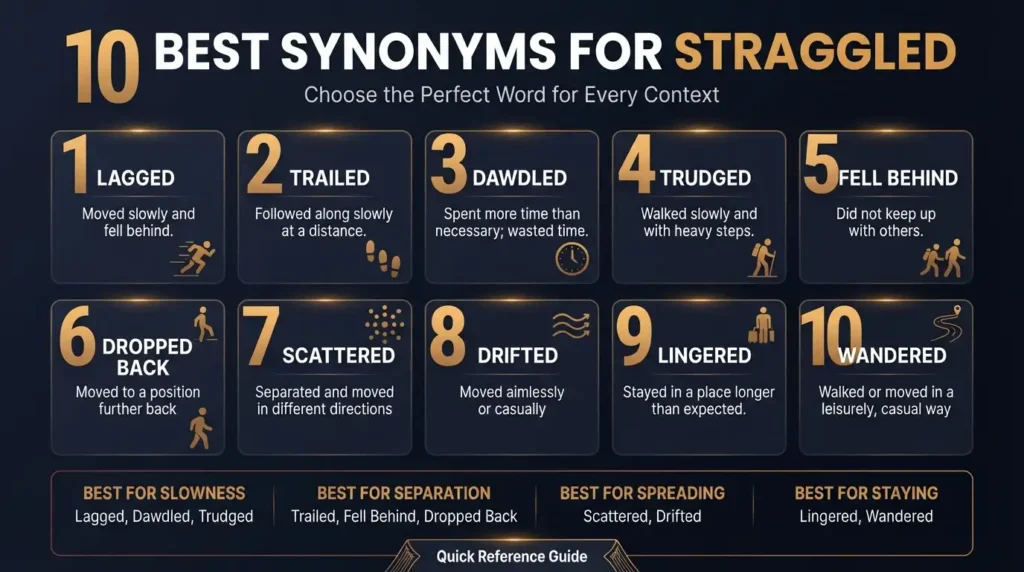
Decision Guide
| If the situation is… | Use this word… |
|---|---|
| Slower speed is the main issue | Lagged |
| Someone is following behind | Trailed |
| Unnecessary slowness or distraction | Dawdled |
| Remaining after others leave | Lingered |
| Moving without purpose | Wandered |
| Gentle, gradual separation | Drifted |
| Deliberate rear positioning | Dropped back |
| Heavy, effortful walking | Trudged or Plodded |
| Hesitation or shyness | Hung back |
| Objects spread unevenly | Scattered, Sprawled, or Stretched |
| A formal description of spreading | Dispersed or Extended |
Tone Guide
| Tone Desired | Recommended Words |
|---|---|
| Casual / Conversational | Fell behind, lagged, stayed behind |
| Formal / Professional | Dispersed, extended, delayed, trailed |
| Creative / Descriptive | Lingered, meandered, drifted, trudged, dawdled |
| Neutral / Informative | Trailed, dropped back, spread out |
Antonyms of Straggled
| Antonym | Meaning | Example Sentence |
|---|---|---|
| Led | Moved ahead of others | “Maya led the group along the trail.” |
| Advanced | Moved forward | “The team advanced steadily up the hill.” |
| Kept pace | Stayed at same speed | “Liam kept pace with the faster runners.” |
| Caught up | Reached those ahead | “We caught up with the group before lunch.” |
| Regrouped | Came together again | “The hikers regrouped at the bridge.” |
| Gathered | Came together in one place | “Everyone gathered near the entrance.” |
| Converged | Moved toward the same point | “The walkers converged at the town square.” |
| Clustered | Stayed closely grouped | “The students clustered around their teacher.” |
Common Collocations with Straggled
Understanding how straggled appears in natural language helps you use alternatives effectively.
| Phrase | Meaning | Example Sentence |
|---|---|---|
| Straggled behind | Fell behind others | “Several walkers straggled behind the guide.” |
| Straggled along | Continued slowly or irregularly | “The tired group straggled along the muddy road.” |
| Straggled in | Arrived slowly in separate groups | “Guests straggled in throughout the morning.” |
| Straggled out | Left or emerged gradually | “The students straggled out of the hall after assembly.” |
| Straggled back | Returned slowly and separately | “The hikers straggled back to camp before sunset.” |
| Straggled across | Moved unevenly across an area | “The runners straggled across the finish line.” |
| Straggled through | Passed slowly through a place | “The group straggled through the narrow village streets.” |
Alternative Collocations Using Synonyms
| Original | Alternative |
|---|---|
| Straggled behind the group | Lagged behind the group |
| Straggled along the road | Trudged along the road |
| Straggled into the hall | Trailed into the hall |
| Straggled out of the building | Dawdled out of the building |
| Straggled back to camp | Hung back returning to camp |
| Straggled across the field | Scattered across the field |
Frequently Asked Questions
What is another word for “straggled”?
The closest alternative is lagged, especially when straggled means moving more slowly than a group. Other useful choices include trailed, dawdled, lingered, drifted, and fell behind. The best replacement depends on why the person or group became separated.
What are synonyms for “straggling”?
Common synonyms include lagging, trailing, lingering, dawdling, wandering, drifting, and falling behind. If straggling describes things spread unevenly, scattered, dispersed, or spread out may be more accurate.
What is the meaning of “straggled”?
Straggled means moved slowly behind others, became separated from a group, or extended in a loose and irregular way. For example, Several hikers straggled behind means they could not keep pace with the main group.
What are some antonyms for “straggled”?
When straggled means falling behind, useful opposites include led, advanced, kept pace, and caught up. When it means becoming scattered, opposites such as gathered, regrouped, clustered, and converged are more suitable.
Can “straggled” be used for non-living things?
Yes. Straggled can describe buildings, plants, or objects that extend unevenly. For example: Small houses straggled along the country road.
Is “straggled” formal or informal?
Straggled is neutral—it works in both everyday conversation and professional writing. Its tone can shift depending on context, but it rarely sounds too casual or too formal.
Conclusion
Choosing the right synonym for straggled transforms your writing from adequate to precise. The options are many, but each carries its own nuance:
- Lagged for straightforward slowness
- Dawdled for unnecessary delay
- Lingered for staying behind by choice
- Wandered for aimless movement
- Trudged and plodded for effortful progress
- Scattered and dispersed for uneven spread
The key to selecting the best alternative lies in understanding why the straggling occurred and what you want to emphasize—speed, effort, direction, intention, or distribution.
Consider these three sentences, each using a different synonym to create a distinct image:
“The tired hikers lagged behind the group.” (Focus: speed difference)
“The distracted children dawdled along the path.” (Focus: lack of focus)
“Exhausted runners trudged toward the finish line.” (Focus: effort and difficulty)
The next time someone straggles in your writing, you’ll have the perfect word at your fingertips. Choose wisely, and your readers will appreciate the clarity and precision.

About Sajjad Ahmed
Sajjad Ahmed is the author behind Guest Paster, where he writes about English vocabulary, synonyms, word meanings, and practical word usage.
His content is designed to help readers understand the differences between similar words, discover suitable alternatives, and use English vocabulary more effectively in everyday writing and communication.
Before publishing, Sajjad focuses on presenting word choices in a clear and easy-to-understand format, with relevant meanings, context, and examples where helpful.
Through Guest Paster, his goal is to make vocabulary learning simpler and provide useful language resources for students, writers, English learners, and anyone looking to expand their vocabulary.
Areas of Focus: English Vocabulary • Synonyms • Word Meanings • Word Usage • Language Learning
Author: Sajjad Ahmed
Website: Guest Paster