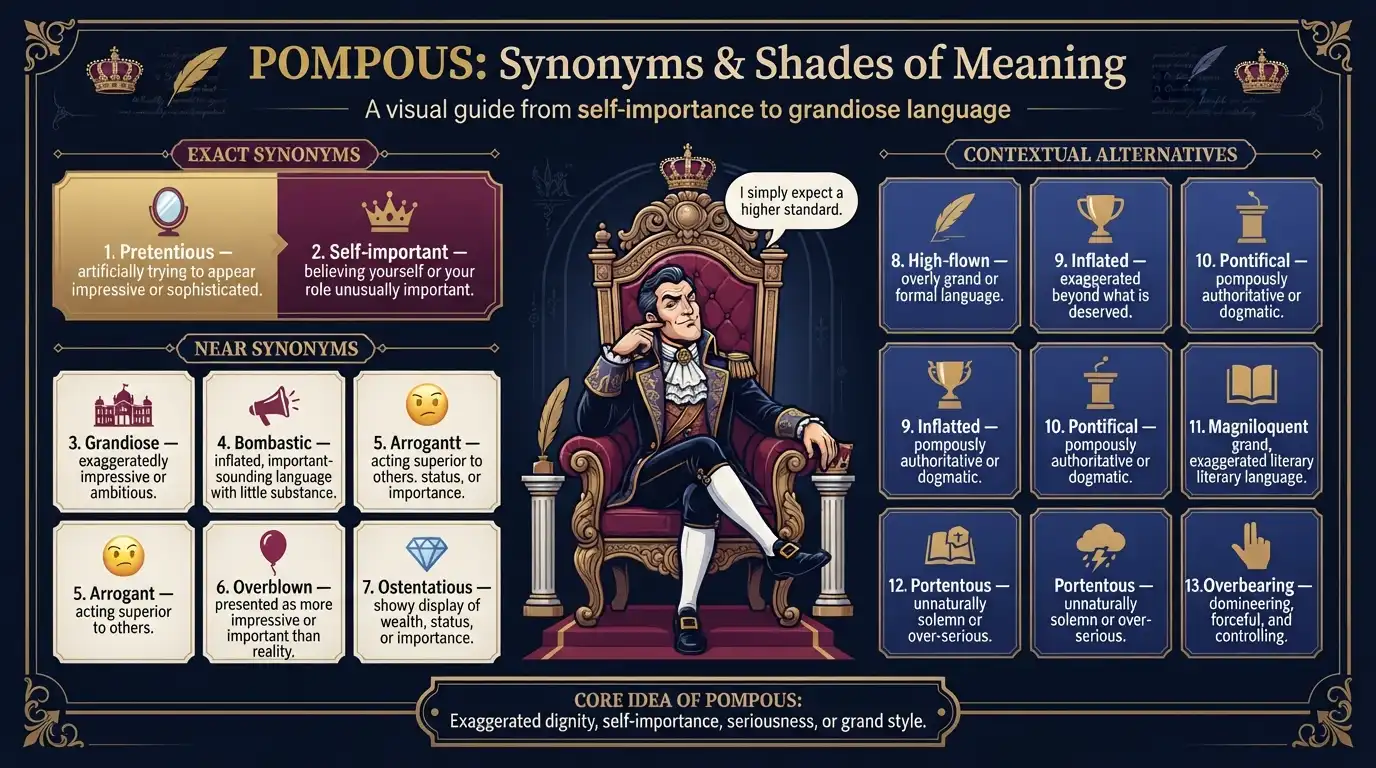
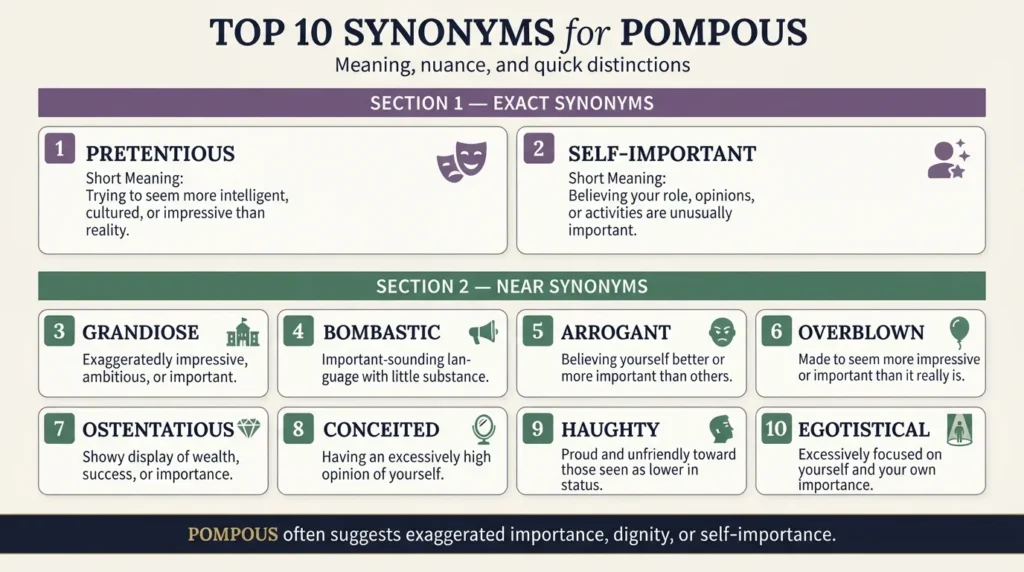
The best synonyms for pompous are pretentious, self-important, grandiose, arrogant and bombastic. Pompous describes a person, style or way of speaking that tries to appear more important, impressive or serious than it really is. The right synonym depends on whether you are describing pride, formal language and dramatic behavior or an exaggerated appearance.
For example: The manager gave a pompous speech filled with complicated words. Here bombastic or grandiose could replace pompous, while arrogant would focus more on the manager’s attitude.
10 Best Synonyms for Pompous and Their Meanings
| Synonym | Simple Meaning |
| Pretentious | Trying too hard to appear important or impressive |
| Self-important | Believing you are more important than others |
| Grandiose | Exaggeratedly impressive, ambitious, or important |
| Bombastic | Using overly grand or inflated language |
| Arrogant | Acting as though you are better than others |
| Overblown | Made to seem more important than it is |
| High-flown | Using language that sounds too grand or formal |
| Ostentatious | Designed to attract attention and display importance |
| Conceited | Having an overly high opinion of yourself |
| Haughty | Proud and unfriendly toward people considered inferior |
What Are Synonyms of Pompous?
Synonyms of pompous describe exaggerated importance, pride, formality or showiness. However they do not all express the same idea. Arrogant focuses on superiority, bombastic usually describes language and ostentatious emphasizes display. The best word depends on whether you are discussing a person’s behavior, speech, writing style, appearance or attitude.
Quick Facts About Pompous
Word: Pompous
Part of Speech: Adjective
Simple Meaning: Acting or speaking as though you are extremely important
Pronunciation: /ˈpɑːm.pəs/
Syllables: Two — pom-pous
Origin: From Latin and French words connected with ceremony, display, and splendor
Formality: Neutral to formal
Common Uses: Everyday conversation, professional criticism, academic analysis, and creative writing
Example Sentence: The pompous official spoke as though no one else understood the problem.
Pompous Meaning and Usage
Basic Meaning
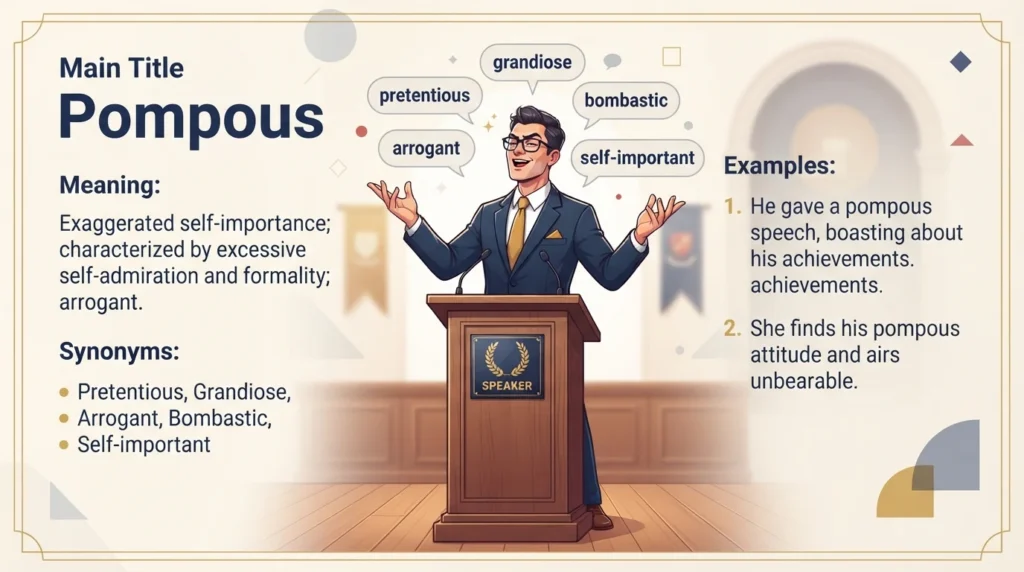
Pompous describes someone who behaves in an overly serious, formal, proud, or self-important way. A pompous person often wants others to view them as intelligent, powerful, or important.
For example:
The pompous man constantly reminded everyone of his job title.
The sentence suggests that the man wanted admiration and placed too much importance on his position.
Deeper Meaning
The word usually carries criticism. It does not simply mean confident, formal, or impressive. It suggests that the person’s behavior is excessive, unnatural, or undeserved.
Someone may sound pompous when they use difficult words to make a simple idea appear intellectual. A building, ceremony, or speech may also be called pompous when it is unnecessarily grand.
Emotional Tone
Pompous has a negative and sometimes humorous tone. It can express annoyance, disapproval, or mild mockery.
Compare:
- He gave a formal speech. — Neutral
- He gave a pompous speech. — Critical
- He gave an inspiring speech. — Positive
Formality and Common Usage
The word is common in both conversation and formal writing. It may describe:
- A pompous person
- A pompous man
- A pompous speech
- Pompous language
- A pompous writing style
- A pompous attitude
- A pompous ceremony
Real-Life Example
Imagine a teacher explaining a simple rule but using long, technical terms only to impress the class. Students might describe the explanation as pompous because it sounds more complicated and important than necessary.
Detailed Analysis of Pompous Synonyms
1. Pretentious
Relationship: Exact synonym
Meaning: Trying to appear more intelligent, cultured, important, or impressive than you really are.
Difference: Pretentious strongly emphasizes artificial effort. Pompous focuses more on exaggerated importance, seriousness, or dignity.
Best Used For: People, writing, art, restaurants, conversations, or behavior that seems designed to impress.
Example: The article sounded pretentious because it used complex terms for very simple ideas.
2. Self-Important
Relationship: Exact synonym
Meaning: Believing that your position, opinions, or activities are unusually important.
Difference: Self-important directly describes a person’s opinion of themselves. Pompous can also describe speech, ceremonies, and writing styles.
Best Used For: People who demand attention, respect, or special treatment.
Example: The self-important supervisor expected everyone to stop working whenever he entered the room.
3. Grandiose
Relationship: Near synonym
Meaning: Exaggeratedly large, impressive, ambitious, or important.
Difference: Grandiose often describes ideas, plans, claims, or language rather than personal pride alone.
Best Used For: Ambitious plans, dramatic claims, impressive language, and unrealistic projects.
Example: His grandiose plan involved turning the small shop into a global company within a month.
4. Bombastic
Relationship: Near synonym
Meaning: Using language that sounds important but contains little real meaning.
Difference: Bombastic mainly describes speech or writing. Pompous can describe both language and behavior.
Best Used For: Speeches, essays, public statements, and political language.
Example: The speaker’s bombastic introduction was longer than the main presentation.
5. Arrogant
Relationship: Near synonym
Meaning: Believing that you are better, smarter, or more important than other people.
Difference: Arrogant focuses on superiority and disrespect. Pompous emphasizes exaggerated dignity, seriousness, or importance.
Best Used For: Rude behavior, superior attitudes, and dismissive treatment of others.
Example: His arrogant response made the new employees feel unimportant.
6. Overblown
Relationship: Near synonym
Meaning: Presented as more impressive, serious, or important than it actually is.
Difference: Overblown often criticizes descriptions, praise, claims, or language rather than a person’s personality.
Best Used For: Reviews, advertisements, speeches, promises, and dramatic statements.
Example: The advertisement made overblown claims about the product’s benefits.
7. High-Flown
Relationship: Contextual alternative
Meaning: Using unusually grand, formal, or impressive language.
Difference: High-flown is usually limited to words, speeches, and writing. It does not necessarily describe arrogance.
Best Used For: Literary criticism, formal speeches, essays, and complicated wording.
Example: The proposal was filled with high-flown phrases but offered few practical solutions.
8. Ostentatious
Relationship: Near synonym
Meaning: Designed to attract attention by displaying wealth, importance, or success.
Difference: Ostentatious focuses on visible display. Pompous more often concerns behavior, attitude, or language.
Best Used For: Clothing, buildings, parties, decorations, lifestyles, and public displays.
Example: They held an ostentatious celebration with expensive decorations and dozens of photographers.
9. Conceited
Relationship: Near synonym
Meaning: Having an excessively high opinion of your abilities, appearance, or importance.
Difference: Conceited usually describes private self-admiration. Pompous describes how that self-importance appears in behavior or speech.
Best Used For: People who frequently praise themselves.
Example: He became conceited after receiving a few positive reviews.
10. Haughty
Relationship: Near synonym
Meaning: Proud and unfriendly toward people considered less important.
Difference: Haughty emphasizes coldness and social superiority. Pompous can be dramatic, formal, or even unintentionally humorous.
Best Used For: Distant, dismissive, or superior behavior.
Example: The haughty receptionist refused to answer basic questions politely.
11. Inflated
Relationship: Contextual alternative
Meaning: Exaggerated beyond what is reasonable or deserved.
Difference: Inflated commonly describes language, claims, reputations, prices, or opinions. When describing a person, it often appears in phrases such as inflated ego.
Best Used For: Claims, descriptions, praise, expectations, and self-image.
Example: The biography gave an inflated account of his role in the project.
12. Egotistical
Relationship: Near synonym
Meaning: Excessively focused on yourself and your own importance.
Difference: Egotistical emphasizes self-centered thinking, while pompous emphasizes the outward display of importance.
Best Used For: People who constantly discuss their achievements or opinions.
Example: Her egotistical comments turned every conversation back to her accomplishments.
13. Vainglorious
Relationship: Near synonym
Meaning: Excessively proud of your achievements and eager to receive praise.
Difference: Vainglorious is more literary and strongly connected with boasting. It is less common in everyday conversation.
Best Used For: Literary writing, historical descriptions, and formal criticism.
Example: The vainglorious ruler ordered artists to create enormous portraits of him.
14. Supercilious
Relationship: Near synonym
Meaning: Behaving as though other people are beneath you.
Difference: Supercilious emphasizes visible contempt or superiority. It is more formal than pompous.
Best Used For: Formal writing and descriptions of insulting or dismissive behavior.
Example: She gave the waiter a supercilious look after noticing the small mistake.
15. Pontifical
Relationship: Contextual alternative
Meaning: Speaking in a pompously authoritative or dogmatic manner.
Difference: Pontifical describes someone who presents opinions as unquestionable facts. It usually relates to speech or attitude.
Best Used For: Lectures, commentary, debates, and opinionated discussions.
Example: His pontifical tone made ordinary suggestions sound like official commands.
16. Magniloquent
Relationship: Contextual alternative
Meaning: Using grand, impressive, or exaggerated language.
Difference: Magniloquent is literary and almost always describes speech or writing, not general behavior.
Best Used For: Literary analysis, speeches, dramatic writing, and formal criticism.
Example: The politician delivered a magniloquent speech about national greatness.
17. Portentous
Relationship: Contextual alternative
Meaning: Excessively serious or important in a way that seems unnatural.
Difference: Portentous emphasizes exaggerated seriousness and solemnity rather than obvious pride.
Best Used For: Announcements, voices, speeches, and dramatic writing.
Example: He spoke in a portentous voice as though the small decision would change history.
18. Overbearing
Relationship: Contextual alternative
Meaning: Controlling, forceful, and unpleasantly dominant.
Difference: Overbearing focuses on controlling other people. A pompous person may seem overbearing, but the words are not interchangeable in every sentence.
Best Used For: Managers, parents, officials, and dominant personalities.
Example: The overbearing director refused to consider suggestions from the team.
19. Imperious
Relationship: Contextual alternative
Meaning: Expecting immediate obedience in a proud or commanding manner.
Difference: Imperious emphasizes authority and command. Pompous emphasizes exaggerated importance or dignity.
Best Used For: Leaders, officials, commands, gestures, and demanding behavior.
Example: She gave an imperious wave and ordered the staff to leave.
20. Lordly
Relationship: Contextual alternative
Meaning: Behaving in a proud, superior, or commanding way.
Difference: Lordly may sound literary, humorous, or old-fashioned. It often suggests someone acting like a powerful noble.
Best Used For: Creative writing, historical descriptions, and humorous criticism.
Example: He entered the office with a lordly manner and waited for everyone to greet him.
21. Affected
Relationship: Contextual alternative
Meaning: Artificially changed to impress people rather than being natural.
Difference: Affected emphasizes unnatural behavior, pronunciation, or style. It may not always involve self-importance.
Best Used For: Accents, manners, writing, artistic styles, and social behavior.
Example: His affected accent disappeared when he began talking to an old friend.
22. Stilted
Relationship: Contextual alternative
Meaning: Unnaturally formal, stiff, or awkward.
Difference: Stilted describes expression and communication rather than pride. Pompous language can also sound stilted.
Best Used For: Dialogue, speeches, letters, acting, and formal conversations.
Example: The interview felt stilted because both speakers used overly formal language.
23. Florid
Relationship: Contextual alternative
Meaning: Using too much decoration, detail, or elaborate language.
Difference: Florid emphasizes excessive ornamentation. It may describe writing that is decorative rather than self-important.
Best Used For: Prose, poetry, speeches, architectural descriptions, and visual design.
Example: The author’s florid writing distracted readers from the simple story.
24. Ornate
Relationship: Contextual alternative
Meaning: Highly decorated or filled with elaborate details.
Difference: Ornate may be positive or neutral. It becomes similar to pompous when decoration or wording feels excessive.
Best Used For: Buildings, furniture, writing styles, ceremonies, and formal language.
Example: The invitation used ornate language that made the casual dinner sound like a royal event.
25. Theatrical
Relationship: Contextual alternative
Meaning: Deliberately dramatic or exaggerated for effect.
Difference: Theatrical focuses on dramatic presentation rather than self-importance. Pompous behavior may appear theatrical when it is highly exaggerated.
Best Used For: Gestures, speeches, reactions, performances, and public behavior.
Example: With a theatrical sigh, he announced that he alone could solve the problem.
26. Rhetorical
Relationship: Contextual alternative
Meaning: Designed to sound persuasive or impressive, sometimes without offering practical meaning.
Difference: Rhetorical is not automatically negative. It becomes similar to pompous when language is overly elaborate or showy.
Best Used For: Speeches, essays, debates, and public statements.
Example: The report relied on rhetorical claims instead of clear evidence.
Synonyms for Pompous by Context
Everyday Conversation
The most natural choices in ordinary speech are:
- Pretentious
- Self-important
- Arrogant
- Conceited
- Showy
- Overblown
Example: He sounds self-important whenever he talks about his position.
Formal Writing
More precise formal alternatives include:
- Grandiose
- Supercilious
- Imperious
- Ostentatious
- Pontifical
- Overbearing
Example: The official adopted an imperious and self-important manner.
Academic and Literary Writing
Useful choices for analysis include:
- Bombastic
- Magniloquent
- Portentous
- High-flown
- Florid
- Vainglorious
Example: The author’s magniloquent style weakens an otherwise thoughtful argument.
Business Communication
In professional settings, less insulting alternatives may be better:
- Overly formal
- Self-important
- Exaggerated
- Overblown
- Authoritative
- Unnecessarily elaborate
Instead of writing, Your email was pompous, a more professional comment would be: The email sounded unnecessarily formal and could be made clearer and more direct.
Creative Writing
Creative writers may use stronger descriptive alternatives such as:
- Lordly
- Haughty
- Vainglorious
- Theatrical
- Imperious
- Grandiose
Example: The mayor entered with a lordly expression, expecting the entire room to fall silent.
Exact vs. Similar Synonyms for Pompous
No synonym matches pompous perfectly in every context. Pretentious is the closest general alternative because both words suggest an artificial attempt to appear impressive. Self-important focuses directly on a person’s exaggerated view of their importance. Grandiose is better for ambitious plans, dramatic claims, or exaggerated language, while bombastic mainly describes inflated speech or writing.
Tone also changes the best word choice. Arrogant is stronger and suggests disrespect toward others. Ostentatious focuses on visible display, such as expensive clothing or elaborate decoration. High-flown is more specific to language. Choosing carefully helps readers understand whether the problem is pride, showiness, formality, dramatic speech, or exaggerated importance.
Antonyms of Pompous
| Antonym | Meaning | Example Sentence |
| Humble | Not believing you are more important than others | Despite her success, she remained humble and approachable. |
| Modest | Not showing excessive pride or importance | He gave a modest description of his achievements. |
| Unassuming | Not trying to attract attention or appear important | The award-winning scientist was quiet and unassuming. |
| Down-to-earth | Practical, natural, and easy to talk to | The new manager is friendly and down-to-earth. |
| Sincere | Genuine and free from artificial behavior | Her sincere speech moved the entire audience. |
| Natural | Relaxed and not artificial or exaggerated | His natural speaking style made the lesson easy to understand. |
| Plainspoken | Using clear, simple, and direct language | The plainspoken mayor explained the policy without unnecessary jargon. |
| Self-effacing | Avoiding attention and minimizing your own importance | His self-effacing humor made the audience feel comfortable. |
Common Collocations with Pompous
| Phrase | Meaning | Example Sentence |
| Pompous speech | A speech that sounds overly grand or important | The pompous speech contained many impressive words but few useful ideas. |
| Pompous language | Unnecessarily formal or complicated wording | Avoid pompous language when writing instructions for beginners. |
| Pompous tone | A voice or style that suggests exaggerated importance | His pompous tone annoyed the rest of the committee. |
| Pompous manner | Proud, formal, or self-important behavior | She disliked the consultant’s pompous manner. |
| Pompous person | Someone who acts more important than they are | Nobody wanted to sit beside the pompous person at dinner. |
| Pompous official | An authority figure who behaves with exaggerated dignity | The pompous official refused to answer ordinary questions. |
| Pompous statement | An exaggerated or overly serious declaration | His pompous statement made the minor disagreement sound like a national crisis. |
| Pompous writing style | Writing that is too grand, formal, or inflated | The editor simplified the author’s pompous writing style. |
Frequently Asked Questions
What is the meaning of a pompous person?
A pompous person behaves as though they are more important, intelligent, or powerful than other people. They may speak in an overly formal way, emphasize their position, or expect special respect. The description is usually negative and suggests exaggerated self-importance.
What does pompous mean in Farsi?
Common Farsi translations include متکبر for arrogant or proud, خودبزرگبین for self-important, and پرطمطراق for grand or bombastic language. The best translation depends on whether pompous describes a person, behavior, speech, or writing.
How can I use pompous in a sentence?
You can write: The professor’s pompous explanation made a simple topic sound unnecessarily complicated. In this example, pompous describes language that is too formal, self-important, and elaborate for the situation.
Is pompous the same as arrogant?
The words are related but not identical. An arrogant person believes they are superior to others. A pompous person displays exaggerated importance through formal behavior, dramatic language, or unnecessary seriousness. Someone can be both arrogant and pompous, but the words emphasize different qualities.
Conclusion
Choosing the correct synonym for pompous makes your meaning more precise. Use pretentious for artificial impressiveness, self-important for exaggerated personal importance, bombastic for inflated language, and arrogant for superiority. Always consider the person, situation, tone, and type of behavior being described.

About Sajjad Ahmed
Sajjad Ahmed is the author behind Guest Paster, where he writes about English vocabulary, synonyms, word meanings, and practical word usage.
His content is designed to help readers understand the differences between similar words, discover suitable alternatives, and use English vocabulary more effectively in everyday writing and communication.
Before publishing, Sajjad focuses on presenting word choices in a clear and easy-to-understand format, with relevant meanings, context, and examples where helpful.
Through Guest Paster, his goal is to make vocabulary learning simpler and provide useful language resources for students, writers, English learners, and anyone looking to expand their vocabulary.
Areas of Focus: English Vocabulary • Synonyms • Word Meanings • Word Usage • Language Learning
Author: Sajjad Ahmed
Website: Guest Paster