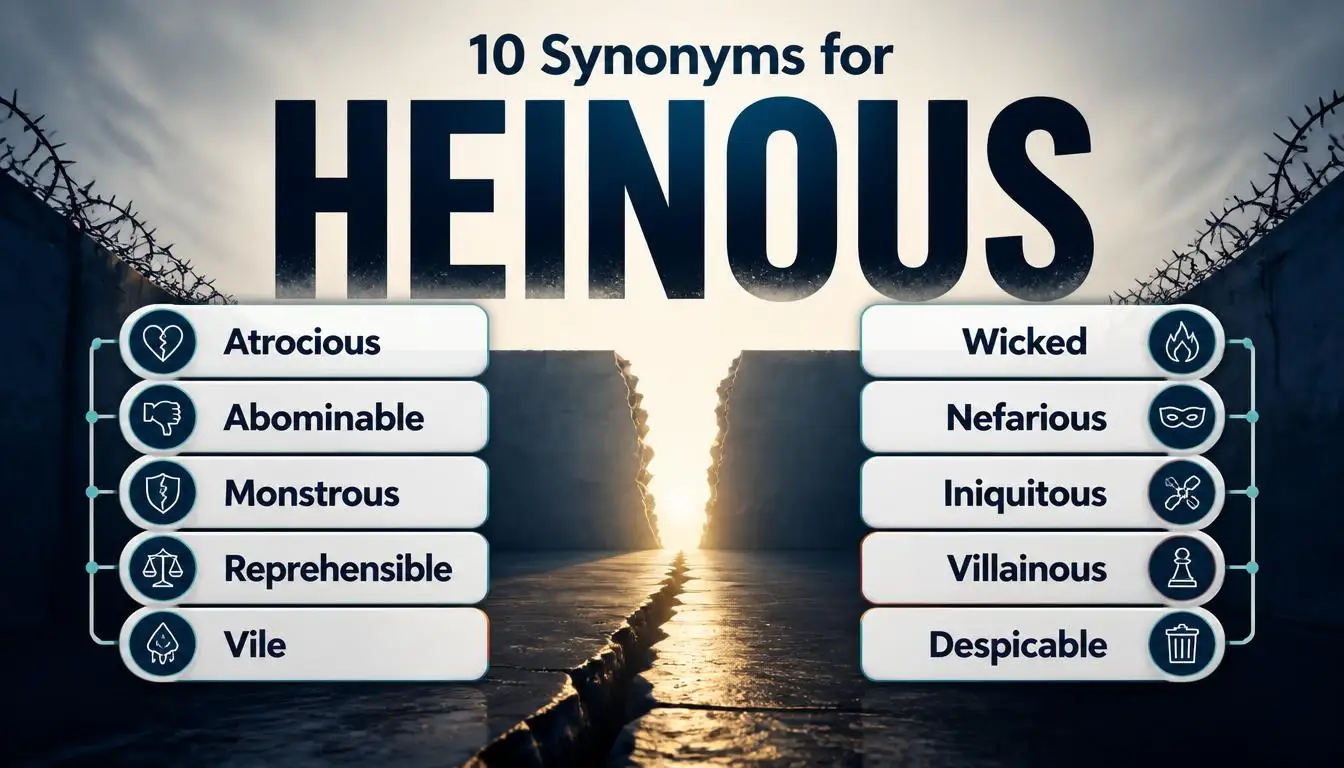
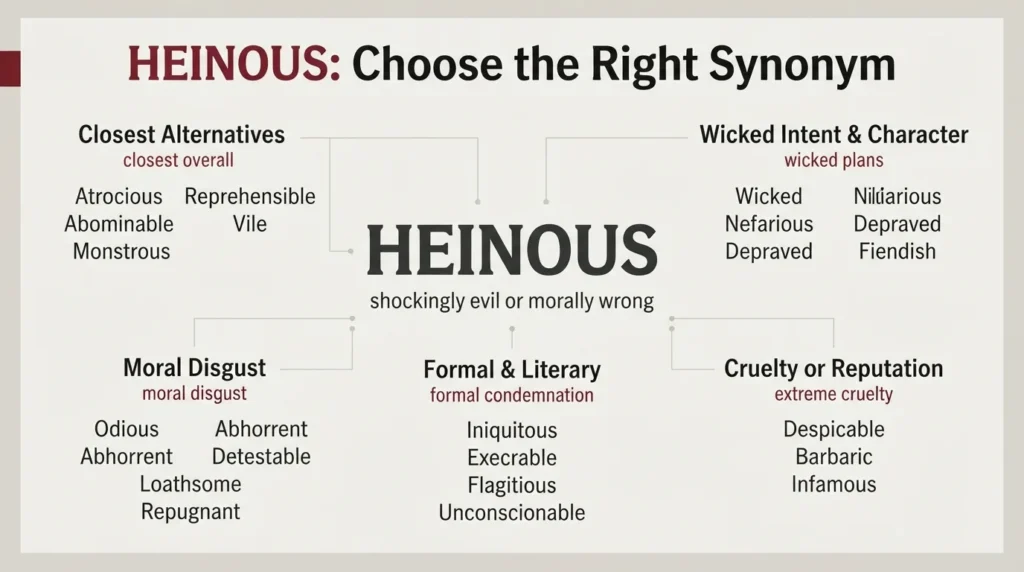
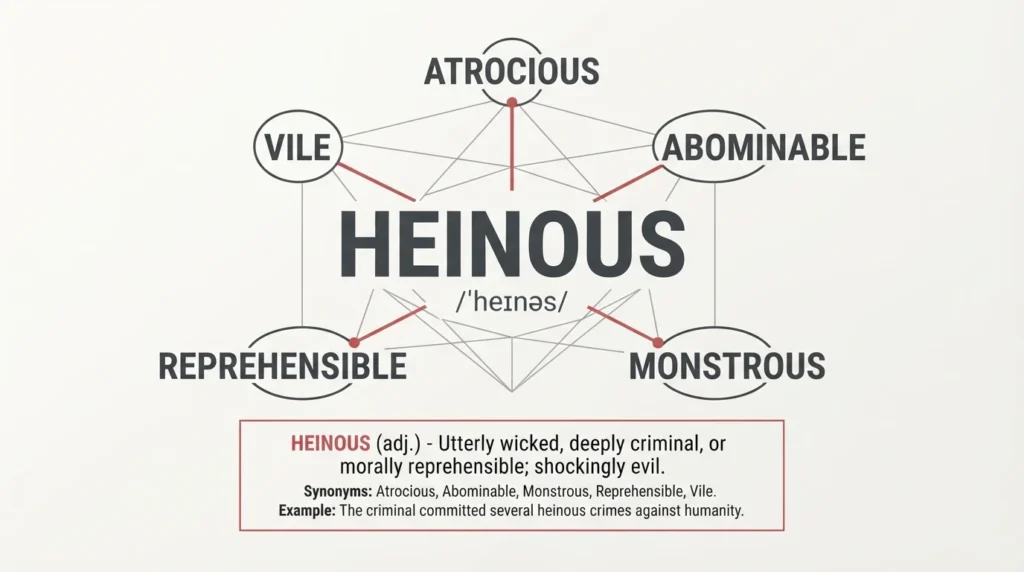
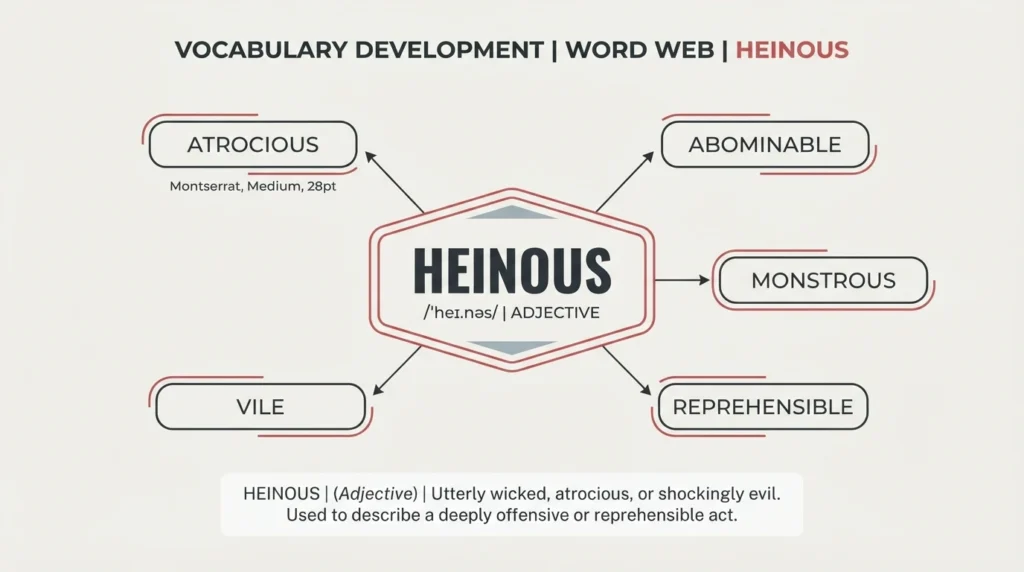
The most similar terms to heinous are atrocious, abominable, monstrous, reprehensible, vile, wicked, nefarious, despicable, odious and detested.
Nonetheless, these terms are not synonymous. Heinous typically refers to something shockingly immoral or evil, especially a serious offense or cruel act that is severely condemned.
Quick Comparison of the Best Synonyms for Heinous
| Word | Relationship to Heinous | Best Used For | Tone |
| Atrocious | Very close | Crimes, cruelty, wrongdoing | Strong |
| Abominable | Very close | Morally offensive behavior | Strong/Formal |
| Monstrous | Very close | Extreme cruelty or injustice | Dramatic |
| Reprehensible | Very close | Conduct deserving criticism | Formal |
| Vile | Very close | Immoral or disgusting behavior | Sharp/Emotional |
| Wicked | Close | Intentional wrongdoing | Neutral/Literary |
| Nefarious | Close | Criminal plans or schemes | Formal/Literary |
| Iniquitous | Close | Extreme injustice or immorality | Literary/Formal |
| Villainous | Close | Deliberate wicked behavior | Literary |
| Despicable | Close | Conduct deserving contempt | Strong |
| Odious | Close | Hateful or offensive conduct | Formal |
| Abhorrent | Contextual | Behavior provoking moral disgust | Formal |
| Depraved | Contextual | Corrupt character or behavior | Strong/Formal |
| Detestable | Contextual | Something deserving hatred | Strong |
| Loathsome | Contextual | Something provoking intense dislike | Emotional |
| Repugnant | Contextual | Morally offensive ideas or behavior | Formal |
| Execrable | Contextual | Extremely bad or detestable conduct | Literary |
| Infamous | Contextual | Notorious wrongdoing or reputation | Formal |
| Flagitious | Contextual | Extremely wicked or criminal conduct | Rare/Literary |
| Barbaric | Contextual | Cruel or brutal actions | Strong |
| Fiendish | Contextual | Wicked or extremely cruel behavior | Dramatic |
| Unconscionable | Contextual | Morally unacceptable conduct | Formal |
Heinous Meaning at a Glance
| Feature | Description |
| Part of speech | Adjective |
| Simple meaning | Shockingly evil or morally wrong |
| Tone | Strong and condemnatory |
| Formality | Formal |
| Commonly describes | Crimes, acts, offenses, abuse, behavior |
| Closest general alternative | Atrocious |
| Adverb | Heinously |
| Noun | Heinousness |
Major English dictionaries consistently place heinous in the semantic field of extreme badness, evil, wickedness, and moral condemnation. Cambridge labels the adjective formal and particularly associates it with crimes, while Merriam-Webster defines it in terms of shocking evil.
What Does Heinous Mean?
Heinous is a formal adjective describing something extremely wicked, morally shocking, or deserving intense condemnation.
It is most commonly associated with:
- serious crimes
- acts of cruelty
- grave offenses
- deliberate wrongdoing
- abuse
- violence
- deeply immoral behavior
For example:
The court condemned the heinous treatment of the victims.
Here, heinous does more than mean “bad.” It makes a strong moral judgment about the behavior.
Heinous Pronunciation
Heinous is pronounced: HAY-nuhs
IPA: /ˈheɪ.nəs/
Syllables: hei-nous
The stress falls on the first syllable:
HAY + nuhs
Cambridge records the same standard pronunciation for both UK and US English.
A common mistake is pronouncing the beginning as “hee.” For general modern English usage, HAY-nuhs is the safest pronunciation.
Where Does the Word Heinous Come From?
Heinous entered English during the Middle Ages through Anglo-French and Old French. Its history is connected to French words related to hatred or hate.
That origin helps explain why heinous still carries such powerful moral force today. It does not simply describe something unpleasant; it traditionally expresses intense condemnation.
Merriam-Webster dates its English use to the 14th century, while historical etymology sources trace it through Old French hainos/haineus and haine, meaning hatred.
What Is Another Word for Heinous?
The best general word to use instead of heinous is usually atrocious.
For example:
Heinous crime: The authorities condemned the heinous crime.
Atrocious crime: The authorities condemned the atrocious crime.
Both sound natural because each conveys extreme wrongdoing.
However, atrocious has a broader meaning. You can describe an atrocious performance, atrocious weather, or atrocious service. Using heinous in those situations would normally sound exaggerated because heinous strongly suggests moral wrongdoing.
Other good alternatives include:
- abominable for intense moral rejection
- monstrous for extraordinary cruelty
- reprehensible for formal condemnation
- vile for disgust and contempt
- nefarious for wicked plans or intentions
- abhorrent for strong moral opposition
22 Synonyms for Heinous With Meanings and Examples
1. Atrocious
Meaning: Extremely wicked, cruel, or exceptionally bad.
Best for: Crimes, cruelty, abuse, serious wrongdoing.
Nuance: Probably the most versatile substitute for heinous, although atrocious can also describe nonmoral things that are simply terrible.
Example: The commission documented several atrocious acts committed during the conflict.
2. Abominable
Meaning: Extremely bad, offensive, or morally hateful.
Best for: Cruel treatment, misconduct, injustice, serious wrongdoing.
Nuance: Emphasizes strong moral rejection and disgust.
Example: The organization condemned the abominable treatment of vulnerable families.
3. Monstrous
Meaning: Shockingly cruel, immoral, or beyond normal standards of human decency.
Best for: Severe cruelty, abuse, injustice, shocking crimes.
Nuance: More dramatic and emotionally forceful than reprehensible.
Example: Investigators uncovered a monstrous abuse of authority.
4. Reprehensible
Meaning: Deserving severe criticism or moral condemnation.
Best for: Journalism, formal statements, academic writing, professional criticism.
Nuance: More controlled and restrained than heinous.
Example: Deliberately exploiting the public’s trust was reprehensible.
5. Vile
Meaning: Extremely immoral, unpleasant, or disgusting.
Best for: Cruel behavior, betrayal, abuse, strong criticism.
Nuance: Shorter and emotionally sharper than heinous.
Example: Witnesses described the intimidation campaign as vile.
6. Wicked
Meaning: Morally wrong or deliberately evil.
Best for: People, motives, plans, actions, storytelling.
Nuance: Broader and simpler than heinous and often emphasizes intention.
Example: The story follows a ruler responsible for numerous wicked acts.
7. Nefarious
Meaning: Wicked, criminal, or deliberately immoral.
Best for: Schemes, secret plans, criminal operations, motives.
Nuance: Often implies deliberate planning or hidden wrongdoing.
Example: Investigators uncovered a nefarious scheme to defraud investors.
8. Iniquitous
Meaning: Extremely immoral or unjust.
Best for: Laws, systems, policies, institutional wrongdoing.
Nuance: Formal and somewhat old-fashioned.
Example: Reformers fought against what they considered an iniquitous system.
9. Villainous
Meaning: Deliberately wicked, criminal, or cruel.
Best for: Fiction, storytelling, deliberate wrongdoing, dramatic descriptions.
Nuance: Strongly associated with villains and intentional misconduct.
Example: The character’s villainous plan becomes clear in the final chapter.
10. Despicable
Meaning: So morally bad that it deserves contempt.
Best for: Betrayal, bullying, dishonesty, exploitation.
Nuance: Focuses more on contempt than shock.
Example: Taking advantage of people in distress was despicable.
11. Odious
Meaning: Extremely unpleasant, offensive, or deserving hatred.
Best for: Formal criticism, conduct, practices, historical writing.
Nuance: Emphasizes hatred or intense dislike.
Example: The memoir documents some of the regime’s most odious practices.
12. Abhorrent
Meaning: Inspiring intense disgust or moral opposition.
Best for: Ethical discussions, discrimination, abuse, harmful practices.
Nuance: Focuses on the reaction of moral disgust rather than the severity of an act alone.
Example: The organization described deliberate discrimination as abhorrent.
Additional Contextual Alternatives for Heinous
The following words can overlap with heinous, but they are not always direct replacements.
13. Depraved
Depraved means morally corrupt or perverted in character.
It works especially well for people, motives, habits, or repeated patterns of wrongdoing.
Example: The novel portrays a depraved leader obsessed with power.
14. Detestable
Detestable describes something deserving intense dislike or hatred.
Example: The deliberate exploitation of vulnerable people was detestable.
It emphasizes hatred more than the shock associated with heinous.
15. Loathsome
Loathsome describes something that inspires intense disgust or hatred.
Example: The narrator exposes the character’s loathsome behavior.
It can be used for morally offensive behavior but also for things that are merely physically disgusting.
16. Repugnant
Repugnant means extremely distasteful, unacceptable, or morally offensive.
Example: The committee called the discriminatory policy morally repugnant.
It works especially well in ethical, political, professional, and formal discussion.
17. Execrable
Execrable can mean extremely bad or deserving condemnation.
Example: Critics denounced the ruler’s execrable treatment of prisoners.
It is much less common in everyday English and has a literary or formal tone.
18. Infamous
Infamous describes someone or something widely known for a bad quality or evil act.
Example: The incident became one of the regime’s most infamous abuses of power.
Unlike heinous, it emphasizes bad reputation or notoriety.
19. Flagitious
Flagitious means extremely wicked or criminal.
Example: The historian described the conspiracy as a flagitious abuse of authority.
It is a legitimate word but rare in modern everyday English, so it works best in literary, historical, or deliberately elevated writing.
20. Barbaric
Barbaric describes behavior that is extremely cruel or brutal.
Example: Human-rights advocates condemned the barbaric treatment of prisoners.
It is particularly useful when cruelty is the central idea.
21. Fiendish
Fiendish can describe something extremely cruel, wicked, or devilishly malicious.
Example: The antagonist devised a fiendish plan to punish his rivals.
It sounds more dramatic and literary than heinous.
22. Unconscionable
Unconscionable describes behavior that is shockingly unfair, unreasonable, or morally unacceptable.
Example: Charging desperate families such excessive fees was unconscionable.
It is especially useful when discussing exploitation, unfairness, ethics, or abuse of power.
Related Words That Are Not Exact Synonyms for Heinous
Large thesauruses may place many words near heinous, but related words are not necessarily interchangeable.
Understanding this difference makes your writing more precise.
Horrific
Horrific means causing horror.
A horrific event can be tragic without anyone having committed an immoral act.
Example: The hurricane caused horrific destruction.
The destruction is horrific, but the hurricane itself is not morally evil.
Gruesome
Gruesome refers to disturbing, frightening, or unpleasant details, often involving injury or death.
Example: The crime novel contains several gruesome scenes.
Something can be gruesome without being morally heinous.
Shocking
Shocking means extremely surprising, disturbing, or offensive.
Example: The company announced a shocking decline in revenue.
A surprising financial result is not necessarily morally wrong.
Egregious
Egregious means outstandingly or remarkably bad.
It can describe ethical misconduct, but it can also describe serious mistakes.
Example: The audit discovered an egregious accounting error.
The error may be severe without being evil.
Horrible
Horrible is much broader than heinous.
A horrible meal, horrible headache, or horrible journey may be extremely unpleasant but not morally wrong.
Terrible
Like horrible, terrible describes many negative situations and therefore lacks the specific moral force of heinous.
Brutal
Brutal emphasizes cruelty, violence, harshness, or severity.
A brutal attack may also be heinous, but brutal focuses primarily on the nature or intensity of the violence.
Heinous vs Similar Words
Heinous vs Atrocious
Both words can describe shocking wrongdoing.
Heinous: Strongly associated with serious moral evil.
Atrocious: Can mean morally terrible or simply extremely poor.
Heinous crime ✓
Atrocious crime ✓
Atrocious performance ✓
Heinous performance usually ✗
Heinous vs Abhorrent
Heinous describes the extreme wickedness of something.
Abhorrent emphasizes the disgust or moral opposition that something causes.
A practice may therefore be called abhorrent because people strongly reject it.
Heinous vs Reprehensible
Both involve moral condemnation.
Heinous is stronger and more emotionally charged.
Reprehensible is more restrained and often works better in reports, official statements, journalism, and professional writing.
Heinous vs Monstrous
Monstrous suggests cruelty so extreme that it seems beyond ordinary human decency.
It is more dramatic and literary.
Heinous remains a more conventional choice in phrases such as heinous crime and heinous offense.
Heinous vs Vile
Vile emphasizes disgust and contempt.
Heinous emphasizes shocking moral wickedness.
Both can describe serious misconduct.
Heinous vs Egregious
These words overlap but should not always be exchanged.
Egregious means exceptionally bad and may describe mistakes, professional failures, or unethical conduct.
Heinous usually requires a much stronger sense of moral wrongdoing.
Heinous vs Horrific
Horrific tells us that something causes horror.
Heinous tells us that something deserves severe moral condemnation.
A natural disaster can be horrific but not heinous.
Best Synonyms for Heinous Crimes and Serious Acts
If you need a synonym for heinous crime, the best choices depend on the emphasis you want.
Atrocious crime
Best all-purpose replacement.
Example: Authorities described the attack as an atrocious crime.
Abominable crime
Emphasizes moral disgust and condemnation.
Monstrous crime
Emphasizes extraordinary cruelty.
Vile crime
Short, emotionally forceful, and strongly condemnatory.
Nefarious act
Better when planning, criminal intent, or deliberate scheming matters.
Reprehensible conduct
A more restrained choice for reports, journalism, policies, and formal criticism.
Barbaric act
Best when extreme cruelty or brutality is central.
For most serious contexts, atrocious crime, monstrous act, reprehensible conduct, and abominable offense are natural alternatives.
Best Synonyms for a Heinous Person
Although heinous person is grammatically understandable, English speakers more often use heinous for a person’s acts, crimes, behavior, or conduct than as a general personality description.
Better synonyms for a heinous person include:
- evil — broad judgment about morality
- depraved — deeply morally corrupt
- despicable — deserving contempt
- wicked — intentionally immoral
- villainous — deliberately wicked, often literary
- odious — deserving strong dislike or hatred
- vile — morally disgusting
- nefarious — wicked or criminal, especially regarding intentions
Compare:
Less natural: He was a heinous man.
More natural: He committed a heinous act.
More natural: He was a depraved man.
Choose person-focused adjectives when describing character and reserve heinous primarily for conduct when possible.
What Are Synonyms for a Heinous Woman?
The phrase synonyms for heinous woman sometimes appears in searches, but English does not require separate male and female synonyms for heinous.
If you want to describe a woman whose conduct is seriously immoral, possible alternatives include:
- depraved
- wicked
- despicable
- vile
- villainous
- odious
- evil
For example:
She was portrayed as a depraved and manipulative character.
or:
The court condemned her heinous actions.
The second construction is often more precise because it condemns the behavior rather than using heinous as a broad label for the person.
Formal Synonyms for Heinous
For essays, reports, journalism, academic work, or official statements, useful formal alternatives include:
Reprehensible
Controlled and precise.
Abhorrent
Strongly communicates ethical rejection.
Iniquitous
Suitable for serious immorality or injustice, although somewhat literary.
Nefarious
Useful for planned criminal or immoral activity.
Repugnant
Effective for morally offensive ideas, practices, or conduct.
Unconscionable
Strong choice for exploitation, unfairness, or ethical misconduct.
Atrocious
Stronger and more emotionally forceful but still common in serious writing.
Synonyms for Heinous in Creative Writing
Creative writing allows more dramatic vocabulary.
Consider:
- monstrous for extraordinary cruelty
- fiendish for malicious schemes
- villainous for intentionally wicked characters
- wicked for straightforward moral judgment
- depraved for corrupt character
- vile for disgust or contempt
- iniquitous for an elevated or historical tone
- flagitious for deliberately archaic or highly literary prose
The best word depends on character, setting, register, and emotional intensity.
Heinous Antonyms
The opposite of heinous should express moral goodness, approval, or admirable conduct.
Useful heinous antonyms include:
| Antonym | Meaning |
| Admirable | Deserving respect or approval |
| Praiseworthy | Deserving praise |
| Laudable | Worthy of approval |
| Virtuous | Morally good |
| Honorable | Showing strong moral principles |
| Noble | Showing high moral qualities |
| Commendable | Deserving approval |
| Good | Morally right or beneficial |
Examples
Heinous: The investigation uncovered heinous behavior.
Praiseworthy: The volunteers made a praiseworthy effort to help the community.
Heinous: The character committed a deeply immoral act.
Virtuous: The character was admired for her virtuous conduct.
Heinous Synonym and Antonym at a Glance
If you need a quick heinous synonym and antonym, use:
Synonym: Atrocious
Antonym: Admirable
Other useful pairs include:
| Heinous Synonym | Possible Antonym |
| Abominable | Praiseworthy |
| Reprehensible | Commendable |
| Wicked | Virtuous |
| Vile | Noble |
| Odious | Admirable |
| Iniquitous | Honorable |
Exact opposites depend on the sentence, because many adjectives carry slightly different shades of meaning.
Common Phrases With Heinous
Heinous frequently appears before nouns connected with serious wrongdoing.
Heinous Crime
An exceptionally wicked or morally shocking crime.
Example: The prosecutor described the offense as a heinous crime.
Heinous Act
An extremely immoral or cruel action.
Example: Community leaders condemned the heinous act.
Heinous Offense
A gravely immoral or shocking offense.
Example: The court considered the conduct a particularly heinous offense.
Heinous Attack
An attack strongly condemned for its cruelty or wickedness.
Example: Officials denounced the heinous attack.
Heinous Murder
A murder described as exceptionally wicked or morally shocking.
Example: The novel centers on the investigation of a heinous murder.
Heinous Abuse
Extremely cruel or morally offensive mistreatment.
Example: The investigation revealed years of heinous abuse.
Heinous Behavior
Conduct regarded as shockingly immoral.
Example: The organization refused to excuse such heinous behavior.
Heinous Crimes
The plural phrase is common when referring to multiple acts of extreme criminal wrongdoing.
Example: The historical account documents several heinous crimes.
Collins specifically records combinations such as heinous crime and heinous offence, while dictionary examples repeatedly associate the adjective with crimes and serious acts.
Heinous in a Sentence
Here are examples showing heinous in a sentence across different contexts:
- The judge described the deliberate attack as a heinous crime.
- The investigation uncovered several heinous acts of cruelty.
- Community leaders condemned the heinous treatment of vulnerable residents.
- No political objective could justify such heinous behavior.
- The novel explores the consequences of a character’s heinous actions.
- Witnesses struggled to understand the motive behind the heinous offense.
- Authorities promised to investigate those responsible for the heinous abuse.
- The report documented some of the most heinous violations committed during the conflict.
Notice that heinous most naturally modifies serious nouns such as crime, act, offense, abuse, behavior, treatment, and actions.
How to Choose the Right Synonym for Heinous
Before replacing heinous, decide exactly what you want the sentence to communicate.
For extreme moral wrongdoing
Use:
atrocious, abominable, vile
For cruelty
Use:
monstrous, barbaric, fiendish
For formal condemnation
Use:
reprehensible, abhorrent, repugnant, unconscionable
For criminal intentions or schemes
Use:
nefarious, villainous, wicked
For corrupt character
Use:
depraved, wicked, despicable
For hatred or disgust
Use:
odious, detestable, loathsome, abhorrent
For injustice
Use:
iniquitous, unconscionable, reprehensible
This approach is more reliable than selecting the first alternative from a thesaurus because genuine synonym choice depends on meaning, context, tone, register, collocation, and intensity.
Frequently Asked Questions
What is the closest synonym for heinous?
Atrocious is one of the closest and most useful general synonyms for heinous. Both can describe extremely wicked or shocking actions. However, atrocious is broader because it can also describe things that are simply very poor, such as atrocious service or an atrocious performance.
What does heinous mean?
Heinous means shockingly evil, wicked, or morally wrong. It is a formal adjective most naturally used for serious crimes, acts, offenses, abuse, or behavior.
What is another word for heinous?
Depending on context, another word for heinous may be atrocious, abominable, monstrous, reprehensible, vile, wicked, nefarious, odious, or abhorrent.
What is a synonym for heinous crime?
Good alternatives for heinous crime include atrocious crime, monstrous crime, abominable crime, and vile crime. For a more formal tone, you might describe the conduct as reprehensible.
What are good synonyms for a heinous person?
For a person, depraved, wicked, despicable, vile, villainous, odious, and evil often sound more natural than heinous person. Heinous itself is especially common with actions and crimes.
What are synonyms for a heinous woman?
The same person-focused adjectives apply regardless of gender. Depending on context, depraved, wicked, despicable, vile, villainous, odious, or evil may work. When possible, describe the specific conduct—for example, “her heinous actions”—rather than applying an unnecessarily broad label to the person.
What are the antonyms of heinous?
Common heinous antonyms include admirable, praiseworthy, commendable, laudable, virtuous, honorable, noble, and good.
What are a heinous synonym and antonym?
A simple pair is:
Synonym: atrocious
Antonym: admirable
The best synonym or opposite changes according to context.
How do you pronounce heinous?
The standard pronunciation is HAY-nuhs, /ˈheɪ.nəs/. The word has two syllables, with stress on the first.
Is heinous a formal word?
Yes. Heinous is generally considered formal. It frequently appears in journalism, legal-style discussion, official statements, historical writing, and serious commentary.
Can heinous describe a person?
It can, but describing a heinous act, heinous crime, heinous offense, or heinous behavior is often more idiomatic. For someone’s overall character, words such as depraved, wicked, despicable, or evil may be more natural.
Are horrific and heinous synonyms?
They are related but not exact synonyms. Horrific emphasizes something that causes horror, while heinous makes a strong moral judgment. A horrific natural disaster, for example, is not morally heinous.
Are heinous and egregious the same?
No. Egregious means exceptionally bad and can describe serious mistakes as well as unethical behavior. Heinous is much more closely associated with morally shocking wrongdoing.
Final Takeaway
The strongest synonyms for heinous are not simply words meaning “very bad.” Heinous combines extreme severity with moral condemnation, which is why it appears so naturally with words such as crime, act, offense, abuse, and behavior.
For the closest general substitute, atrocious is an excellent choice. Use abominable for moral disgust, monstrous for extraordinary cruelty, reprehensible for controlled formal criticism, vile for contempt, and nefarious for deliberately wicked intentions.
The best synonym is ultimately the word that preserves the exact meaning, tone, and context of your sentence.

About Sajjad Ahmed
Sajjad Ahmed is the author behind Guest Paster, where he writes about English vocabulary, synonyms, word meanings, and practical word usage.
His content is designed to help readers understand the differences between similar words, discover suitable alternatives, and use English vocabulary more effectively in everyday writing and communication.
Before publishing, Sajjad focuses on presenting word choices in a clear and easy-to-understand format, with relevant meanings, context, and examples where helpful.
Through Guest Paster, his goal is to make vocabulary learning simpler and provide useful language resources for students, writers, English learners, and anyone looking to expand their vocabulary.
Areas of Focus: English Vocabulary • Synonyms • Word Meanings • Word Usage • Language Learning
Author: Sajjad Ahmed
Website: Guest Paster