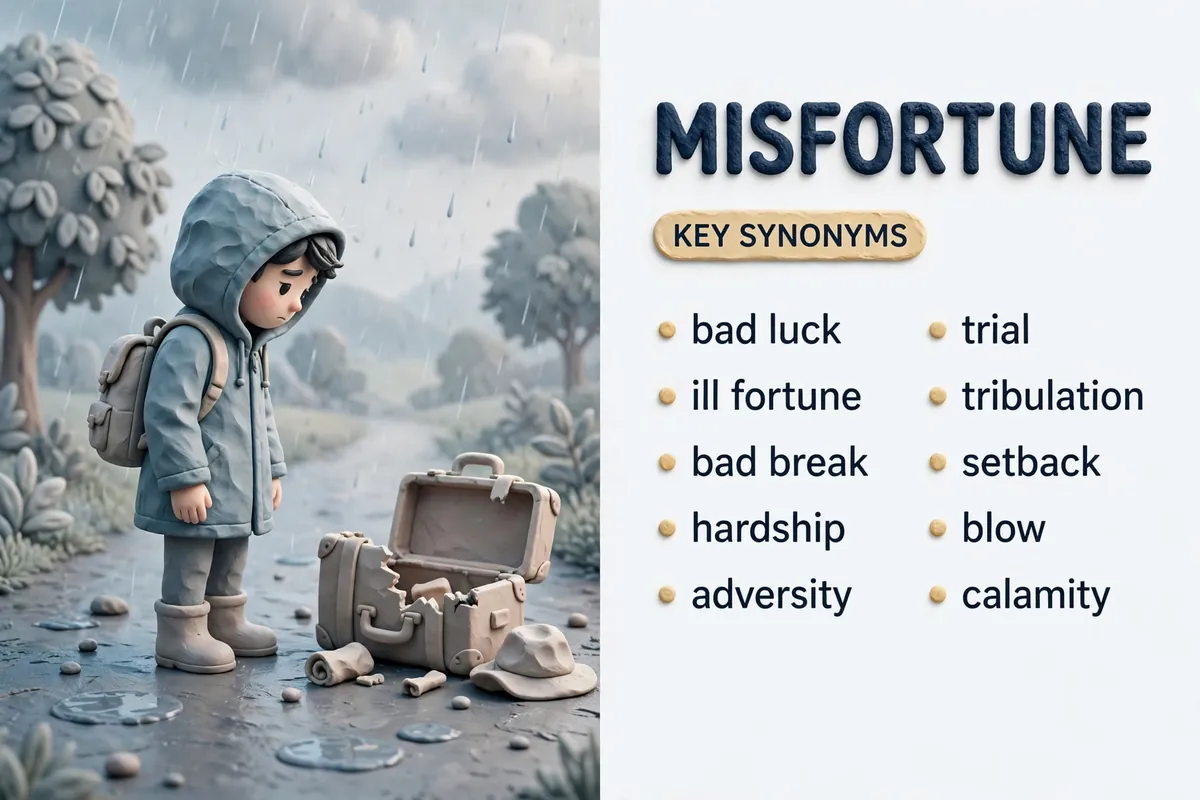
Misfortune means bad luck or an unlucky event that brings loss or pain. Moreover bad luck is the closest of these misfortune synonyms because it covers the same ground.
This guide compares 15 misfortune synonyms, from bad luck to reverse, with plain meanings and real examples. You will see which word fits a small setback, a long hard time or a great disaster.
Misfortune Synonyms at a Glance
| # | Synonym | Meaning Difference |
| 1 | Bad luck | Plain bad chance in daily life |
| 2 | Ill fortune | Formal bad luck in old writing |
| 3 | Bad break | One unlucky turn in a plan |
| 4 | Hardship | Long hard conditions |
| 5 | Adversity | Hard times that test strength |
| 6 | Trial | A hard test of patience |
| 7 | Tribulation | Long suffering in formal use |
| 8 | Setback | A check that slows progress |
| 9 | Blow | A sudden hard hit |
| 10 | Calamity | A great disaster |
Quick Facts About “Misfortune”
Part of speech: noun. Moreover, the adjective is unfortunate, and the adverb is unfortunately.
Core meaning: bad luck, or an unlucky event that brings loss or pain.
In addition, two main senses: (1) bad luck in general, as in a run of misfortune; (2) one unlucky event, as in a misfortune on the road.
Register: neutral to formal. In fact, misfortune fits news stories, essays, and everyday talk.
Common mistake: using misfortune for a plain failure. For example, a failed exam shows weak study, not misfortune, unless bad luck caused the fail.
The Closest of These Misfortune Synonyms: Bad Luck
In fact, bad luck is the closest of these misfortune synonyms, because it covers the same ground most fully: chance that turns against a person. “He blamed his misfortune for the loss” becomes “He blamed his bad luck for the loss.” “A run of misfortune closed the shop” becomes “A run of bad luck closed the shop.”
Bad luck also wins on plainness. It sounds natural in daily talk, therefore it fits sports, work, travel, and family stories. But misfortune stays wider and more formal. Finally, use bad luck for everyday chance, but save misfortune for formal writing or a long run of troubles.
Where Misfortune Synonyms Come From
According to Etymonline, fortune dates to about 1300 and meant “chance, luck as a force in human affairs.” Moreover, it came from Old French fortune, “lot, good fortune, misfortune,” and from Latin fortuna, “chance, fate, good luck.” Latin fortuna came from fors, “chance, luck.”
Indeed, mis- adds the bad turn. Etymonline traces mis- to Old English mis-, “bad, wrong,” from Proto-Germanic missa-, “divergent, astray.” Therefore, misfortune joins a bad turn with chance: luck that goes wrong. Read the full misfortune entry and the fortune entry.
Can You Swap Misfortune Synonyms Freely?
In short: only inside the same meaning group.
- “He met with misfortune on the trip.” (bad luck)
- “He met with bad luck on the trip.” (bad luck)
- “He met with calamity on the trip.” (calamity means a great disaster, not a small hitch; say bad luck or setback)
- “Years of misfortune wore the family down.” (long hard times)
- “Years of hardship wore the family down.” (long hard times)
Therefore, before you swap words, ask what struck: chance, a long hard time, or a great disaster.
Misfortune Synonyms in Detail
Group 1: Bad Luck Itself
1. Bad luck
- Meaning: Plain bad chance in daily life.
- Difference: Indeed, bad luck names chance with no extra weight. Misfortune sounds more formal, but bad luck sounds like normal talk.
- Best Used For: Sports, work, travel, and everyday stories about chance.
- Formality: Neutral · CEFR: A2 · Frequency: Very common
- Example (Daily): “He missed the train by bad luck, not by slow feet.”
- Example (Work): “Bad luck cost the team its best player before the final.”
- When NOT to Use It: For a great disaster, use calamity instead.
2. Ill fortune
- Meaning: Formal bad luck, often in old writing.
- Difference: In fact, ill fortune carries an old and formal tone. Bad luck fits a chat, but ill fortune fits a novel or a formal speech.
- Best Used For: Formal writing, old stories, and serious reports.
- Formality: Formal · CEFR: C1 · Frequency: Rare
- Example (Story): “Ill fortune followed the sailor from port to port.”
- Example (Formal): “The report blamed ill fortune for the failed harvest.”
- When NOT to Use It: For everyday talk, use bad luck instead.
3. Bad break
- Meaning: One unlucky turn in a plan.
- Difference: Indeed, a bad break names a single event. Misfortune can name a whole run of troubles, but a bad break names one twist.
- Best Used For: Sports, games, job hunts, and plans that went wrong once.
- Formality: Informal · CEFR: B2 · Frequency: Common
- Example (Sports): “A bad break in the second half cost us the match.”
- Example (Work): “She lost the job by one bad break in the interview.”
- When NOT to Use It: For long suffering, use hardship instead.
Group 2: Hard Times That Press On
Moreover, these misfortune synonyms name troubles that last.
4. Hardship
- Meaning: Long hard conditions that wear a person down.
- Difference: In fact, hardship stresses time and weight. It lasts for weeks or years, while misfortune can strike once.
- Best Used For: Poverty, war, illness, and long struggles in life.
- Formality: Neutral · CEFR: B2 · Frequency: Common
- Example (Daily): “Hardship taught the family to live on very little.”
- Example (Story): “The pioneers faced hardship on every mile of the trail.”
- When NOT to Use It: For one unlucky moment, use bad break instead.
5. Adversity
- Meaning: Hard times that test strength.
- Difference: Specifically, adversity adds a test. Hardship names the hard conditions, but adversity names the fight against them.
- Best Used For: Speeches, essays, and stories about courage and growth.
- Formality: Formal · CEFR: C1 · Frequency: Common
- Example (Essay): “Adversity made the young leader strong and calm.”
- Example (Daily): “She met adversity with a smile and kept working.”
- When NOT to Use It: For plain chance with no test, use bad luck instead.
6. Trial
- Meaning: A hard test of patience.
- Difference: Indeed, a trial tests a person over time. A setback blocks a plan once, but a trial asks for endurance day after day.
- Best Used For: Illness, grief, faith, and long personal struggles.
- Formality: Neutral · CEFR: B2 · Frequency: Common
- Example (Family): “The long illness was a trial for the whole family.”
- Example (Daily): “Each trial left him more patient than before.”
- When NOT to Use It: For a sudden disaster, use calamity instead.
7. Tribulation
- Meaning: Long suffering, often in formal or old use.
- Difference: In fact, tribulation sounds solemn and old. Trial fits plain talk, but tribulation fits scripture, old books, and formal prose.
- Best Used For: Formal writing, religious texts, and solemn stories.
- Formality: Formal · CEFR: C2 · Frequency: Rare
- Example (Story): “The group bore its tribulation in silence for years.”
- Example (Formal): “War brought tribulation to every village in the valley.”
- When NOT to Use It: For everyday troubles, use hardship instead.
8. Setback
- Meaning: A check that slows progress.
- Difference: A setback blocks a plan but leaves hope. Misfortune can end a plan, but a setback only delays it.
- Best Used For: Careers, projects, health, and sports comebacks.
- Formality: Neutral · CEFR: B2 · Frequency: Very common
- Example (Work): “The firm met a setback when the deal fell through.”
- Example (Daily): “A small setback kept her from the race, not from training.”
- When NOT to Use It: For a great loss of life, use tragedy instead.
Group 3: A Sudden Hard Event
Overall, these misfortune synonyms strike in one moment.
9. Blow
- Meaning: A sudden hard hit.
- Difference: Indeed, a blow strikes fast and shocks. A setback slows a plan, but a blow shakes a person in one moment.
- Best Used For: Sudden news, losses, and shocks in stories and reports.
- Formality: Neutral · CEFR: B2 · Frequency: Common
- Example (Daily): “The news of the closure came as a blow to the town.”
- Example (Story): “One blow ended the boxer’s hopes for the title.”
- When NOT to Use It: For slow trouble over years, use hardship instead.
10. Calamity
- Meaning: A great disaster with wide loss.
- Difference: In fact, calamity scales the loss up. A blow hits one person, but a calamity hits a town, a region, or a whole people.
- Best Used For: Floods, fires, quakes, and other great disasters.
- Formality: Formal · CEFR: C1 · Frequency: Uncommon
- Example (News): “The flood was a calamity for the whole valley.”
- Example (Story): “Calamity struck the fleet in a single stormy night.”
- When NOT to Use It: For a small hitch in a plan, use setback instead.
11. Disaster
- Meaning: A sudden event that causes great harm.
- Difference: Specifically, disaster names the event itself. It fits news and plain reports more often.
- Best Used For: News reports, safety talks, and plain accounts of ruin.
- Formality: Neutral · CEFR: B2 · Frequency: Very common
- Example (News): “The fire was a disaster for the market traders.”
- Example (Daily): “A burst pipe turned the trip into a small disaster.”
- When NOT to Use It: For plain bad luck with no ruin, use bad luck instead.
12. Tragedy
- Meaning: A sad event with deep loss, often of life.
- Difference: Indeed, tragedy adds grief to ruin. Disaster names the harm, but tragedy names the sorrow that follows it.
- Best Used For: Deaths, accidents, and sad news in stories and reports.
- Formality: Neutral · CEFR: B2 · Frequency: Common
- Example (News): “The crash was a tragedy for three families.”
- Example (Story): “Tragedy struck the village on a quiet Sunday.”
- When NOT to Use It: For a lost game or a late train, use bad luck instead.
Group 4: Suffering That Lingers
13. Affliction
- Meaning: A lasting pain or trouble that weighs on a person.
- Difference: In fact, affliction stresses the burden. It names the pain that hard conditions leave behind.
- Best Used For: Illness, grief, and long personal troubles.
- Formality: Formal · CEFR: C1 · Frequency: Uncommon
- Example (Daily): “Her bad knee was an affliction through the long winter.”
- Example (Story): “The old man bore his affliction without complaint.”
- When NOT to Use It: For one unlucky day, use bad break instead.
14. Misadventure
- Meaning: An unlucky accident, often on a trip or in an attempt.
- Difference: Specifically, misadventure names the event and its unlucky turn. Bad luck names the chance, but misadventure names the whole failed attempt.
- Best Used For: Travel tales, old stories, and formal reports of accidents.
- Formality: Formal · CEFR: C2 · Frequency: Rare
- Example (Story): “A misadventure on the mountain cost them two days.”
- Example (Formal): “The court heard of the misadventure at sea.”
- When NOT to Use It: For long hard times, use adversity instead.
15. Reverse
- Meaning: A turn of fortune against a plan or a person.
- Difference: Indeed, a reverse flips good luck to bad. It turns a plan’s fortune around.
- Best Used For: War, business, sports, and politics.
- Formality: Formal · CEFR: C1 · Frequency: Uncommon
- Example (Work): “The firm met a sharp reverse when the market fell.”
- Example (Sports): “A late goal was a cruel reverse for the home team.”
- When NOT to Use It: For a sad personal loss, use tragedy instead.
Best Misfortune Synonyms by Context
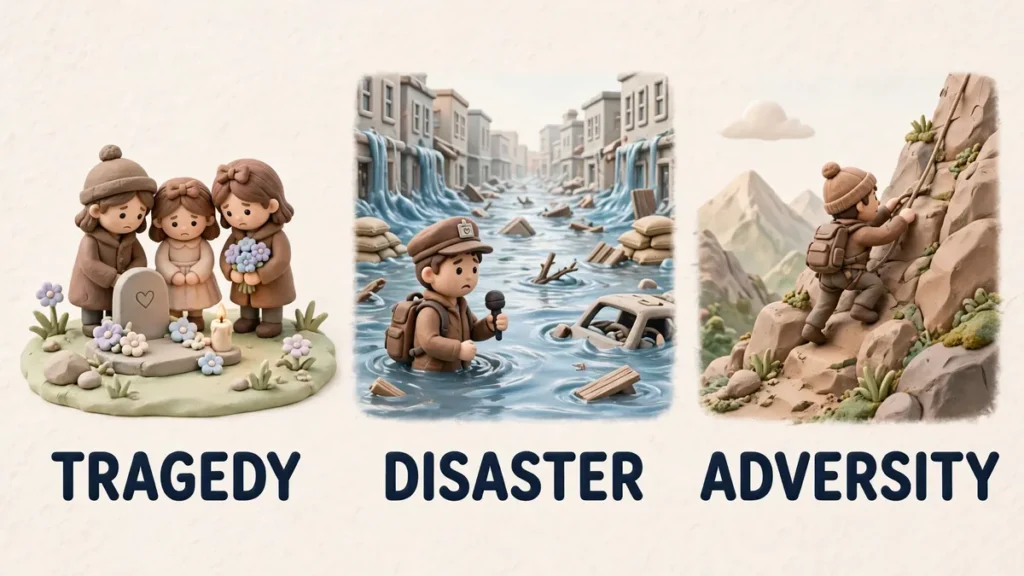
Overall, each of these misfortune synonyms fits one real situation.
In a sympathy note. A friend writes to a family after a loss. Tragedy fits best, because it names grief with respect. Similarly, affliction follows for a long illness. Our guide to empathy synonyms covers feeling the pain of others.
In a news report. A reporter covers a flood town. Therefore, disaster fits best, because it stays plain and clear. Calamity follows for the scale of the loss, while blow suits one sharp piece of news.
In an exam essay. A student writes about courage in hard times. Therefore, adversity fits best, because it names a test that builds strength. Hardship follows for long conditions, while trial suits a personal test of patience.
In a story. A writer shows a hero who keeps going. Therefore, trial fits best for slow tests, while blow fits a sudden shock. Tribulation suits an old tale, but it sounds heavy in a light story.
In everyday speech. A friend tells a tale of a ruined trip. Therefore, bad luck fits best, because it sounds natural and light. Similarly, bad break follows for one unlucky twist, while setback suits a plan that still has hope.
Which of These Misfortune Synonyms Should I Choose?
| Situation | Best word | Why |
| Plain bad chance in daily talk | Bad luck | It sounds natural and covers most cases |
| One unlucky twist in a plan | Bad break | It names a single event, not a whole run |
| Long hard conditions | Hardship | It stresses time and weight |
| A test that builds strength | Adversity | It names the fight, not just the pain |
| A sudden shock | Blow | It strikes fast and shakes a person |
| A great disaster | Calamity | It scales the loss up to a whole town |
| A sad loss of life | Tragedy | It adds grief to the ruin |
| Formal or old writing | Ill fortune | It carries the right old tone |
Collocations and Idioms With Misfortune Synonyms
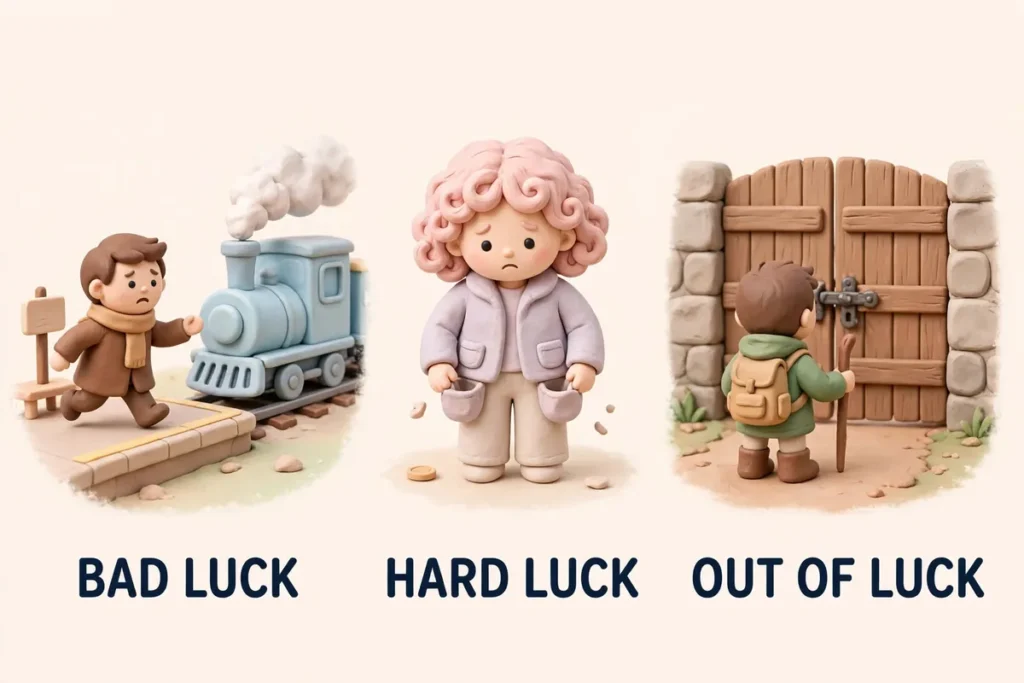
A run of bad luck. Moreover, people use this phrase for troubles that come one after another. “He met a run of bad luck all spring.”
A stroke of bad luck. In addition, this phrase names one sharp twist of chance. “A stroke of bad luck broke her racket before the match.” Finally, it fits sports and work tales.
Down on your luck. Furthermore, this idiom means short of money and out of fortune for a time. “He was down on his luck after the shop closed.” Finally, it sounds warm and informal.
Out of luck. Similarly, this idiom means no chance left in the moment. “We were out of luck, so we walked home.” In addition, it fits plain talk.
A hard-luck story. This phrase names a sad tale of troubles told to win pity or help. “He told a hard-luck story at the shelter door.” Use it with care, because it can sound unkind.
Suffer misfortune. Writers pair suffer with misfortune for a formal tone. “The town suffered misfortune in the war years.”
Bear misfortune. This pair adds courage to the pain. “She bore her misfortune with quiet grace.” Our guide to strength synonyms covers standing firm after hard times.
Misfortunes never come singly. This old proverb says troubles arrive in groups. “Misfortunes never come singly, so the family braced for more.”
Overall, writers pair these misfortune synonyms with fixed phrases.
Misfortune Antonyms in One Table
| Opposite | Meaning |
| Good luck | Good chance in daily life |
| Good fortune | Luck that favours a person |
| Fortune | Luck itself, good or bad, as a force |
| Luck | Chance, with no bad turn |
| Prosperity | Wealth and success over time |
| Success | A good result after effort |
| Blessing | A gift of good that lifts a person |
| Windfall | Sudden good luck, often money |
Overall, good luck is the safe plain opposite. Moreover, for wealth over time, use prosperity, and for a sudden gift, use windfall.
Words Commonly Confused With Misfortune Synonyms
Misfortune versus unhappiness. In fact, unhappiness names a feeling inside a person. Misfortune names bad luck or an unlucky event outside a person. A person can feel unhappy with no misfortune at all, yet meet misfortune and stay calm. Our guide to unhappy synonyms covers plain low spirits. Use unhappiness for feelings, but misfortune for luck and events.
Misfortune versus failure. Failure names a result that falls short of a goal. In contrast, misfortune names bad luck that may cause the fall. A student can fail through weak study, with no bad luck at all. Use failure for the result, but misfortune for the unlucky cause.
Misfortune versus poverty. Poverty names a lack of money over time. However, misfortune names bad luck, which can strike rich and poor alike. A rich trader can meet misfortune in one bad deal. Use poverty for the condition, but misfortune for the unlucky turn.
Misfortune versus accident. An accident names an event that no one planned. In contrast, misfortune adds a bad outcome to the event. A small accident can end with a laugh, but misfortune ends with loss. Use accident for the event, but misfortune when luck turns bad.
Misfortune versus curse. A curse names a supernatural cause, or a wish for harm. However, misfortune names plain bad luck with no magic behind it. A farmer can blame a curse, but a reporter blames misfortune. Use curse for magic or blame, but misfortune for plain chance.
American vs British English
Overall, misfortune keeps the same spelling and use in American and British English. Indeed, bad luck, hardship, and disaster never change across the Atlantic. Britons say “hard luck” more often after a loss, while Americans say “tough luck” in the same place. This article also uses American spelling throughout.
Practice Exercises With Misfortune Synonyms
Therefore, use these misfortune synonyms to fill each gap.
Exercise 1: Fill in the blank. First, choose from bad luck, hardship, calamity, setback, tragedy, and bad break.
- The flood was a ______ for the whole valley.
- A small ______ kept her from the race, not from training.
- Years of ______ taught the family to live on very little.
- The crash was a ______ for three families.
- He missed the train by ______, not by slow feet.
- One ______ in the second half cost us the match.
Finally, exercise 2: Choose the right word.
- “The ______ struck the fleet in a single stormy night.” (calamity / setback)
- “She met ______ with a smile and kept working.” (adversity / blow)
- “A ______ in the second half cost us the match.” (bad break / hardship)
- “The firm met a sharp ______ when the market fell.” (reverse / tragedy)
Answer key
- Exercise 1: (1) calamity: great disaster; (2) setback: a check that slows progress; (3) hardship: long hard conditions; (4) tragedy: sad loss of life; (5) bad luck: plain bad chance; (6) bad break: one unlucky turn.
- Exercise 2: (1) “The calamity struck the fleet in a single stormy night”: calamity fits great disaster; (2) “She met adversity with a smile and kept working”: adversity fits a test of strength; (3) “A bad break in the second half cost us the match”: bad break fits one unlucky turn; (4) “The firm met a sharp reverse when the market fell”: reverse fits a turn of fortune.
Frequently Asked Questions
What is the best misfortune synonym?
Bad luck is the best of these misfortune synonyms, because it covers the same ground: plain bad chance in daily life. Hardship fits long hard times, calamity fits a great disaster, and setback fits a delay, therefore the best word follows the scene.
What is the difference between misfortune and bad luck?
Misfortune means bad luck or an unlucky event, therefore it fits a person, a plan, and a place. Bad luck means plain bad chance, therefore it fits daily talk best. Misfortune sounds more formal, while bad luck sounds plain and light.
Can misfortune describe a person?
No, and writers should keep this limit in mind. In fact, misfortune describes luck or an event, not a person. A person meets, suffers, or bears misfortune, but the person is not a misfortune. Use unfortunate for the person instead.
What is the opposite of misfortune?
Overall, it depends on the sense. For plain chance, the opposite is good luck, as in a fan who wins a late prize. Similarly, for wealth over time, use prosperity, and for a sudden gift, use windfall. Good luck is the safe plain opposite.
Is misfortune formal or informal?
Overall, misfortune is neutral to formal. Indeed, it fits news, essays, stories, and everyday talk with ease. In everyday talk, bad luck often sounds more natural, while adversity fits a serious speech. Use misfortune when the setting asks for weight and gravity.
Can I use misfortune in everyday speech?
Yes, and it sounds natural in daily talk. Indeed, misfortune fits a loss, a hard time, or a run of bad luck that truly hurts. For a small hitch, it sounds too strong, since a late bus brings bad luck but never misfortune.
Conclusion: Picking the Right Misfortune Synonyms
Overall, a word earns its place among the misfortune synonyms when it names real bad luck or real hard times. Moreover, bad luck adds plainness to chance, hardship adds long weight, and calamity adds great scale, but each starts from the same root: luck that turned against a person.
Finally, pick the word that matches the scene: bad luck for everyday chance, hardship for long hard times, and calamity for a great disaster. In addition, the right word tells your reader not just that luck turned bad, but how it turned.

About Sajjad Ahmed
Sajjad Ahmed is the author behind Guest Paster, where he writes about English vocabulary, synonyms, word meanings, and practical word usage.
His content is designed to help readers understand the differences between similar words, discover suitable alternatives, and use English vocabulary more effectively in everyday writing and communication.
Before publishing, Sajjad focuses on presenting word choices in a clear and easy-to-understand format, with relevant meanings, context, and examples where helpful.
Through Guest Paster, his goal is to make vocabulary learning simpler and provide useful language resources for students, writers, English learners, and anyone looking to expand their vocabulary.
Areas of Focus: English Vocabulary • Synonyms • Word Meanings • Word Usage • Language Learning
Author: Sajjad Ahmed
Website: Guest Paster