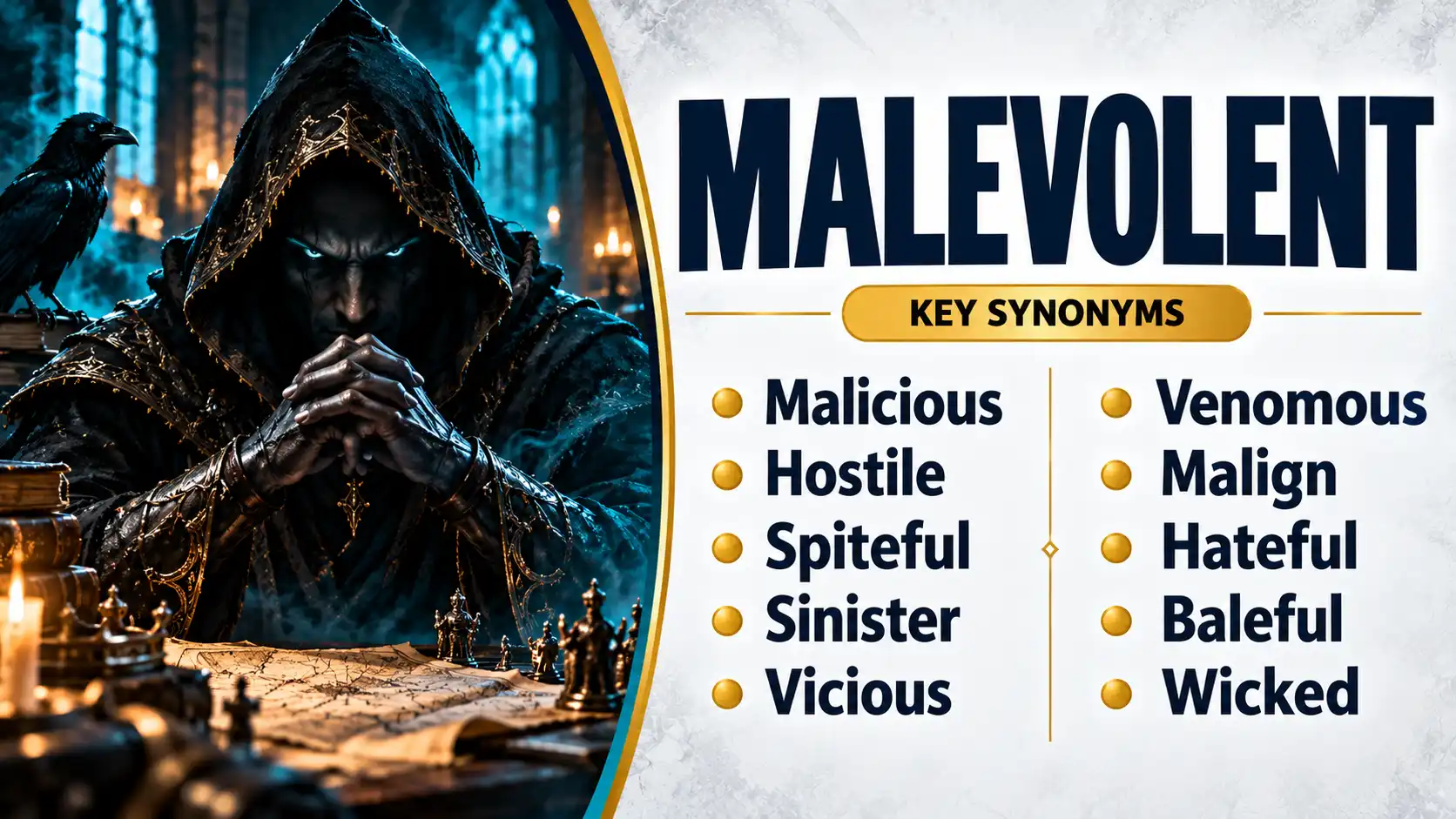
Malevolent is a literary adjective for someone or something that intends to cause harm or evil. Malicious is probably the closest you can get to a practical synonym, particularly if it involves intentional damage.
Select spiteful for harm driven by resentment, vindictive when revenge is the motivation and sinister when something appears threatening or evil. Literary choices such as malign and baleful suit ominous influences, looks, or presences.
The most suitable synonym will depend on one query: are you referring to the premeditated infliction of suffering, personal grudge, revenge, antagonism or merely the semblance of evil?
Alternative For Malevolent Synonyms
| # | Synonym | Meaning Difference |
| 1 | Malicious | Deliberately intends harm |
| 2 | Spiteful | Harm driven by resentment |
| 3 | Vindictive | Harm motivated by revenge |
| 4 | Ill-intentioned | Has harmful intentions |
| 5 | Ill-disposed | Hostile or unfriendly attitude |
| 6 | Malign | Evil or harmful influence |
| 7 | Baleful | Menacing, often through a look |
| 8 | Sinister | Suggests threatening evil |
| 9 | Venomous | Bitterly hostile, often in speech |
| 10 | Vicious | Cruel and aggressively harmful |
Quick Facts About Malevolent
| Fact | Detail |
| Part of speech | Adjective |
| Simple meaning | Wanting or causing harm or evil |
| Pronunciation | /məˈlev.əl.ənt/ |
| Syllables | Four: ma-lev-o-lent |
| Word forms | malevolence, malevolently |
| Register | Literary/formal |
| Closest synonym | Malicious |
| Best used for | Deep ill will or harmful intent |
The UK and US pronunciations recorded by Cambridge are effectively the same. The word is particularly useful when ordinary words such as mean, unfriendly, or hostile are too weak to express genuine ill will.
What Is the Closest Synonym for Malevolent?
Malicious is the closest practical synonym for malevolent in many contexts.
Both words can express a deliberate desire to cause harm, but they do not behave identically. Malicious is particularly natural for specific actions and intentions: a malicious rumor, malicious attack, malicious email or malicious accusation.
Malevolent often has a darker, more literary quality and can describe an enduring disposition or threatening presence.
Compare:
- The employee spread a malicious rumor about his manager.
- The villain concealed his malevolent intentions behind a friendly smile.
Use malicious as the default alternative when deliberate harm is clear. Keep malevolent when you want stronger ill will or a darker literary tone.
Word Origin and Etymology
Malevolent entered English around 1500. Etymonline traces it through Old French malivolent and directly to Latin malevolentem, from elements associated with badly and wishing.
Its history therefore closely reflects its modern meaning: being ill-disposed toward others or wishing them harm.
The related noun malevolence is older in English, with Etymonline recording it from the mid-15th century. Its historical sense centers on ill will, personal hatred, or being badly disposed toward another person.
This etymology also helps distinguish malevolent from words that merely describe something dangerous or harmful. The concept of ill will is central to the word.
Can These Synonyms Be Used Interchangeably?
Sometimes—but rarely without changing the nuance.
Malicious comes closest when intentional harm is involved. Spiteful narrows the meaning to resentment, while vindictive adds a desire for revenge. Sinister can suggest evil without proving that harmful intent actually exists.
Consider:
A malevolent manager suggests someone with genuinely harmful intentions.
A hostile manager may simply be unfriendly or antagonistic.
A vindictive manager wants retaliation for a perceived wrong.
A spiteful manager behaves hurtfully because of bitterness or resentment.
All four descriptions are negative, but they tell the reader different things. The strongest synonym is therefore the one that preserves the motive and tone of the original sentence.
Detailed Synonym Meanings and Examples
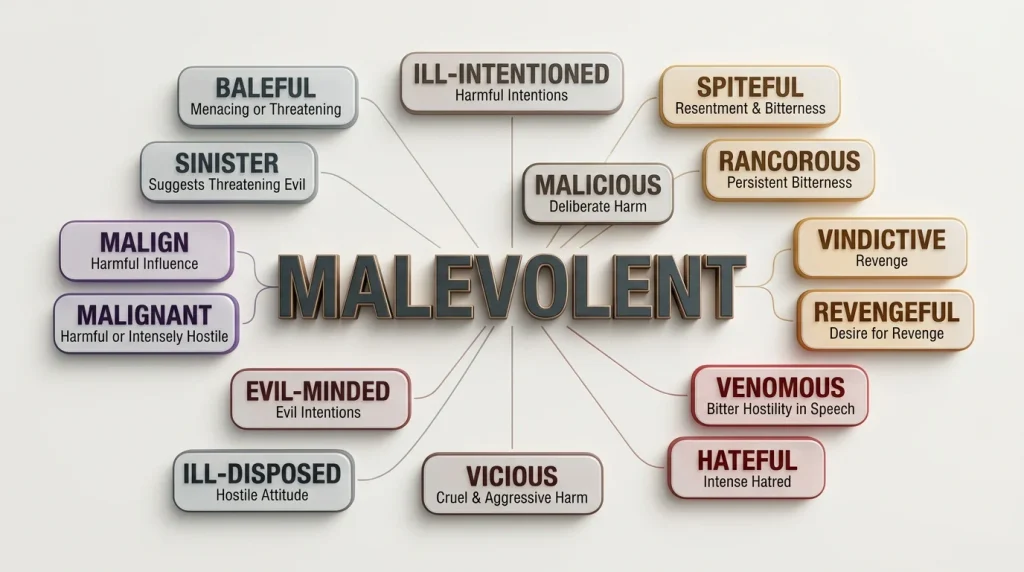
The alternatives below are restricted to words with genuine semantic overlap with malevolent. Some are close replacements, while others work only in particular contexts.
Because major dictionaries do not provide a consistent, authoritative CEFR rating for every word below, unsupported A1–C2 labels are not assigned.
1. Malicious
Meaning: Intending or designed to cause harm, injury, or trouble.
Difference from Malevolent: More natural for specific harmful actions; malevolent can suggest a deeper disposition of ill will.
Best Used For: Intentions, rumors, attacks, accusations, behavior, cybersecurity
Formality: Neutral to formal
Frequency: Common in contemporary English
Examples:
- [Workplace] Someone spread a malicious rumor to damage the new manager’s reputation.
- [Technology] The security software blocked a malicious attachment before it opened.
When NOT to Use It: Do not use it when the harm is clearly accidental.
2. Spiteful
Meaning: Deliberately hurtful because of resentment, bitterness, or spite.
Difference from Malevolent: More personal and usually motivated by resentment rather than broader evil intent.
Best Used For: Arguments, insults, gossip, relationship conflicts
Formality: Neutral
Frequency: Common
Examples:
- [Personal] His spiteful message was intended to embarrass his former friend.
- [Workplace] She refused to participate in the spiteful gossip about her colleague.
When NOT to Use It: Avoid it when resentment is not part of the motive.
3. Vindictive
Meaning: Wanting to punish or hurt someone in revenge.
Difference from Malevolent: Requires a retaliatory motive; malevolent does not.
Best Used For: Revenge, grudges, retaliation, personal disputes
Formality: Neutral to formal
Frequency: Common
Examples:
- [Workplace] The employee described the punishment as a vindictive response to his complaint.
- [Fiction] Betrayal transforms the character into an increasingly vindictive rival.
When NOT to Use It: Do not use vindictive unless a real or perceived previous wrong motivates the behavior.
4. Ill-intentioned
Meaning: Having intentions that are harmful, dishonest, or unfriendly.
Difference from Malevolent: More restrained and literal, without necessarily implying profound evil.
Best Used For: Motives, people, security concerns, formal explanations
Formality: Neutral to formal
Frequency: Less common
Examples:
- [Security] An ill-intentioned user could exploit information posted publicly.
- [General] The safeguard prevents ill-intentioned individuals from manipulating the process.
When NOT to Use It: Avoid it when the harm happened unintentionally.
5. Ill-disposed
Meaning: Unfriendly, hostile, or negatively inclined toward someone.
Difference from Malevolent: Can indicate hostility without the stronger implication of actively wishing serious harm.
Best Used For: Attitudes, relationships, formal narratives
Formality: Formal
Frequency: Less common
Examples:
- [Politics] Several committee members were already ill-disposed toward the proposal.
- [Narrative] He seemed ill-disposed toward his neighbor before they had even spoken.
When NOT to Use It: Choose a stronger word when deliberate harmful intent must be explicit.
6. Malign
Meaning: Evil or harmful in character, nature, or influence.
Difference from Malevolent: Particularly useful for harmful influences or forces rather than specific acts of ill will.
Best Used For: Influences, forces, literary descriptions, abstract harm
Formality: Formal
Frequency: Uncommon
Examples:
- [Literature] Greed becomes a malign influence on the entire family.
- [Historical Writing] The author portrays the adviser as a malign influence on the ruler.
When NOT to Use It: Do not substitute it mechanically for the medical adjective malignant.
7. Baleful
Meaning: Threatening or suggesting harm in a menacing way.
Difference from Malevolent: More literary and particularly associated with threatening looks, expressions, or influences.
Best Used For: Gazes, looks, presences, literary description
Formality: Literary
Frequency: Rare in everyday speech
Examples:
- [Fiction] She gave the intruder a baleful stare from across the room.
- [Narrative] A baleful presence seemed to linger around the abandoned building.
When NOT to Use It: Avoid it in ordinary conversation when hostile or threatening communicates the idea more naturally.
8. Sinister
Meaning: Giving the impression that something harmful, threatening, or evil may happen.
Difference from Malevolent: Describes the appearance or suggestion of evil rather than necessarily proving harmful intent.
Best Used For: Atmospheres, motives, characters, warnings, mysteries
Formality: Neutral to formal
Frequency: Common
Examples:
- [Mystery] There was something sinister about the anonymous message.
- [Literature] The organization gradually takes on a more sinister role in the story.
When NOT to Use It: Do not treat a sinister appearance as proof of deliberate harmful intent.
9. Venomous
Meaning: Extremely bitter, spiteful, or hostile when used figuratively.
Difference from Malevolent: Most naturally describes the poisonous quality of someone’s language, tone, or attitude.
Best Used For: Remarks, criticism, arguments, personal attacks
Formality: Neutral to formal
Frequency: Less common in its figurative sense
Examples:
- [Media] The article became a venomous personal attack rather than a serious critique.
- [Argument] Her venomous reply revealed how bitter the dispute had become.
When NOT to Use It: Do not automatically use the figurative meaning for physical harm; venomous also has a literal biological sense.
10. Vicious
Meaning: Deliberately cruel, violent, or extremely aggressive.
Difference from Malevolent: Emphasizes cruelty or brutality more strongly than the underlying wish to cause harm.
Best Used For: Attacks, criticism, behavior, conflicts
Formality: Neutral
Frequency: Common
Examples:
- [News] Police investigated what witnesses described as a vicious attack.
- [Workplace] A disagreement developed into a vicious personal dispute.
When NOT to Use It: Avoid it when you mean hidden ill will without cruel or aggressive behavior.
11. Malignant
Meaning: Harmful, evil, or intensely hostile in its nonmedical sense.
Difference from Malevolent: Can overlap strongly with malevolent when describing hostile attitudes or influences, but it also has an important medical meaning unrelated to intention.
Best Used For: Hostile attitudes, damaging influences, elevated writing
Formality: Formal
Frequency: Common in medicine; less common in this figurative sense
Examples:
- [Figurative] A malignant hostility had developed between the rival factions.
- [Literary] The character’s malignant influence gradually corrupts those around him.
When NOT to Use It: A malignant tumor is cancerous; it is not malevolent and has no intention to cause harm.
12. Hateful
Meaning: Showing or expressing intense hatred.
Difference from Malevolent: Focuses on hatred rather than necessarily intending to cause harm.
Best Used For: Comments, speech, attitudes, personal behavior
Formality: Neutral
Frequency: Common
Examples:
- [Online] Moderators removed several hateful comments aimed at other users.
- [Personal] His hateful response ended any chance of a productive discussion.
When NOT to Use It: Do not assume that every expression of hatred amounts to a deliberate plan to harm.
13. Evil-minded
Meaning: Inclined toward evil intentions or morally bad behavior.
Difference from Malevolent: More direct and broader in moral judgment; it is less precise about the particular kind of harm intended.
Best Used For: Character descriptions, storytelling, strong moral judgments
Formality: Neutral
Frequency: Uncommon
Examples:
- [Fiction] The evil-minded adviser secretly encouraged the king’s worst impulses.
- [General] An evil-minded person could deliberately exploit the weakness in the system.
When NOT to Use It: Avoid it in objective professional writing where such a strong moral judgment is unsupported.
14. Revengeful
Meaning: Wanting revenge for an injury or perceived wrong.
Difference from Malevolent: Narrower because its harmful intent specifically comes from a desire for revenge.
Best Used For: Retaliation, personal conflicts, literary characterization
Formality: Neutral
Frequency: Less common than vindictive or vengeful
Examples:
- [Fiction] The revengeful character spends years planning retaliation.
- [Conflict] His revengeful attitude prevented any meaningful reconciliation.
When NOT to Use It: Avoid it when no earlier grievance explains the hostility.
15. Rancorous
Meaning: Characterized by deep, persistent bitterness or resentment.
Difference from Malevolent: Centers on long-lasting bitterness, which may produce ill will but does not always involve an active plan to cause harm.
Best Used For: Disputes, relationships, debates, long-running conflicts
Formality: Formal
Frequency: Uncommon
Examples:
- [Politics] Years of rancorous debate had destroyed trust between the groups.
- [Family] The inheritance dispute created a rancorous relationship between the brothers.
When NOT to Use It: Do not choose it when deliberate harmful intent matters more than persistent resentment.
Best Alternatives by Context
Everyday Conversation
Choose malicious for intentional harm, spiteful for petty resentment, and hostile when someone is simply antagonistic.
Formal Writing
Malicious, ill-intentioned, and malign work well, but the evidence should justify the strength of the word. Avoid labeling someone malevolent when you can only establish disagreement or hostility.
Academic Writing
Prefer precise, supportable descriptions such as malicious, hostile, or ill-disposed. Words carrying strong moral judgment should be used only when the context warrants them.
Business Communication
Malicious works for deliberate misconduct or harmful digital activity. Hostile is usually more appropriate for antagonistic negotiations or workplace relationships where an intention to cause harm has not been established.
Creative Writing
Malevolent, sinister, baleful, and malign provide different levels of menace. Sinister creates suspicion; baleful works especially well with looks or presences; malevolent makes ill will more explicit.
Social Media
Spiteful, malicious, hateful, and venomous are generally easier for a broad audience to understand than highly literary alternatives.
Which Synonym Should I Choose?
| Situation | Best Choice | Why |
| Deliberate harmful intent | Malicious | Closest practical alternative |
| Resentment | Spiteful | Shows personal bitterness |
| Revenge | Vindictive | Makes retaliation explicit |
| General antagonism | Hostile | Does not overstate evil |
| Harmful influence | Malign | Fits abstract influence |
| Threatening appearance | Sinister | Suggests rather than proves evil |
| Menacing gaze | Baleful | Natural literary choice |
| Bitter language | Venomous | Fits hostile speech |
| Cruel aggression | Vicious | Emphasizes brutality |
| Bad intentions | Ill-intentioned | Clear and restrained |
Exact and Near Synonyms: What’s the Difference?
Perfect synonyms are rare because words differ in scope, motive, emotional force, register, and typical context.
Malicious is a close synonym of malevolent, but the two still differ. Malicious readily describes a particular harmful act, while malevolent can describe a broader disposition or ominous force.
Near synonyms alter the picture further:
- Spiteful adds resentment.
- Vindictive adds revenge.
- Rancorous adds persistent bitterness.
- Vicious adds cruelty or aggression.
- Sinister suggests danger without proving intent.
- Baleful creates a literary sense of menace.
- Hostile expresses opposition without necessarily implying evil.
Instead of asking whether two words have roughly the same dictionary definition, ask whether replacing one with the other preserves the motive and tone of your sentence.
Words Commonly Confused with Malevolent
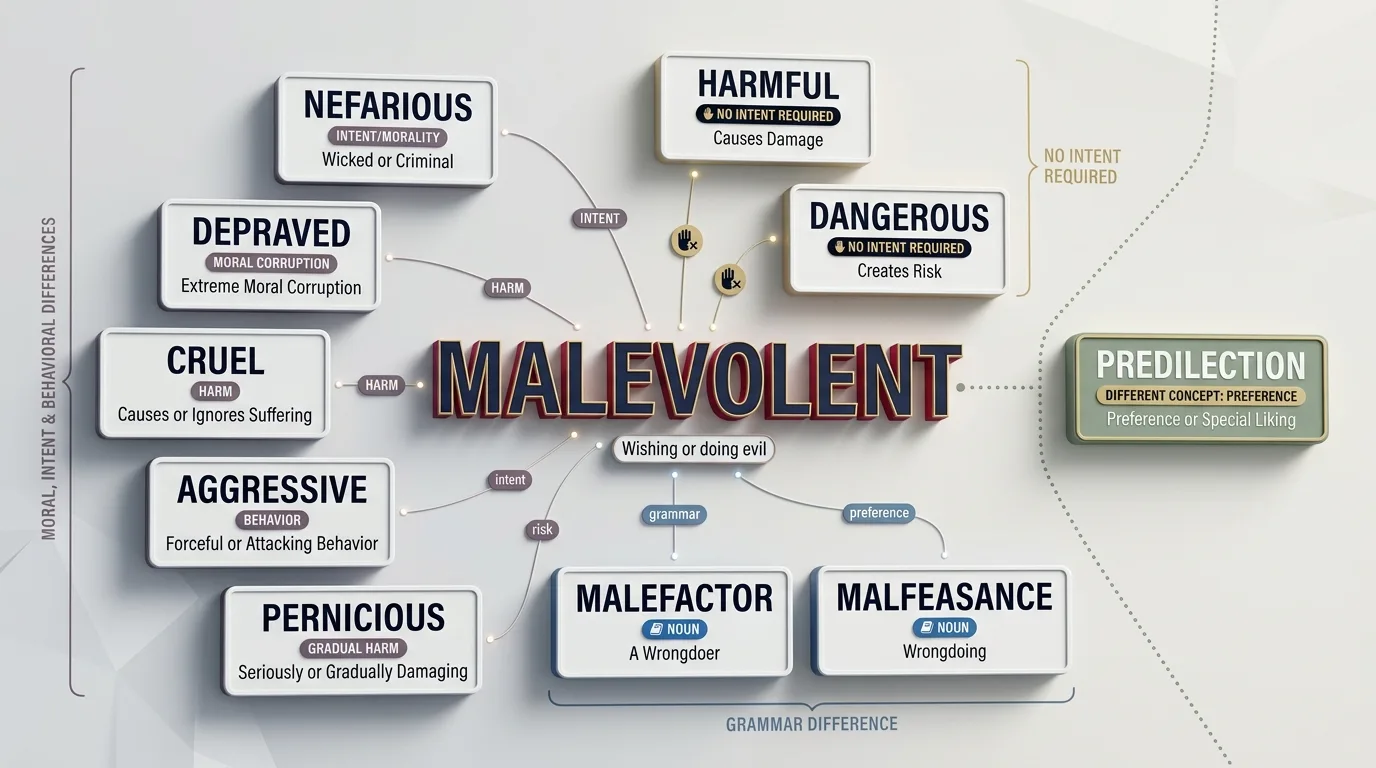
Nefarious
Nefarious means wicked or criminal, especially when describing an action, activity, or scheme. A nefarious scheme can be morally bad without expressing the specific idea of wishing another person harm, so it should not automatically replace malevolent.
Depraved
Depraved describes extreme moral corruption. A depraved person may also be malevolent, but moral corruption and wishing harm are not the same concept.
Cruel
Cruel concerns causing suffering or showing indifference to suffering. Someone can behave cruelly without having the deeper disposition implied by malevolent.
Harmful
Anything capable of causing damage can be harmful. Chemicals, weather, habits, and accidents can all be harmful without possessing intentions.
Dangerous
Dangerous describes risk. A dangerous road or storm cannot be malevolent because it cannot wish harm.
Aggressive
Aggressive behavior may be forceful or attacking, but aggression alone does not establish malevolent intent.
Pernicious
Pernicious describes something seriously damaging, often in a gradual or subtle way. The word concerns harmful effects rather than necessarily conscious ill will.
Malefactor
A malefactor is a noun referring to a person who commits wrongdoing. It cannot grammatically replace the adjective malevolent.
Malefactor in a sentence: The authorities eventually identified the malefactor responsible for the fraud.
Malfeasance
Malfeasance is a noun referring to wrongdoing, particularly improper or unlawful conduct in an official or professional role.
Use Malfeasance in a sentence: The investigation uncovered evidence of financial malfeasance.
Predilection
A predilection is a preference or special liking for something and has no inherent connection with evil or harmful intent.
Predilection in a sentence: She has a predilection for historical novels.
Common Mistakes
| Mistake | Better Choice | Why |
| malevolent accident | harmful accident | Accidents have no intent |
| malevolent weather | dangerous weather | Weather cannot wish harm |
| vindictive stranger | hostile stranger | Revenge requires a grievance |
| malevolent = cruel | Check the motive | Meanings only partly overlap |
| malevolent = malefactor | Keep separate | Adjective vs. noun |
Another common mistake is treating malevolent as simply a stronger version of bad. The word carries a more specific idea of ill will or harmful intent, so it should not be inserted merely to make a sentence sound sophisticated.
Antonyms of Malevolent
| # | Antonym | Why It’s the Opposite |
| 1 | Benevolent | Wishes or promotes good |
| 2 | Benign | Kindly or harmless |
| 3 | Kind | Shows care, not ill will |
| 4 | Friendly | Shows goodwill |
| 5 | Warmhearted | Naturally kind and sympathetic |
| 6 | Gracious | Shows kindness and goodwill |
| 7 | Magnanimous | Generous rather than resentful |
Benevolent is the clearest direct antonym because it reverses the central idea of malevolent: wishing good rather than harm.
Is Virtuous an Antonym of Malevolent?
Virtuous can work as a broad conceptual opposite, but it is not the most precise lexical antonym.
Virtuous means morally good, whereas malevolent specifically concerns harmful or evil intentions. Benevolent creates the cleaner contrast because both words describe a person’s disposition toward others.
Compare:
- malevolent → wishing harm
- benevolent → wishing or promoting good
- virtuous → morally good more generally
American vs British English
There is no important spelling difference: both American and British English use malevolent.
Cambridge currently records the UK and US pronunciation as /məˈlev.əl.ənt/. Natural accents can affect the exact realization of individual sounds, but learners do not need separate British and American forms.
Malevolent in French
A standard French translation of malevolent is malveillant, although the best translation still depends on the sentence.
Real-World Collocations and Phrases
Malevolent + Noun
Natural combinations include:
- malevolent intentions
- malevolent gaze
- malevolent look
- malevolent force
- malevolent spirit
- malevolent presence
- malevolent influence
Linking Verb + Malevolent
Natural patterns include:
- seem malevolent
- appear malevolent
- become malevolent
Related Expressions
English also expresses similar ideas through established phrases such as:
- harbor ill will
- bear someone ill will
- mean someone harm
- have bad intentions
These expressions overlap with malevolent, but they are not exact replacements in every sentence.
Malevolent in a Sentence: Examples
Seeing malevolent in a sentence is one of the easiest ways to understand how the word differs from ordinary descriptions such as angry or unfriendly.
- The detective suspected a malevolent purpose behind the anonymous threats.
- Her malevolent glare suggested that the conflict was far from over.
- The novel portrays the spirit as a malevolent force that feeds on fear.
- He concealed his malevolent intentions behind a polite smile.
- The villagers believed a malevolent presence occupied the abandoned house.
- The antagonist’s apparently generous offer hides a malevolent plan.
Notice that each malevolent sentence provides enough context to establish serious ill will or harmful intent.
Malevolent in a Sentence for Kids
For children, examples should make the meaning obvious without requiring another difficult word:
- The malevolent wizard wanted to hurt the peaceful villagers.
- The story’s malevolent queen planned to harm the hero.
- A malevolent creature tried to destroy the kingdom.
A simple child-friendly meaning is: malevolent means wanting to cause harm or do something evil.
Benevolent in a Sentence
Comparing the antonym can make the distinction easier:
- The malevolent ruler frightened the villagers and wished them harm.
- The benevolent ruler tried to protect the villagers and improve their lives.
Another natural example is:
- The benevolent donor quietly helped families who needed food.
Practice Exercises
Fill in the Blanks
Choose from malicious, spiteful, vindictive, sinister, benevolent.
- The hacker sent a ______ file designed to steal passwords.
- Her ______ comment was intended to embarrass her former friend.
- The manager became ______ after discovering who had reported his misconduct.
- Something about the anonymous message seemed ______.
- The ______ donor funded meals for local families.
Rewrite the Sentences
Replace malevolent with a more precise alternative.
- His malevolent response was motivated entirely by revenge.
- She spread a malevolent rumor specifically to damage her colleague’s reputation.
- The character gave his rival a malevolent, threatening stare.
Match the Words
| Word | Meaning |
| Malicious | A. Seeking revenge |
| Spiteful | B. Deliberately harmful |
| Vindictive | C. Suggesting threatening evil |
| Sinister | D. Motivated by resentment |
| Benevolent | E. Wishing good |
Vocabulary Quiz
1. Which word is the closest practical synonym for malevolent?
A. Careless
B. Malicious
C. Cheerful
D. Nervous
2. Which word most clearly expresses revenge?
A. Vindictive
B. Sinister
C. Baleful
D. Hostile
3. Which word mainly suggests that something threatening or evil may be happening?
A. Benevolent
B. Sinister
C. Friendly
D. Gracious
4. Which word can describe risk without implying harmful intent?
A. Dangerous
B. Malevolent
C. Malicious
D. Ill-intentioned
5. What is the clearest antonym of malevolent?
A. Aggressive
B. Spiteful
C. Benevolent
D. Vicious
Answer Key
Fill in the blanks: 1. malicious; 2. spiteful; 3. vindictive; 4. sinister; 5. benevolent.
Rewrite: 1. vindictive; 2. malicious; 3. baleful or sinister.
Matching: Malicious—B; Spiteful—D; Vindictive—A; Sinister—C; Benevolent—E.
Quiz: 1-B; 2-A; 3-B; 4-A; 5-C.
Frequently Asked Questions
What is the closest synonym for malevolent?
Malicious is usually the closest practical synonym for malevolent. Both can describe deliberate harmful intent, but malicious is especially natural for specific actions, remarks, rumors, attacks, and intentions. Malevolent often carries a darker or more literary tone and can suggest a deeper disposition of ill will.
Can malevolent and malicious be used interchangeably?
They can sometimes replace each other, but not perfectly. Malicious commonly describes a particular harmful action or intention, while malevolent can describe a broader disposition, influence, gaze, or threatening presence. Substitution may therefore preserve the general idea of harmful intent while changing the tone and naturalness of the sentence.
What does malevolent mean in simple English?
Malevolent means wanting to cause harm or evil, or displaying that kind of harmful intention. It is stronger than simply being unfriendly or angry. The word is often used for people, intentions, looks, characters, forces, or presences that convey serious ill will.
Is malevolent a formal word?
Malevolent has a literary or relatively formal character. In ordinary conversation, speakers may choose more familiar alternatives such as malicious, spiteful, or hostile, depending on what they mean. In fiction and descriptive writing, malevolent is particularly useful when the writer wants a darker sense of deliberate ill will.
How do you use malevolent in a sentence?
Use malevolent when the sentence provides evidence of ill will or a desire to cause harm. For example: The villain concealed his malevolent intentions behind a friendly smile. It also occurs naturally with nouns such as gaze, force, spirit, presence, and influence, particularly in literary writing.
What is the opposite of malevolent?
Benevolent is the clearest direct antonym. Malevolent concerns harmful or evil intentions, while benevolent describes a kindly or well-meaning disposition. Depending on context, words such as benign, kind, friendly, gracious, and warmhearted can also express contrasting qualities, although they are not identical in meaning.
Conclusion
The strongest synonym is not necessarily the most dramatic one; it is the word that preserves the intended motive and tone.
Use malicious for deliberate harm, spiteful for resentment, vindictive for revenge, sinister for an ominous impression, and baleful when a literary sense of menace fits the sentence. Words such as dangerous, harmful, depraved and nefarious may appear in similar discussions but should not automatically be treated as interchangeable with malevolent.
Choosing by context rather than by dictionary similarity makes writing clearer, more accurate and more natural.

About Sajjad Ahmed
Sajjad Ahmed is the author behind Guest Paster, where he writes about English vocabulary, synonyms, word meanings, and practical word usage.
His content is designed to help readers understand the differences between similar words, discover suitable alternatives, and use English vocabulary more effectively in everyday writing and communication.
Before publishing, Sajjad focuses on presenting word choices in a clear and easy-to-understand format, with relevant meanings, context, and examples where helpful.
Through Guest Paster, his goal is to make vocabulary learning simpler and provide useful language resources for students, writers, English learners, and anyone looking to expand their vocabulary.
Areas of Focus: English Vocabulary • Synonyms • Word Meanings • Word Usage • Language Learning
Author: Sajjad Ahmed
Website: Guest Paster