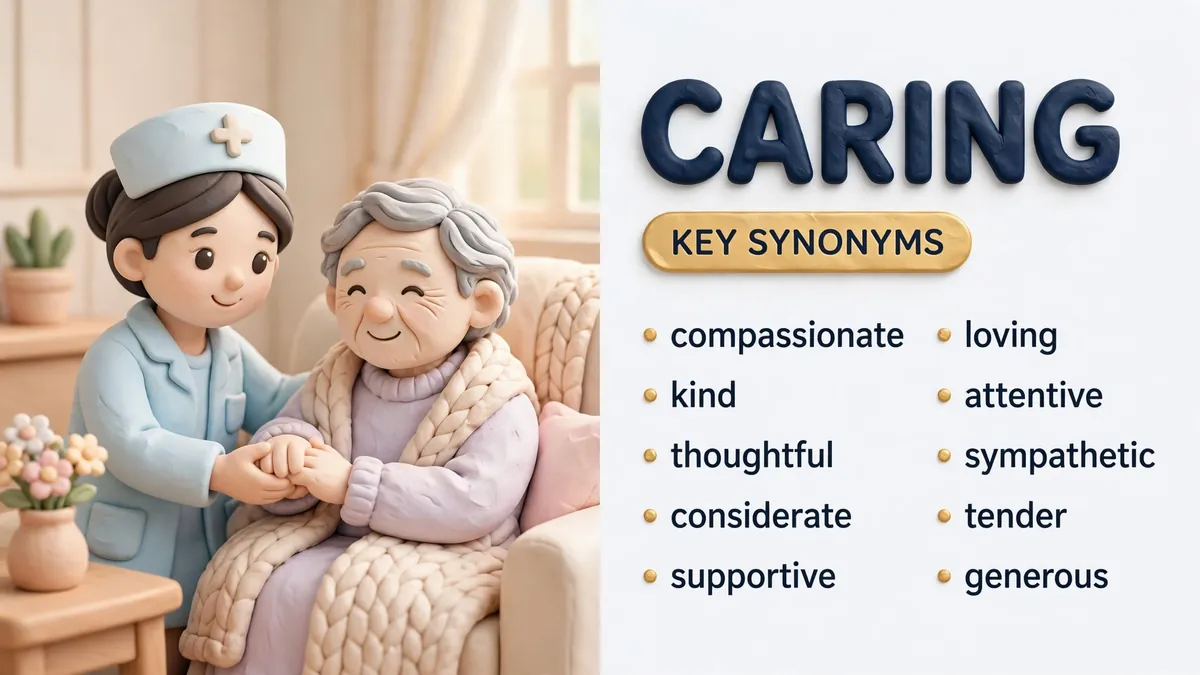
A nurse finishes her shift at midnight but she stays ten minutes to hold an old patient’s hand. For example a neighbour leaves soup at a sick friend’s door with no note and no fuss. Therefore both show the same quality: a warm concern for others that turns into action.
Moreover caring means showing kindness, concern and attention toward others and it fits people, actions and attitudes. Compassionate is the closest synonym for caring because it adds a deep feeling for people who suffer.
This guide compares 15 caring synonyms, from compassionate to generous, with plain meanings, real examples and honest limits so you can pick the word that fits your sentence and your reader.
Caring Synonyms at a Glance
| # | Synonym | Meaning Difference |
|---|---|---|
| 1 | Compassionate | Feels the pain of others and wants to help |
| 2 | Kind | Good to others in a warm, simple way |
| 3 | Thoughtful | Thinks of what others need before acting |
| 4 | Considerate | Thinks about the feelings of others |
| 5 | Supportive | Gives help and encouragement |
| 6 | Loving | Shows deep love and affection |
| 7 | Attentive | Notices what others need |
| 8 | Sympathetic | Shares the feelings of a person in trouble |
| 9 | Tender | Gentle and loving in touch and tone |
| 10 | Generous | Gives time, money, or help freely |
Quick Facts About Caring Synonyms
In short, the part of speech is adjective. Moreover, the verb is care, and the noun is care.
Furthermore, the core meaning is showing kindness, concern, and attention toward others.
First, there are two main senses: (1) kind and concerned about others, as in a caring teacher; (2) giving attention and help, as in caring hands.
In general, the register is neutral. Moreover, caring fits everyday talk, stories, and formal writing.
First, a common mistake is using caring for careful. In contrast, careful means cautious, while caring means kind.
The Closest Caring Synonym: Compassionate
Compassionate is the closest of these caring synonyms, because it covers the same ground most fully: a heart that feels the pain of others and wants to help. For example, “She is a caring nurse” becomes “She is a compassionate nurse.” “His caring work with people in need changed the town” becomes “His compassionate work with people in need changed the town.”
However, compassionate also wins on depth. It adds a strong feeling to kindness, so it fits nurses, doctors, and helpers who meet people in pain. But caring stays wider and plainer. Use caring for everyday kindness, and save compassionate for moments when someone suffers.
Where Caring Synonyms Come From
In fact, caring comes from the verb care, according to Etymonline. The noun care dates to Old English caru and cearu, “sorrow, anxiety, grief” and “serious mental attention.” Moreover, it comes from Proto-Germanic *karō, “lament; grief, care.”
Similarly, the verb care dates to Old English carian and cearian, “be anxious or solicitous; grieve; feel concern or interest.” Moreover, it comes from Proto-Germanic *karo-, “lament,” and from the PIE root *gar-, “cry out, call, scream.” In the end, the first sense of the word was a cry of grief, and it slowly turned into concern.
Caring as a noun dates to the 1550s and meant “act or state of showing concern for others.” Furthermore, it is a verbal noun from care. The warm senses grew later: “have fondness for” dates to the 1520s, and “have an inclination” dates to the 1550s. However, Etymonline notes that care is not related to Latin cura, even though the two words look alike. Therefore, the history explains the word behind these caring synonyms: it began as a cry of grief and grew into a warm wish to help. Read the full entry at Etymonline.
Can You Swap Caring Synonyms Freely?
In short: only inside the same meaning group.
- ✅ “She is a caring nurse.” (kind and attentive ✔)
- ✅ “She is a compassionate nurse.” (deep feeling for suffering ✔)
- ❌ “She is a careful nurse.” (careful means cautious, not kind ✘, say caring or compassionate)
- ✅ “The caring teacher stayed after class.” (gave attention and help ✔)
- ✅ “The supportive teacher stayed after class.” (gave help and strength ✔)
Finally, before you substitute one of these caring synonyms, ask what the kindness looks like: a feeling, a thought, or an action.
Caring Synonyms in Detail
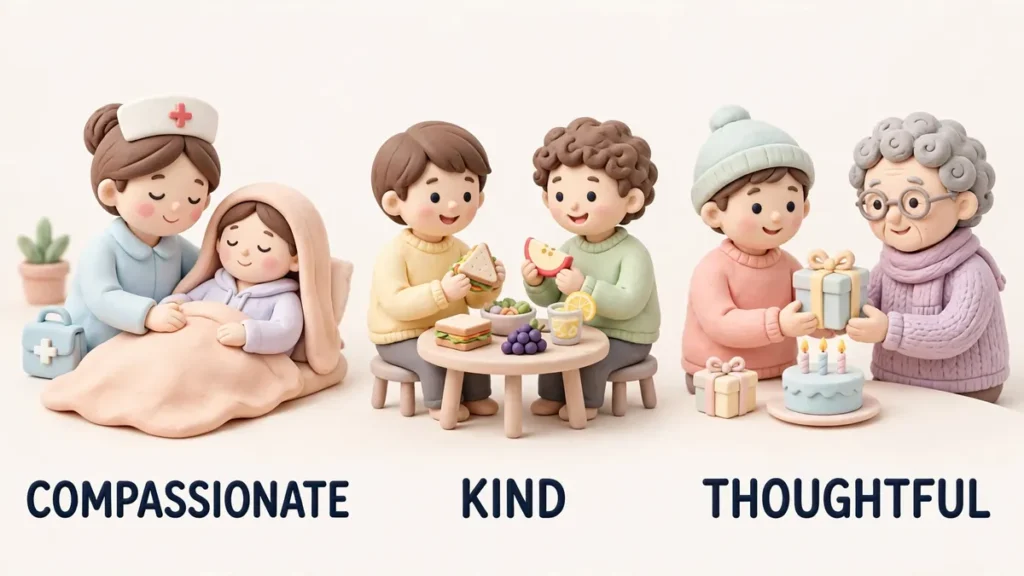
Group 1: A Warm Heart
1. Compassionate
- Meaning: Feeling the pain of others and wanting to help.
- Difference: Moreover, compassionate adds deep feeling to kindness. A caring friend listens, but a compassionate friend shares the pain.
- Best Used For: Nurses, doctors, and helpers who aid people in pain.
- Formality: Neutral to formal · CEFR: C1 · Frequency: Common
- Example (Work): “The compassionate nurse stayed with the frightened child all night.”
- Example (Daily): “A compassionate neighbour cooked meals for the sick family.”
- When NOT to Use It: For simple everyday kindness with no pain, use kind instead.
2. Kind
- Meaning: Good to others in a warm and simple way.
- Difference: Furthermore, kind is the broadest word here and fits almost any good act. A caring person acts from concern, but among these caring synonyms, a kind person acts from a good heart.
- Best Used For: Everyday talk, stories, and simple praise.
- Formality: Neutral · CEFR: A2 · Frequency: Very common
- Example (Daily): “The kind shopkeeper gave the boy a free apple.”
- Example (School): “Our kind teacher reads stories to us after lunch.”
- When NOT to Use It: For deep care in hard times, use compassionate instead.
3. Loving
- Meaning: Showing deep love and affection for another.
- Difference: In addition, loving adds warmth close to love. A caring mother feeds her child, but a loving mother hugs the child and says kind words.
- Best Used For: Family, close friends, and romantic partners.
- Formality: Neutral · CEFR: B1 · Frequency: Very common
- Example (Family): “The loving grandmother knitted scarves for her grandchildren.”
- Example (Daily): “He wrote a loving letter to his wife.”
- When NOT to Use It: For professional care at work, use supportive instead.
4. Tender
- Meaning: Gentle and loving in touch and voice.
- Difference: Above all, tender stresses softness. A caring nurse gives medicine on time, but a tender nurse speaks softly and holds a hand.
- Best Used For: Parents, nurses, and anyone who comforts with touch.
- Formality: Neutral · CEFR: B2 · Frequency: Common
- Example (Family): “The tender father rocked the baby to sleep.”
- Example (Daily): “She answered in a tender voice and smiled.”
- When NOT to Use It: For strong practical help, use supportive instead.
5. Warm-hearted
- Meaning: Having a warm and generous heart toward others.
- Difference: On top of that, warm-hearted stresses a person’s nature. A caring act helps once, but a warm-hearted person helps again.
- Best Used For: Character descriptions in stories and praise.
- Formality: Neutral · CEFR: B2 · Frequency: Common
- Example (Story): “The warm-hearted farmer shared bread with travellers.”
- Example (Daily): “A warm-hearted neighbour also looks after our cat.”
- When NOT to Use It: For one act of help, use kind instead.
Group 2: Thinking of Others
6. Thoughtful
- Meaning: Thinking of what others need before you act.
- Difference: Moreover, thoughtful stresses the mind. A caring friend helps, but among these caring synonyms, a thoughtful friend plans help ahead.
- Best Used For: Gifts, notes, and small acts planned with care.
- Formality: Neutral · CEFR: B1 · Frequency: Very common
- Example (Daily): “The thoughtful student brought tea for her teacher.”
- Example (Work): “He sent a thoughtful note to thank the team.”
- When NOT to Use It: For strong feeling in hard times, use compassionate instead.
7. Considerate
- Meaning: Thinking about the feelings and needs of others.
- Difference: Furthermore, considerate stresses respect for others. A caring host offers food, but a considerate host asks about allergies.
- Best Used For: Manners, hosts, colleagues, and shared spaces.
- Formality: Neutral to formal · CEFR: B2 · Frequency: Common
- Example (Work): “The considerate manager moved the meeting for parents.”
- Example (Daily): “She spoke in a considerate tone and asked about his day.”
- When NOT to Use It: For deep emotional support, use sympathetic instead.
8. Attentive
- Meaning: Paying close attention and noticing what others need.
- Difference: In addition, attentive stresses watchful eyes. A caring teacher helps, but an attentive teacher notices a quiet child in the corner.
- Best Used For: Teachers, nurses, waiters, and carers.
- Formality: Neutral to formal · CEFR: B2 · Frequency: Common
- Example (School): “The attentive teacher noticed the boy’s fear and helped him.”
- Example (Work): “An attentive waiter refilled the glass without a word.”
- When NOT to Use It: For warmth of feeling, use loving instead.
9. Sympathetic
- Meaning: Sharing the feelings of a person in trouble.
- Difference: Similarly, sympathetic stresses shared feeling. A caring friend helps, but a sympathetic friend feels sadness with you.
- Best Used For: Comfort after loss, illness, or bad news.
- Formality: Neutral to formal · CEFR: B2 · Frequency: Common
- Example (Daily): “The sympathetic nurse listened to the old man’s story.”
- Example (News): “A sympathetic crowd gathered outside the hospital.”
- When NOT to Use It: For practical help with no feelings, use supportive instead.
10. Understanding
- Meaning: Showing patience and acceptance for the feelings of others.
- Difference: On top of that, understanding stresses patience. A caring boss gives time off, but an understanding boss accepts the reason.
- Best Used For: Bosses, teachers, parents, and friends in hard times.
- Formality: Neutral · CEFR: B1 · Frequency: Very common
- Example (Work): “The understanding manager gave her a day to rest.”
- Example (Family): “An understanding father listened without anger.”
- When NOT to Use It: For active help and gifts, use generous instead.
Group 3: Help in Action
11. Supportive
- Meaning: Giving help, strength, and encouragement.
- Difference: Moreover, supportive stresses action. A caring friend feels for you, but a supportive friend stands beside you and helps.
- Best Used For: Teams, families, and friends in a hard time.
- Formality: Neutral · CEFR: B2 · Frequency: Very common
- Example (Team): “The supportive coach praised every player after the loss.”
- Example (Daily): “Her supportive friends visited her every evening.”
- When NOT to Use It: For quiet warmth with no action, use tender instead.
12. Generous
- Meaning: Giving time, money, or help freely.
- Difference: Furthermore, generous stresses giving. A caring person feels concern, but a generous person opens the wallet or diary.
- Best Used For: Donors, hosts, and free sharers.
- Formality: Neutral · CEFR: B1 · Frequency: Very common
- Example (Daily): “The generous baker gave free bread to people in need.”
- Example (Work): “A generous colleague shared his notes with the class.”
- When NOT to Use It: For emotional comfort alone, use sympathetic instead.
13. Selfless
- Meaning: Putting the needs of others before your own.
- Difference: In addition, selfless stresses sacrifice. A caring person helps, but a selfless person gives up comfort, time, or money.
- Best Used For: Volunteers, heroes, and stories of sacrifice.
- Formality: Neutral to formal · CEFR: C1 · Frequency: Common
- Example (Story): “The selfless firefighter ran back into the smoke to save the dog.”
- Example (Daily): “She made a selfless choice and gave her seat to the old man.”
- When NOT to Use It: For normal everyday kindness, use kind instead.
14. Devoted
- Meaning: Giving loyal love and steady care.
- Difference: Similarly, devoted stresses loyalty over time. A caring nurse helps for a day, but a devoted nurse stays for years.
- Best Used For: Parents, spouses, carers, and loyal friends.
- Formality: Neutral to formal · CEFR: B2 · Frequency: Common
- Example (Family): “The devoted son visited his mother every day.”
- Example (Work): “A devoted teacher stayed late to help slow learners.”
- When NOT to Use It: For one kind act, use kind instead.
15. Nurturing
- Meaning: Helping a person or thing grow with patient care.
- Difference: Above all, nurturing stresses growth. A caring teacher helps, but a nurturing teacher builds skill step by step.
- Best Used For: Parents, teachers, gardeners, and mentors.
- Formality: Neutral to formal · CEFR: C1 · Frequency: Less common
- Example (School): “The nurturing teacher helped the shy girl find her voice.”
- Example (Family): “A nurturing home gives children room to grow.”
- When NOT to Use It: For quick help in a crisis, use supportive instead.
Best Caring Synonyms by Context
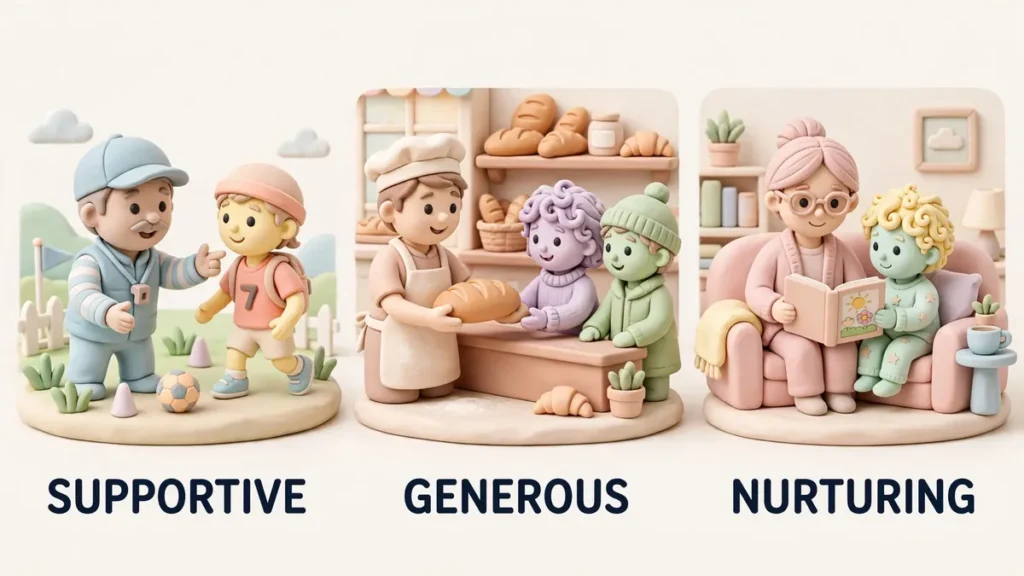
In fact, these caring synonyms fit real scenes.
At work. For example, a manager writes a thank-you note to a nurse who stayed late. In fact, supportive fits best, because it names help in action. Similarly, attentive works when the note stresses watchful care.
In a story. For example, a writer tells the life of a kind grandmother. In fact, loving leads, because she shows deep affection. Warm-hearted follows for her nature, but tender fits the scenes of touch and soft words.
In a thank-you note. A student thanks a teacher who stayed after class. However, thoughtful fits best, because the teacher planned the help. A caring teacher lifts a whole class, and our guide to teamwork synonyms covers the words for shared effort.
Which Caring Synonyms Should I Choose?
In fact, each of these caring synonyms fits one sense.
| Situation | Best pick | Why it wins |
|---|---|---|
| Deep feeling for people in pain | Compassionate | The closest word |
| Simple everyday kindness | Kind | The broadest word |
| Love in a family | Loving | The warmth |
| Gentle touch and tone | Tender | The softness |
| A good nature | Warm-hearted | The character |
| A planned kind act | Thoughtful | The mind |
| Respect for others’ feelings | Considerate | The manners |
| Watchful care | Attentive | The eyes |
| Shared sadness | Sympathetic | The feeling |
| Patience in hard times | Understanding | The patience |
| Help in action | Supportive | The strength |
| Free giving | Generous | The gift |
| Sacrifice for others | Selfless | The cost |
| Loyal care over years | Devoted | The loyalty |
| Patient growth | Nurturing | The growth |
Caring Synonyms and Their Opposites
Moreover, each of these caring synonyms has a clear opposite. Therefore, the right opposite follows the sense.
A cold heart (opposites of caring as kindness):
- uncaring: shows no concern for others.
- cold-hearted: feels nothing for the pain of others.
- heartless: cruel and without pity.
- indifferent: does not care what happens.
- unfeeling: shows no emotion or warmth.
No help given (opposites of caring as action):
- neglectful: fails to give the care a person needs.
- selfish: thinks only of the self.
- self-centered: puts the self first.
- unhelpful: refuses help or gives none.
- inconsiderate: ignores the feelings of others.
No attention paid (opposites of caring as attention):
- inattentive: pays no attention to others.
- thoughtless: acts without thinking of others.
- careless: gives too little attention to a task or person.
- distracted: looks away and misses needs.
Therefore, uncaring is the plain opposite for everyday writing. Heartless suits a cruel act, but neglectful suits care owed and failed to give.
Caring Synonyms in Everyday Phrases
For example, these caring synonyms appear in fixed phrases that fluent speakers actually use.
- a caring person: as in “She is a caring person who helps.”
- a caring attitude: as in “A caring attitude wins trust at work.”
- a caring heart: as in “He has a caring heart and a gentle voice.”
- caring hands: as in “The baby slept safe in caring hands.”
- care for: as in “She cares for her sick father every day.”
- take care of: as in “Take care of your friends when they feel low.”
- care about: as in “He cares about his students and their future.”
Words Commonly Confused With Caring Synonyms
Caring versus careful. Careful means cautious and exact. Caring means kind and concerned. A careful driver watches the road, but a caring driver stops to help a stranger. Careful work shows attention to detail and often wins praise. Our guide to quality synonyms covers the words for work done well. Use careful for attention to detail, and caring for kindness toward people.
Caring versus worried. First, worried means anxious and afraid. In contrast, caring means warm concern with a wish to help. Worry grows from fear, but care grows from love. For example, a worried mother paces the floor, while a caring mother packs lunch and listens.
Caring versus nice. First, nice means pleasant and agreeable. In contrast, caring means kind in action. A nice person smiles and says hello, but a caring person stays to help. Therefore, nice describes manners, while caring describes the heart.
Caring versus loving. First, loving means deep love, often in family or romance. Caring fits a wider circle: friends, nurses, teachers, and neighbours. A loving husband brings flowers, but a caring nurse brings water to a stranger. Use loving for love, and pick from these words for a kind heart.
Caring versus nosy. First, nosy means too much interest in the private life of others. In contrast, caring respects privacy. For example, a caring neighbour brings soup to a sick friend. A nosy neighbour watches through the window and asks rude questions. Care helps, but nosiness harms.
American vs British English
Caring keeps the same spelling and use in American and British English. Compassionate, thoughtful, and generous never change across the Atlantic.
However, one small difference sits nearby: Americans write “behavior” where Britons write “behaviour.” This article also uses American spelling throughout.
Practice With Caring Synonyms
First, test these caring synonyms in the exercises below.
Exercise 1: Fill in the blank. First, choose the best word from the list: compassionate, kind, thoughtful, generous, supportive, attentive.
- “Fill the gap: the _____ nurse stayed with the frightened child.”
- “Her most _____ act was the soup she left at the door.”
- “In class, the _____ teacher noticed the quiet boy in the corner.”
- “The _____ coach praised every player after the loss.”
- “He gave a _____ gift to the poor family at Christmas.”
- “His _____ note thanked the whole team for its hard work.”
Exercise 2: Next, rewrite each sentence with a better synonym from this article.
- “A nice nurse helped the old man every day.”
- “One good coach praised the team after the loss.”
- “A good mother rocked the baby to sleep.”
- “He is a nice friend who listens without anger.”
Answer key
- Exercise 1: (1) compassionate: deep care in hard times; (2) kind: a simple act; (3) attentive: watchful care; (4) supportive: help in action; (5) generous: free giving; (6) thoughtful: a planned kind act.
- Exercise 2: (1) “The compassionate nurse helped the old man every day”: compassionate fits deep care in hard times; (2) “The supportive coach praised the team after the loss”: supportive fits help in action; (3) “The tender mother rocked the baby to sleep”: tender fits gentle touch; (4) “He is an understanding friend who listens without anger”: understanding fits patience.
Frequently Asked Questions
What is the best of these caring synonyms?
Therefore, compassionate is the best of these caring synonyms, because it covers the same ground: a heart that feels the pain of others and wants to help. Thoughtful also fits planned kind acts, supportive fits help in action, and kind fits plain talk, so the best word follows the scene.
What is the difference between caring and kind?
Caring means kind concern that turns into attention and action. Kind means a good heart in a broad sense, so a kind person smiles and helps, but a caring person also notices needs and stays to help. For example, a kind shopkeeper gives a free apple, while a caring nurse stays after her shift.
Can caring describe a thing?
Yes, and writers also use it that way often. A caring home gives children room to grow, a caring school looks after slow learners, and a caring community helps new families settle in. Therefore, the sense stays the same: the place shows attention to the needs of people.
What is the opposite of caring?
First, it depends on the sense. For example, for a cold heart, the opposite is uncaring, as in a person who feels nothing for others. Moreover, for no help, use neglectful, and for no attention, use inattentive. Therefore, uncaring is the safe plain opposite when no sense stands out.
Is caring formal or informal?
In short, caring is neutral. For example, it fits news stories, essays, stories, and everyday talk with ease. However, in plain everyday talk, kind often sounds more natural, while compassionate fits a serious speech. Therefore, use caring when the setting asks for a warm and plain tone.
Can I use caring in everyday speech?
Yes, and it sounds natural in daily talk. For example, caring fits a nurse, a teacher, a friend, or a parent who shows kindness. However, for a grand hero or a formal speech, compassionate fits better, since caring asks for simple warmth. So save caring for people who show it.
Conclusion: Picking the Right Caring Synonyms
Therefore, a heart earns its place among the caring synonyms when people see real kindness behind it. Compassionate adds deep feeling, thoughtful adds planning, and supportive adds action, but each starts from the same root: attention that turns into help.
First, pick one of these caring synonyms that matches the scene. Finally, use caring for everyday kindness, compassionate for deep feeling, and kind for plain talk. Therefore, the right word tells your reader not just that a person is good, but how the goodness shows.

About Sajjad Ahmed
Sajjad Ahmed is the author behind Guest Paster, where he writes about English vocabulary, synonyms, word meanings, and practical word usage.
His content is designed to help readers understand the differences between similar words, discover suitable alternatives, and use English vocabulary more effectively in everyday writing and communication.
Before publishing, Sajjad focuses on presenting word choices in a clear and easy-to-understand format, with relevant meanings, context, and examples where helpful.
Through Guest Paster, his goal is to make vocabulary learning simpler and provide useful language resources for students, writers, English learners, and anyone looking to expand their vocabulary.
Areas of Focus: English Vocabulary • Synonyms • Word Meanings • Word Usage • Language Learning
Author: Sajjad Ahmed
Website: Guest Paster