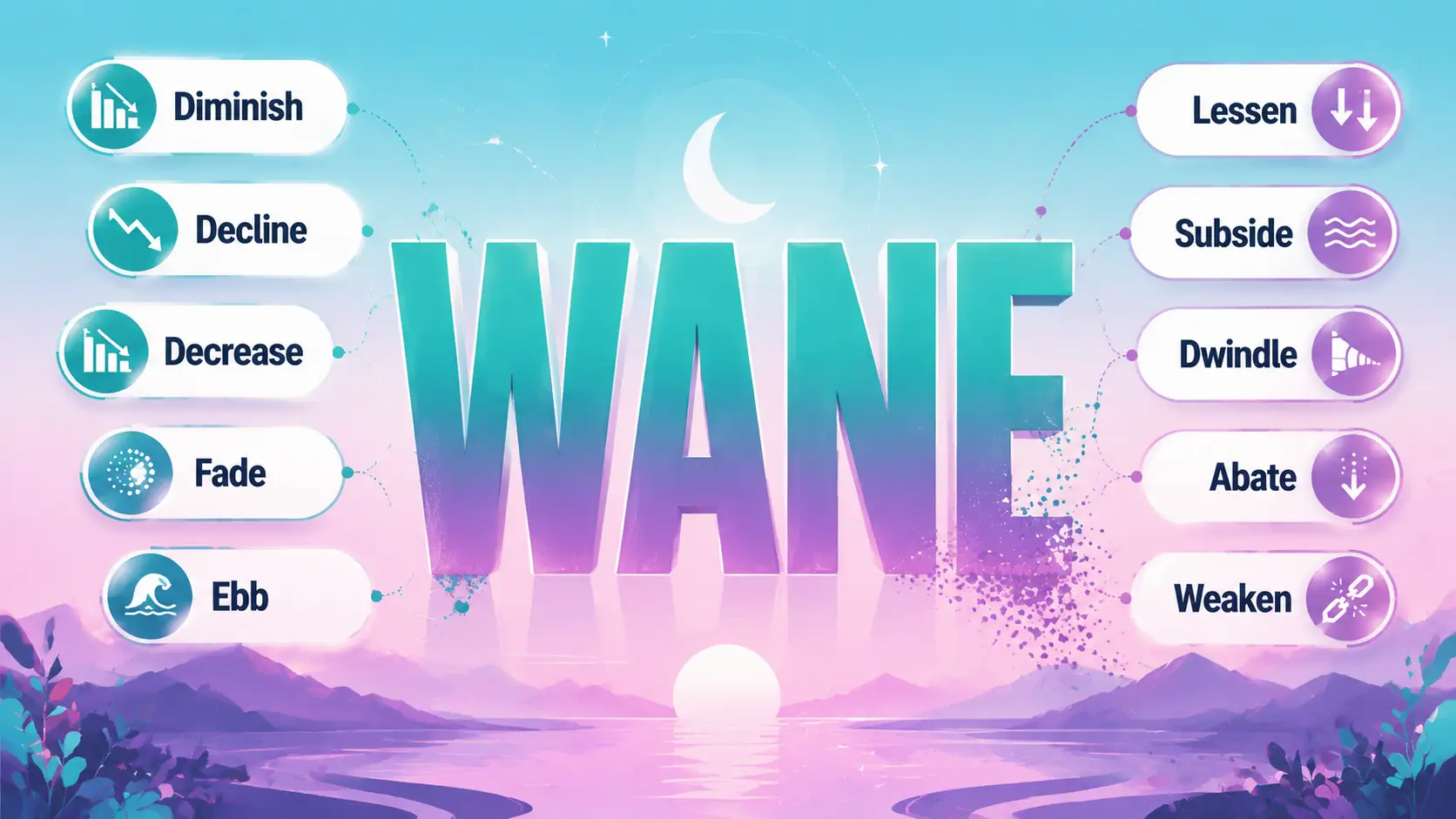
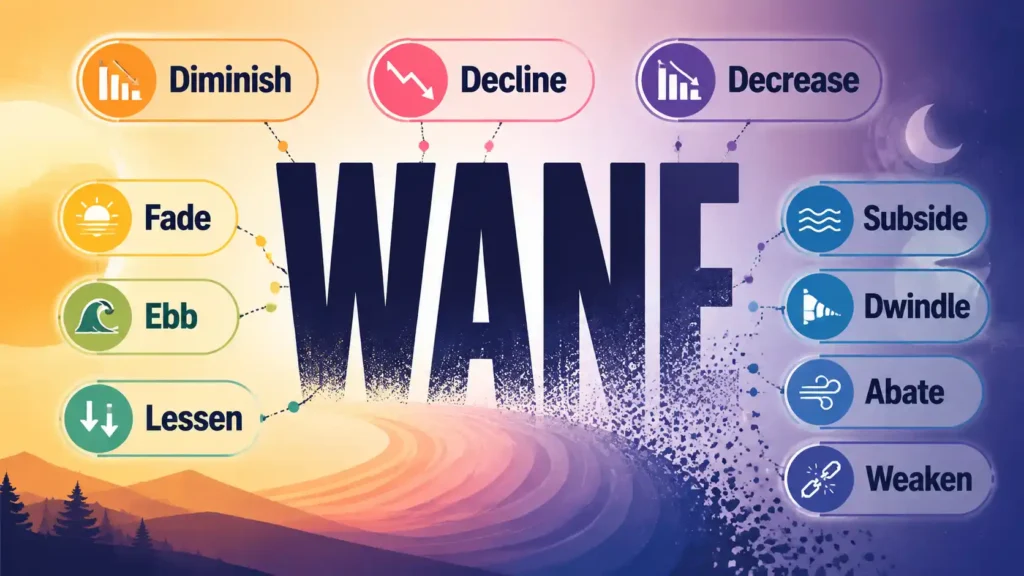
Synonyms for wane include diminish decline, decrease fade and ebb. Wane means to become smaller, weaker, less intense or less important over time. It can describe interest power energy influencing light or the visible part of the moon. The best synonym depends on what is decreasing and how quickly it changes.
For example “Her enthusiasm began to wane” means her enthusiasm gradually became weaker. In this sentence fade, diminish and decline are natural alternatives while drop would suggest a faster or more noticeable change.
10 Best Synonyms of Wane and Their Meanings
| Synonym | Simple Meaning |
| Diminish | Become smaller or weaker |
| Decline | Gradually become less or worse |
| Decrease | Become smaller in amount or degree |
| Fade | Slowly lose strength or intensity |
| Ebb | Gradually become weaker or lower |
| Lessen | Become smaller or less serious |
| Subside | Become less strong or severe |
| Dwindle | Gradually become very small |
| Abate | Become less intense or severe |
| Weaken | Lose strength or power |
What Are Synonyms of Wane?
Synonyms of wane describe something becoming weaker, smaller, less intense or less important. However these words are not always interchangeable. Fade often describes feelings, memories light or color while subside commonly describes pain storms or conflict. Decline is broader and often sounds more formal. The right choice depends on the situation, speed of change and tone.
Quick Facts About Wane
Word: Wane
Part of Speech: Verb
Simple Meaning: To gradually become weaker smaller or less
Pronunciation: /weɪn/
Syllables: 1
Origin: From Old English wanian meaning “to lessen or diminish”
Formality: Neutral to slightly formal or literary
Common Uses: Professional writing academic writing news creative writing and everyday conversation
Example Sentence: Public interest in the story began to wane after several weeks.
Wane Meaning and Usage
The basic meaning of wane is “to decrease gradually.” It usually describes a change that happens over time rather than all at once.
You might say:
- enthusiasm wanes
- support wanes
- influence wanes
- energy wanes
- demand wanes
In each case something that was once stronger or greater slowly becomes weaker or smaller.
Wane as a General Decline
The most common modern use of wane refers to strength, interest, importance, influence or intensity becoming lower.
Example:
His interest in the project began to wane.
Here wane suggests a gradual loss of interest rather than an immediate decision to stop caring.
Wane and the Moon
Wane also has a specific astronomical meaning. The moon wanes when its visible illuminated portion becomes smaller after the full moon and before the new moon.
Example:
The moon will continue to wane during the coming week.
The opposite word in this sense is wax. A waxing moon appears to grow while a waning moon appears to shrink.
Tone and Formality
Wane is a neutral word but it can sound slightly more polished or literary than simple alternatives such as drop or fall.
Compare:
Everyday: My excitement started to fade.
More formal: My enthusiasm began to wane.
The second sentence sounds more suitable for formal writing journalism or descriptive prose.
25 Accurate Synonyms for Wane
1. Diminish
Relationship: Near synonym
Meaning: To become smaller, weaker or less important.
Difference: Diminish is one of the closest synonyms for wane. It works in many formal and neutral situations although it can also be used transitively while wane is usually intransitive.
Best Used For: Importance strength influences value or intensity.
Example: Her influence within the organization gradually diminished.
2. Decline
Relationship: Near synonym
Meaning: To gradually decrease in strength, amount, quality or importance.
Difference: Decline is broader than wane and is especially common with numbers health sales performance or economic conditions.
Best Used For: Business academic professional and general writing.
Example: Attendance began to decline near the end of the season.
3. Decrease
Relationship: Near synonym
Meaning: To become smaller in number, amount size or degree.
Difference: Decrease is more factual and measurable than wane. It is often preferred when discussing numbers or statistics.
Best Used For: Prices quantities temperatures rates and measurable changes.
Example: Demand for the product decreased during the winter.
4. Fade
Relationship: Near synonym
Meaning: To gradually lose strength, brightness, clarity or importance.
Difference: Fade often sounds more natural than wane when describing memories, emotions, colors , sounds or light.
Best Used For: Feelings, memories, enthusiasm, light color and sound.
Example: Her nervousness faded once the presentation began.
5. Ebb
Relationship: Near synonym
Meaning: To gradually become weaker or lower.
Difference: Ebb originally refers to the movement of the tide and often gives writing a more figurative or literary tone.
Best Used For: Confidence, energy enthusiasm influence and emotional strength.
Example: His confidence began to ebb after several difficult rounds.
6. Lessen
Relationship: Near synonym
Meaning: To become smaller, weaker or less serious.
Difference: Lessen is straightforward and often focuses on degree rather than a long period of gradual decline.
Best Used For: Pain risk pressure concern or intensity.
Example: The pressure lessened as the deadline passed.
7. Subside
Relationship: Near synonym
Meaning: To become less intense, violent or severe.
Difference: Subside is especially useful for something unpleasant or powerful that calms down. It is less natural for influence or popularity.
Best Used For: Pain storms anger noise conflict and fear.
Example: The heavy rain finally subsided before sunrise.
8. Dwindle
Relationship: Near synonym
Meaning: To gradually become smaller in amount or number.
Difference: Dwindle often suggests that very little remains at the end of the process.
Best Used For: Money supplies crowds, resources, opportunities or numbers.
Example: Their savings dwindled after several months without work.
9. Abate
Relationship: Near synonym
Meaning: To become less strong, severe or intense.
Difference: Abate is more formal than wane and commonly describes difficult conditions.
Best Used For: Storms, pain, anger, tension, noise and problems.
Example: The wind showed no sign of abating.
10. Weaken
Relationship: Near synonym
Meaning: To lose strength, power or effectiveness.
Difference: Weaken focuses directly on loss of strength while wane can also describe declining interest size or importance.
Best Used For: Power arguments influence support structures and physical strength.
Example: Public support for the proposal weakened over time.
11. Recede
Relationship: Contextual alternative
Meaning: To move back or become less noticeable or intense.
Difference: Recede suggests movement away from a previous level or position. It works especially well with water fear memories or problems.
Best Used For: Floodwater anxiety, memories danger and concerns.
Example: Her worries slowly receded after she received the results.
12. Taper Off
Relationship: Near synonym
Meaning: To gradually become smaller, weaker or less frequent.
Difference: Taper off emphasizes a steady reduction toward a low level or an ending.
Best Used For: Rain activity conversation demands symptoms or production.
Example: Orders usually taper off after the holiday season.
13. Shrink
Relationship: Contextual alternative
Meaning: To become smaller in size, amount or range.
Difference: Shrink often suggests a physical or measurable reduction while wane commonly refers to abstract qualities.
Best Used For: Budgets market populations opportunities or physical size.
Example: The available budget continued to shrink.
14. Drop
Relationship: Contextual alternative
Meaning: To become lower in level amount or number.
Difference: Drop can suggest a faster or more noticeable decrease than wane. It is also more common in everyday speech.
Best Used For: Prices, temperatures, sales scores and levels.
Example: Temperatures dropped sharply overnight.
15. Fall
Relationship: Contextual alternative
Meaning: To move to a lower level amount or position.
Difference: Fall is a broad everyday term. Unlike wane it does not necessarily imply that the change is gradual.
Best Used For: Prices numbers rates temperatures or measurements.
Example: Unemployment fell for the third month in a row.
16. Die Down
Relationship: Near synonym
Meaning: To gradually become less strong or active.
Difference: Die down is more informal and usually describes temporary activity or intensity.
Best Used For: Noise wind excitement arguments and crowds.
Example: The cheering slowly died down after the players left.
17. Dissipate
Relationship: Contextual alternative
Meaning: To gradually disappear or become weaker.
Difference: Dissipate often suggests that something spreads out until little or nothing remains.
Best Used For: Fog tension fear confusion heat or clouds.
Example: The morning fog dissipated as the sun rose.
18. Slack
Relationship: Contextual alternative
Meaning: To become less active, intense or busy.
Difference: As a verb slack is less common than wane and often refers to reduced effort pace or activity.
Best Used For: Work activity speed, effort or demand.
Example: Business tends to slack during the quietest weeks of the year.
19. Slacken
Relationship: Contextual alternative
Meaning: To become less active tight, fast or intense.
Difference: Slacken commonly describes pace, effort, tension or activity rather than popularity or influence.
Best Used For: Speed demands effort, tension or work.
Example: The pace slackened as the runners approached the hill.
20. Flag
Relationship: Contextual alternative
Meaning: To become weaker, less energetic or less enthusiastic.
Difference: Flag is especially useful when energy or interest begins to fail.
Best Used For: Energy, attention, motivation , enthusiasm and confidence.
Example: Their energy began to flag late in the afternoon.
21. Cool
Relationship: Contextual alternative
Meaning: To become less enthusiastic, friendly or intense.
Difference: Cool is commonly used for emotions, relationships, markets or enthusiasm. It is less formal than wane.
Best Used For: Interest enthusiasm relationships demand or markets.
Example: Investor enthusiasm cooled after the announcement.
22. Soften
Relationship: Contextual alternative
Meaning: To become less strong, harsh or severe.
Difference: Soften suggests reduced intensity rather than a general decline.
Best Used For: Tone criticism demands attitudes, light or economic conditions.
Example: Demand softened during the second half of the year.
23. Dim
Relationship: Contextual alternative
Meaning: To become less bright, clear or strong.
Difference: Dim is especially suitable for light hope memories and expectations.
Best Used For: Light hopes, memories, prospects or awareness.
Example: Their hopes of reaching the final began to dim.
24. Thin
Relationship: Contextual alternative
Meaning: To become fewer, less dense or less plentiful.
Difference: Thin usually describes numbers, crowds, traffic clouds or physical density rather than abstract power.
Best Used For: Crowds, traffic clouds, forests or groups.
Example: The crowd began to thin after midnight.
25. Peter Out
Relationship: Contextual alternative
Meaning: To gradually become weaker and finally stop.
Difference: Peter out is informal and suggests that something loses strength until it ends completely.
Best Used For: Conversations efforts activity trails rain or movements.
Example: The conversation petered out when everyone became tired.
Synonyms for Wane by Context
Everyday Conversation
For casual speech the most natural choices are often:
fade drop fall die down cool weaken
Instead of saying “My interest began to wane” you could naturally say “My interest started to fade.”
Formal and Professional Writing
Good choices include:
diminish decline decrease lessen weaken abate
These words work well in reports, news articles, business documents and professional communication.
Example: Consumer confidence declined during the quarter.
Academic Writing
For academic or analytical writing consider:
diminish decline decrease subside recede
Decrease is especially useful when the change can be measured.
Example: Participation decreased as the study progressed.
Business Communication
Useful business alternatives include:
decline decrease weaken soften taper off shrink
Example: Demand softened after the initial product launch.
Creative Writing
More expressive choices include:
fade ebb recede dim dwindle
These words can create a stronger visual or emotional effect.
Example: As daylight faded their excitement began to ebb.
Crossword-Friendly Synonyms for Wane
Crossword clues often require a short answer rather than the closest possible synonym in every context.
A common 4-letter synonym for wane is fade.
A useful 5-letter synonym for wane is abate.
For shorter crossword answers ebb is also a very common three-letter answer meaning to gradually decline or weaken.
Exact vs. Similar Synonyms for Wane
No synonym replaces wane perfectly in every sentence. Diminish is one of the broadest alternatives while decline works especially well for levels of quality health or performance. Fade suggests a slow loss of strength, brightness, memory or feeling. Ebb also describes gradual weakening but often has a more figurative or literary tone.
Context is therefore important. You can say that enthusiasm wanes, fades or diminishes but a storm is more likely to subside or abate. Sales usually decline or decrease. Choosing the right synonym makes the sentence sound more natural and communicates the exact type of change.
Wane Synonyms and Antonyms
The clearest opposite of wane is wax especially when talking about the moon. In broader contexts words such as grow, increase and strengthen can also be antonyms.
| Antonym | Meaning | Example Sentence |
| Wax | Gradually grow or increase | The moon waxes before it becomes full. |
| Grow | Become larger or stronger | Her confidence grew with experience. |
| Increase | Become greater in amount or degree | Demand increased throughout the summer. |
| Rise | Move to a higher level | Public interest rose after the announcement. |
| Strengthen | Become stronger or more effective | Support for the plan strengthened over time. |
| Intensify | Become stronger or more extreme | The storm intensified during the night. |
| Expand | Become larger or more extensive | The company continued to expand. |
| Surge | Increase suddenly and strongly | Demand surged after the product appeared online. |
Common Collocations With Wane
| Phrase | Meaning | Example Sentence |
| Interest wanes | Interest gradually becomes weaker | Interest in the trend waned after a few months. |
| Enthusiasm wanes | Excitement or eagerness decreases | Her enthusiasm waned as the project became harder. |
| Support wanes | Approval or backing becomes weaker | Support for the proposal began to wane. |
| Influence wanes | Power over people or events decreases | His influence waned after he left office. |
| Power wanes | Authority or strength decreases | The ruler’s power slowly waned. |
| Demand wanes | Fewer people want something | Demand waned toward the end of the season. |
| Confidence wanes | Belief or certainty becomes weaker | Their confidence waned after two defeats. |
| The moon wanes | The visible bright part becomes smaller | The moon wanes between the full moon and the new moon. |
Wane in a Sentence
Here are several natural examples showing how wane is used:
Interest: Public interest in the issue began to wane.
Energy: My energy usually wanes late in the afternoon.
Influence: The group’s political influence gradually waned.
Enthusiasm: Her enthusiasm waned when the project was repeatedly delayed.
Moon: After the full moon the moon begins to wane.
Notice that wane usually describes a gradual change. If something decreases suddenly words such as drop plunge or fall may be more accurate.
Frequently Asked Questions
What is the synonym of waning?
Good synonyms for waning include fading diminishing declining decreasing ebbing and weakening. The best choice depends on context. Fading is natural for feelings or light while declining and decreasing work better for numbers, performance demand or measurable levels.
What are 5 good synonyms of wane?
Five strong synonyms for wane are diminish decline decrease fade and ebb. Diminish is a broad replacement decline that suits gradual downward trends. Decreasing works for measurable changes fade describes weakening feelings or intensity and ebb suggests a slow loss of strength.
What does “waning” mean in English?
“Waning” means becoming weaker, less intense, or gradually decreasing over time.
Example: The moon is waning means the visible part of the moon is becoming smaller.
What is a synonym of wain?
Wain and wane are different words. Wain is an old-fashioned noun meaning a wagon or cart so it does not have the same synonyms as wane. If you meant wane, useful synonyms include diminish decline, fade ebb and decrease.
What is a 4-letter or 5-letter synonym for wane?
For a wane synonym crossword clue fade is a strong four-letter answer. Abate is a useful five-letter option depending on the clue. Ebb with three letters is also extremely common in crosswords because it means to gradually weaken or decrease.
Conclusion
Choosing the right synonym for wane helps you describe decline more precisely. Words such as diminish fade decline and ebb share the general idea of becoming less but each fits different situations.
Always consider what is changing, how quickly it changes and the tone you want.

About Sajjad Ahmed
Sajjad Ahmed is the author behind Guest Paster, where he writes about English vocabulary, synonyms, word meanings, and practical word usage.
His content is designed to help readers understand the differences between similar words, discover suitable alternatives, and use English vocabulary more effectively in everyday writing and communication.
Before publishing, Sajjad focuses on presenting word choices in a clear and easy-to-understand format, with relevant meanings, context, and examples where helpful.
Through Guest Paster, his goal is to make vocabulary learning simpler and provide useful language resources for students, writers, English learners, and anyone looking to expand their vocabulary.
Areas of Focus: English Vocabulary • Synonyms • Word Meanings • Word Usage • Language Learning
Author: Sajjad Ahmed
Website: Guest Paster