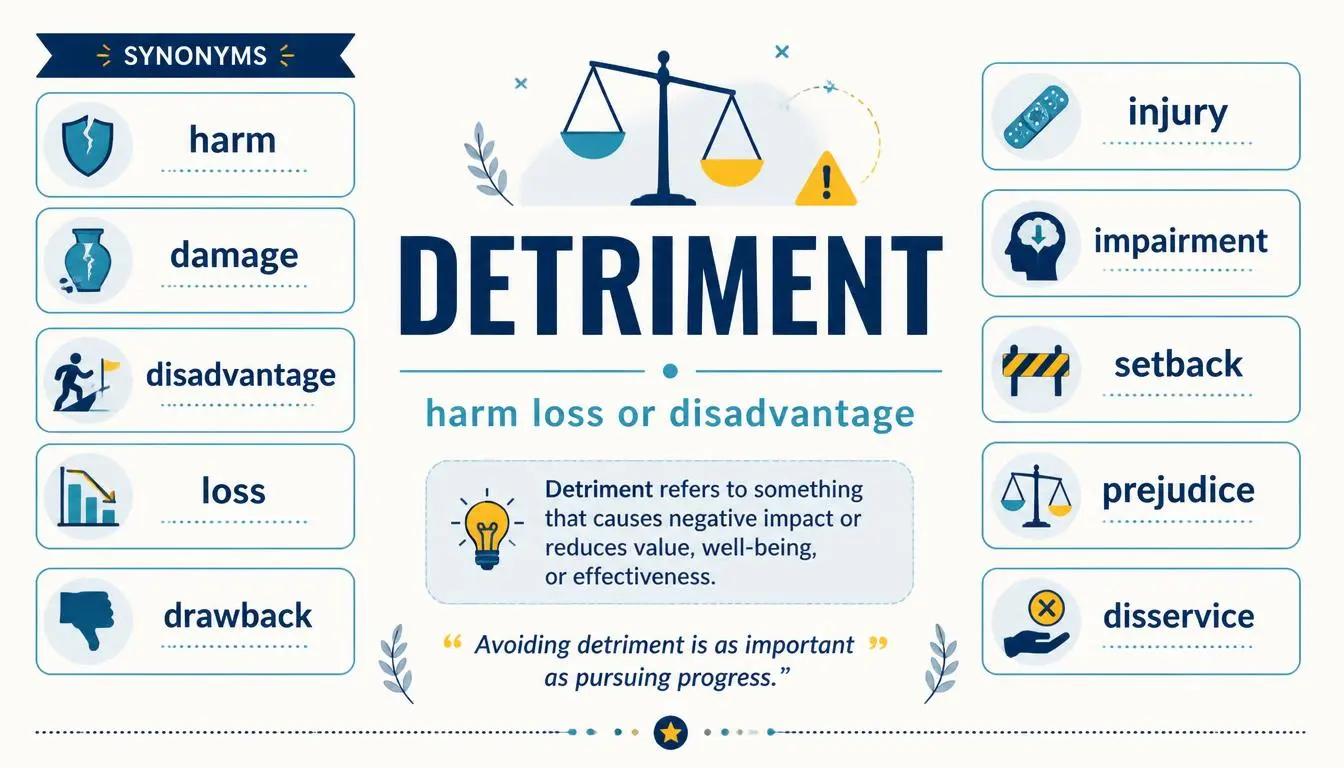
Synonyms for detriment include harm, damage, disadvantage, injury and loss. Detriment is a noun meaning harm loss or a negative effect caused to a person’s situation or interest. The best synonym depends on what kind of harm you mean and how formal you want to sound.
For example “The new rule worked to the detriment of small businesses” could become “The new rule put small businesses at a disadvantage.” In another context harm or damage may sound more natural. Understanding these differences helps you choose a precise word rather than treating every synonym as interchangeable.
Best Synonyms for Detriment and Their Meanings
| Synonym | Simple Meaning |
| Harm | A negative effect or injury |
| Damage | Harm that reduces value or condition |
| Disadvantage | Something that puts someone in a worse position |
| Injury | Harm to a person right interest or reputation |
| Loss | Something valuable that is lost |
| Impairment | A weakening of quality ability or function |
| Drawback | A negative feature or disadvantage |
| Setback | A problem that delays progress |
| Prejudice | Harm or disadvantage especially in formal or legal use |
| Disservice | An action or effect that causes harm instead of help |
What Are Synonyms of Detriment?
Synonyms of detriment describe some form of harm, loss, disadvantage or negative effect. However their meanings are not identical. Harm is broad damage often suggests measurable injury and drawback usually describes a negative feature rather than serious harm. The best choice depends on the situation, the strength of the negative effect and whether the writing is casual professional academic or legal.
Quick Facts About Detriment
Word: Detriment
Part of Speech: Noun
Simple Meaning: Harm loss or disadvantage
Pronunciation: /ˈdɛtrəmənt/
Syllables: 3 — det-ri-ment
Origin: From Latin detrimentum meaning “loss” or “damage”
Formality: Formal
Common Uses: Professional writing academic writing legal writing and careful everyday speech
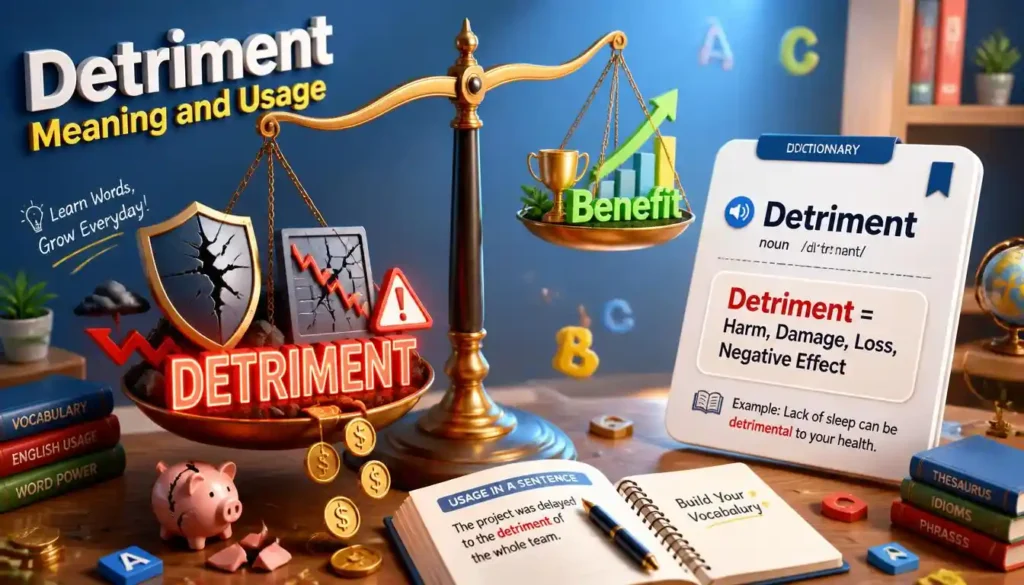
Example Sentence: Lack of sleep can be a detriment to concentration.
Detriment Meaning and Usage
Basic Meaning
The noun detriment means something that causes harm or puts someone or something in a worse position.
A simple detriment definition is:
Detriment = harm loss or disadvantage.
For example:
“Constant interruptions were a detriment to her productivity.”
Here the interruptions harmed her ability to work effectively.
Deeper Meaning
Detriment often focuses on the negative effect or disadvantage created by something rather than on the event itself.
Compare:
- “The storm caused damage to the roof.”
- “The delays were a detriment to the project.”
Damage sounds natural when something has been physically or measurably harmed. Detriment is broader and often describes an effect on progress interests health quality or success.
Tone and Formality
Detriment has a fairly formal neutral tone. It is more common in professional academic government and legal writing than in casual conversation.
In everyday speech people are more likely to say:
- harm
- disadvantage
- downside
- drawback
Instead of:
“The change was to my detriment.”
Someone might simply say:
“The change put me at a disadvantage.”
Detriment Meaning in Law
In legal writing detriment can mean harm loss, disadvantage or the surrender of a legal right.
In contract law the idea of legal detriment can have a specialized meaning. A person may incur a legal detriment by doing something they were not already legally required to do or by giving up something they had a legal right to do. It does not always mean that the person suffered financial or physical harm.
Because of this specialized meaning the best detriment synonym in law may be prejudice, injury loss or disadvantage depending on the legal context.
Detailed Analysis of Synonyms for Detriment
1. Harm
Relationship: Exact synonym
Meaning: Damage or a negative effect on a person’s interest or situation.
Difference: Harm is broader and much more common in everyday English. Detriment sounds more formal and often emphasizes disadvantage.
Best Used For: General academic professional and everyday contexts.
Example: Excessive noise can cause harm to concentration.
2. Damage
Relationship: Exact or near synonym
Meaning: Harm that reduces the condition value, usefulness or reputation of something.
Difference: Damage often suggests that something has been measurably harmed. Detriment can describe a disadvantage even when no visible damage exists.
Best Used For: Property finances reputation health and measurable effects.
Example: The false report caused serious damage to the company’s reputation.
3. Disadvantage
Relationship: Exact synonym
Meaning: A condition or factor that puts someone in a worse position.
Difference: Disadvantage emphasizes an unfavorable position. Detriment places more emphasis on the harmful effect itself.
Best Used For: Competition education employment business and social situations.
Example: Limited internet access placed some students at a disadvantage.
4. Injury
Relationship: Near synonym
Meaning: Harm done to a person’s reputation, legal right or interest.
Difference: Injury can describe physical harm but it also has formal and legal meanings involving rights and interests. Detriment is usually less physical.
Best Used For: Legal formal medical and reputational contexts.
Example: The court considered whether the decision caused injury to the claimant’s interests.
5. Loss
Relationship: Near synonym
Meaning: The state or result of losing something valuable.
Difference: Loss focuses on what has been lost. Detriment focuses more generally on the resulting disadvantage or harm.
Best Used For: Money opportunities, property time rights and business.
Example: The cancellation resulted in a significant financial loss.
6. Impairment
Relationship: Near synonym
Meaning: A reduction in strength quality value or ability.
Difference: Impairment specifically suggests weakening or reduced function. Detriment can refer to many kinds of negative effects.
Best Used For: Technical academic financial professional and formal writing.
Example: Poor maintenance can lead to an impairment of the system’s performance.
7. Prejudice
Relationship: Contextual alternative
Meaning: Harm or disadvantage to someone’s rights, interests or position.
Difference: Although prejudice commonly means an unfair opinion or bias, formal and legal English can also use it to mean harm or disadvantage.
Best Used For: Legal and highly formal contexts.
Example: The delay should not operate to the prejudice of either party.
8. Drawback
Relationship: Near synonym
Meaning: A negative feature or disadvantage.
Difference: Drawback is usually milder than detriment. It often refers to one unfavorable part of an otherwise useful idea product or plan.
Best Used For: Reviews comparisons decisions products and everyday conversation.
Example: The main drawback of the apartment is its small kitchen.
9. Setback
Relationship: Near synonym
Meaning: A problem or event that interrupts or delays progress.
Difference: Setback focuses specifically on lost progress. Detriment can describe any harmful effect whether progress is involved or not.
Best Used For: Projects careers recovery business and personal goals.
Example: The equipment failure was a major setback for the project.
10. Disservice
Relationship: Near synonym
Meaning: Something that harms rather than helps a person group or cause.
Difference: Disservice often describes an action that was supposed to help or could have helped but instead had a negative effect.
Best Used For: Advice public discussion education reputation and professional communication.
Example: Oversimplifying the issue does a disservice to students.
11. Downside
Relationship: Contextual alternative
Meaning: A negative aspect of a situation or choice.
Difference: Downside is informal and usually less serious than detriment. It is common when weighing advantages and disadvantages.
Best Used For: Everyday conversation product comparisons and informal business discussions.
Example: The downside of working remotely is having fewer face-to-face conversations.
12. Burden
Relationship: Contextual alternative
Meaning: Something that creates difficulty, responsibility, expense or pressure.
Difference: A burden may be detrimental because it creates strain but it is not always a direct synonym for harm.
Best Used For: Financial emotional administrative and professional situations.
Example: Rising maintenance costs became a burden for the organization.
13. Liability
Relationship: Contextual alternative
Meaning: A person thing or factor that creates risk or disadvantage.
Difference: Liability often refers to something that could cause trouble or loss while detriment refers more directly to the negative effect.
Best Used For: Business finance law and professional writing.
Example: Outdated equipment had become a liability for the factory.
14. Cost
Relationship: Contextual alternative
Meaning: Something that must be lost, spent or given up to achieve something else.
Difference: Cost does not always mean money. It can describe a negative consequence or sacrifice attached to a decision.
Best Used For: Business economics policy and decision-making.
Example: Faster production came at the cost of lower quality.
15. Sacrifice
Relationship: Contextual alternative
Meaning: Something valuable that is given up for another purpose.
Difference: Sacrifice emphasizes what a person gives up while detriment emphasizes the resulting disadvantage. The idea may also be relevant when discussing legal detriment.
Best Used For: Personal decisions negotiations contracts and trade-offs.
Example: Accepting the position required a significant sacrifice of free time.
16. Deprivation
Relationship: Near synonym
Meaning: The loss or denial of something important or necessary.
Difference: Deprivation usually involves being denied a benefit, right resource or basic need. Detriment is broader.
Best Used For: Social issues rights education health and formal writing.
Example: Long-term sleep deprivation can affect attention and learning.
17. Hardship
Relationship: Contextual alternative
Meaning: A condition that causes serious difficulty or suffering.
Difference: Hardship refers to the difficult condition itself. Detriment can include much smaller or more technical disadvantages.
Best Used For: Financial social personal legal and policy contexts.
Example: The sudden increase in expenses created hardship for many families.
18. Hindrance
Relationship: Contextual alternative
Meaning: Something that makes progress more difficult.
Difference: A hindrance blocks or slows progress. It becomes a detriment because of that obstructive effect.
Best Used For: Work learning projects development and formal writing.
Example: Poor communication became a hindrance to the team’s progress.
19. Impediment
Relationship: Contextual alternative
Meaning: An obstacle that makes movement development or progress difficult.
Difference: Impediment stresses obstruction. Detriment stresses the negative consequence or disadvantage.
Best Used For: Formal academic business and legal writing.
Example: Complex regulations can become an impediment to rapid expansion.
20. Penalty
Relationship: Contextual alternative
Meaning: A disadvantage, punishment or extra cost caused by breaking a rule or making a particular choice.
Difference: A penalty usually has a specific cause such as a rule or condition. Detriment can arise without any punishment being involved.
Best Used For: Finance contracts rules sports taxes and regulations.
Example: Customers may face a penalty for ending the agreement early.
21. Erosion
Relationship: Contextual alternative
Meaning: A gradual weakening reduction or loss.
Difference: Erosion emphasizes slow deterioration over time while a detriment may occur suddenly or gradually.
Best Used For: Trust authority profits rights soil reputation and institutions.
Example: Repeated delays caused an erosion of public confidence.
22. Deterioration
Relationship: Contextual alternative
Meaning: A process of becoming worse in quality or condition.
Difference: Deterioration describes worsening itself. Detriment describes something harmful or the disadvantage it creates.
Best Used For: Health quality relationships, infrastructure and economic conditions.
Example: Engineers reported a deterioration in the bridge’s condition.
Synonyms for Detriment by Context
Everyday Conversation
For normal conversation simpler alternatives often sound more natural:
- harm — general negative effect
- drawback — an unfavorable feature
- downside — informal negative aspect
- setback — something that slows progress
- disadvantage — something that puts you in a worse position
Formal and Professional Writing
More formal choices include:
- harm
- damage
- disadvantage
- impairment
- injury
- prejudice
Prejudice and injury require especially careful context because both have other common meanings.
Academic Writing
Useful alternatives include:
- harm for broad negative effects
- impairment for reduced function
- disadvantage for an unfavorable position
- deterioration for worsening conditions
- erosion for gradual weakening
Business Communication
Depending on the situation useful choices include:
- drawback for a negative feature
- liability for a source of risk
- cost for a trade-off
- setback for delayed progress
- disadvantage for an unfavorable position
- damage for measurable negative effects
Exact vs. Similar Synonyms for Detriment
Synonyms rarely match each other in every situation. Harm is probably the broadest and closest everyday replacement for detriment. Damage is also close but it often suggests a clearer or measurable injury. Disadvantage focuses on being placed in a worse position rather than on harm itself.
Words such as drawback and downside are usually milder. A drawback may simply be one inconvenient feature. Setback specifically refers to delayed or reversed progress while impairment means reduced ability or function.
Tone matters too. Detriment sounds formal while downside sounds conversational. In legal writing injury or prejudice may sometimes replace detriment but only when the specific legal meaning allows it.
Antonyms of Detriment
| Antonym | Meaning | Example Sentence |
| Benefit | A helpful or positive effect | Regular practice provides a clear benefit to learners. |
| Advantage | Something that improves a person’s position | Experience gave her an advantage in the interview. |
| Gain | An increase or positive result | The change produced a gain in efficiency. |
| Improvement | A change that makes something better | The update brought a major improvement in performance. |
| Help | Something that makes a situation easier or better | Additional training was a great help to the new staff. |
| Aid | Assistance that supports a person or purpose | The guide served as an aid to new students. |
| Asset | A useful or valuable quality or resource | His technical knowledge is an asset to the team. |
| Boon | Something especially helpful or beneficial | Reliable internet access was a boon to local businesses. |
Common Collocations With Detriment
| Phrase | Meaning | Example Sentence |
| To the detriment of | In a way that harms something | He focused on work to the detriment of his personal life. |
| Cause detriment | Produce harm or disadvantage | The change could cause detriment to smaller companies. |
| Suffer detriment | Experience harm or disadvantage | Employees should not suffer detriment for reporting a problem. |
| Serious detriment | Major harm or disadvantage | The delay caused serious detriment to the project. |
| Significant detriment | Noticeable or important harm | Removing the service could create significant detriment for residents. |
| Financial detriment | Harm involving money | Customers experienced financial detriment after the error. |
| Material detriment | Important or meaningful harm | The amendment did not create any material detriment to either party. |
| Public detriment | Harm affecting the public interest | Regulators considered whether the merger might cause public detriment. |
Frequently Asked Questions
What is another word for detriment?
Another word for detriment is harm. Other close synonyms include damage disadvantage injury loss impairment drawback and setback. The best choice depends on the context. For example damage is common for physical or measurable harm while disadvantage works better for an unfavorable situation.
What is a synonym for determinant?
A synonym for determinant depends on its meaning. When it means a factor that influences an outcome alternatives include factor cause influence element or deciding factor. In mathematics a determinant is a specific value calculated from a matrix and does not have a direct synonym.
What does detriment mean?
Detriment means harm loss damage or a disadvantage caused to someone or something. It describes a negative effect or condition. For example “Working without rest can be a detriment to your health” means that it can negatively affect your health.
What’s a better word for detrimental?
Better alternatives for detrimental include harmful damaging adverse negative unfavorable injurious and destructive. The best replacement depends on the situation. For example harmful is common in everyday writing while adverse is more suitable for formal or professional contexts.
What is the adjective for detriment?
The adjective is detrimental meaning harmful or damaging. Common detrimental synonyms include harmful, damaging, adverse and injurious. Common antonyms include beneficial, helpful , favorable and advantageous. Example: “The policy had a detrimental effect on small businesses.”
Is there a verb for detriment?
Detriment is normally used as a noun not a verb in modern standard English. If you need a verb for detriment, use harm, damage, impair, weaken or disadvantage depending on the meaning. For example “The delay harmed the project.”
Conclusion
Choosing the right synonym for detriment makes your meaning clearer and more natural. Harm damage and disadvantage are the closest general alternatives while words such as drawback impairment and setback fit more specific situations.
Always consider context strength and formality before replacing the word.

About Sajjad Ahmed
Sajjad Ahmed is the author behind Guest Paster, where he writes about English vocabulary, synonyms, word meanings, and practical word usage.
His content is designed to help readers understand the differences between similar words, discover suitable alternatives, and use English vocabulary more effectively in everyday writing and communication.
Before publishing, Sajjad focuses on presenting word choices in a clear and easy-to-understand format, with relevant meanings, context, and examples where helpful.
Through Guest Paster, his goal is to make vocabulary learning simpler and provide useful language resources for students, writers, English learners, and anyone looking to expand their vocabulary.
Areas of Focus: English Vocabulary • Synonyms • Word Meanings • Word Usage • Language Learning
Author: Sajjad Ahmed
Website: Guest Paster