What Is Pollution?
Pollution refers to the introduction or presence of harmful materials, substances, or forms of energy into an environment which have adverse effects on air-water-soil-humans-animals-or ecosystems. The term ‘pollution’ is a noun and is frequently used in environmental science, news articles, essays, reports and everyday conversation.
Pollution, although standard terminology used by many professionals involved in environmental issues, may not always be the most precise term used when communicating about pollution-related issues. Words like contamination, degradation and fouling describe specific forms or effects of pollution but they are not always interchangeable.
Identifying differences between these terms helps writers, students and professionals determine which term(s) are best suited for their needs.
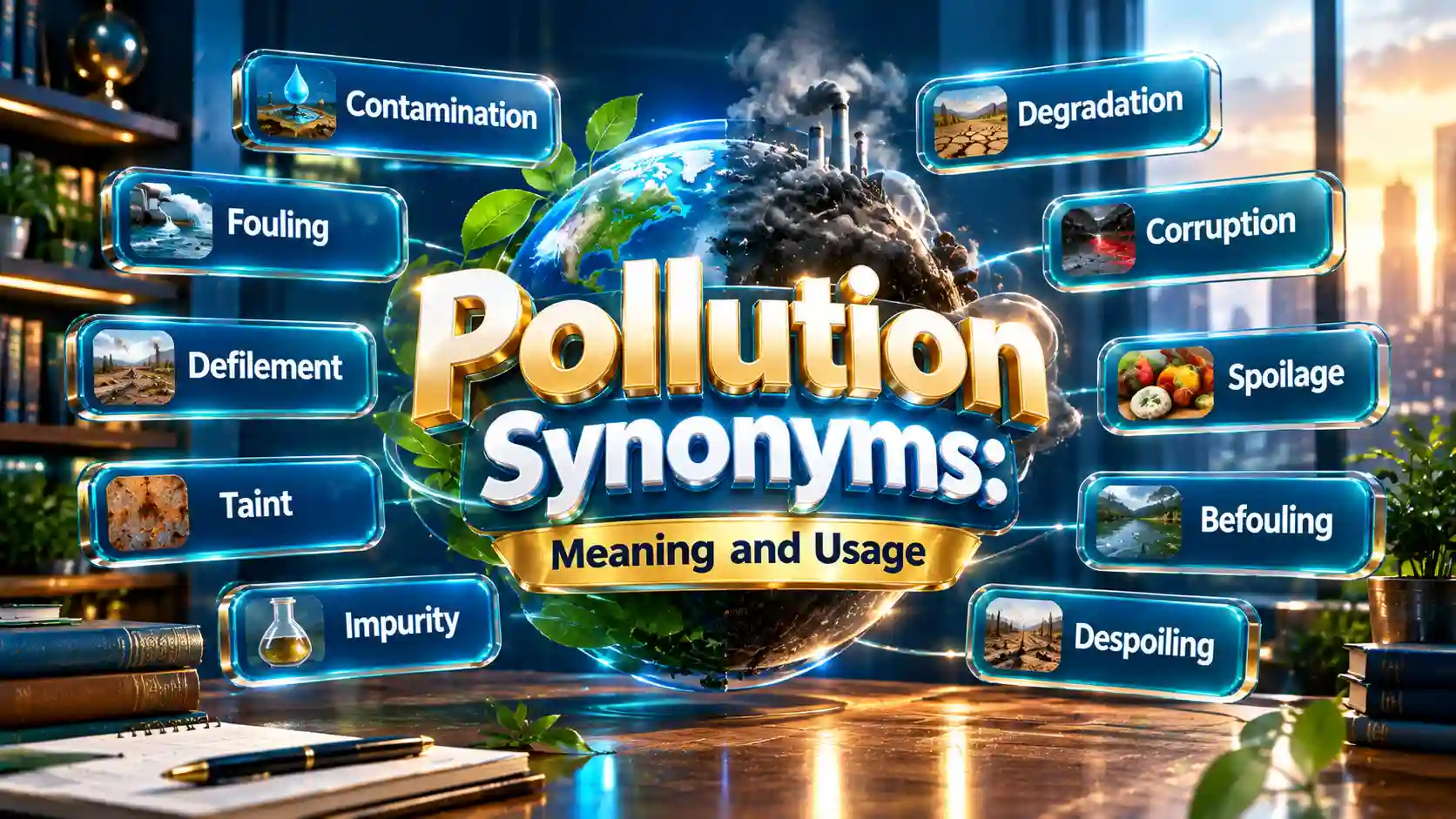
10 Best Synonyms for Pollution
| # | Synonym | Meaning Difference | Best Used For | Formality |
| 1 | Contamination | Harmful substances entering a clean environment or material | Water, food, soil, scientific contexts | Formal |
| 2 | Fouling | Making something dirty, damaged, or unsuitable through unwanted substances | Water systems, machinery, environments | Neutral |
| 3 | Defilement | The act of making something impure, dirty, or spoiled | Nature, land, literary descriptions | Formal |
| 4 | Taint | A harmful influence that damages purity or quality | Resources, reputation, quality | Neutral |
| 5 | Impurity | The presence of unwanted substances in something | Chemistry, materials, liquids | Formal |
| 6 | Degradation | A decline in environmental quality or condition | Ecosystems, land, natural resources | Formal |
| 7 | Corruption | The deterioration of something from its original clean state | Water sources, systems, processes | Formal |
| 8 | Spoilage | Damage that makes something unusable or harmful | Food, organic materials | Neutral |
| 9 | Befouling | The process of making something dirty or polluted | Formal descriptions of environmental harm | Formal |
| 10 | Despoiling | The destruction or damage of natural beauty or resources | Land, forests, landscapes | Formal |
Quick Facts About Pollution
Part of Speech:
Noun
Simple Meaning:
The process of making the environment harmful or dirty through unwanted substances or activities.
Pronunciation:
pollution
(Pronunciation varies slightly by accent; common English pronunciation begins with a stressed first syllable.)
Syllables:
pol-lu-tion (3 syllables)
Word Forms:
| Word Form | Example |
| Pollute (verb) | Factories pollute rivers. |
| Polluted (adjective) | Polluted air affects health. |
| Polluting (adjective/verb) | Polluting activities harm nature. |
| Pollution (noun) | Pollution is a global issue. |
Formality:
Neutral. It can be used in casual conversations, academic writing, and professional reports.
Closest Synonym:
Contamination
Best Used For:
Environmental harm involving harmful substances in air, water, or land.
What Is the Closest Synonym for Pollution?
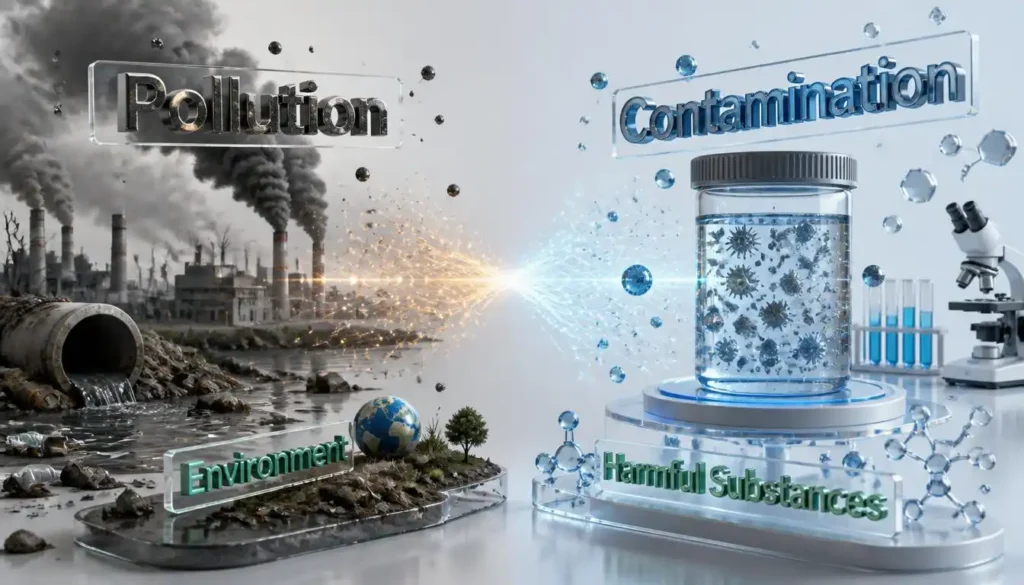
The closest synonym for pollution is contamination.
Both words describe the presence of harmful substances that make something unsafe or impure. However, they are not exactly identical.
Pollution:
Usually refers to environmental damage, especially:
- Air pollution
- Water pollution
- Soil pollution
- Noise pollution
Example:
Air pollution is increasing because of vehicle emissions.
Contamination:
Focuses more on the unwanted presence of harmful substances in a specific material or place.
Example:
The drinking water was contaminated with harmful chemicals.
Key Difference:
| Pollution | Contamination |
| Usually environmental | Can involve food, medicine, science, and materials |
| Focuses on environmental damage | Focuses on impurity or harmful substances |
| Common in public discussions | Common in scientific writing |
Can These Synonyms Be Used Interchangeably?
Not all synonyms of pollution can replace the word in every situation.
Usually Interchangeable
Pollution → Contamination
Example:
- Water pollution damaged the river.
- Water contamination damaged the river.
Both can work, but contamination sounds more scientific.
Sometimes Interchangeable
Pollution → Degradation
Example:
- Pollution has damaged marine ecosystems.
- Environmental degradation has damaged marine ecosystems.
The second sentence focuses more on the long-term decline rather than the cause.
Rarely Interchangeable
Pollution → Impurity
Example:
❌ Air impurity is increasing.
This sounds unnatural.
Better:
✅ Air pollution is increasing.
Not Interchangeable
Pollution → Degradation
Pollution is often the cause.
Degradation is often the result.
Example:
Industrial pollution caused environmental degradation.
Replacing one with the other changes the meaning.
Why Synonyms of Pollution Are Not Always Equal
Many words connected with pollution describe different stages:
Cause → Pollution → Effect
Example:
Industrial waste
↓
Pollution
↓
Environmental degradation
This is why choosing the correct synonym matters.
A student writing an IELTS essay, a scientist publishing research, and a journalist reporting news may all describe the same issue but choose different vocabulary.
Pollution Synonyms for IELTS Writing Task 2
For IELTS essays, repeating the word pollution many times can reduce vocabulary variety. However, alternatives must be used accurately.
Better IELTS Alternatives
| Basic Word | Better Alternative | Example |
| Pollution | Environmental contamination | Environmental contamination threatens public health. |
| Pollution | Environmental degradation | Human activities contribute to environmental degradation. |
| Polluted water | Contaminated water sources | Many communities depend on contaminated water sources. |
| Polluted air | Poor air quality | Poor air quality affects urban populations. |
| Pollution problems | Environmental challenges | Governments must address environmental challenges. |
IELTS Tip:
Do not replace every use of pollution with a synonym. IELTS examiners value accuracy, not just complex vocabulary.
Detailed Synonym Meanings and Examples
1. Contamination
Meaning:
The presence of harmful substances in something that should be clean.
Difference from pollution:
Contamination is broader and can apply to food, medicine, laboratories, and the environment.
Best Used For:
- Water quality
- Food safety
- Scientific research
Formality: Formal
Examples:
- The contamination of groundwater became a serious environmental concern.
- Scientists tested the sample for chemical contamination.
2. Fouling
Meaning:
The process of making something dirty, blocked, or damaged by unwanted material.
Difference from pollution:
Fouling often describes a specific physical problem rather than general environmental damage.
Best Used For:
- Rivers
- Pipes
- Industrial systems
Formality: Neutral
Examples:
- Plastic waste caused fouling of the drainage system.
- The factory equipment suffered from biological fouling.
3. Defilement
Meaning:
The act of damaging the purity, beauty, or natural condition of something.
Difference from pollution:
Defilement carries a stronger emotional meaning.
Best Used For:
- Nature writing
- Environmental criticism
Formality: Formal
Examples:
- The defilement of the forest shocked local communities.
- Many activists protested against the defilement of natural areas.
4. Taint
Meaning:
A harmful influence that damages quality or purity.
Difference from pollution:
Taint can be physical or symbolic.
Best Used For:
- Water
- Reputation
- Products
Formality: Neutral
Examples:
- Chemical leaks left a taint on the local water supply.
- The company’s reputation suffered a taint after the incident.
5. Impurity
Meaning:
An unwanted substance mixed into something, reducing its quality or purity.
Difference from pollution:
Impurity focuses on the unwanted material itself, while pollution focuses on the harmful environmental impact.
Best Used For:
- Chemistry
- Water quality
- Manufacturing
Formality: Formal
Examples:
- Scientists detected harmful impurities in the water sample.
- The factory uses filters to remove impurities from industrial materials.
6. Degradation
Meaning:
The gradual decline or deterioration of environmental quality.
Difference from pollution:
Pollution is often a cause of degradation, while degradation describes the resulting damage.
Best Used For:
- Ecosystems
- Forests
- Soil
- Oceans
Formality: Formal
Examples:
- Plastic waste contributes to ocean degradation.
- Environmental degradation threatens biodiversity worldwide.
7. Corruption
Meaning:
The process of damaging something from its original clean or proper condition.
Difference from pollution:
Corruption suggests deterioration or loss of original quality and is less commonly used for physical environmental problems.
Best Used For:
- Water systems
- Processes
- Resources
Formality: Formal
Examples:
- Industrial activities caused the corruption of natural water sources.
- The corruption of ecosystems can take decades to reverse.
8. Spoilage
Meaning:
The process of becoming damaged, unusable, or harmful.
Difference from pollution:
Spoilage usually applies to food and organic materials rather than the environment.
Best Used For:
- Food
- Agricultural products
- Organic materials
Formality: Neutral
Examples:
- Poor storage conditions caused food spoilage.
- Chemical exposure accelerated the spoilage of natural resources.
9. Befouling
Meaning:
The act of making something dirty, polluted, or unpleasant.
Difference from pollution:
Befouling emphasizes the action of making something dirty.
Best Used For:
- Formal environmental descriptions
- Literary writing
Formality: Formal
Examples:
- The company was accused of befouling the nearby river.
- Human activity has led to the befouling of natural habitats.
10. Despoiling
Meaning:
The destruction or removal of the natural beauty and value of something.
Difference from pollution:
Despoiling often includes physical destruction, not only harmful substances.
Best Used For:
- Forests
- Landscapes
- Natural resources
Formality: Formal
Examples:
- Illegal mining resulted in the despoiling of mountain areas.
- The project was criticized for despoiling the natural landscape.
11. Damage
Meaning:
Physical or environmental harm caused to something.
Difference from pollution:
Damage describes the result, not necessarily the cause.
Best Used For:
- General explanations
- Reports
- News writing
Formality: Neutral
Examples:
- Pollution causes serious damage to marine ecosystems.
- The chemical spill created long-term environmental damage.
12. Harm
Meaning:
Injury, loss, or negative effects caused to people, animals, or nature.
Difference from pollution:
Harm is much broader and can refer to any negative effect.
Best Used For:
- General communication
- Health discussions
Formality: Neutral
Examples:
- Air pollution can cause harm to human health.
- Scientists study the harm caused by environmental changes.
13. Destruction
Meaning:
Severe damage that causes something to lose its original condition.
Difference from pollution:
Destruction is much stronger and usually refers to extreme consequences.
Best Used For:
- Environmental disasters
- Dramatic writing
Formality: Neutral/Formal
Examples:
- Pollution contributes to the destruction of wildlife habitats.
- The disaster caused widespread destruction of forests.
14. Dirtying
Meaning:
Making something physically dirty.
Difference from pollution:
Dirtying is informal and does not always suggest environmental danger.
Best Used For:
- Everyday conversation
Formality: Informal
Examples:
- Littering is dirtying public spaces.
- Industrial waste is dirtying the river.
15. Spoiling
Meaning:
Making something less useful, attractive, or valuable.
Difference from pollution:
Spoiling is broader and often less serious.
Best Used For:
- Natural beauty
- Food
- Experiences
Formality: Neutral
Examples:
- Waste dumping is spoiling the beauty of the countryside.
- Chemical leaks are spoiling farmland quality.
16. Desecration
Meaning:
The act of damaging something considered valuable, pure, or respected.
Difference from pollution:
Usually carries emotional or moral meaning.
Best Used For:
- Protected areas
- Cultural or natural sites
Formality: Formal
Examples:
- Environmental groups called the destruction of the forest a desecration of nature.
- The dumping of waste was viewed as the desecration of a protected area.
17. Deterioration
Meaning:
The gradual worsening of a condition.
Difference from pollution:
Deterioration describes decline rather than the specific cause.
Best Used For:
- Environmental conditions
- Quality changes
Formality: Formal
Examples:
- Air quality deterioration has affected urban residents.
- The deterioration of rivers threatens local communities.
18. Decline
Meaning:
A reduction in quality, quantity, or condition.
Difference from pollution:
Decline is general and does not specifically mean contamination.
Best Used For:
- Environmental trends
- Statistics
Formality: Neutral
Examples:
- Pollution has contributed to the decline of fish populations.
- Scientists observed a decline in ecosystem health.
19. Ruination
Meaning:
The complete destruction or serious damage of something.
Difference from pollution:
Much stronger and more dramatic than pollution.
Best Used For:
- Storytelling
- Emotional descriptions
Formality: Formal/Literary
Examples:
- Years of pollution led to the ruination of the once-beautiful lake.
- The industrial disaster caused the ruination of farmland.
20. Befoulment
Meaning:
The act of making something dirty or polluted.
Difference from pollution:
A rare formal word emphasizing the action of making something impure.
Best Used For:
- Legal writing
- Environmental discussions
Formality: Formal
Examples:
- The illegal dumping resulted in the befoulment of local waterways.
- Strict laws were introduced to prevent environmental befoulment.
Best Alternatives by Context
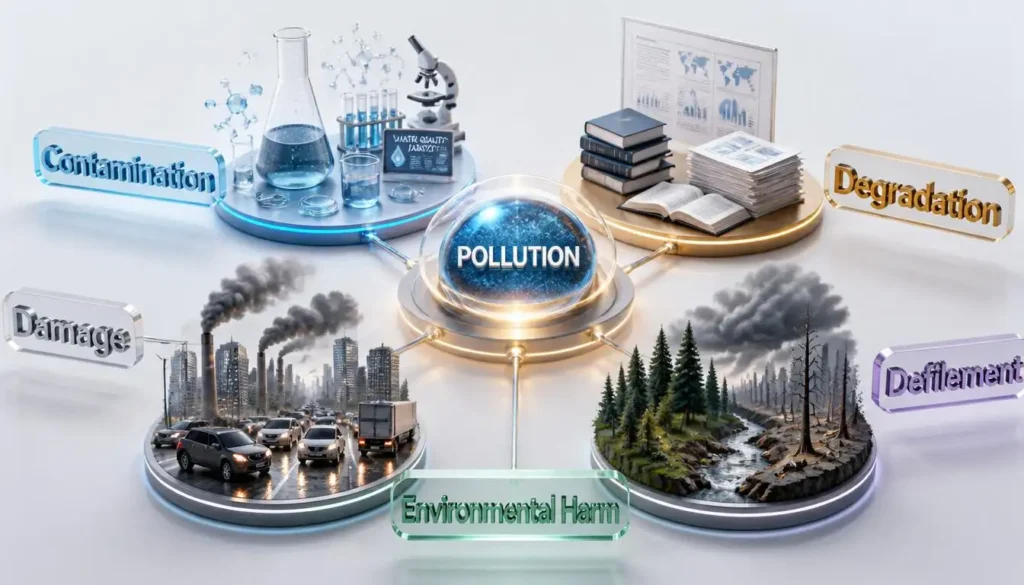
Everyday Conversation
In normal conversation, simple words are usually better.
Recommended words:
- Pollution
- Contamination
- Dirtying
- Waste problems
- Environmental damage
Examples:
The city needs better solutions for pollution.
The river is suffering from contamination.
Formal Writing
For reports, articles, and professional communication:
Recommended words:
- Environmental contamination
- Environmental degradation
- Environmental deterioration
- Defilement
Example:
Industrial activities have accelerated environmental degradation in coastal regions.
Academic Writing
Academic writing requires precise terminology.
Recommended words:
| Situation | Better Choice |
| Chemical substances entering water | Contamination |
| Long-term ecosystem damage | Environmental degradation |
| Declining ecosystem health | Environmental deterioration |
| Harmful substances | Contaminants |
Example:
Industrial contamination has contributed to long-term ecological degradation.
Business Communication
Companies usually avoid emotional language and use measurable terms.
Recommended words:
- Environmental impact
- Environmental damage
- Contamination
- Emissions-related issues
Example:
The company is investing in strategies to reduce environmental impact.
Creative Writing
Creative writing allows stronger emotional words:
Recommended words:
- Defilement
- Despoiling
- Desecration
- Ruination
Example:
The once-green valley became a symbol of environmental defilement.
Social Media
For social platforms, simple and powerful language works best:
Recommended words:
- Environmental damage
- Toxic waste
- Dirty environment
- Nature destruction
Example:
Protect our oceans before plastic waste causes irreversible damage.
Which Pollution Synonym Should I Choose?
Use this simple guide:
| If You Mean… | Choose… |
| Harmful substances entering water/soil | Contamination |
| Long-term environmental decline | Degradation |
| Damage to natural beauty | Despoiling |
| Making something dirty | Fouling |
| Scientific impurity | Impurity |
| Severe environmental destruction | Ruination |
| General negative effect | Environmental damage |
| Food or material becoming unsafe | Spoilage |
The best synonym depends on the exact meaning you want to communicate.
A professional writer should not choose a synonym only because it sounds advanced. The correct word is the one that matches the situation.
Exact and Near Synonyms: Difference
Although many words appear similar, true synonyms are rare.
For example:
Pollution
A general term for harmful environmental contamination.
Contamination
The presence of harmful substances.
Degradation
The decline caused by harmful activities.
Destruction
A severe final result.
These words overlap but represent different points in the process.
A strong writer chooses words based on:
- Meaning
- Context
- Audience
- Formality
- Emotional strength
Synonyms of Polluted
The adjective polluted means affected by harmful substances or made dirty.
Common Synonyms of Polluted
| Polluted | Alternative |
| Polluted water | Contaminated water |
| Polluted air | Toxic air / poor-quality air |
| Polluted land | Contaminated land |
| Polluted environment | Degraded environment |
| Polluted area | Tainted area |
| Polluted river | Fouled river |
| Polluted soil | Contaminated soil |
Examples:
- The polluted river became a health concern.
- The contaminated river became a health concern.
Words Related to Pollution
Synonyms are not the only words people search for when learning about pollution. Many users also look for related vocabulary to improve writing, IELTS essays, research, and environmental discussions.
These words are connected to pollution but may describe causes, types, effects, solutions, or environmental concepts rather than direct synonyms.
15 Words Related to Pollution
| # | Word | Meaning |
| 1 | Contaminant | A harmful substance that causes contamination |
| 2 | Waste | Unwanted materials that are discarded |
| 3 | Emission | Gas or particles released into the environment |
| 4 | Toxin | A poisonous substance produced naturally or chemically |
| 5 | Chemical | A substance that may affect the environment |
| 6 | Smog | A mixture of smoke and air pollutants |
| 7 | Litter | Small pieces of waste left in public places |
| 8 | Sewage | Wastewater containing human waste |
| 9 | Carbon dioxide | A greenhouse gas linked with climate change |
| 10 | Plastic waste | Discarded plastic materials harming ecosystems |
| 11 | Landfill | A place where waste is stored underground |
| 12 | Industrial waste | Waste produced by factories |
| 13 | Deforestation | Removal of forests affecting ecosystems |
| 14 | Acid rain | Rain containing harmful acidic substances |
| 15 | Greenhouse gases | Gases that trap heat in the atmosphere |
20 Words Related to Pollution
- Air pollution
- Water pollution
- Soil pollution
- Noise pollution
- Plastic pollution
- Industrial waste
- Chemical waste
- Toxic substances
- Carbon emissions
- Vehicle exhaust
- Factory smoke
- Oil spills
- Waste disposal
- Recycling
- Renewable energy
- Environmental protection
- Climate change
- Ecosystem damage
- Public health risks
- Sustainable development
50 Words Related to Pollution
Types of Pollution
- Air pollution
- Water pollution
- Soil pollution
- Noise pollution
- Light pollution
- Plastic pollution
- Marine pollution
- Thermal pollution
- Radioactive pollution
- Industrial pollution
Causes of Pollution
- Factory emissions
- Vehicle exhaust
- Chemical dumping
- Industrial waste
- Sewage discharge
- Oil spills
- Mining activities
- Deforestation
- Burning fossil fuels
- Agricultural chemicals
Harmful Substances
- Toxic chemicals
- Heavy metals
- Carbon monoxide
- Carbon dioxide
- Nitrogen oxides
- Sulfur dioxide
- Microplastics
- Pesticides
- Hazardous waste
- Contaminants
Effects of Pollution
- Environmental damage
- Climate change
- Global warming
- Health problems
- Respiratory diseases
- Habitat destruction
- Loss of biodiversity
- Ecosystem imbalance
- Water shortage
- Poor air quality
Solutions and Prevention
- Recycling
- Waste management
- Conservation
- Renewable energy
- Pollution control
- Environmental awareness
- Sustainable living
- Green technology
- Clean energy
- Environmental protection
Pollution Antonyms
The opposite of pollution depends on the context. There is no single perfect antonym because pollution describes many different types of harm.
Direct Opposites
| Antonym | Meaning |
| Cleanliness | The state of being clean |
| Purity | Freedom from harmful substances |
| Clean environment | A place without harmful pollution |
| Freshness | Natural quality without contamination |
| Sanitation | Maintaining hygienic conditions |
Environmental Opposites
| Antonym | Meaning |
| Conservation | Protection of natural resources |
| Preservation | Keeping nature safe from damage |
| Restoration | Returning damaged environments to a better state |
| Protection | Preventing environmental harm |
| Sustainability | Maintaining resources for the future |
Examples:
- Pollution damages ecosystems.
- Conservation protects ecosystems.
Common Phrases with Pollution
These natural collocations are commonly used in academic writing, news, and everyday English.
Types of Pollution
- Air pollution
- Water pollution
- Noise pollution
- Soil pollution
- Plastic pollution
- Environmental pollution
Examples:
Air pollution is one of the biggest challenges facing modern cities.
Pollution Problems
- Rising pollution levels
- Severe pollution
- Pollution crisis
- Pollution problem
- Pollution-related diseases
- Pollution damage
Example:
Many countries are experiencing rising pollution levels.
Pollution Control
- Pollution prevention
- Pollution reduction
- Pollution monitoring
- Pollution control measures
- Pollution management
- Pollution regulations
Example:
Governments are introducing pollution control measures.
Common Words Confused with Pollution
Many environmental terms are related to pollution but do not mean the same thing.
| Word | Difference |
| Climate change | A global environmental change partly caused by pollution |
| Global warming | Increase in Earth’s temperature |
| Waste | Material that can cause pollution |
| Emissions | Released substances that may create pollution |
| Contaminant | A substance causing contamination |
| Recycling | A method to reduce pollution |
| Conservation | Protection of nature |
Frequently Asked Questions
1. What is the closest synonym for pollution?
The closest synonym for pollution is contamination. Both describe harmful substances affecting something, although contamination is used more broadly in scientific and technical contexts.
2. Can pollution synonyms be used interchangeably?
No. Some alternatives have similar meanings, but they are not always interchangeable. For example, contamination can replace pollution in many situations, but emissions and waste describe related concepts rather than the same thing.
3. What does pollution mean?
Pollution means the introduction of harmful substances or activities into the environment that damage living organisms, natural resources, or ecosystems.
4. Which pollution synonym is best for formal writing?
For formal or academic writing, words such as contamination, environmental degradation, and environmental deterioration are often more precise than general terms.
5. What synonym should I use instead of pollution in IELTS writing?
For IELTS essays, suitable alternatives include:
- Environmental contamination
- Environmental degradation
- Harmful substances
- Poor air quality
- Environmental damage
However, use each term according to its exact meaning.
6. What are the opposite words of pollution?
Common antonyms include:
- Cleanliness
- Purity
- Conservation
- Protection
- Restoration
- Sustainability
Conclusion
Choosing the right synonym for pollution helps you communicate ideas more clearly and accurately. Although pollution is the most common word, alternatives such as contamination, degradation, fouling, and defilement provide more precise meanings for different situations.
Students can improve IELTS essays by using accurate environmental vocabulary, while professionals can create clearer reports by selecting words that match their intended meaning. Good vocabulary is not about using the most complicated word; it is about choosing the word that communicates the exact idea.

About Sajjad Ahmed
Sajjad Ahmed is the author behind Guest Paster, where he writes about English vocabulary, synonyms, word meanings, and practical word usage.
His content is designed to help readers understand the differences between similar words, discover suitable alternatives, and use English vocabulary more effectively in everyday writing and communication.
Before publishing, Sajjad focuses on presenting word choices in a clear and easy-to-understand format, with relevant meanings, context, and examples where helpful.
Through Guest Paster, his goal is to make vocabulary learning simpler and provide useful language resources for students, writers, English learners, and anyone looking to expand their vocabulary.
Areas of Focus: English Vocabulary • Synonyms • Word Meanings • Word Usage • Language Learning
Author: Sajjad Ahmed
Website: Guest Paster