
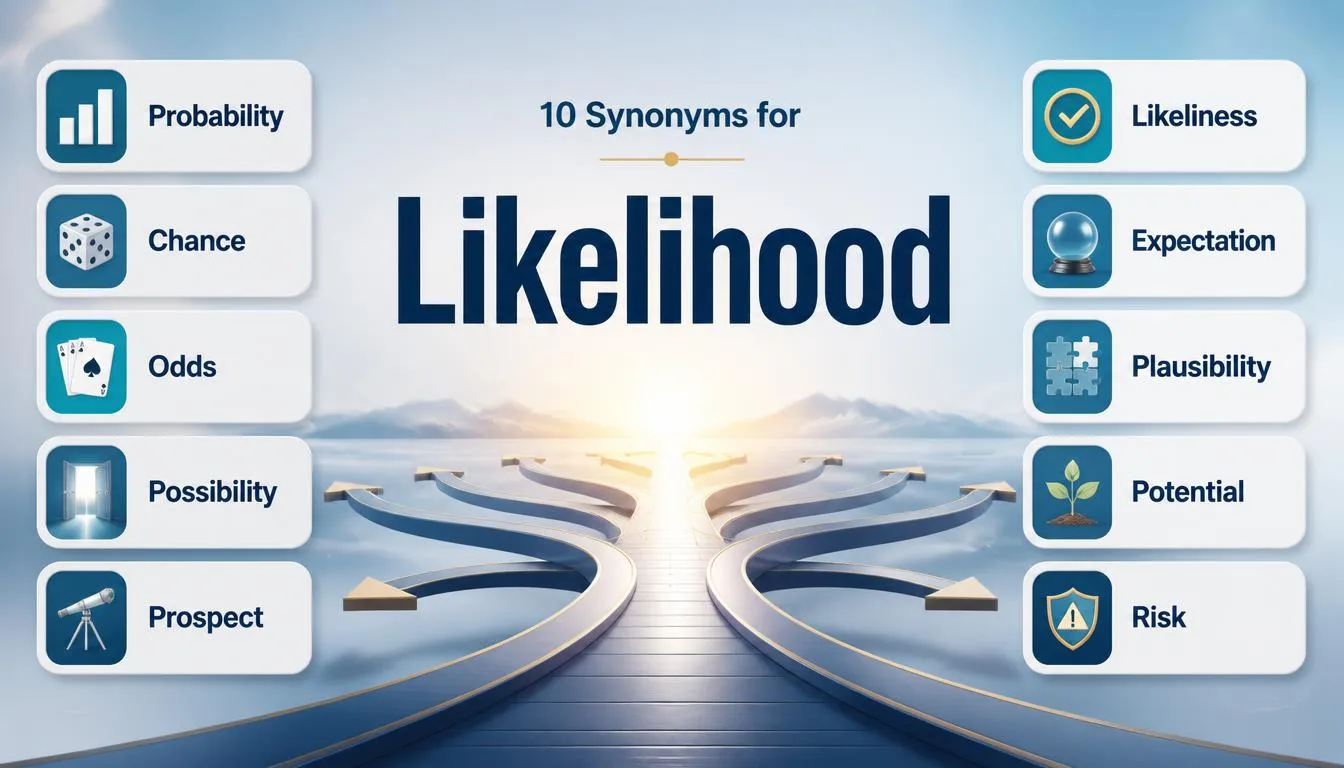
The best synonym for likelihood is probability. Both words describe how likely something is to happen. Other close synonyms include chance, odds, possibility and prospect.
In everyday English likelihood means the chance that an event will occur. The best replacement depends on context, tone and formality. For example: “The clear weather increased the likelihood of the event going ahead as planned.”
10 Best Synonyms for Likelihood and What They Mean
| Synonym | Relationship | Direct Replacement | Simple Meaning | Best Used For |
| Probability | Exact synonym | Yes | How likely something is to happen | General, academic, technical writing |
| Chance | Near synonym | Yes | The possibility that something may happen | Everyday conversation |
| Odds | Near synonym | Sometimes | The chances for or against an outcome | Informal and numerical contexts |
| Possibility | Near synonym | Sometimes | Something that may happen or be true | General writing |
| Prospect | Near synonym | Sometimes | The chance of a future event | Professional and formal writing |
| Likeliness | Exact synonym | Yes | The state of being likely | Rare or less common usage |
| Expectation | Near synonym | Sometimes | A belief that something will probably happen | General and professional writing |
| Plausibility | Contextual alternative | Sometimes | How believable or reasonable something seems | Academic and analytical writing |
| Potential | Contextual alternative | Sometimes | The possibility of developing or happening | Business and general writing |
| Risk | Contextual alternative | Sometimes | The possibility of an unwanted event | Safety, business, and technical writing |
Quick Facts About Likelihood
- Word: Likelihood
- Part of Speech: Noun
- Simple Meaning: The chance or probability that something will happen
- Pronunciation: LIKE-lee-hood
- IPA: /ˈlaɪ.kli.hʊd/
- Syllables: 3 — like-li-hood
- Origin/Etymology: Formed from likely + -hood; its meaning connected with probability developed in English by the mid-1400s.
- Other Word Forms: likely, unlikely, likeliness
- Formality: Neutral to formal
- Difficulty Level: Advanced
- CEFR Level: C2 in the Cambridge classification
- Common Uses: Everyday conversation, academic writing, professional writing, statistics, risk analysis
- Example Sentence: There is a strong likelihood that the school trip will go ahead.
Likelihood Meaning and Usage
Core Meaning
Likelihood means the chance that something will happen or turn out to be true. It is closely connected with ideas such as probability, uncertainty, prediction and future outcomes.
You might discuss the likelihood of rain, success, failure, delays, improvement or a particular result.
Example: The likelihood of heavy traffic is greater during rush hour.
Nuance and Tone
Likelihood is neutral and slightly more formal than chance. It works naturally in school assignments, reports, news writing, research, business communication and everyday speech.
It also allows speakers to describe different degrees of probability:
- high likelihood — something is quite likely
- low likelihood — something is unlikely
- greater likelihood — something has become more probable
- little likelihood — there is only a small chance
Likelihood in Statistics
In ordinary English, likelihood and probability can be very close in meaning. In statistics, however likelihood can have a specialized mathematical meaning especially in expressions such as likelihood function and maximum likelihood estimation. In that technical setting the two terms should not automatically be treated as interchangeable.
Detailed Synonyms for Likelihood
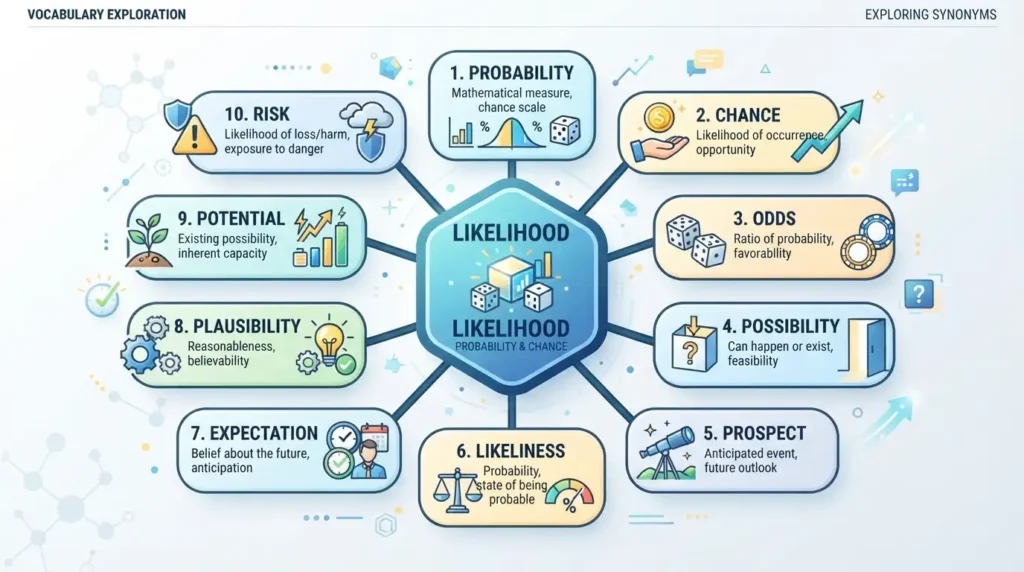
1. Probability: A Synonym of Likelihood
- Relationship: Exact synonym
- Direct Replacement: Yes
- Difficulty Level: Intermediate
- Meaning: Probability describes how likely an event is to happen.
- Difference: More technical than likelihood especially in mathematics, statistics and research.
- Best Used For: Academic writing, technical writing, professional writing
- Examples:
- The probability of success increases with careful planning.
- Scientists calculated the probability of the storm occurring.
2. Chance: A Synonym of Likelihood
- Relationship: Near synonym
- Direct Replacement: Yes
- Difficulty Level: Beginner
- Meaning: Chance refers to the possibility that something may happen.
- Difference: More casual and conversational than likelihood. It can also refer to luck or opportunity.
- Best Used For: Everyday conversation
- Examples:
- There is a good chance that she will arrive early.
- We have a small chance of finishing before sunset.
3. Possibility: A Synonym of Likelihood
- Relationship: Near synonym
- Direct Replacement: Sometimes
- Difficulty Level: Beginner
- Meaning: Possibility means something can happen or be true.
- Difference: Broader than likelihood because it only shows that something is possible not how probable it is.
- Best Used For: General writing, conversation
- Examples:
- The possibility of rain changed our plans.
- They considered the possibility of expanding the business.
4. Odds: A Synonym for Likelihood
- Relationship: Near synonym
- Direct Replacement: Sometimes
- Difficulty Level: Intermediate
- Meaning: Odds describe the chances of a particular outcome occurring.
- Difference: Often used with measurable chances and is usually plural.
- Best Used For: Informal speech, analysis, predictions
- Examples:
- The odds of winning improve with more practice.
- The team knows the odds are challenging.
5. Prospect: A Synonym for Likelihood
- Relationship: Near synonym
- Direct Replacement: Sometimes
- Difficulty Level: Intermediate
- Meaning: Prospect refers to the possibility of a future event or result.
- Difference: Usually focuses on future opportunities or outcomes.
- Best Used For: Business writing, formal writing
- Examples:
- The prospect of promotion motivated employees.
- Investors liked the prospect of long-term growth.
6. Likeliness: A Synonym for Likelihood
- Relationship: Exact synonym
- Direct Replacement: Yes
- Difficulty Level: Intermediate
- Meaning: Likeliness means the quality of being likely.
- Difference: Correct but less common than likelihood.
- Best Used For: General explanation
- Examples:
- The likeliness of delays depends on the weather.
- They discussed the likeliness of different outcomes.
7. Expectation: A Synonym for Likelihood
- Relationship: Near synonym
- Direct Replacement: Sometimes
- Difficulty Level: Intermediate
- Meaning: Expectation is a belief that something will probably happen.
- Difference: Focuses more on a person’s belief than the actual probability.
- Best Used For: Business writing, general writing
- Examples:
- Our expectation is that sales will improve.
- There was an expectation of higher demand.
8. Probability Rate: A Synonym for Likelihood
- Relationship: Contextual alternative
- Direct Replacement: Sometimes
- Difficulty Level: Advanced
- Meaning: Probability rate describes the measured level of chance.
- Difference: More statistical and numerical than everyday likelihood.
- Best Used For: Technical writing
- Examples:
- Researchers examined the probability rate of infection.
- The probability rate changed after new evidence appeared.
9. Potential: A Synonym for Likelihood
- Relationship: Contextual alternative
- Direct Replacement: Sometimes
- Difficulty Level: Intermediate
- Meaning: Potential refers to the ability or possibility of something happening.
- Difference: Focuses on future capacity rather than probability.
- Best Used For: Business writing, professional writing
- Examples:
- The project has strong potential for success.
- The discovery has the potential to change medicine.
10. Plausibility: A Synonym for Likelihood
- Relationship: Contextual alternative
- Direct Replacement: Sometimes
- Difficulty Level: Advanced
- Meaning: Plausibility describes how believable something appears.
- Difference: Used for ideas, explanations, and arguments rather than simple predictions.
- Best Used For: Academic writing, analysis
- Examples:
- The evidence increased the plausibility of the theory.
- Readers questioned the plausibility of the explanation.
11. Prospectiveness
- Relationship: Contextual alternative
- Direct Replacement: No
- Difficulty Level: Advanced
- Meaning: Prospectiveness refers to the quality of having future possibilities.
- Difference: More focused on future potential than probability.
- Best Used For: Formal analysis
- Examples:
- The prospectiveness of the market attracted investors.
- Researchers studied the prospectiveness of new treatments.
12. Probability Factor
- Relationship: Contextual alternative
- Direct Replacement: Sometimes
- Difficulty Level: Advanced
- Meaning: A factor representing how likely something is.
- Difference: Sounds analytical and is common in research or decision-making.
- Best Used For: Technical writing
- Examples:
- Cost was an important probability factor in the decision.
- Analysts reviewed each probability factor carefully.
13. Feasibility
- Relationship: Contextual alternative
- Direct Replacement: Sometimes
- Difficulty Level: Intermediate
- Meaning: Feasibility describes whether something is realistically possible.
- Difference: Focuses on practicality rather than chance alone.
- Best Used For: Business writing, planning
- Examples:
- The company evaluated the feasibility of the project.
- Engineers tested the feasibility of the design.
14. Expectancy
- Relationship: Near synonym
- Direct Replacement: Sometimes
- Difficulty Level: Advanced
- Meaning: Expectancy refers to a belief about a future outcome.
- Difference: More formal and often used in psychology or statistics.
- Best Used For: Academic writing
- Examples:
- Positive expectancy improved employee motivation.
- The study measured expectancy levels among participants.
15. Forecast
- Relationship: Contextual alternative
- Direct Replacement: No
- Difficulty Level: Intermediate
- Meaning: Forecast is a prediction about what is likely to happen.
- Difference: Refers to the prediction itself, not the chance level.
- Best Used For: Business, weather, economics
- Examples:
- The economic forecast predicts steady growth.
- The weather forecast shows possible storms.
16. Prediction
- Relationship: Contextual alternative
- Direct Replacement: No
- Difficulty Level: Beginner
- Meaning: A prediction is a statement about a future event.
- Difference: Describes the result of estimating likelihood, not likelihood itself.
- Best Used For: General writing
- Examples:
- Her prediction about the election was accurate.
- The prediction was based on previous data.
17. Certainty
- Relationship: Opposite-related concept
- Direct Replacement: No
- Difficulty Level: Beginner
- Meaning: Certainty describes complete confidence that something will happen.
- Difference: It represents the highest level of likelihood rather than a synonym.
- Best Used For: General writing
- Examples:
- There is no certainty about the final result.
- Scientists cannot claim complete certainty yet.
18. Risk
- Relationship: Contextual alternative
- Direct Replacement: Sometimes
- Difficulty Level: Intermediate
- Meaning: Risk describes the possibility of an unwanted outcome.
- Difference: Usually carries a negative meaning.
- Best Used For: Business, safety, technical writing
- Examples:
- The company reduced the risk of failure.
- Drivers face greater risk during severe weather.
19. Tendency
- Relationship: Contextual alternative
- Direct Replacement: Sometimes
- Difficulty Level: Intermediate
- Meaning: Tendency describes a pattern or direction toward an outcome.
- Difference: Suggests a repeated pattern rather than a single probability.
- Best Used For: Academic writing, analysis
- Examples:
- The data shows a tendency toward improvement.
- Some plants have a tendency to grow faster in sunlight.
20. Inclination
- Relationship: Contextual alternative
- Direct Replacement: Sometimes
- Difficulty Level: Advanced
- Meaning: Inclination means a natural tendency or preference toward something.
- Difference: Often describes people, decisions, or behavior rather than events.
- Best Used For: Formal writing
- Examples:
- She showed an inclination toward creative work.
- His inclination to help others was well known.
21. Likelihood Level
- Relationship: Contextual alternative
- Direct Replacement: Sometimes
- Difficulty Level: Intermediate
- Meaning: Likelihood level refers to the degree of probability.
- Difference: Used when comparing different levels of chance.
- Best Used For: Reports, assessments
- Examples:
- The risk assessment assigned a high likelihood level.
- Each possibility received a different likelihood level.
22. Vulnerability
- Relationship: Contextual alternative
- Direct Replacement: No
- Difficulty Level: Advanced
- Meaning: Vulnerability describes exposure to possible harm.
- Difference: Related to negative outcomes and risk rather than probability itself.
- Best Used For: Security, safety, technical writing
- Examples:
- The system’s vulnerability increased the likelihood of problems.
- Researchers studied environmental vulnerability.
23. Credibility
- Relationship: Contextual alternative
- Direct Replacement: No
- Difficulty Level: Intermediate
- Meaning: Credibility describes how believable something is.
- Difference: Similar to plausibility but focuses more on trustworthiness.
- Best Used For: Academic writing, communication
- Examples:
- The source gained credibility after verification.
- Evidence improved the credibility of the claim.
24. Feasibility Probability
- Relationship: Contextual alternative
- Direct Replacement: No
- Difficulty Level: Advanced
- Meaning: A combined measure of whether something is practical and likely.
- Difference: Used mainly in specialized analysis.
- Best Used For: Technical and business writing
- Examples:
- The team evaluated feasibility probability before investing.
- The proposal required a feasibility probability assessment.
25. Expectation of Occurrence
- Relationship: Contextual alternative
- Direct Replacement: Sometimes
- Difficulty Level: Advanced
- Meaning: The expected chance that an event will occur.
- Difference: More formal and descriptive than simple likelihood.
- Best Used For: Research and reports
- Examples:
- The report measured the expectation of occurrence.
- Experts reviewed the expectation of occurrence for each event.
Synonyms for Likelihood by Context
Everyday Conversation
For natural conversation, the easiest alternatives are:
- chance
- possibility
- odds
Instead of saying, “There is a high likelihood of rain,” you could naturally say, “There is a good chance of rain.”
Formal Writing
Useful formal alternatives include:
- probability
- prospect
- expectation
These words work well in reports, professional documents, and formal explanations.
Academic Writing
Depending on the subject, academic writers may use:
- probability
- plausibility
- prospect
- expectation
Choose carefully: plausibility is especially suitable when evaluating whether an argument or explanation appears credible.
Business Communication
Common choices include:
- probability
- prospect
- potential
- risk
For example, prospect of growth is more natural than likelihood of growth in some business contexts.
Creative Writing and Literature
Creative writing often favors less technical alternatives such as:
- chance
- possibility
- prospect
- expectation
These can make sentences feel more natural and less analytical.
Exact vs. Similar Synonyms for Likelihood
No synonym matches likelihood perfectly in every context. Probability is its closest general alternative because both words measure or describe how likely something is. Probability can sound more mathematical or technical.
Chance is also close but feels more conversational. “There is a good chance of success” sounds natural in speech, while “there is a high likelihood of success” sounds more analytical.
Possibility is broader. It tells us that an event can happen but does not necessarily suggest that the event is probable. A result may be possible even when its likelihood is very low.
Antonyms for Likelihood
| Antonym | Simple Meaning | Example Sentence |
| Improbability | The quality of being unlikely | The improbability of the plan succeeding worried the team. |
| Unlikelihood | A low chance of happening | The unlikelihood of rain encouraged us to hold the event outside. |
| Impossibility | A state in which something cannot happen | The broken bridge made a direct crossing an impossibility. |
| Implausibility | The quality of seeming unbelievable or unreasonable | The implausibility of the explanation made readers question it. |
| Doubtfulness | Uncertainty about whether something is true or will happen | The doubtfulness of the result made further testing necessary. |
Common Collocations With Likelihood
| Phrase | Meaning | Example Sentence |
| High likelihood | A strong chance | There is a high likelihood of delays during the holiday weekend. |
| Low likelihood | A small chance | Experts found a low likelihood of major problems. |
| Greater likelihood | A stronger probability than before or than another option | Extra practice creates a greater likelihood of improvement. |
| Increased likelihood | A chance that has become higher | Heavy traffic creates an increased likelihood of delays. |
| Likelihood of success | The chance of succeeding | Good planning improves the likelihood of success. |
| Likelihood of failure | The chance of not succeeding | Testing reduces the likelihood of failure after launch. |
| Likelihood of occurrence | The chance that an event will happen | The report assessed the likelihood of occurrence for each problem. |
| In all likelihood | Almost certainly or very probably | In all likelihood, the work will be finished tomorrow. |
Frequently Asked Questions
What is a synonym for likelihood?
The closest synonym for likelihood is probability. Other useful alternatives include chance, odds, possibility, and prospect. The best word depends on whether you are writing casually, formally, or in a technical context.
What words are similar to likelihood?
Words similar to likelihood include probability, chance, odds, possibility, prospect, likeliness, expectation, plausibility, potential, and risk. Not all are direct replacements. For example, risk is mainly useful when discussing the likelihood of a negative event.
What does likelihood mean?
Likelihood means the chance or probability that something will happen. A high likelihood means an event is expected to happen, while a low likelihood means it is less probable.
What is a synonym for high likelihood?
Useful alternatives to high likelihood include high probability, strong chance, good chance, and, in suitable contexts, favorable odds. For example, “There is a high likelihood of success” can become “There is a good chance of success.”
What is another way to say “increase the likelihood”?
You can say increase the probability, increase the chance, make more likely, raise the chances, or improve the odds, depending on context. “Make more likely” is especially clear in everyday English, while “increase the probability” sounds more formal or technical.
What is another word for likeliness?
The best alternatives to likeliness are likelihood and probability. Likeliness is understandable, but likelihood is generally the more natural choice in modern English, especially in professional, academic, and everyday writing.
Conclusion
Choosing the right synonym for likelihood makes writing clearer and more precise. Probability is the closest general replacement while chance, odds, possibility and prospect suit different tones and situations. More specialized alternatives such as plausibility and risk only work in certain contexts.
Practice these words in essays, emails, articles and conversations. The best vocabulary choice is not always the biggest word—it is the word that expresses your exact meaning naturally.

About Sajjad Ahmed
Sajjad Ahmed is the author behind Guest Paster, where he writes about English vocabulary, synonyms, word meanings, and practical word usage.
His content is designed to help readers understand the differences between similar words, discover suitable alternatives, and use English vocabulary more effectively in everyday writing and communication.
Before publishing, Sajjad focuses on presenting word choices in a clear and easy-to-understand format, with relevant meanings, context, and examples where helpful.
Through Guest Paster, his goal is to make vocabulary learning simpler and provide useful language resources for students, writers, English learners, and anyone looking to expand their vocabulary.
Areas of Focus: English Vocabulary • Synonyms • Word Meanings • Word Usage • Language Learning
Author: Sajjad Ahmed
Website: Guest Paster